Obstacle Course

I’ve been intending to point this out for decades, but for some reason I never did. There’s a visual element in a scene from Billy Wilder‘s The Spirit of St. Louis that makes no sense at all. I’m talking about the 90-foot-tall eucalyptus trees at the very end of the Roosevelt Field runaway — the ones that Charles Lindbergh (James Stewart) barely clears once the plane finally lifts off.

The first “hold on”, of course, is “why would any airfield allow huge trees to grow at the very end of a runway?” The second thing, of course, is that there are no eucalyptus trees in Long Island, or in any region that has cold temperatures.

We’re talking, in short, about two suspension-of-disbelief whoppers at the same scene. Wilder or his second-unit director presumably shot the takeoff scene somewhere in Southern California.

This pales alongside the biggest suspension of disbelief whopper of all time, which happened in the original King Kong. 24 words: “If the Skull Island natives built that huge wall to keep Kong out, why’d they make gates big enough for him to get through?”

This observation was first delivered by the late film scholar and archivst Ron Haver on the 1985 Criterion Collection King Kong laser disc, which contained one of the first-ever audio-track commentaries ever put on the market.”

Read more

Latest Stone Rundown

[4:40 mark] “This film, today, is a satisfactory…uh, triumphant film for me, but it’s a smaller audience because documentaries don’t get worldwide attention. We’re selling it very nicely here, in Europe, and we’ll see where it goes. But America will remain a tough market.” — Oliver Stone, director of JFK Revisited: Through The Looking Glass, speaking to France 24 on 7.13.21.

I know that all the biggies said “no” to Stone and Through The Looking Glass over the last several months, but it really doesn’t figure that some distributor or streaming outfit somewhere wouldn’t want to offer this doc to the U.S. market. Amazon, Hulu, Netflix, HBO Max, History Channel, National Geographic…it doesn’t add up that none would have the slightest interest in putting it out there. Stone and his producers must be asking too much.

Psy-ops (or psychological operations) “are operations to convey selected information and indicators to audiences to influence their emotions, motives, and objective reasoning, and ultimately the behavior of governments, organizations, groups, and individuals.”

Read more

“Iceblink” Can Suck It

HE commenter Iceblink (about an hour ago): “I’m really starting to miss the days when Jeff had access to and had actually had seen at least some of these films. Now we’re rewarded with lame Friendo hot takes and the ruminations of one of my least favorite film critics out there. And you want people to pay for this?”

HE to Iceblink: “I didn’t go to Cannes this year…big deal. A lot of people didn’t. It didn’t feel right, money was tight, etc. I see everything I can in a timely fashion, and I’ll be attending Telluride, the coolest festival of them all, in less than six weeks. If you don’t like the column these days, fine. Go where ya wanna go.

“I have a better idea. Let’s reverse our respective roles. Why don’t you try entertaining me? Turn me around, open my mind, excite my blood….c’mon, man. I need some top-grade Iceblink reportage or poetry in my life. Or, you know, maybe you could write one or two things that would knock me out sometime later today. If so, great. But try doing it two days in a row. Try doing it five days in a row. Try doing it every fucking day including weekends. Try doing it 365 days a year.

“And if you can’t manage to dazzle me today or at the end of the week or the end of the month or by the end of the year…I’m not saying it’s not in you because maybe it is…but if you can’t manage it, would you consider doing one thing? Or trying to do one thing? Would you consider putting your phone on a camera mount, aiming it in your direction, turning on the video and…well, use your imagination.”

Persistence of Terror

In yesterday’s paywall-protected riff on Grace Kelly (“Randy Society Girl“), I wrote the following: “Am I allowed to say that Kelly was slutty, or at least that I love the stories that suggest she was? I don’t mean this in a derogatory way — I mean it in the most delicious way imaginable.”

Friendo to HE: “I don’t think you can say that — slutty. You will be roasted for it.”

HE to Friendo: “I didn’t ‘say’ that — I asked if I was allowed to do so. Then I went to some effort to explain that I was using the term in a non-derogatory fashion, in a totally ‘you go girl’ way…from the perspective, in short, of a devout admirer. The difference between randy and slutty barely exists. How about frisky?”

Friendo to HE: “Doesn’t matter. Twitter will say you said slutty. This is the world in which we live.”

HE to Friendo: “If Anais Nin came back from the dead and said the same thing, would she too be roasted?”

Thin Slice of Joe Weisenheimer

A clip from Apichatpong Weerasethakul‘s Memoria, which has split the Cannes Film Festival’s Jury Prize with Nadav Lapid‘s Ahed’s Knee. The film shot in Colombia (presumably in Cartagena) in late 2019.

Tilda Swinton: “I’ve composed a poem. A poem for the sleepless nights. ‘Beyond the pecking and once furious winds, an air gusts at its fading shadow.”

Tilda’s companion: “And…?”

Tilda: “That’s it.”

HE to comment community: I recognize that I occasionally interpret dialogue according to my own perceptions, so if I’ve misheard Tilda’s dialogue, please advise.

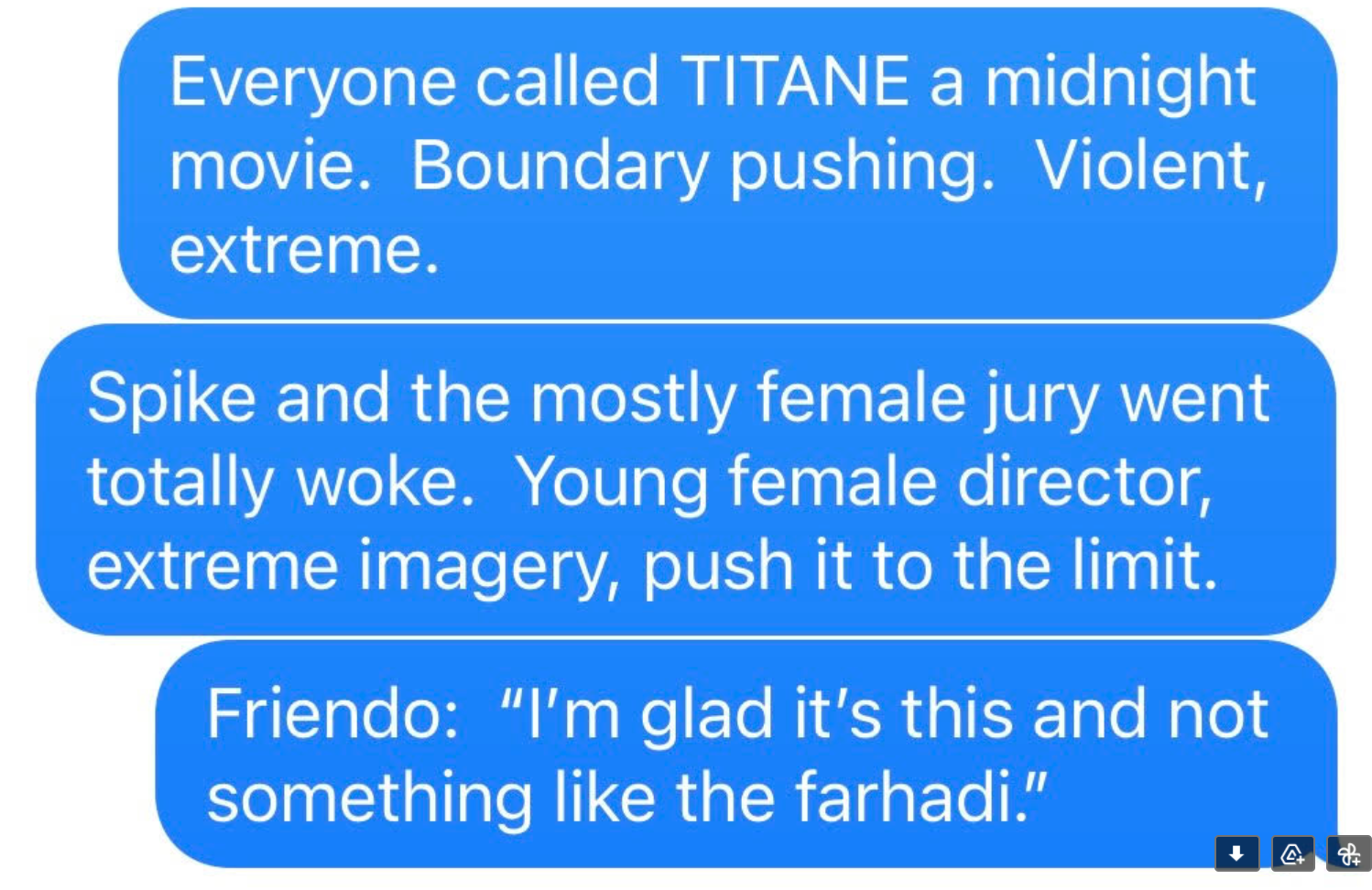
Wackazoid Car-Sexy “Titane” Wins Top Cannes Prize

Spike Lee’s mostly-female Cannes jury has spoken: “If it’s extreme and provocative and ‘out there’ or in any way mind-bending, give it a big prize. Okay, we don’t have to go 100% extreme but let’s definitely emphasize that…anti-normal, change-driven cultural politics! And if we can give the biggest prize to a woman while letting the monsters in, so much the better.”

And so the Palme d’Or has gone to the most dynamically out-there film of the festival — a midnight movie, some called it — Julia Ducournau‘s Titane. And the guy who orchestrated not one but two singing cunnilingus scenes in a half-hallucinatory, magnificently ludicrous Sparks opera wins the Best Director Prize. And “Joe” Weerasethakul’s Memoria, whom one major critic called “a nearly pitch-perfect parody of an art film,” has tied for the third-place Jury Prize. And the Best Actor prize went to Nitram‘s Caleb Landry Jones and his performance as Martin Bryant, the perpetrator of the 1996 Port Arthur Massacre.

While acknowledging that among wiggy creatives and lifestyle provocateurs “the world is becoming more and more fluid,” Ducournau thanked the jury for embracing diversity and “for letting the monsters in.”

Spike’s Jury has second thoughts: “Okay, wait, wait…maybe we should tone things down a bit. Let’s give the Grand Prix to Asghar Farhadi‘s more cerebral, more ground-level, sad but safe-feeling A Hero. Farhadi wins second prize! Oh, wait, some of us don’t agree. Okay, let’s split the Grand Prix between the Farhadi (an Iranian film) and Nadav Lapid‘s Ahed’s Knee (shot in Israel), which feels, according to Deadline‘s Todd McCarthy, “like the work of someone who is flailing around, angry at everything and everyone and unwilling to take a step back and assess his thoughts, feelings and priorities in the interests of good drama.”

Jordan Ruimy: “Titane is certainly a compulsively watchable movie. It’s very hard to be bored by it. Lots of implausibility issues, but a very original creation. Compartment No. 6 is a slightly-above-average train movie.”

Critic who hasn’t seen Titane: “The good news here is that the world now doesn’t have to pretend to take these awards seriously (as it would have if the Farhadi had won). Ducournau’s Raw was a lot better in theory than execution. Is Titane great, or is it another theoretical transgressive feminist button-pusher? My guess is the latter. It’s not like they’ve ever considered giving the Palme d’Or to Gaspar Noe.”

Palme d’Or: Titane

Grand Prix — tie between Asghar Farhadi‘s A Hero and Juho Kuosmanen’s Compartment No. 6.

Best Director: Annette‘s Leos Carax.

Best Actor: Nitram‘s Caleb Landry Jones.

Best Actress: Renate Reinsve for The Worst Person in the World.

Jury Prize — tie between Nadav Lapid‘s Ahed’s Knee and Apichatpong “Joe” Weerasethakul’s Memoria.

Best Screenplay: Ryusuke Hamaguchi for Drive My Car.

Read more

Randy Society Girl

The thing I’ve always loved about the young Grace Kelly isn’t just her ice-queen beauty, but the blend of her Philadelphia blue-blood lineage and refinement with the many stories (however true or untrue) that suggest she was seriously promiscuous.

Am I allowed to say that Kelly was slutty, or at least that I love the stories that suggest she was? I don’t mean it in a derogatory way — I mean it in the most delicious way imaginable.

Kelly’s father, John B. Kelly, was a hound and so, apparently or reputedly, was she. No shame. It has been my experience that very few women are Grace Kelly-like — they might be randy but they lack the looks and breeding, or they have said qualities but are hesitant and ambivalent when it comes to this or that opportunity. Kelly was reputedly focused and fearless.

I’m not suggesting anything new here. We’ve all read the stories. Whatever the actual truth of things, Kelly is believed to have been right up there with the voracious Tallulah Bankhead, Elizabeth Taylor, Mary Astor, Gene Tierney and Lupe Velez, and the mostly older (and mostly married) fellows Kelly allegedly got down with were all famous, wealthy, top-of-the-line…Frank Sinatra, Gary Cooper, Ray Milland, Clark Gable, Marlon Brando, Bing Crosby, William Holden, (allegedly) JFK, Oleg Cassini.

There were almost certainly more, or at least I hope so.
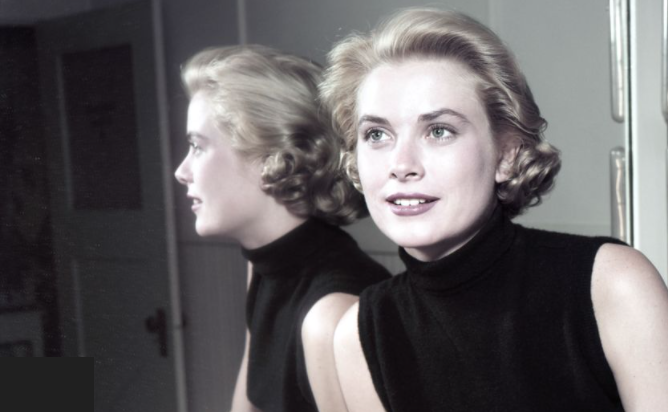
If you’re delighted by the idea of Kelly tearing at the belt buckles of almost every older guy she costarred with during her five-year film career (between ’52 and ’56), you don’t want to read Donald Spoto‘s “High Society: The Life of Grace Kelly” (’09), as he pours water on just about every sexual allegation and anecdote anyone’s ever shared about her. You start to get the idea that the more stories about Kelly’s sexual life that Spoto is able to debunk, the better he feels. He doesn’t seem to like the idea of catting around in the slightest.

Whatever the truth of it, Robert Lacey‘s “Grace” (’94) delivers what I want to hear. During a discussion of Kelly’s affair with the married Ray Milland during the shooting of Alfred Hitchcock‘s Dial M For Murder, Skip Hathaway, wife of director Henry Hathaway, who directed Kelly in Fourteen Hours, a 1951 suicide-watch drama, says the following:

“Grace Kelly was a conniving woman. She almost ruined my best friend Mal’s [i.e., Muriel Frances Weber, Milland’s wife of many decades] marriage. Grace Kelly fucked everything in sight. She was worse than any woman I’d ever known.”

Please. Yes. More of this. God.

And yet it appears that Kelly didn’t have it off with her To Catch A Thief costar Cary Grant, or her Rear Window leading man James Stewart. It doesn’t add up but there it is.

Kelly starred or costarred in 11 films between Fourteen Hours (’51) and High Society (’56). Six of them are goodHigh Noon, Dial M for Murder, Rear Window (her best overall effort), The Country Girl, The Bridges at Toko-Ri and To Catch A Thief.

But you can’t really count Toko-Ri as Kelly’s screen time in that 1954 Korean War film comes to only 12 or 14 minutes, or something in that realm.

How Many More Times?

How many dozens of times will McCartney 3,2,1 show us footage of these music industry legends — singer-songwriter Paul McCartney, 79, and hip-hop producer Rick Rubin, 58 — listening to isolated-track playbacks of Beatles songs from the ’60s and early ’70s, and particularly of McCartney lip-synching along and having fun with each tune?

I’ve just been watching teasers and trailers and I’m sick of it already.

And I have to say this even if it doesn’t sound nice. I’ll hang with Macca anyhow and any way, but I don’t like the idea of spending several hours listening to old songs with a guy who looks like a cross between Moondoggy and a balding Santa Claus. Rubin has friendly eyes but the beard is way too big and bushy…later.

Indoor Masks Again

Hollywood Elsewhere extends its thanks to the young and the careless…the unvaccinated sociopaths…thanks, guys, for ushering in the Delta variant tenfold over the past four or five weeks…thank you thank you thank you.

I’d begun to feel really wonderful about not wearing masks indoors. But now, thanks to All The Fine Young Ayeholes of L.A. County, we all have to put them back on starting tomorrow night.

Dr. Sam Torbati, medical director of the emergency department of Cedars-Sinai: “All of a sudden in the past couple weeks, we’ve seen a seven-fold increase in the number of people coming to the emergency room with COVID-related issues. Right now we’re seeing more young assholes infected because they’re more active and proportionally less-vaccinated because, you know, they’re stupid and arrogant…they’re not wearing face masks and aren’t protected so they’re going to get infected.”

Shawn Robbins, chief analyst at Box Office Pro to Variety: “It’s too soon to tell if renewed mask mandates in localized areas will discourage much activity. There’s still a pent-up desire to get back to normality. With many people having had a taste of that so far this summer, it would be challenging to expect such encouraging trends to reverse significantly as long as vaccines continue proving to be effective against known variants.”

“Summer of Soul” Again

Last night I had my second taste of Summer of Soul (Searchlight, 7.2). I had seen it theatrically in late June and had a nice, easy time with it. It’s a very warm and affecting film — a piece of New York-area cultural history I hadn’t sampled before, and was glad to have finally done so.

Shot during the mid-to-late summer of ’69 at the Harlem Cultural Festival, the doc is half…make that two-thirds about music and a third about revolutionary-cultural uplift. Changes were in the air; terra firma was shifting. ’69 was the year, remember, when average African Americans began self-identifying as “black”. And the footage is magnificent. You can almost feel the heat, smell the New York air, grass and trees, the cooked food, the cigar and cigarette smoke and the faint scent of flat, room-temperature beer.

Most of the film — directed by Ahmir “Questlove” Thompson, shot a half-century ago by Shawn Peters, brilliantly edited by Joshua L. Pearson — is focused on the great songs and performances, and is what you might call (for lack of a better term) honkyfriendly. Nobody says anything about the legacy of inherently evil whiteys or The 1619 Project or CRT…a blessing! Then it becomes more political and more Black-attuned about the serious consciousness elevations that were happening everywhere in all corners, and then it whips back into a more-or-less pure musical mode at the end.

Last night’s viewing was on Hulu, and it was just as pleasurable as the first time. Stevie Wonder on the drums, Mahalia Jackson uncorked, Nina Simone (I immediately flashed back to Liz Garbus‘s What Happened, Miss Simone?), The 5th Dimension (at age 26 Marilyn McCoo was arguably the dishiest 20th Century pop star who’d ever performed… pure strawberry shortcake), The Staple Singers, Gladys Knight & the Pips, and the orgasmic, thundering, X-factored Sly and the Family Stone — the only group who performed at the Harlem Cultural Festival who looked and posed and performed in a hippie-ish manner…the only organic, live-wire reflection of what had been happening in music and on campuses and in the cities since ’66 or thereabouts.

Festivalgoers are interviewed about their reactions to the 7.20.69 Moon landing, and the all-but-universal reaction was “that’s very nice but we could use some of that money down here in Harlem, because a lot of people are poor and hurtin’.”

Nobody mentions the Woodstock Music and Arts Fair or compares it to the Harlem Cultural Festival (i.e., “the black Woodstock”). It just was what it was on its own terms.

And nobody mentions the hour-long specials of the concerts that were broadcast by WNEW Metromedia (Channel 5) on Saturday evenings throughout June, July and August — 10:30 to 11:30 pm.

“I Suppose I’m Sad”

For what it’s worth, a critic friend who’s been around and knows the score says that Sean Baker‘s Red Rocket (A24) is his pick for the best in the Cannes competition.

Will it win the Palme d’Or? Or one of the major awards at least? I know nothing but if Spike Lee‘s jury is determined to choose a “woke” winner…okay, I won’t go there.

Let’s just say that the likeliest Palme d’Or winners appear to be Red Rocket, Ryusuke Hamaguchi‘s Drive My Car, Asghar Farhadi‘s A Hero or Wes Anderson‘s The French Dispatch.

The general consensus seems to be that Paul Verhoeven‘s Benedetta and Leos Carax‘s Annette are noteworthy but too eccentric.

Jordan Ruimy: “Based on Spike’s reactions after screenings I’m thinking the frontrunners are Lungui, A Hero or Casablanca Beats.”

Remancipator

16 years ago I came upon a fascinating passage in the third paragraph in Wikipedia’s Raymond Massey page. It said that sometime in the early 1920s Abraham Lincoln’s son, Robert Todd Lincoln (1843-1926), “heard Massey perform and was struck by the close similarity of Massey’s speaking voice to that of his father.”

I quoted this passage in a 2.25.06 HE post that mentioned the possible casting of Liam Neeson as Lincoln in a then-forthcoming biopic, which was first reported in early ’05. (Yes, the same Steven Spielberg-directed, Tony Kushner-authored biopic that Daniel Day Lewis wound up starring in seven years later.)

Alas, this passage is no longer in Massey’s Wikibio, which obviously suggests that the sourcing was deemed suspicious or questionable and therefore deleted. Too bad.

But let’s imagine that there was credible reason to believe that Massey did sound something like Lincoln, and that a documentarian had decided to make a Lincoln doc based solely on his letters, and that the filmmaker had decided, a la Morgan Neville and Anthony Bourdain, to digitally reconstitute and re-assemble Massey’s voice for the doc’s many narrative passages.

If, once again, historians had located persuasive testimony that Lincoln’s voice resembled Massey’s or vice versa, I would be delighted and fascinated to watch this theoretical Lincoln documentary. On a certain level it would probably seem amazing or astonishing to hear “Massey” do Lincoln. And yet the same “deepfake” or A.I. voicing technology that Mark Harris, Roger Friedman, David Friend and others have bemoaned in the case of Neville’s Roadrunner would be responsible for this.

It’s all a matter of perspective and what people are ethically accustomed to.

Incidentally: In August ’07 I mentioned an idea for “a weird-thoughtful comedy from director Mike Binder about Lincoln being somehow brought back to life by an electric charge of some kind or another, and grappling with life in 2007. I’m not kidding, and I think it’s an excellent concept. But what would you call it? Remancipator?

“My first thought was ‘cool…Abe’s back’ but then I thought a bit more about this. A great legend of the 19th Century comes face to face with the mind-blowing and the tragic aspects of what this country has become is…not funny. A man from a world of sabers, horse and buggies, hoop skirts and top hats encountering obese people and SUVs everywhere, McMansions, global warming, George Bush, celebrity meltdowns, junk food, etc.? That’s a kind of horror film.

“But the more I thought about it, the funnier it became. A fish-out-of-water piece with all kinds of strange cultural undercurrents. Lincoln driving a car, visiting Banana Republic, taking a Pilates class, dealing with an iPhone, etc. He can’t meet a nice bank teller and fall in love like Malcolm McDowell‘s H.G. Wells did in Time After Time? What would be do with himself? Become a politician? An art dealer? A horse breeder?