Dispute Over Deepfake Bourdain

From the comment thread about last night’s “Bourdain Deepfake Isn’t A Problem“:

PartTimeHero: “Jesus Christ…people are actually upset about this? They were Anthony Bourdain‘s own verified words. Let’s not get too ‘woke’ on documentary filmmakers or you are going to have to accept the equal and opposite: that a documentary in theory is not far off from the makers of Jersey Shore or Survivor cobbling together their own storylines from footage.”

Mr. F.: “All they had to do was say it wasn’t an actual recording of Bourdain and they would have been fine. I just don’t understand the need to make it “his” voice. It’s the aural equivalent of putting a deepfake into a documentary, yet I suspect that would cross a line for you.”

Jeffrey Wells to Mr. F.: “Putting a visual deepfake into a documentary? Yes, that would be unacceptable. But there’s nothing wrong with what Neville did. Nothing whatsoever. I agree that he should have copped to it in the closing credits.”

Mr. F. to Jeffrey Wells: “But it’s exactly the same thing. Say you want to include a scene in a documentary that the subject has described in a book, interview, whatever — but there was never a video recording. You have the technology to shoot an actor doing what the subject says they did, then deepfake the footage to put the subject’s face on the actor’s body. While one is a visual recreation and the other an audio recreation: they are the same thing.”

Jeffrey Wells to Mr. F.: “Wrong. The key situation facing Neville was how to best aurally represent what Bourdain had written.

“Documentarians never resort to just showing passages that have been written — they ALWAYS have somebody read them. So the question was should Neville have (a) hired an actor to imitate Bourdain, or (b) read the passages himself (like Scorsese did in his Dylan doc) or (c) digitally replicate Bourdain’s voice?

“The key thing was representing Bourdain’s thoughts accurately and scrupulously. HOW they were read is a secondary issue. I have no problem with a deepfake Bourdain voice reading them, and why should you? Nobody’s lying or misrepresenting. It was simply a matter of what kind of voice would read Bourdain’s thoughts — the voice of an imitator, the voice of a neutral party (like Neville’s) or the simulated voice of Bourdain.

“If a Bourdain-imitating actor had read the passages in question, nobody would have said boo.

“Yes, there should have been a closing credit acknowledgment of this strategy, but otherwise it was obviously no biggie.”
Bourdain Deepfake Isn’t A Problem

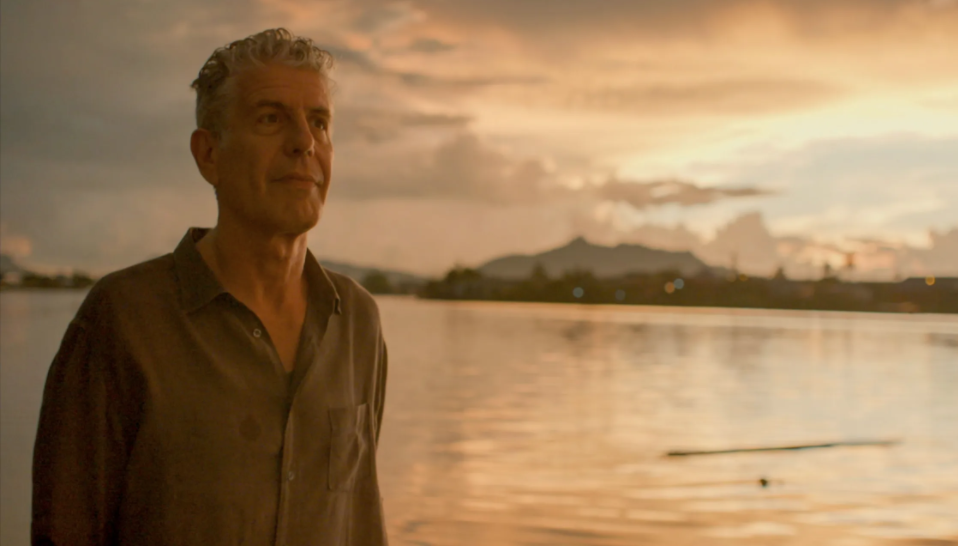
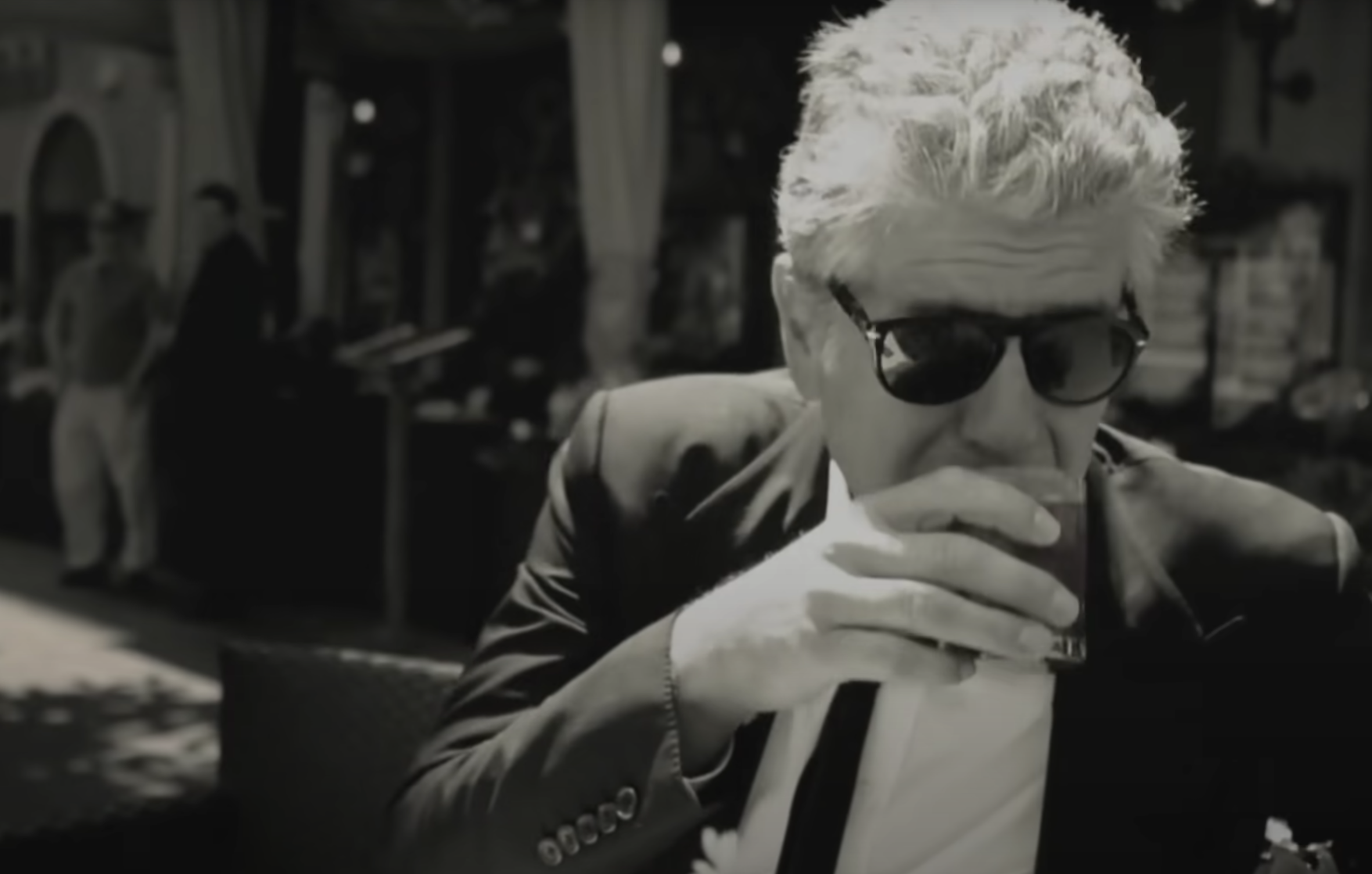
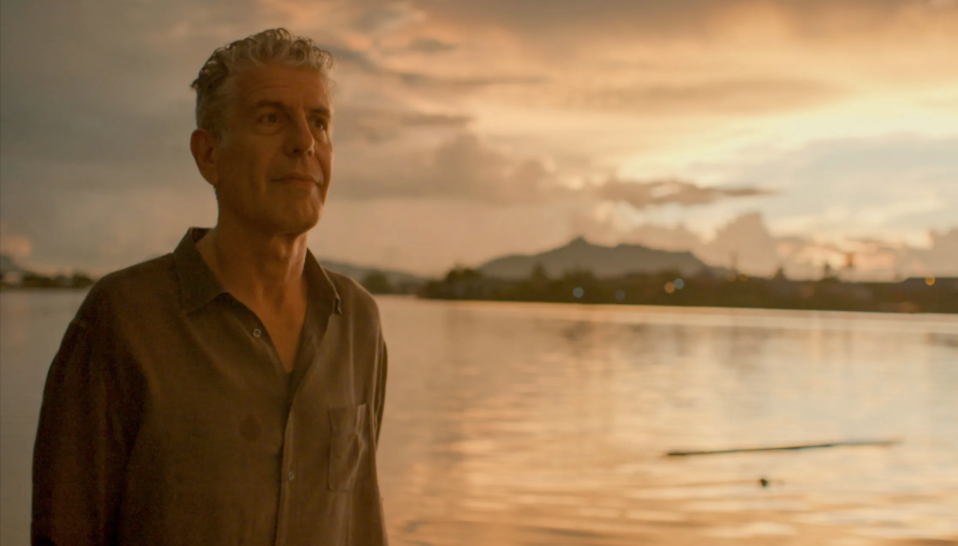
In a 7.15 New Yorker article titled “A Haunting New Documentary About Anthony Bourdain,” Helen Rosner has revealed that director Morgan Neville resorted to a sophisticated voice-editing or voice-replicating process that some on Twitter are tut-tutting about.

It involved the audible creation of passages not actually spoken by Bourdain but written by him. Neville created a deepfake or A.I. replication of Bourdain’s voice, assembled from vowel and consonant splices and fragments of legit Bourdain recordings. And so we hear Bourdain “reading” the passages even though he didn’t actually say them.

Get it? The passages that we hear Bourdain reading were definitely 100% written by him, and the voice we hear reading them is definitely Bourdain’s. But he didn’t actually speak these passages and wasn’t actually recorded saying them. Neville created a highly convincing simulation.

Does someone have a problem with this? Not I because nothing substantive was fabricated. Bourdain wrote the words and passages in question, and Neville’s simulation of Bourdain’s voice reading them is “real” as far as it goes and it’s all straight from the horse’s mouth. So what’s the problem?

If Neville had faked or invented passages that Bourdain hadn’t written, a fully justified ethical scandal would’ve erupted…but he didn’t. The words and thoughts are Bourdain’s.

If Neville had hired a Bourdain-sounding actor to read the passages and then revealed this ruse in the closing credits, nobody would’ve said boo.

But because Neville used Bourdain’s own voice instead of an actor’s, some are calling this an ethical foul. Except there was nothing wrong or even shady about what Neville did. Sophisticated, obviously, but so what? Should Neville have admitted to this in the closing credits of the film? Yes, he should have. But it’s not that big of a deal.

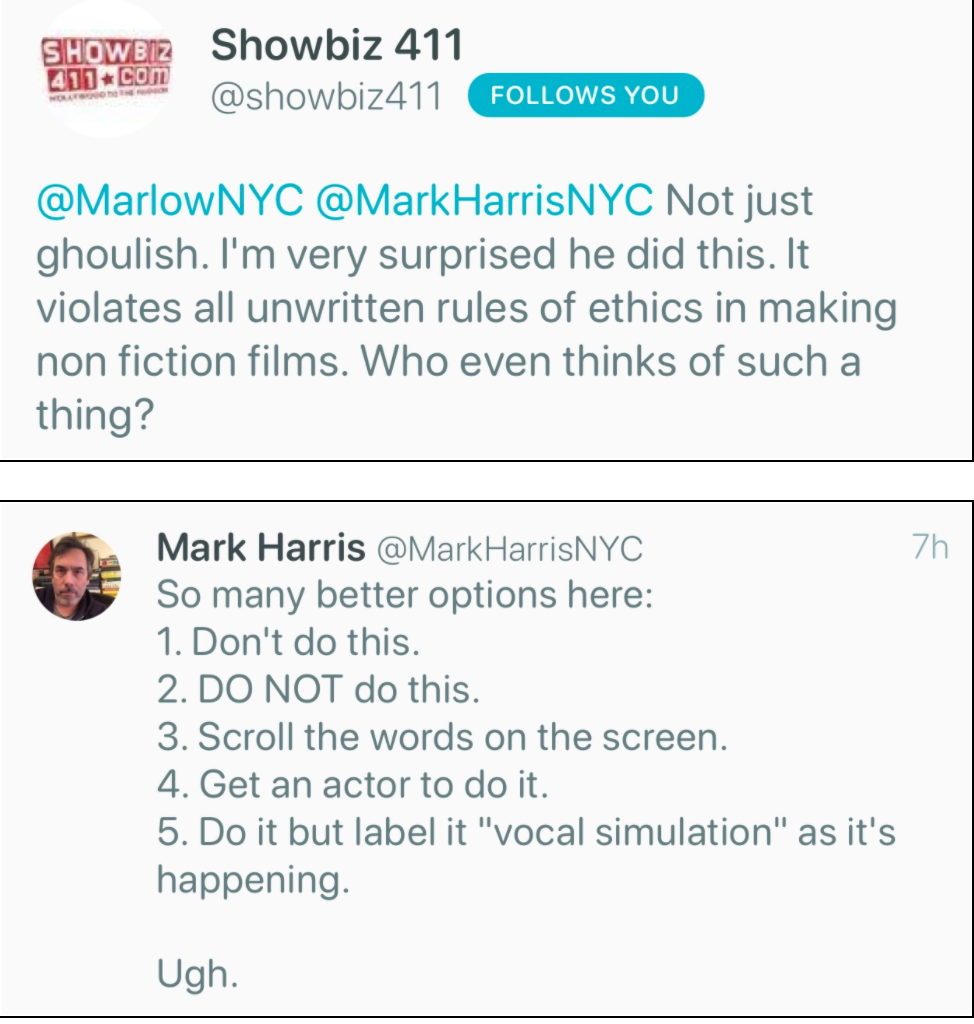
Canadian entertainment reporter David Friend: “The new Anthony Bourdain documentary didn’t have audio of him reading emails, so they created a fake A.I. model of his voice…and didn’t bother disclosing that in the film. We need a serious check on ethics in documentary filmmaking.”

Read more

Anti-Asian Racism Very Bad

The Blue Bayou trailer lays it right on the line — racism is very bad. Right away you detect the tone of social-justice instruction and an unsubtle replay of the anti-racism current that was explored 64 years ago in Joshua Logan‘s Sayonara (’57), in which an inter-racial couple (Red Buttons, Miyoshi Umeki) struggled against repressive racial attitudes.

This time an adopted, Korean-born New Orleans family man (Justin Chon, who also directed and wrote the screenplay) and his pretty Anglo-Saxon American wife (Alicia Vikander) are up against shit-for-brains ICE guys who insist on treating him like a Korean immigrant with a criminal record and want to kick him out blah blah.

Variety‘s Guy Lodge calls this “an emotional pile-driver of a film [in which] sob-disrupted dialogue and background strings [compete] for our eardrums.” Obviously punishment for characters and audience members alike. Sanctimonious preaching to the woke choir.

Apeshit For New Weisenheimer

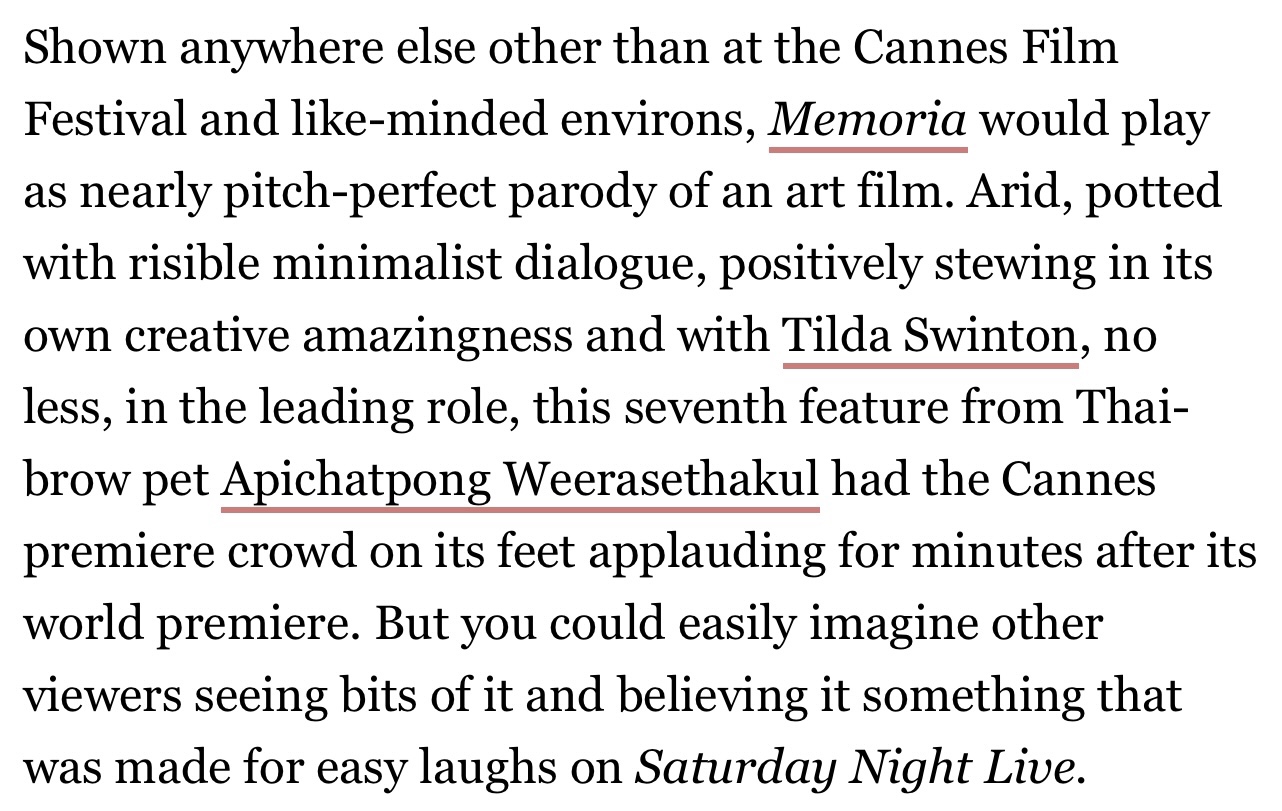
The Guardian‘s Peter Bradshaw insists that Apichatpong Weerasethakul‘s Memoria “is a beautiful and mysterious movie, slow cinema that decelerates your heartbeat.

“In a calmly realist, non-mystic movie language, Weerasethakul” — a.k.a. Joe Weisenheimer — “really can convince you that the living and the dead, the past and the present, the terrestrial and the other, do exist side by side.

“All admirers of this director, with his enigmatic realist-mystic masterpieces such as Tropical Malady and Uncle Boonmee Who Can Recall His Past Lives will know broadly what to expect. But he is still capable of astonishing you, all over again. I’m not being facetious when I say that watching this film reminded me of when I was 17, hearing ‘Revolution 9’ on The White Album for the first time. It left a residue of happiness in my heart.”

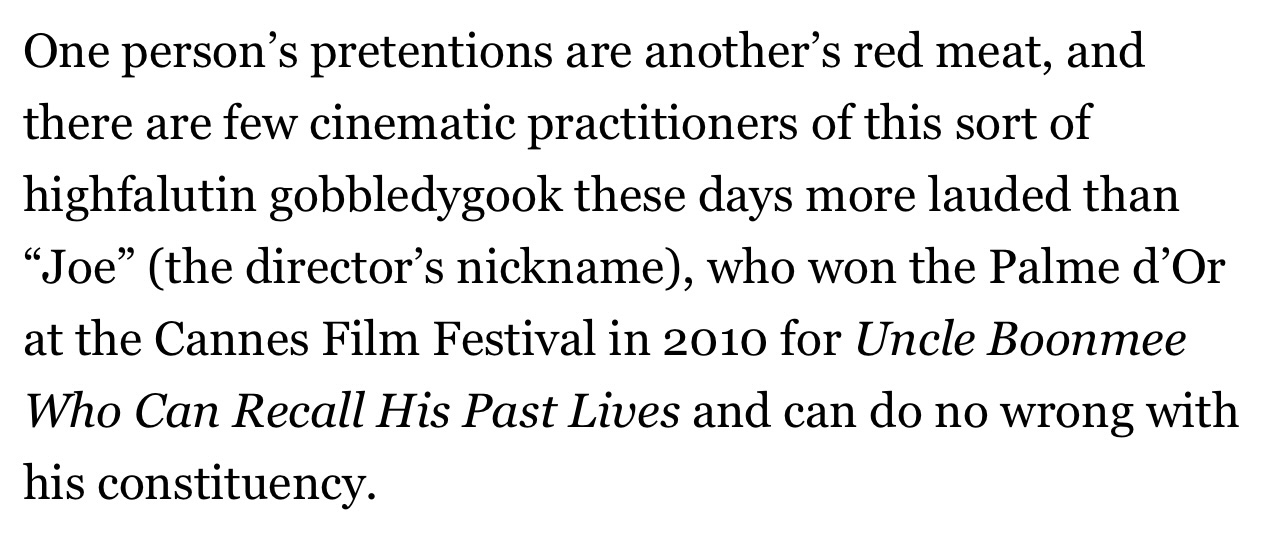
A few years ago I wrote that spelling and pronouncing the name of the celebrated Thailand director (Mekong Hotel, Cemetery of Splendor) has always been a challenge for me. His Wiki bio says that “cinephiles affectionately refer to him as ‘Joe’ Weerasethakul — a nickname that he, like many with similarly long Thai names, has adopted out of convenience.”

The last name, of course, is much more difficult to handle than the first. In my mind he’s always been Apichatpong J. Weisenheimer or, more simply, “Joe Weisenheimer.”

The film is basically about hearing or at least believing that you’re hearing (or vaguely sensing) sound vibrations that may be connected to something more meaningful than mere ound vibrations. I know all about that.

Friendo: “I heard it was a total joke. Unwatchable, except for the minimalist crowd. I would NEVER sit thru another of this guy’s movies ever again.”

From Todd McCarthy’s Deadline review:

Devoted Faithful

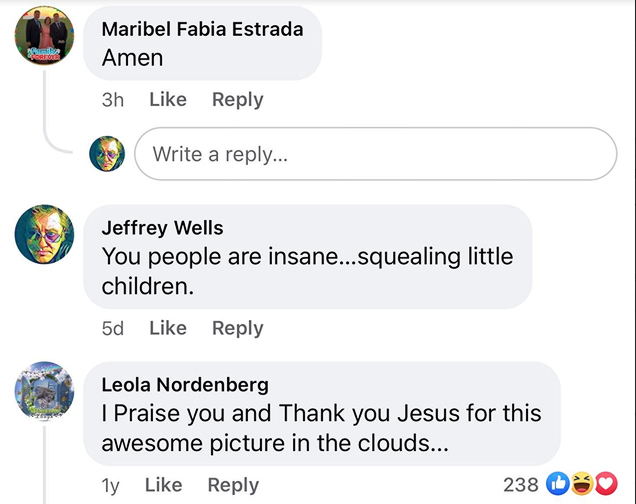
During the summer of ’20 I happened to notice a minor Facebook thing — a long-distance photo of an odd-shaped cloud that looked like Godzilla from, like, a distance of six or seven miles. Since that time literally hundreds of thousands (or it is millions?) of idiots have decided that this cloud had some kind of religious significance. That thread is still going today, and if you ask me it’s a metaphor for how stunningly stupid and delusional religious people can be when they put their minds to it. In a way, the fact that so many saw Jesus in a Godzilla cloud shape explains why Donald Trump is still an influential figure. Among the mouth-breathers, I mean.

“This life’s hard, man, but it’s even harder if you’re stupid.” — Steven Keats‘ “Jackie Brown” character in Peter YatesThe Friends of Eddie Coyle (’73).

Read more

Peak Allure

We’re no longer allowed to use the words “foxy” or “fetching” these days (or even think in those terms), but this Hejira image is perfect…easily the effiest of Joni Mitchell ever beheld. The outdoor Hejira photos were taken by Joel Bernstein at Lake Mendota, in Madison, Wisconsin; the indoor studio shots (of which this is obviously one) were taken by Norman Seeff.

Fairly Accurate

Speaking as a central Jersey, Wes Anderson-type of guy (Union County, southwest of Newark, not far from Route 22) this seems like a reasonably honest capturing or delineation of the four stratas of New Jersey culture. I know that I always regarded South Jersey (Timothee Chalamet or Bruce Springsteen-ville) as a somewhat coarser, less cultured region…punky, scrappier. At the same time I don’t relate to the North Jersey Tilda Swinton thing either. (Not that I mind the projecting of greater wealth — I just can’t emotionally find myself in that realm.)

“I Liked The Bleakness…”

“…because you could dream in it.”

This obviously first-rate, professional-grade short was produced by A24 marketing to promote J.C. Chandor‘s A Most Violent Year (2015). It’s not pushing fiction — Manhattan, Brooklyn (I never even visited Williamsburg until sometime in the mid ’90s) and Queens were unquestionably rougher, scrappier, grimmer and less hygenic 40 years ago.

Not to me and my semi-struggling journalist-photographer friends and the neighborhoods in which we lived (West Village, Soho, Chelsea, Hell’s Kitchen, Upper West and East Sides, Murray Hill) but certainly to people living in the marginalized areas and shittier nabes.

This is a tired, soggy cliche, of course, but Manhattan was a much richer, livelier and more flavorful place in ’81, certainly from a cultural standpoint. The Manhattan of Sidney Lumet‘s Prince of the City was a real, actual thing back then. Repertory cinemas were plentiful and doing okay. A degraded but half-alluring version of Studio 54 was still in business. Cafe Central (my home-away-from-home in late ’81 and ’82) was the greatest actor-hangout bar in the world; and Nishi was the greatest Japanese restaurant of all time. The greedy ’80s were just beginning (Ronald Reagan had recently taken a bullet), but the storied Pearl Paint, which gave up the ghost in ’14, was thriving. I would have that time again.

Today’s Manhattan is cleaner, tidier and safer but unaffordable unless you earn a mid six-figure income or better. And millionaires fare all the better.

Read more

Bourdain Agonistes, Part 2

In his 7.15 review of Morgan Neville‘s Roadrunner: A Film About Anthony Bourdain (opening Friday), Wall Street Journal critic Joe Morgenstern notes that the film “has been criticized for what some see as a sexist and reductionist implication that Bourdain’s failed relationship with his last girlfriend, the Italian actress and filmmaker Asia Argento, was the cause of his suicide.

“Argento figures significantly toward the end of the film, as she did in its subject’s life,” Morgenstern writes. “But she’s a latecomer in a documentary that evokes, and makes sense of, the full sweep of Anthony Bourdain’s gifts, charms, successive careers, sustaining passions and bedeviling obsessions. A film of fitting energy and complexity, it’s a stirring account of an astonishing life.”

I’m sorry but that’s just not honest or true. After seeing Neville’s film a month ago I tried to explain the Bourdain suicide thing as plainly as possible (6.16). Here it is again for good measure:

“The first 80 to 90 minutes of Roadrunner are just okay. At times they almost feel a bit boring. But during the final 30 or 40 minutes the film dives into the ‘what happened during the final few weeks of Bourdain’s life, and why did he fucking hang himself?’ section.

“By the end the viewer has been left with a clear impression that Bourdain’s relationship with the notoriously edgy and prickly Asia Argento was a giddy, obsessive thing that intensified Bourdain’s hot plate and probably jarred his sense of emotional equilibrium.

“I’m not saying that Argento ‘killed’ him in some way — Bourdain sadly did that all to himself — but she definitely shook him up and rattled his composure and apparently brought him to the edge of something or other.

“Bourdain was a moody, free-associating, nakedly honest fellow with a tendency to occasionally fall into caves of depression, and it appears that he swan-dove into the Argento relationship without the slightest sense of measured, step-by-step gradualism. Frank Sinatra once sang “let’s take it nice and easy…it’s gonna be so easy.” Bourdain definitely didn’t do that with Argento.

“There’s a stocky guy from Bourdain’s camera crew who tells Neville that Anthony was ‘a lifelong addictive personality, [and at the end he was] addicted to another person [i.e., Argento]. He didn’t understand he would drive her away if he didn’t stop talking about [how great she was]…you could see her pulling back and he just wouldn’t stop.’

“So in a way Bourdain was apparently smothering Argento to some extent, and so just before his death she performed that public affair in Rome with Hugo Clement. Her apparent intention was to say to Bourdain ‘back off, don’t smother me, let me be free.’ She and Bourdain had an open relationship, but if Argento had been a tad more considerate she would have indulged herself with Clement more discreetly.

In the doc, Parts Unknown director Michael Steed says he checked on Bourdain after the Argento-Clement photos appeared online, and that Bourdain was not cool about it, mentioning that “a little fucking discretion” would have been nice on Argento’s part.

He meant that if you have an open relationship you fuck around in the shadows — you don’t push it in your partner’s face.

Argento didn’t push Bourdain off the cliff — he jumped of his own accord. But had it not been for their relationship and his extreme immersion in that bond, Bourdain might be alive today. Maybe. Who knows? Possibly. This is definitely what the film leaves you with.

Bad Aspect Ratio Presentation

This will be of little interest, I realize, to anyone except for aspect-ratio fanatics like myself. But within the past month I’ve watched Amazon rentals of Billy Wilder‘s The Spirit of St. Louis (’57) and John Guillermin and Irwin Allen‘s The Towering Inferno (’74). And neither made me happy.

Both films were shot within a standard widescreen a.r. (2.39:1), but for reasons of pure laziness and indifference are being presented to Amazon renters with flat aspect ratios of roughly 1.78:1 or 16 x 9, which is the dimension of a standard widescreen HD TV.

The difference between the two screen shapes (comparison below) is obvious — the 1.78 version chops the sides off. It’s just as obvious that certain parties (most likely on the Amazon end) involved in the presentation of these films couldn’t care less about showing them correctly.

I’ve been watching The Spirit of St. Louis for years so why did I pay to rent it on Amazon? Because the 1.78 version is presented in HD, and the 2006 DVD is obviously available only in 480p.

Persistence of “Westworld”

I had mostly bailed on HBO’s Westworld by the end of season #1 and certainly by the middle of season #2. The endless puzzleboxing was infuriating. I was amazed that the producers had the chutzpah to launch a third season (eight episodes, 3.15.20 to 5.3.20), but that they did. I refused to watch. I was done.

A fourth season was announced in April 2020, and they’ve been shooting it over the last several weeks, or so I understand. A couple of months ago a certain Reddit guy posted that the old western village of Sweetwater would be used again for the new season, and has been moved forward in time to the 1920s.

Posted on 2.20.20: Westworld‘s third season is nearly upon us. An eight-episode endurance test that begins on 3.15.20, it will presumably deliver the same infuriating mixture of bullshit brain-teasing, dick-diddling, plotzing and puzzleboxing.

Last summer showrunners Jonathan Nolan and Lisa Joy told Entertainment Weekly that season 3 would have a more comprehensible story line…really? “Season 3 is a little less of a guessing game and more of an experience with the hosts finally getting to meet their makers,” Nolan said.

Posted on 4.27.18: “That feeling of being fiddled and diddled without end, of several storylines unfolding, expanding and loop-dee-looping for no purpose than to keep unfolding, expanding and loop-dee-looping…is such that I’m determined to hate all further permutations of Westworld without watching it. I don’t care how that sounds or what it implies. Come hell or high water, I will not go there.”

From a 4.20.18 review by CNN’s Brian Lowry: “The first half of [season #2] repeats the show’s more impenetrable drawbacks — playing three-dimensional chess, while spending too much time sadistically blowing away pawns. The result is a show that’s easier to admire than consistently like.

“The push and pull of Westworld is that it grapples with deep intellectual conundrums while reveling in a kind of numbing pageant of death and destruction. Where the latter is organic to the world of HBO’s other huge genre hit, Game of Thrones, it doesn’t always feel integral to the story here, but rather a means of killing (and killing and killing) time.”