“Suicide” Stand Down

Every now and then I’ll have a passing interest in this or that fanboy film — emphasis on “passing.” But for a while, the James Gunn factor meant something. It lent a certain edge and intrigue. I used to regard his fanboy flicks as clever and amusing and certainly worth catching. I was a huge fan of Super (’10) and Guardians of the Galaxy (’14). Then I saw Guardians 2 and had a half-meh reaction. Then I felt enormous sympathy and compassion when Gunn was thrown into the Disney doghouse over some old tweets.

But I didn’t have the slightest, fleeting interest in seeing Gunn’s The Suicide Squad (Warner Bros., 8.5), which opened two nights ago and has semi-tanked. Okay, “underperformed.” I didn’t read about it, watch the trailer, read the reviews…nothing. It’s sitting right there on HBO Max, and I couldn’t care less.

The Suicide Squad earned around $12 million yesterday in 4,002 theaters plus $4.1 million on Thursday night. By Sunday night the tally should be in the mid-to-high $20 million range, according to Deadline‘s Anthony D’Alessandro.

D’Allessandro on 8.4: “Total global opening we’re pegging is at $70M; $30M from 4,000 U.S./Canada theaters and $40M from abroad. Stateside, unlike previous Warner Bros./HBO Max movies, there will be Thursday previews starting at 7PM. It would not be shocking should Suicide Squad approach $40M domestic.”

D’Alessandro current: “Some continue to wonder whether the delta variant is the contributing factor here in further upsetting the grosses for Suicide Squad, a movie which won over critics at 92% certified fresh; the best reviewed in the DC villain ensemble trilogy.

“It’s an easy excuse to make in a marketplace where some studios continue to fool around with the dynamic window. Warners isn’t sorry about sticking with their HBO Max/theatrical plan after recent New York Times headlines about restaurants struggling, and WSJ reporting a dip in travel despite an earlier summer boom. Granted, there is a mixed message out there about the surging variant, particularly since we haven’t returned to lockdown, and kids are heading back to college to stay in dorms. We continue to live and manage life with the virus. Of those I’ve spoken to in the industry, no one is really expecting the vaccine card mandate in NYC or LA to effect business.”

“Hollywood vs. Fans — Everybody Loses”

You have to hand it to The Critical Drinker — this is about as succinct a description of the terrible impossible hell of Hollywood movie “product” today (outside of the realm of true-class, potential-clear-light movies celebrated at film festivals) that anyone’s recently put into words [starting at 2:41]:

“We’re kind of drowning in a sea of entertainment these days, There are so many TV shows, movies, miniseries and fuck knows what else, that people don’t know what the hell they’re supposed to be watching now. And any original property that does comes out, is up against so many competitors that the chances of success are about the same as a homeless man getting into a high-end strip club.”

Willy Loman in Cannes

More than any other admonishment or influence, this horrific photo (snapped 11 years ago by Sasha Stone) made me stand up straighter and think more seriously about good vs. bad posture. One glance and I was immediately flashing back to Charles Bukowski’s book about working as a bent-over mail carrier.

First Stone

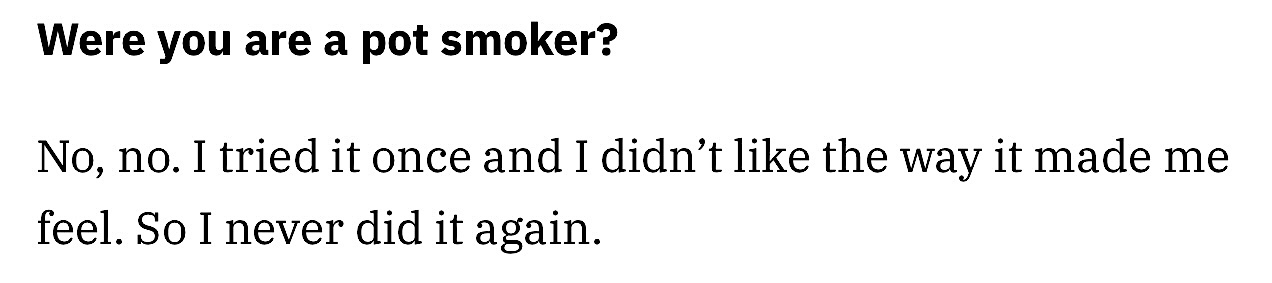
I was 19 when I inhaled the first joint of my life, and after five or six tokes (I was sharing with three or four others) I was completely ripped. I had no choice but to succumb to all the classic effects — giggling fits (I don’t think I’ve ever laughed quite as hard or as hysterically), dry-mouth, time drop-outs (falling into a deep dream state as through a trap door and then abruptly returning to reality, not knowing if 30 seconds or 45 minutes had passed) and of course the munchies.

Barbra Streisand apparently never experienced any of this, which indicates caution in her bones. Caution and hesitancy. God had simply ordained that she wouldn’t be open to easing up or letting go…floating downstream into that sparkling cosmic Revolver dream state…”it is being”, John Lennon, newspaper taxis…the realm that kept on giving…her Brooklyn-honed mentality said “nope” and that was that…never again.

Best Real Time Debate In Months

Ben Shapiro vs. Malcolm Nance on Critical Race Theory, and I was riveted. Delighted actually. It lasted nine and a half minutes, and I wished it could have gone on for 20. This is the kind of crossed-swords dispute that Bill Maher‘s show needs more of. Shapiro “won”, by the way — it was the first time I’d watched him debate while saying to myself, “This is reasonable, he’s making sense,” etc. Shapiro’s CRT definition struck me as spot-on, and Nance (who was a little unfair and dismissive with that statement about his great-grandfather) agreed with it.

Throw Stuff At The Screen

Now that Leos Carax‘s Annette is playing in theatres, I’m a bit put off by the positive reviews. More than 60% of the critics on both Rotten Tomatoes and Metacritic are giving it a pass, and that’s not cool. But I’m mainly perplexed by the the genteel tone of the pans. Nobody hates this film, in short, and that doesn’t feel right. Because if there’s one movie I’ve seen this year that really pushed the revulsion button, it’s Annette.

You can admire or love Annette, of course, but if you don’t approve mild naysaying is not the way to go — trust me.

In his New Yorker review, Anthony Lane delivers what feels to me like a kid-gloves pan. He says that Annette “is a folie de grandeur, alas, without the grandeur,” and that it “strikes one false note after another,” and that “there’s nothing in Annette” — a sung-through musical, for the most part — “that’s quite as overwhelming as Adam Driver’s roaring rendition of Stephen Sondheim’s ‘Being Alive’ in Marriage Story,” etc. See? He wont do the mean.

CNN’s Brian Lowry: “Let the record show that no drinking took place while watching the movie for this review. But by the time it was over, that didn’t seem like a bad idea.” Not bad, still too restrained.

Time‘s Stephanie Zacharek: “Driver’s height and brawn are used to menacing effect here. He’s never been so believably unlikable, which is certainly an achievement, if it’s the kind of thing you want to see.” Better!

For me, reviewing Annette required absolute fuck-all bluntness. I titled the review”Revulsion and Contempt.”

“Only the most perverse, anti-populist critics will even flirt with being kind to, much less praising, Annette when it opens stateside,” I wrote. “Once you get past the strikingly surreal visual style and the fact that it was, like, made at all, there is only the self-loathing rage of Adam Driver’s Henry McHenry character, and Carax’s seething disdain for easily led-along audiences.

Annette is ‘brave’ and wildly out there, but this is arguably the most morally repellent musical ever made in motion picture history. Driver’s Henry, an envelope-pushing comedian who performs one-man shows that aren’t in the least bit amusing, is astounding — one of the most flagrantly revolting protagonists I’ve ever spent time with in my moviegoing life.

“Henry is a kind of sociopathic Jack the Ripper figure, and Annette is a misanthropic rock opera about rabid egotism, demonic personality disorder, black soul syndrome, rage, alcoholism, murder, self-loathing, self-destruction.”

McCarthy Coolly Dismisses Knox Beef

In an 8.4 Variety interview Amanda Knox told Chris Willman that she hadn’t yet seen Tom McCarthy‘s Stillwater. (She added she wouldn’t mind being invited to a screening while hinting that paying to see it might be a bridge too far.) I wrote yesterday that this didn’t make a lot of sense, and that Knox should’ve paid to see it at a local plex as soon as she was able to, in order to lend authority to her argument that the film had unfairly appropriated her legal troubles in Italy from over a decade ago.

And now, in a just-posted interview with Variety‘s Janelle Riley, McCarthy has pounced on Knox’s admission that she hasn’t seen the film.

Riley: “I’m sure you’re aware Amanda Knox has taken issue with the film, saying it’s based too closely to her own story. What’s your response?”

McCarthy: “I deeply empathize with Amanda and what she went through. She was rightfully found innocent and acquitted in the Meredith Kercher case. She has platforms to speak her truth and engage with the media and she is exercising her absolute right to do so. But, by her own account, she has not seen Stillwater and what she seems to be raising feels very removed from the film we actually made.

Stillwater is a work of fiction and not about her life experience. It does take from aspects of true life events, like many films, but Stillwater is about Bill Baker’s journey, his relationship with his estranged daughter Allison and a French woman and her young daughter he meets along the way. The questions the movie poses about American identity and moral authority are what compelled me to make this film. But I do think good films spark conversation in and around the story, and I welcome audiences’ engagement in that.”

In short, McCarthy is better at this game than Knox.

On Its Own Terms

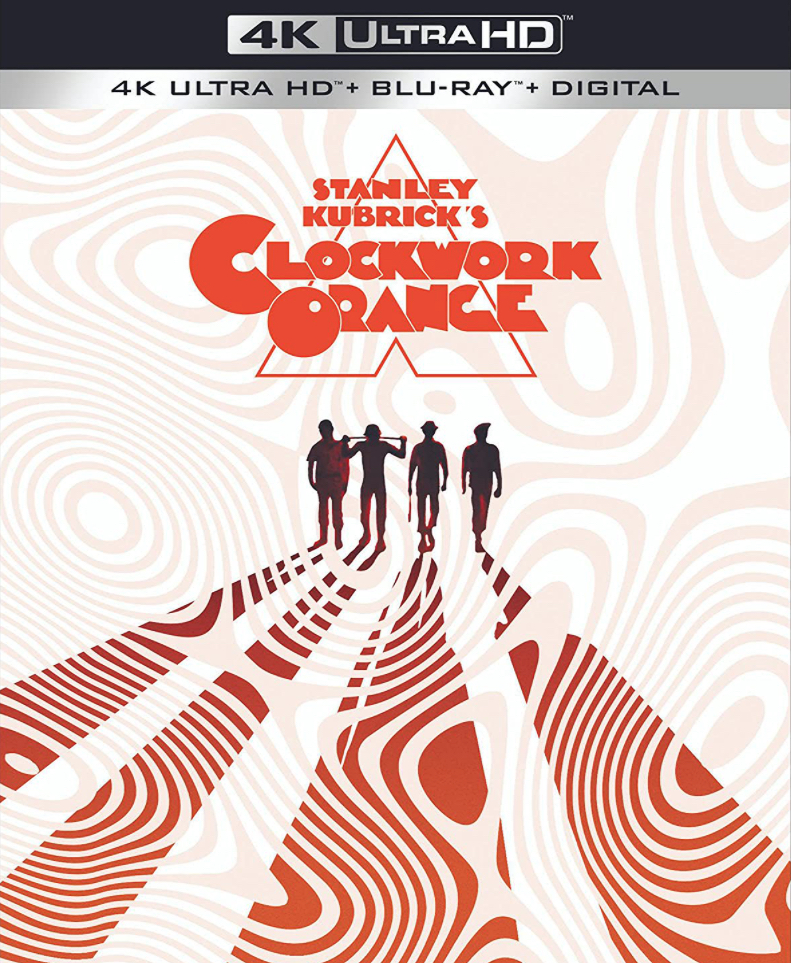
An excellent job of selling a half-century-old film — the forthcoming, undoubtedly spiffy 4K Bluray of Stanley Kubrick‘s A Clockwork Orange (9.21.21).

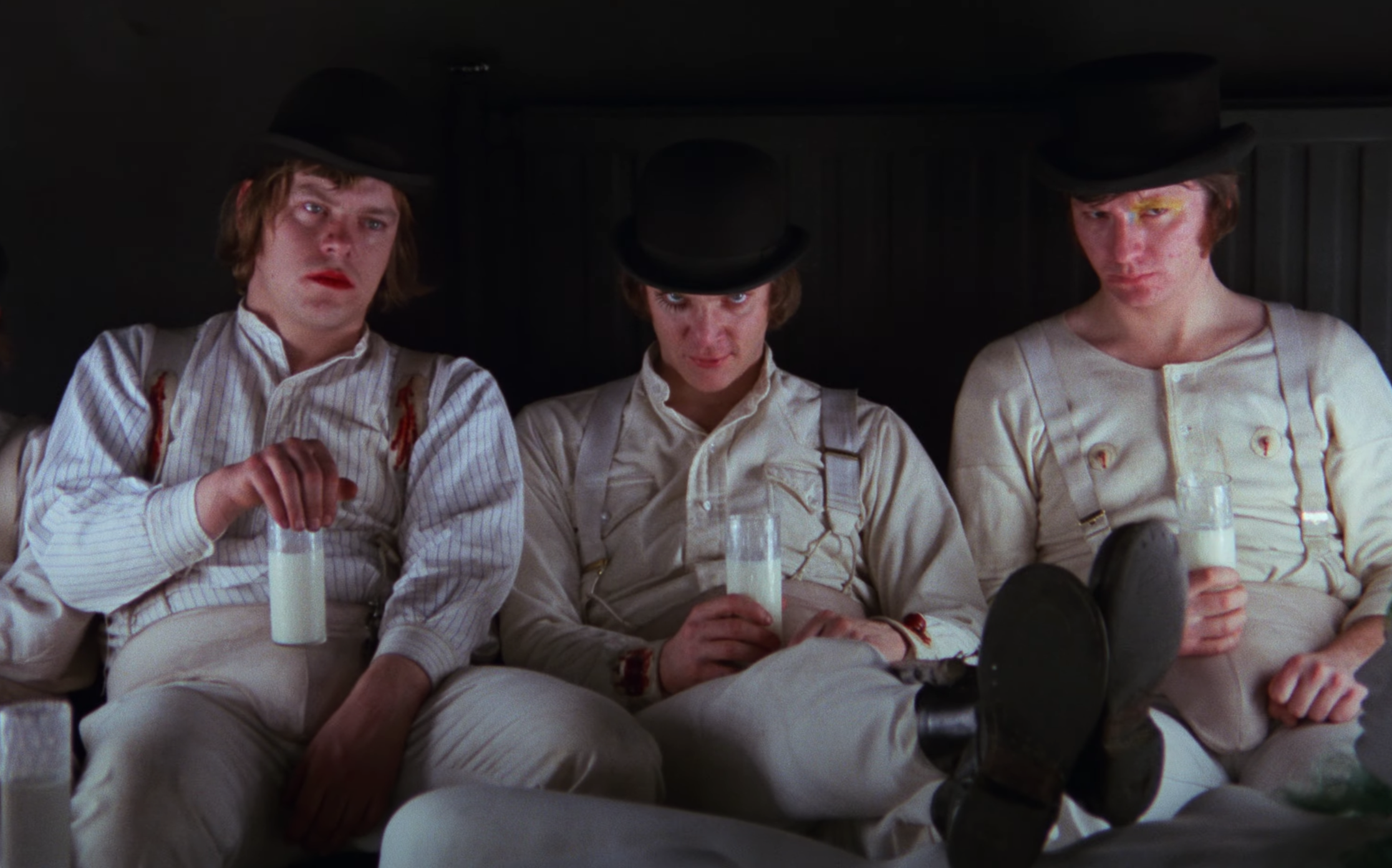
From yesterday’s [8.5] pay-walled assessment: “It’s still a crisp, clean, mesmerizing film, and I’ll never stop worshipping that final shot of those well-dressed 19th Century couples clapping approval as Alex and a scampy blond cavort in the snow. But this is nonetheless one really cold film. And yet at the same time (and this is what makes Orange such an odd duck) it’s genuinely amusing here and there. Every line and gesture delivered by Michael Bates‘ chief prison guard is a hoot, and I chuckle every time I see that fat, middle-aged fuckface making kissy-face gestures at Malcolm McDowell‘s Alex in the prison chapel.

“At the same time I can’t honestly say that I like A Clockwork Orange much any more. I was always more impressed with the scene-by-scene verve than what it all amounted to in the end. I still respect the visual energy and exquisite 1.66:1 framings (John Alcott was the dp) and the Wendy Carlos meets Gene Kelly meets lovely lovely Ludwig Van musical score, and I still “admire” the tone of ironic ruthlessness and even fiendishness, but I’m not even sure if I like McDowell’s performance any more. (I feel a much greater rapport these days with his Mick Travis character in Lindsay Anderson‘s If…) I respect Orange historically, of course, and I still love the stand-out moments from the flawless first act, but it hasn’t delighted me overall for years.

A Clockwork Orange was the first Kubrick film that felt wholly misanthropic** — a high-style show-off movie that sold audiences on the idea that Kubrick-stamped cruelty and brutality were palatable — that irony and arch acting styles somehow changed the game. But it was always more amoral than moral, and pretty much devoid of human compassion. Orange has 23 significant characters with noteworthy dialogue, and only one could be honestly described as decent or humane — Godfrey Quiqley‘s prison chaplain.”

Read more

Minus The Style, “Orange” Is Sour Fruit

Stanley Kubrick‘s A Clockwork Orange will celebrate its 50th birthday on 12.19.21. I don’t know if I’ll be able to summon fresh interest as I’ve seen this cynical, ice-cold film too many times, but the new 4K Ultra HD Bluray from Warner Home Video — a fresh harvest, sure to look better than the current Bluray version — is too appetizing to refuse. I bought it today on Amazon. The street date is 9.21.21.

Orange remains a chilly, dead-on capturing of Anthony Burgess’s 1962 novel, and it seems doubly fascinating when you regard it as a portrait of the chilly, German-like social scientist that Pauline Kael imagined that Kubrick had become in ’71, and indeed the fellow that Kubrick had more or less evolved into since he made Dr. Strangelove seven or eight years earlier.

It’s still a crisp, clean, mesmerizing film, and I’ll never stop worshipping that final shot of those well-dressed 19th Century couples clapping approval as Alex and a scampy blond cavort in the snow. But man, it’s really cold and almost induces nausea from time to time. And yet at the same time it’s genuinely amusing here and there. Every line and gesture delivered by Michael Bates‘ chief prison guard is a hoot, and I chuckle every time I see that fat, middle-aged fuckface making kissy-face gestures at Malcolm McDowell‘s Alex in the prison chapel.

At the same time I can’t honestly say that I like A Clockwork Orange much any more. I was always more impressed with the scene-by-scene verve than what it all amounted to in the end. I still respect the visual energy and exquisite framings (John Alcott was the dp) and the Wendy Carlos meets Gene Kelly meets lovely lovely Ludwig Van musical score, and I still admire the ironic ruthlessness and even fiendishness, but I’m not even sure if I like McDowell’s performance any more. (I feel a much greater rapport these days with his Mick Travis character in Lindsay Anderson‘s If…) I respect Orange historically, of course, and I still love the stand-out moments from the flawless first act, but it hasn’t delighted me overall for years.

A Clockwork Orange was the first Kubrick film that felt truly misanthropic — a high-style show-off movie that sold audiences on the idea that Kubrick-stamped cruelty and brutality were palatable — that irony and arch acting styles somehow changed the game. But it was always more amoral than moral, and pretty much devoid of human compassion. Orange has 23 significant or otherwise noteworthy characters, and only one could be honestly described as decent or humane — Godfrey Quiqley‘s prison chaplain.

A Dickensian crime-and-punishment thing, Orange is composed of four acts or movements. The first act is about the wicked rush of sociopathic “fun”, but the second and third acts (applying the Luduvico technique + Alex suffering for his crimes after being released from prison) comprise a long and punishing slog. The film rebounds during its brief fourth act (the hospitalized Alex cuts a deal with Anthony Sharp‘s Minister of the Interior, and is restored to his old wicked self) and the ending shot, a sexual fantasy sequence, is the equal of Kubrick’s “We’ll Meet Again” finale in Dr. Strangelove.

Read more

Gotham Neutral

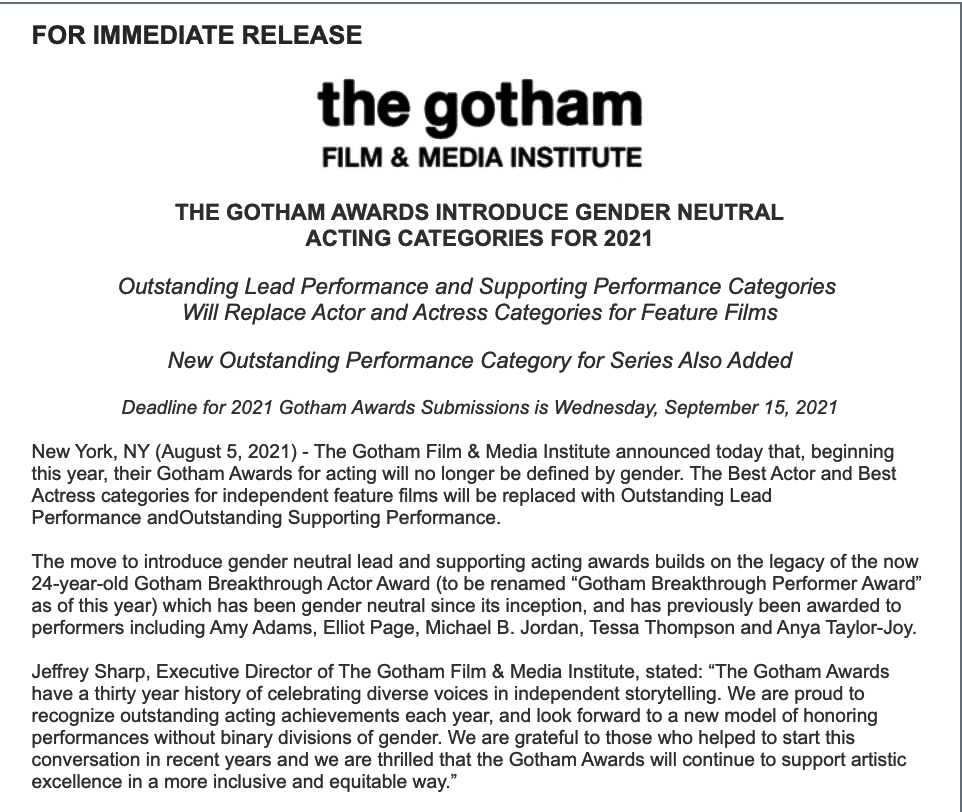
In years past the Gotham Awards have (a) never handed out male/female acting awards in the supporting category, and (b) only focused on Best Actor and Best Actress. The new thing, announced today, is that henceforth the Gotham acting awards will be (a) gender neutral and (b) will focus on lead and supporting — i.e., one in each category.

So hooray for supporting actors but boo-hoo at the same time because only one actor of either gender can win a Gotham supporting actor trophy. Likewise, only one lead actor (either gender) can win.

The new acting categories will be called Outstanding Lead Performance and Outstanding Supporting Performance.

May I suggest something? If the Gothams must do the gender-neutral thing, hand out four of them — two lead, two supporting.

Friendo: “While wokesters believe in disappearing gender, they also believe in non-color-blind casting and race relations. These two things do not agree with each other. Plus gender neutral ignores how women have a hard time getting great roles, especially women of color. Having separate categories HELPS them do better. Taking that away gives men the advantage. It’s so bizarre.”