David Bowie’s “Five Years”

For those who may not have read yesterday’s comment thread for “Four Moments When Culture Turned”:

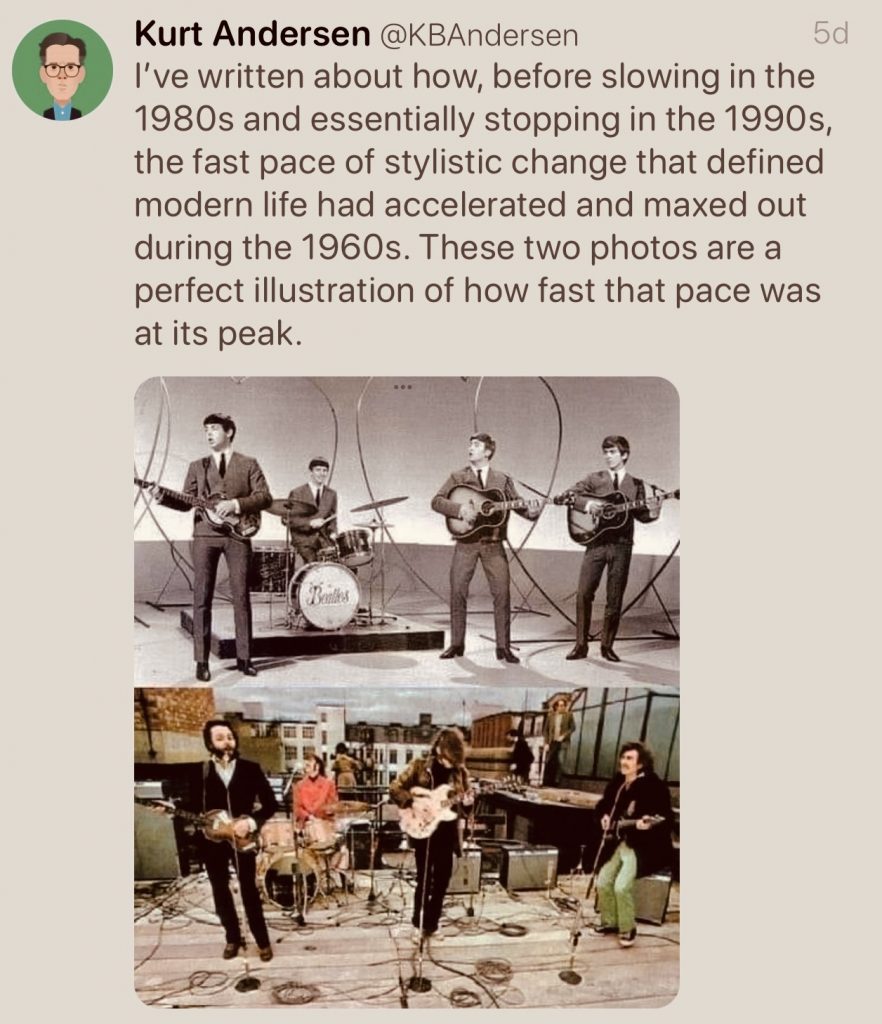
The things that happened in this country between late 1963 (or very early ‘64) and late ‘68 constituted a massive cultural transformation.

Within a mere five years this country experienced (a) a complete altering of traditional male thinking, behavior and appearance (long hair, more inward-looking, a lessening or diluting of traditionally aggressive attitudes**) + (b) increasingly unmodified or unbridled sexual behavior & liberation + (c) a significant trend toward the abandonment of puerile top-40 music and the introduction of poetic, socially reflective rock music lyrics with complex, avant-garde musicianship + (d) the all-but-total collapse of traditional religious authority as pot, mescaline, LSD & transcendental meditation redefined American spiritual life + (e) anti-Vietnam War consciousness and massive street demonstrations + (f) notions of convulsive political revolution or at least primal changes in terms of the shattering of political norms.

Before 11.22.63 this country was basically still thinking and behaving according to the ethos & norms of the relatively sedate 1950s — but soon after the country all but completely went off the cliff on every front, and everything exploding within this comparatively brief chapter, or by the fall of ‘68.

Not that the convulsions didn’t continue into the early to mid ‘70s, but those five years, glorious and turbulent and fundamentally transformative as they were, are what ushered in Richard Nixon, the “Southern strategy”, lawnorder and the whole cultural counter-reaction. Joe Sixpack and Susie Homemaker were scared shitless.

Nothing that happened in the ‘70s, ‘80s or ‘90s was as jolting or mind-blowing or primal (“Something’s happening’ here, what it is ain’t exactly clear”) as what happened during those 60 months. Which isn’t a long time in the grand scheme of things.
** The complete altering of female behavior happened a lot more in the ‘70s and beyond.
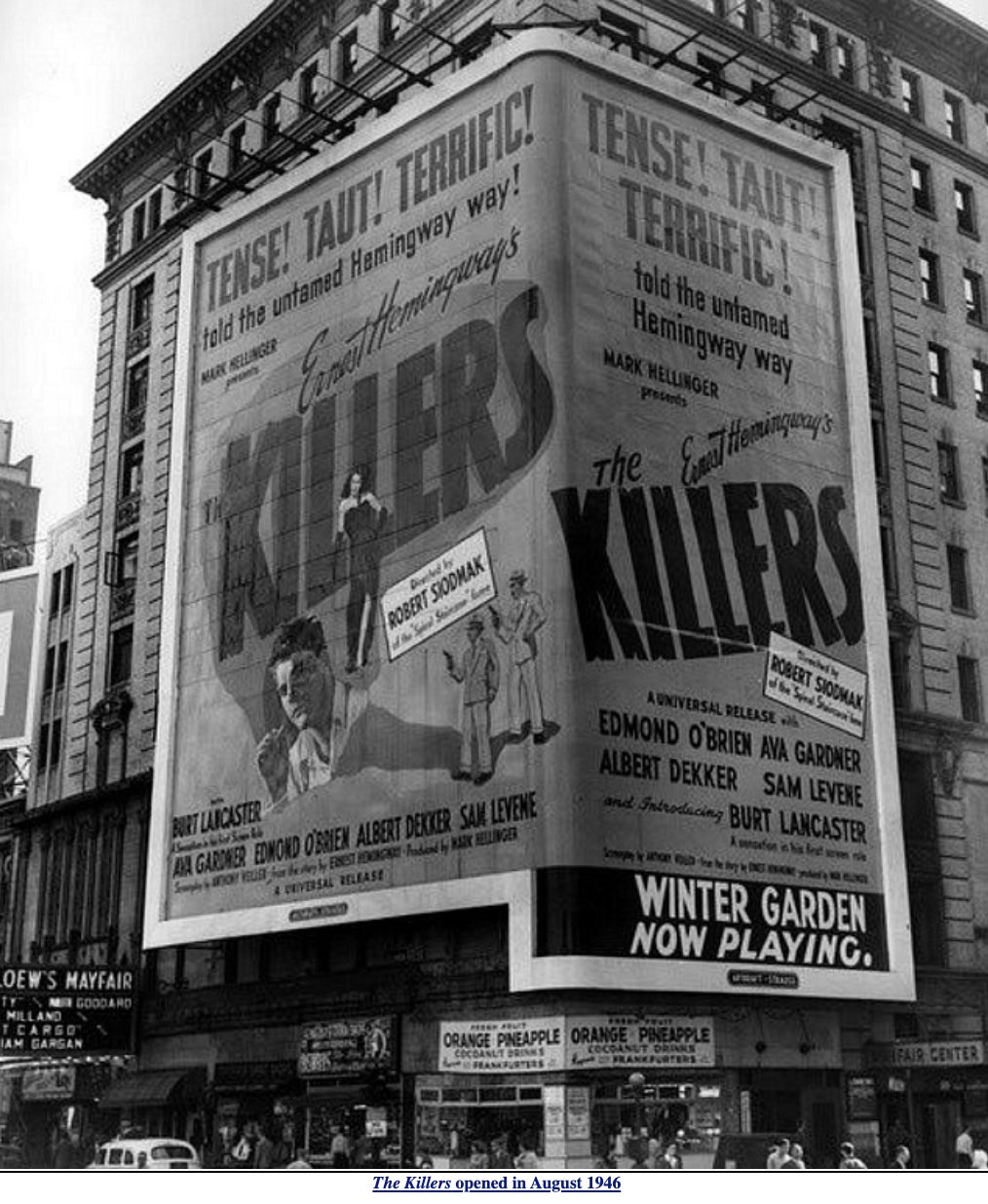
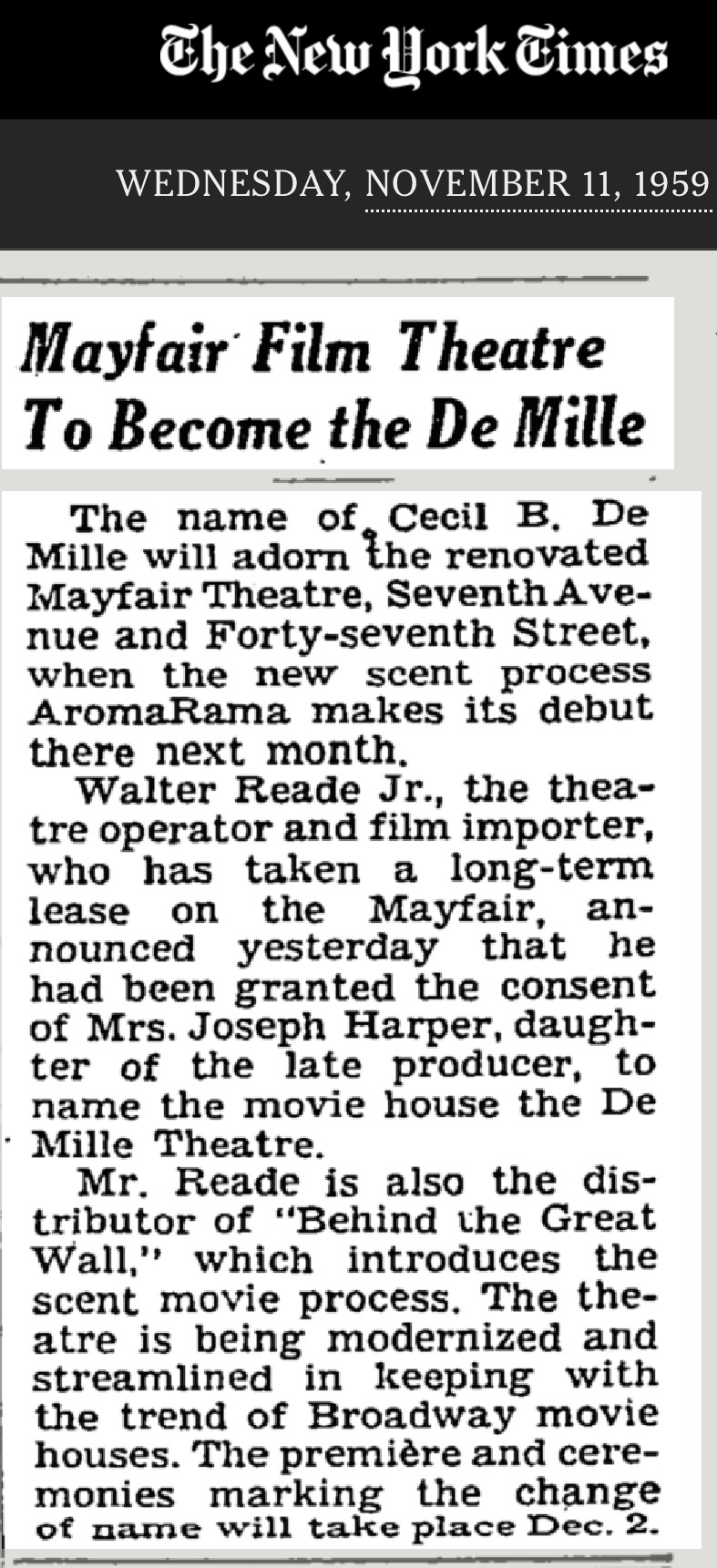
Mayfair “Killers” Billboard In Red & Mustard

Two years ago I posted a nice monochrome snap of a Times Square wraparound billboard for Robert Siodmak and Mark Hellinger‘s The Killers (’46). The odd thing was that The Killers, which opened in late August, wasn’t showing at the Mayfair but at the legendary Winter Garden theatre. United Artists had briefly turned the decades-old venue into a movie palace between ’45 and ’46.

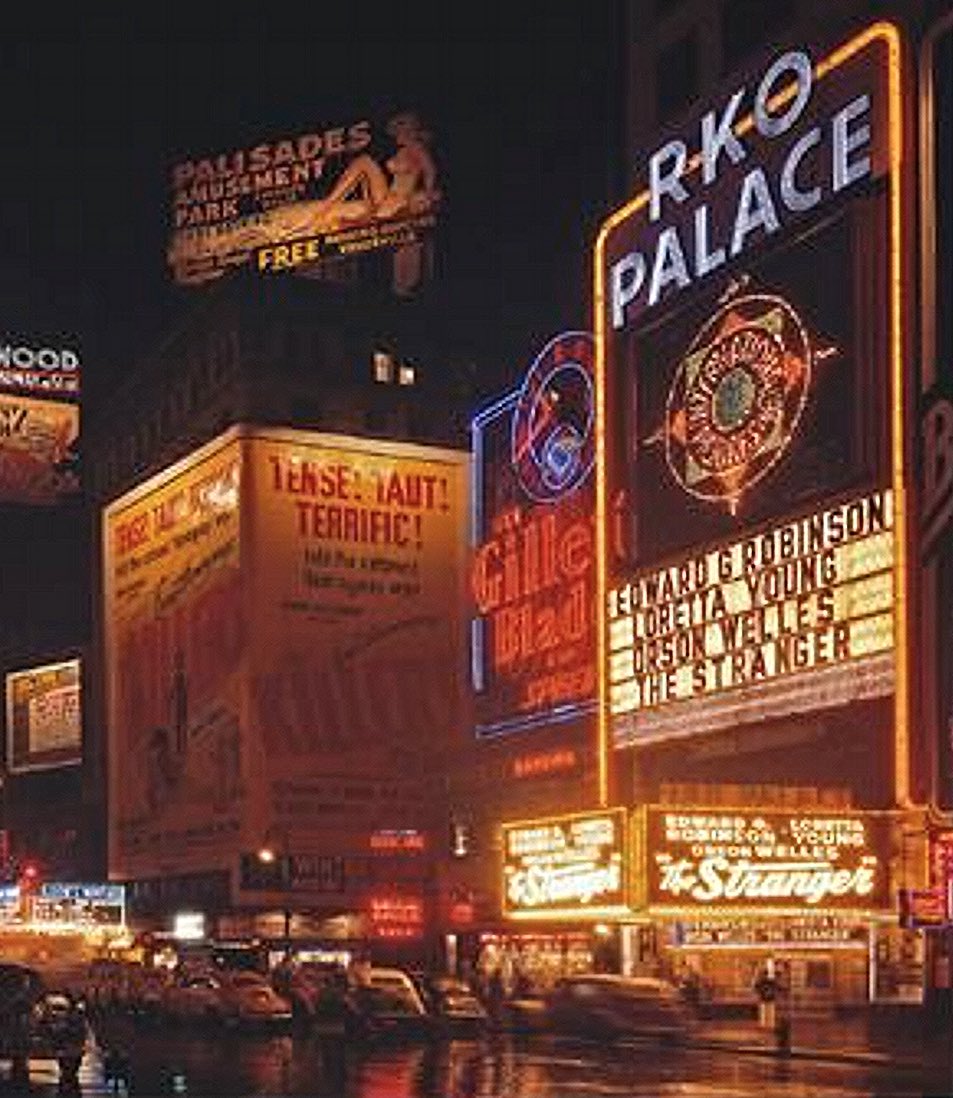
Last night I happened upon a somewhat blurry if richly colored snap of the same Mayfair Killers billboard along with a shot of the RKO Palace marquee, which had recently opened Orson WellesThe Stranger, a Nazi-hunting drama that costarred Welles, Edward G. Robinson and Loretta Young. It opened on 7.11.46.

Decent color snaps of 40s-era Times Square marquees are very hard to come by.

Gaydos Chums Delighted by “Dog” Killing

For years and years Variety‘s Steven Gaydos was an HE friendo, but over the last two or three he’s become…well, a tad judgmental. Okay, more than a tad. Okay, he’s become a woke scold. Which goes hand in hand with being a politically adaptable fellow working for a woke trade, and knowing which way the winds are blowing and who’s buttering which side of his bread, etc.

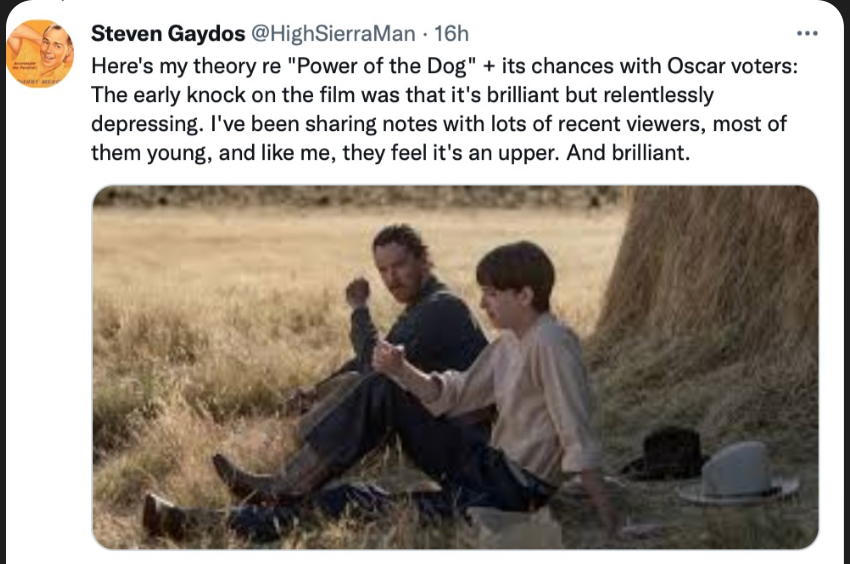
All to say that Gaydos recently tweeted about “sharing notes” with “recent” viewers of The Power of the Dog, “most of them young,” and that these young ‘uns, like Gaydos, feel that Jane Campion‘s 1920s cattle-ranch saga is “an upper.”

Repeating: Some youngish weirdos are telling Gaydos that the most melancholy gay western of the 21st Century and easily the draggiest downer of the 2021 Best Picture race…they’re saying it put a smile on their faces and made them giggle and skip down the sidewalk like schoolkids….whee!

We all understand that Dog is brilliantly composed in its own deliberate, unhurried fashion, but that’s not what Gaydos is talking about. He’s saying that Campion’s screenplay, which is based on Thomas Savage’s 1967 novel, made his little Millennial pallies feel good.

They were turned on, in other words, by the story of a pretty young gay guy named Peter Gordon (Kodi Smith McPhee) who gradually gets around to murdering Phil Burbank (Benedict Cumberbatch), an ugly, stinky, foul-tempered closet case. Phil has made life miserable for Peter’s mom, Rose (Kirsten Dunst), an alcoholic who’s come into unfortunate contact with Phil due to having married his chubby, ginger-haired brother, George (Jesse Plemons). And so Peter does what he feels he needs to do, for his mom’s sake.

And so that’s the thing — good young gay guy (delicate, soft-spoken, makes tiny paper flowers) kills the bad older gay guy by poisoning him with anthrax. And Gaydos’ young chums are going “whoo-whoo!…Phil is fucking dead, all right! Hey, let’s get on Facebook or Twitter and tell that Variety guy how cool we think this is!!”

There’s no question that Phil Burbank is a mean, snarly asshole, and that his death is, at the end of the day, no great loss to the planet earth, but the world is full of miserable people in denial about something or other (including their sexuality), and it’s not as if Phil had murdered anyone or tortured a dog to death or molested a child. He’s just a cruel dickhead who’s making his brother’s new wife very unhappy and turning her into a drunkard. Does he deserve to die for this? Campion clearly thinks he does, and Gaydos’ young pally-wallies are overjoyed by his killing.

What movie-villain deaths turned you on the most?