“Switched The Buttons”

In her Thursday (5.19) testimony in the DeppHeard defamation lawsuit trial, Ellen Barkin was persuasive in recollections about her “sexual” relationship with Depp (she said she preferred that term to “romantic”), which began sometime in ‘94 and lasted for maybe “five or six months”, give or take.

But they had a friendly relationship, both pre- and post-sexual, for roughly ten years, she said. Things were platonic at first, Barkin said, but then Depp “switched the buttons.”

Things were largely defined by Depp almost always being drunk (i.e., “red wine”) or ripped or high in some way, Barkin said. In addition Depp was a “controlling, jealous man,” she testified.

Depp was nine years younger than Barkin (31 to her 40) when their relationship first became carnal during the second year of the Clinton administration. They later costarred in ‘98’s Fear and Loathing in Las Vegas.

Barkin’s snow-white hair, cut short as if she was playing an anti-Nazi freedom fighter in a Sidney Lumet or a Michael Mann film, is striking. Ditto her “I have nothing to prove one way or the other” no-bullshit street vibe, and that wonderfully raspy New York accent.

Barkin was married to Gabriel Byrne between ‘88 and ‘99: she subsequently married billionaire Ron Pearlman, who divorced her in ‘06. Barkin reportedly emerged from that union with a $20 million settlement plus $20.3 million in a Christie-supervised jewelry auction.
Gray Surprise

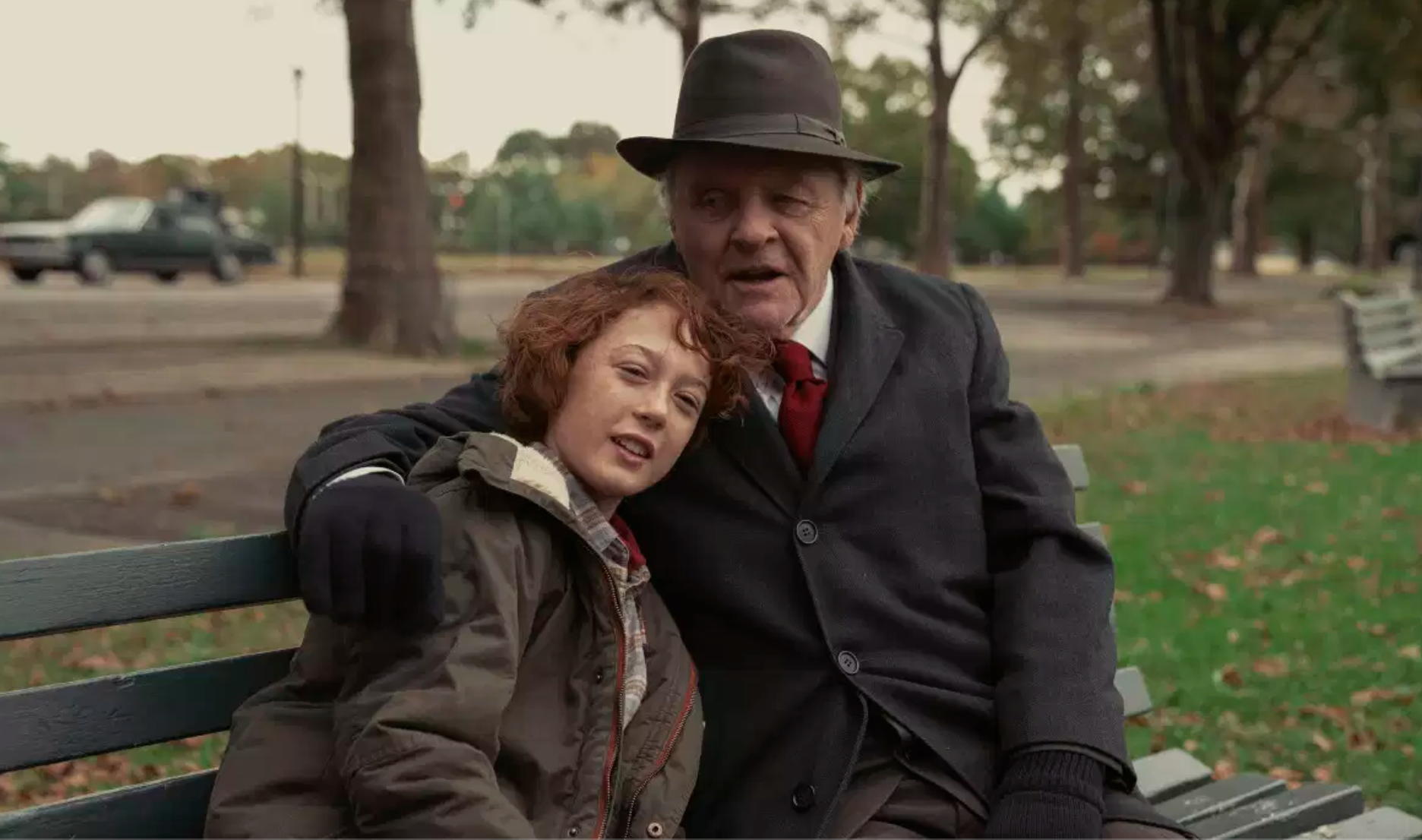
I haven’t been on the James Gray train for years, but early Thursday evening I saw Armageddon Time, his latest, and I was seriously, solemnly impressed. It’s the first really good film of the 2022 Cannes Film Festival.

It’s a modest little moral tale — concisely written, very well acted (especially by first-timer Michael Banks Repeda plus Jeremy Strong, Anthony Hopkins and Anne Hathaway) and ridden with echoes, laments and (from its 1980 perspective) dark projections.. And it’s definitely a Best Picture contender — of this you can be certain.

Armageddon Time is Gray’s best film — the most unaffected, straight-shooting and plain spoken — in a dog’s age. I was a Gray fan during his peak decade (The Yards, We Own The Night, Two Lovers), which happened between ‘98 and ‘08. I fell away in the 20-teens but now I’m back, as is Gray himself.

Largely autobiographical, Armageddon Time is basically a Queens-based family drama, set in the fall of 1980 and focused on the moral and creative growing pains of 11-year-old Paul Graff (Repeda).

In its own unpretentious, quietly on-target way it grapples with ethics and ethnicism, grandfather comforts, morality, racism, the Age of Reagan and the early seeds of Trumpism, brutal parenting, “life is hard” and “the game is rigged.”

I don’t know why I’ve decided to call it “a modest little Truffaut film,” but that’s the phrase I’ve been using since last night.

It’s a film about a kid dealing with family demands (particularly a brutal father) and being sent to a Forest Hills prep school and absorbing the first whiffs of late 20th Century evil in this country — Reagan, Trump, elitism and the ever-present component of half-hearted, laissez-faire racism.

A friend asked last night if it’s woke and I said it’ll certainly strike a chord with wokesters, but it’s “not really a woke film…it’s certainly not about woke Hollywood lecturing the middle of the country or anything in that vein.

“It’s Gray telling an honest, unpretentious story of his own childhood. It’s simple and real and I believed it.

“Racism and unfairness in life are real — you can’t just swat them away like a fly. It’s not about today’s deranged left. It’s set in 1980. ‘Woke’ wasn’t a thing 42 years ago. It wasn’t a thing ten years ago, and was barely a thing give six or seven years ago.

“Stop trying to define everything by today’s toxic cultural terminology,” I concluded. “Respect this movie for what it does and doesn’t do. It’s not playing any tricky or underhanded games.

“Vep” Re-Imagined

In late ’96 (or 25 and 1/2 years ago) Olivier AssayasIrma Vep was released. Starring Maggie Cheung as herself, it was about a middle-aged French film director (Jean-Pierre Léaud) trying to remake Louis Feuillade’s Les Vampires. Now comes Assayas’ new Irma Vep, an eight episode miniseries starring Alicia Vikander as a movie star who travels to France to star in a big-budget arthouse film.

Out of respect for Assayas and particularly his masterful Personal Shopper (’16), attention must be paid.

HE to Waggy, Keslassy & Donnelly: Try Fact-Checking

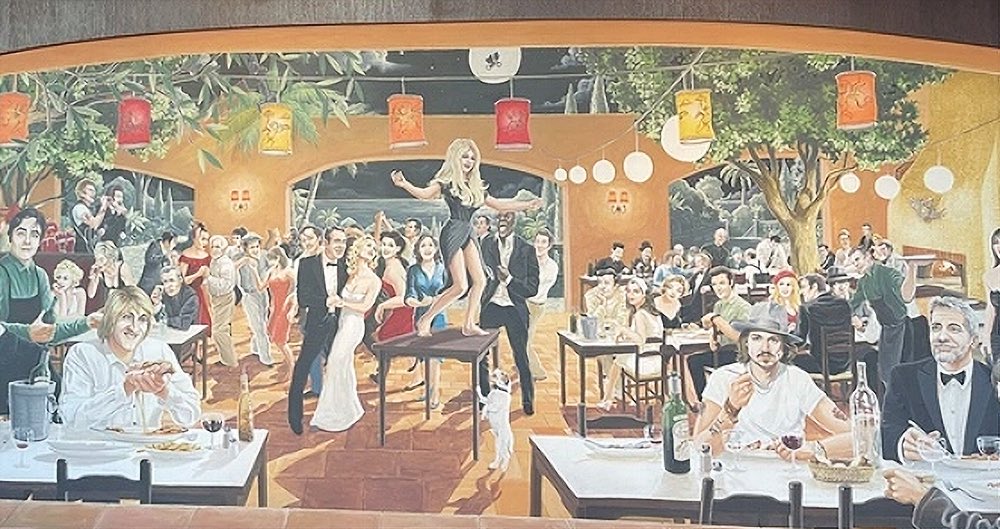
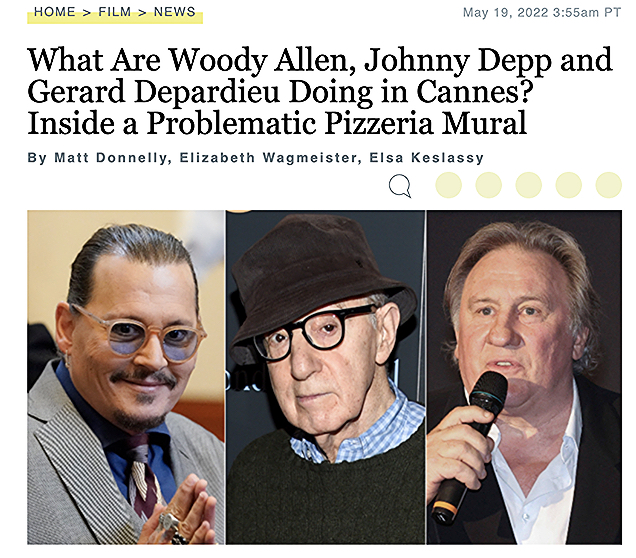
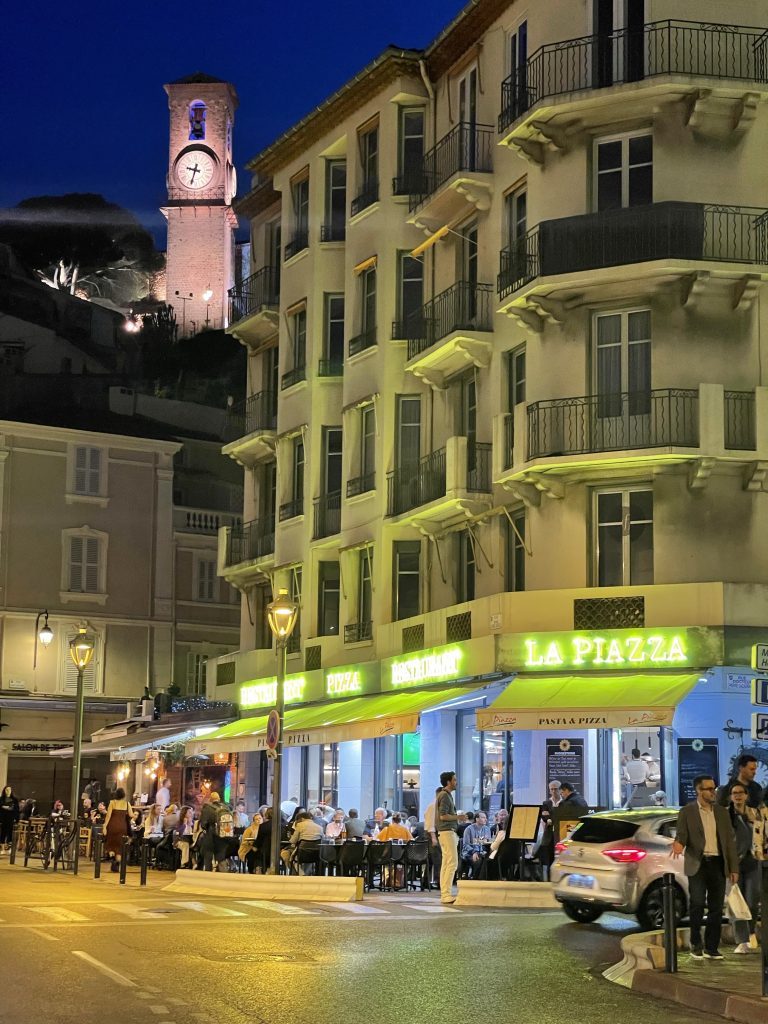
Variety‘s Elizabeth Wagmeister, Matt Donnelly and Elsa Keslassy are shocked, shocked to discover that Woody Allen, Gerard Depardieu and Johnny Depp are featured in a celebrity mural on the 2nd floor of La Pizza, a popular eatery adjacent to the Cannes marina.

They’ve co-authored a 5.19 article that basically says “gasp!…why hasn’t La Pizza eliminated these three from the mural, particularly since we — crusading trade-paper wokesters casting a vigilant eye — don’t approve?”

Here’s something that I don’t approve of: Waggy, Donnelly and Keslassy falsely stating that Allen “was accused of rape by his then 7-year-old adoptive daughter, Dylan [Farrow], in 1992.” From the get-go the accusation has been about sexual molestation, not rape, and for three decades there’s been a mountain of evidence and testimony casting doubt upon the validity of Farrow’s claim.

“The La Pizza mural stands in conflict with recent changes trying to be implemented at the Cannes Film Festival,” the trio asserts, “[given that the festival] has attempted to become more inclusive to women and people of color (although progress has been slow). Festival organizers are making efforts to catch up to the industry at large, which has attempted to implement sweeping changes in the era of #MeToo.”

Denial As Insanity

Though technically exacting and historically authoritative from a visual, atmospheric, production-design perspective, Kirill Serebrennikov‘s Tchaikovsky’s Wife is a perfectly miserable film to sit through.

It’s the story of Antonina Miliukova, a mentally unstable obsessive who persuaded the closeted Pyotr Ilyich Tchaikovsky to marry her (he needed a beard) in 1877 Russia.

For 16 years or until the composer’s death from cholera in 1893, Antonina refused to understand or accommodate herself to the fact that Pyotr was gay. Tchaikovsky realized very quickly that he’d made a terrible mistake. The marriage was almost nothing but misery for the poor guy.

Born in 1848, the headstrong Antonina married Tchaikovsky at age 28 — well past the appropriate age in late 19th Century Russia. She was 45 when he passed, and spent her last 20 years in an insane asylum. She died in 1917.

In short, the narrative of Tchaikovsky’s Wife has nowhere to go but down, and boy, does it ever! The viewer is condemned to endure Antonina’s delusion and denial for two hours. It feels airless and repetitive and de-oxygenated and terminal.

The muddy, murky, candle-kit cinematography made me feel like I was slowly going blind. I certainly felt as if I was dying of boredom, and it left me feeling afflicted with a form of spiritual typhoid fever.

I began to hate Tchaikovsky’s Wife almost immediately. Russians lived in a dungeon in the 1870s and 1880s…what a hellish environment. I couldn’t stand it, and was especially appalled by Serebrennikov’s refusal to let a little light into the situation by allowing us to revel in Tchaikovsky’s music. Ken Russell‘s The Music Lovers (’70) is not without issues, but it’s a much more arresting film than Tchaikovsky’s Wife.

For what it’s worth, Alyona Mikhailova, 26, delivers a sad, believable performance as Miliukova. As Tchaikovsky, Odi Biron is also fine or, you know, as good as the script permits.

HE agrees 110% with Owen Gleiberman‘s Variety pan.

Read more

“Carol” Afterglow

I took this video inside the Cannes press conference salon on 5.17.15. Call it a period of relative calm before the storm. The #MeToo movement would launch two years and five months later, and over the following year the first stirrings of the woke Robespierre plague began to be felt. Peak terror was felt during ’19,’20 and ’21. All in all the plague has been with us for four and a half years now, going on five. It’s just about run its course, but the real death throes won’t be felt until the November ’22 midterms.

From “The Moment I Realized Carol Was Toast With Older Viewers (i.e., Academy Voters)“, posted on 2.2016: Todd HaynesCarol may have been, for me, the most emotionally affecting relationship film of 2015. I’m not going to rehash all the praise-worthy elements (Cate Blanchett and Rooney Mara‘s fully felt performances, Ed Lachman‘s 16mm cinematography, the early ’50s vibe of repression and propriety). It so perfectly captured, for me, what it feels like to be in love (“I know how it feels to have wings on your heels”). I particularly remember what a high it was to see it in Cannes…everyone was levitating, it seemed.

“Then I saw it again six months later — in late October, or a month before it opened commercially on 11.20 — at the Middleburg Film Festival. Middleburg is a more conservative town than Los Angeles, of course, but it’s similar to the Academy in that it’s full of wealthy over-50 white people. And the instant Carol finished playing in the main conference room of Middleburg’s Salamander Resort and the lights came up, you could feel the vibe. They ‘liked’ and respected it, but they didn’t love it. The atmosphere was approving and appreciative, but a bit cool. And I said to myself, ‘Okay, that’s it…not even Christine Vachon dreamed that Carol could win Best Picture Oscar but after Cannes I thought it would probably be Best Picture-nominated because it’s so affecting and classy and poised….now I don’t think that’ll happen.’

“It went on to win big with critics and industry groups, but older whites never embraced it. They somehow didn’t see themselves in it.”

The Big Sleep

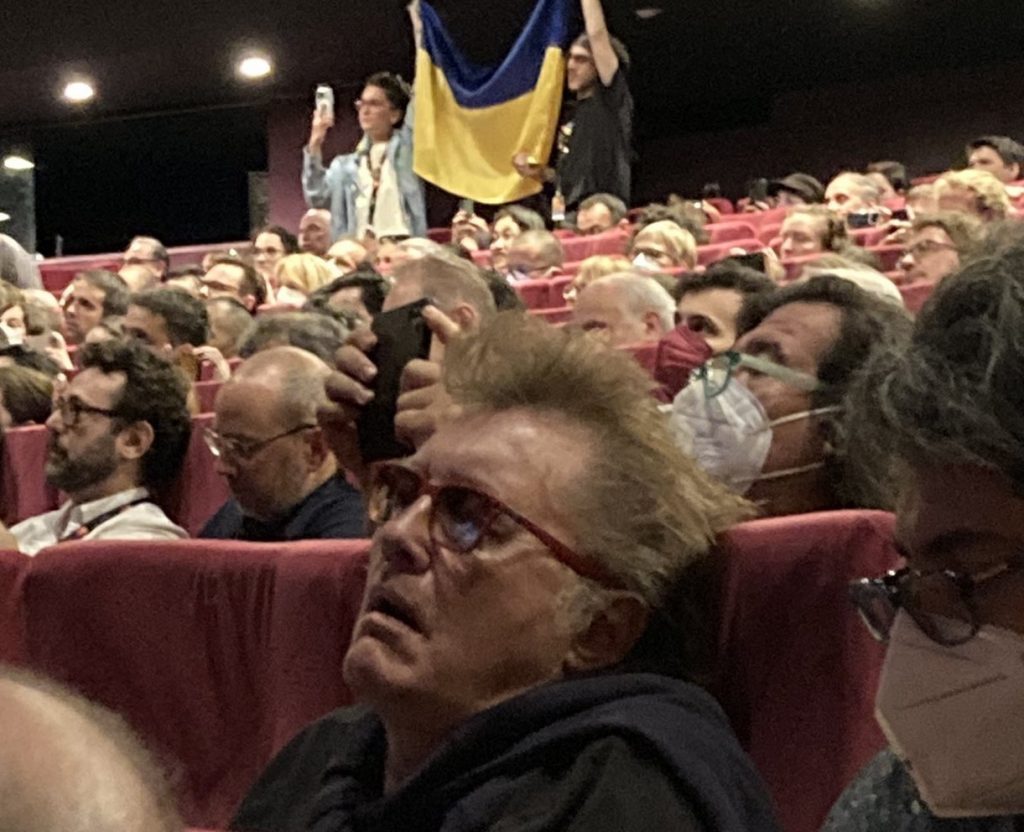
A hideous creep journalist-critic, Charles Bramesco, posted this photo on Twitter, but what the hell. I don’t look like I’m napping in my seat — I look like I’ve just succumbed to a massive heart attack. But it’s just my natural, blessed ability to nap anywhere at any time. I close my eyes and I’m gone. In this instance I was merely escaping from the usual opening-night, pre-screening ceremonies.

Still A Matter of Dispute

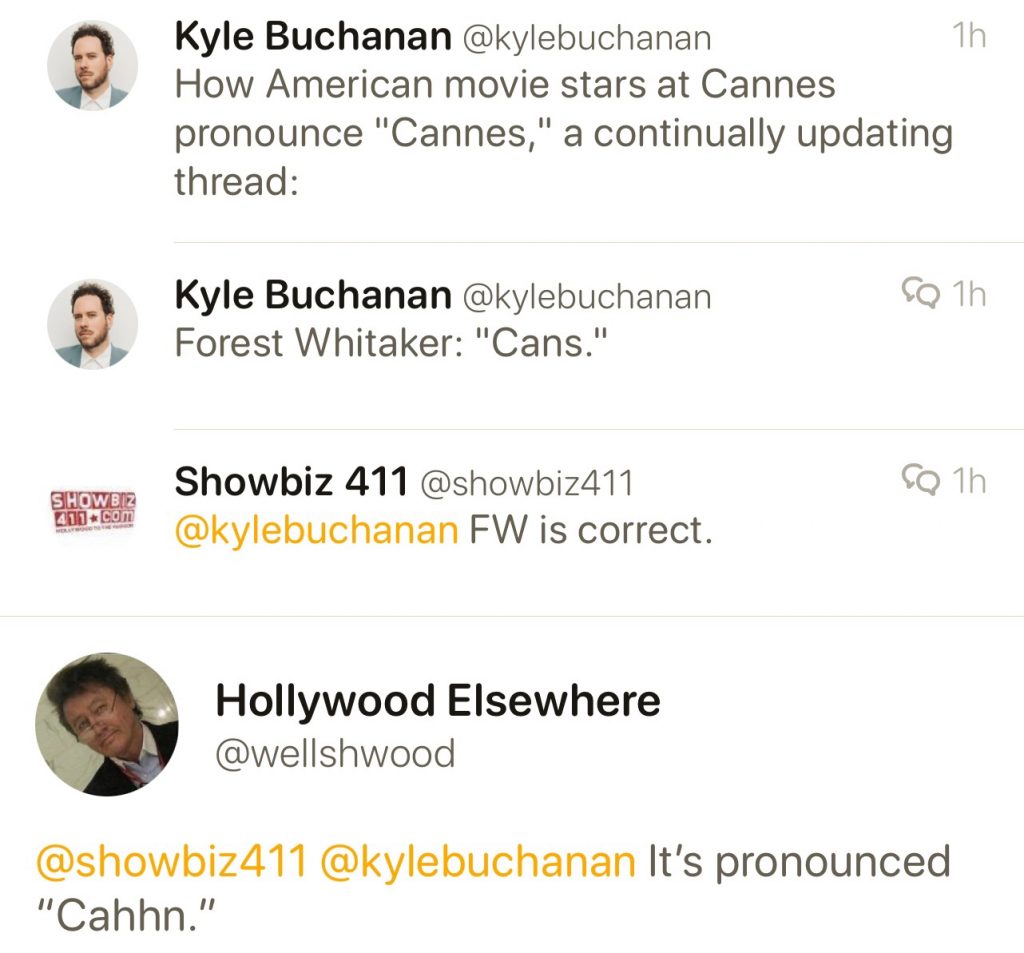
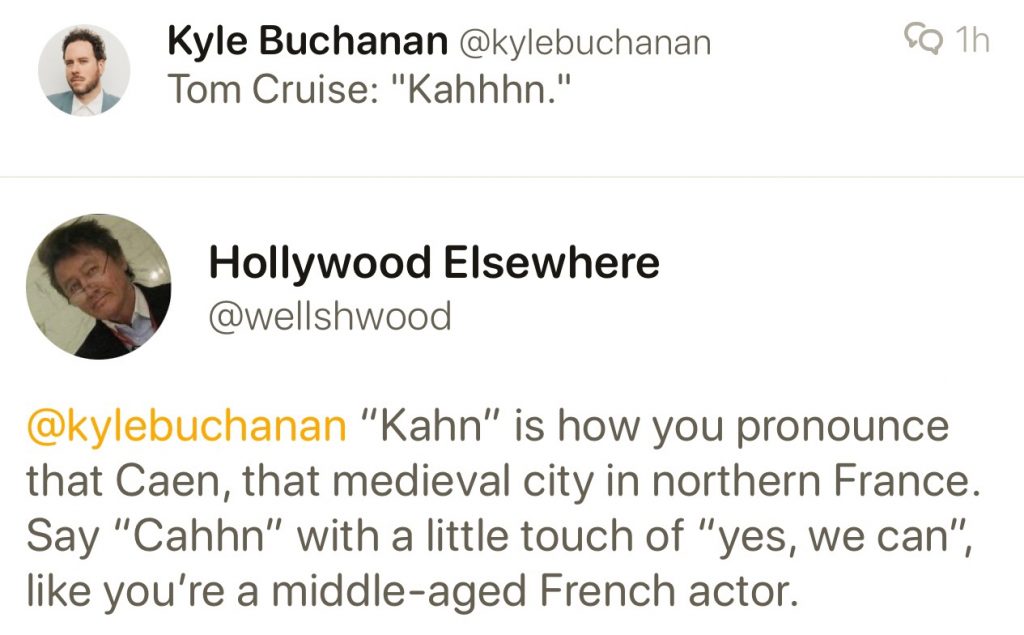
There’s a certain middle-aged Frenchman’s way of pronouncing “Anne” — it sounds a bit subdued and abbreviated with a slightly prolonged “nnn” sound. This is how you need to pronounce “Cannes.” Note to Forrest Whitaker: the “s” is silent.