
Month: May 2022
Clayton Is Offended by “Armageddon Time”
Variety‘s Clayton Davis has posted a torpedo response to James Gray‘s Armageddon Time, at least as far as its awards potential is concerned. Scenes conveying white elitist viewpoints from three or four odious characters have rubbed Clayton’s woke sensibilities the wrong way.
In describing the film as deeply offensive in terms of said attitudes, Davis is half-suggesting that the film’s admirers are either missing something or oblivious to same.
The autobiographical Armageddon Time is a humanist, well-honed, memory-lane film about what Gray experienced as an 11-year-old youth in Queens, and the ugly elements that he encountered after enrolling in a Forest Hills private school. It’s the first really good film I’ve seen at this technically troubled festival.
Davis excerpt #1: “Armageddon Time, a deeply personal look at how the auteur became the auteur we, or at least the French, came to know and love, debuted to warm applause on Thursday. However, the film’s problematic depiction of racial inequalities in the Reagan era may turn off awards voters.”
Davis excerpt #2: “In a one-scene surprise, recent Oscar-winner Jessica Chastain plays U.S. State Attorney Marianne Trump, speaking to a sea of privileged white children at an elite private school, where [lead protagonist] Paul eventually attends, while Fred Trump (yes, Donald’s father) is present.
“[Marianne] channels the entitlement to be superior, oozing the grotesque and vile nature of a class of people in this country who are ‘the chosen ones’ for no other reason than the tint of their skin. While never named, two boys who use the ‘n-word’ when speaking about [a young Black protagonist] when he visits the school, have the narrative DNA of young Eric and Donald Trump Jr. The cringe factor may be too much to bear for more progressive voters.”
Davis excerpt #3: “Respected critics like Justin Chang of the L.A. Times were high on it, while Peter Bradshaw of The Guardian absolutely admonished it. Unfortunately, when this tale unveils itself stateside, a new racial debate will likely ensue regarding the undertones, similar to Licorice Pizza from Paul Thomas Anderson last year in the AAPI community. That may keep many voters at a distance.”
Comfort and Joy
I’ve been Cannes-ing for over 20 years (my maiden visit was in ’92), and I’ve never encountered such persistent difficulty in gaining access to this or that elusive screening. The system works fine, and then it gets all moody and listless and doesn’t work.
Yes, I’ve booked a couple of dozen tickets through the online system, but now there may be another stall-out happening. Yesterday The Hollywood Reporter reported that an internet collapse had occured. Our home wifi system is currently working, but it wasn’t for a long while, and my blood pressure is pounding.
Plus over the last couple of hours the ticket office site won’t let me log in. I’ve been able to log in but I can’t get past the access button. On top of which there may be some kind of new citywide internet happening. Or at least as far as my two and my iPhone computers are concerned. Okay, now it’s working (4:30 pm) but who knows what will happen a couple of hours from now?
I’ve been coming to Cannes as a credentialed journalist since ’92, and steadily for the last 20-odd years. I’ve never had to deal with any level of difficulty in merely obtaining access to this or that screening. It’s kind of awful. In the old days (2019 and before) you could just show up and get in line, and 97 times out of 100 you’d get in, even with a blue pass.
During the random times the system has been functioning (it was working fine yesterday) I’ve been completely unable to book a ticket for George Miller‘s Three Thousand Years of Longing. There has never been a doorway of any kind. Miller is a major filmmaker. Yes, the fact that Longing is being screened out of competition may indicate something, but the fact remains that I’ve flown thousands of miles and gone to great expense to be here, and the doors to George’s film are bolted shut.
I’ve written a couple of DDA publicists for last-minute help in getting a ticket to today’s Grand Lumiere screening at 6:30 pm. (Three hours from now.) Yes, I’m aware that there’s a makeup screening tomorrow at the Cineum IMAX, but that’s way the hell over in Cannes La Bocca (13 Av. Maurice Chevalier, 06150 Cannes). The Grand Lumiere screening would so so much more convenient.
I’ve pretty much decided not to attend this festival again unless they abandon the online ticketing system. Life is way too short, and this infernal system is just too much trouble. And I don’t want to hear any reader complaints about this crap. It’s not me — it’s them.

Tatiana, Gummies & Charles Bramesco

Last night Tatiana was fired up by recent contrasting samples of the human character — the odious Charles Bramesco on one hand, and a good-samaritan gummie buyer on another. Here’s her essay, received this morning:
“I guess I am totally addicted to cannabis-infused gummies. No gummies = no sleep for me. Realizing the possibility of going back to Moscow or moving to Paris or London in the near future, where marijuana is illegal, the idea of quitting this addiction has been on my mind lately.
“One recent evening, when the 150th container of gummies was empty, I thought: Great, that’s the right moment to start to fight the bad habit! I did my best, but was unable to fall asleep till 4 am. Next evening I thought: Okay, I didn’t sleep enough last night, my body is exhausted and now I will do better. Nope! Awake until 4 am again. So next evening I gave up. I decided to buy gummies but reduce the intake.

I arrived at The Artist Tree on Santa Monica Blvd., 15 minutes before closing. The receptionist always asks for ID and only after that you are allowed to enter the area of buying stuff.
I knew this rule, but that evening I had my tiny Chanel purse, where I could fit only my credit card and iPhone and ten dollars, hoping that the photo of my ID would be fine. But the receptionist said that only physical ID could be accepted. I said that I have been their loyal customer for almost five years, that I am completely unable to sleep without those gummies and maybe they can save me and sell at least two gummies for one night.
“There were three people behind me: a tall, slender, pretty woman in white pants; beautiful hair below her shoulders; she looked like a rockstar to me. And two well dressed and nice looking gentlemen with her. The woman partially overheard our conversation and asked me: What do they want? I said desperately: They want my ID. Then I showed her the empty box from gummies and told her, that I was very unhappy because I am unable to sleep without them. And I din’t have time to walk home to pick up my ID and back then, because they were about to close.
“The tall rock star said, ‘Don’t worry — I will buy them for you.’ I said, ‘No, no, thank you very much, but I have only ten dollars in cash and the gummies cost $27 and I will be fine.’ “But you can’t sleep without them, right?,” she said. “Yes,” I answered, ‘but I will feel very bad that I owe someone money. Unless I can send it to you through Zelle right now.
“It was no biggie, she insisted. No worries at all, it’s nothing. She took the empty box from my hand and asked one of the gentlemen to get them. I didn’t know what to do. I was so grateful to that woman and begged her to take at least ten dollars I had. Looking at my desperation, she took it.
“Three minutes later the gentleman was back with my medication, I hugged her warmly and my heart was about to jump out of my chest. I said that I wish I could do something nice for her. She said, ‘You are very sweet, I am so sorry for your trouble with sleeping. No worries about the money. Go to church, that will be enough.’ I said that I would definitely do that. I left the store and ten seconds later I realized that I didn’t even know her name. I rushed back in and asked her name. It was Janice.
“Switched The Buttons”
In her Thursday (5.19) testimony in the Depp–Heard defamation lawsuit trial, Ellen Barkin was persuasive in recollections about her “sexual” relationship with Depp (she said she preferred that term to “romantic”), which began sometime in ‘94 and lasted for maybe “five or six months”, give or take.
But they had a friendly relationship, both pre- and post-sexual, for roughly ten years, she said. Things were platonic at first, Barkin said, but then Depp “switched the buttons.”
Things were largely defined by Depp almost always being drunk (i.e., “red wine”) or ripped or high in some way, Barkin said. In addition Depp was a “controlling, jealous man,” she testified.
Depp was nine years younger than Barkin (31 to her 40) when their relationship first became carnal during the second year of the Clinton administration. They later costarred in ‘98’s Fear and Loathing in Las Vegas.
Barkin’s snow-white hair, cut short as if she was playing an anti-Nazi freedom fighter in a Sidney Lumet or a Michael Mann film, is striking. Ditto her “I have nothing to prove one way or the other” no-bullshit street vibe, and that wonderfully raspy New York accent.
Barkin was married to Gabriel Byrne between ‘88 and ‘99: she subsequently married billionaire Ron Pearlman, who divorced her in ‘06. Barkin reportedly emerged from that union with a $20 million settlement plus $20.3 million in a Christie-supervised jewelry auction.
Gray Surprise
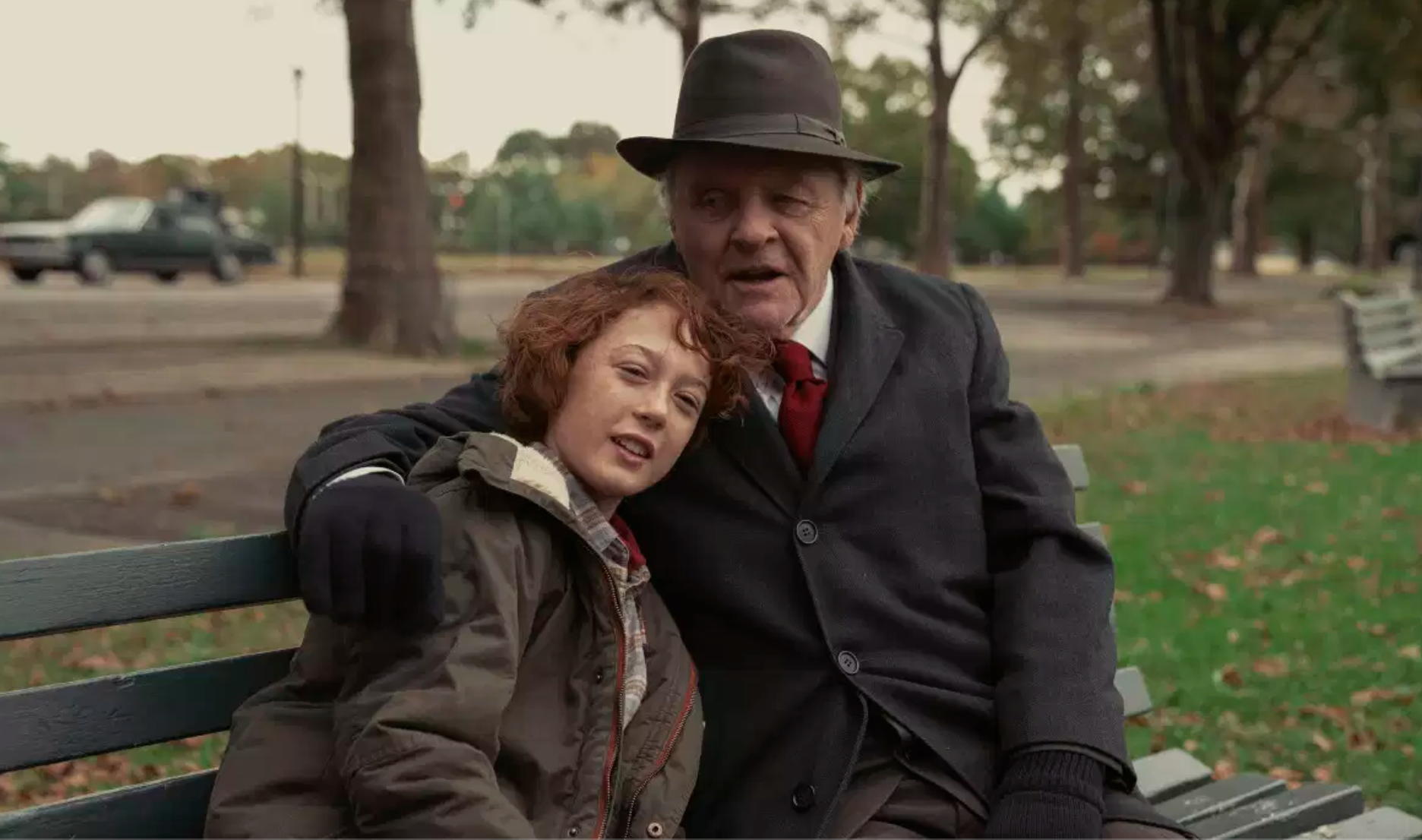
I haven’t been on the James Gray train for years, but early Thursday evening I saw Armageddon Time, his latest, and I was seriously, solemnly impressed. It’s the first really good film of the 2022 Cannes Film Festival.
It’s a modest little moral tale — concisely written, very well acted (especially by first-timer Michael Banks Repeda plus Jeremy Strong, Anthony Hopkins and Anne Hathaway) and ridden with echoes, laments and (from its 1980 perspective) dark projections.. And it’s definitely a Best Picture contender — of this you can be certain.
Armageddon Time is Gray’s best film — the most unaffected, straight-shooting and plain spoken — in a dog’s age. I was a Gray fan during his peak decade (The Yards, We Own The Night, Two Lovers), which happened between ‘98 and ‘08. I fell away in the 20-teens but now I’m back, as is Gray himself.
Largely autobiographical, Armageddon Time is basically a Queens-based family drama, set in the fall of 1980 and focused on the moral and creative growing pains of 11-year-old Paul Graff (Repeda).
In its own unpretentious, quietly on-target way it grapples with ethics and ethnicism, grandfather comforts, morality, racism, the Age of Reagan and the early seeds of Trumpism, brutal parenting, “life is hard” and “the game is rigged.”
I don’t know why I’ve decided to call it “a modest little Truffaut film,” but that’s the phrase I’ve been using since last night.
It’s a film about a kid dealing with family demands (particularly a brutal father) and being sent to a Forest Hills prep school and absorbing the first whiffs of late 20th Century evil in this country — Reagan, Trump, elitism and the ever-present component of half-hearted, laissez-faire racism.
A friend asked last night if it’s woke and I said it’ll certainly strike a chord with wokesters, but it’s “not really a woke film…it’s certainly not about woke Hollywood lecturing the middle of the country or anything in that vein.
“It’s Gray telling an honest, unpretentious story of his own childhood. It’s simple and real and I believed it.
“Racism and unfairness in life are real — you can’t just swat them away like a fly. It’s not about today’s deranged left. It’s set in 1980. ‘Woke’ wasn’t a thing 42 years ago. It wasn’t a thing ten years ago, and was barely a thing give six or seven years ago.
“Stop trying to define everything by today’s toxic cultural terminology,” I concluded. “Respect this movie for what it does and doesn’t do. It’s not playing any tricky or underhanded games.
Incurably Diseased
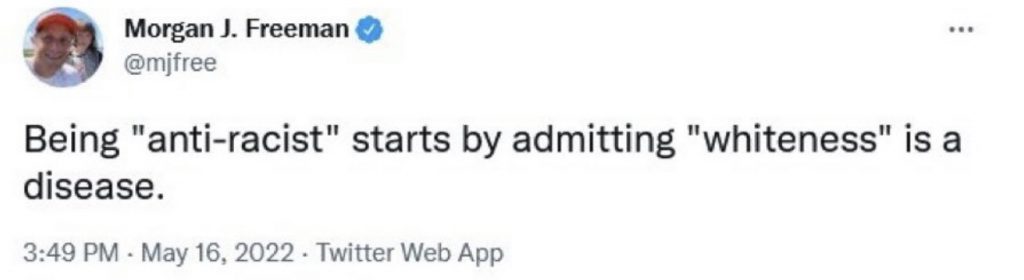
Morgan Freeman, the white-haired actor with a deep purry-crackly voice, is not Morgan J. Freeman, a white, Brooklyn-based social justice warrior and extreme virtue signaller. That said, what a delightful fellow to have around!

“Vep” Re-Imagined
In late ’96 (or 25 and 1/2 years ago) Olivier Assayas‘ Irma Vep was released. Starring Maggie Cheung as herself, it was about a middle-aged French film director (Jean-Pierre Léaud) trying to remake Louis Feuillade’s Les Vampires. Now comes Assayas’ new Irma Vep, an eight episode miniseries starring Alicia Vikander as a movie star who travels to France to star in a big-budget arthouse film.
Out of respect for Assayas and particularly his masterful Personal Shopper (’16), attention must be paid.
I Can Take It
I think I can. Probably. No, I’m going to tough it out! Okay, maybe it’s not in me.
Viggo Mortensen. Kristen Stewart. David Cronenberg.
CRIMES OF THE FUTURE.
Exclusively in theaters June 3. pic.twitter.com/9wj4UH2ZzP— NEON (@neonrated) May 19, 2022
HE to Waggy, Keslassy & Donnelly: Try Fact-Checking
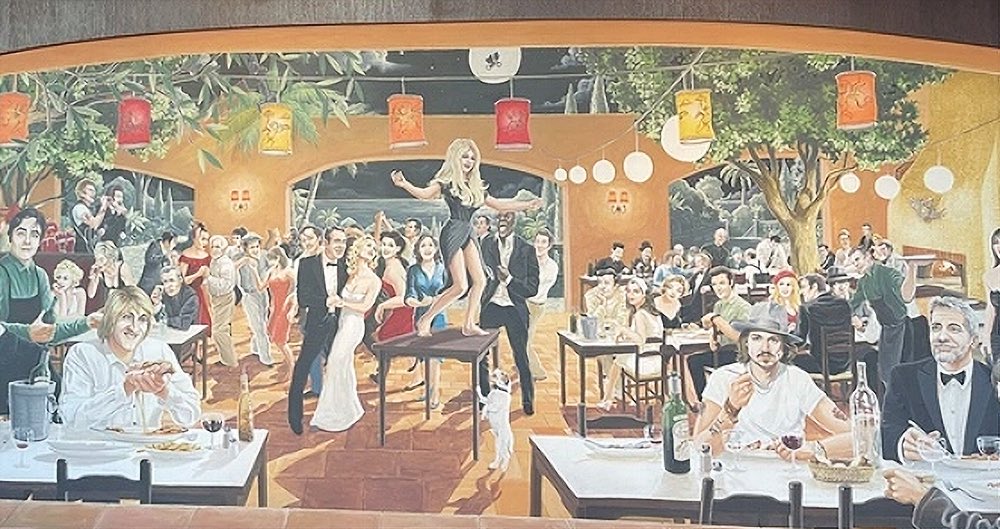
Variety‘s Elizabeth Wagmeister, Matt Donnelly and Elsa Keslassy are shocked, shocked to discover that Woody Allen, Gerard Depardieu and Johnny Depp are featured in a celebrity mural on the 2nd floor of La Pizza, a popular eatery adjacent to the Cannes marina.
They’ve co-authored a 5.19 article that basically says “gasp!…why hasn’t La Pizza eliminated these three from the mural, particularly since we — crusading trade-paper wokesters casting a vigilant eye — don’t approve?”
Here’s something that I don’t approve of: Waggy, Donnelly and Keslassy falsely stating that Allen “was accused of rape by his then 7-year-old adoptive daughter, Dylan [Farrow], in 1992.” From the get-go the accusation has been about sexual molestation, not rape, and for three decades there’s been a mountain of evidence and testimony casting doubt upon the validity of Farrow’s claim.
“The La Pizza mural stands in conflict with recent changes trying to be implemented at the Cannes Film Festival,” the trio asserts, “[given that the festival] has attempted to become more inclusive to women and people of color (although progress has been slow). Festival organizers are making efforts to catch up to the industry at large, which has attempted to implement sweeping changes in the era of #MeToo.”

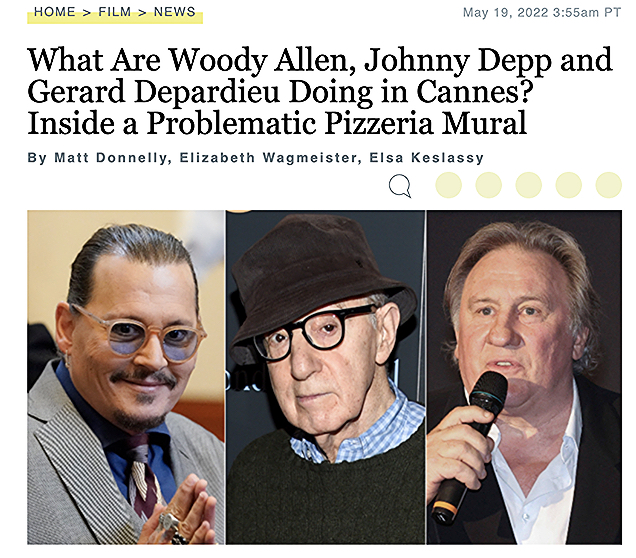
It's always been strange to me that the unofficial "first stop" in Cannes – dinner and Chianti at eatery La Pizza – features a mural of several cancelled men. @EWagmeister @ElsaKeslassy and I investigate. https://t.co/smYcgXhwqr
— Matt Donnelly (@MattDonnelly) May 19, 2022
Denial As Insanity
Though technically exacting and historically authoritative from a visual, atmospheric, production-design perspective, Kirill Serebrennikov‘s Tchaikovsky’s Wife is a perfectly miserable film to sit through.
It’s the story of Antonina Miliukova, a mentally unstable obsessive who persuaded the closeted Pyotr Ilyich Tchaikovsky to marry her (he needed a beard) in 1877 Russia.
For 16 years or until the composer’s death from cholera in 1893, Antonina refused to understand or accommodate herself to the fact that Pyotr was gay. Tchaikovsky realized very quickly that he’d made a terrible mistake. The marriage was almost nothing but misery for the poor guy.
Born in 1848, the headstrong Antonina married Tchaikovsky at age 28 — well past the appropriate age in late 19th Century Russia. She was 45 when he passed, and spent her last 20 years in an insane asylum. She died in 1917.
In short, the narrative of Tchaikovsky’s Wife has nowhere to go but down, and boy, does it ever! The viewer is condemned to endure Antonina’s delusion and denial for two hours. It feels airless and repetitive and de-oxygenated and terminal.
The muddy, murky, candle-kit cinematography made me feel like I was slowly going blind. I certainly felt as if I was dying of boredom, and it left me feeling afflicted with a form of spiritual typhoid fever.
I began to hate Tchaikovsky’s Wife almost immediately. Russians lived in a dungeon in the 1870s and 1880s…what a hellish environment. I couldn’t stand it, and was especially appalled by Serebrennikov’s refusal to let a little light into the situation by allowing us to revel in Tchaikovsky’s music. Ken Russell‘s The Music Lovers (’70) is not without issues, but it’s a much more arresting film than Tchaikovsky’s Wife.
For what it’s worth, Alyona Mikhailova, 26, delivers a sad, believable performance as Miliukova. As Tchaikovsky, Odi Biron is also fine or, you know, as good as the script permits.
HE agrees 110% with Owen Gleiberman‘s Variety pan.
“Carol” Afterglow
I took this video inside the Cannes press conference salon on 5.17.15. Call it a period of relative calm before the storm. The #MeToo movement would launch two years and five months later, and over the following year the first stirrings of the woke Robespierre plague began to be felt. Peak terror was felt during ’19,’20 and ’21. All in all the plague has been with us for four and a half years now, going on five. It’s just about run its course, but the real death throes won’t be felt until the November ’22 midterms.
From “The Moment I Realized Carol Was Toast With Older Viewers (i.e., Academy Voters)“, posted on 2.2016: Todd Haynes‘ Carol may have been, for me, the most emotionally affecting relationship film of 2015. I’m not going to rehash all the praise-worthy elements (Cate Blanchett and Rooney Mara‘s fully felt performances, Ed Lachman‘s 16mm cinematography, the early ’50s vibe of repression and propriety). It so perfectly captured, for me, what it feels like to be in love (“I know how it feels to have wings on your heels”). I particularly remember what a high it was to see it in Cannes…everyone was levitating, it seemed.
“Then I saw it again six months later — in late October, or a month before it opened commercially on 11.20 — at the Middleburg Film Festival. Middleburg is a more conservative town than Los Angeles, of course, but it’s similar to the Academy in that it’s full of wealthy over-50 white people. And the instant Carol finished playing in the main conference room of Middleburg’s Salamander Resort and the lights came up, you could feel the vibe. They ‘liked’ and respected it, but they didn’t love it. The atmosphere was approving and appreciative, but a bit cool. And I said to myself, ‘Okay, that’s it…not even Christine Vachon dreamed that Carol could win Best Picture Oscar but after Cannes I thought it would probably be Best Picture-nominated because it’s so affecting and classy and poised….now I don’t think that’ll happen.’
“It went on to win big with critics and industry groups, but older whites never embraced it. They somehow didn’t see themselves in it.”