I realize that Congressperson Val Demings has been behind Sen. Marco Rubio all along in the polls. A new pool from Florida Atlantic University shows Rubio leading Demings by 6 points, 48 percent to 42 percent.
That said, Demings came off as a better debater, and I believe she’s a better human being. Nobody laughed at her during the debate, but they laughed their ass off at Rubio when he lied about his former position on the 2020 election.
“Senator Marco Rubio of Florida and his Democratic challenger, Representative Val Demings, met for the only debate of the Florida Senate race on Tuesday, a fast-paced, fiery face-off that cruised through a series of the top issues affecting the country and the state.
“Mr. Rubio, who participated in around a dozen debates as a Republican presidential candidate in 2016, was polished and quick. Taking a more evocative approach, Ms. Demings sought to cast him as heartless, disconnected from the human impact of his policies on issues like abortion and guns.
“Still, she may not have gotten the kind of viral moment necessary to shift the trajectory of the race in her favor. For months, polls have shown Mr. Rubio with a lead in Florida, a perennial battleground state but one that has shifted to the right.”
Three days ago Criterion laid off 16 staffers, or roughly 20% of its 80-person workforce. Peter Becker called it a “reorganization” brought about by new “challenges and opportunities.” What he meant is that Criterion income has been shrinking and they have no choice but to cut back on expenses. The home-video world is changing. Physical media is dying and streaming is king. And Criterion’s film-snob appeal isn’t what it used to be. Hell, they’re still dragging their feet in the matter of 4K Blurays.
The snob thing has been a yes-no factor for decades. If you don’t like snob films, you’re not a true Criterion person, and they’ve been dining out on this sensibility since the ’80s. For every Malcom X Bluray (Spike Lee populism at its finest), there are ten dweeb titles. That’s how they roll.
Look at their current offerings — Bergman Island (a better-than-decent film but obviously aimed at people who prefer arugula salads to pizza or hot dogs), Lars von Trier’s Europe Trilogy, the 1934 Imitation of Life, Terry Gilliam‘s The Adventures of Baron Munchausen, Todd Haynes‘ The Velvet Underground doc, Three Films by Mai Zetterling, a Michael Haneke trilogy, Jane Campion‘s nearly-impossible-to-rewatch The Power of the Dog.
Criterion should release more ’70s noirs like Don Siegel‘s Charley Varrick and John Flynn‘s The Outfit.
Why didn’t Criterion ever release a decent Bluray of David Jones‘ adaptation of Harold Pinter‘s Betrayal (’83)?
As irritated as I’ve been over the visual quality of certain Criterion releases over the last 15 years (way too much inky darkness in their Only Angels Have Wings and Rebecca Blurays, horrible digital mosquito grainstorming in several Blurays of black-and-white classics, the Dressed To Kill fiasco, the relatively recent teal plague, releasing A Hard Day’s Night within a 1.75 aspect ratio rather than 1.66) I still love them for the blue-chip, grade-A presentation factor, and would like to see their physical media business continue indefinitely.
I’m very sorry they’re going through a rough patch.
“In contrast to other companies producing physical media, Criterion increasingly comes off like a cold monolith, too stuck in a pattern of ‘we’re the Criterion Collection, motherfuckers…don’t you know who we are?! You move with us — we don’t move with you.’
“The result? Kino Lorber, Arrow, Imprint, Indicator and other boutique labels easily moved into their space –– a space that they first colonized.
True story: A reputable critic was seated at a dinner table during a wedding reception (let’s presume it was sometime in the ’90s or early aughts), and noticed that producer Mace Neufeld was a tablemate. After being introduced, Neufeld (who passed last January) had one…make that two questions for the critic. Neufeld question #1: ”Do you know Manohla Dargis?” The critic said yeah, he did. Neufeld question #2: “What’s the deal with that broad?”
Early in Todd Field‘s Tar there’s a glaring moment of assholery. Not owned by Cate Blanchett‘s Lydia Tar but Zethphan D. Smith-Gneist‘s Max, a student in Lydia’s conducting class.
Upon being questioned by Lydia, Max declares that “as a BIPOC pangender person” he’s not “into” Johann Sebastian Bach, due to the 18th Century composer having been (a) white, (b) privileged and (c) a bit of a sociopath in his youth.
The instant Max says this, the viewer understands what a tyrannical little bitch he is — a Zoomer willing to throw the baby out with the bathwater because a gifted artist’s behavior was imperfect or even abusive.
Others (including, I presume, Tar director Todd Field) see things differently. In a fair-minded world the unfortunate shortcomings of a genius artist (like, say, the predatory Roman Polanski of the ’70s and ’80s) wouldn’t be disqualifying when it comes to assessing his/her work. The presence of profound talent, mind, doesn’t mean that sexually voracious or manipulative behavior warrants an automatic “get out of jail” card. But given the historical record, it should, I feel, be regarded with a less-damning perspective. I mean, we certainly don’t want the Max brigade to be calling the shots…good heavens.
In Michelle Goldberg‘s 10.21 N.Y. Tines essay about Tar (“Finally, a Great Movie About Cancel Culture“), she writes that “the notion of separating the art from the artist has gone out of fashion,” at least among Millennials and Zoomers. Over-45 types, she notes, “have complicated and contradictory feelings about the rapid changes in values, manners and allowances that fall under the rubric of cancel culture.”
In my case, these feelings can be fairly described as disgusted and appalled. But then you knew that.
I’m prodded by a 12.21 story posted yesterday by World of Reel‘s Jordan Ruimy. It concerns a Max-like critic (presumably younger but who knows?) who recently voted in the once-a-decade Sight & Sound poll about the Greatest Films of All Time The critic, an East Coast IndieWire person and quite possibly a woman (though not necessarily), recently told a film producer that he/she had refused to vote for any Alfred Hitchcock film because of his sexual “predator” rep, earned by well-sourced accounts of his behavior with Tippi Hedren during the filming of The Birds and Marnie.
How many Max-ian critics are part of the current Sight & Sound fraternity, which has, I gather, recently expanded its ranks with certain Millennial and Zoomer contributors? Are there enough Hitchcock haters to unseat his masterful Vertigo (’58), which pushed aside Citizen Kane in the last Greatest of All Time poll in 2012? (Vertigo didn’t even appear in the S&S poll until 1982, when it came in seventh. It ranked fourth in ’92, and then second in ’02 polling,) A critic friend says he’s “sure that Hitchcock is safe overall,” but a voice is telling me that the Max factor may topple Vertigo.
HE believes that Kerry Condon, who plays the sensible but distraught Siobhan (the sister of Colin Farrell‘s Paddy) in The Banshees of Inisherin, has given the most grounded and formidable supporting actress performance so far this year.
For what it;s worth Condon is on the Best Supporting Actress lists of almost all of the finger-to-the-wind Gold Derby prognosticators, and clearly has plenty of wind in her sails as we speak.
If not Condon I would vote for Carey Mulligan‘s Megan Twohey in She Said.
Due respect but I find it almost satirical that Stephanie Hsu and Jamie Lee Curtis‘s broad, comic-book-level performances in Everything Everywhere All at Once are even being discussed in this context. Claire Foy and Jessie Buckley‘s taut, enraged performances in Sarah Polley‘s Women Talking are entirely respectable, but they’re arguably playing feminist constructs as opposed to rounded, relatable human beings.
Meanwhile the competition for the appealing alternate titles of of Martin McDoangh’s new film continues apace. My favorites are (a) Fingers (hat tip to James Toback’s 1978 film), (b) Five Finger Exercise or…what others?
Serial killer sagas have always been hot tickets. I’ve liked exactly five — Manhunter, Mindhunter, The Silence of the Lambs, Se7en and Zodiac — but then I’m an outlier.
Jett and Cait are big fans of serial killer “product.” Netflix’s idiotically titled Dahmer — Monster: The Jeffrey Dahmer Story is “the ninth most popular English-language TV show of all time, with 56 million households having viewed all 10 episodes.” Against my better judgment I watched three or four episodes…later.
A friend had told me that The Good Nurse, a stand-alone, fact-based drama about the hospital serial killer Charles Cullen, was quite good so I caught it the other night in Manhattan. I was underwhelmed. Mystified even. It’s one of those films that you manage to endure. It’s certainly nothing to write home about. I began losing patience around the 40-minute mark, and then I was stuck for another 80.
It’s one of the darkest and dreariest looking films I’ve seen in ages (obviously intentional and quite the contrast as the dp, Jody Lee Lipes, shot Trainwreck and Manchester By The Sea).
All through it I was asking myself “who could possibly care about this glum, plodding little film?” The answer, of course, is that tens of millions will become instant fans, no matter how flat or slow it is. Simply because Cullen (Eddie Redmayne) murdered at least 40 hospital patients and perhaps hundreds of others with injections of insulin and dejoxin, etc. That’s all they care about.
Redmayne’s Cullen is a kind of soft-voiced, good-natured dolt…dullness incarnate until the very end. Jessica Chastain is Amy Loughren, a nurse who’d been fairly friendly with Cullen but later helped detectives get the goods on him.
A friend called The Good Nurse “Fincheresque” but David Fincher would never direct a film this dull.
By the way, what other film set in a hospital focused on an unstable man who surreptitiously kills patients with overdoses of insulin and dijoxin? Paddy Chayefsky’s The Hospital (‘71).
Friendo #2: “Although it might have been taking artistic license, if I had been brought in to punch up The Good Nurse I would have suggested the following: Chastain’s character agrees to help the police only because she’s convinced Redmayne is innocent and wants to prove it to them. She’s then doubly horrified to learn the truth.”
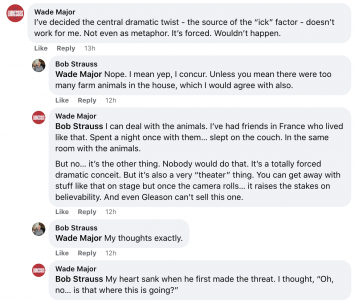
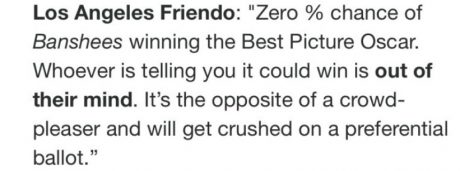
On 10.11 I passed along some positivereactions to Martin McDonagh’s TheBansheesofInisherin (Searchlight, 10.21), and quoted a critic friendo who’d been told by a couple of eccentric colleagues that Banshees might win the Best Picture Oscar…”peopleadorethisfilm.”
This prompted another critic friendo to pass along the following:
Last night I saw McDonagh’s film. Five minutes after emerging from the 1350 Sixth Avenue screening room I wrote the Los Angeles guy as follows:
“In some respects a lovely metaphorical lament about Irish anguish and turbulence and the general impermanence of things, and fortified by excellent dialogue, fine acting (especially by Colin Farrell and Kerry Condon), handsome cinematography and so on, but in other respects a bizarre, brutal thing that struck me as borderlinediseased.
“You were right — the New York people who said that TheBansheesofInisherin might win the Best Picture Oscar are out of their fecking minds….INSANE.
“There were three or four sane characters in that film, Farrell’s Paddy Súilleabháin (at least initially) and Condon’s Siobhan (i.e., Farrell’s sister) being the sanest. Certain measures of rational behavior are also noticable from, I suppose, Sheila Flitton’s old crone, Pat Shortt’s bartender and one or two others.
“But Brendan Gleeson’s Colm Doherty and the mad priest and the belligerent cop and Barry Keohgan’s local loon (a counterpart to John Mills’ village idiot in Ryan’sDaughter, which also occurs in a rural Irish seaside village roughly a century ago), are all lunatics of one kind or another.
“It’s a film about rage and nihilism and futility and banality and bloody finger stumps.
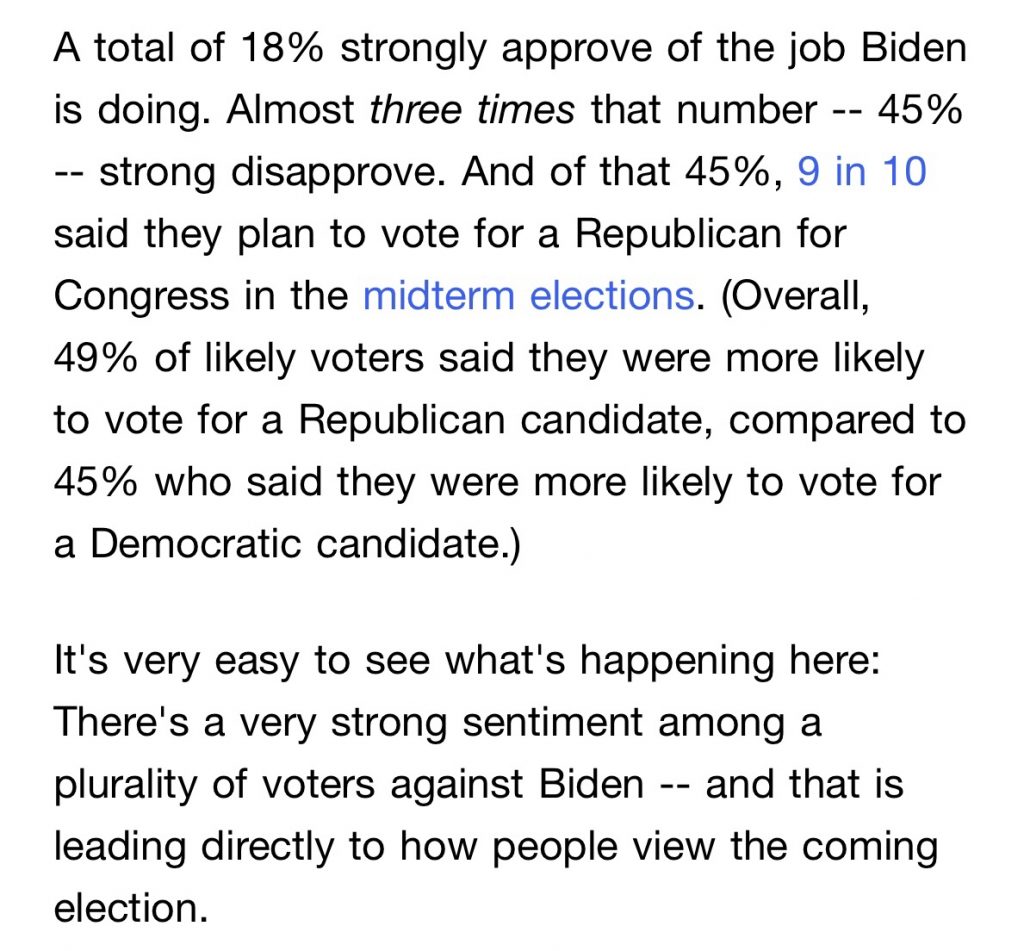
The “rage against the Supremes killing Roe” bump is apparently subsiding. Biden’s bad numbers are returning; ditto projections about likely Republican gains. I modestly, half-heartedly approve of Joe’s job performance save for his kowtowing to the wokester wing. But the fact is that somethingawful might happen if he runs again. A younger, credible and compelling left-centrist Democrat has to primary him.
— from Common Sense / TGIF columnist Nellie Bowles, postedon10.21.
PattiLupone recently said that B’way ticket prices are “insane.” I knew they were painful but it’s been a few years since I actually pondered (i.e., fantasized about) a purchase. I also presumed Lupone had turned on the hyperbole spigot. Then I looked at prices for Tom Stoppard’s Leopoldstadt. Okay, Telecharge isn’t as punishing.
For what it’s worth, I didn’t see this coming. I doubt if anyone did. Then again…
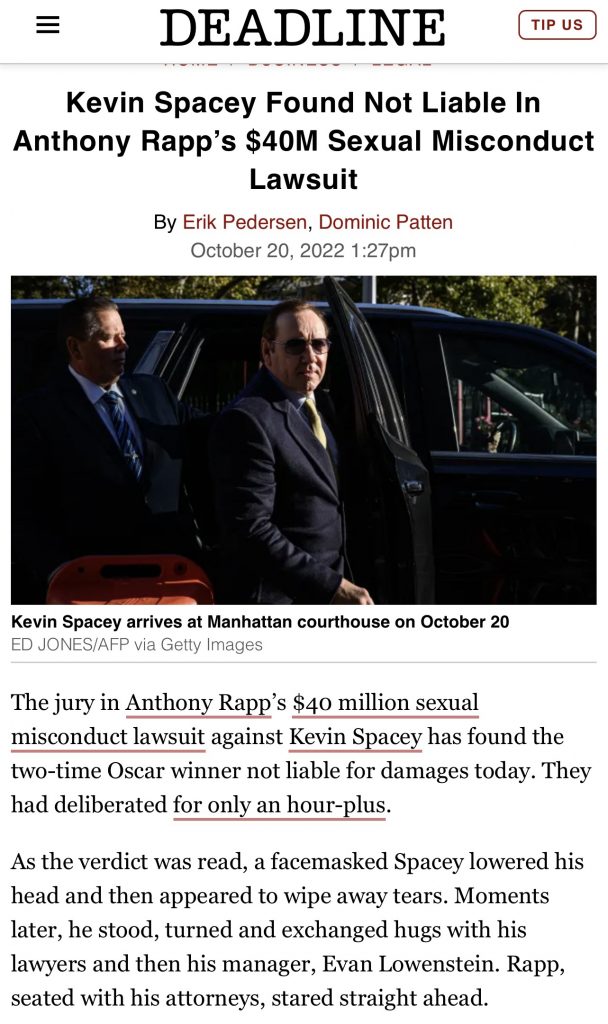
If I had been on the jury, I would have felt piqued by the time factor. The alleged incident happened in ‘86 when Kevin Spacey, now 63, was 26, and his accuser Anthony Rapp, now 50, was 14. I would have said “why are we dealing with this so many years after the fact? It happened 36 years ago.”
I experienced a few awful, hurtful things in my teens. Do I still feel angry or wounded about some of them? Yeah, but they happened a long-ass time ago. Move on, be here now.
Based on a Wikipedia link to figures from the CaliforniaFilmDivision, I recently reported that Damien Chazelle’s Babylon (Paramount, 12.23) cost $110 million. That’s wrong, I was told today by a Paramount spokesperson. The tab was actually $78 million. Okay then.
Despite my admiration for all things Tony Gilroy, I still have yet to watch the seven-episode Andor. It is my solemn belief that doing so would be bad for my soul. Plus I don’t care for brown-and-beige color palettes.