Ehrenreich Facing Cote d’Azur Gauntlet

It was announced this morning that Ron Howard‘s Solo: A Star Wars Story, the most negative-buzz-plagued Star Wars movie in the history of the franchise, will screen out-of-competition during the Cannes Film Festival. The screening will happen on Tuesday, 5.15, or ten days before the U.S. debut and eight days before the French opening.

It’s not certain that Alden Ehrenreich, the too-short, charisma-challenged, completely miscast actor who had to be professionally coached in a seemingly desperate effort to capture the insouciant vibe and commanding physicality of young Harrison Ford, will be roasted by the Cannes press contingent. But the knives will be out, you bet.

Then again Disney probably wouldn’t offer Solo for a big Cannes screening if they weren’t at least somewhat confident that it satisfies on its own terms, Aldrenreich’s shortcomings notwithstanding.

Solo costars Woody Harrelson, Emilia Clarke, Donald Glover, Thandie Newton, Phoebe Waller-Bridge, Joonas Suotamo and Paul Bettany.

Exec producers Phil Lord and Christopher Miller, who directed Solo for for four and 1/2 months before being canned by producer Kathy Kennedy over creative differences, will presumably attend the red-carpet ceremony along with Kennedy, director Ron Howard, screenplay authors Lawrence and Jonathan Kasdan, producer Simon Emanuel and executive producer Jason McGatlin.

The Cannes Film Festival runs from Tuesday, 5.8 thru Saturday, 5.19. The slate will be announced on Thursday, 4.12.
Anspach

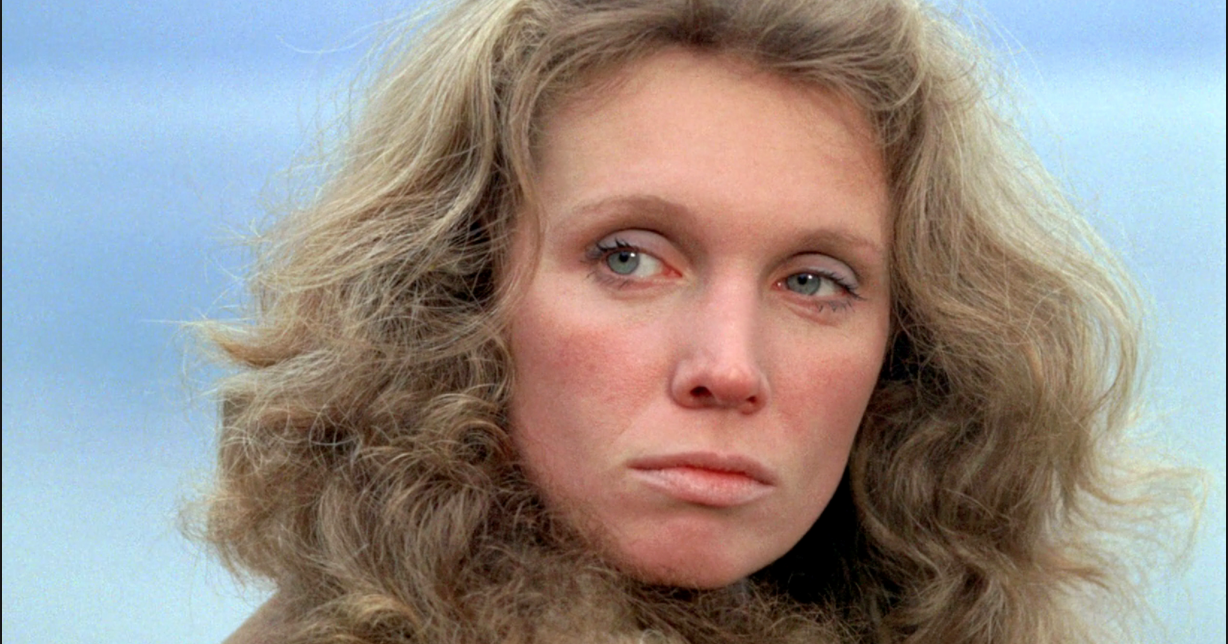
I felt a pang when I read about the passing of actress Susan Anspach. She was felled three days ago (Monday, 4.2) by a heart attack. She was 75. The Hollywood Reporter obit was only posted today so I guess the news is just getting around. Anspach’s son Caleb Goddard, whose father is Jack Nicholson, announced her death earlier today.

Anspach made her mark in Hal Ashby‘s The Landlord (’70), Bob Rafelson‘s Five Easy Pieces (’70) and especially Paul Mazursky‘s Blume in Love (’73). She was quite the vibey presence in these films, very silky and sexy with the ability to suggest a complex and particular inner life. To more than a few she was an object of erotic fascination. There, I’ve said it.

No offense but I don’t even remember Anspach in Jeremy Kagan‘s The Big Fix.

Her last performance that left a significant impression was in Dusan Makavejev‘s Montenegro (’81), in which she played a bored housewife who gets into “slut-strutting” (a term used by a smart female critic) during a visit to the country formerly known as Yugoslavia (i.e., Bosnia and Herzegovina, Croatia, Macedonia, Montenegro, Serbia, Slovenia).

I’m sorry but sometimes the end comes suddenly. Life is short, but then you knew that. Wings of a dove.

Didn’t Wanna Know

I was sensing early on that Barry Levinson‘s Paterno (HBO, 4.7), about the Penn State child sex scandal of 2011 and ’12, and which primarily involved pedophile Jerry Sandusky and legendary Penn State football coach Joe Paterno, wouldn’t be as good as Amir Bar Lev‘s Happy Valley (’14).

It couldn’t be as good, I figured, because Happy Valley is too brilliant, fascinating, penetrating, haunting, etc. It can’t be topped. I saw Paterno a week ago, and I’m sorry but the whole time I was saying over and over “this isn’t as good as it needs to be.” I wish it were otherwise.

I wrote the following (“The Town That Looked Away“) after catching it at the 2014 Sundance Film Festival: Amir Bar-Lev‘s Happy Valley is a shrewdly sculpted, richly perceptive study of denial — of people’s willingness and even eagerness to practice denial if so motivated.

“The specific subject is the Penn State child-abuse sex scandal, which resulted in convicted pedophile Jerry Sandusky doing 30 years in jail and the late beloved Penn State coach Joe Paterno being at lest partly defined between now and forever as a pedophile enabler.

“The Freeh report (conducted by former FBI director Louis Freeh and his law firm) stated that Paterno, Penn State president Graham Spanier, athletic director Tim Curley and school vp Gary Schultz all knew about Sandusky probably being guilty of child molestation as far back as 1998, and that all were complicit in looking the other way. State College residents and especially Penn State football fans were enraged when Paterno was fired for not saying or doing enough. Even after the Freeh report they wouldn’t let go.

“People always say ‘I never knew’ or ‘I never noticed anything’ whenever someone is busted for something appalling or illegal or worse. The central message of Happy Valley is that if people like or admire someone, they don’t want to know or notice anything bad about him/her. (That was Burt Lancaster‘s line in Judgment at Nuremberg — ‘If we did not know it’s because we did not want to know!’) People will do daily calisthenics to avoid facing facts. What’s great about Happy Valley is that it sticks to specifics and never mentions that denial disease is a pandemic.”

All Paterno is about, really, is the fact that lazy, borderline-senile “JoePa” (Al Pacino) was in major, serious, old-man denial. He didn’t wanna know, wanna know, wanna know….”who, me?” The movie doesn’t explore new material or engage you in ways you don’t see coming. It just plods along and grinds it all out — covering everything that you knew from Happy Valley but making you go half-blind from all the dark lighting. It’s not really a “bad” film as much as a sufficient, passable, mildly boring one.

Read more

“All But The Brightest Stars”

It’s politically unsafe right now to write even somewhat favorably about Norman Mailer, who was regarded as a bit of a brutish chauvinist in his day. The Daughters of Maximilien Robespierre wouldn’t approve. Nonetheless Mailer did write an excellent book about the Apollo 11 moon mission and the dull NASA technocrats who made it all happen (“Of A Fire On The Moon“). And it does seem like a good idea to re-read it in preparation for Damian Chazelle‘s First Man (Universal, 10.12), which tells the story of astronaut Neil Armstrong (Ryan Gosling) and how, on 7.20.69, he became the first earthling to set food on the lunar surface.

If you ask me “Of A Fire On The Moon” is one of Mailer’s most personal and stirring works. One should try to appreciate it as an epic piece of writing that doesn’t necessarily reflect upon early ’70s firebrand feminists. It’s about much bigger fish.

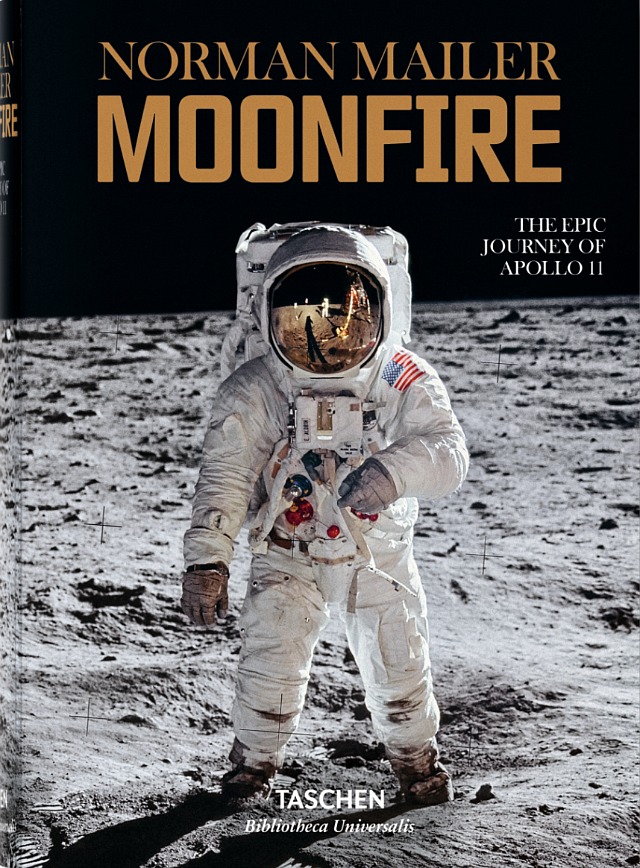
Last weekend I was poking around inside the Taschen store near the Farmer’s Market, and I happened to notice an abridged, small-scaled version of Mailer’s book, called “Moonfire“, on sale for a mere $20. When Taschen did the first publishing nine years ago they were selling a huge coffee-table version that sold for $1800.

The “Moonfire” copy: “One of the greatest writers of the 20th century captures the definitive event of modern science…discover the men, the machinery, and the sheer thrill of the lunar mission with Norman Mailer’s dazzling account of the Apollo 11 adventure, illustrated by hundreds of photographs,” blah blah.

The original book starts with a riff about the death of Ernest Hemingway, which right away tells you Mailer is not exactly levitating with admiration for each and every aspect of the NASA space program, or certainly the men who worked for the agency.

Read more

Best Picture Situation Favors Womanly Subject Matter

The 2016/2017 Oscar race taught us about a major seismic shift in the way younger Oscar voters (i.e., the Academy cool kidz) are seeing things now, as opposed to just five years ago when the old boomer-farty Oscar-worthy standards still applied. Traditional Oscar-bait movies are now regarded askance, and identity politics are almost everything. Oscar-bait now means indie, socially relevant, ‘woke’, tribal identity, etc.

Because Oscars are the new Spirits. Technical, artistic achievement means squat for the new-generation Academy. They want politically charged messages and they wanna take a stand, and tribal identity politics definitely drives their votes. “The under-40 crowd has invested Race, Gender and Sexuality with a kind of cosmic significance,” an HE commenter said earlier this year. “It doesn’t mean a lot to them — it means everything to them.”

So what does this mean in terms of the 2018 Best Picture race? There are 15 contenders right now, and eight of these are tribal-identity pics.

Two of the eight are POC dramas — Barry JenkinsIf Beale Street Could Talk and Spike Lee‘s Black Klansman. And six are about strong women — Josie Rourke‘s Mary, Queen of Scots (Universal, 11.2), Mimi Leder‘s On The Basis of Sex (Ruth Bader Ginsburg), Yorgos LanthimosThe Favourite (Queen Anne), Bjorn Runge‘s The Wife, Robert Zemeckis‘s The Women of Marwen (fantasy) and Steve McQueen‘s Widows.

There are also a pair of potentially stand-outtish political films — Adam McKay‘s Backseat (Dick Cheney) and Jason Reitman‘s The Front Runner (Gary Hart).

Plus five films that you could describe as character intrigue for character intrigue’s sakeDamien Chazelle‘s First Man, Bryan Singer‘s Bohemian Rhapsody (15-year period from the formation of Queen and lead singer Freddie Mercury up to their performance at Live Aid in 1985), David Lowery‘s The Old Man and the Gun, Richard Linklater‘s Where’d You Go, Bernadette? and Jennifer Kent‘s The Nightingale.

The numerical odds alone suggest that the Best Picture winner will be chosen from among the six strong women films. Handicappers said the 2018 Best Picture winner would reflect the #TimesUp, year-of-the-woman cultural zeitgeist thing. It didn’t happen, but it probably will next year.

The willingness of the Academy cool kidz to nominate genre films means that Steve McQueen‘s Widows and The Old Man and the Gun, both essentially caper films, have a clear shot.

The likeliest Best Foreign-Language Feature nominees right now are Terrence Malick‘s Radegund (Germany), Asghar Farhadi‘s Everybody Knows (Spain), Alfonso Cuaron‘s Roma (Mexico); Pawel Pawlikowski‘s Cold War (Poland) and Laszlo NemesSunset (Hungary).

Read more

“Black Klansman” Going To Cannes?

There’s an interesting bit of speculation in a 4.5 Cineuropa piece by Fabien Lemercier about next month’s Cannes Film Festival (“A New Phase For Cannes?“). “Several names from North America continue to pop up rather insistently,” Lemercier writes. “Namely, Under the Silver Lake by David Robert Mitchell, Domino by Brian De Palma and” — wait for it — “Black Klansman by Spike Lee.”

This is the first spitball piece to mention Lee’s fact-based melodrama as a serious possibility…no?

Black Klansman is based on on Ron Stallworth’s 2014 novel, the full title of which is “Black Klansman: Race, Hate, and the Undercover Investigation of a Lifetime.”

Set in the late ’70s, pic isn’t literally about a black guy joining the Klan but an undercover investigation of the Klan by Stallworth when he was “the first black detective in the history of the Colorado Springs Police Department.”

After initial correspondence with the Klan, Stallworth received a call in which he was asked if he wants to “join our cause.” According to an Amazon summary, “Ron answers the caller’s question that night with a yes, launching what is surely one of the most audacious, and incredible undercover investigations in history. Ron recruits his partner Chuck to play the ‘white’ Ron Stallworth.”

In Lee’s film Stallworth is played by John David Washington. The “Chuck” character is apparently called “Flip,” and is played by Adam Driver. Laura Harrier and Topher Grace costar. Corey Hawkins plays Stokely Carmichael.

Read more

Here’s To You, Franz Kafka

Last August Tatyana Antropova, the fabled SRO and wife of Hollywood Elsewhere, began the application process for a green card and Employment Authorization card. A lot of work, a lot of forms, roughly $1700 in fees.

We were informed on 10.16.17 via I-797 (“notice of action”) that the USCIS (U.S. Citizen and Immigration Services) had approved her application for employment authorization (otherwise known as an EAD or work permit card) and that it would be arriving soon in the mailbox. All seemed well.

Then it all went bad. In early November we were informed that the letter containing the work permit had been mailed to our address but sent back. This was apparently because the letter had a 90046 zip code instead of the correct 90069, and so the mailman decided not to deliver it. That was six months ago, and despite countless pleas, appeals, letters, phone calls and visits to the downtown L.A. USCIS office (300 No. Los Angeles Street, Los Angeles, CA 90012), the work-permit card senders, based in a building in Lee’s Summit, Missouri, about 10 miles southeast of Kansas City, haven’t re-mailed the card.

Because of one lame-ass decision by a West Hollywood mailman (the zip code is a meaningless distraction as there’s no other Westbourne Drive in the entire city and 90046 is right nearby), poor Tatyana has been without a work permit for a full half-year, and to this date we still haven’t received it in the mail.

We have received, mind, several USCIS letters about other immigration matters at this address, but never the work permit. We have received letters with the incorrect and correct zip codes. We have repeatedly informed the USCIS that the correct zip code is 90069, and they have confirmed to us that their “system” now understands this, but we’ve still gone six months without a card. So much frustration and hair-pulling, so much draining of the spirit.

What government agency mails you something, and then, when it gets sent back to the agency for a nonsensical reason, refuses to re-send? These people are bureaucratic fiends.

Gilda, Spirit, Cancer, Death

Lisa D’Apolito‘s Love, Gilda will open the 2018 Tribeca Film Festival on 4.18. The late Gilda Radner made millions laugh, but like any half-decent comedian she always told the unfettered truth. And she apparently never side-stepped or shilly-shallied when she was diagnosed with cancer in late ’86, at age 40. She wrote about it candidly in “It’s Always Something,” a 1989 autobiography. To go by a 2014 fundraising trailer [after the jump], the primary focus of Love, Gilda focus is Radner’s four-year battle with cancer. It’s also about Gilda’s Club, a community organization for cancer copers.

Read more

Friends and Admirers Always Lie

I’ve watched this old Steven Spielberg clip a few times. I love it because it’s a reminder that serious artists have no interest in hearing nice bullshit from their alleged friends and admirers. Give it to me straight or don’t say anything at all.

Stanley Kubrick had to sit on Spielberg’s chest and force him into being honest about his true, deep-down feelings about The Shining. He had to grill and interrogate the truth out of him, otherwise Spielberg (who has since come to love The Shining) would have never given it up.

Husbands and wives are like this also — they always lie to protect each other’s feelings. The only way you get the real truth from a husband or wife is when you’re arguing with them and they’re really angry at you and losing their temper, and so they’ll tell you some uncomfortable fact or observation they would otherwise keep quiet about.

Before I stopped drinking (I’ve been sober since 3.20.12) I told an ex-girlfriend that I was starting to feel horrified about my weight and that I was starting to resemble a 50ish lesbian in a cowboy hat. “Stop it…you look fine!” she insisted. She lied — I was turning into Wallace Beery in Min and Bill. Hell, I was turning into Marie Dressler. Everybody lies about everything, including your enemies.

Artsy French Zombies…Mai Oui, Bien Sur!

Once upon a time zombie movies were cool. Certainly between the debut of George Romero‘s Night of the Living Dead (’68) and Dawn of the Dead (’78), his first sequel. Since then mongrels have taken over the genre. As a matter of routine policy Hollywood Elsewhere spits on 21st Century zombies. I haven’t paid the slightest attention since Juan Carlos Fresnadillo‘s 28 Weeks Later (’07) and before that Danny Boyle and Alex Garland‘s 28 Days Later (’02).

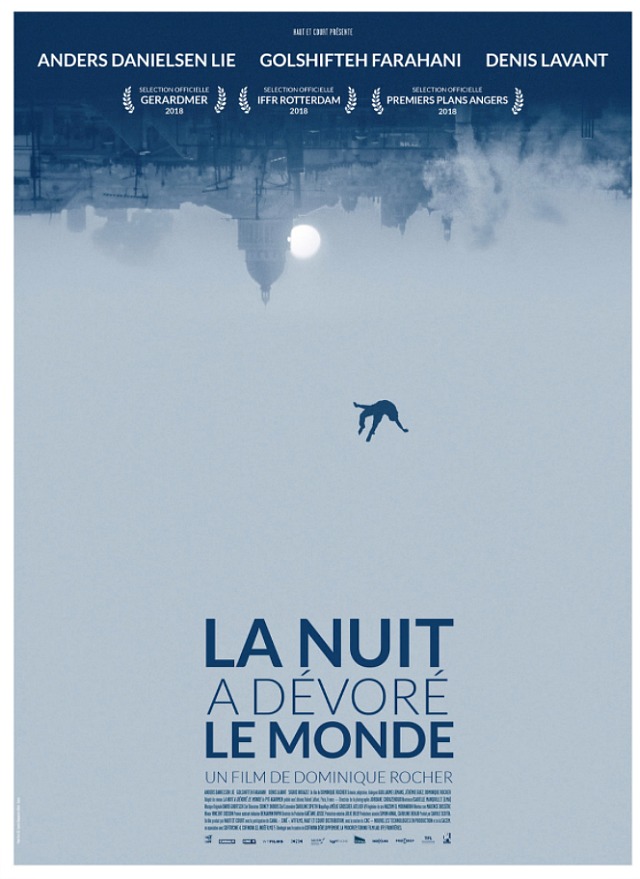
But I’m down for Dominique Rocher‘s Night Devours The World (La Nuit a devore le monde) because (a) it’s French, (b) it has a great poster, and (c) it avoids standard zombie movie tropes like the plague. This in itself wins my absolute allegiance.

From Jordan Mintzer‘s 3.7.18 Hollywood Reporter review: “Imagine 28 Days Later without the action, The Walking Dead without the ensemble cast or [Rec] without the video camera and white-knuckle suspense, and you’ll get an inkling of what goes on in The Night Eats the World.

“A minimalist arthouse zombie movie set almost entirely inside a Paris apartment building, this debut feature from director Dominique Rocher has some clever ideas and well-crafted moments, but in terms of horror fodder, it’s so pared down you’ll practically miss it if you blink. Still, it probably deserves a lower-case ‘z’ for “zeal,” taking the subgenre to a place it hasn’t quite gone before. You’ve got to give the filmmakers some credit for eschewing the predictable gory antics in favor of something more artsy and contemplative.”