No Hugs, Sorrows, Laments — I Prefer Jerry the Flinty Prick

What I’d really like to see is a story of 90-year-old Jerry Langford, the late-night talk show star who was kidnapped by Rupert Pupkin back in the early ’80s. Jerry is semi-retired but still plugging away, involved in real estate and other ventures, still playing golf, still on the cryptic and blunt side, still disdainful when the occasion requires and is no one’s idea of a gentle or lovable fellow. And yet he’s largely unbent and, for an old guy, still full of beans. And he’s nice with kids and dogs.

Does “mean” Mr. Langford feel badly about still being flinty and not all that considerate with each and every person he deals with? Okay, maybe, but he’s ecstatic about the fact that he’s alive and crackling and living a pretty good life for a guy born in 1926. He’s on Twitter and Facebook and owns over 300 Blurays. And he has a 79 year-old girlfriend that he “puts it to” every so often (i.e., extra-strength Cialis), and he rides a bicycle and walks two or three miles every day and lifts weights. Who needs love, kindness and forgiveness when you’ve got your health? Langford pushes on! But watch out when he’s in a bad mood.

Read more

Wrench Me, Squeeze It Out

All Vanity Fair cover stories are blather, but if you read them carefully you can sometimes find a line or two that hints at the truth of things. Case in point: Evgenia Peretz‘s profile of The Light Between Oceans costar Alicia Vikander. Peretz describes Derek Cianfrance’s film (Disney, 9.2) as “the kind of wrenching adult melodrama that Hollywood rarely makes these days, because it’s hard to pull off successfully — although they got this one right.”

Let’s imagine for the sake of argument or hypothesis that they didn’t “get this one right.” That the film underwhelms on this or that level. If so, would there be any chance in hell that Peretz or Vanity Fair would indicate this?

What unsuccessful “wrenching adult melodramas,” I wonder, did Peretz have in mind? Which ones have worked and which haven’t? A more thoughtful writer would have explored this sub-topic to some extent, at least, but that’s not Peretz’s job. She’s on hand to fawn, to spin, to convey glamor and fascination.

Peretz later states that there was “no room for restraint” in the making of Oceans, which is “based on a full-on weepie best-seller” by M. L. Stedman. She reports that the book had director Derek Cianfrance “crying on the C train in Brooklyn when he finished it.”

Seriously? Cianfrance told her that he wept on the C train? This in itself is cause for concern.

Read more

If The Score Is Right, A Film is Halfway There

The “bad” Ben-Hur (Paramount, 8.19) had its world premiere last night (8.1) inside the Cinepolis JK in Sao Paulo, Brazil. Not Rio de Janeiro, where the 2016 Olympics will begin on Friday, 8.5 and where thousands of major-media types are congregated, but in corporate Sao Paulo. (Why?) I can’t find any Twitter reactions to Timur Bekmambetov‘s Christian-angled remake, but one can at least compared the musical scores between the two films to get a sense of things.

Miklos Rosza composed the Oscar-winning score to William Wyler’s 1959 film. To my ears Rosza’s music was a character, a voice, a force unto itself. The newbie’s score, obviously a lesser thing, was written by Marco Beltrami (3:10 to Yuma, The Hurt Locker, Hellboy, The Wolverine).

Above is a passage from Beltrami’s Ben-Hur channellings — a mildly dreamy, keyboard-synth thing. The main-title section of Rosza’s score, performed in 2013 by the John Wilson Orchestra inside London’s Royal Albert Hall, is below. A second Rosza composition (“Parade of the Charioteers”, performed by an all-brass band conducted by André Rieu) is after the jump, followed by a special Ben-Hur related performance of “Ceasefire,” performed by For King & Country, a Christian pop duo composed of Australian-American brothers Joel and Luke Smallbone. Please compare and assess.

Read more

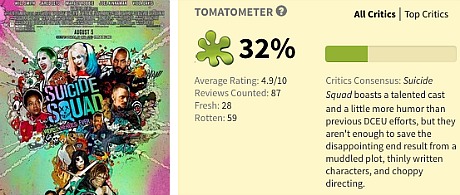
Has Suicide Squad’s David Ayer Submitted to Realm/Scheme of Dreaded Zack Snyder?

How do you feel about revisiting Zack Snyder‘s Sucker Punch? Tonight the second-tier, all-media crowd (i.e., people like myself) will face up to the reality of Suicide Squad at screenings on both coasts. I’m a man, I can take it, I can handle anything they throw at me, bring it on! And yet I feel as if I’m about to go to the dentist. Especially after reading Peter Debruge‘s Variety review, which warns of a Snyder-type experience in more ways than one…good God:

Excerpt #1: “Suicide Squad plunges audiences right back into the coal-black world of Batman v Superman: Dawn of Justice…for reasons beyond Ayer’s control, he’s beholden to the corporate vision of other recent DC adaptations, most notably Zack Snyder’s sleek-surfaced and oppressively self-serious riffs on the Superman legend. [and is] ultimately forced to conform to Snyder’s style, to the extent that Suicide Squad ends up feeling more like [Snyder’s] gonzo effects-saturated Sucker Punch.”

Excerpt #2: “[While Ayer] and Jared Leto manage to invent a version of the Joker every bit as unsettling as the late Heath Ledger’s immortal incarnation, turning the iconic Batman rival into a ruthless seducer (hunt down ‘Mr. Nobody’ to see the origins of Leto’s wicked deep-throated cackle), the character barely has anything to do. [For] the Joker exists only to inspire his deranged arm candy, Harley Quinn.”

Read more

Hello, Monsters…Back For More

On display at the just-opened LACMA exhibit “Guillermo del Toro: At Home With Monsters” (8.1 thru 11.26) are dozens upon dozens of props, busts, full-size models, paintings and other recreations and knick-knacks from Del Toro‘s 23 years of filmmaking — i.e, Cronos to Crimson Peak. But I have a soft spot for the recreations of ’30s black-and-white monsters and especially Boris Karloff‘s Frankenstein monster…sorry. Yes, I dropped by late this afternoon. The exhibit walls are the exact same color (dark earthy red mixed with terra cotta) as those at the original Bleak house in Thousand Oaks. These creations are the purest and most vivid realization of GDT’s art, even more so than the content of his films. The acute detail in each artifact pulses and throbs. Each one has a soul, a history, a completeness.


I always thought Elsa Lanchester’s hair in The Bride of Frankenstein was grayish with silver-white streaks, but it’s exciting to imagine it as flaming red, even if it wasn’t.

Outside main entrance to LACMA’s Guillermo del Toro: At Home With Monsters exhibit, Moscow-based director Nick Sarkisov, HE’s own Svetlana Cvetko.

Immaculate tattoo goth girl, Edgar Allen Poe.

Read more

BFCA’s Doc Awards

Speaking as a member of the Broadcast Films Critics Association, the just-announced fact that the Critics’ Choice Awards (i.e., synonymous with the BFCA) is launching a documentary awards show next November seems like an excellent thing. Docs need all the hoo-hah they can get, and this will hopefully influence awards-think on the part of the Golden Globes, the guilds and Oscars. Nominees will be announced on 10.10; the award show itself will be staged and aired on 11.3 at BRIC in Brooklyn. What I haven’t been able to ascertain since this announcement came through last night is what the BRIC acronym stands for. BRIC is a nonprofit arts and media organization located near BAM. Founded in 1979, the original name was “Fund for the Borough of Brooklyn” but that no longer applies.

And Speaking of Viva Zapata…

Many years ago Guillermo del Toro told me he disapproved of Elia Kazan‘s Viva Zapata because it was an inauthentic, American-ized take on Mexican history, and that the life of Emiliano Zapata could and should be captured by a Mexican filmmaker or at least someone with a closer perspective than a New York Greek-American like Kazan. Agreed, sympathized with, no dispute. I’d like to see that Mexican-made version some day. But the look on Marlon Brando‘s face at the very end of this scene, a look of not just impudence but balls and confidence, is about as good as non-verbal acting gets. Moments like this are why I swear by Kazan’s film, why I’ve watched it over and over, why I own the Bluray.


For whatever reason the TCM embed code isn’t working so I’ve posted a screen grab. Watch the clip via this URL.

The Revenant, The Bear, Grizzly Man…Which Contains Strongest Echo of This Recent Incident?

On 7.30 Mammoth Lakes resident Rodney Ginn posted a video of a momma bear and a cub invading his home. Esquire‘s Matt Miller posted a riff about it this morning, but he didn’t mention the sound that comes out of Ginn — a fluttery, falsetto shriek — when he sees the bears coming up the stairs. Listen to him…”whoaaaaa…whoo-whoo!” It reminds me of the sound that Harold Gordon makes in Viva Zapata when his character, Francisco Indalecio Madero, is about to be shot by the military.


Harold Gordon’s screaming realization that he’s about to be shot in Elia Kazan‘s Viva Zapata.

Lest The Horror Be Forgotten

Writing yesterday about that 33 year-old Japanese Spielberg documentary led me to investigate the horrific helicopter accident that came to define Twilight Zone: The Movie, which Spielberg produced, and to some extent cast a shadow over the life/career of John Landis. The footage is old news but I hadn’t really watched it until yesterday. It happened on 7.23.82 at an Indian Dunes location in what is now Santa Clarita, during a late-night filming of a Vietnam nightmare sequence. A helicopter lost its tail rotor due to a stronger-than-expected VFX detonation and it suddenly crashed, killing poor Vic Morrow and two child actors, Myca Dinh Le and Renee Shin-Yi Chen, in a millisecond. I’d never read until yesterday that Spielberg ended his relationship with Landis after the incident. The rap against Landis was that he was incautious, but there’s always been a fine line between reckless disregard and capturing that extra element of super-charged realism. It was an accident, yes, but attitudes about safety certainly weren’t paramount. This was the worst on-set accident until the Midnight Rider train-track incident of 2014.

Nihilist Hillbilly Dumbshits — A Brief Literary Visit to Trumpland

Yesterday a conservative-minded ex-girlfriend suggested that I read Kyle Smith‘s N.Y. Post review of J.D. Vance‘s “Hillbilly Elegy: A Memoir of a Family and Culture in Crisis.” The review (which also includes interview quotes) is titled “Why ‘White Trash’ Americans Are Flocking to Donald Trump.”

Vance is a successful blue-state guy (a “principal” at a Silicon Valley investment firm, lives in San Francisco with wife and family) but he comes from a hillbilly rustbelt town in Ohio, and apparently knows whereof he speaks about downmarket lifestyles and despairing Appalachian culture. A key passage from Smith’s review:

“When Vance returns home these days, he sees yard after yard festooned with Trump signs. Trump’s attacks on the media and political correctness make Vance’s people stand up and cheer. From the Democrats, they draw the same sense of condescension that struck Vance when, at Yale, another student said she couldn’t believe he was in the Marines because he was a nice guy.

Trump’s me-against-everybody combativeness, his refusal to back down, his vows to disrupt Washington deal-making are giving the hillbilly class a feeling they haven’t had in decades, [which is] that they’ve got a friend at the top.”

Read more

A Moment for Ida Lupino

This morning I happened upon a short Fandor video in honor of Ida Lupino. First known as a sullen firecracker actress during the ’30s and ’40s (my strongest recollection is her husband-killing femme fatale in Raoul Walsh‘s They Drive By Night), Lupino was the first name-brand woman to make it as a Hollywood feature and TV director (late 40s to mid ’60s). And she made her features as a hip-pocket, self-funding director-producer with an indie attitude — she was John Cassevetes before Cassavetes came along.

Lupino once remarked that during her acting heyday she was “the poor man’s Bette Davis” but when she become a director she regarded herself as “the poor man’s Don Siegel.”

I’d like to post the Fandor video here but the embed code has been hidden — thanks, guys! Here instead is a restored version of Lupino’s creepy noir — The Hitchhiker (’53). Kino issued a remastered Bluray version in ’13 — I just bought a copy.

Read more

How Cool is Cruel?

James Schamus‘s Indignation opened in four theaters this weekend. It earned $89,072 for an average of $22,268 per situation. In my 7.26 review I wrote that it’s worth seeing for a 16-minute argument/debate scene between Logan Lerman (as a Newark-born freshman at an Ohio college) and Tracey Letts (as the college dean). Here’s a Village Voice piece about the writing and filming of this scene. I called Indignation a “respectable, adult-friendly, nicely refined period drama (i.e., early ’50s) about values, academia, obstinacy, surprisingly good sex, Jews (in particular a tough Jewish mom) and — this is key — brutally cruel fates.” I explained that “the ending alienated me to no end.” Did anyone happen to catch it? If so, any thoughts about the third-act windup and the fates that envelop Lerman’s Marcus Messner and Sarah Gadon‘s Olivia Hutton?