We Feel Your Pain, or Harris vs. Redford

In his latest Grantland column, Mark Harris has advanced an idea about presumed Oscar-worthy performances that I’d kind of forgotten about or never really waded into. Academy members vote for an actor whom they admire for the skill and depth of his or her acting chops (as well as the degree to which they’ve physically disappeared into a character by losing or gaining weight or wearing a prosthetic nose) but also by the measure of how sorry they feel for the character he/she has portrayed.
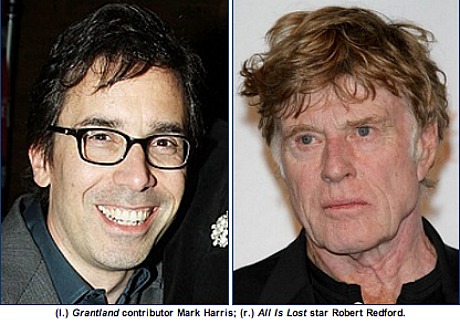
Why do we feel sorry for a character or for anyone in real life? Because we’ve been there and we can relate. We know what it’s like to be in his or her shoes and what the shoulder weight feels like. Obviously Academy members vote for actors they like or admire or feel in awe of, but more often than not the deep-down thing kicks in and they vote for characters they feel closest to. Which is why, I’m suspecting more and more, All Is Lost‘s Robert Redford is probably going to win for Best Actor.
Read more

Again, Please…Reduce Deadwood Influence

Last April I posted one of the most logical, sensible and fair-minded parliamentary suggestions in the nine-year history of Hollywood Elsewhere. (The column is 15 years old if you count the Mr. Showbiz version, which began in August of ’98, and the Reel.com version from ’99 to ’02 and the Movie Poop Shoot version from ’02 to ’04). It was about the need to minimize the impact of the likes and dislikes of out-to-pasture Academy members. Not in a dismissive or disrespectful way, but moderately and appropriately.

“If the Academy wants to be part of the world as it is right now and have the Oscar winners reflect this, it has to reduce the influence of people whose professional peaks happened 15 or 20 or more years ago,” I wrote. “These people will retain membership and all the priveleges that go with that, but their votes won’t count as much as those who are actively working and contributing to the films of today, or at least films made within the last five to ten years — simple.

Read more

War As Surreal, Exhilarating Nightmare

The review embargo for Peter Berg‘s Lone Survivor (Universal, 12.27 limited) lifts on Wednesday, 11.13, but Universal had a big “hello, journalists!” screening last night at the TV Academy in Burbank, and apparently it’s okay to “comment” in discreet bursts. Here are three or four. Lone Survival is a blue-chip, this-really-happened war film in the tradition of Pork Chop Hill, Hamburger Hill, We Were Soldiers and particularly Black Hawk Down. It’s an expertly assembled, emotionally jarring wallop — it quickens your pulse and makes you go “whoa…that was fierce and heavy.” It throttles you all to hell and that ain’t hay. My mouth was open with a “good effing God!” look on my face (I wasn’t holding a mirror but trust me) for at least half of the two-hour running time. The two thoughts I had were “God help the guys who went through this nightmare” and “thank God I’m sitting warm and safe and dry in a theatre in Burbank.”


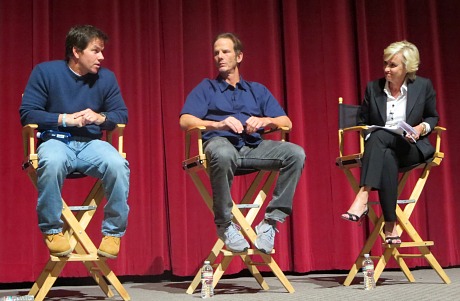
Lone Survivor star Mark Wahlberg, director Peter Berg & interviewer Tina Brown during last night’s q & a.

Is Lone Survivor an awards-season contender? Yes. Certainly. Or it damn well should be, at least. The honest gut-punch aspect plus the high level of craft and unmissable emotion that went into it demand this level of consideration.

Read more

“What Happened on That Mountain…”

The first significant media screening of Peter Berg‘s Lone Survivor (Universal, limited late December opening) happens this evening. All indications are that it’s another Black Hawk Down only darker — a tale of a failed Middle-Eastern military mission (i.e., 2005’s Operation Red Wing in Afghanistan) that led to a lot of American soldiers getting wasted. The highlight, I’m told, is a long unbroken battle sequence that lasts a good 30 or 40 minutes. (I’ll time it this evening.) I respected Black Hawk Down, but I’m a tiny bit suspicious of U.S. war films that focus on brotherly camaraderie and ignore the bigger questions. The Afghanistan War (which we’re finally extricating ourselves from) was pure quicksand from the get-go. U.S. forces could never hope to defeat the Taliban or reduce them to some level of insignificance because sooner or later all foreign invaders are out-lasted and eventually defeated by the natives. It’s brave and noble to protect and fight for your buddies, but it’s a sad thing to die for a no-win objective.

Coveted Atmosphere

In the view of Nick “Action Man” Clement, Anton Corbijn‘s The American, Sam Peckinpah’s Bring Me the Head of Alfredo Garcia and David Fincher‘s Se7en are spiritual brethren of Ridley Scott‘s The Counselor.

“Much like in The American, Scott and screenwriter Cormac McCarthy smartly subvert the audiences’ preconceived genre expectations: the chase has to be here, it needs to end there, this character needs to be killed by that character, etc. And as in Peckinpah’s down and dirty Garcia, the narrative in The Counselor comes to a rational (however disturbing and bleak) conclusion that has to be considered as ‘audience-unfriendly’ or ‘morally reprehensible.’ [But] it’s not the job of cinema or of filmmakers to only tell stories about the morally just and dignified.

Read more

Gregg Toland’s Ghost Is Pissed Off

I’m not saying that DVD Beaver‘s Gary W. Tooze has never criticized a Bluray in one of his reviews, but I can’t remember the last time this happened. The man loves to cheer and show affection whenever possible (especially if a Bluray image is covered in digital mosquitos). So it’s significant that Tooze has actually complained about the cropping on Warner Home Video’s The Best Years Of Our Lives Bluray. Tooze provides screen captures that show a modest but significant portion of the right-side area having been sliced off, and asks “why?” Tooze’s screen captures are generally reliable so I see no need to doubt his evidence. The trimmed section appeared on earlier DVD versions; it makes no sense to me that WHV technicans would decide to do this. (Tooze says the slicing is evident only “through the beginning.”) WHV’s Ned Price has been snippy ever since last spring’s Shane brouhaha but maybe the good-natured George Feltenstein can answer this. What’s the rationale for cleavering Gregg Toland‘s framings during the early portions of this 1946 classic?


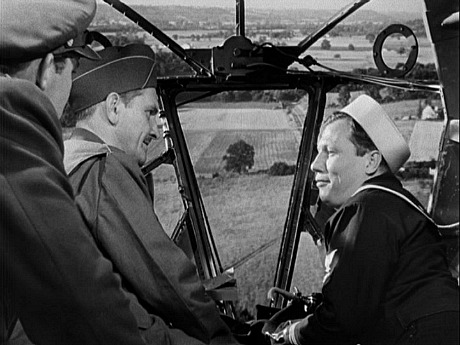
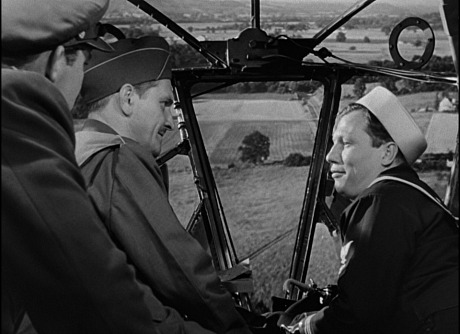
Frame capture from 2000 MGM Home Video DVD — notice the breathing room on Harold Russell’s mid-back area on the right side.

Same scene on Warner Home Video’s new Bluray — Russell’s back has been sliced off. At the same time there’s more to see of Dana Andrew’s cap on the left side. Why crop the image at all? Why not show a generous portion of Andrews’ cap as well as Russell’s lower back area?

Decadent Roman Splendor Guy

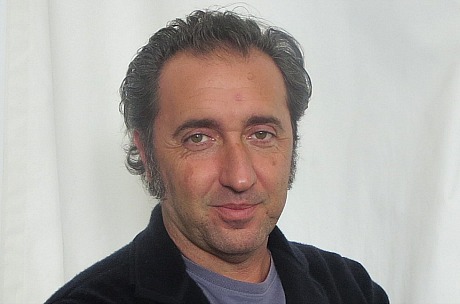
Late this morning I drove up to the Chateau Marmont for a brief chat with acclaimed Italian director Paolo Sorrentino about his latest film, The Great Beauty (La Grande Bellazza), which I discussed a couple of days ago (“Beauty in A Shoebox“). Pretty much everyone has called it a modern day, Berlusconi-era version of Federico Fellini‘s La Dolce Vita, but I barely went there. I just don’t have the nerve to ask obvious questions. (Sorrentino says virtually everyone has brought this up.) I mostly asked about Beauty‘s dazzling visual style, which is composed in a luscious old-school fashion. Sorrentino shot Beauty on film, but acknowledges this won’t happen again. Like his pallies the Coen brothers, who have also admitted they’ve thrown in the celluloid towel, Sorrentino is resigned to shooting his next film digitally. He has no clue what that next film might be about, although he says he intends to keep his partnership going with Toni Servillo, the star of Beauty as well as Sorrentino’s Il Divo (’09).


The Great Beauty director Pasolo Sorrentino at L.A.’s Chateau Marmont — Wednesday, 10.30, 11:25 am.

Read more

Nosferatu and Me

Last night I popped in the Kino Bluray of F.W. Murnau‘s Nosferatu (1922), which I’ve been absorbing by way of clips and stills since the ’70s but which I’d never watched whole. I’m glad I got it out of the way but I have to say that my respect for Nosferatu as a seminal German expressionist horror film has now been mitigated. The restoration by Luciano Berriatua presumably represents the best this 92 year-old film can look, but the best I can say about the content is that it’s a noteworthy, occasionally interesting slog.

Read more

Gods Cast A Spell

Every December I tap out a list of the year’s best (excellent, very good and good) and I usually end up with a tally of maybe 20 films or 25 films, and 30 if I want to be liberal about it. But if you were to boil these down to the really good ones that will probably stand the test of time, you’d probably be closer to 10 or 15. Which is why 1962 seems like such an amazing year. Jules and Jim, The Manchurian Candidate, To Kill a Mockingbird, Knife in the Water, Lawrence of Arabia, The Man Who Shot Liberty Valance, Whatever Happened to Baby Jane?, L’Eclisse, Lolita, The Exterminating Angel, Ride the High Country, The Miracle Worker, The Longest Day, Days of Wine and Roses, The Loneliness of the Long Distance Runner — that’s 15 films and we’re less than halfway through the list. The Trial, Sundays and Cybele, Winter Light, Dr. No, My Name Is Ivan, A Kind of Loving, Mutiny on the Bounty, Billy Budd, The L-Shaped Room, Cape Fear, Freud, Carnival of Souls, Lonely Are the Brave, Advise & Consent, Birdman of Alcatraz, Eva, David and Lisa, Sweet Bird of Youth, Requiem for a Heavyweight, The Counterfeit Traitor, War Hunt, Phaedra, Lisa, Day of the Triffids and Antoine and Colette. 40 films that pretty much everyone who’s taken a film course or owns a film anthology book has seen and admired or or least respects, and at least 20 or 25 stone classics.

Just Arrived Today

I’m going to be brave and admit something that undermines my fanatical film guy authority (if you want to call it that). I’ve twice seen Werner Herzog and Klaus Kinski‘s Nosferatu the Vampyre (’79) and I’ve seen Shadow of the Vampire (’00), E. Elias Merhige‘s fictionalized story of the making of F.W. Murnau‘s Nosferatu, but I’ve never really sat down and watched F.W. Murnau’s Nosferatu. Now, finally, tonight…the restored Kino Bluray version (which streets on 11.12).

Madness In The Blood

You can’t go by the trailers, which suggest a flat-out satirical comedy. Trailer cutters always go for the socko stuff, the lowest-common-denominator defaults. But if it’s more or less a huge sprawling black comedy (and I say “if”), that may amount to a brilliant approach. Scorsese, screenwriter Terrence Winter and star Leonardo DiCaprio came to the Wall Street table way too late to play it as some kind of dark, solemn, high-stakes melodrama. The last 25% of Goodfellas (arguably the best part) was pure cocaine in the veins. Well, cocaine and then the comedown.

Read more

Come Again?

I was reading Andrew Stewart‘s 10.29 Variety story about Paramount having officially slated Martin Scorsese‘s The Wolf of Wall Street for a 12.25.13 release when I was jerked alert by a phrase at the end of the story. Yes, okay, I stole that expression from Tom Wolfe‘s “The Painted Word,” but I nonetheless sat up and said “whoa.”

Stewart writes that “a list of other Oscar contenders have vacated the race in recent weeks, including Sony Classics’ Foxcatcher,” the Weinstein Co.’s Grace of Monaco and Sony’s The Monuments Men, which sources say the studio pushed back based on the assumption that Paramount would end up making the year-end release for Wall Street.”

Read more