“Everything Matters!”

That May 4th letter from Transformers: Revenge of the Fallen director Michael Bay to Paramount honchos that TMZ posted earlier today is instructive because it tells you that Bay isn’t all that highly educated, or at least didn’t pay attention during English composition class in high school.


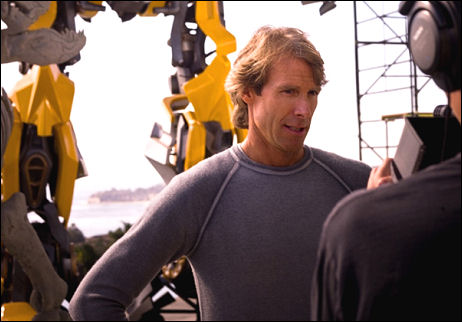
Michael Bay on set of one of the Transformers films — doesn’t matter which one.

Content-wise it shows that he was angry that the Transformers sequel (out 6.24) wasn’t getting decent buzz. Maybe it wasn’t at the time and “no big deal” anyway — we all get angry and complain, etc. But the seventh-grade spellings and thoughtless, sloppy-ass sentence construction speak volumes.

But I like one portion of the letter because it shows that Bay understands pop-culture currents, that he doesn’t want to repeat mistakes, that he listens to Jerry Bruckheimer and can read the writing on the wall: “You all say it doesn’t matter,” he writes. “Everything matters! The first time any studio said this very thing to me was on The Island.

“Over the years Jerry Bruckheimer mentored me on event movies, [and] he had a mantra. ‘A studio that does not make it into an event [or] will it into an event [and] thinks the audience will just show up will always be bitten in the ass.” I love this line also: “Clips don’t blow people away!”

“Who Are These Men?”

I fully understand and support what’s going on right now in the streets of Tehran because I’ve understood (and, let’s face it, practiced) rebellion all my life. But my understanding of the Islamic fundamentalist practice of stoning women as punishment for adultery and other crimes against Allah is a little different. I realize, of course, that this ghastly and horrific tradition is still practiced in certain Islamic backwaters, but it’s so beyond-the-pale in terms of cruelty and fiendish chauvinism that it doesn’t seem real. A part of me says, “C’mon, no…this is too much.”

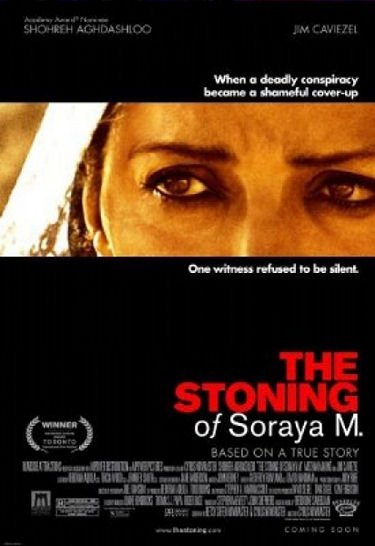
Which is why I couldn’t find my way into The Stoning of Soraya M., a respectably crafted, stirringly performed melodrama, based on Freidoune Sahebjam‘s 1995 book of the same name, about a stoning of a blameless woman in a small Iranian village in the mid 1980s.

I know that this ghastly murder occured (due to a conniving husband who wanted his wife out of the way so he could marry a younger woman) but as I watched it unfold I was saying to myself, “This happened on the planet Earth? Certain human beings of an Islamic stripe actually do this to women from time to time?” It felt beyond cold, beyond malignant.

The Stoning of Soraya M. makes Eli Roth‘s woman-hating Hostel 2 almost feel like humanism because at least (if you buy what Roth says) his film is an exercise in B-movie manipulation and therefore not rooted in anything “real,” and on top of this is at least familiar and recognizable in a cultural popcorn sense. Not so with Soraya M., which seems to be taking place on Mars.

At no point was I saying to myself “this isn’t a well-made film” or “this doesn’t cut it” or anything along those lines. The Stoning of Soraya M. is a reasonably solid B-plus docudrama, and anyone looking to work up a righteous head of steam about Islamic fundamentalism having unleashed cruel and backward and horribly chauvinistic cultural forces will find satisfaction.
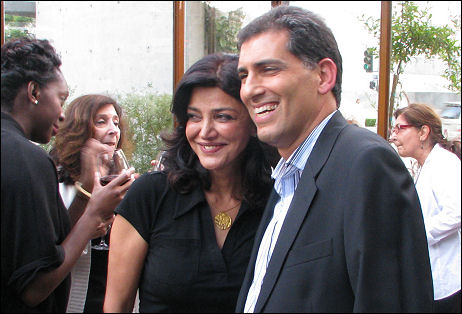

The Stoning of Soraya M. star Shoreh Agdashloo, director-cowriter Cyrus Nowrasteh — Saturday, 6.230 8:10 pm.

My revulsion at what I saw in the film makes me an honorary right-winger, I think. I certainly feel like a rightie when I think about Islamic dictatorships and those effin’ mullahs. Count on it — Soraya M. will be popular among Jon Voight conservatives as well as the rich Iranians who fled their country after the 1979 Islamic revolution.

But I also knew I was watching a depiction of human behavior so far afield from anything I’d ever seen or imagined inside a movie theatre that I didn’t know what to do with it.

This despite a decision by director Cyrus Nowrasteh to portray Sahebjam’s tale in straight, plain terms, and the screenplay he wrote with wife Betsy Giffen Nowrasteh being matter-of-fact. Mozhan Marno is heartbreaking as Soraya — a feisty and spirited mother whose only error is not realizing soon enough that she’s doomed. Shoreh Agdashloo (House of Sand and Fog) delivers a powerhouse, potentially award-calibre performance as an older woman of authority who becomes Soraya’s only defender.

I’m not saying that the male Iranian villagers who conspired in the death of Soraya M. some 23 years ago showed any humanity or common decency, but the utter lack of such values among all but two male characters in the film presents a problem. There’s not a human being among them. Even the women act like fiends, or at least like acquiescent fools. It’s a ugly portrait of what humans are capable of, let me tell you.


The Stoning of Soraya M. star Mozhan Marno at last night after-party following the film’s late afternoon screening at Westwood’s Festival theatre — Saturday, 6.20.09, 7:45 pm

The two exceptions are the village’s morally conflicted mayor, played by David Diaan, and a travelling journalist — a stand-in for Sahebjam played by Jim Caviezel — who is told about the stoning by Agdashloo’s character at the beginning of the film, and who leaves the village at the finale with an audio tape of her story.

Even if you share my confused reaction, there’s no arguing that Soraya M.‘s finale — a drawn-out depiction of Soraya’s brutal and bloody death — is devastating to sit through. When asked about the explicitness of this scene, Nowrasteh said that he’s a seen a tape of an actual stoning that was “much worse than what I’ve shown in the film” in terms being difficult to watch.

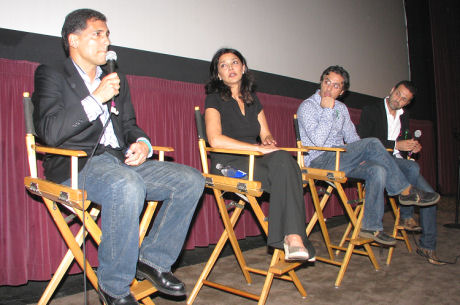
I saw The Stoning of Soraya M. yesterday afternoon at a Los Angeles Film Festival showing. The film will opens on Friday, 6.26. The post-screening panel included Nowrasteh, star Shoreh Agdashloo, religious scholar Reza Aslan and The Kite Runner author Khaled Hosseini, who moderated.

The title of this article, by the way, isn’t a quote from Soraya M. but The Verdict. It’s a line that Lindsay Crouse says on the witness stand in the big third-act testimony scene — “Who are these men? Who are these men? I wanted to be a nurse!” But it obviously fits.

Doesn’t Mean Jack

The Proposal‘s estimated Friday gross of $12.4 million represents Sandra Bullock‘s biggest opening-day haul ever — fine. But what’s happened to poor Pelham? Tony Scott‘s subway thriller dropped over 60% compared to last Friday’s opening. You can’t even speak of Year One in the same breath as Pelham, and yet Harold Ramis‘s comedy earned $8.5 million yesterday. Shit floats.

Uncommon Grit

“The chants of death to Khamenei are true,” a Canadian citizen has told Huffington Post live-logger Nico Pitney. “I witnessed people’s fear of the Basij disappear. I saw an 80 year old Chadori woman with rocks in her hands call for the execution of Khamenei and all Basij. A group of Basij were surrounded and forced into a building, [and then] the front was blocked with garbage and set on fire. The Basij opened fire on the crowd with what I assume were blanks. The crowd dispersed for a moment and then came back with a fury. That’s when the Molotov cocktails came out. When I moved on the building was on fire. An hour later when I passed by again there wasn’t much of a building left. There was full-blown war.”

“Radical Aspirations”

In a highly unusual and highly admiring interview piece, thorny N.Y. Times critic Manohla Dargis speaks with Hurt Locker director Kathryn Bigelow in tomorrow’s edition (i.e., Sunday). Are the Times editors telling Manohla to step outside the critics’ box and write more to beef up page views, or did she ask to interview Bigelow out of personal passion? Perhaps a little of both.


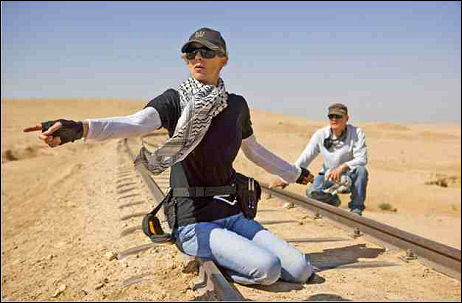
Hurt Locker director Kathryn Bigelow during filming in Jordan.

Bigelow’s film, says Dargis, was “greeted with rapturous praise and some misapprehension” after its Venice Film Festival premiere nine months ago. “Mostly, it seems, because its extraordinary filmmaking, which transmits the sickening addiction to war as well as its horrors in largely formal terms, doesn’t come wedded to a sufficiently obvious antiwar position. One British critic went so far as to say that while the film had ‘excellent acting, camerawork and editing, it could pass for propaganda.’

Except The Hurt Locker “doesn’t traffic in the armchair militarism of Hollywood products like Top Gun and Transformers,” she says, “[and] neither is it an antiwar screed. It’s diagnostic, not prescriptive: it takes an analytical if visceral look at how the experience of war can change a man, how it eats into his brain so badly he ends up hooked on it.

“And, like all seven of Ms. Bigelow’s previous feature films, this new one is also as informed by the radical aspirations of conceptual art as it is by the techniques of classical Hollywood cinema.”

Cameron Chat

I was walking with two friends across the Fox lot after that 500 Days of Summer screening, and who do I see coming out of a post-production facility but Avatar director Jim Cameron? The helmer of Titanic, Aliens, The Abyss and T2 was getting into his cream-colored SUV when I waved and said, “Hey, Jim.” He walked over and we spoke for a couple of minutes. I didn’t machine-gun him with Avatar questions. I wanted to be cool and laid-back and I was, I think.

Cameron’s hair is longish and flowing (like in the above video clip) and grayish white. His skin is smooth and healthy-looking. He doesn’t look older as much as different, as if an ’09 version has replaced the earlier models. I first spoke to him on the phone in ’85 following the success of the first Terminator. My first Cameron interview was for the N.Y. Daily News, around the release of True Lies. We later did a Titanic phoner when I was with People. And I listened to him talk about deep-sea stuff at the Santa Barara Film Festival a couple of years ago.

I asked him about a career-overview book that Rebecca Winter Keegan is writing called “The Futurist” which he’s cooperating with (and has asked his colleagues to follow suit) to ensure accuracy.

He alluded to his long hiatus from feature-film directing — ’97 to ’05. We all know what Cameron did with his time and money (deep sea explorations, 3-D technology, etc.), which I presume he found interesting and nurturing and satisfying on at least a couple of levels. But we’re not here to be happy and satisfied, dammit. We’re here to be what we can do. Another way of putting it, as William Burroughs did at a Manhattan poetry reading that I attended in the late ’70s, is that “we’re here to go.” We’re here to do the sometimes very difficult creative thing and to endure the necessary byproducts of stress and suffering and lovelessness and what-have-you. Because “art isn’t easy,” as Stephen Sondheim once wrote.

All serious artists accept this. It can sometimes be brutal. It often hurts and wears you down and gives you lines in your forehead. It is my humble conviction that artists who wimp out on this so they can be happy are taking the dilletante path. I’ve always admired and respected Cameron and I’m certainly glad he’s back in the saddle, but no more eight-year vacations.

I asked Jim how many times he’s seen The Hurt Locker, directed by his ex-wife Kathryn Bigelow, and he said twice. I told him I’ve seen it four times. He said he feels slightly responsible for her making it since they had a discussion two or three years ago about which project she might do. At some point Kathryn mentioned “this other thing” about Iraq as a kind-of secondary option, and Cameron told her, “Are you kidding? You should do this. This is a report from the front and people need to see it.” I told him I think it’s her finest film by far, and he seemed more or less on the same page.

He had to head out to a meeting in Malibu that he and producer Jon Landau were late for so we said our goodbyes. I guess we’ll all start to hear about Avatar screenings sometime in October.

Lesher, Awful Traffic, Gyoza

I missed Nikki Finke’s first report yesterday (which went up around 2:50 pm) about poor John Lesher getting fired as president of Paramount’s Film Group and Adam Goodman taking his place. The somewhat notorious Brad Weston (i.e., the guy who wasn’t interested in Twilight) has also been demoted.

I was out of the loop due to suffering through an obscene traffic jam on Sunset (allegedly due to a couple of accidents on the 10 and the 405). I had to cancel an appointment because of my entrapment; it also kept me from checking for online updates. You can’t fume and swear in the midst of stop-and-go traffic while surfing on your iPhone — being angry consumes you 100%.

A friend called and told me about the Lesher whacking around 4 or 4:30 pm, as I was heading over to the Fox lot for that 500 Days of Summer screening. But when I got out I figured nobody cared that much and it could wait. I care personally — Lesher always treated me decently and seemed a reasonably humane and responsive guy. (Plus I related to his neurotic temperament.) But I’ve never understood how the firing of another suit affects the price of rice in any meaningful way. Finke and Sharon Waxman and Kim Masters and Claudia Eller positively live for these stories…whatever, fine, go for it.

For me the bottom line is that the door is constantly revolving at the big studios — always has been, always will be — and none of these guys is Irving Thalberg so where’s the fire?

So when I got out of the film I said, “You know what? Fuck it.” I arranged to meet a good friend over at Typhoon, that cool exotic restaurant located on the Santa Monica Airport runway. The proprietor is Brian Vidor, son of director Charles Vidor. Excellent vibe, good people, delicious eats. My favorite L.A. haunt.

“Killing Young People Like Animals”

This BBC-provided Tehran-demonstration footage, only a few hours old, feels like raw footage from a Paul Greengrass film. I’ve been in a violent demonstration and know that demonstrators who risk bludgeonings and worse by fighting back have more courage than I. Mahsa from Tehran: “I was in the rally today and police forces in Azadi square cruelly killed people.” From Iran: “I am home since 10 minute and Basij forces and police were killing young people like animals”

President Obama “has been right to tread carefully, given the poisonous American-Iranian history,” says N.Y. Times op-ed columnist Roger Cohen, “but [he] has erred on the side of caution. He sounds like a man rehearsing prepared lines rather than the leader of the free world. A stronger condemnation of the violence and repression is needed, despite Khamenei’s warnings.

“Obama should also rectify his erroneous equating, from the U.S. national security perspective, of Ahmadinejad and Moussavi. Ahmadinejad is Iran’s Mr. Nuclear. He has rapidly advanced the program and, through preaching in every village mosque, successfully likened it to the nationalization of the oil industry as an assertion of Iranian nationalism. By contrast, Moussavi has not abjured the program, but has attacked Ahmadinejad’s ‘adventurist’ and ‘delusional’ foreign policy. These are essential distinctions.

“Obama should think hard about whether this ballot-box putsch is not precisely about giving Ahmadinejad and his military-industrial coterie four more years to usher Iran at least to virtual nuclear-power status. He should also think hard about the differences in character: Ahmadinejad is volatile and headstrong, the interlocutor from hell, while Moussavi is steady and measured.

“Shrugging away these distinctions like a dispassionate professor at a time when people are dying in the streets of Iran is no way to honor this phrase in his Inaugural Address: “Know that America is a friend of each nation and every man, woman and child who seeks a future of peace and dignity, and that we are ready to lead once more.”

Tranquility

Snapped early last evening on the 20th Century Fox lot after a screening of Marc Webb‘s 500 Days of Summer (Fox Searchlight, 7.17), which isn’t half bad and may be, in fact, be the most honest and agreeable blend of romantic headiness and sinking despair since Jerry Maguire. I’ll get into it in a subsequent post, but this could work nicely with the educated under-30 date crowd.

Young pot-bellied wildebeest males may shine it on, but Webb is seriously taken with the love and the #1 romantic myth surrounding it, which is that we all have a destiny to meet a perfect soulmate, etc. I came out loving Summer for having very persuasively debunked this idea — but not cynically and with feeling. And with an obvious affection for intelligent writing and the emotional legacy of The Graduate. It doesn’t wallow in cheap manipulation and emotional-behavioral pig vomit like so many other youth-romance pics. It’s the anti-I Love You Beth Cooper. And I could actually stand Joseph Gordon-Levitt this time.

“Day of Destiny”

The Iran dictatorship’s threatened crackdown moves — shootings, tear gas, water cannons, baton beatings — are happening as we speak. All the Hangover and Zach Galifianakis fans (who are not being necessarily equated with simian-level idiocy) need to watch this poem video, which was apparently taped last night. Bless the woman who wrote and taped these words.

All For Now

It’s one of those late-filing days with too much to do and not enough hours. I now have to move my bags to another place and then see 500 Days of Summer at 5 pm and then attend an LA Film Festival party. But what is all this running around town compared to the terrible coming fate of Iran’s green opposition forces? Awful news.