George C. Scott: “What do you mean ‘if I love you’? I raped you in a suicidal rage. How do we get love and children all of a sudden?”
Diana Rigg: “For heaven’s sake, Herb…I ought to know if a man loves me or not. You must have told me a hundred times last night that you love me. You murmured it, shouted it. One time you opened a window and bellowed it out into the street.”
Scott: “Well, I think those were more expressions of gratitude than love.”
Rigg: “Gratitude for what?”
Scott: “Well…my God, for resurrecting feelings of life in me that I thought dead!”
Rigg: “Oh, my God…what do you think love is?”
Scott: “All right, I love you! You love me! I’m not about to argue with so relentless a romantic.”
Daily
No Direction Home
I’m not comfortable admitting that I have a weird soft spot for ruthlessly violent, rightwing Mel Gibson movies, as long as they’re efficiently made.

Buzzed Entitlement
From P.J. O’Rourke‘s “How to Drive Fast on Drugs While Getting Your Wing-Wang Squeezed and Not Spill Your Drink“, written in the mid ’80s:
“When it comes to taking chances, some people like to play poker or shoot dice; other people prefer to parachute-jump, go rhino hunting, or climb ice floes, while still others engage in crime or marriage. But I like to get drunk and drive like a fool.
“Name me, if you can, a better feeling than the one you get when you’re half a bottle of Chivas in the bag with a gram of coke up your nose and a teenage lovely pulling off her tube top in the next seat over while you’re going a hundred miles an hour down a suburban side street. You’d have to watch the entire Mexican air force crash-land in a liquid petroleum gas storage facility to match this kind of thrill.
“If you ever have much more fun than that, you’ll die of pure sensory overload, I’m here to tell you.
“Is that any way to have fun? How would your mother feel if she knew you were doing this? She’d cry. She really would. And that’s how you know it’s fun. Anything that makes your mother cry is fun. Sigmund Freud wrote all about this. It’s a well-known fact.
“Of course, it’s a shame to waste young lives behaving this way – speeding around all tanked up with your feet hooked in the steering wheel while your date crawls around on the floor mats opening zippers with her teeth and pounding on the accelerator with an empty liquor bottle. But it wouldn’t be taking a chance if you weren’t risking something. And even if it is a shame to waste young lives behaving this way, it is definitely cooler than risking old lives behaving this way.
“I mean, so what if some fifty-eight-year-old butt-head gets a load on and starts playing Death Race 2000 in the rush-hour traffic jam? What kind of chance is he taking? He’s just waiting around to see what kind of cancer he gets anyway. But if young, talented you, with all of life’s possibilities at your fingertips, you and the future Cheryl Tiegs there, so fresh, so beautiful — if the two of you stake your handsome heads on a single roll of the dice in life’s game of stop-the-semi — now that’s taking chances! Which is why old people rarely risk their lives. It’s not because they’re chicken — they just have too much dignity to play for small stakes.
“It’s important to be drunk because being drunk keeps your body all loose, and that way, if you have an accident or anything, you’ll sort of roll with the punches and not get banged up so bad. For example, there was this guy I heard about who was really drunk and was driving through the Adirondacks. He got sideswiped by a bus and went head-on into another car, which knocked him off a bridge, and he plummeted 150 feet into a ravine. I mean, it killed him and everything, but if he hadn’t been so drunk and loose, his body probably would have been banged up a lot worse — and you can imagine how much more upset his wife would have been when she went down to the morgue to identify him.”
Myth of Good Driving While Half-Stinko
As we all know, Robert Zemeckis‘s Flight is about the disease of alcoholism. I responded well to this 11.2.12 release, in part, because I had become a sober person roughly nine months earlier — on 3.20.12. And yet the film contains a certain drunk-driving paradox. Because Denzel Washington‘s “Cpt. Whip Whitaker” saves his commercial plane from crashing by flying upside down. We’re led to understand that if Whip had been 100% sober he might not have rolled the plane over and saved the day.
But even if this isn’t what the film says, I’m thinking that this principle applies to some extent to car driving.
“A Wing and a Prayer,” posted on 9.23.12: If you’re driving your Lexus drunk your reaction time is slower than if you’re cold sober, and if you’re really stinko you’re definitely a menace to all humanity. But drunk or semi-drunk driving isn’t all bad, and sometimes it works. Or at least it did for me.
I know, I know — did I just say that? In today’s world DUI is a felony punishable by huge fines and jail time in some cases, and rightly so. But in the ’70s tens of thousands of people drove from place to place every night with a buzz-on and in some cases plain shitfaced, and some awful things resulted, I’m sure. But quite often, probably the vast majority of times, drunks just drove home and parked their cars and watched a little TV and went to sleep on the couch. And then woke up at 3 am, undressed and flopped in their bedroom.
May God forgive me but in my early drinking days when I lived in Wilton and Westport, Connecticut, I drove late at night with several beers and/or Jack Daniels on the rocks in my system, and I just cruised on through, and I mean weekend after weekend after weekend after weekend. No accidents, no fender benders, nothing. Others plowed their cars into ponds and trees and guard-rails, but not me.
There were times, in fact, when I drove down those winding country roads at high speeds and I would focus like a motherfucker, and I was convinced at times that I was driving like Paul Newman at Lime Rock.
I started to tell myself, in fact, that I drove better when half-bombed because I was less intimidated by the possibility of something going wrong. I drove without fear, without hesitation. I took those hairpin turns like a champ.
Present tense: In short, if you’re as good a driver as I was and you’re not flat-out wasted, driving with booze in your system isn’t such a bad thing. Or at least it doesn’t need to be. Would I drive drunk now? Of course not. I stopped drinking 8 and 2/3 years and I’m not an asshole. I’m just saying that I got away with it for years, and…well, I’ve said it.
Compelling Protagonists Who Skirt the Ethical Edge
It didn’t get the love it deserved, but John Lee Hancock‘s The Founder, which opened a little more than five years ago, is easily one of the most fascinating and easily re-watchable dramas of the 20teens — half character study and half hard-scrabble success story, and a film about a highly unusual protagonist — Michael Keaton‘s Ray Kroc — who straddles the line between admirable and not-so-admirable.
Most people don’t know what to do with a character like Kroc. Half-good and half-shifty characters are hard to relax with. It’s okay if a lead character is a bit of an ethical muddle, but audiences generally like their main protagonists to be more sympathetic than not.
Kroc and Scarlett O’Hara aside, what movie characters are the most memorable half-and-halfers? And don’t tell me that Charles Foster Kane belongs in this fraternity. Because he doesn’t.
The Founder is basically the story of how Kroc persuaded the earnest, slightly doltish, small-time-thinking McDonald brothers (Dick and Mick, respectively played by Nick Offerman and John Carroll Lynch) to let him franchise their small fast-food business and turn it into a super-sized empire.
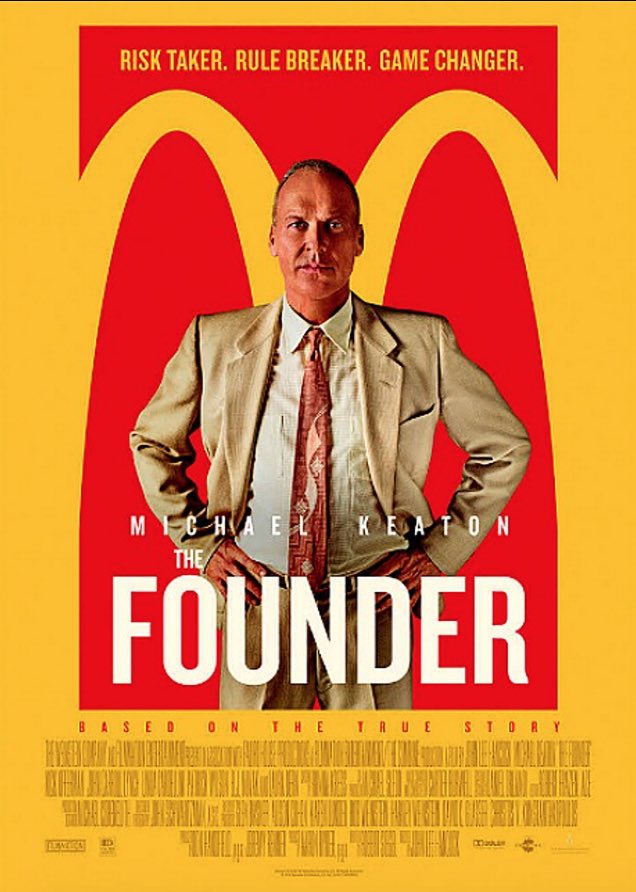
But more generally The Founder is a nuts-and-bolts story about what a scramble it is to grow a business and then stay afloat with all the serpents snapping at your heels.
Robert Siegel‘s script is a portrait of dog-eat-dog entrepenurial capitalism — a movie that basically says “sometimes it takes a pushy, manipulative shithead to orchestrate a big success.”
Except Keaton’s Kroc is not really a shithead. He’s just a hungry, wily go-getter who believes in the organizational basics that made McDonald’s a hit during its early California years (1948 to ’54) and who has the drive and the smarts to build it into a major money-maker. Your heart is basically with the guy, and I was surprised to feel this way after having nursed vaguely unpleasant thoughts about Kroc (scrappy Republican, Nixon and Reagan supporter) my entire life.
You know who is unlikable? Offerman’s Dick McDonald — a guy who’s always complaining, always frowning or bitching about something, always a stopper. The bottom line is that Dick doesn’t get it and neither does Mac, but Ray does. And to my great surprise I found myself taking Ray’s side and even chucking when he tells Dick to go fuck himself in Act Three. Ray is a bit of a prick but not a monster. And I understood where he was coming from. He’s a little shifty here and there, but I couldn’t condemn him all that strongly.
Keaton turns the key in just the right way. He doesn’t try to win you over but he doesn’t play Ray as a bad guy either — he plays it somewhere in between, and it’s that “in between” that makes The Founder feel quietly fascinating. It allows you to root for a not-so-nice-but-at-the-same-time-not-so-bad guy without feeling too conflicted.
And yet The Founder didn’t exactly burn up the box-office. It wound up grossing $12.8 million domestic and $24.1 million worldwide.
Best & Slightly Blemished ’70s Films
How do you whittle down the greatest-ever movie decade into a list of 15 films?
World of Reel‘s Jordan Ruimy is asking critics and other film neurotics to submit their lists of the 15 finest films of the ’70s, “ranked or unranked.” Fine, but with minor tweaks they’re all going to name the same films.
Let’s imagine for a second that the following are my top picks: (1) William Friedkin‘s The French Connection; (2) Peter Bogdanovich‘s The Last Picture Show; (3) Stanley Kubrick‘s A Clockwork Orange (4) Arthur Hiller and Paddy Chayefsky‘s The Hospital, (5) Robert Altman‘s McCabe & Mrs. Miller, (6) John Schlesinger’s Sunday Bloody Sunday, (7) Mike Hodges‘ Get Carter, (8) Sam Peckinpah‘s Straw Dogs, (9) Louis Malle‘s Murmur of the Heart, (10) Alan Pakula‘s Klute, (11) Luchino Visconti‘s Death in Venice, (12) Mike Nichols‘ Carnal Knowledge, (13) Hal Ashby‘s Harold and Maude, (14) Roman Polanski’s Macbeth and (15) Ken Russell‘s The Devils.
Well, guess what — they were all released in 1971! What about the other nine years?
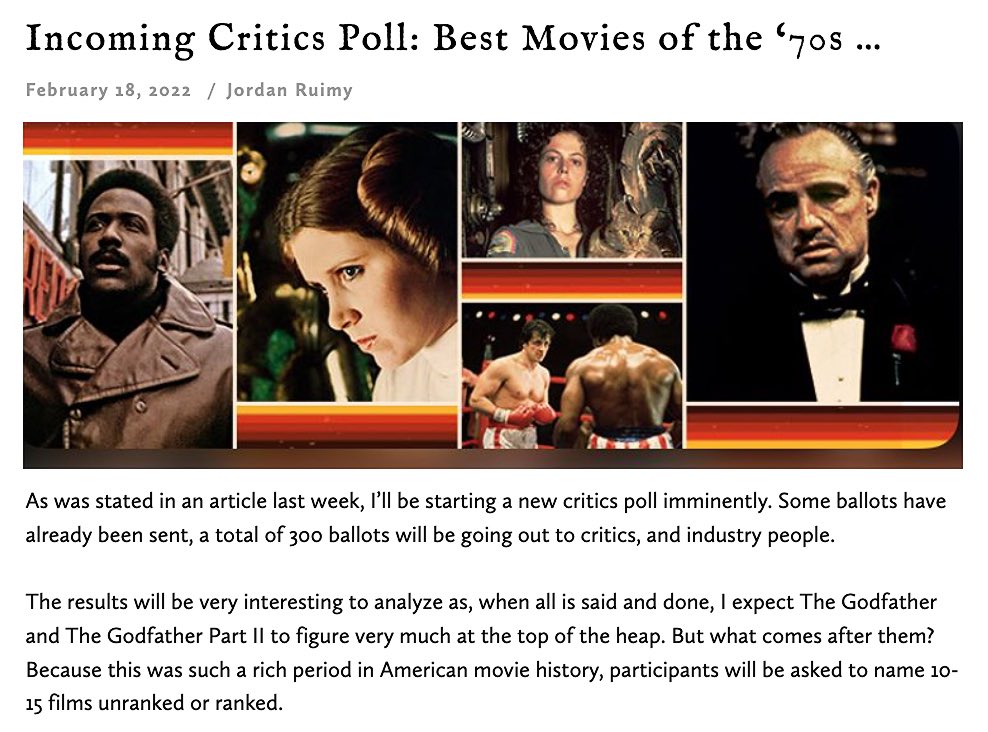
Here’s my actual 15 (ranked): 1. The Godfather (’72), 2. The Godfather, Part II (’74). 3. The French Connection (’71), 4. All The Presidents Men (’76), 5. Assault on Precinct 13 (’76), 6. Network (’76), 7. Serpico (’73), 8. The Last Detail (’73), 9. Chinatown (’74), 10. The Hospital (’71), 11. McCabe and Mrs. Miller (’71), 12. The Friends of Eddie Coyle (’73), 13. Mean Streets (’73), 14. Days of Heaven (’78), 15. Annie Hall (’77).
Just missed the mark…
16. A first-rate, handsomely produced war film driven entirely by character and fate, and with one of the greatest endings ever written (“All glory is fleeting”) — Patton (’70).
17. 75% of a great movie that’s mainly about itself (Coppola, grandiosity, Vittorio Storaro, tracking shots, cinematic opera, Wagner and Valkyries)…pretending to be a Vietnam War film — Apocalypse Now (’79).
18. Not a “great” film but a very good one that contains one of the greatest extended long-take, single-shot finales — The Passenger (’75).
19. A celebration of the rough and tumble that comes with blue-collar, Boston-area hockey + a dose of middle-aged what-the-hell — Slap Shot (’77).
20. Not a great film but a delicious, Damon Rynyon-esque crime fable that I’ve watched at least 10 or 12 times — The Sting (’73).
21. The greatest God’s Lonely Man movie ever made, Paul Schrader incarnate, etc. But the “dating Betsy” portion is ridiculous (Cybill Shepherd would go out with a psycho? He takes her to a 42nd Street porno film?) and the ending, which has always been quite clear to me, has confused too many for too long — Taxi Driver (’75).
22. Arguably the greatest Parisian mood flick ever, containing the most nakedly vulnerable Marlon Brando performance ever, and certainly the strangest, kinkiest and most compelling sexually-driven film-for-the-swells ever made — Last Tango in Paris (’72).
Top-Tier ’70s Films With Nagging Problems: 1. Barry Lyndon (dead-zone third act), 2. A Clockwork Orange (repetitive, overly coincidental plot turns, Alex is going to croon “Singing In The Rain” a second time in the victim’s bathroom?), 3. Halloween (best of the slashers, but a fairly ridiculous conceit), 4. Close Encounters of the Third Kind (dozens of bothersome elements), 5. The Deer Hunter (tedious, overlong opening concerning a Pennsylvania blue-collar wedding, ridiculous Russian roulette playing in Vietnam), 6. Frenzy (lacks tension, believability in some sections), 7. One Flew Over The Cuckoo’s Nest (decent social parable but way over-praised, McMurphy could have left at any time but he stuck around for a lobotomy?), 8. Nashville (snide attitude towards country-music yahoos), 9. Jaws (crafty popcorn excitement but don’t call it a great film), 10. Dirty Harry (smug, unbelievable in some respects), 11. Star Wars (huge hit, iconic franchise launch, nowhere near as good as The Empire Strikes Back), 12. Harold and Maude (too precious); 13. Dog Day Afternoon (absorbing heist dramedy with fascinating lead chgracter, but I didn’t believe Al Pacino‘s bank robber was gay…he didn’t quite convince me).
“I Need To Grovel”
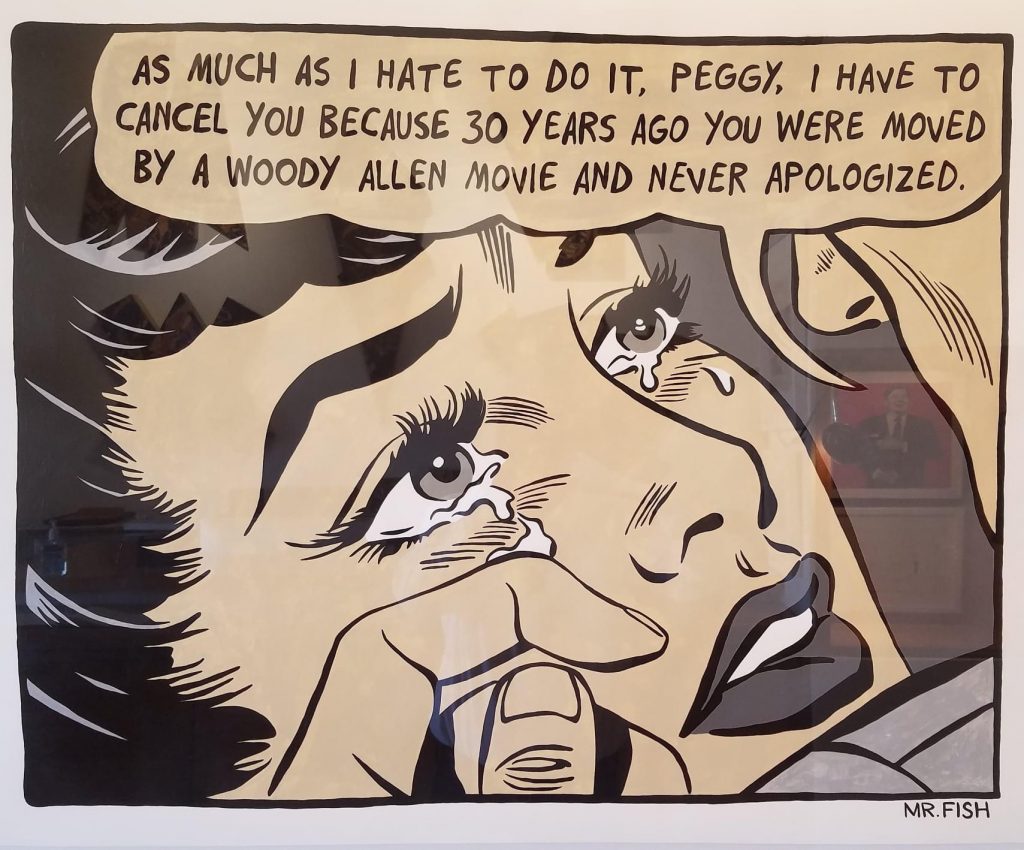
We all know what “learn” means in this context. Bryan Cranston seems to be more or less saying “forgive my privileged white guy sins, which we all know are considerable. Should I list them alphabetically? My shame is absolute.”

Paddy Chayefsky’s “The Middle of the Night”
Decades ago I read a Charles Bukowski recollection about the glorious results of a long, deep sleep. The author-poet had slept for two days straight, and when he finally awoke he felt wonderful. Bukowski’s body felt like $10 million bucks, etc. So I decided to follow suit. Lights out at 9 pm, a good 10 or 11 hours.
I woke up at 1:30 am and couldn’t get back to sleep. I studied my Twitter feed for an hour or so, and then decided to re-watch Steven Spielberg‘s The Post (’17) on the phone. My reaction was roughly the same as it was four years ago — respected the effort, loved the performances, admired Liz Hannah and Josh Singer‘s well-honed script, felt a certain emotional poignancy toward the end.
The Post was nominated for Best Picture and Best Actress (Streep) at the 90th Academy Awards, but Academy members mostly ignored it — identity politics and representation of historically devalued groups were the big concerns. If you ask me The Post didn’t deserve to be dismissed as a self-congratulating, middle-class, big-studio film about journalistic integrity, made by and for well-off, well-educated whiteys. But that’s how a certain percentage of the Academy saw it.
The Post isn’t a journalistic procedural as much as a feminist parable — a story about how Washington Post publisher Katherine Graham (Meryl Streep), who initially saw herself as less than ideally suited to the task and little more than a blandly embedded figure in Washington social circles, gradually grew some courage and a sense of journalistic purpose during the Pentagon Papers episode, which transpired over a 17-day period in June 1971.
In this light, the key scene — Spielberg’s signature moment — comes when Streep emerges from a historic Supreme Court session about the legality of publishing the Pentagon Papers, and several women on the steps gaze with admiration as she passes by.
On the other hand I found myself distracted by those klutzy moments that Spielberg always puts into his films — little errors of judgments that normalize characters by making them seem vulnerable. Graham waking up in her bedroom with several books and files on her bed, and of course they all fall from the bed and onto the floor, loudly. Graham meeting Ben Bradlee (Tom Hanks) inside a posh Washington restaurant, and of course she stumbles and accidentally knocks over a chair. An open-mouthed Washington Post intern visits the N.Y. Times building on West 43rd street, and as he starts to cross the street you just know he’ll almost get hit by a taxi…sure enough, that happens. (I’m fairly sure that another cab screeches to a stop later on.)
I finally got back to sleep at 5:30 am. The Bukowski sleep-in thing will have to wait.
Long-Game “Invaders” Strategy?
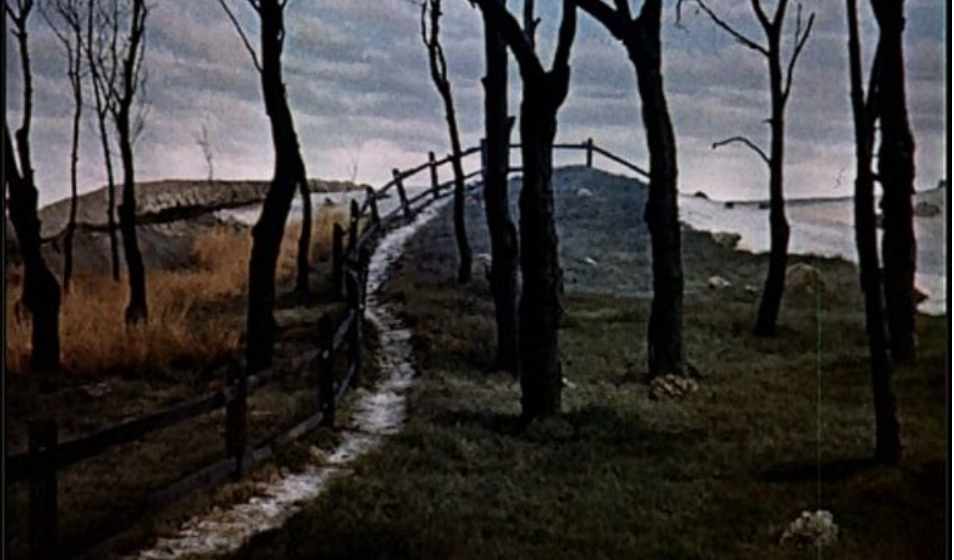
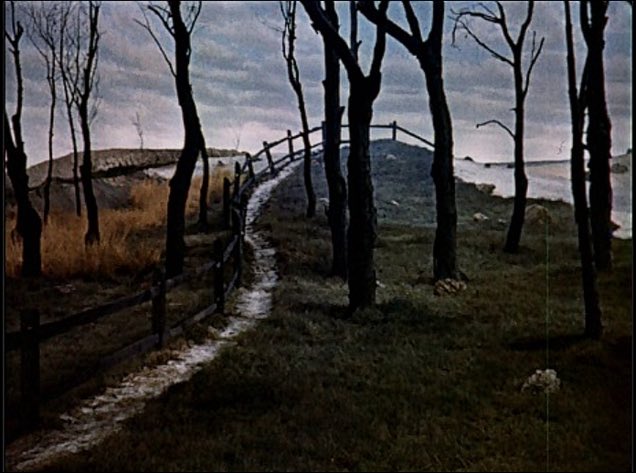
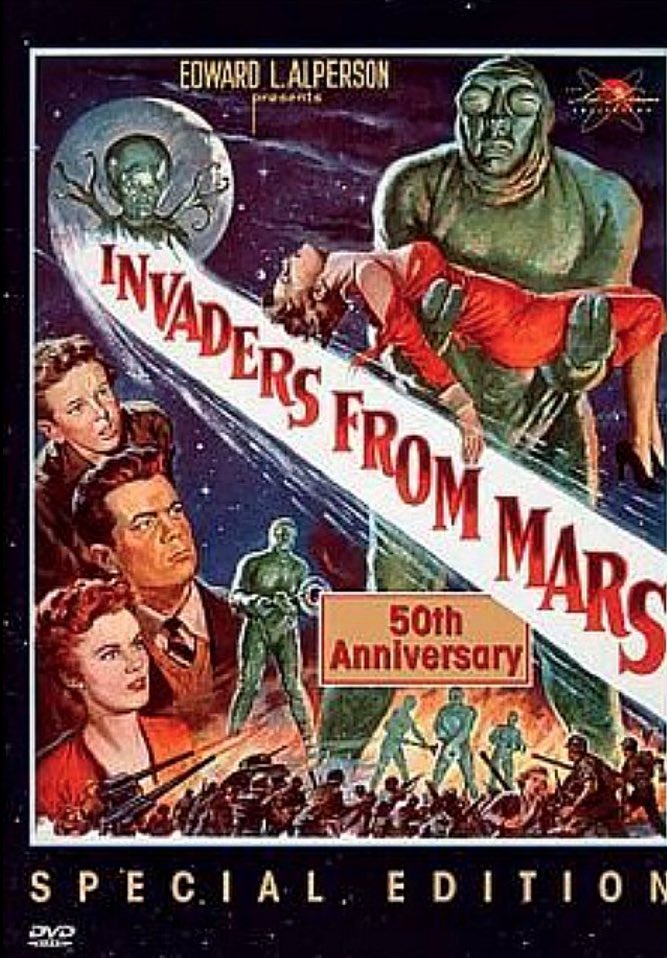
Hollywood Elsewhere suspects that classic-film distributor and alleged rights-squatter Wade Williams, the apparent owner of distribution rights to William Cameron Menzies‘ Invaders From Mars (’53) since the mid ’70s, has a top-secret plan for creating and then distributing a restored 4K Bluray of this legendary impressionist classic.
It was just over five years ago when Williams projected, in a letter to director Joe Dante, that a high-grade restoration of Invaders elements was probably just around the corner and that a reputable distributor of this restored film would soon emerge.
But of course, Williams being Williams, nothing ever happened.
HE can now officially share the above-referenced, fully considered suspicion. Wade’s plan may involve waiting for the inevitable deaths of hundreds of thousands of the film’s boomer-aged fans — movie fanatics who were deeply impressed by Invaders‘ spooky vibe and penetrtating, dream-like hallucinatory impressions during their soft-clay years.
It is entirely reasonable to suspect that Wade’s plan may be to wait for these film buffs (particularly boomers who experienced said reactions to Menzies’ film in their adolescent years)…it’s quite possible that the plan is to wait until all the boomer-aged fans of this film are dead and gone. Once departed and their remains scattered to the winds, Williams will finally assist with a restoration effort and then release and approve a 4K scan of the best extant materials.
Then again a respected inside-track guy who knows all the players has confided the following: “From my knowledge, Wade Williams doesn’t hold controlling rights to Invaders From Mars, nor does he control the original camera negative, so any activity that may occur need not have his approval.”
Buy On Faith or Forget It
As I mentioned last week I’m in the midst of selling the rumblehog and trying to buy a nice little tool-around car — $4K or less. No daily commuting, no long trips, steady as she goes. I’ve looked at several modest vehicles that seemed promising, but which were quickly sold before I had a chance to clear my throat and make a move.
The basic rule is “take a test drive, look the seller in the eye, and then buy with your gut.” That’s because sellers are always evasive when I ask for the VIN# (basic history search), which of course makes me suspicious. And with most of the sellers living in outlying burghs like Compton, Bell Gardens, Long Beach, Santa Ana or Camarillo, arranging to show the vehicle to my West Hollywood mechanic (standard procedure for any sensible person) is damn near impossible.
I’ve been seriously focused on six or seven cars over the last ten days and they were all sold before I had a chance to talk turkey. So if I’m willing to buy a car without having time to search the VIN# (buyers have been resisting this request during initial texting) and I’m willing to buy it without my trustworthy local mechanic (Carlos at the corner of Fairfax and Melrose) having a looksee, I might be able to make the deal.
But if I think cautiously or methodically and meticulously — any stalling or any kind of step-by-step inquiry, or even trying to arrange for a mere verbal conversation — if I do or say anything other than “Yes, I’ll be right over with the money!” — somebody else will swoop in and buy it within a day, and sometimes within hours.
Compton seller last week: “Everyone knows that if you buy a ten-year-old car, you’re buying a car that will experience a few problems. There are no whistle-clean deals…no blemish-free, pure-as-the-driven-show used cars. You just have accept that and go with your gut…”