Respect & Kudos for Coen’s “Macbeth”

With the exception of Screen Daily‘s Stephen Whitty, the critics who’ve seen Joel Coen‘s The Tragedy of Macbeth via the New York Film Festival are not only admiring but in some cases highly enthused.

Right now both Metacritic and Rotten Tomatoes are posting 89% approval ratings.

How does this square with the fact that nothing came of a months-old screening for Cannes topper Thierry Fremaux, and the fact that the Venice Film Festival committee didn’t care for it, and declined to invite it to the recent 2021 gathering.

Variety‘s Owen Gleiberman and THR‘s David Rooney found Coen’s film impressive. To go by their reviews, The Tragedy of Macbeth sounds respectable enough. Perhaps not to everyone’s liking, but certainly a film with integrity and a certain scheme. And yet Venice turned it down.

Nonetheless something about these upbeat notices feels a tad suspicious. Robert Daniels calling it “definitely the bleakest adaptation” of Shakespeare’s tragedy prompts the inevitable “okay but why?” Macbeth isn’t bleak and bloody enough on its own? How does Coen’s decision to make his Macbeth stark and stripped down and lacerating…in what way does this approach enhance the material?

Roman Polanski’s 1971 version of this melancholy masterpiece was and is a knockout on so many levels, and yet critics at the time were partly dismissive because they didn’t care for Polanski having injected his own personal tragedy (i.e., the savage murder of his wife and her housemates two years earlier) into the film. And yet, perverse as this sounds, Polanski’s history gave his Macbeth an urgency and an attachment to the early ’70s zeitgeist; in this context very much alive.

What igniting element has prompted Joel Coen’s film other than wanting to give his gifted wife (Frances McDormand) a chance to play a great role? No Country for Old Men was a superb suspense film about a stalking killer, but it was also about a certain cultural poison that, in the view of original author Cormac McCarthy, had begun to infect the water table. What is informing Coen’s Macbeth in this sense? What’s the echo factor? Does it have one?

Friendo: “It’s no secret that pandemic-era film critics have veered towards hyperbole and over-praising certain films. I wouldn’t be surprised if that’s the case with Macbeth, but I’m very excited to see it. Visually, it looks stunning.”

Read more

Reiterating The Obvious

In the unlikely event that Joe Biden decides against running in ’24, Kamala Harris somehow snagging the Democratic nomination for President would absolutely ensure a Republican win. I admire and respect Harris, but she just doesn’t have it. Even if Donald Trump becomes her Republican opponent…I actually don’t have a reading on that hypothetical race, but God help us if that were to happen. Let’s imagine that Biden declines to run for whatever reason — which potential Democratic candidate could step in and win?

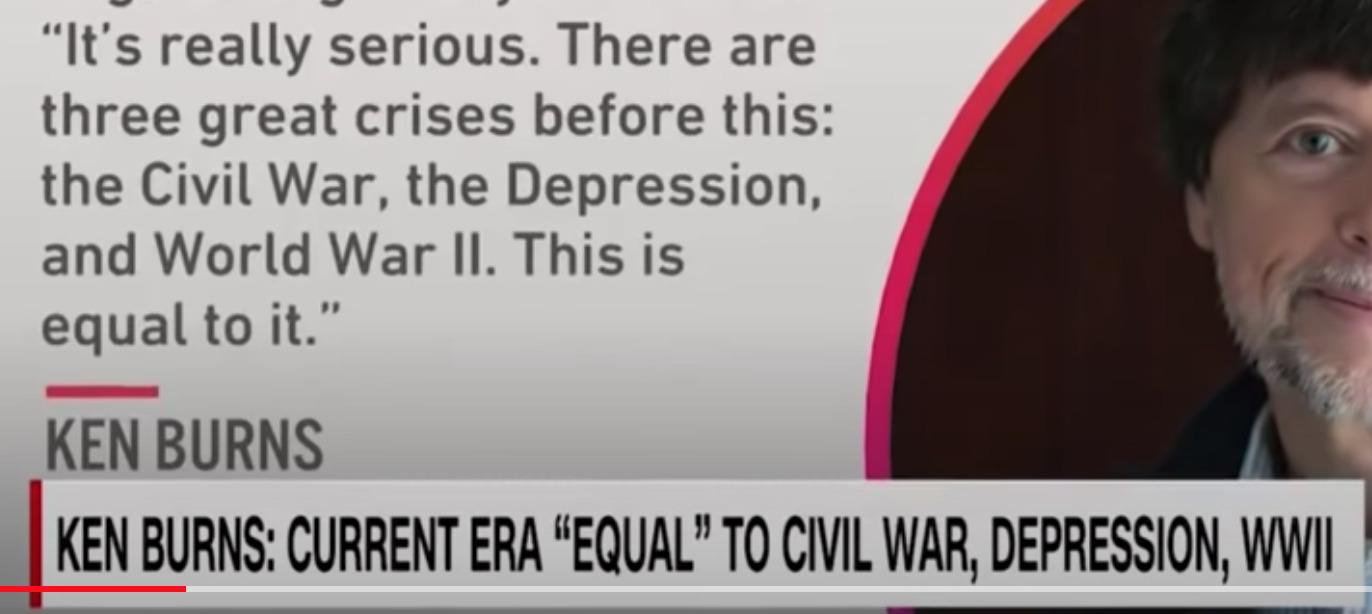
Ken Burns Is Not Exaggerating

The feral insanity on the right (anti-vax, Texas abortion law, Marjorie Taylor Greene, Lauren Boebert, January 6th, dumb-animal Trump loyalty, Ron DeSantis-styled Covid denialism) is born of a sense that culturally, politically and statistically things are winding down for whites, certainly in terms of dominance.

It’s actually more than a “sense” — it happens to be true. It also happens to be true that rightwing morons are doing an excellent job of persuading most of us that they’re foursquare against fairness, maturity, reasonable humanism, rationality, decency.

A half-century ago this country was more or less run by WASP whitebreads + Irish and Italian Catholics, etc. Progressive activist blacks, gays and women were only just beginning to be heard, and now things have more or less reversed themselves — people of color, the #MeToo vanguard and LGBTQs are more or less calling the shots in the big cities and within the big-media realm, and the term “older white straight male” has become an epithet.

Things are shifting and the bumblefucks believe, however unreasonably or ignorantly, that “diversity” means a growing tide of anti-white racism.

This has ignited a sense of blood-level panic and rage, a feeling of “throw out the usual playbook because this is war” rebellion. Especially with the spread of wokesterism and the various diluting-of-tradition signifiers, etc. And so conservative nutters are doing everything they can to load the cannons and fortify the Alamo walls, and to hell with fairness, decency and due process.

The rabid right is freaking out, and Ken Burns is not wrong.

Reaching Out To Idiots

BooneOakley‘s “Don’t get vaccinated” van campaign, which happened last Sunday in Charlotte for only a few hours, should be used nationwide. Earnest pleas to millions of Covid vaccination skeptics to please reconsider and take the stab have not worked among certain pockets of rural white bumblefucks, African Americans and Hispanics so maybe a sardonic negative approach will get through to more of them. (Charlotte vaccinations have reportedly risen around 20% since last weekend.) As we speak roughly 182 million Americans54.8% of the population — have been fully vaccinated, although 77% of U.S. adults have received at least one dose.

Read more

Sleeps Without Fishes

The Spanish section of Jonathan Glazer and Jeremy Thomas‘s Sexy Beast (’00) was shot in Agua Amarga, a small village in the Almeira region on the southeastern coast. The large, white, three-bedroom cliffside home that was occupied by “Gal” Dove (Ray Winstone) and his wife DeeDee (Amanda Redman) is located on Calle Ferrocarill Minero (04149), and is called “El Palmeral“. I can’t tell if rooms inside the home are renting for $164 nightly or if the entire place rents for some other figure.

If you’ve seen Sexy Beast, you’ll appreciate this Google Maps photo of the home and the mention of a certain character just south of the residence (i.e., the swimming pool).

Read more

McDormand’s Snippy Response to Rudin Question

In a just-up interview with The Tragedy of Macbeth‘s Joel Coen and Frances McDormand, Deadline‘s Michael Fleming tries to detour them by asking about producer Scott Rudin, with whom Coen and McDormand have worked many times.

Fleming mentions something he’s heard about Coen and McDormand having witnessed “a Rudin outburst toward an underling and not reacting.”

Toward the end of the Rudin discussion McDormand gets a little testy. She basically tells Fleming that they’re finished talking about Rudin, and that the interview may be over if he continues in this vein. Here’s the transcript.

Fleming: “[The Tragedy of Macbeth] was originally hatched with producer Scott Rudin, with whom you collaborated on in the Best Picture Oscar winner No Country for Old Men and other things. His name is not in the credits; he put himself on sabbatical after his bullying behavior toward subordinates was exposed by THR. His bullying was widely known in industry circles but presented and reframed by THR in this #MeToo moment, it created an outcry for him to be gone, despite him being an undeniable champion of taste-making subject matter like The Tragedy of Macbeth, which has always been hardest to get made. There was a report there that both of you witnessed an outburst by him toward an underling, and not reacting. It has nothing to do with what I just saw onscreen, but it is out there. What can you say about all this?”

Coen: “To work backwards from your question. I’ve made a number of movies with Scott over the years. I’ve known him since I started making movies, probably when he was head of production at Fox on our second movie, but if you look at all of the producers out there in the world, there aren’t that many who you would say, well, making an adaptation of Macbeth is a natural fit for the two of us. I mean, there’s Scott and then there’s nobody else that you would say that about. So, knowing him and having made movies with him, he seemed absolutely natural to go to with this, and in fact, he was. So, that’s that part of it.

“As far as the allegations and Scott’s behavior, yes, I think there isn’t anyone who works in the business who hasn’t heard those stories over the last however many decades that Scott has been working. Yeah. I hear stories about all kinds of people, I myself have witnessed all kinds of behavior. I never witnessed any of it with Scott, absolutely never. But on the other hand, I heard the stories and to a certain extent, I didn’t doubt the stories. I knew there was…you hear a lot of it and you figure a lot of it is probably true. But like I say, I hear stories about lots of people and I’ve seen questionable behavior from lots of people, but I never, ever saw anything like that from Scott. I don’t condone it, of course, but I never saw it.

“As far as people saying that we did, I just want to say this. I’ve been making movies for almost 40 years, Fran has been making movies that long, I think both Fran and I have reputations, and you can ask anybody we’ve worked with, for being aboveboard and honest, and the honest truth is I never saw it. So, I know I’m being honest about that. You can ask anybody who knows us whether they believe we’re honest about that.

Read more

Roger Michell (1956-2021)

HE is sorry to report that director Roger Michell has passed at age 65 of an unstated cause. It can be deduced that his death was sudden and unexpected, as Michell was at Telluride only three or four weeks ago with his latest film, The Duke; he was also talking about working on a forthcoming documentary.

Michell was not what you’d call an auteur-level director with a signature style, but he was a little bit like John Schlesinger. He had an eye for engaging, first-rate material and was notoriously good with actors.

Michell’s peak moment happened over a three-year period with Notting Hill (’99) and Changing Lanes (’02) — a hugely popular Julia Roberts-Hugh Grant romcom and a brilliant, racially-charged urban drama costarring Ben Affleck and Samuel L. Jackson. His next two films — The Mother (’03) and Enduring Love (’04) — were highly unconventional relationship films costarring Daniel Craig, the former about a love affair between a home renovator (Craig) and a woman in her ’60s (Anne Reid) and the latter about the hippie-ish Rhys Ifans developing a strange fixation upon Craig following an air-balloon accident.

The came Venus (’06), an engaging comedy drama with Peter O’Toole, and Morning Glory (’10), a peppy Broadcast News-like vehicle that costarred Rachel McAdams, Harrison Ford and Diane Keaton. I happened to go apeshit over the latter.

Michell’s subsequent films were Hyde Park on Hudson (’12), Le Week-End (’13), My Cousin Rachel (’17), Nothing Like a Dame (’18), Blackbird (’19) and The Duke.

“We are devastated and shocked by the news of the passing of our dear friend Roger Michell. We were just with him a few weeks ago in Telluride with The Duke celebrating his exceptional accomplishment. Roger was a world class filmmaker, one of the best AND and one of the loveliest and warmest people you will ever meet. We have been close since 1995 when we brought him and his first film Persuasion to Telluride. Our heart goes out to his family and friends who are experiencing the profound sadness we all share.”
—- from Michael Barker, Tom Bernard and the entire Sony Pictures Classics team.

“Stripped-Down, Impressionistic” Shakespeare

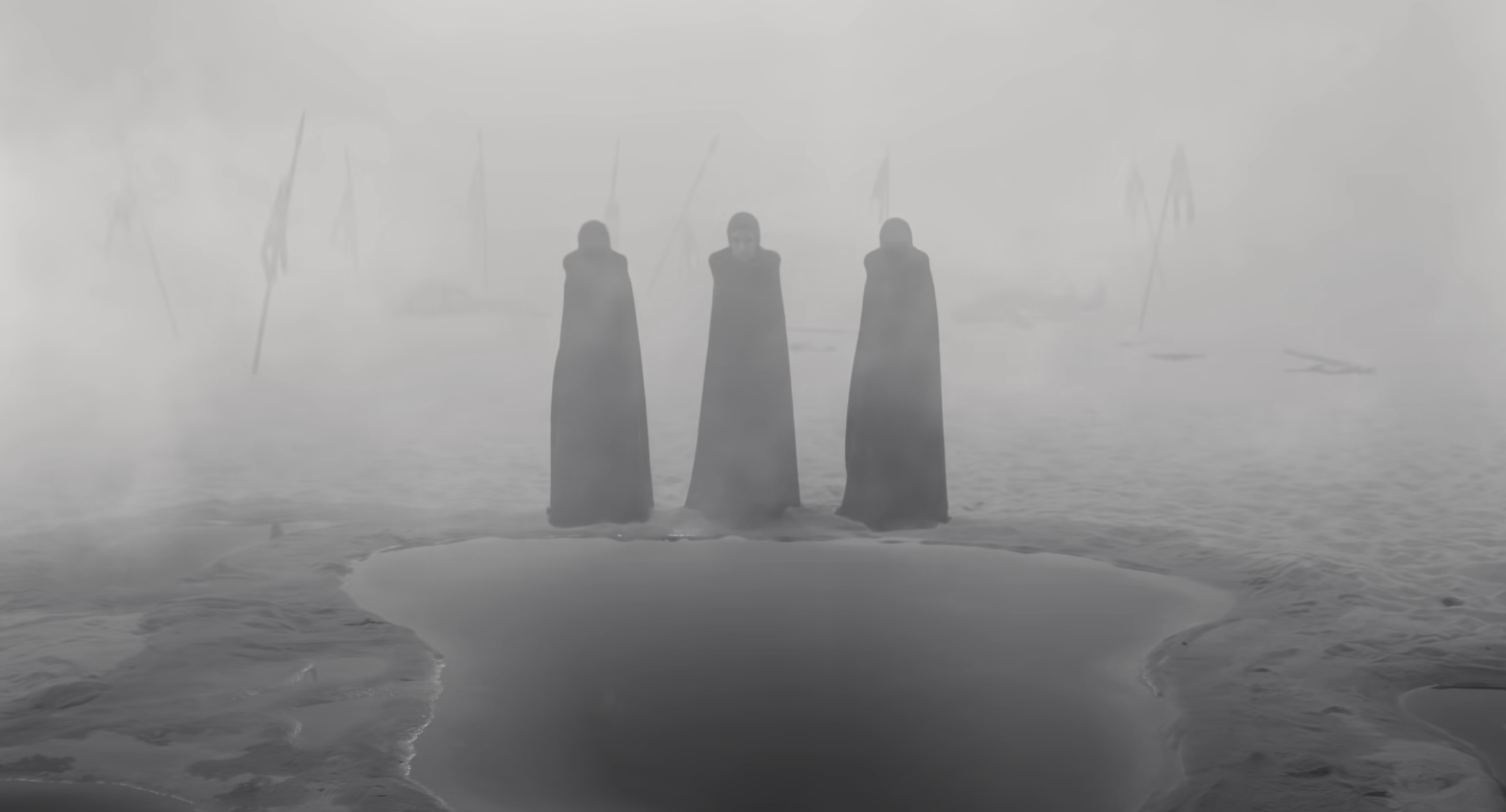
All indications suggest that Joel Coen‘s The Tragedy of Macbeth (debuting tomorrow at the New York Film Festival) may be on the visually restricted side. It was shot on sound stages and in black and white — exactly the opposite approach taken by Roman Polanski‘s open-air, braving-the-elements, full-color 1971 version that I just rewatched a couple of days ago, and found bracingly realistic and fully alive.

N.Y. Times Manohla Dargis: “Blood and betrayal, toil and trouble — filmmakers from Akira Kurosawa to Roman Polanski have taken on Macbeth. In his stripped-down version, Joel Coen pitches his expressionistic tent between cinema and theater, taking a lead from Orson Welles, whose 1948 adaptation” — shot on hand-me-down western sets in Studio City — “was one of his last Hollywood films.

“Is this an ill omen from Coen?” [HE interjection: An ill omen in what sense?] The play is still the thing and so is a volcanic Denzel Washington, who ferociously embodies, as Welles put it, ‘the decay of a tyrant.'”

An “expressionistic tent” suggests something inventive but shrouded, protected from the elements, a realm with limits. Dargis also implies that Coen’s film is as much of a theatrical piece as a movie. In other words, a film that may strike some as confining, perhaps even under-oxygenated….maybe. We shall see what we shall see.

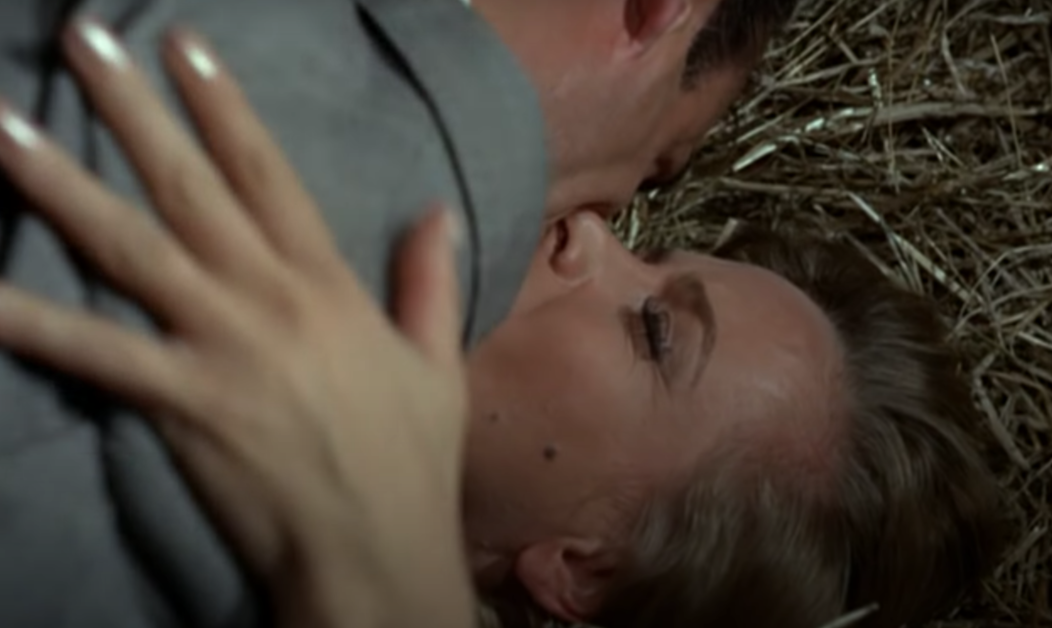
Pussy Galore Isn’t “Raped”

No Time To Die helmer Carey Fukunaga to THR‘s Tatiana Siegel: “Is it Thunderball or Goldfinger where, like, basically Sean Connery’s character rapes a woman? She’s like ‘No, no, no,’ and he’s like, ‘Yes, yes, yes.’ That wouldn’t fly today.”

Of course it wouldn’t. Such a scene would never be considered. But it didn’t “fly” 57 years ago either.

Even by mid ’60s standards the Goldfinger “barn” scene was a silly jape. The joke was that Connery’s 007 was such an irresistable hound that even Honor Blackman‘s Pussy Galore, an avowed lesbian, succumbs to his overbearing masculinity after resisting for three or four seconds. Remember also that Blackman’s surrender happens after a judo match in which she and Connery throw each other around.

True, Connery is on top of Blackman during the moment of capitulation, but the attitude is half-comedic. The playful music conveys the mood.

Perhaps Fukunaga is partly recalling a scene from Alfred Hitchcock‘s Marnie, in which Connery’s Mark Rutland actually rapes the frigid titular character (Tippi Hedren), whom he’s just married. Marnie and Goldfinger were released the same year (’64) and two months apartMarnie on 7.22.64, Goldfinger on 9.18.64 (in England) and 12.22.64 (in the U.S,).

Read more