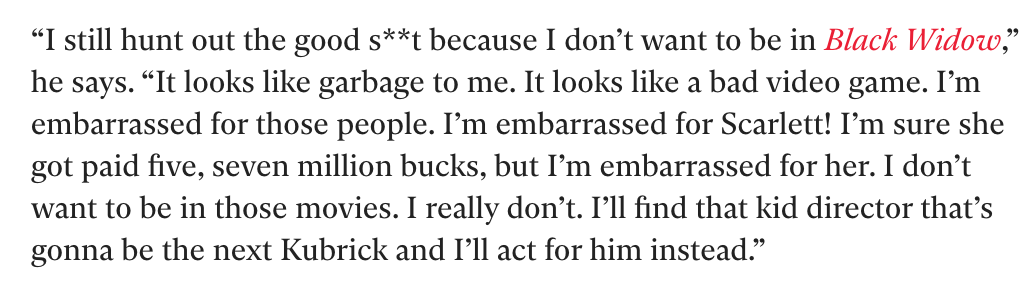
As much as I despise the idea of paying money to see Black Widow, the seemingly reprehensible Marvel newbie from director Cate Shortland and the evil, cap-wearing Kevin Feige, I’m determined to experience the big, full-blast whomping bullshit effect by catching it on a large IMAX screen. I’ll be submitting sometime later this afternoon, probably at the AMC Century City.
I know I’m going to HATE it, but I have to do this. For years I’ve hated most things (85% to 90%) Marvel. Oddly, in a strange way, I can’t wait to get my seethe on: “Towards thee I roll, thou all-destroying but unconquering Marvel poison; to the last I grapple with thee; from hell’s heart I stab at thee; for hate’s sake I spit my last breath at thee.”
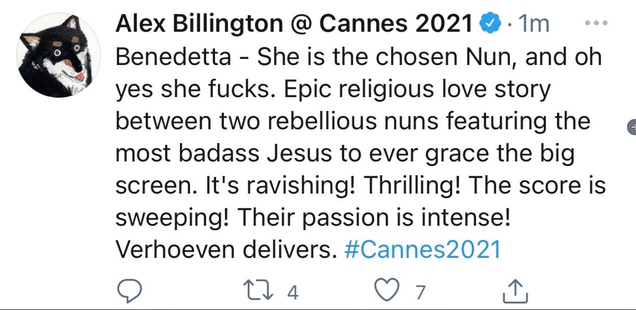
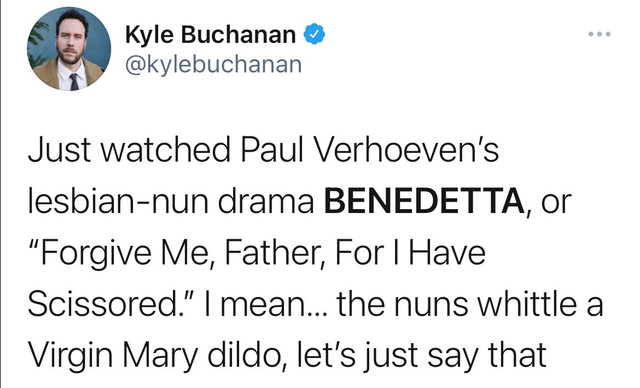
HE to Jordan Ruimy: “I’m loving the wild reactions to Paul Verhoeven‘s Benedetta, and especially Kyle Buchanan‘s reference to a Jesus Christ figurine used as a sexual tool. Man to man, Jordan, and no beating around the bush: a small sculpture of Christ is used as a dildo…right? Please tell me this is true.”
Ruimy to HE: “Yes, sir. Carved to penis size because she wanted it deep and the nun’s fingers weren’t lengthy enough.” [Note: The Telegraph‘s Tim Robeyclaims that the sexual tool is “a whittled statuette of the Virgin Mary.”]
Does anyone remember the rightwing Christian loon response to descriptions of Willem Dafoe‘s Jesus having sex with Barbara Hershey‘s Mary Magdelene in The Last Temptation of Christ (all of it imagined as he experiences doubt and agony as he hangs on the cross and dreams about having lived a normal life)?
I saw Last Temptation at the Century City Plitt on the day it opened (8.12.88) and when it was over we encountered a mob of devout Orange County nutters howling about religious sacrilege.
Does anyone remember how Warner Bros. refused to integrate the infamous “rape of Christ” sequence into a DVD/Bluray director’s cut of Ken Russell‘s The Devils, presumably out of fear that heartland Christians would freak out over a group of naked, sexually frenzied nuns (Vanessa Redgrave among them) using a statue of Christ to grind out orgasms?
Judging by the heated Benedetta descriptions, The Last Temptation of Christ and The Devils were mere dabblers in terms of blending representations of the Son of God with sexually perverse eroticism.
When Benedetta opens stateside your deranged righties are going to have a field day…Tucker Carlson! And the left can point to relentless rightwing sexual hypocrisy over the decades, not to mention The Eyes of Tammy Faye.
The anti-Benedetta chant will go something like “hot lesbian action defiling the image of Jesus of Nazareth…this diseased Paul Verhoeven fantasy gives us an idea of what Christianity under the left is headed for…sweaty paganism spilling sex juice over the image of our Lord and Savior…these people are beyond sick…stop them at the ballot box in ’22! This is disgusting!”
FriendotoHE: “Val Kilmer may have been very shrewd to have his son speak his lines in that Val documentary. You’ll recall that Jack Hawkins, a heavy smoker who had his larynx removed, continued to act thanks to having all his dialogue looped in post by Charles Gray. He was still employable despite having a voice that sounded like Kilmer’s. Kilmer will surely be able to do the same thing with his son providing a voice.”
Working backwards from today, here are (a) Hollywood Elsewhere’s ten best fictional presidents and (b) best portrayals of historical presidents in feature films. Yes, I’m allowing for Saturday Night Live and other comedic portrayals.
FICTIONALS (in order of preference): 1. Lee Tracy, The Best Man; 2. Peter Sellers, Dr. Strangelove, 3. Jack Warden, Being There; 4. Donald Moffat, Clear and Present Danger; 5. Henry Fonda, Fail Safe; 6. John Heard, My Fellow Americans, 7. Harrison Ford, Air Force One; 8. Jeff Bridges, The Contender; 9. Walter Huston, Gabriel Over The White House; 10. Kevin Pollak, Deterrence.
JOE BIDEN: Jim Carrey on SNL. 2nd Best — Jason Sudeikis, SNL.
DONALD TRUMP: Thomas Mundy. 2nd best — Jeff Bergman, Our Cartoon President. 3rd best — Brendan Gleeson, The Comey Rule.
BARACK OBAMA: No opinion. Okay, SNL’s Jay Pharoah was fairly decent.
RONALD REAGAN: Phil Hartman, SNL. 2nd best — Tim Matheson, Killing Reagan.
JIMMY CARTER, GERALD FORD: Nobody. (Chevy Chase made no attempt to impersonate Ford.)
RICHARD NIXON: Rip Torn, Blind Ambition.
LYNDON JOHNSON: Randy Quaid, LBJ: The Early Years (’87).
JOHN F. KENNEDY: There’s never been a truly first-rate JFK, ever. That said, Bruce Greenwood wasn’t too bad in Roger Donaldson‘s Thirteen Days. Worst — William Devane, The Missiles of October.
Rick Rubin to Paul McCartney: “When could you look back and realize [that] what we did back then was really special?”
If I was interviewing McCartney I would never ask a question as moronic and simple-dick as that…ever. Creative people never look back and say “wow, I was really rumbling with high-test gas when I did this or that”…never! You never stand back and give yourself a review…ever. If you’re somehow possessed of something special and exceptional and God-sent, you just go with it. You go with it and hope that it takes you someplace worthy and nutritious. And that’s it. Nothing more or less than that.
I think we’ve all understood for the last 10 to 15 years and certainly since the pandemic hit that the lore and religiosity of film…the faith and investment and occasional wonder of movies as it used to exist in the ’70s, ’80s, ’90s and even the early aughts is over…a few welcome exceptions aside, the beating heart of movies as it used to be is in permanent cardiac arrest…double kaput and triple fucking finito.
But just to be sure that we all understand this without the slightest trace of ambiguity, former Paramount and 20th Century Fox honcho Barry Diller has repeated the death mantra in so many words:
“The movie business is over,” Diller said in an exclusive interview with NPR’s David Goura during the Allen & Company Sun Valley Conference. “The movie business as before is finished and will never come back.”
Diller’s remarks sounds better if you add the “f” word so here they are again, augmented: “The movie business that we used to know is fucking over. It’s fucking finished and will never fucking come back.”
“There used to be a whole run-up,” Diller said, remembering how much time, energy and money studios invested in distribution and publicity campaigns. The goal, he said, was to generate sustained excitement and enthusiasm for new movies. “That’s finished,” he said. “I used to be in the movie business where you made something really because you cared about it,” he said, noting that popular reception mattered more than anything else.
Best Diller quote: “These streaming services have been making something that they call ‘movies.’ They ain’t movies. They are some weird algorithmic process that has created things that last 100 minutes or so.” The definition of “movie,” he said, “is in such transition that it doesn’t mean anything right now.”
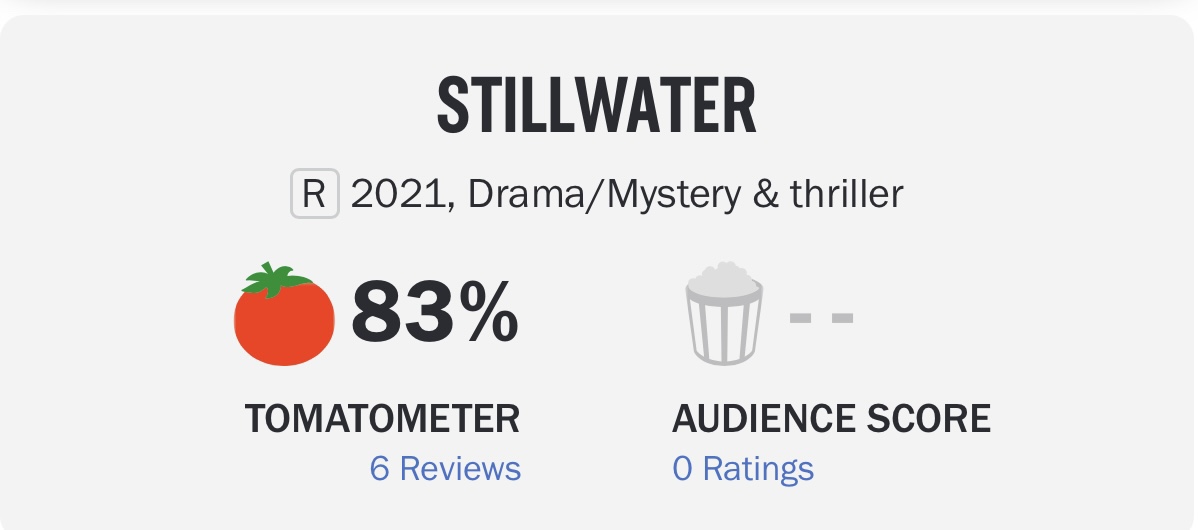
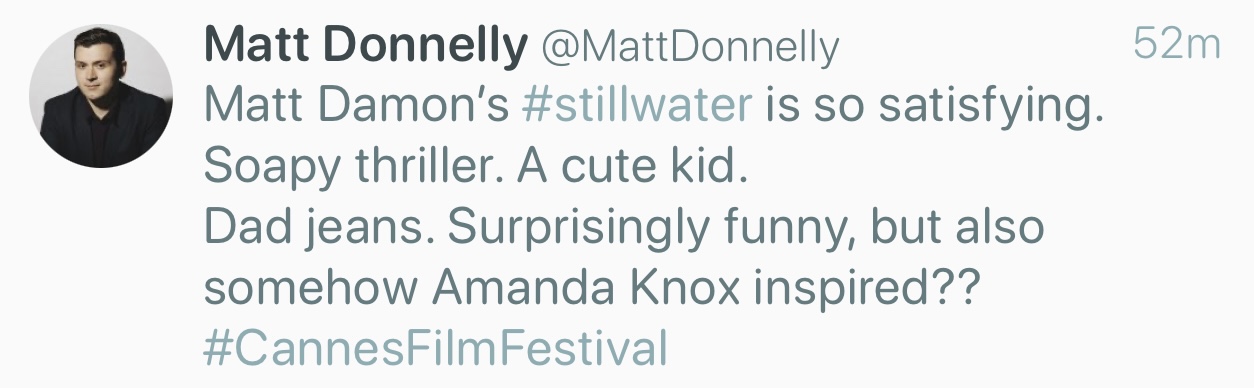
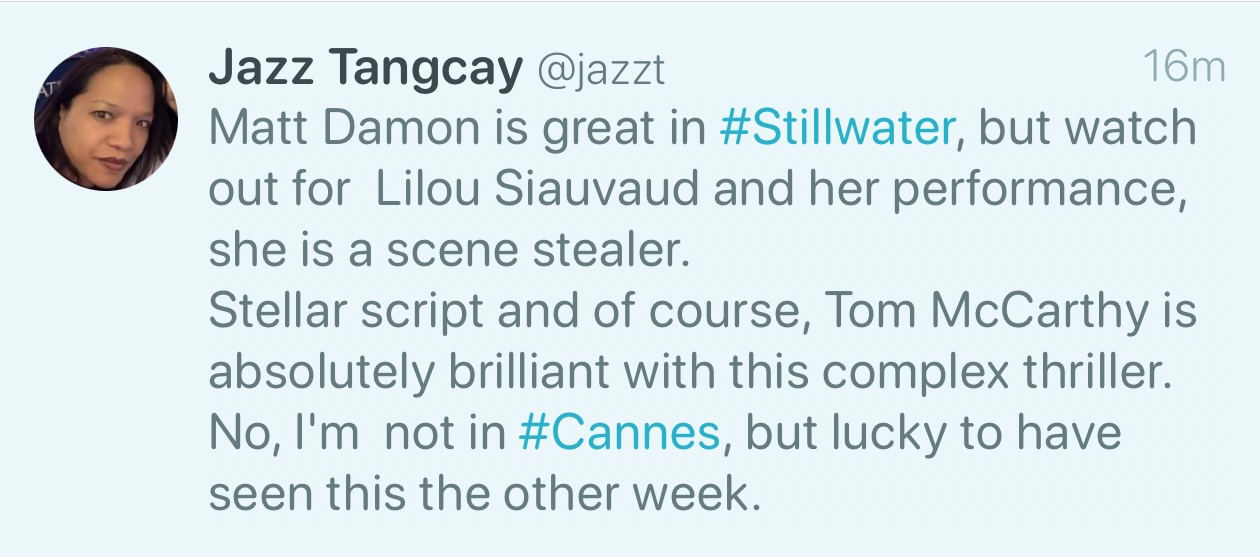
The Stillwater praise out of Cannes is fairly strong but I’m a bit leery. Something feels wrong or the wrong people are cheering it on. Can’t put my finger on it, but for the time being I’m just gonna wait. Update: The more reviews I read, the more promising Stillwater sounds.
Indiewire‘s David Ehrlich: “A strained but strangely affecting turducken of a movie that bakes a dad-on-a-mission thriller together with a heartwarming fish-out-of-water story and then a brutal crime drama before glazing the whole thing with a marvelously goateed Matt Damon, Tom McCarthy’s Stillwater is the kind of original Hollywood production that would make you say “they don’t make them like that anymore” if only they had ever made them quite this way in the first place…equal parts Taken, Paddington and Prisoners, one after the other.”
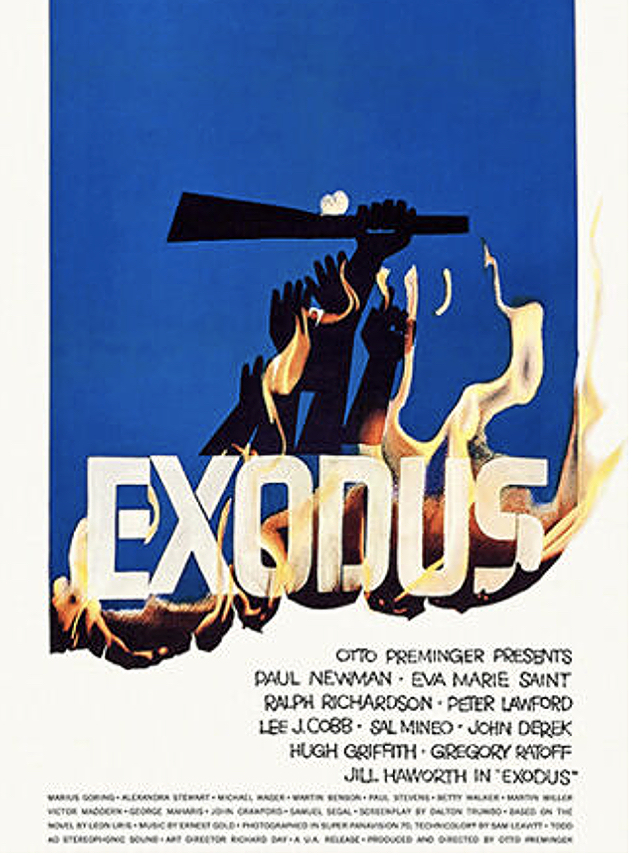
Even among hardcore cineastes, interest in or even awareness of Otto Preminger‘s Exodus (’60) is minimal. A 208-minute historical drama about the founding of the state of Israel in 1948, Exodus is a sluggishly paced if decently made film, handsomely shot in widescreen 70mm color by Sam Levitt (The Defiant Ones, Anatomy of a Murder, Pork Chop Hill) and efficiently performed by Paul Newman, Eva Marie Saint, Ralph Richardson, Peter Lawford, Sal Mineo, Jill Haworth, Lee J. Cobb, et. al.
Preminger’s decision to hire and openly credit the formerly blackballed Dalton Trumbo as the sole Exodus screenwriter did a lot to end the Hollywood blacklist era of the ’50s. Kirk Douglas‘s Spartacus, which opened two months before Exodus in early October, has also been credited with doing the same. The Spartacus-Exodus one-two punch.
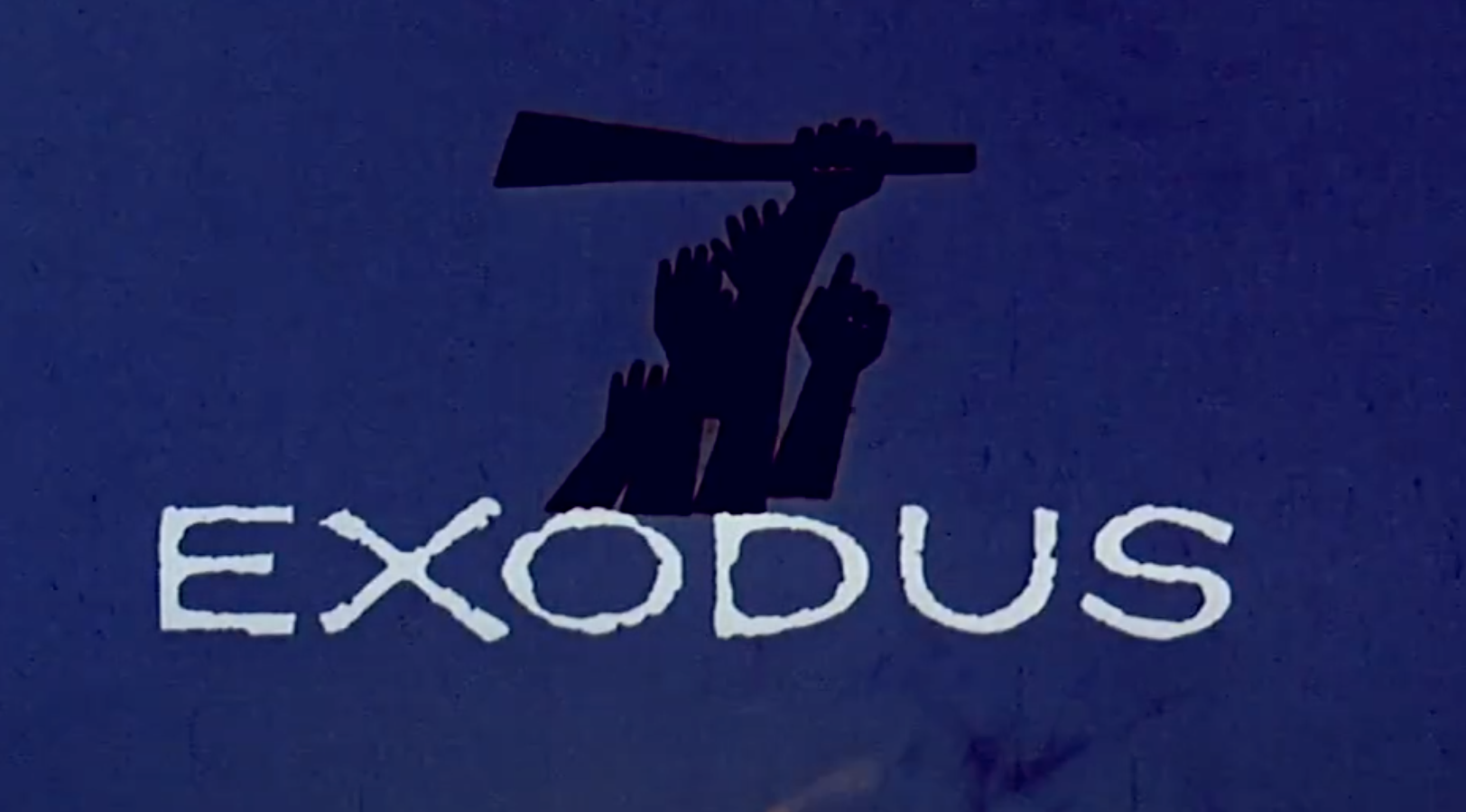
60 years on, there’s only one remnant of Preminger’s film that has lingered into the 21st Century, and that’s Saul Bass‘s Exodus logo — that image alone has held on and persisted. Nobody remembers the film, but everyone knows that image of armed rebellion and revolution.
Ultrasound images of unborn babies developing in their mothers’ warm amniotic fluid were fairly primitive in the late ‘80s. Things are much more advanced today. I would use the word “startling.” As would Rene Magritte if he was among us.
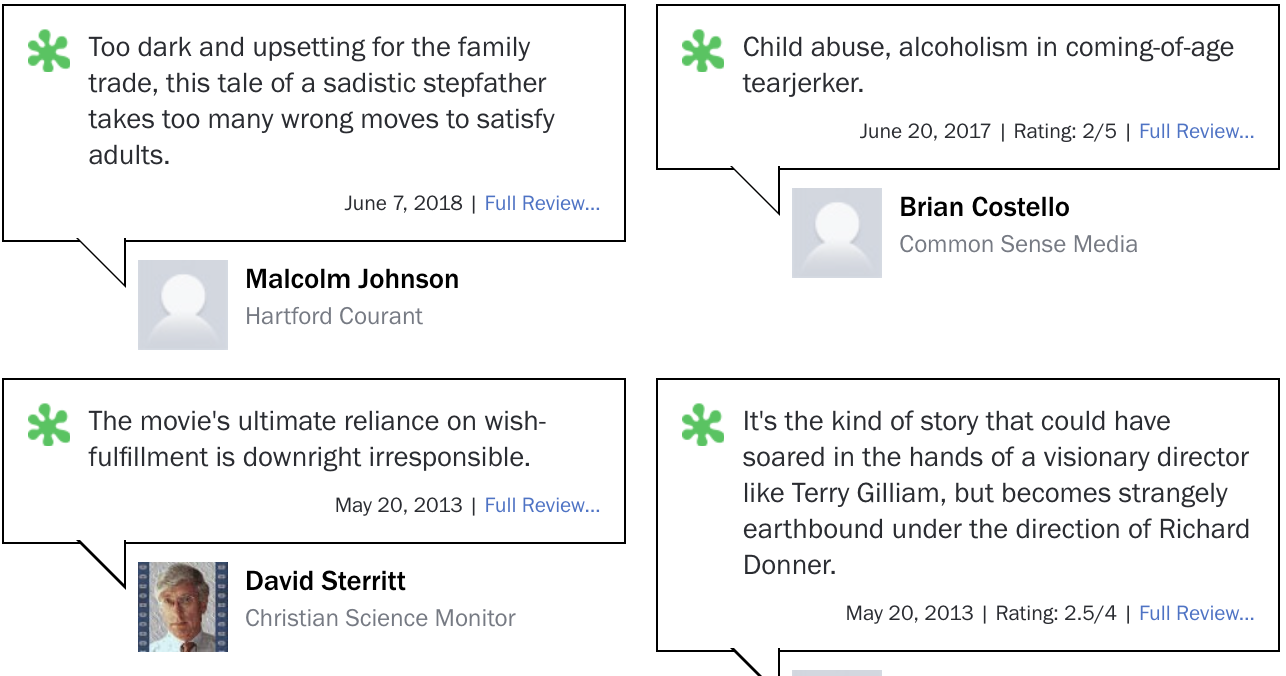
Richard Donner‘s Radio Flyer was mostly dismissed when it opened 29 and 2/3 years ago (2.21.92). People of taste were appalled. And yet this dreadful little film, which lost a ton of money (made for $35M, earned a lousy $4.75 million) has a current RT audience score of 73% — three out of four Joe Popcorn types approve!
I’m presuming that no one in the HE commentariat will defend Radio Flyer, but maybe I’m wrong. Obviously something about it appealed to people during the final year of the George H.W. Bush administration, but what exactly? The initial word was that it was a Spielberg thing, but of course it wasn’t.
HE question: What kind of diseased, depraved mother (i.e., Lorraine Bracco‘s Mary) marries an abusive animal (Adam Baldwin‘s unseen “King”) and turns a blind eye to abuse of her own sons?
From Owen Gleiberman‘s EW review (dated 2.28.92): “It’s 1969, and Bobby (Joseph Mazzello) and Mike (Elijah Wood), two brothers with matching doleful expressions, have just traveled cross-country with their newly divorced mom (Lorraine Bracco). The three arrive in a beautiful, wide-open section of Northern California, where their cozy suburban street is nestled within a beckoning expanse of sun-dappled hills.
“As the boys roam their pastoral surroundings, each new encounter takes on the aura of a storybook adventure. They open the door to the toolshed, and a ‘monster’ pokes forth its bald, reptilian head; actually, it’s just the harmless old turtle who lives there. There are bullies to frighten them (and to frighten off with their trusty German shepherd). And there are wishful reveries inspired by their red Radio Flyer wagon — dreams of rolling off that big hill near the airport and flying, really flying, the way a boy named Fisher did years ago, when (according to legend) he powered his bicycle right up into the air.
“The music gushes, the late-afternoon sunlight glints, and one half expects to look up and see E.T. himself grinning from the nearest bush. Yet even as Radio Flyer seems a tribute to the magic of childhood, an undertow of darkness develops. The boys’ mother has quickly remarried; her husband (Adam Baldwin), a sadistic, beer-swilling roughneck, directs his rage toward quiet, defenseless little Bobby. We learn that he’s been beating the child, giving him huge brown welts all over his back. Bobby, though, is reluctant to tell his mother, and he makes Mike swear to keep his secret.
“For the entire movie, the stepfather’s face remains hidden in shadow. He appears, instead, as a malevolent specter: a hand reaching into the fridge for yet another six-pack, a voice barking out caustic threats. Radio Flyer wants to show us how a man this vicious could seem, in Bobby’s eyes, a kind of abstraction, less a human being than a monstrous force. At the same time, the movie suggests that children escape intolerable situations by withdrawing into a cocoon of streamlined fantasy.
“Donner keeps his camera at a serene distance, so that we seem to be eavesdropping on the two boys. Elijah Wood, in particular, holds the screen — he has a beautifully inquisitive face, with eyes like liquid marbles. Despite flashes of sensitivity, though, the movie is so rigid and programmatic about contrasting its light and dark sides — the horror and the dream-retreat — that it seems fundamentally schizoid.
Earlier today THR‘s Scott Feinbergwrote that Leo Scott and Ting Poo‘s Val, a portrait of Val Kilmer, was “rapturously received” at the Salle Debussy (and by The Hollywood Reporter‘s Sheri Lindenin her review).
Val will be released on Amazon Prime on 8.2.21.
Feinberg: “The film is comprised largely of footage shot by Kilmer, who broke through as a dashing 26-year-old in 1986’s Top Gun, over a span of several decades, intercut with footage of him in the present day as a 61-year-old navigating life with a breathing tube, the result of a tracheostomy that he underwent after receiving radiation to treat throat cancer. Needless to say, the contrast is striking.
“But the doc is not a pity party. In fact, it’s an often funny and brutally honest portrait of an artist — someone who early in his career was labeled a cocky, difficult pretty boy, but who was actually a grief-stricken (his younger brother drowned at 15), ambitious (the youngest student accepted at Juilliard at the time) and committed but frustrated artist (we see him tirelessly rehearsing Shakespeare), and remains one to this day, albeit in artistic endeavors that do not require the use of his voice.”
The Val footage was shot by Kilmer over decades, and the narration, voiced by son Jack Kilmer, was written by the actor. So the voice that narrates the trailer, obviously, is Jack’s. They definitely sound alike, or used to.
True stuff: I went to a party at Kilmer’s Hollywood Hills home sometime in early ’03. (Bill Maher was there also.) I never regarded Kilmer as anything more than just a name-brand actor I’d said hello to once or twice, but he was a friendly host that night. Cool to shoot the shit with. We talked about The Saint.
Three years later I did a fair amount of reporting on an Entertainment Weekly hit piece about the tumultuous shooting of The Island of Dr. Moreau. At one time or another the piece was called “Psycho Kilmer, Qu’est ca c’est?”
In 2011 I was interviewing Judy Greer at a West Hollywood La Pain Quotidien about her award-calibre supporting performance in Alexander Payne‘s The Descendants. Kilmer was there also, and we exchanged curt smiles and waves without speaking. We waved at each other again as he left 15 or 20 minutes later. When it came time to pay the bill for Judy and myself, I was told by the waitress that Kilmer had paid it.