JFK’s Occipital Head Wound Still A Myth

Less than a month hence Oliver Stone’s JFK Revisited: Through the Looking Glass, an in-depth documentary, will be screened and reviewed in Cannes, and we’ll all be obediently diving back into that Dealey Plaza sinkhole once again, for the umpteenth time.

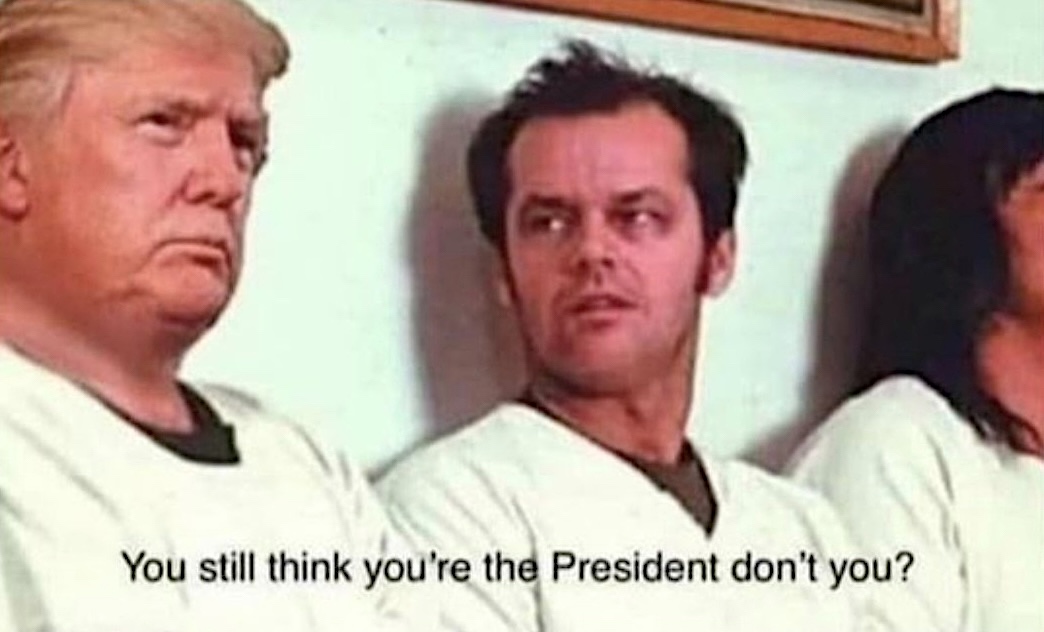
The basic Stone view is that the JFK kill shot came from the grassy knoll, and that the back of his head was blown out with brain matter spilling onto a Parkland Hospital stretcher 10 or 15 minutes later. I’m not doubting what this or that Parkland doctor claimed he saw in emergency room #1, but Hollywood Elsewhere has never seen one glimmer of visual evidence to suggest that the back of JFK’s head was destroyed…nothing whatsoever.

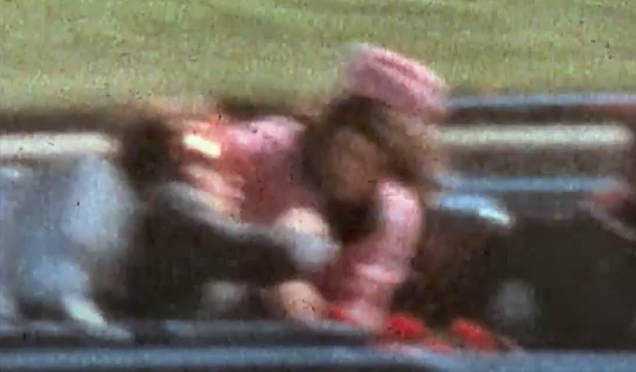
In the Zapruder film it’s JFK’s right temple that explodes, not the rear of his head, plus a split second after the fatal shot Jackie Kennedy‘s white-gloved hand touches the back of his head — how come that glove wasn’t soaked with blood and brain matter?

Oliver Stone to Bloomberg News, 11.15.13 / 2:48: “The evidence in the case…you have to look at the evidence and apply common sense….in my mind the nub of JFK (’91) is that Kennedy was shot from two sides…he was shot from the back and he was shot from the front. And no matter how you fancy up the evidence and talk about gravitational physics and neuro effects and jet effects, it’s all blah-blah-blah.

“The man you see in the Zapruder film and [what] the autopsy revealed [along with] people who saw him right at that moment, right after the death…they all talk about the big shot, the kill shot was from the front. Shot in the front [actually the right temple] of his head, and it blew out the back of his head. It’s what people kept seeing, and they still see it to this day.

“People who were at the autopsy revealed to the assassination records review board that the autopsy photos that are now in the national archives have no resemblance to the head wound that they saw in Bethesda.”

Read more

The Great Ned

The monumental Ned Beatty has passed at age 83.

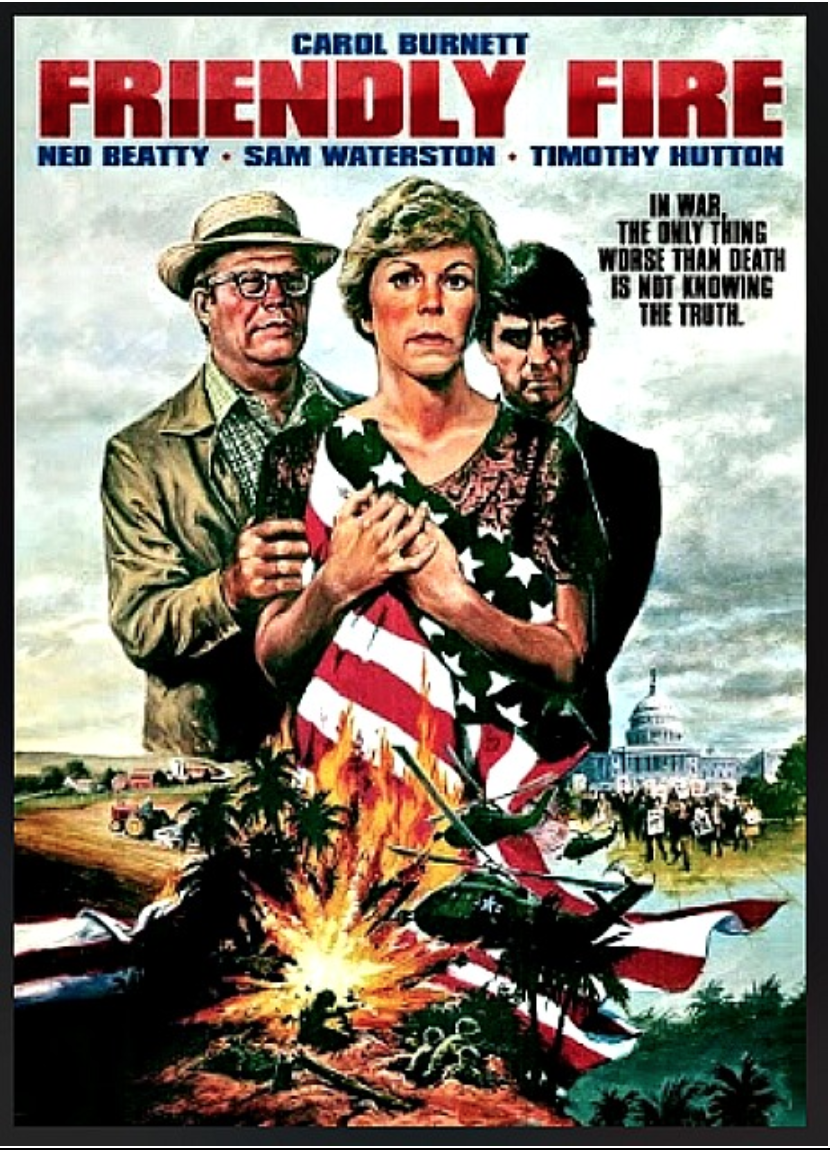
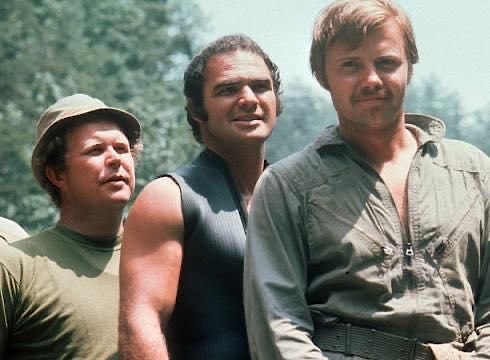
He was damn good at whatever and whomever he played, but when you boil it down his best years happened in the ’70s. Bobby Trippe in Deliverance (’72), a racetrack boss in The Last American Hero, The Marcus-Nelson Murders, The Execution of Private Slovik, W.W. and the Dixie Dancekings and Nashville, Arthur Jensen in Network (his greatest performance), Justin Dardis in All the President’s Men, Mikey and Nicky, Lex Luthor’s inept henchman Otis in two Superman films plus Friendly Fire, Wise Blood and 1941.

I lived in a Beachwood Canyon bungalow in ’84 and ’85 (2932 Durand Drive), and I recall several times in which I watched the overalled Beatty doing work on his handsome Spanish-style home, which was right across the street from the Beachwood Cafe.

Killers You Can Trust

More and more frank depictions of sex and violence began to manifest in the mid ’60s, but relatively few actors have delivered what I regard as serious authenticity when it came to portraying gangsters, hitmen, ruffians, sociopaths, etc.

Any two-bit actor can wear a hollow, ice-cold expression or radiate animal hostility; the trick is to suggest serious malevolence with as little effort as possible, and particularly with your eyes and manner and body language. Bottom line: If you’re a serious monster, the camera can spot it right away.

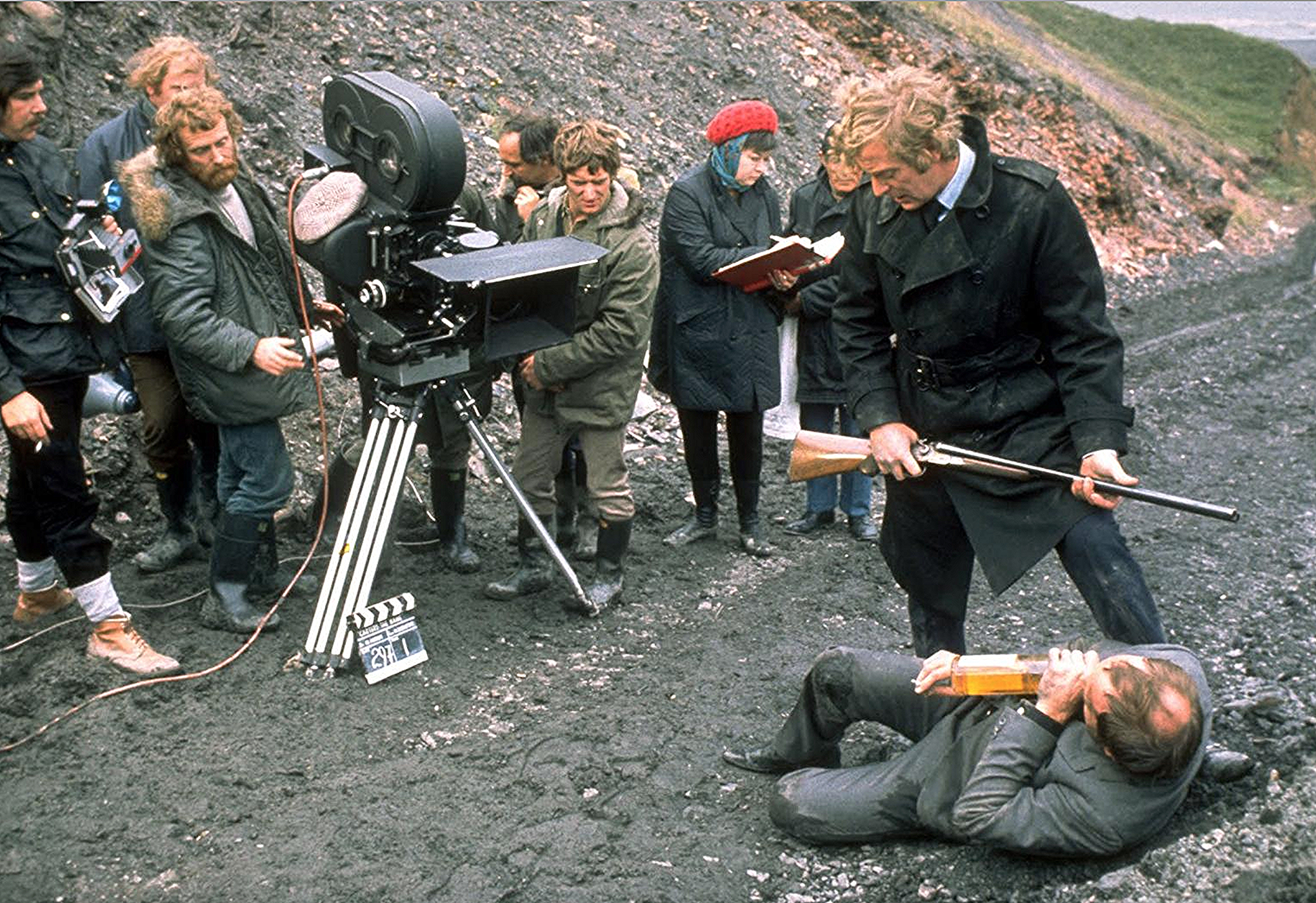
In my mind one of the most believable bad guys ever was Michael Caine‘s Jack Carter in Mike Hodge‘s Get Carter (’71).

Please name other movie characters who radiated evil and malevolence without any showy gestures or demonstrations. Like Michael Madsen‘s Reservoir Dogs psycho, for example. Heath Ledger‘s Joker doesn’t count (way too showy); ditto Richard Widmark‘s giggly nutcase in Kiss of Death (too spazzy and cackly).

I’m talking about bad guys who simply are that rancid thing. You look at them, sense their vibe and you know they’re the Real McCoy.

“Buh-BOH-Buh-Boh-BOH!”

Based on the late Jonathan Larson‘s autobiographical stage musical, Tick, Tick…BOOM! (Netflix, late ’21) is the first feature directed by Hamilton and In The Heights creator Lin-Manuel Miranda.

I realize that right now may not be the best time to promote a new Miranda musical given what’s just happened to In The Heights, but the world turns and the show must go on.

Set in the early ’90s, Tick, Tick…BOOM! stars Andrew Garfield as a character based on Larson, a 20something composer and playwright grappling with doubt and uncertainty and whether or not he has the makings of a successful Stephen Sondheim-like composer. Larson finally hit it big when a workshop version of Rent opened off-Broadway in ’93. The Broadway version opened in ’96; the film version opened in ’05.

Pic also stars Alexandra Shipp, Robin de Jesus, Joshua Henry, MJ Rodriguez, Bradley Whitford, Tariq Trotter, Judith Light and Vanessa Hudgens. Produced by Brian Grazer, Ron Howard, Julie Oh and Miranda, pic is written by Steven Levenson (Dear Evan Hansen).

Read more

Don’t Ask, Don’t Tell

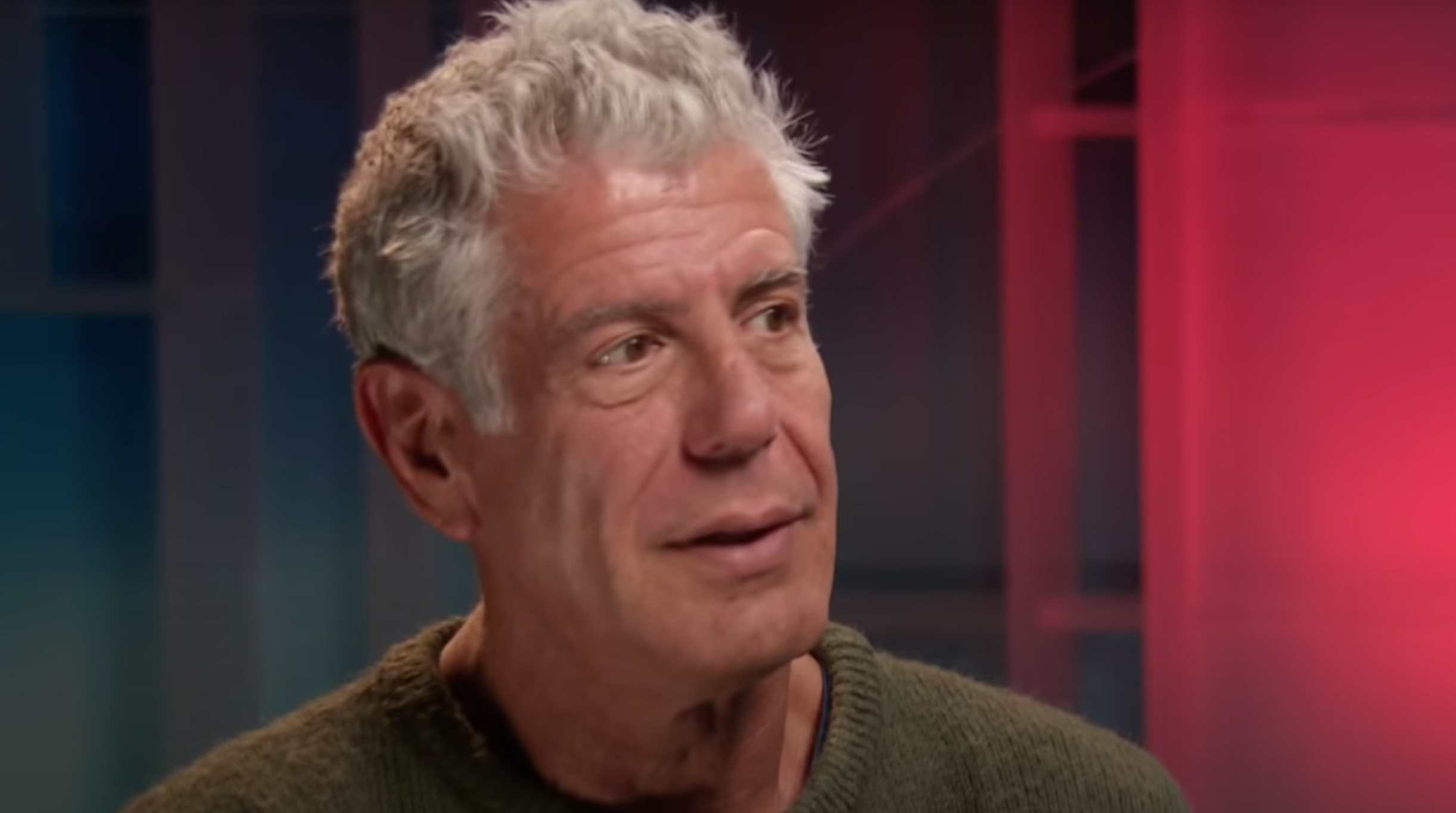
I’m told that yesterday’s HE riff about Morgan Neville‘s Roadrunner (“Obvious Factor in Bourdain Suicide Ignored?“) gets into the whole Asia Argento mishegoss much more than than the film. The
story about Argento having allegedly seduced the 17 year-old Jimmy Bennett is shown in one brief headline. The affair with Hugo Clement isn’t mentioned at all.

There’s nonetheless a weird obsession that pokes through in two reviews of the film — Eric Kohn’s in Indiewire, Matt Goldberg’s in Collider. Both claim there’s something unseemly about the movie trying to “solve” the mystery of Bourdain’s suicide.

Why is it wrong for Roadrunner to examine Bourdain’s suicide and try to figure what happened? Are we not allowed to ask those questions? Or think about them? Are we invading the ghost of Anthony Bourdain‘s safe space? What the hell else is a documentary supposed to do but ask questions and, if possible or reasonable, look deeper?

You really never know where the next stupid woke umbrage is going to come from. The sensitives and their arbitrary dumbshit “moral” rules. This fucking generation of woke idiots is going to kill us.

Collider‘s Matt Goldberg: “A suicide is not a crime to be solved. It’s a tragic circumstance going to the depths of another person’s psyche. You can’t reason it out because no reason will be satisfying. There’s no conclusion where you will get an audience to think, ‘Oh, well I guess suicide made sense in this regard.’ It cannot comfort, and it cannot illuminate. And yet Neville attempts to reason out why Bourdain would take his own life as if that’s a question that needed to be answered beyond anyone’s morbid curiosity.

“This leads Roadrunner down a deeply dark road where the film basically insinuates that Bourdain’s romance with actor and filmmaker Asia Argento was personally destructive to his well-being. If this is a film about Bourdain and his legacy, then why do we need scenes showing footage of an episode directed by Argento that Bourdain’s coworkers felt were not up to the standards they had set? Why do we need talking heads alluding to tabloids that say Argento was cheating on Bourdain and that drove him to despair and ultimately suicide because his personality operated at extremes?

“Even if you have one talking head say, ‘I don’t want to pin a man’s suicide on the woman in his life,’ the fact that Roadrunner is even broaching that as a possibility is deeply gross and incredibly irresponsible.”

Indiewire‘s Eric Kohn: “Roadrunner enters dicey territory during its final act, as it delves into Bourdain’s relationship with actress Asia Argento, who’s absent from the movie as a participant but appears in ample documentary footage.

“By all indications, Argento brought Bourdain to a new plane of happiness in his final months, when he hired her to direct an episode in Hong Kong shortly before his death. It also gave him a renewed sense of purpose as he became a public voice in the #MeToo scandal with Argento’s revelations about being raped by Harvey Weinstein.

Roadrunner, however, bursts the sunny image of Bourdain’s new partner with claims from his former collaborators that he cut them off in the midst of the relationship; then the movie goes one step further by hinting at the idea that his suicide was an erratic act of revenge as the romance went south. Despite one subject who makes it clear Argento isn’t truly to blame — Tony killed himself, after all — it’s still a queasy passage that comes dangerously close to exploiting the scenario with a murky explanation assembled from secondhand accounts.”

Harryhausen Embarassment

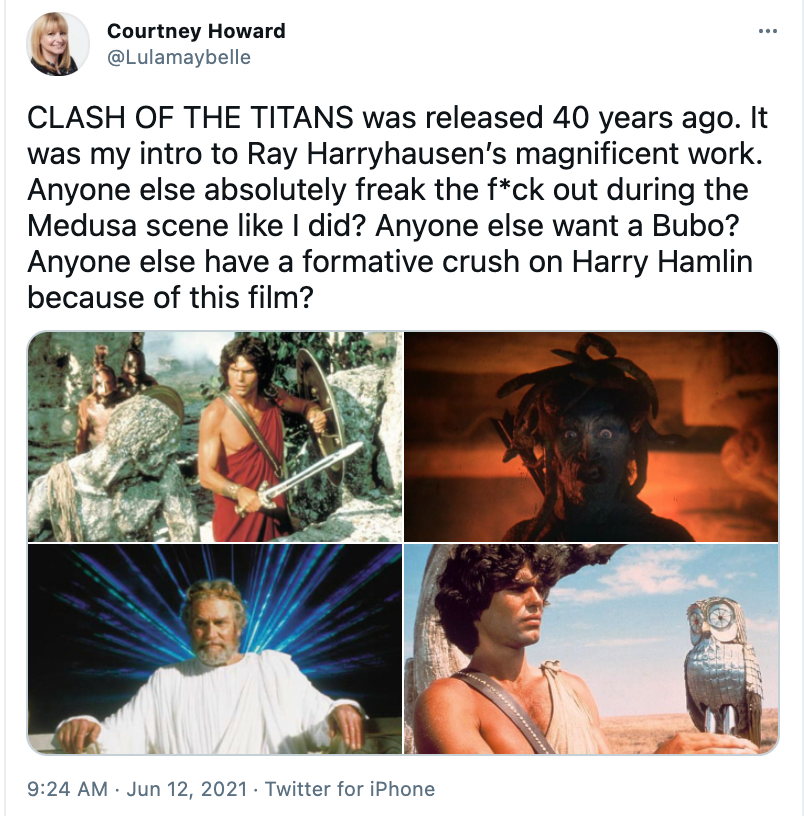
I may have been overly harsh yesterday in my dismissal of the 40-year-old Clash of the Titans. I’m walking it back a bit because the Harry Hamlin vs. Medusa sequence is half-tolerable. There’s no believing it, of course, but it’s spooky all the same. Otherwise the entire film is a tedious, old-hat, stop-motion joke.

Theatrical Death of “In The Heights”

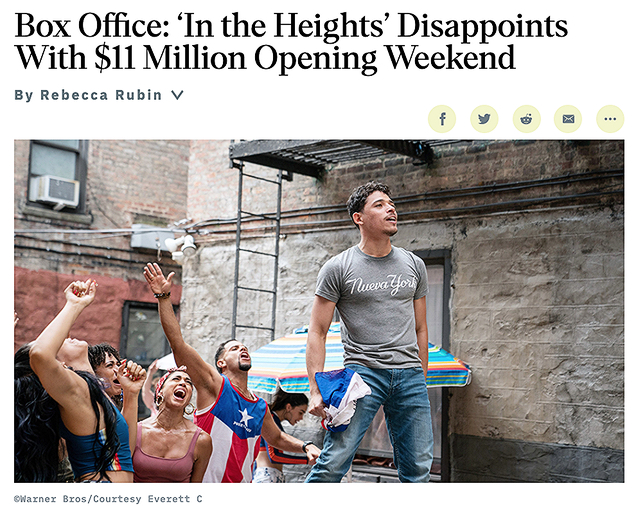
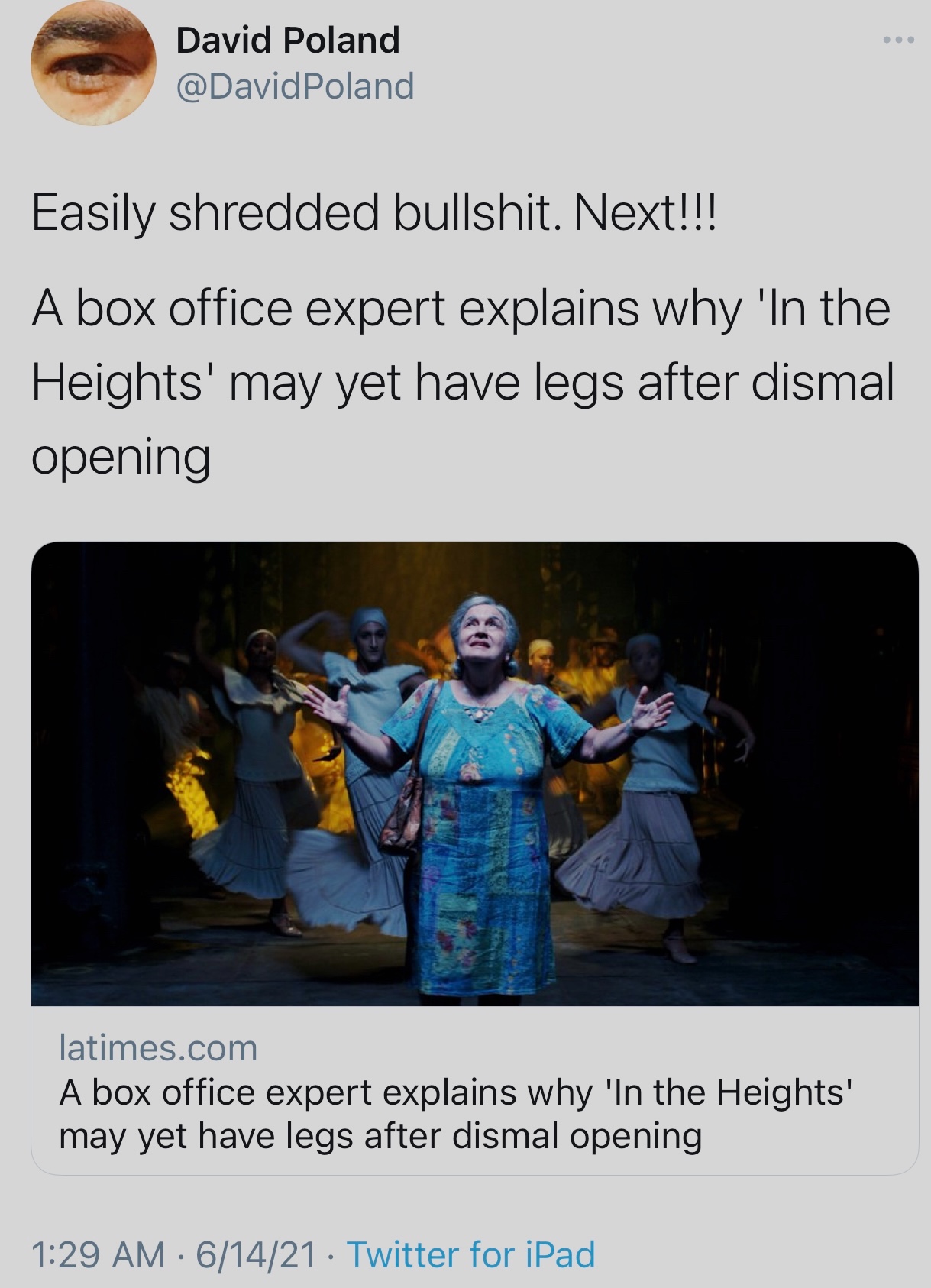
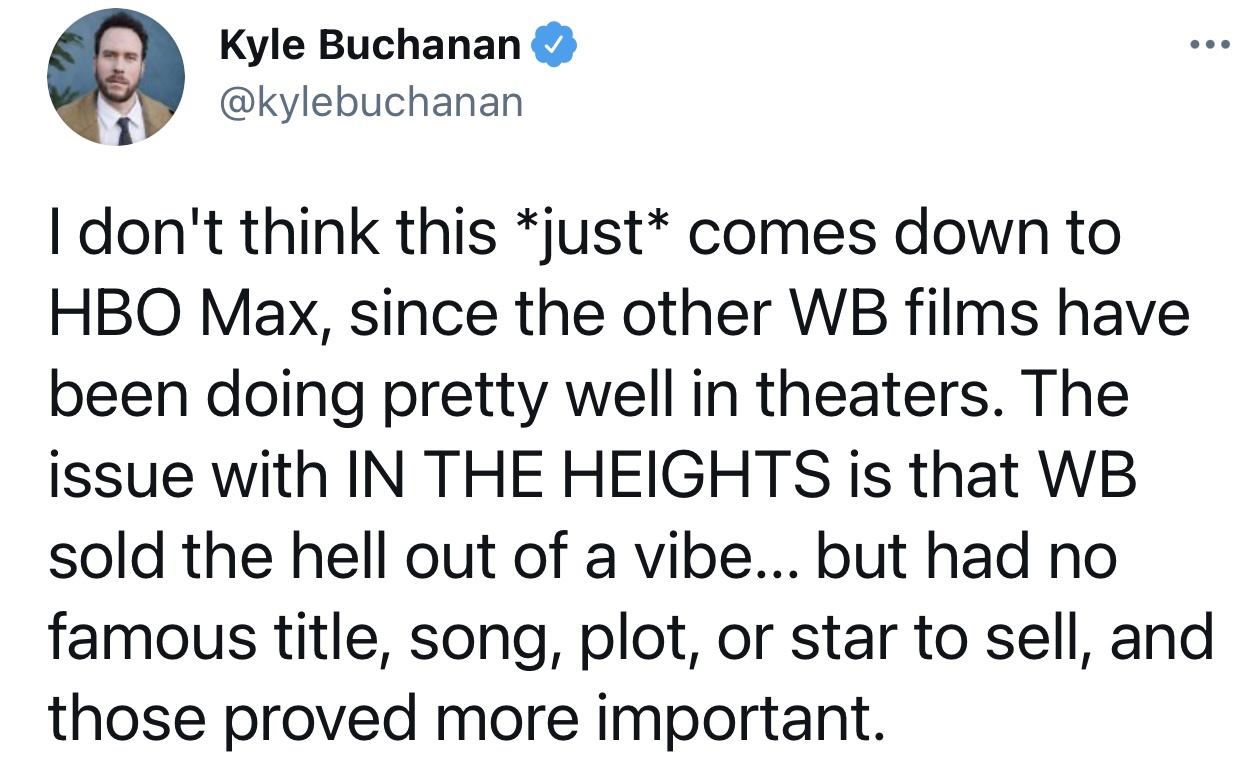
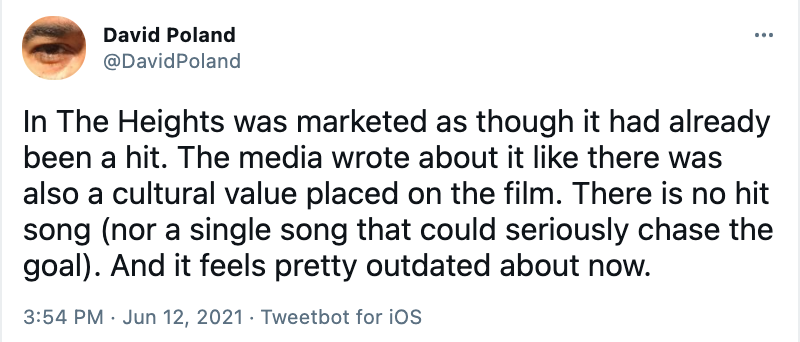
In The Heights has stumbled and crashed at the box-office — not modestly but decisively.

Yesterday morning ForbesScott Mendelson lamented an estimate of “a frankly mediocre $5 million Friday” and “an over/under $15 million weekend launch.” Then Variety reported that Heights had earned even less — $4.9 million on Friday with an expected weekend tally of “just under $13 million.” Now Variety‘s Rebecca Rubin is reporting an $11 million weekend haul.

Variety‘s Rebecca Rubin: “The disappointing commercial reception for In the Heights is puzzling because critics embraced the joyous film, showering it with some of the best reviews of the pandemic era.”
HE interjection: Nobody cares what elitist critics think — they live on their own woke planet.

Rubin: “Moreover, Warner Bros. put substantial marketing heft behind the picture, and director Jon M. Chu and Lin-Manuel Miranda devoted a great deal of energy into promoting the movie, which compensated for the fact that its cast was comprised of mostly unknown stars and emerging actors.

“The film’s hybrid release on HBO Max likely affected its box office business. [And yet] recent Warner Bros. releases like Godzilla vs. Kong, Mortal Kombat and The Conjuring: The Devil Made Me Do It still pulled in solid receipts despite being offered simultaneously on streaming.”

Make no mistake — In The Heights is a very well made, ace-level, stylistically assured neighborhood musical with an emotionally affecting current. It made me feel trapped, okay, but I resisted and toughed it out. The apparent message is that unsophisticated proles will only pay for theatrical if the film in question is scary, if it has wowser visual effects or if it’s aimed at kids and families. Teens on a Saturday night or children on Saturday and Sunday afternoons.

Friendo: “The original overestimates of how well In the Heights would do are, of course, the whole problem. (‘Projecting $20 million or higher!”) And that was definitely a case of seeing the movie through woke-colored glasses. ‘Look, it’s a Latinx musical! Every brown person in America will go! The same legions of cool brown people who are going to vote for Kamala Harris for president! What a wonderful progressive world!’

“Uh, no, you fucking idiots.”

Read more

Flash Forward

As much as I admire who Kamala Harris is and the values she’s stood by (and for), I suddenly realized this morning that she won’t win the ’24 election if Biden doesn’t run (will he run for a second term?) and if she beats out all competitors. Don’t ask me how I know — I just do. It’s an instinctual thing — an insight I don’t welcome but can’t ignore.

Her theoretical Republican opponent (God help the country if Trump actually runs again) would tar and feather, slice and dice…it would be awful. Plus she doesn’t have a commanding or musical speaking voice — she has little if any Obama in her. And she’s quite short — 5’2″.

I would will vote for her in a New York minute — I’d love to see a smart, tough woman in the Oval Office. But my vote means nothing in this context.

Read more

“Heights” Stockholm Syndrome

Now that In The Heights has opened and failed to make box-office history and now that between half and two-thirds of the moviegoing public has written it off or at least decided to defy Eric Kohn and watch it on HBO Max…now that it’s regarded as a ruptured duck and people have left it behind, does anyone who saw it yesterday or today agree with the following?

One, that it’s a first-rate, well-made, go-for-the-gusto, real-deal musical, shot and performed and edited to the professional utmost but two, it’s also a film that strangely makes you feel a bit trapped and suffocated…a film that you’d like to escape from but you can’t because you shouldn’t because you paid to see it and you might as well tough it out. Does anyone feel that way?

I’m serious about the quality of John Chu‘s film — Heights is an absolutely first-rate production in every department.

Honestly? I Don’t Even Remember “The Crossing Guard”

I know it’s about basically a revenge story, or about planning payback. Freddy Gale (Jack Nicholson) is distraught over his daughter’s death in a five-year-old car accident. When he finds out that the guy who ran his daughter down (David Morse) is about to be released from prison, he decides “I’m gonna make this guy suffer, or maybe even die…I’ll play it by ear.”

It opened 25 and 1/2 years ago, and I swear to God I don’t remember a single scene, a single line of dialogue, a single shot, the ending…none of it. Is it me or the film?

“One Of The Big Problems With Wokeness…”

“…is that what you say doesn’t have to make sense, or jibe with the facts, or ever be challenged lest the challenge itself be conflated with racism. Seeing clearly is necessary for actually fixing problems, and clearlyt racism is simply no longer everywhere. It’s not in my home, and it probably isn’t in yours. We date human events as A.D. and B.C. but he need a third marker for Millennials and GenZ…B.Y., or Before You.” [Starting at 4:58 mark]