
Daily



















Son of Alfred Hitchcock’s “The Bears”
Posted on 9.6.15: I was on my way from the Sheridan bar after-party for Cary Fukanaga‘s Beasts of No Nation (which kicks the shit out of you but is a work of undeniable visual poetry of war and carnage — a 21st Century successor to Apocalypse Now) and had just passed Alpine Street when I ran into a 20something woman who seemed a bit unnerved. Even a bit scared.
If a woman strikes up a conversation with a total stranger on a really dark street, you can assume she’s been motivated by something.
“Have you seen any bears?” she asked me. “Uhhm, no, I haven’t,” I half-smirked. “Seriously, I’ve been coming to this festival for five years and I’ve never even heard of bears in town.” But she was serious.
She: “I’m telling you I just saw two bears walking down this street…really, no joke.” Me: “Really?” She: “Actually walking on the sidewalk.” Me: “You’re kidding! Really? How big were they?” She: “One was bigger and the other was smaller. Probably a mama bear and a baby bear on a scavenge hunt.”
We discussed ways of scaring them off or at least, you know, avoiding getting attacked. Make a lot of noise, she said. I said I’d heard you’re supposed to be cool and stand your ground and not run. I don’t think bears are very aggressive unless a mama bear thinks you might hurt her cub, I added. But what does a city slicker know?
“I Don’t Need Therapy — They Do”
From David Rooney’s Hollywood Reporter 9.14.20 TIFF review of Joe Bell (Roadside/Vertical, 7.23): “It’s impossible to watch Mark Wahlberg’s performance as this burdened man, still grappling with his shortcomings as a human being, without taking into account the actor’s own very public reckoning with the hate crimes of his past.
“My feelings on whether he has a right to be pardoned have no place in a film review. But with his scraggly beard and haunted eyes, there’s a palpable sense here of a man who is suffering and hungering for redemption.
“In one or two instances Diana Ossana and Larry McMurtry’s screenplay drifts into teachable moments, such as Joe’s exchange at a gay bar with a local who talks about the damage wrought by his church’s rejection. But then there are lovely organic moments of illumination such as Joe’s encounter, well into his journey, with a sheriff whose warmth and understanding are fueled by his own troubled experience as the parent of a gay son. In this small but cathartic role, Gary Sinise shows what a great actor can do merely by listening.”
“Kong” Made ‘Em Wait
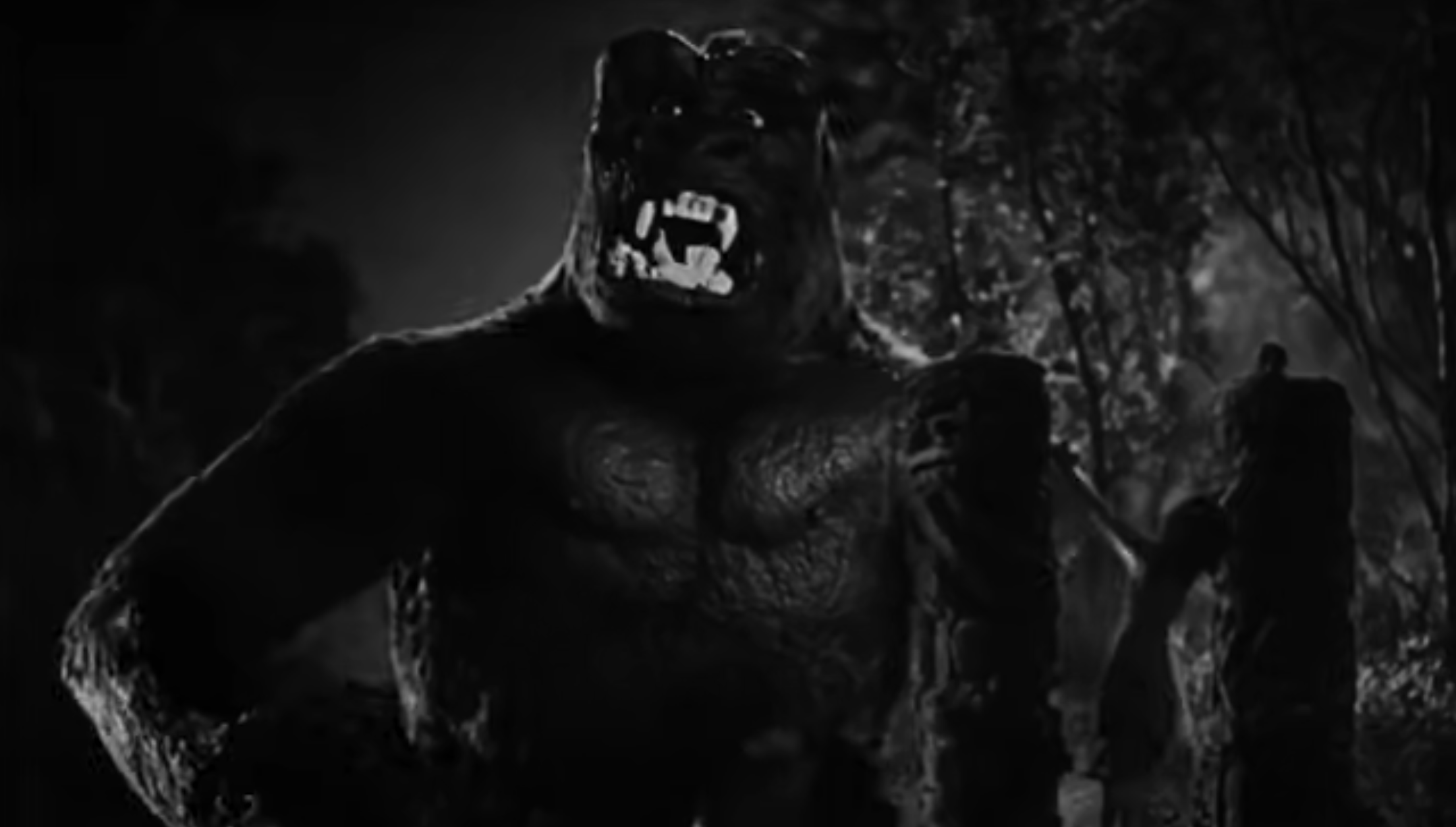
Just a reminder that King Kong, which ran 104 minutes with an overture, delayed the entrance of the big ape until the 46-minute mark. Build-up, set-up. In other words, co-directors Merian C. Cooper and Ernest B. Schoedsack made the audience wait until nearly the midpoint of this not especially long film to deliver the simian thrills. The Skull Island adventure chapter lasts for roughly 38 minutes, and ends at the 84-minute mark. The New York City finale lasts exactly 20 minutes, or from the 84 and 1/2 minute mark to 104 minutes and 23 seconds.
Peter Jackson‘s absurdly bloated King Kong (’05) ran 188 minutes.
Netflix in Telluride
Deadline‘s Pete Hammond, filed on 6.18.21: “I have reliably heard that Netflix will have at least four films at Telluride if things work out. I am told Warner Bros, which just confirmed Denis Villeneuve’s Dune for Venice, is possibly going to have a film [in] Telluride as well, likely one of its awaited fall titles like David Chase’s Sopranos prequel The Many Saints of Newark, Clint Eastwood’s Cry Macho or even November title King Richard with Will Smith.
“A strong Searchlight contingent was spotted [at the recent Telluride party in West Hollywood], and they usually are good for one or two movies. Whether Cannes entry Wes Anderson’s The French Dispatch is one of them is unknown (it has also been announced for NYFF), but September release The Eyes of Tammy Faye with Jessica Chastain and Andrew Garfield makes sense. Amazon was out in force Thursday night as well, so expect some its goodies.”
HE is presuming that the four Telluride-Netflix titles will be Paolo Sorrentino‘s The Hand of God, Jane Campion‘s The Power of the Dog, Adam McKay‘s Don’t Look Up and Andrew Dominik‘s Blonde.
Less likely Netflix possibilities are Christian Schwochow‘s Munich and Lin-Manuel Miranda‘s Tick, Tick…BOOM!.
Injection of Agony, Misery
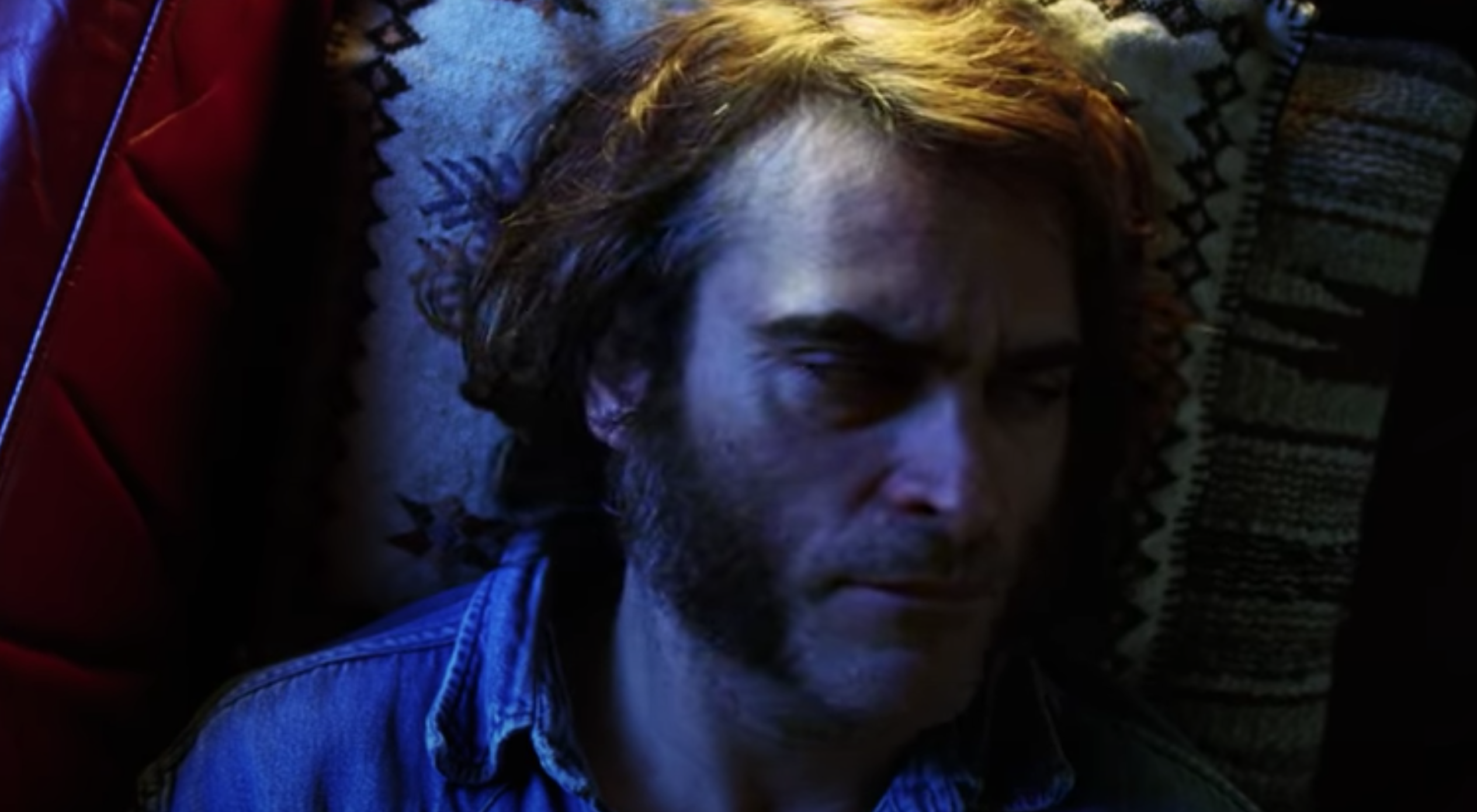
I’ve rarely felt so bummed and thrown by a film as I was after seeing Paul Thomas Anderson‘s Inherent Vice at the 2014 New York Film Festival (10.4.14). I was so destroyed that I couldn’t find the spirit to attend the Tavern on the Green after-party. I just jumped on the IRT south…I had to get out of there.
From “Trippy, Woozy ’70s Sink-In…Texture, Man…Dirt and Scratch Marks…Whoa,” posted on 10.4.14:
“I need to think about Inherent Vice a bit before writing anything. It just broke an hour ago and then I just hopped on the train. I was thinking about it while I was watching but that only got in the way. A friend wrote and said ‘how was it?’ Here’s what I wrote: ‘Oh, dear God…maybe it’ll come into focus after I’ve seen it a second or third time, or when I catch in on Bluray and can access the subtitles. Maybe by then I’ll have grown enough as a person or as a moviegoer or as a dog catcher. Maybe someday I’ll be as perceptive as Drew McWeeny or Scott Foundas.
“One thing’s for sure and that’s that I just wasn’t hip or smart or observant enough tonight to really get down in the swamp with Inherent Vice. I kinda got where it was coming from but I couldn’t get to a place of delight. I certainly got portions of it. I know I chuckled at a few lines. But I’m basically too fucking stupid or my ears are too full of wax or something. So it’s me — I’m the problem and not PTA.
“Vice is a meticulous recreation of an early ’70s film complete with dirt and scratch marks…it’s like you’re watching a semi-decent print of a film made in 1971 at the New Beverly in 1986. It really is an immersion and a half. Beautiful atmosphere, perfect Nixonian vibe, bleachy lighting scheme, ultra-dry humor, Aryans, dopers, a Neil Young tune or two, endless manner of perversity and duplicity and what-the-fuck-ity…but I couldn’t figure out a whole lot. Some but not enough. It’s in, it’s out, it’s back in again, it moves left and right, it drops its pants, it takes a hit, it bongs out again…it makes your brain feel like cheese that’s been left on the counter overnight, and it goes on for…what, two and a half hours?
“If only I was smarter…if only I could hear more of the dialogue…if only I had several lines of heroin to snort while watching it. You know what? Forget the plot. Solutions are for squares, man. Just submit to the period-ness and let that be enough. Let Joaquin Phoenix‘s mutton-chops rule. Doobies, sandals, hippie chicks, waves, the residue of Manson, shiny 1970 cars…all of it, dude. Be a ‘yes’ person.”
“Vice Mets The Public“, posted on 12.14.14: I really don’t want to hang with Joaquin Phoenix‘s Doc Sportello again, man. I hated his company like nothing else. Vice is far from thoughtless or haphazard and certainly deserves respect for PTA’s meticulous composition and use of…was it one or two Neil Young tunes? But I didn’t give a damn who did what (and neither did Thomas Pynchon — I get that) and I didn’t care about anyone in the entire cast except Martin Short.
“Pynchon fans might argue that Inherent Vice is an entirely different bird than Robert Altman‘s The Long Goodbye and Joel and Ethan Coen‘s The Big Lebowski, but these films are still quasi-detective stories about low-rent loser types trying to make sense of a complex Los Angeles demimonde and scratching their heads and shrugging their shoulders at the perverse and ungainly sprawl of it all. I recognize that Vice is more liked than disliked by critics and that the HE comment symphony may take a few pokes at me, but I’m used to that.”
“Beatles Document Dump”
Peter Jackson‘s The Beatles: Get Back “is — or was — a movie I dreamed of seeing in theaters. Today, most music documentaries are streaming only, but the Beatles remain larger-than-life. They turned the entire world into a community, and still have the power to turn an audience into a congregation. If the Beatles aren’t worthy of the big screen, I don’t know who is.
“But that’s no longer going to happen. Now we’ll all sit at home, watching the Beatles separately, on three separate nights. Beyond that, I’m compelled to ask: Six hours? It’s clear that Jackson fell in love with this material and was eager to give us more of it, which sounds like a generous impulse. But six hours of Get Back is a lot of Get Back.
“In general, Jackson tends to be dominated by his go-big-or-go-home side, which first showed itself in the Lord of the Rings trilogy (which I think of, in my snarkier moments, as nine hours of folks riding through the woods), then in the bloat of King Kong, and then in the jaw-dropping grandiosity with which he inflated The Hobbit, J.R.R. Tolkien’s slenderest Middle-earth novel, into three damn epic movies. Do you sense a trend here?
“I’m not prejudging The Beatles: Get Back, but I do have a trepidation, one that I feel justified in saying out loud. My fear is that Jackson, in chopping the Get Back footage down to a gargantuan six hours, hasn’t done the disciplined and demanding work of editing, of shaping, of putting an exquisitely honed movie together. My fear is that he’ll be giving us not a Beatles documentary but a Beatles document dump.” — from Owen Gleiberman‘s “The Beatles: Get Back Is Now a Six-Hour Mini-Series. So Why Does It Feel Like More Might Be Less?“
Black Rebels Motorcycle Club or Beetles?
Thundering down Santa Monica Blvd. in Beverly Hills last night, sometime around 11 pm. Wheelies!
Tatiana spoke to a member of the motorcycle batallion, a muscular good-humored dude who called himself Johnny. Tatiana: “What are you rebelling against, Johnny?” Johnny: “Whaddaya got?” Tatiana: “No, seriously, what’s this about?” Johnny: “Freedom from Covid.” Tatiana: “Are you a Trump supporter?” Johnny: “Pete Buttigieg all the way.”
“Masters of the Universe” Complicity
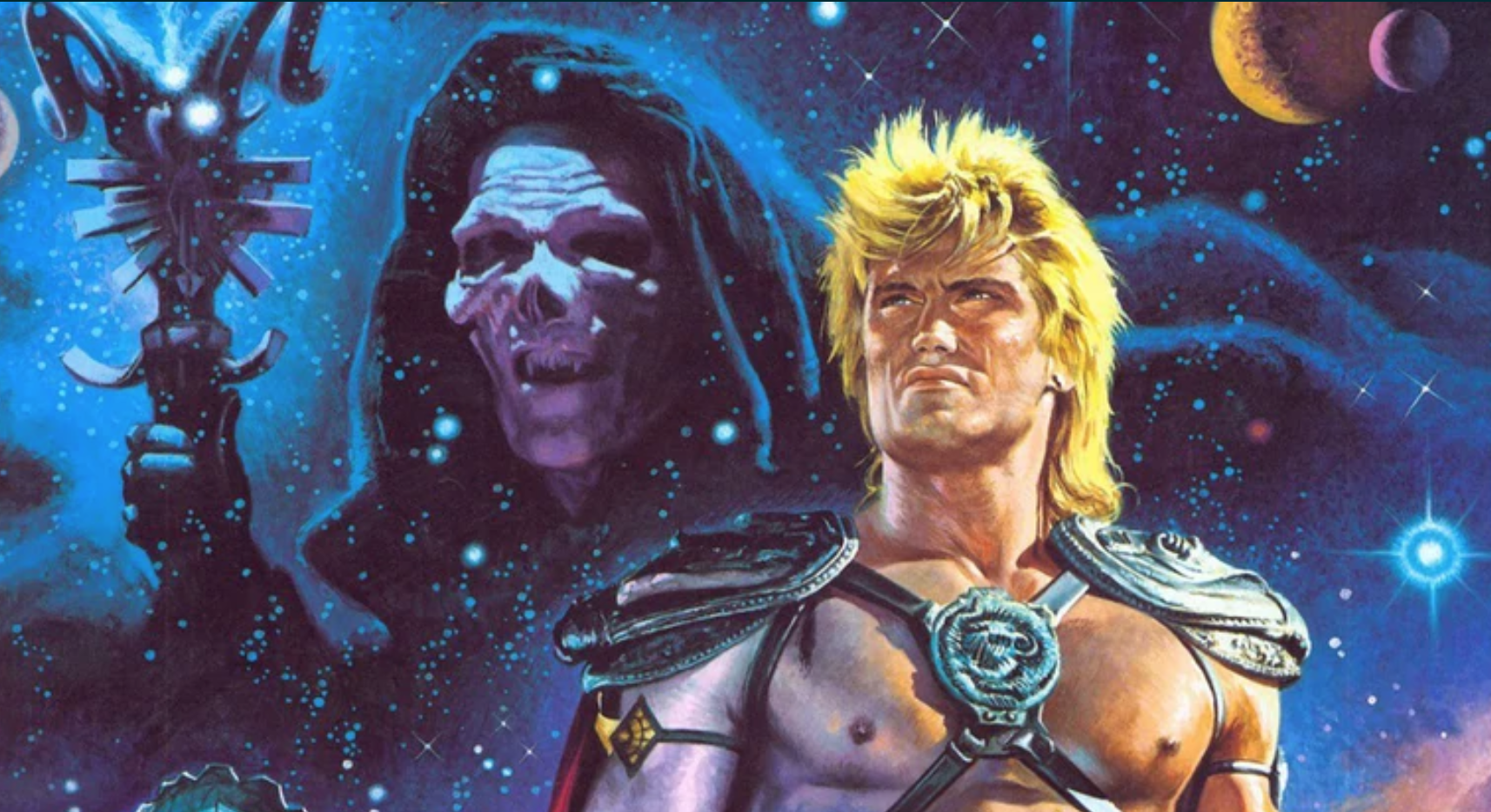
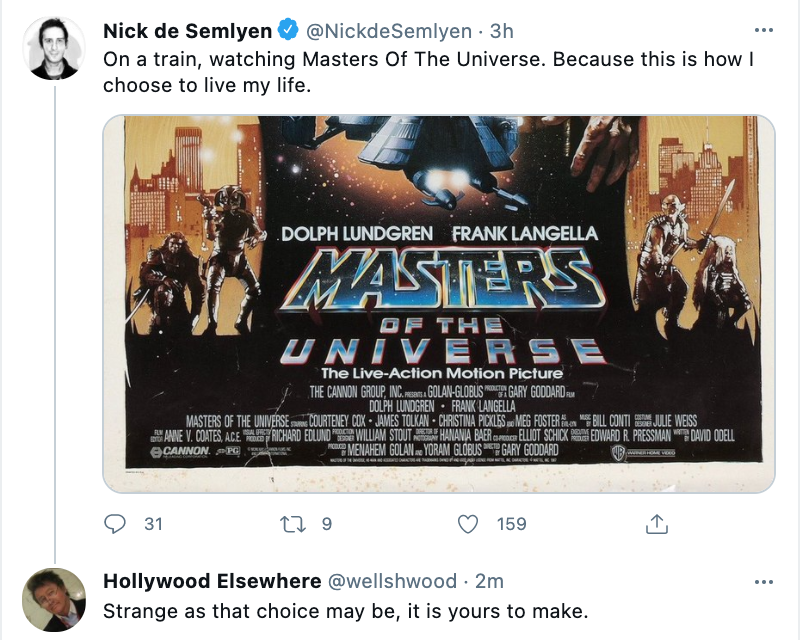
As a Cannon publicity staffer and press-kit writer, I visited the Culver City set of Masters of the Universe sometime around…oh, probably the late fall of ’86. I seem to recall interviewing director Gary Goddard and screenwriter David Odell, although I may not have. I don’t recall speaking with Dolph Lundgren, Frank Langella, Courteney Cox and other cast members, although I may have.
It was a difficult write as I was totally disheartened and certainly not into the Mattel sword and sorcery-themed franchise. The general presumption during filming was that Cannon had bitten off more than it could chew, and that the $22 million budget was probably insufficient. Masters opened on 8.7.87, was creamed by critics and wound up making $17.3 million.
And yet, very curiously, it has a modest cult following today.
Crumbum Hood Confidential
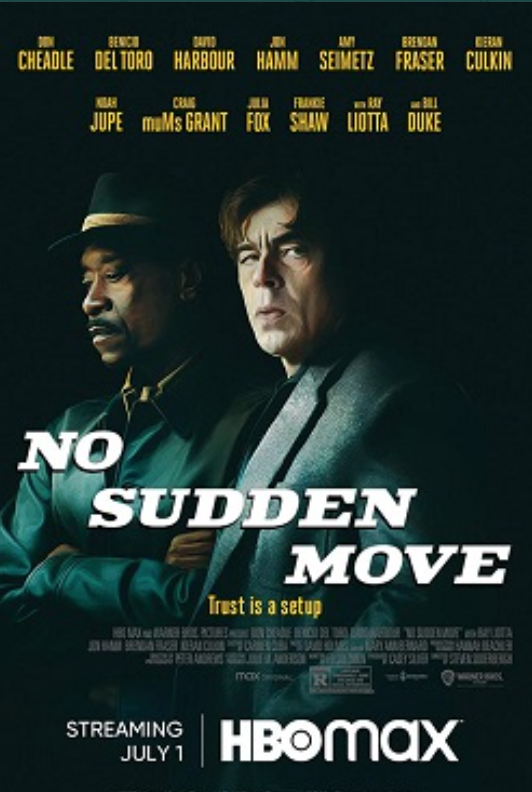
“No Sudden Move (HBO Max, 7.1) is an ambitious, light-spirited, high-twist modernist noir in the tradition of Devil in a Blue Dress and Steven Soderbergh’s own Out of Sight.
“Soderbergh, who shot and edited the film, works with a knack for the drama of amorality: the off-kilter camera angles, the lean mean mood of hardboiled misanthropy, the relish that great actors can take in playing crumbum hoods. The movie is clever and blithely vicious, it keeps you guessing, and it invites you to share Soderbergh’s joy in filmmaking.
“And yet: Just when the movie’s interlocking treacheries should be catching fire, you feel them wilt a bit.
“Soderbergh doesn’t make any obvious wrong moves, but the plot isn’t quite the tightly hot-wired tale of descent and payback we’ve been geared to expect. It’s more like watching an enormous, slightly abstract jigsaw puzzle of corruption come together.
“There is, it turns out, a Larger Theme at work, one that hinges on a Mr. Big played with graying omnipotence by Matt Damon. And while this kind of late-in-the-game revelation is fair game, the film is a little too pleased with its corporate conspiracy-theory dimension. You watch it and think: We’ve been here before, lots of times.
“For all its pleasures, No Sudden Move doesn’t quite make the old seem new again.” — from Owen Gleiberman‘s 6.18 Variety review.
Indy Fatigue
I should have watched something here-and-now last night (Bo Burnham Inside, Hacks, The Sons of Sam) but like a jackass I streamed the 4K version of Raiders of the Lost Ark, which I’d heard looks extra sharp and luscious. Well, it looks good, sure, but calm down. I loved Raiders when it first popped in June of ’81, which led to my seeing it too many times. But now? Again? For the ninth or tenth time?
Ten minutes into last night’s viewing I was muttering four things: (1) “I really can’t watch this any more…I’m sick of it,” (2) “All of the jokes and bits and tricks that seemed so cool 40 years ago have been over-mined and over-imitated, and have lost their pizazz,” (3) “The idea was to make thrill comedy out of the conventions of old Saturday matinee serials, but so much of the action choreography seems silly now…Harrison Ford chased through the jungle by 15 or 20 natives with bows-and-arrows and poison dart blowguns, and he doesn’t get tagged once, even when he’s swimming towards the plane?…slender Karen Allen drinking an overweight Tibetan guy under the table?…the cute little monkey who alerts the Nazis to Allen’s hiding place inside a large woven basket (bad!) is the same critter who pretends to moan and cry when Ford is moping over her apparent death…the film is jam-packed with little irritations like this”, and (4) “Allen’s constant shrieking of ‘Indiiieeee!’ is enough to drive you nuts.”
The only bit that still works (it actually made me laugh out loud, and I’m a total LQTM type) is when Ford casually pulls out a pistol and shoots the scary North African guy with a huge sword. And this film would be almost nothing without John Williams‘ rousing, haunting, at times even spooky score…seriously, none of the big moments would work without the music.
My favorite Raiders film remains Indiana Jones and the Last Crusade…it’s funnier and spritzier that the original.
Quick — name some Spielberg films that have aged really well. Answer: There aren’t that many. Schindler’s List, of course. Minority Report, E.T. Saving Private Ryan except for the awful bookends, Duel, and two portions from Close Encounters — the silent opening-credits followed by the crash-crescendo of the Sonoran desert plus the air-traffic controller sequence. For the most part early Spielberg flicks are sugary soft drinks. Very soothing and satisfying if you’re hot and thirsty, but most of them don’t linger. They’re not really intended to. He has a great cinematic eye and a fine sense of strategic choreography, but he’s not what anyone would call a deep, moody, meditative filmmaker.