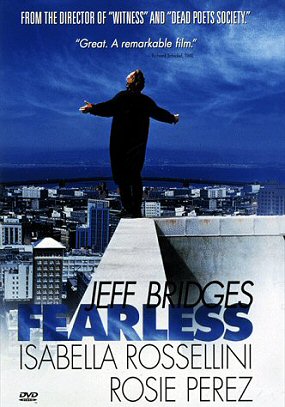
Heads Will Roll

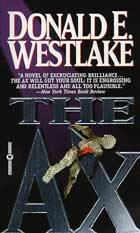
The stand-out thing about The Ax, the new Costa-Gavras satire that opened the San Francisco Film Festival on Thursday night (4.23), isn’t that it’s utterly black. That’s obvious and easily digestible from the get-go. We’re used to this, in any case.
The money element for me — the selling point — is that it’s so bracingly dry. And tightly plotted and suspenseful. And the fact that it never quite tips into being a reassuring “comedy.”
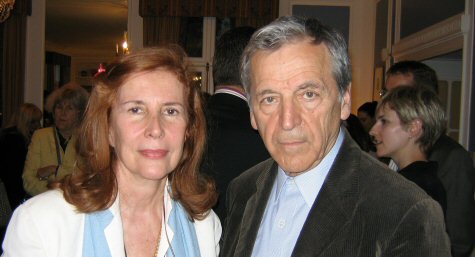

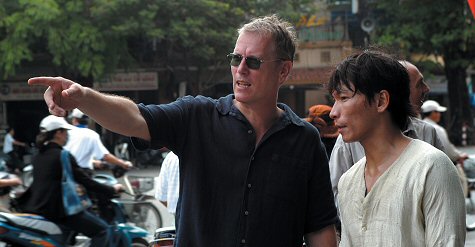
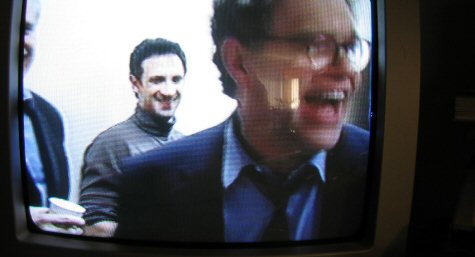
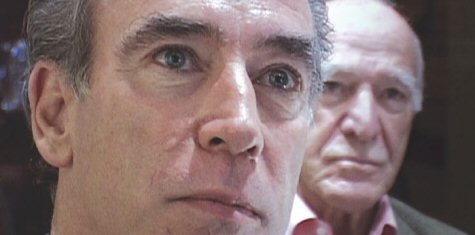
The Ax director and co-writer Costa-Gavras, producer (and wife) Michele Ray-Gavras during reception at home of Frederic Desagneaux — Friday, 4.22.05, 7:10 pm.

That in itself means a lot of people are going to find it a little too cool for their liking. This would be short-sighted of them, of course, because what Costa-Gavras has accomplished here is a very impressive balancing act.
The lead character, a kind of cold-blooded killer, could have been repulsive or at least alienating if the director’s mood and attitude had been off just an inch or two off. The Ax is lightly, ironically, mordantly humorous…and at the same time needling and nerve-wracking.
< ?php include ('/home/hollyw9/public_html/wired'); ?>
If you’ve seen The Corporation (which recently came out on DVD in a great two-disc package), you know the bedrock theme is that corporations are psychopathic. The Ax, which is taken from a 1997 Donald Westlake novel, flips this over and asks, what if a guy in a tough financial spot acted with the same win-at-all-costs, social-mores-be-damned attitude of a typical corporation?
What if an out-of-work guy, in other words, decided to increase his chances of finding a new job by killing the guys who appear to be his chief competitors?
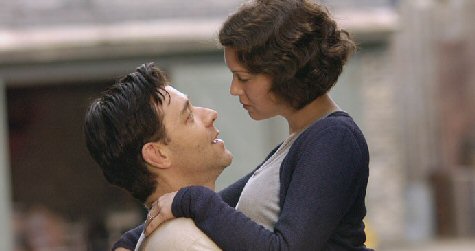
Bruno Davert (Jose Garcia), 41, is a former top-level executive at a French paper mill who’s been fired (along with several hundred others) because the company decided to go with cheaper labor in another country. He hasn’t found a new job in over two and a half years, but he’s got his eye on a position at a big paper company called Arcadia.
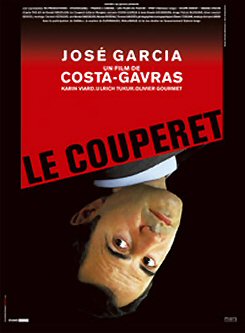
The only thing (or things) standing in his way, he figures, are six or seven unemployed guys whose qualifications are as good if not better than his own. So he decides one day to eliminate them. He turns out to be a sloppy hit man, but he’s persistent and gets the job done.
Then the cops come knocking because they’ve noticed that a string of murders all involve male victims who worked for paper companies. And then the screws tighten further.
The twists and turns that follow make it a natural thing to root for Bruno, despite his constant murdering. There are few things in a drama as unnerving or even surreal as a truly sympathetic fiend. The Ax isn’t exactly “realistic” — the slightly arch and aloof tone underlines this — but it’s real enough to sink in and feel like something that’s part of our world.
Costa-Gavras seems to be saying to his audience, “Go a little easy on this guy. He may be killing one innocent victim after another, but he can’t find work and he’s really hurting and so he’s not really that bad. In fact, he’s almost blameless. If you want to blame someone, blame the corporations…blame globalism.”
The final irony of this film is that Bruno, his story and the underlying morale are not extreme elements. Every character, everything that happens is presented in moderate terms.
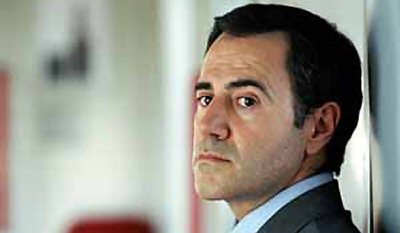
Bruno is a basically moral, considerate, middle-class family man who has been pushed into a state of almost animal-like ferocity. And yet he crosses the line as discreetly as he can manage, and then he is the recipient of incredible luck, and things finally work out. It’s all very neat and tidy.
The more I think about The Ax, the more I’m convinced it’s Costa Gavras’ best film — the most focused and most satisfying — since Missing (’82).
I respected his last film, Amen, which was based on The Deputy, a play about Vatican immorality during World War II, but I wasn’t blown away by it.
The Ax is certainly more assured than Mad City , Costa-Gavras’s 1997 film that was also about an average guy (John Travolta) pushed to desperate acts after losing his job.
The Ax joins a group of films that have come out over the last two or three years about the effects of corporate-think upon average middle-class people.
The most respected of these among elite film critics is Laurent Cantet’s Time Out, about a middle-aged husband and father who embarks on a massive charade in order to hide from his family the fact that he’s been laid off.
I’m not a huge fan of this film, personally. I respected it but I vaguely hated it. I felt drained by the passively dull and pig-eyed main character and the oppressive lethargy that seemed to seep out of the film at every turn.
There was also Cantet’s Human Resources, which portrayed the scruples of a young white-collar comer who finally decides to reject the rules of the game.
My favorite so far has been Jean-Marc Moutout’s Violence des Echanges en Milieu Tempere, which I saw at the Locarno Film Festival in the summer of `03. The title roughly translates into Violent Changes In The Workplace, although the English title is Work Hard, Play Hard. It was never distributed in the U.S. or even, as far as I know, put out on DVD.
I wrote back then that “as a portrait of what it means to be an agent of icy efficiency in a heartless business scheme, it’s one of the most riveting and quietly unsettling moral tales I’ve seen in a long while.”

Streets of San Francisco
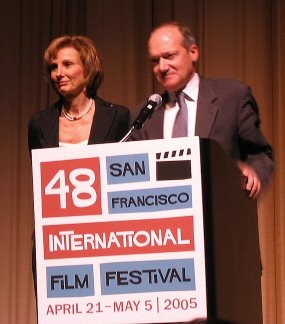

San Francisco Film Festival Executive Director Roxanne Messina Captor receiving a Chevalier Order of Arts and Letters medallion from French Consul General Frederic Desagneaux — Kabuki Theatre, 4.22.05, 8:12 pm.
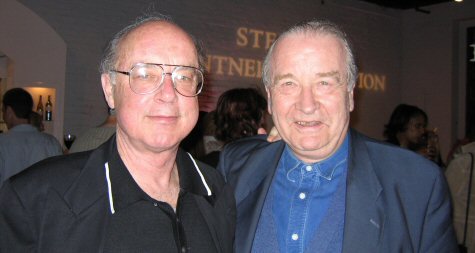
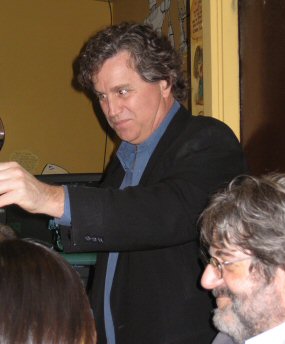
San Francisco Film Festival programmer and Telluride Film Festival kingmaker Tom Luddy (l.) and the festival’s French cinema programmer Michel Ciment at an outdoor opening night party for 48th annual San Francisco Film Festival at Girhardelli Square.


The great Bobby Yang on violin during a performance of a four-piece quasi-jazz group at VIP lounge at Ghirardelli Square.
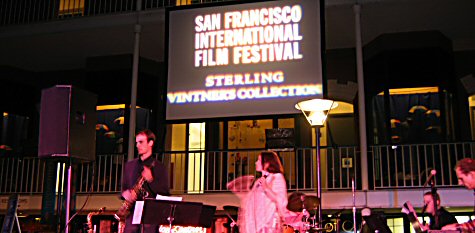
A jazz-lite group performs during Thursday night’s outdoor opening-nighter at Ghirardelli Square.

In north-facing living room of the home of Frederic Desagneaux, French Consul General of France, during 4.22 reception, at 7:20 pm.

Fine Madness

It’s out about eight months too late but there’s no sense crying over spilt milk and it doesn’t really matter anyway, because Nicholas Jarecki’s The Outsider is a surprisingly strong film.
It doesn’t simply capture the essence of director-writer James Toback in all the right ways (smartly, perceptively, humorously), and I don’t mean to imply that doing this alone would be some kind of marginal accomplishment.
I know Toback personally, and can say with some authority that Jarecki gets all the right quotes and insights and whatnot, and determines the measure of one of the nerviest and most relentless uber-mavericks in the film business today.
I’ve said several times in this column over the last five or six years that I admire Toback for his wit and smarts and maverick spirit. I’m especially taken by his moxie and tenacity in making his films his own way.
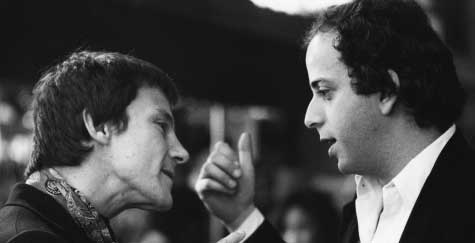

Harvey Keitel, James Toback during shooting of Fingers some 27 or 28 years ago.

And with one exception, I really like his movies. I loved Two Girls and a Guy and Black and White. I was even okay with most of Harvard Man. The irony is that the one Toback film I’m not terribly keen on is When Will I Be Loved?, the making of which is the focus of Jarecki’s doc.
But even a second- or third-tier Toback film is worth seeing, I feel, because of the aliveness of the personality behind it. Go to Jarecki’s site for The Outsider and listen to Toback’s comments during a radio interview with Joe Franklin, and you’ll have a clue about what I mean.
The Outsider is showing this evening (Saturday, 4.23) as an attraction of the Tribeca Film Festival at the Regal Battery Park, at 8:30 pm. It’s also showing at the Pace Schimmel Center on Friday, 4.29, at 9 pm, and on Sunday, May 1st, at the Regal Battery Bark at 1:15 pm.
Toback made When Will I Be Loved? because his producer, Ron Rothholz, found a financier who would put up a few million to make a film for tax reasons, but Toback would have to shoot the whole thing in about three weeks’ time, and with almost no time to prepare.
A Manhattan-based relationship drama shot in a semi-improvised fashion similar to his Black and White, When Will I Be Loved? is a somewhat cynical, more-than-frankly-sexual drama that stars Neve Campbell, Fred Weller and Dominic Chianese.
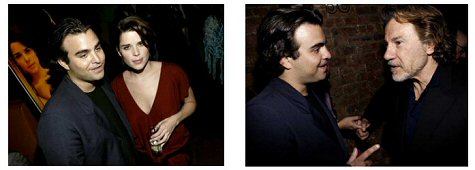

(l.) The Outsider director Nick Jarecki, When Will I Be Loved? costar Neve Campbell at reception; (r.) Jarecki and Harvey Keitel.

It’s hard to make a really exceptional film, much less a good one, in three weeks’ time, especially if you’re working from a script that has only been generally blocked out and needs to be somewhat improvised, as was the case here. It says a lot for Toback’s fast footwork that When Will I Be Loved? turned out as well as it did.
In the view of Roger Ebert, Christian Science Monitor critic David Sterritt, Newsday‘s Gene Seymour and other front-line critics, it was more than a pretty good effort. But Toback and Rothholz had a seriously rough time finding a distributor, and for a while there it looked like it might have to go straight-to-video.
What gives Jarecki’s doc that extra dimension is watching Toback face resistance from distributors and perhaps (and I’m basically talking impressions here) start to wonder deep down about whether he’s played it right this time. There’s something about seeing a guy who’s usually very confident and even a bit of a boaster and a swaggerer go through anger, denial, bargaining, additional shooting, etc.
The irony is that When Will I Be Loved?, which was finally acquired by IFC Films, performed decently where it played, and the DVD has brought in about $5 million so far, which isn’t nothing.
I spoke to Jarecki a few days ago. He called himself “the new Leni Reifenstahl,” and I leave readers to interpret that one all on their own.
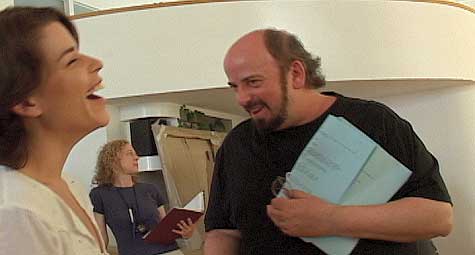

Neve Campbell (l.) and Toback on the set of When Will I Be Loved?.

He concurs that The Outsider‘s final act, in which Toback suffers his moments of doubt and pain, lend an extra dimension.
“The reality is that you make a crazy movie that doesn’t play by the rules and everybody says what the fuck is this? The reality is that he got hurt by the response to it. Jim makes his films up…and his personality in general is partially an example of how you have to be in the movie business, because he builds up a tremendous defensive wall.”
The talking-head admirers in The Outsider include Woody Allen, Robert Downey, Jr., Harvey Keitel, Mike Tyson, Neve Campbell, Norman Mailer, Brooke Shields, Barry Levinson, Robert Towne, Brett Ratner, Roger Ebert, Damon Dash, Woody Harrelson, Jim Brown, John Calley, Bijou Phillips, Jeff Berg, Dominic Chianese, and Power from Wu-Tang Clan.
We’ve all read George Bernard Shaw’s quote about how “reasonable men always try to adapt themselves to fit the world around them, while unreasonable men persist in trying to adapt the world to fit themselves, and therefore all progress is made by unreasonable men.” Or words to that effect. Take the point or not.

Doesn’t Matter

I don’t think it matters that much if some of the big-name critics are taking shots at Sydney Pollack’s The Interpreter (Universal, opened 4.22). All that counts is whether it’s been smartly promoted and, more to the point, whether or not there’s an appetite out there for this level of sophistication.
But it’s a curious thing to see a film you absolutely know to be a smart, above-average thriller be hammered and picked apart by people who know the difference between crap and good-enough quality, and who seem to have a stick up their ass.
You may not come out of this movie weeping or needing a double Jack Daniels to calm your nerves, but you’d have to have a pissy attitude not to admit that it’s a totally assured,bump-free ride. Smooth and crafty and well-ordered, and no trouble to sit through at all.
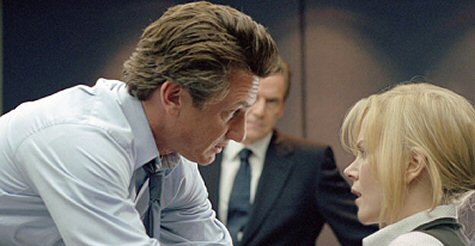

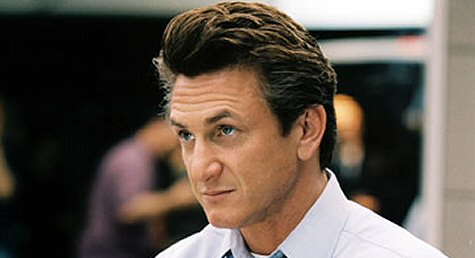
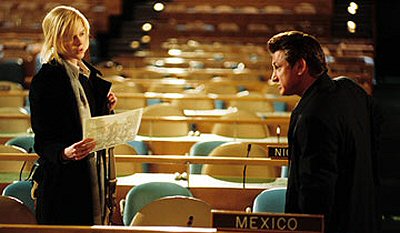
Sean Penn, Nicole Kidman in Sydney Pollack’s The Interpreter.

That sounds like damnation with faint praise. What I mean is, The Interpreter is a finely tuned engine. It’s a Bentley. Once it kicks in there’s no shifting in your seat or looking at your watch.
I’m a little perplexed by Eleanor Ringel Gillespie’s review in Friday’s (4.22) Atlanta Constitution. She calls it classy, well-honed, deftly organized…and then out comes the knife.
“As sleek and solid as a late ’50s Cadillac, The Interpreter is very much your father’s — perhaps, your grandfather’s — thriller,” she writes. “And that’s a good thing.”
Gillespie means that the kind of careful, exacting craft that Pollack put into making this film is a dying discipline. But she also knows that the notion of any movie being seen as appealing to fathers and grandfathers terrifies studio executives, agents, producers. She couldn’t have wounded Pollack more if she had literally stabbed him.
The Seattle Post Intelligencer‘s William Arnold is another wounding admirer: “Made with the intelligence, glossy production values and classic filmmaking technique that characterizes Pollack at his finest,” he calls The Interpreter “an elegant entertainment of the old school.”
Obviously there’s a consensus of opinion here. I even heard the term “old school” (or “old-fashioned”) from a guy who worked on the film, so I guess I’m in denial.
I suppose there are things in The Interpreter that feel a bit shop-worn. I just hate equating good craftmanship with “old-school.” Jesus, think of the implications.
Are they saying it moves too slow? They’re nuts. William Steinkamp’s cutting is about as brisk and economical in the service of this kind of complex story as anyone can expect, and it’s faster and punchier than the cutting Pollack used for his last New York thriller, Three Days of the Condor, which came out in ’75.
In all the important ways, The Interpreter strikes me as fully caught up in the here and now. It just doesn’t have that visual-energy-for-visual-energy’s-sake thing that a lot of 40-and-under directors love to put in their films. And the naysayers are telling me that’s a bad thing?
Is it really such a rickety, old-fashioned pleasure to enjoy careful strategic weaving of dozens of story strands that have to fit together just so and pay off in just the right way?
Are we saying that thrillers that don’t necessarily add up or which try to wallop their way past difficult plot points are the kind of films that younger paying audiences prefer?
I give up. I’m talked out on this film. The duel is over. It’s in the public’s hands now.
Saturday figures suggest The Interpreter will earn in the vicinity of $20 to $22 million this weekend. Not bad. Something tells me the hold factor won’t be all that great next weekend, but let’s keep our cynicism in check.

DVD Commentaries

I’ll be popping in some of the letters I got about this subject on Sunday morning. I don’t know why it’s taking me so long to put this column up, but I feel like I’m covered in gelatin and stuck in some kind of eerie slow-mo realm.

Absent Ace

“I recently came across the fantastic Billy Wilder film Ace in the Hole (re-released as The Big Carnival). Unfortunately, it’s only available on a rare VHS copy (I found it at Vidiots in Santa Monica) and the dialogue is out of sync for most of the film.
“You often use your column to promote films deserving of the deluxe DVD treatment and I think this one more than qualifies. This is a media satire, after all, that is possibly even more relevant today than when it was released.
“I was going to point to Elia Kazan and Budd Schulberg’s A Face in the Crowd as another example of both a great media satire and a film criminally overlooked on DVD, but Amazon now shows that a DVD version will be release on May 10.
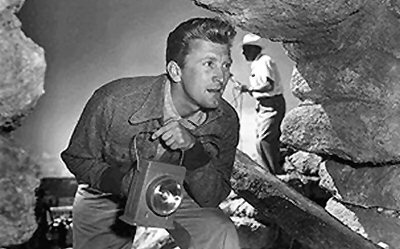
“Just thought I’d bring that to your attention. Do with it what you will.” — Chris Casper , Los Angeles, CA.
Wells to Casper: I love Ace in the Hole and yes, of course, it should be digitally restored and released on DVD. It’s not that bitter by today’s standards, although it was seen as overly so in 1951 when it was first released.
I’ve always loved Ace in the Hole‘s dialogue, which came from Wilder, Walter Newman and Lesser Samuels.
I adore that rant from Douglas’ newspaper reporter character about how he prefers those “four spindly trees” in front of Rockefeller Center over the vast wonders of nature commonly found in Hicksville because he can’t stand the hicks.
Jan Sterling to Douglas after an abusive verbal smack-down: “I’ve known some hard-boiled eggs in my time, but you’re twenty minutes.”


Room #501, Rex Hotel, 562 Sutter Street, San Francisco.
Schmoozers at Castro theatre prior to opening-night showing of the new Costa-Gavras film, The Ax (i.e., Le Couperet).


Beautiful Journey

How many coming-to-America immigrant movies have I seen that have put the hook in? Not that many. Up until two days ago I would have said I’m not a huge fan of this genre, if you can call it that. People uprooted, struggling, adversity, etc. I’ve got enough aggravation.
I remember liking Elia Kazan’s America, America (1963), about a young Greek guy (based upon Kazan’s uncle) making his way to these shores. And the young Vito Corleone, Robert De Niro, life-in-Little- Italy sections of The Godfather, Part II. And I’ll never forget Oliver Stone’s Heaven and Earth (1993), about a young Vietnamese woman going through all kinds of pain on her way to the States. It was hell to sit through, I mean.


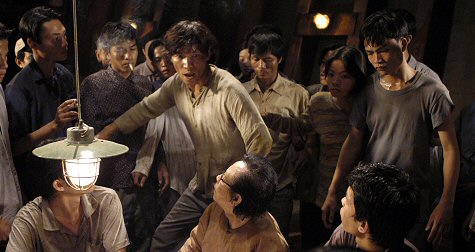
Damien Nguyen, Thi Kim Xuan Chau, Bai Ling aboard freighter in Hans Petter Moland’s The Beautiful Country.

And that was pretty much it for me until last Monday night, when I saw Hans Petter Moland’s The Beautiful Country (Sony Pictures Classics, 7.8) and just about flipped.
It won’t open for another two and a half months, which is plenty of time for people to read this article and then forget about it, but this 125 minute Norwegian-made, mostly English-speaking film is, by my sights, a nearly great thing. And it’s come out of nowhere, in a sense. And it needs all the advance word it can get.
< ?php include ('/home/hollyw9/public_html/wired'); ?>
A road (and sea) movie in the most profound sense of that term, and a story about the resilience of the human spirit (although I have mixed feelings about describing it this way, given how totally full-of-shit that last proclamation sounds), The Beautiful Country is a movie about restraint, restraint and more restraint…and eventually, huge payoffs.
Especially during the last 20 minutes or so, when the great Nick Nolte arrives.
Set in 1990, The Beautiful Country is about a mixed-race, half-American young Vietnamese guy named Binh (Damien Nguyen) whom we first meet in a rural Vietnamese village working as a handy man, and dealing with racist disdain for being the son of an American G.I., and generally wondering who he is and where he belongs.
The movie follows Binh to Saigon (Ho Chi Minh City) to find his long-lost mother. He lives and works with her for a spell, and then something bad happens and he drifts off to sea with some boat people with his mother’s young son in tow.
They land in a Malaysian refugee camp, where Binh meets and falls in love with the beautiful Ling (Bai Ling). He and Ling and the boy eventually climb aboard a rusty freighter, which is captained by a cold-hearted prick (Tim Roth), that’s transporting illegals to the U.S.

And then it’s into his life in New York City as an indentured slave worker in a Chinatown restaurant, and finally a trip to Texas where he eventually finds his dad, who turns out to be Nolte.
The 64 year-old Nolte gives one of best-ever performances, and if you ask me is a probable candidate for a Best Supporting Actor nomination eight or nine months from now.
I could feel The Beautiful Country taking hold and feeling like the real deal almost immediately. You can say it’s not 100% perfect (maybe a tad cliched here and there, but only a little bit), and that it’s just another variation on a Terrence Malick-styled young-people-on-the-run movie. (Malick thought up the basic story idea and co-produced the film with Badlands producer Edward Pressman).
But it felt to me (and I can be a soft touch at times) like some kind of masterwork…one of the most profound and compassionate and finely nuanced films about the rough-and-tumble, never-say-die life of a roaming, disenfranchised person I’ve ever seen.
It’s also a great Vietnam healing movie for American audiences. I don’t know how to put it exactly, but this film feels like it’s in touch with feelings about the Vietnam War that should have come to the surface a long time ago. It’s a movie that says to American vets and Vietnamese nationals, “Uhm, guys? You need to talk.” It seems to be mining the emotional aftermath of this 40 year-old conflict on a level that’s never really been sorted out before. And without raising this or that issue or memory or specific incident. It all just kind of seeps in.


Beautiful Country director Hans Petter Molan with star Damien Nguyen.

It’s also a great and sometimes very sad movie about parenting. And it ends with a father-son moment that really touches bottom. And it manages to make the title of the film echo back in a way that feels different and thoughtful.
The irony is that The Beautiful Country was half-written off, or at least put on hold in the minds of potential distributors, after it was shown at the Berlin Film Festival in February 2004. It ran 136 minutes, and everyone (or a good percentage of those who were there) thought it was too long.
It took Moland, Malick and Pressman several months to prune it down to 125 minutes, partly over creative disagreements, and partly, I’ve been told, due to post-production coin being a little short. It played at Karlovy Vary last summer, but the trimmed version, I’ve heard, wasn’t completed in time to make the deadline for last September’s Telluride and Toronto and New York Film Festivals. And it didn’t play Sundance.
But the guys at Sony Pictures Classics saw through all this and now it’s slated as a mid-summer counter-programmer.
The people who mainly go to dumb-shit movies and don’t want to know or feel anything new or exotic will probably figure out ways of ducking The Beautiful Country, and maybe not even seeing it on DVD. It’s their loss and what can you do?
I didn’t know Moland at all before this, but he knows exactly what he’s doing here. I’m told I should see a mother-daughter relationship film he directed in 2000 called Abderdeen.

The Beautiful Country screenplay is by Sabina Murray and Larry Gross, working from a “story” by Lingard Jervey and an idea by Malick.
I said earlier that Roth’s character is a prick, and he is, but it’s part of this film’s delicate calibrations that he’s not painted too broadly and has other colors to show. There’s an American businessman who takes an interest in Ling in the New York section who could have been portrayed as a crass vulgar sort, but he, too, comes through with a certain humanity. Ditto the middle-aged woman who plays Nolte’s angry ex-wife.
There are one or two exceptions, but just about everyone in this movie has some kind of unexpected (by the cut-and-dried standards of too many films these days) dimension.
Stuart Dryburgh’s widescreen photography reminded me at times of the work of Chris Doyle (the dp for all those Wong Kar Wai films as well as Phillip Noyce’s The Quiet American ), which came as something of a surprise. Dryburgh is a respected veteran and all, but his recent credits (Aeon Flux, Bridget Jones’ Diary, Runaway Bride, Analyze This) don’t exactly say “art film cinematographer.”
I disagree with those who’ve said that Nguyen’s performance, which is all about being quiet and saying very little and frequently cowering, is some kind of liability. I believed in his character completely, and didn’t detect a single false note. I actually found him charismatic in a tentative, meditative, internalized way.
Bai Ling, a fairly well-known Asian actress who’s been working in Hollywood for about ten years (Red Corner, Anna and the King, Star Wars, Episode 3: Revenge of the Sith), seems out of place in the Malaysian refugee camp…at first.


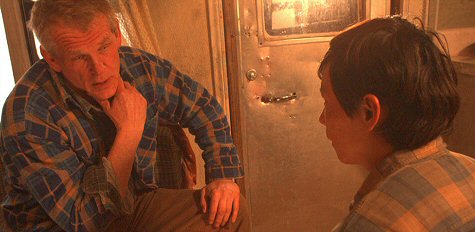
Nick Nolte, Damien Nguyen.

She seems too shrewd and attractive to be from the bottom rung, or to have landed in such dire straits. But I bought into this because she delivers a convincingly cynical (bordering on bitter) attitude, and because I wanted her character to hook up with Binh.
Some critics (I can almost predict which ones) won’t fall for this film like I have, and that’s fine. But I can’t imagine anyone not being wowed by Nolte, who gathers that whole grizzled-older-guy thing that he’s been developing over the past 10 years or so and knocks it out of the park.
The title, according to Derek Elley’s Variety review, refers to the Chinese name for America — “mei guo” — which literally means “beautiful country.” But this is a film about beauty in all corners of the world, and in all sorts of unexpected places.

Considering the Smiths

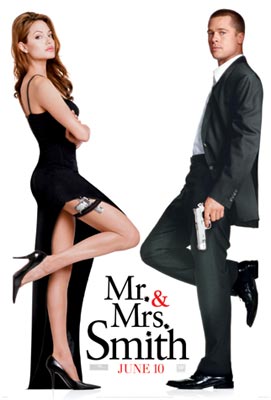
Things seem to be happening between Brad Pitt and Angelina Jolie these days. Stories about recent time spent together (shared vacations, swanky hotel rooms, etc.) have been inside all the supermarket tabs, including Us magazine. And the evidence seems conclusive. **
Question is, what effect will these tabloid shenanigans have on the fortunes of Mr. and Mrs. Smith (20th Century Fox, 6.10), an obviously pumped-up, very expensive action comedy from director Doug Liman (The Bourne Identity, Go ) in which they play married-to-each-other professional assassins?


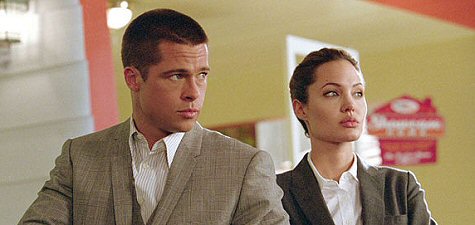
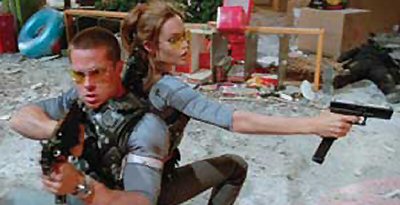
Brad Pitt, Angelina Jolie in Doug Liman’s Mr. and Mrs. Smith.

Liman is one of the best 40-and-under directors out there right now. I talk with him from time to time. He told me last January during the Sundance Film Festival that Mr. and Mrs. Smith is “the best thing I’ve ever done.” I don’t know what he precisely meant by this, but he said it persuasively.
But I have to be honest and say that right now, however great, good or not-so-good the film might be, the Pitt-Jolie affair could usher in some resistance.
< ?php include ('/home/hollyw9/public_html/wired'); ?>
Whenever there’s hanky-panky on a movie set, especially when one of the lovers is married to someone else, women and conservative-minded types in the audience get their dander up and sometimes don’t want to go, and those who line up do so with a kind of a “show me” attitude. Okay, we’ve paid to see this thing…let’s see that chemistry!
If the romantic intrigue is there, fine. If it’s not, or if the director wimps out and tries to push it aside, the movie usually has problems.
Director Taylor Hackford cut out some love-scene footage when he edited Proof of Life , the Russell Crowe-Meg Ryan movie that had the same kind of attention from the tabloids during filming due to Crowe and Ryan’s affair. Hackford’s strategy worked against the film. The general reaction seemed to be, this is what all the fuss was about?
Gigli had problems of its own, but didn’t the Ben and J. Lo affair (which everyone was sick of before it opened) help sink it?

Besides, aren’t all those women who buy the supermarket tabs presumed to be more in Jennifer Aniston’s camp? Vaguely resentful, I mean, about Pitt having cheated on Aniston and taken up with this vaguely wacko hussy type? I’m addressing the situation with dopey tabloid cliches, but you know what I’m saying.
To me, the tone of the Mr. and Mrs. Smith trailer feels arch and a bit staid. It tells me the movie might be funny or clever here and there, and that Pitt uses his charm in a scene or two, but also that Jolie gives up very little.
She doesn’t have a screwball temperament, she doesn’t break down and weep, she doesn’t have a wacky Julia Roberts-type laugh. She’s poised and chilly.
The assassins-out-to-kill-each-other plot is apparently being used as a kind of metaphor for today’s high-powered couples who concentrate so much on their jobs and individual tasking than they don’t know how to unload all that stuff and just “be” with each other.
I know they’re supposed to be a bored married couple (initially, I mean), but the trailer never seems to show Pitt and Jolie being warm with each other or looking into each other’s eyes with any kind of excitement or fear or anything. It seems to be selling a rather dry and aloof film that’s mainly about thrills, aggression and physical comedy. And a lot of hardware.
We’re taking about the trailer, mind. I presume the movie of Mr. and Mrs. Smith is about more than what it conveys. Liman doesn’t make assembly-line crap.


Not an actual Pitt portrait, but a Worth 1000 Photoshop thing.

There’s one really funny bit at the end when a guy says to Pitt, “You’re ticking!” and Pitt realizes Jolie has planted a bomb on him.
There’s a piece about this very subject by Ann Donahue in the May issue of Premiere. It discusses the film’s “rocky” production history and on-set arguments, etc. Liman is quoted as saying he has never had a movie be under such tabloid scrutiny.
(Donahue uses the word “controversial” to describe “Liman’s belief that he can bring the small-scale independent film ethos…to major studio productions.” Wanting to make big-budget films sharper, quirkier and more flavorful is controversial?)
Pitt is a bigger star overseas than he is here. Troy earned much more over there than it did here. But he can act when the chips are down (I’ve always loved him in Se7en) and he’s basically likable.
I don’t think Jolie is very likable at all, and I wonder if she means all that much to general audiences. Her second Tomb Raider flick was seen as a tank (cost $90 million, earned $65 million in US theatres), and the responses to her last few films — Beyond Borders, Taking Lives, Sky Captain and the World of Tomorrow — were underwhelming.
Angelina’s got those great lips and all but she’s also seems kind of crazy, no? Heavily into her own orbit, I mean, in an over-indulged, rich-actress, Tallulah Bankhead-type way. Smooching her brother at the Oscars, refusing to speak with her dad (Jon Voight), blowing off Billy Bob with her U.N. spokeswoman thing and then jumping whole-hog into adopting third-world kids, etc.

She seems like a moment-to-moment person. Not much of an investor in long-term relationships. But really great in bed, I’ll bet…or so goes the general assumption.
I was talking about Brad and Angelina with a woman the other night in the checkout line at Pavilions. Neither of us trusts her, we decided. We also agreed that Brad is in a typically randy, post-divorce rebound mode and his Angelina relationship is not long for this world.
But for the movie’s sake, they should probably try to stay together until the opening.
** Pitt’s p.r. rep Cindy Guagenti has called stories about the Pitt-Jolie romance “untrue.” In a statement given yesterday (4.14) to the Associated Press, Us magazine, which has a cover story saying the Pitt-Jolie thing is very real, said, “Pitt has long denied stories involving his personal life, beginning with reports of trouble in his marriage to Jennifer Aniston prior to the separation. Multiple sources both on and off the record confirmed Pitt and Jolie were physically affectionate in public areas of [a desert] resort where they were [recently] staying.”

Summer Shakedown

It doesn’t matter which big-studio tentpole movies are going to make the most money this summer. What counts is which ones will be good.
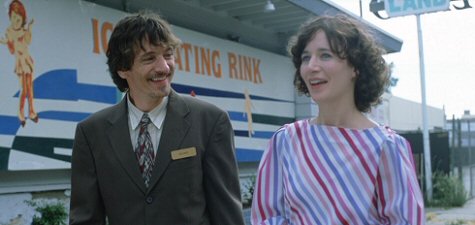
The best films of the May-August season are going to be Ridley Scott’s Kingdom of Heaven (20th Century Fox, 5.6); Paul Haggis’s Crash (Lions Gate, 5.6); Marilyn Agrelo’s Mad Hot Ballroom (Paramount Classics, 5.13.05); Ron Howard’s Cinderella Man (Universal, 6.3.05); Sebastian Cordero’s Cronicas (Palm Pictures, 7.1); Craig Brewer’s Hustle & Flow (Paramount Classics, 7.15); Miranda July’s Me and You and Everyone We Know (IFC, 6.24), and Tony Scott’s Domino (New Line, August 19).


Jon Hawkes, Miranda July in Me and You and Everyone We Know.

My apologies for being so buried in the hurlyburly that I somehow missed the announcement (earlier this month?) about Cameron Crowe’s Elizabethtown, which I put into this piece yesterday (4.15), having been moved from a late July opening to October 14th.
I also failed to include Me and You in yesterday’s posting. I didn’t see it at Sundance last January, but this much loved film has been urgently brought to my attention my friends and readers, so I’m accepting their endorsements on faith.
Crash went over extremely well with my UCLA Sneak Preview class, which is made up of mostly older viewers. Cronicas may do marginal business, or it could do better than this. (It’s a dark piece, but gripping as hell with an above-average John Leguizamo performance.) The rest will all be “audience” pictures. Maybe not as big as the monster tentpoles, but popular.
I’m rock solid about Kingdom, Crash , Ballroom , Cronicas and Hustle & Flow because I’ve seen them. I’ve read Richard Kelly’s Domino screenplay and can’t imagine Scott not making something startling and fully alive with it.
I haven’t seen Cinderella Man but I’ve been hearing pretty good things for a long while and the trailer sells you on the prestige-level elements.
I would like Richard Linklater’s The Bad News Bears to be a bit more than Bad Santa-manages-a-kids-baseball team…but maybe that’ll be enough.
Based solely on the trailer, I have massive hopes for The Wedding Crashers (New Line, 7.15).
I would like to see Mr. and Mrs. Smith and John Stockwell’s Into the Blue (MGM, 9.30) pan out.


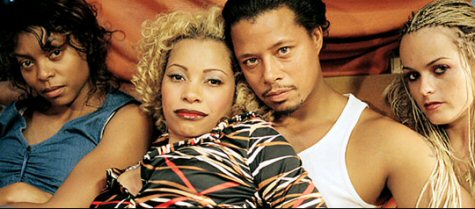
(l. t. r.) Hustle & Flow‘s Taraji P. Henson, Paula Jai Parker, Terrence Howard and Taryn Manning.

Hooray, sight unseen, for George Romero’s Land of the Dead (Universal, 6.24)! And here’s hoping Terry Gilliam’s The Brothers Grimm (Dimension, 7. 29) turns out to be somewhat better than the advance word has indicated for several months.
Long Lines, Few Surprises: Star Wars, Episode III: Revenge of The Sith (2oth Century Fox, 5.19); Madagascar (DreamWorks, 5.27); The Longest Yard (Paramount, 5.27); Batman Begins (Warner Bros., 6.17), The War of the Worlds (Paramount, 7.1); XXX2 (Sony, 4.29); Charlie & the Chocolate Factory (Warner Bros., 7.15); The Bad News Bears (Paramount, 7.22); The Island (DreamWorks, 7.22); Dark Water (Disney, 7.8); Fantastic Four (20th Century Fox, 7.8); Bewitched (Columbia, 6.24).
For some reason, Monster in Law (New Line, 5.13) isn’t making me tingle with anticipation. Same deal with Aeon Flux (Paramount, 8.12); The Honeymooners (Paramount, 6.10); The Hitchhiker’s Guide to the Universe (Disney, 4.29); The Lords of Dogtown (Columbia, 6.3); The Sisterhood of the Traveling Pants (Warner Bros., 6.3); and The Pink Panther (MGM, 8.12).

Talk Soup

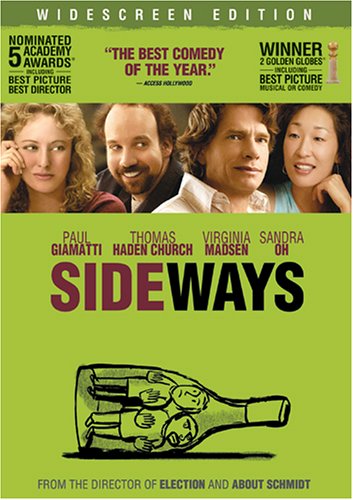
That rollicking commentary track by Paul Giamatti and Thomas Haden Church on the Sideways DVD made me think of a few others.
You can’t listen to this anymore unless you’re a laser disc collector, but Howard Suber’s commentary about The Graduate for the Criterion Collection laser disc is the most insightful I’ve ever heard or read about this film.
Suber’s commentaries on the Criterion laser discs of Some Like it Hot and High Noon are, I feel, just about perfect, and it’s a crying shame they’re not available on DVD.

The late John Frankenheimer’s commentary about the making of The Train is one of the best of its kind — the most candid, intimate and precise. It was first available on an MGM/UA laser disc for The Train that came out in the mid ’90s. Wonder of wonders, it was actually transferred to the MGM/UA Home Video DVD.
The giddy, almost drunken-sounding chat between Kurt Russell, Bob Zemeckis and Bob Gale on the Used Cars DVD is a real hoot.
So is the commentary track between Ron Shelton, Kevin Costner and Tim Robbins on the Bull Durham special edition DVD.
The chat between Steven Soderbergh and screenwriter Lem Dobbs on the DVD of The Limey is a classic, especially when Dobbs starts laying into Soderbergh for ignoring chunks of his screenplay and thereby inviting commentary from critics that the explanation of story and character in the film was threadbare….when in fact it wasn’t on the page.
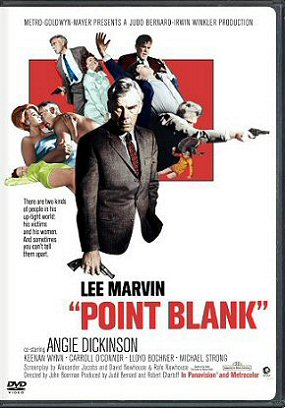
I loved Soderbergh’s chat with Mike Nichols on the Paramount Home Video DVD of Catch 22, and I can’t imagine that the Soderbergh-John Boorman chat on the forthcoming DVD of Point Blank won’t be worth its weight in gold.

David Thomson’s commentary about Out of the Past for the old Image laser disc version that came out in the mid ’90s is lost to the world (and will probably never be heard on DVD), but it was truly a masterful verbal essay.
If anyone has any others they’d like to mention….
For me, a great commentary isn’t about how brilliant or informative or well prepared the talkers are, although obviously that matters. It’s about how much they get to you.
Does what they have to say seem open, engaging, amusing? If it’s a filmmaker talking, is he/she offering some kind of deeply sincere exploration of the process, or is he/she giving what might be called a good-enough performance?

Authenticity

“Have you seen the trailer for The Lords of Dogtown (Columbia, 6.3) yet?
“As an avid skateboarder from 1975 through 1990, I can say with some authority that none of those guys would have said any of the lines in the trailer. The dialogue is atrocious. I’m predicting this thing is going to laughed right out of the theaters by skaters when it hits.” — Jody, c/o, www.guruphiliac.org.
Jeff to Jody: Like what, for example? What doesn’t ring true?

Jody to Jeff: Here are some examples:
“‘Now get out there and surf, you little grommets.’ I think it would be more like ‘you little assholes’ or ‘you little fuckheads.’
“‘With these you can do the same hard turns you do on your surf boards.’ It would be more like, ‘You can shred the street, dude.’ Or, ‘With these you won’t slide out anymore.’
“‘This wave breaks 24 hours a day, everyday. You know what, bros? You’re going to be the first to ride it.’ From Tony Alva? No way. I don’t know the man, but I do know he wasn’t known for his verbal expressiveness.
“And it’s not like these guys suddenly decided to ride pools. There was a distinct progression from ramps and drainage ditches to pools, half-pipes and full-pipes.
“Other offenders:
“‘Yeah, surf it like a wave, man.’
“‘We can’t bail on Skip. We’re Z-Boys. We’re family.’
“‘Hey Tony, it looks like it’s going to be you or me.’
“‘We’re going to be on summer vacation for the next 20 years.’
“It all sounds cloying and false to me, as if they’ve dumbed it way, way down for general consumption.
“These kids were basically the gangsters of their era and area. Some of them may have been intelligent, but none of them wanted to sound it. It just wasn’t cool back then. Insight was not approved.
“I wasn’t there, so I guess I’d have to admit I’m talking out of my ass with regards to the actual Z-Boys.


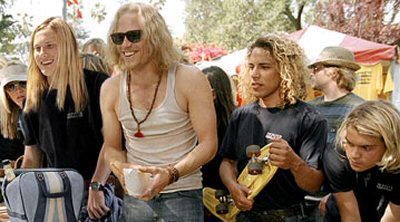
Heath Ledger (long blonde surfer hair, black shades) in scene from Catherine Hardwicke’s Lords of Dogtown.

“But I did work for a California pro skater in his distribution company. I also sold skateboards at a skateshop in Orange County. And I was at the birth of the Orange County punk movement at the Cuckoo’s Nest in Costa Mesa. I also worked at Gotcha Sportwear and Stussywear, both in Orange County.
“Now I’m a middle-aged graphic designer living a few thousand miles away from the ocean, and I’m an occasional fruitbooter (rollerblader) to boot.
“I could be completely wrong, but the dialogue in the trailer just wasn’t ringing true at all for the time and venue. That’s not at all surprising given Hollywood’s penchant for dumbing everything down to the LCD, but I hoped it would be different for this movie. So far that doesn’t appear to be the case.
“Then again, maybe they used all the worst dialogue for the trailer in the hopes of pulling the widest audience.”

Pitt, Jolie, Aniston

“What is it about beautiful, confident, talented, take-charge women like Angelina Jolie that scares the bejesus out of everyone? And what is it about Jennifer Aniston, who in all her movies seems to be re-cycling simpering, clueless Rachel, that makes people want to leap to her defense and assume that everyone else in the saga is a villain?
“Jolie can act circles around Aniston, does not seem nearly as high maintenance, and does not seem to need everyone around her constantly reassuring her as Jennifer reportedly does.

“I love the spin on this. The Jennifer camp says Brad broke Jen’s heart and that all was a paradise before homewrecker Jolie came along. The Pitt camp says he’ll let her have the house and that he was powerless against Jolie…Brad Mouse to her Angelina Cat. And the Jolie camp just says the hell with all of you, I don’t need to sleep with married men, they’re lining up for me, plus I work for the U.N.

“Why can’t it be as simple as this? Pitt, wanting children, seeing his wife booking movies into her 40s and realizing that it ain’t gonna happen? And Jennifer seeing that the family promises she made during Friends don’t hold a candle to grabbing movie offers before her heat dies down and she hits the Hollywood women-over-40 ceiling?
And Jolie being flabbergasted that Pitt has allowed it all to come to this and nature taking its course?

“Will I see Mr. and Mrs. Smith? Nope. Partly because the trailer looks lame and the story does not sound that compelling. And also partly because of the whole Pitt-Aniston-Jolie saga. I am tired of reading about it and don’t need to pay money to watch Pitt and Jolie play house.” — Zoey.

The Big Stink

Deep down there’s something in us that enjoys the art of financial hoodwinking and flim-flamming… as long as it’s presented in a suitably fictional and charming package.
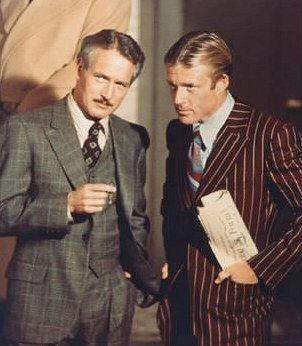
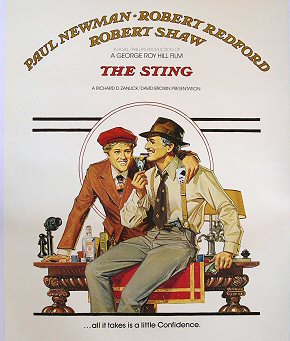
There’s an appealing example of this in The Sting when Paul Newman’s Henry Gondorff is talking about his days with the O’Shea mob in Chicago in the 1920s, when corruption was rife and “the feds took their end without a beef.”


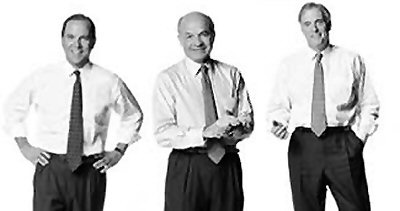
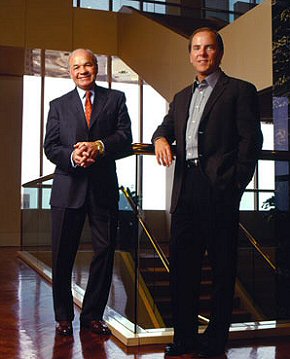
(l. to r.) Former Enron CEO Kenneth Lay, former COO Jeff Skilling, sullied execs Andy Fastow and Lou Pai

And then Newman’s smirk grows into a shit-eating grin as he says to Robert Redford’s Johnny Hooker, “And it really stunk, kid.”
If you’re honest, you’ll admit your reaction when you first saw this scene was something along the lines of “yup…corruption can smell like nectar when there are no squealers and everyone’s equally dirty” or “there’s something to be said for graft and payoffs if they’re handled in a civilized manner.” Right? Especially if guys like Newman are in on it.
< ?php include ('/home/hollyw9/public_html/wired'); ?>
In real life, of course, financial snookery isn’t quite as sexy.
Nine times out of ten the grifters are high-end corporate types with fleshy faces and boring haircuts and heavy political connections and an ability to put people to sleep with their inane remarks at stockholder’s meetings, or in their statements to the press.
And so it was with the Enron meltdown that began to break about four years ago, and spilled over into total scandal in early ’02.

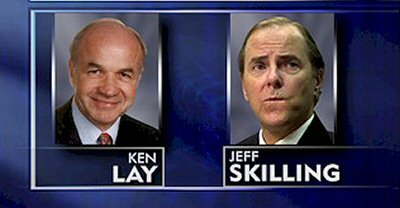
Nothing remotely charming in this mess. The leading Enron bad guys, CEO Kenneth Lay and COO Jeff Skilling, were just odious. And yet Alex Gibney’s Enron: The Smartest Guys in the Room (Magnolia, 4.22 in New York and Houston, expanding on 4.29) manages to make their story a gripping thing.
It is, in fact, fully entertaining, and I never thought I’d say that about a documentary recounting the wrongdoings of a bunch of George Bush-supporting pirates.
“It’s like a heist film,” Gibney told me earlier this week. “When you think of it that way, it takes on a certain dimension.”
Over-valued and increasingly founded on imaginary concepts as it got closer and closer to the financial precipice, the Houston-based Enron, which got rolling in the `80s as as a gas-pipeline energy company but began to get into all kinds of stuff in the late `90s, was this country’s seventh-largest corporation before collapsing in 2001.
Lay, Skilling and other bigwigs walked away with over a billion dollars in their pockets, leaving lower-level investors and employees holding the bag, in some cases with their life savings wiped out.
Gibney has based his film on the 2003 bestseller of the same name, co-written by Fortune magazine reporters Bethany McLean and Peter Elkind. He began working on it just over a year ago and finished it last Thanksgiving,


(l. to r.) Skilling, Lay and former Enron executive Joseph Sutton.

Enron adds new reporting about stuff that has come out since ’03, including some indictments that have come down. The feds are putting Lay and Skilling on trial for fraud in January ’06. If they get a conviction, stiff sentences may result.
There is also TV coverage of Congressional hearings, several on-camera recollections from eyewitnesses and various folks who got burned. Lay and Skilling didn’t talk to Gibney but their statements are covered with TV news footage, C-SPAN clips and corporate videotapes originally meant for in-company viewing.
The basic message is that as things got more and more vision-driven in the mid to late ’90s, Enron became an absurdly overvalued company. Its stock was pumped up by deceptive maneuvering, and it borrowed heavily to make itself look good to the world, and eventually the fakery couldn’t sustain itself.
In ’91 Skilling introduced one of his cuter moves, which he got SEC approval on, called “mark to market” accounting. It was a scam by which Enron could project millions of dollars in potential profits from some newly launched endeavor or acquisition in their stockholders reports. If the venture wasn’t profitable, Enron was obliged to cover the losses with heavy borrowing.
A key component in all this, Gibney says, is that Enron wasn’t hassled all that much by federal oversight agencies, partly, he feels, because of a certain chumminess between Lay and George Bush, who accepted millions in Enron campaign contributions. Enron’s freedom to pretty do what it wanted to do seemed linked in a lot of people’s minds to an attitude on Bush’s part to go easy on “Kenny Boy” and his pals.

It turns out Enron was behind the big California energy crisis of 2000 and ’01. As footage of California brush fires are shown in the film, tapes are heard of Enron guys chortling about the success of their plan to artificially create the crisis. This was partly achieved by selective “maintenance” shut-downs of power plants, which allowed for hikes in electricity rates.
Former California governor Gray Davis, whom Enron tried to blame for the rolling blackouts that were happening back then, is shown trying to point the finger at Enron. Gray “suspected something [like this] was going on but he couldn’t prove it at the time,” says Gibney. “When 50% of the power plants were down for maintenance on a single day, you have to wonder what’s going on. That smelled fishy.”
Enron suggests that a May ’01 conference between Lay and eventual California gubernatorial candidate Arnold Schwarzenegger gave the latter information that he used to make Gray look bad over his handling of the energy crisis.
The one note of compassion (or at least empathy) comes when the doc briefly focuses on Lou Pai, a Skilling associate who had a yen for strippers and strip clubs. It reminded me of Mort Sahl’s crack that revelations in the early ’80s of sexual impropriety by a certain Republican fat cat was “a cynical attempt to humanize the Reagan administration.”
The most chilling scene for me happens during a morale-boosting meeting among Enron employees right when the meltdown is happening, and some guy asks if he should invest all of his money, “all of my 401 K” in Enron, and he is told by a spokeswoman who happens to be standing at the mike, “Absolutely!” And then she laughs.
Bottom line: a lot of people were being paid a lot of money for working with Enron and being good team players, and as long as the checks were coming in none of them wanted to know anything. Nobody being paid good money ever does.
An Enron employee named Cliff Baxter killed himself in January ’02.

How much did Lay and Schilling walk away with? In the film Lay is quoted as saying he’s down to his last $20 million and something like $1 million in liquidity. Skilling reportedly paid $23 million to his attorney as a retainer fee.
Andrew Weissman is heading the prosecution of Lay and Skilling in the upcoming fraud trial. He was also the lead attorney in the government’s prosecution of fraud charges against the Arthur Andersen accounting firm, which cooked and then shredded the books for Enron during its big-calamity phase.
The Justice Department has been investigating the Enron debacle since January 2002. Why has it taken so long to put together a case against Lay and Schilling? “Because it’s very complicated,” says Gibney. “It’s going to be very tough to try because they’re going to have to prove intentional fraud. They may be found not guilty.”
President Bush “is, I think, happy to have the Department of Justice pursue this case as aggressively as possible. Now he can just say ‘I didn’t know’ and if they did something crooked, they have to pay the price.”
Gibney says “if I were king of the world, and it’s probably a good thing that I’m not, I’d like to see Ken Lay work as a grill man for McDonald’s and be forced to ride only public transportation for the rest of his life.”
Here’s a link to Bethany McLean’s 3.5.01 Fortune magazine piece, “Is Enron overpriced?”
If McLean’s piece has a money paragraph, it’s this: “‘Enron is an earnings-at-risk story,’ says Chris Wolfe, the equity market strategist at J.P. Morgan’s private bank, who despite his remark is an Enron fan. ‘If it doesn’t meet earnings, [the stock] could implode.'”
Fortune has put up a special webpage linking to various other aspects of its Enron reporting.

The thing that sticks with you at the end of Gibney’s film is the look in Lay and Skilling’s eyes as they try to sell the concept of Enron’s financial health.
I don’t know if these guys would have gotten off any easier if they had some of that Henry Gondorff charm, but I know audiences tend to respond to this on all sorts of levels.
If I had been an Enron stockholder five or six years ago in a buy-sell position, and all I had to go on was the way these guys presented themselves and the deep-down attitudes they conveyed, I would have unloaded like that. I feel sorry for the people who kept their Enron stock and lost everything, but that’s life in the big city.
Enron: The Smartest Guys in the Room “is kind of a moral report card,” says Gibney. “There is a moral dimension to our economy that has to be reckoned with. It says, in a way, that the free market ultimately makes us slaves….utterly free but slaves at the same time.”
HDNet, the high-definition cable station owned by Enron producers Mark Cuban and Philip Garvin, will screen Enron: The Smartest Guys in the Room concurrent with the 4.22 theatrical debut. It will play at 8 pm eastern (5 pm Pacific) and then at 11 pm eastern (8 pm Pacific).

Bill of Goods

The thing that made me want to buy Universal Home Video’s new 2-Disc Anniversary Edition of Apollo 13 was a promise on the jacket art that the IMAX version of this 1995 film is included on the second disc.
I saw a piece of the IMAX version on this Ron Howard film at a special invitational press screening a couple of years ago, and it made the images look sharper, fuller and bolder than those in the theatrical version, which was pretty good to start with.
The IMAX version looks better because each frame of the original has been digitally tweaked so as to make everything look richer and more vivid, in order to meet the blown-up standards demanded by the much larger IMAX screen.


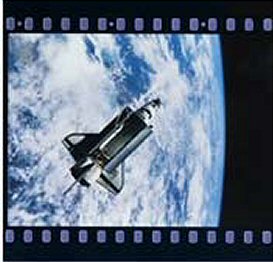
Actual frame of IMAX film, indicating the appproximate 1.33 to 1 aspect ratio in which IMAX films are projected in theatres…

I wondered at first how this would work since the aspect ratio of an IMAX screen is kind of boxy (close to 1.33 to 1), and Apollo 13 was originally released in Scope (2.35 to 1). The solution, I learned at the press conference, is that Apollo 13 was actually shot in Super 35mm, which captures a 1.33 to 1 image but is then cropped in post-production to create a Scope aspect ratio. So there was plenty of extra top-and-bottom image space to fill the IMAX frame.
Pretty much all Scope films are shot in super 35, or so I’ve heard. This is how DVD pan-and-scan versions of Scope films are assembled — not by cropping off the sides of the Scope image but by using the original 1.33 to 1 super 35 image.
Anyway, knowing all this I was shocked when I played the IMAX version last night and discovered it’s not the IMAX version at all. What Universal Home Video has released on Disc 2 is a cropped IMAX image with an aspect ratio that looks roughly to me like 1.75 to 1.
(A critic on www.dvdtalk.com wrote that the IMAX DVD version uses a 1.66 to 1 aspect ratio. He’s wrong. Check out the Warner Home Video DVD of Barry Lyndonthat’s 1.66 to 1.)
I’m not strenuously complaining about this. Image quality-wise the IMAX-on-DVD version of Apollo 13 looks quite superb. It has a knock-down, almost startling clarity and all kinds of ripe bountiful colors. It is so appealing and soothing to the eye that I stopped working last night in order to watch it.
But — but! — to tell DVD buyers they’ll be getting the IMAX version of this film when they buy the new DVD is a cheat. It’s the IMAX image quality without the actual shape of the image shown in IMAX theatres, and in my book to sell it as a “the IMAX Experience version” is at least a half-lie. To me it’s a flat-out fib.


…and the 1.75 to 1 aspect ratio of the “IMAX Experience” version as presented on the new Apollo 13 2-Disc DVD.

I enjoyed Apollo 13 when it came out ten years ago, but I hadn’t looked at it again since last night and it plays better than I remember. Well shot, professionally paced and believably acted, this is a fully involving, methodical recreation of a true-life event. I still love Dean Cundey’s photography and while the special effects look a bit dated by today’s standards, they’re still decent.
It’s always the mark of a good film when the third-act tension (i.e., will the possibly damaged heat shield hold during re-entry?) in the third-act works even when you know astronaut Jim Lovell (i.e., Hanks character) and the other two guys made it and there’s nothing to worry about.
I had forgotten how young Hanks used to look, and how thin he once was. Kevin Bacon looks so much younger also; ditto Bill Paxton. I know it sounds banal for an industry journalist to mention age and weight issues, but this is the first thing you notice when you watch this DVD. You say to yourself, “Wow, time really moves along.”

Thunder Approaching

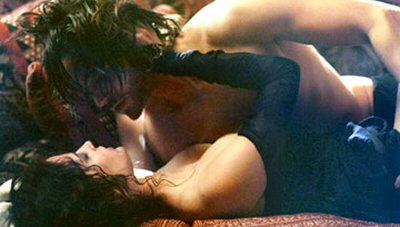
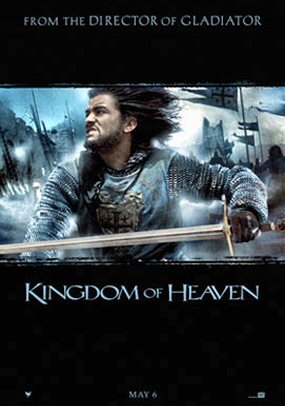
My baby blues have beheld the majesty of Ridley Scott’s Kingdom of Heaven (20th Century Fox, 5.6).
It may be a little bit early to say what it is, but I think it’s fair to say what it isn’t. That sounds, I realize, like I’m qualifying or being “careful” by saying as little as possible. Not so. I just need to set the record straight about something I wrote about this super-sized epic late last year.

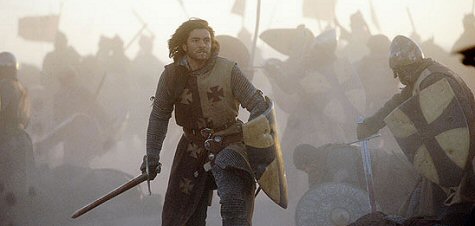
In some ways surprising, in several ways stirring and in almost every way admirable, Kingdom is a big-canvas historical drama that dares to be different. I’m not saying it doesn’t give in to formula now and then, but it’s a complex and unusual thing for the most part, and altogether a textural masterpiece.
That sounds like I’m dodging the central issue of whether it’s entertaining or not. It is, but what got me is the beauty of the brushstrokes. That and the avoidance of the usual usual.
< ?php include ('/home/hollyw9/public_html/wired'); ?>
Has there ever been a big expensive film about warring armies in which one side didn’t triumph absolutely? In which the loser wasn’t totally beaten down and slaughtered? I felt amazed and lifted up when this didn’t manifest…when life and sanity, in effect, is chosen over death and fanaticism.
The 12th Century milieu feels entirely authentic, the big siege-of-Jerusalem battle scene totally aces Peter Jackson’s similar third-act sequence in Return of the King, there are fine supporting performances throughout (especially from Jeremy Irons and a masked Edward Norton), and William Monahan’s script, praise Allah, avoids a lot of black-and-white, good-and-evil stereotypes.
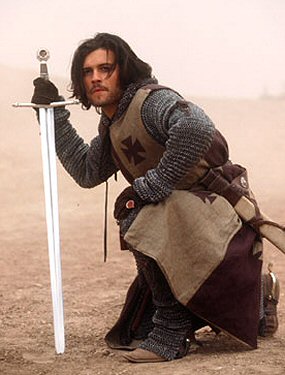
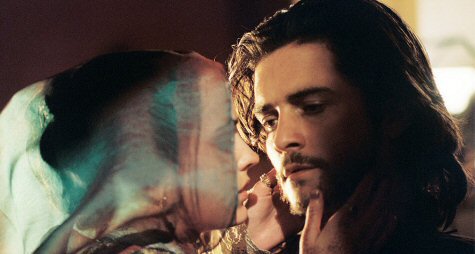
In the title role of Balian of Ibelin, defender of Jersualem, Orlando Bloom has zotzed the girlyman image he created for himself in Troy . He is bearded, grimy, quiet and steady throughout Kingdom of Heaven. He is manly, in short, and does that classic Jimmy Cagney thing — planting his feet, looking the other guy in the eye and telling the truth.

Does he channel Laurence Olivier? No, but Bloom has definitely held his ground here, and the stage is now set for him to carry the ball into the end zone, maybe, in Cameron Crowe’s Elizabethtown.
Ghassan Massoud, the Middle Eastern actor who plays Saladin, makes an especially strong impression. He doesn’t just play a man of honor and a commanding leader — he seems to possess these traits himself, and has made them readable on the screen by just being. It’s one of those “wow, who was that?” performances that should be remembered at year’s end.
But let’s get back to my original point — what the film isn’t. Especially since the unspooling of Kingdom of Heaven argues with a forecast piece that I wrote about and posted on 12.29.04.
This is a film about the Crusades and a decisive late 12th century battle between Muslim and European armies over the occupation of Jerusalem. Given the invading Anglos vs. Middle East natives angle, one might expect Kingdom of Heaven to conjure a political echo or two about the U.S. occupation in Iraq.
At the very least, this seemed like a perfectly logical and reasonable thing to presume.
“9/11 was three years and three months ago, the invasion of Iraq happened in March ’03, and principal photography on Kingdom of Heaven began in Morocco last January,” I wrote. “And in the minds of Scott and his creative team, the U.S. vs. Iraqi insurgent situation didn’t weave its way into the film on this or that level?”

These echoes are there, I suppose, if you want to dig them up. I suppose you could regard the last ten or fifteen minutes of this film in a metaphorical light and say it addresses the fundamental folly of being an occupier, and in fact offers an honorable solution for those who find themselves in this situation.
But Kingdom of Heaven is such an atmospheric reconstruction of the 12th Century, such a devoted here’s-how-it-looked-and-smelled experience, and Scott’s eye is so painterly and his focus so unlike, say, what Oliver Stone’s might have been, that you just don’t get much of a Baghdad/Fallujah/Abu Ghraib residue.
In my 12.29 piece I said, “Can anyone think of another occupying Anglo force that went into a Middle Eastern country for bogus reasons and is probably fated to leave with its tail between its legs?
I then linked to an 8.12.05 New York Times piece by Sharon Waxman that explored this and related issues to some degree.
“With bloody images of Muslims and Westerners battling in Iraq and elsewhere on the nightfly news, it may seem like odd timing to unveil a big-budget Hollywood epic about the ferocious fighting between Christians and Muslims over Jerusalem in the Crusade of the 12th Century,” her story began.
“While the studio has tried to emphasize the romance and thrilling action, some religious scholars and interfaith activists…have questioned the wisdom of a big Hollywood movie about an ancient religious conflict when many people believe that those conflicts have been reignited in a modern context.”

I never got hold of Monahan’s script and I don’t know if Scott cut stuff out in order to de-politicize Kingdom of Heaven, but once it starts to be shown, those scholars and interfaith activists will, in my opinion, have a hard time selling whatever complaints they may have to journalists.
And I’m including anyone in the pro-Islamic p.r. community. I didn’t see anything in this film that dismissed or put down any Muslim characters, or which failed to respect their point of view.
One of my favorite scenes is when Bloom, freshly arrived in Jerusalem, asks where Jesus Christ was crucified and goes there, to the barren hilly area called Golgotha. Then he sits on a hillside and waits for something to happen. The movie becomes very quiet and still, and for almost a minute (or maybe a bit more), everything flatlines.
It doesn’t amount to a condensation of Bergman’s trilogy about God’s silence or anything, but I could feel pleasure seeping in…pleasure in the fact Scott isn’t afraid of taking this movie into a moment of meditation.
I also enjoyed a scene in which Bloom and his soldierly allies dig for water in a barren area, and then find it and create an irrigation system.
I will always remember this film for the sonic impact of those heavy thundering hoofbeats upon my ribs.
The pleasures of the stellar supporting cast are considerable. Everyone shines…Irons, Liam Neeson, Eva Green (last in The Dreamers), David Thewlis, Jon Finch (I always liked his Thane of Cawdor in Roman Polanski’s Macbeth), Brendan Gleeson, Alexander Siddig, Velibor Topic, etc.

I didn’t exactly “like” Marton Coskas’ performance as Guy de Lusignan, one of the really arrogant bad guys who creates most the trouble, but he fills the boots.
I can’t say I’m totally delighted that Scott is still queer for that herky-jerky, skip-frame way of shooting action scenes that he used in Gladiator, but c’est la guerre.
There’s another Gladiator echo in the form of an attacking horsemen scene about ten or fifteen minutes in. It appears to have been shot in the same forest used for the opening battle scene in Gladiator, with the same blue tint and the same digital snowflakes.
One of the Kingdom of Heaven sites is here .

Peet Problem

It was about two and a half years ago when I began to forgive Amanda Peet for being intensely dislikable. And she is that — make no mistake.
I’m sure she’s fast and hip and cool to hang with, but she plays the same kind of woman in film after film, and this can’t be just because casting directors lack imagination and like to play follow-the-leader.
There is something in Peet’s screen attitude that always seems to bring lying, insincerity and cynical mind games to the table. Just as there are faces that radiate warmth and kindness and all that other sweet stuff, there are faces that do the opposite and make you feel wary about everything. Peet’s basic vibe is that of a born conniver.

Peet could never (or at least, should never) be cast in a film like Kingdom of Heaven. There’s something grotesquely and opportunistically “now” about her that doesn’t, I feel, adapt to any other time or sensibility.
Her eyes are striking, to be sure (People called her one of the 50 most beautiful people in the world in 2000), but also shrewd and predatory. She has a smile right out of Fall of the House of Usher with Vincent Price. It says, “You don’t get me and you never will. I’m going to make sure of that.”
But she was truly exceptional as Ben Affleck’s soulless wife in Changing Lanes, particularly in that restaurant scene when she tells Affleck she married him because she knew he would always be the kind of guy who would kowtow to power and do what’s necessary to keep her in clover. It was such a cool scene I figured, okay, give it up.
And then she was fairly agreeable as Diane Keaton’s daughter in Something’s Got To Give and as Will Ferrell’s go-getter spouse in Woody Allen’s Melinda and Melinda.

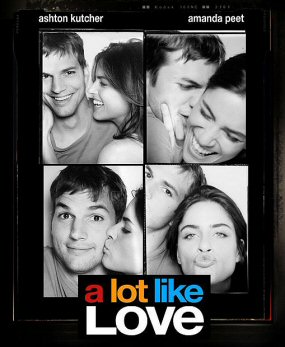
But now she’s back as Ashton Kutcher’s romantic interest in Nigel Cole’s A Lot Like Love (Touchstone, 4.22) and I’m getting the creeps again. Those photo booth shots of her and Kutcher in the poster…the way she looks and sounds in the trailer. Everything is telling me to duck and hide.
This isn’t very interesting to write about. Gut likes and dislikes are so arbitrary. There must be tens of thousands (or more) who find Peet attractive or funny or whatever. A distributor who wrote me a couple of days ago swears A Lot Like Love is a sleeper, and for all I know I’m the only one who feels this way about Peet. But I doubt it.
A Lot Like Love is said to be an above-average film. It’s about Kutcher and Peet wanting each other and not doing anything about it for seven years because they don’t feel they’re ready to pull the trigger or take the plunge. In other words, it’s a twentysomething movie that basically says, “Relax…chill…you have all the time in the world.”
Well, don’t we?

Pollack Dissing

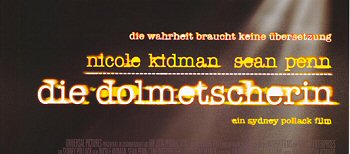
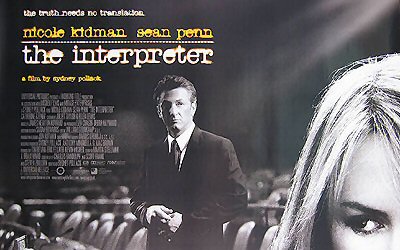
It has been observed that Sydney Pollack’s name is barely legible on the U.S. one-sheet for his latest film, The Interpreter (Universal, 4.22), and that this is probably not an accident.
The words “A Sydney Pollack Film” are printed in a light, barely visible gray and scrunched between the larger, bold-faced names of the film’s stars, Nicole Kidman and Sean Penn. (Pollack’s name is so hazy and small I can’t even find a focused blowup.)

If Out of Africa had won the Best Picture Oscar in ’94 instead of ’84, you can bet Sydney’s name would be a tad larger and probably pop through a bit more. Universal’s marketing guys are definitely making a statement of some kind.
It’s interesting, also, that Pollack’s name is larger and more visible on the English and German one-sheets for the film.

The international ad guys are obviously less concerned about whatever it is that has scared their U.S. counterparts (memories of Pollack’s Random Hearts?). That or Random hearts did better in Europe than it did here.

Psycho Bondo

So how will the James Bond loyalists take to the apparent hiring of Daniel Craig as the new James Bond?
The Bond casting rumors been all over the map the last few months and ya never know, but reporter Sean Hamilton of London’s The Sun has just reported that Bond producer Barbara Broccoli has offered Craig a three-picture 007 deal, and I’m told by a knowledgeable source that “she really likes him [and] wants him bad.”

Didn’t I just read that the Sony guys, who’ve bought the 007 franchise from MGM, want to stay with Pierce Brosnan for one more film? And what about that plan to de-age Bond and make him into a early thirty-something (which is what Sean Connery was when he played 007 in the early `60s)?
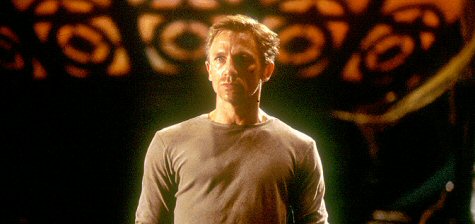
Craig is a GenXer (he just turned 37), and about as far away from a Brosnan-type Bond as you can get. Like I said in a recent item, he strikes me as vaguely psychotic in a Timothy Dalton (i.e., smarter, more serious, less into the sardonic quips) vein. He’s a bit of an ice man. But when you think about it, so was Connery.
< ?php include ('/home/hollyw9/public_html/wired'); ?>
Craig is clearly a serious guy with talent and focus and a certain screwed-down studliness. But there’s also something a bit creepy and even sadistic lurking within. Craig’s grayish-blue eyes have an inert quality mixed in with a hint of menace, and I suspect it’ll hard for the troops to warm up to a guy who just might strangle or throttle you on a whim.
A guy who’s met all the Bond actors (Connery, Brosnan, et. al.) says Craig is “slight…about five-nine or so. The other guys are all six-one or six-two…they command the room when they walk in. You can feel it.”
Craig will be co-starring with Eric Bana in Steven Spielberg’s Untitled Munich Project, which starts filming in the summer for release in late December.

He’s a fairly sympathetic, down-to-business drug dealer in Matthew Vaughn’s Layer Cake (Sony Classics, 5.13).
He was a bit gnarly and impenetrable in Roger Michell’s Enduring Love, which Paramount Classics brought out last fall, but he was easily the most interesting player in Michell’s The Mother.
Maybe Craig’s chilliness will prove a healthy addition to the 007 casserole. Maybe Pierce Brosnan was too fey and quippy and Irish pub-ish. Or am I just reacting too strongly to the impression left by Craig’s psychotic son-of-Paul Newman gangster role in Road to Perdition?
I’d really like to hear some opinions about this. Send `em off today and I’ll post `em on Friday.

Talk

I mentioned in last Friday’s column the exceptionally cool commentary track delivered by Paul Giamatti and Thomas Haden Church on the new Sideways DVD, which came out yesterday.
I think it’s a classic — truly one of the hippest and most engaging DVD commentaries ever put forward.
Anyway, here’s a taste. It plays just as Giamatti and costar Virginia Madsen (described by Haden Church at one point in the conversation as “be-jugged”) begin their scene in Sandra Oh’s home in Los Alamos. You know…the beginning of that now-famous scene on the back porch.

Thomas Haden Church: Look at you. You look very handsome there.
Paul Giamatti: Thank you, sir.
THC: Look at you! Rakish…rakish.
PG: Rakish, yeah. Like a Renaissance prince. With that sculpted beard. Look at that sculpted beard.
THC: Absolutely.
[Note to reader: at a later point Giamatti says he thinks he resembles Fernando Rey in The French Connection.]
PG: Was this real wine…we were drinking the real deal here? I think we were.
THC: Now, did you shoot this in sequence?
PG: We shot this whole thing in sequence.
THC: I remember Virginia [Madsen] saying during the q & a, that she very much wanted sort of a mellow…kind of a real mellow thing going. I think Virginia’s tremendous in this scene.
PG: Oh, God..yeah.
THC: Because she completely…she, she badmintons
PG: Wow. I’ve got it. I’m following you!
THC: The, the, the amateur vintner’s palette….right back at you.
PG: She keeps the birdie aloft.

THC: Well, she keeps you
PG: Ah!
THC: On it.
PG: Nice!
THC: In the scene.
PG: Yes.
THC: Because you kind of play it off in a politic way.
PG: Correct. She plays it for real. You’re absolutely right.
THC: Yeah. You don’t want to insult Stephanie’s meager trappings.
PG: Hemmed in by…whatever.
THC: Yeah.
PG: By my doughy white flesh!

Bad Guys

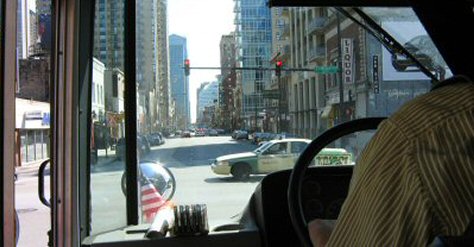
I was in Chicago last weekend and got suckered into going on a gangster tour of the city in a dark brown chauffeured school bus. It cost me $24 dollars. It was half-embarrassing and half-interesting, and it reminded me that curiosity can sometimes lead to suffering.
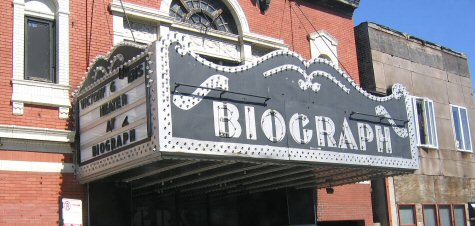
Actually, I suckered myself. I wanted to see the Biograph theatre where John Dillinger got it and the hotel where Al Capone’s headquarters used to be and the parking garage where the St. Valentine’s Day Massacre happened, etc. By the time it was over I felt I’d been worked over by a couple of low-rent thugs, which was more or less what happened.
The name of this sucker-bait operation is Untouchable Tours. I highly recommend it to any Chicago visitor who doesn’t mind being treated like an eight year-old as the price for learning a little history.

The owners have been running Untouchable Tours for 17 years, which means they’re not stupid and know what they’re doing.
They’ve learned that people sincerely enjoy being driven around town by a couple of aging hams dressed up as 1930s Damon Runyon characters.
They know that talking in fourth-rate Danny Aiello goombah accents that would get them fired from any respectable touring company of Guys and Dolls plays like gangbusters here.
They know that shooting off cap guns and playing rinky-dink tapes of machine-gun fire along with Nino Rota’s theme from The Godfather are fine atmospheric ingredients.
I felt so embarrassed by these coarse vaudevillian shenanigans, I was close to weeping.
The rubes loved it. I think it’s fair to say they were euphoric. They were poking the tour guides in the arm after the tour on the sidewalk and saying “great show!”…”okay“…”way to go!” I was ready to puke. These are the good people who re-elected George Bush, I told myself. Aristocrats of the American heartland.

A copy line on the Untouchable Tour website says, “Experience Chicago as it was during the 1920s and 30s!” Bunk. Pretty much every Chicago gangster landmark is gone, and the vibe created by the Untouchable bus bozos is pure Disneyworld.
The hotel where Al Capone’s headquarters used to be — the Lexington, at the northeast corner of East Cermak and Michigan Avenue — was torn down about ten years ago. The turn-of-the-century buildings that housed the saloons and whore houses on the South Side that Capone used to run for Dion O’Bannion are all gone. The St. Valentine’s Day massacre parking garage was destroyed a long time ago…terrific.
The only thing still standing is the Biograph, where the G-men closed in on Dillinger in 1934 and put two or three slugs into his back, and one in his left eye. The tour guy said that a female bystander went over to Dillinger’s body and dabbed her handkerchief in his blood, for a souvenir.
When you see movies about Capone and the Chicago gangs, the actors are always in their late 30s, 40s and early 50s. But the real guys were in their 20s and early 30s. Capone was in his early 20s when he started working for Dion O’Bannion, and was only 25 when he had O’Bannion killed in 1924. Hit man Earl “Hymie” Weiss was only 28 when he was gunned down in front of a cathedral at the corner of State and Superior. O’Bannion was only 32 when he died. Bugsy Moran was about 37 when the Valentine’s Day killing happened in 1929.

I kept asking the tour guys this and that, and they told me what they knew between their performance routines. A little begrudgingly, it seemed. Yo…why can’t this guy put the note pad away, sit back and enjoy the ride?
The basic attitude behind their performances is that gangsters are exotic, thrilling, vaguely lovable creatures. Murder in the street, bullets in the head…aayyyy!
At one point the more obnoxious of the two got out a cowbell and started clanking away as he told the story of Mrs. O’Leary’s cow knocking over a kerosene lantern in a barn on the night of October 8, 1871, and thereby starting the fire that ravaged old Chicago.
At this moment my cell phone rang. It was Michael Wilmington, senior film critic for the Chicago Tribune, calling to organize our meeting for later that day. But the guy with the cowbell didn’t like it that Wilmington had called — I guess he felt I wasn’t showing the proper respect for his performance, and he was probably right.
So he started clanging the cow bell right in my ear and riffing to the others in the bus about how “we have this guy in the front with a cell phone who thinks he’s something special,” or words to this effect.

Wilmington, hearing the ruckus, said to me in an irritated tone, “Jeff, are you in the middle of a cow pasture or what?”
After the tour was over I asked one of the Untouchable guys if they knew which Chicago subway line would be the best to get to a certain location, and he said he hadn’t been on a subway in ages. (A mark of a successful man!) As I was about to head off I asked the other guy if he knew where the nearest subway station entrance was, and he said, “I wouldn’t know, pal.”
That was it. That’s when I decided to do what I could to help their business.
I’m not suggesting this as a plan of action, but if a couple of pistoleros were to ambush one of these tour buses on North Lincoln Avenue and let go with some machine gun fire…no intentions of hurting anyone, of course…just put a few holes in the bus, shatter some glass, blow out the tires. If this were to happen, there would be a certain symmetry, I think. And it would really give the tourists a thrill.
Aayyyy!

Chicago Snaps

Destroy All Broccolis

“On one hand, Daniel Craig as 007 is sort of inspired: Fleming’s Bond was more than a bit of a bastard, and a true read of the character would reveal him as much more sociopathic than we’ve seen him on film.
“Indeed, I had the sense, watching Dalton’s two outings, that if he hadn’t been forced to make with a quip at stupid times, we’d have seen that simmering homicidal rage inside Dalton get out and get the real character.
“On the other hand, the Broccolis aren’t dead and haven’t turned the franchise over to someone who will actually make something other than a loud, exploding, popcorn film. So what fucking difference does it make, right?
“The Bourne movies have proven that there’s still room for quality spy films in the marketplace. Too bad Bond has no chance to be any of them.” — Marc Mason, “Should It Be A Movie?” c/o MoviePoopShoot.com.

Sin City

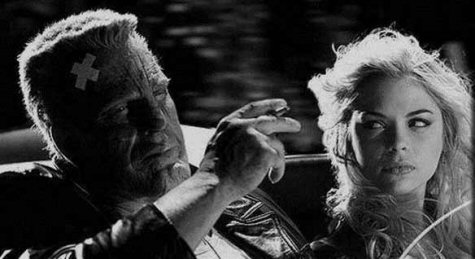
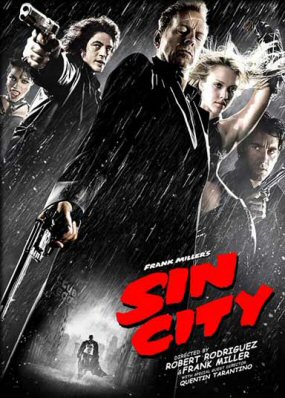
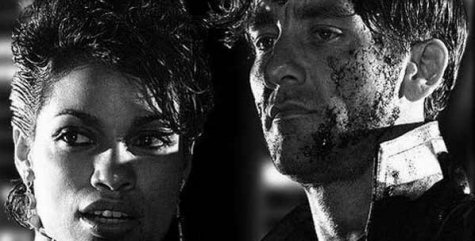
“I love your column and read it fairly religiously, and I’m amazed by how you and so many other people missed the point of Sin City.
“Yes, the direction was amazing, the actors played their roles faithfully, the lighting was great and the whole feel of the movie was fantastic, but that’s not what the movie was about at all.

“Did you ever stop to think about what was the philosophical differences between the good guys and bad guys? Did you ever stop to think why the most powerful women in the movie were prostitutes? It seems to me every critic who reviewed this movie just turned their brain off because they thought it was a piece of pulp fiction, but no-ones talking about the real message of the movie.
“Go see it again with attention to these details and I’ll let you know how I saw the movie. It went way beyond the skin deep treatment it’s getting.” — Aaron

Sleeper?

“Being the fan of Cameron Crowe that I am, I just can’t help wondering if he made the right choice when he fired Ashton Kutcher off Elizabethtown. Why? I just saw Kingdom Of Heaven and then went back to see Kutcher’s A Lot Like Love again.

“And my doubts were confirmed into a very fine conclusion: Ashton Kutcher is a truly wonderful and talented actor. Something that Orlando Bloom might become one day. He’s the only thing that’s keeping Kingdom Of Heaven from becoming a masterpiece. Let’s hope that he will not screw-up Elizabethtown. I’m pretty sure that Ashton wouldn’t.
“And, yes: A Lot Like Love will be first true sleeper hit of 2005.” — Zagreb-based exhibition guy.

Travis

“Your Jekyll and Hyde comments baffle me. What is it you don’t understand about Taxi Driver, the genius of Scorsese, or the greatness of screenwriter Paul Schrader? It’s listed as #47 on AFI’s list of the 100 greatest films ever made, so you must be mistaken.
“However, your comments on the brainless Sin City are absolutely correct. The film is geek noir — ‘hard guys talking tough’ — and it is, as you say, ‘all crap.’
Taxi Driver, though gritty and unnerving, tells us something about who we are as a people, a commentary on the society in which we live. Sin City, while spectacular and slick, tells us nothing, and leaves us, like the old lady in the Wendy’s commercial, screaming ‘where’s the beef?'” — Ron Cossey.

Bruised, Not Beaten

The best thing I’ve seen on the tube since HBO’s Unscripted is another HBO thing — a 90-minute documentary called Left of the Dial.
It premiered last night (3.31) and will air next Tuesday and Friday a few times. For some reason HBO isn’t showing it today or Saturday or Sunday. Why? Because it’s a political doc and viewers are — what? — presumed to be in a non-receptive, beer-drinking mood on weekends?

This is a good meal, dammit…satisfying and nutritious. If you ask me it should play this weekend as a respite or a detox from the cloying machismo of Sin City.
Directed by Patrick Farrelly and Kate O’Callaghan, Dial is about the launch and near-fatal crash last spring of Air America, the leftie radio talk-show network.
< ?php include ('/home/hollyw9/public_html/wired'); ?>
Just a week or so after Air America went on the air last March 31st, everything started to fall apart financially.
Two major-market stations that had been contracted to broadcast the show in Chicago and Los Angeles claimed (accurately, as it turned out) that checks written to them had bounced, resulting in Air America being yanked. Evan Cohen, the station’s founding chairman and big money guy, stopped coming to the office, and everyone began wondering if the whole deal might collapse.
But the station hung on, eeking by on this and that cash infusion or Peter-paying-Paul maneuver. And then the ratings showed that Franken had beaten Rush Limbaugh and Rhodes had out-pointed right-wing talk show rival Sean Hannity. Sponsors started to show limited support around last December. Air America had a new lease on life.


Janeane Garafalo

Today 51 stations are carrying the show and things look hunky dory.
The story of Air America’s near-meltdown is a kind of metaphor about the scary dips and turns and unfair curve balls that always seem to get thrown. Life can be rough and disheartening, but if you’ve got the pluck and the stamina and if God smiles a bit, you can make it through and possibly even prosper.
Left of the Dial is not just some piecemeal, fly-on-the-wall observational piece. It tells a good story and is packed with strong characters.
There’s Al Franken, the clever, sardonic figurehead guy…charismatic and great with the quips, but privately shaking his head and frowning and muttering to himself as things get worse and worse.
There’s Randi Rhodes, the neurotic, under-appreciated talk-show host with the Zabar’s sensibility and hair-trigger temper.
There’s Cohen in the role of the villain…the hustler who totally flim-flammed everyone and bounced checks and led Air America to the brink of ruin.


Air America’s Al Franken (l.) and COO Carl Ginsburg as the meltdown phase began.

There’s the decent soldier, David Goodfriend, Air America’s general counsel who feels so stunned by Cohen’s betrayal that he eventually quits rather than let the fiasco tarnish his rep.
There are the insecure talk-show hosts — Janeane Garafalo, Sam Seder, and “Morning Sedition’s” Marc Maron — wondering about how to get through this and fretting about their on-air material and wondering if they’ll get canned.
There’s Carl Ginsburg, the network’s executive producer in the role of the tough realist, grappling with the day-to-day expenses…the kind of hard-nosed financial affairs guy you always want on your team.
I love the scene when a couple of staffers find out about the bounced checks from reading the Drudge Report. When there’s bad stuff going down inside a company you never hear the straight dope from the guys at the top. The rumor mill always has it first.
My favorite moment is when a crisis meeting is called and “silent investor” Doug Kreeger politely asks Farrelly or O’Callaghan (or their cameraman) to please turn off the camera, and of course the tape keeps rolling. And we hear the whole “all right, people…don’t panic, we’re fine” speech.


Al Franken and Air America colleagues just after Franken’s debut show had concluded.

I knew something was wrong with Air America’s operation when I tried to listen to it online last April and I couldn’t get anything. Now you just click on “listen” and it plays on Real Player and Windows Media, no sweat.
I remember a statement or press release of some kind that Franken put out during the crisis that said, “Don’t believe these check-bouncing rumors…we’re doing fine…the righties are just trying to make us look bad.”
I’ve always loved Franken’s humor and I’ve read his two books and all, but in person he’s a bit chilly…a bit of a snob. I guess we can’t all be schmoozers.
Anyway, consider Left of the Dial a must-see.

Et tu, Lebowski?

Who could have predicted when The Big Lebowski opened seven years ago it would one day become the new Rocky Horror Picture Show? And perhaps a bit more than that?
I don’t know how many thousands of Lebowski freaks are out there, but I know they`re into seeing Joel and Ethan Coen’s 1998 stoner comedy repeatedly. They’re into memorizing the lines (“Am I the only one here who gives a fuck about the rules?”) and dressing up as Jeff Bridges’ Duderino (or John Goodman’s Walter or Tara Reid’s Bunny) and bowling and slurping down those White Russians.
And over the last two or three years, they’re into this general party-down, journey-to-Mecca thing at these homey fan gatherings known as Lebowskifests.
If I wasn’t so lazy and disorganized I would have called the great Jeff Dowd — the L.A. movie industry guy whom Joel and Ethan Coen based their Jeff Lebowski character on — and asked him to get me into the first L.A. Lebowskifest last weekend.


Producer’s rep Jeff Dowd (a.k.a., the original “Dude”) with Cami Hermann (r.) and Ben Reilly (l.) at last weekend’s Lebowskifest.

It happened last Friday night at Hollywood’s Knitting Factory and then at some bowling alley on Saturday, and the main vibe, according to Dowd, was all about “a tremendous camaraderie” and “real warmth and affection” among the fans.
Jeff Bridges performed a set with some Santa Barbara-area band he plays with, Lebowski costar Peter Stormare did the same, and David Huddleston (“I’m a Lebowski, you’re a Lebowski…..so what?) attended the bowling alley party on Saturday.
No Coen brothers, no Philip Seymour Hoffman, no Tara Reid, no Ben Gazzara, no John Turturro…but no worries and all things in good time.
The first Lebowskifest was produced in Louisville, Kentucky in October ’02, by a couple of local guys, Will Russell and Scott Shuffitt.
Since then they’ve staged Lebowskifests in New York, Las Vegas and Los Angeles (while keeping the Louisville event going, of course). Russell says they’re thinking about doing an Austin version sometime soon.
Russell and Shuffitt should do them all over. Orlando, Bangor, Seattle…maybe even Europe. All a Lebowskifest needs are fans, and there are middle-aged, out-of-shape boomer types who bowl and smoke too much pot and get Lebowski‘s absurdist stoner humor in every corner of the globe.
Russell says there are three documentaries being made about the Lebowskifest experience.
A couple named Robin and Rose Roman are working on one. A guy named John Nee, who has an outfit called Idiot Works and who also works for Adam Sandler’s Happy Madison production company, is doing another. The third Lebowski doc, called Over the Line, is the sire of an L.A. guy named Eddie Chung. (It’s currently in post-production and may be viewable, says Chung, within a month or two.)
Here’s some of what Dowd told me last Tuesday about the L.A. Lebowskifest and the general tangents:
“This thing always sells out. It sold out here before last Thursday’s [3.24] Los Angeles Times story hit. These guys have no publicists, no paid advertising.
“The two nights were totally different. Friday night is kind of like a pre-party…a lot of different bands played and the surprise guest was Jeff Bridges and his band, who played a full-on set.” (There’s some information about Jeff’s group on www.jeffbridges.com.)
“I spoke to this Latino family from San Diego that drove up to attend. A whole family… father, grandfather, kids…he was talking about how at Xmas time, they first watched it together. You wouldn’t think that a relatively straight, relatively conservative Latino family would be into this film, but they are. It’s an annual Xmas event with them.


Fan Cami Herman (l.), The Big Lebowski costar David Huddleston,

“I make a thousand new friends when I go to these things, but forget me…it’s the same emotional thing with everybody who comes. It appeals to all people…people who like to have fun watching the movie with their friends. For millions of potheads, it bears repeat viewings. It’s one of the few films you can watch over and over.
“I was up at Sundance four years ago and this guy recognizes me. I just got back from Korea, he says, and we used to watch that movie a couple of times a week out on a missile base. Now, what condition are these guys at a high-security missile base in if they’re watching The Big Lewbowski?
“As Francois Truffaut once said, it’s a phenomenon sociologique. It’s a pretty big thing. It’s really popular at this Wall Street brokerage firm I’ve heard about. It seems to bring out the subversive side in people
“The Saturday night thing was great. There was a guy dressed as Moses. There was a bowling pin girl, and a half-and-half carton with Bunny Lebowski thing on the back. Guys in CSI type lab coats. Quite a few guys like that. There were tons of Walters.
“Some guy from Ecuador had flown up. There were two girls who showed up in towels. There was this guy who showed up in torn Army fatigues….he was supposed to be a guy who died face down in the muck in Vietnam…this is the bizarre part. People don’t just come as characters — they come as lines out of the movie.
“When I first heard about these things I thought it might be full of Star Trek-type fans… you know, get a life types…but it’s not. This ranks right up there with one of the best parties I’ve ever been to. Somebody said to me the other night – “Have you met any person [at a Lebowskifest] you didn’t like?”

Replay

I thought I was a little Sideways-ed out, what with the Spirits and the Oscars and then watching a heavily edited version on the plane coming back from Argentina, which was awful.
Every funny joke, it seemed, had been ruined by those stupid verb and noun substitutions the airlines always require.
In the theatre version Paul Giamatti is telling Virginia Madsen he was really going to tell her about Thomas Hayden Church getting married, and she says, “But you wanted to fuck me first.” In the airplane version she says, “But you wanted to fool me first.”
Men and women are dishonest with each other all the time, but Madsen wasn’t on about being fooled. Why couldn’t she say, “But you wanted to do me first”? Or “have me first”?


Sideways DVD, out Tuesday, 4.5.

I called Sideways director and co-writer Alexander Payne about this, and it turns out he chose the alternate dialogue himself. Oh.
Payne said he saw the airplane dubbing process as an opportunity to be droll and make substitutions that are so dopey-sounding they’re almost hip. He said that Joel and Ethan Coen edit their airplane dialogue with this attitude.
Anyway, the Sideways DVD is out on Tuesday (4.5), and it’s great to have a copy sitting there on the DVD shelf, like a friend I can be myself with.
I haven’t seen the behind-the-scenes featurette or the seven deleted scenes. I only just picked up a copy on Thursday night.
But I’ve listened to some of the commentary by Giamatti and Haden Church, and now I’m looking forward to hearing it all. It’s on the same pleasure level as the talk between Kurt Russell, Bob Zemeckis and Bob Gale on the Used Cars DVD, and that’s saying something. Smart, amusing, easy-going banter between a couple of very planted dudes.


Accidental capturing of transition from one over-the-shoulder shot to the other during Pacino-De Niro Kate Mantellini scene in Michael Man’s Heat.

Sock That Choppy

I loved Crouching Tiger and all, but it’s no secret there are more ardent fans of martial-arts movies than myself.
I like aerial chop-socky the way I like musical numbers in a ’50s Arthur Freed musical — visually exciting and beautifully performed, etc., but if there’s too much exposure to restricted worlds of this sort you can start to go a bit nuts. Sublime choreography, Chinese mythology, inspired cutting…I get it but all right already.


Kung Fu Hustle Stephen Chow performing obligatory single-hero-vs.-eighty-bad-guys fight sequence…done before by the Wachowski brothers and Quentin Tarantino, but never so hilariously.

That said, Stephen Chow’s Kung Fu Hustle, which I saw last night at the L.A. premiere at the Arclight, is truly something else. Part parody and partly a genre redefiner, it’s easily the funniest and most imaginatively nutso chop-socky flick I’ve ever seen.
Sony Classics is opening Hustle in New York and L.A. on April 8th and wide on April 22nd, and I can’t see it not being a huge action hit. If you’ve got genre skeptics like me saying it’s cool, you have to figure the action fans will be all the more enthusiastic….right?
< ?php include ('/home/hollyw9/public_html/wired'); ?>
Chow is a friendly, mild-mannered sort in person (we spoke last night at an after-party at The Palm in West Hollywood), but creatively he’s quite clearly a madman. Mad like Mozart or Picasso or Orson Welles. In the grip of a fine madness….unbound and flying on faith.
Kung Fu Hustle is not just imaginative and off-the-planet….it’s insane.
You can argue that when a genre film starts veering into genre parody, that’s the beginning of the end…but maybe not. The James Bond films were getting heavily spoofed in the mid ’60s and they’re still around.


Stephen Chow at West Hollywood’s Palm Restaurant– Tuesday, 3.29, 10:05 pm.

Maybe Chow-styled lunacy is what the martial arts genre needs at this stage. Even more illogical and indulgent…losing its mind and taking a leap off the cliff.
Chow, 42, is obviously the new Jackie Chan. He’s a longtime martial arts devotee and fan of Bruce Lee known for nonsense humor (which is apparently known as “moleitau”) and playing the fool. The only other film I’ve seen of his is Shaolin Soccer , which was released in ’01. I haven’t seen Chow’s God of Cookery or King of Comedy, but I can guess what they were like.
Hustle is an effects-driven Hong Kong goofball comedy (i.e., “comedy-fu”) by way of The Matrix .
The setting is some urban pre-Communist Chinese burg, and the plot is about a gang war of sorts between the inhabitants of a slum called Pigsty Alley (which isn’t an alley but a big U-shaped tenement) and the top hat-wearing Axe Gang, which is run by Brother Sum (Chan Kwok-kwan).
Chow plays Sing, a comic kungfu smartass with a fat sidekick (Lam Tze-chung), who eventually turns out to be a man with a mission in the Keanu Reeves/Matrix mold.


Special menu for Kung Fu Hustle dinner at Palm restaurant — Tuesday, 3.29.05, 9:40 pm; collapsable Kung Fu top hat.

There are all kinds of rumbles, ass-kickings, foot-crunchings and whatnot. The edge is in the inspired, cartoon-like lunacy of the visual imaginings, the choreography and the CGI. And also from the occasional surprise turn, like when a certain studly, good-looking warrior with a great fighting style gets his head sliced off like that…whoa.
There’s a great Roadrunner chase sequence between Sing and a fightin’, formidable character called The Landlady (Yuen Qiu)….surreal-funny, totally amped.
The final turn comes when Sing is hired by Brother Sum to break an all-powerful martial arts master called The Beast (Leung Siu-lung) out of some kind of insane asylum, and soon after realizes that he has a super-hero’s destiny. This revelation comes only at the very end, thus allowing Chow to do his dopey-ass comic stuff for most of the duration.
I asked Chow (and his interpreter, who stood next to him) if he was comfortable calling Kung Fu Hustle a martial-arts satire. “What’s a satire?” he asked.
I re-phrased by asking if Hustle is laughing at martial arts films, or laughing with them? Chow asked what the difference is. I said laughing at is basically about criticism and laughing with is about affection. “Definitely with,” he said.


Sony Pictures Classics chief Tom Bernard offering toast to Kung Fu Hustle star-writer-director Stephen Chow.

The schmoozing at the Palm eventually gave way to a sit-down dinner. Sony chief Tom Bernard dinged on his wine glass and offered a toast to Chow, and a few minutes later Ray director Taylor Hackford did the same, praising Chow for his wit and visual pizazz.
Critics and Asian cinema scholars David Chute and Andy Klein (writing now for L.A.’s City Beat) were there also, along with Movie City News editor/columnist David Poland and a few other journos. My thanks to publicists Melody Korenbrot and Ziggy Koslowski for inviting me.
I fell off my diet by eating filet mignon and lobster, but eating steak is okay by the Atkins Diet so I guess I didn’t screw up too badly.

Sydney’s World

There are classic chase scenes and classic suspense sequences, but it’s rare to come across a really superb two-in-one. I don’t know if this has gotten around, but such a sequence — and it’s a major wow, trust me — is in Sydney Pollack’s The Interpreter (Universal, 4.22).
At the same time, it’s too bad that Universal’s marketing department has spoiled the climax by including it in their Interpreter trailer.
I’ve provided the link because it’s a free country and we can’t ignore what Universal has done, but do yourself a favor and don’t watch it. If the trailer plays before a film you’re about to see over the next month or so, run out to the lobby…seriously.


Nicole Kidman (r.) in scene from Sydney Pollack’s The Interpreter (Universal, 4.22).

It’s standard practice for trailers to show the audience a clip of every “money” scene in a forthcoming film and therefore, in the case of thrillers, ruin 90% of the surprises. But the Interpreter giveaway is especially bad because of the unusual character of what’s being ruined.
This sequence doesn’t just get you on a visceral level — the finesse that went into the editing is truly dazzling.
Let me explain by turning to a famous film lover’s book “Hitchcock Truffaut” (Random House), and an example of what makes a typically good suspense scene, as told by Alfred Hitchcock to Francois Truffaut.
A non-suspenseful approach, explains Hitch, would be to show a group of men eating in a restaurant when suddenly a bomb explodes and everyone is killed…shocking but that’s all. The suspenseful approach, he says, is to show the audience that a bomb is wrapped in a package under a restaurant table, and then tell them what time it will go off. Then a minute or so before detonation, have the men start to get up and leave but have one of them say, “Wait, I want to finish my coffee.”
Pollack and his editor, William Steinkamp, have taken a nervier approach in The Interpreter .
Instead of tipping the audience off about the certainty of coming destruction, they indicate that something bad is brewing…without revealing exactly what. They show various opposing forces (cops, bad guys, innocents) focusing on the same space or activity, and edit and score this scene so as to create a feeling of a fuse getting shorter and shorter and something about to pop.

Certain people are watching others, some are oblivious to anything but their own moves, some are playing their end of the court but are unaware of the overall, and so on. And it builds and builds and then…
Just don’t watch the trailer.
I have thought this through and I am showing restraint in comparing this scene to the Popeye Doyle subway car chase scene in William Freidkin’s The French Connection. The tension penetrates just as deeply, the editing is just as assured…it’s a marvel.
And on top of the sheer mechanics of this scene, it flashes the viewer into real-life associations that stay with you — I shouldn’t be any more specific.
The film itself is about as smart and satisfying as a mainstream political thriller can get. It doesn’t just push buttons — it delivers a compassionate theme and uses that familiar Pollack element of a love affair that might happen or work out…but it’s not in the cards.
This may sound like trivial terminology, but a screenwriter friend is calling The Interpreter “the ultimate over-25 date movie. There are no movies like this around right now that my wife and I like to go to together.”


Sean Penn

A friend is telling me Penn is too gnarly and internally bothered to succeed in a leading man mode. I think he’s blind. Penn’s innate ability to suggest a feeling of having suffered emotional wounds is precisely what makes his Interpreter performance work as well as it does.
Perhaps my friend is forgetting that Penn had an emotional breakthrough in 21 Grams. With audiences, I mean…it changed everything. It turned him into this decent hurting 40ish guy who smokes.
The careful strategic weaving of the dozens of story strands that have to fit together just so and pay off in the right way in a film of this sort (a discipline that Pollack used to fine effect in The Firm and Three Days of the Condor) is damned near immaculate.
And the performances by Nicole Kidman and especially Penn (bringing a certain grit and gravitas to what might have seemed like a fairly standard romantic lead role with someone else playing it) are ripe and impassioned and true to the mark.

Theory

I don’t mean to offend anyone or sound too clunky in my thinking, but I’ve always thought people who frequently go to serious action movies (as opposed to an off-the-ground variation like Kung Fu Hustle) are expressing feelings of social impotence.
The swift, decisive, lethal moves of on-screen combatants give the disenfranchised, pushed-around male masses a temporary feeling of spiritual strength and assurance, or so goes the theory.
Which explains, obviously, why they’re so popular with young males, the most impotent group in any society.


A scene from Bruce Lee’s Enter the Dragon.

It follows that in the case of hardcore fans, the more outlandish the action the greater the feelings of powerlessness.
Before anyone gets angry they should know I’m including myself in this equation. I got a definite charge from watching Tom Cruise blowing all those guys away with stylish dispatch in Collateral. But what his “Vincent” character did was in the realm of reality, or at least one that I accepted as being vaguely tethered to it.
It can be said that the widespread popularity of martial arts films in Asia, which are known for their flights into total cartoon fantasy of flying super-heroes with endless reserves of energy….it can be said that their popularity shows that feelings of social impotency run far deeper in Asia than they do here.
This is hardly a new observation, but how about some reactions?

Kid Flicks

“I loved your article about cultivating young cinema lovers. As a father of two young children — Bain, 5, and Lillie, 3 — I find myself in the same position of making sure my children grew up to not only good people but also appreciating good art.
“I’ve found that along with many of the films that you and Jett mentioned my kids will also watch silent films with me. Charlie Chaplin and Buster Keaton films are really popular around here, but my son also really liked Metropolis and The Cabinet of Dr. Calagari.
“Other non-animated favorites are John Boorman’s Excaliber, The Adventures of Robin Hood, any Tim Burton movie (except the totally forbidden Planet of the Apes) and Jean Cocteau’s Beauty and the Beast.

“For a long time my son would watch Dr. Strangelove over and over, referring to it as the ‘airplane Movie.’ I seriously doubt that the themes of the film were apparent to him, but somehow I think that hearing Sterling Hayden’s ‘purity of essence’ speech may have made an impression.” — unnamed husband of Karen McKibben.
“I definitely identify with your article on kids and movies. I have two young children, and I end up censoring what they watch over quality issues much more than content issues…although I’m sure at six years old my son doesn’t understand why Superbabies 2 isn’t worth the rental fee.
“It has paid off from time to time, though. A few months ago my hyperactive five year-old daughter sat perfectly still for two hours while we watched Rear Window, and she has asked to watch it again several times since. To be honest, I get a little choked up when I hear her give out a conspiratorial chuckle over what’s buried in the flower garden.” — Randall Pullen
“I saw Taxi Driver with my mom in Mexico City when I was twelve, and it changed me. I didn’t quite understand everything but it opened my eyes to a new kind of filmmaking. I don’t think your idea is bizarre. Bad movies teach youngsters that the world is black and white place where good and evil are easily identifiable and definable things. i think good movies show the world as complex and often baffling, where we all have the capability of being either good or bad, often on the same day.” — Tom Engel.

Pollack at UCLA


Sydney Pollack (l.) addressing UCLA Sneak Preview class after showing of The Interpreter — Monday, 3.28.05, 9:55 pm.

End of the Affair

I wonder (and I realize this is a vaguely cynical question) if ticket sales for Million Dollar Baby are going to go up or down this weekend because of the Terry Schiavo thing?
The Schiavo case is just about over, and I’m not just speaking about her parents’ many failed attempts to have her feeding tube re-inserted. I’m not going to get into this sad saga any more than necessary (a reader wrote on Wednesday he hasn’t been this ashamed to be an American since the Clarence Thomas hearings), but before God’s alleged grace actually steps in and releases this poor manipulated woman, a curious synergy deserves note.


Two-thirds of one of David Rees’s recent Terry Schiavo cartoons.

Has it occurred to anyone else that the flaring up and final climax of the Schiavo case, which, after all, is rooted in a medical situation that’s been going on since the early `90s…does it strike anyone else as odd that this would all come to a big conclusion less than a month after Million Dollar Baby won the Best Picture Oscar on 2.27, and only…what?…five or six weeks after the Christian right orchestrated a concerted attempt in the media to trash that movie for its death-with-dignity finale?
< ?php include ('/home/hollyw9/public_html/wired'); ?>
Think about it: the one-two punch of Schiavo plus Baby has made this into a front-and-center issue for what feels like a month and a half straight.
I’m not saying the Florida legal system waited for Clint Eastwood’s movie to open before making its final moves, but it does seem odd that the climax of the Schiavo case didn’t happen, say, early last year or whenever, or that it didn’t stay on the back burner for another six months or a year or two more before push came to shove and a certain judge finally said, okay, now‘s the time to take her feeding tube out.
At least everyone has thought hard about where they stand in this debate, which has felt pretty degrading to me, and, I imagine, a lot of others. It hasn’t been about medical reality or humanitarian concern, after all, but about the fanatical Christian right pushing their grotesque agenda in the courts and in the news media, and everyone else having little choice but to respond.


Clint Eastwood, Hilary Swank in Million Dollar Baby.

Journalist and author Chris Hitchens (“The Trial of Henry Kissinger”) said yesterday on Chris Matthews’ “Hardball” show that it would probably be more compassionate to give Schiavo a shot of morphine than put her through the presumed agonies of slow starvation.
I’ve read a disputing of this view by medical authorities in today’s New York Times (“many doctors say that patients in a persistent vegetative state, like Ms. Schiavo, feel no discomfort when the flow of nutrients through a feeding tube stops”) and they probably know what they’re talking about, but I agree with Hitchens, who was only talking about not prolonging a ghastly situation and sending her on her star-field voyage as pleasantly and expeditiously as possible.
Of course, few have the balls to say this, and no one would ever step up and do a Clint Eastwood (I mean, a “Frankie Dunn”) on the poor woman.
I’ll bet there are rightie wackjobbers out there right now who would love to attempt a commando-style raid on her hospice and take her away so they can “save” her. (Michael Mitchell of Rockford, Illinois, was arrested Thursday evening after trying to steal a weapon from a gun shop so he could “take some action and rescue Terri Schiavo,” a news story said.)

As soon as Hitchens mentioned morphine, Bill Donohue, the reactionary president of the Catholic League for Religious and Civil Rights (the one who tried to boil Kevin Smith in oil for making Dogma), sneered and harumphed and suggested there’s something wrong with Hitchens’ value system.
There is something very wrong with the value system of people pushing a rabid philosophical and political agenda, but have almost nothing to say about simple decency and compassion.
God protect us from purist zealots of whatever stripe. They are the bringers of atrocities…the worst people on this planet except for child molesters and those who practice deliberate cruelty. This isn’t very nice, but when I think of the religious right I get an image in my head…an image of the good men and women of Loudon, wearing 17th Century grab and cheering the burning of Father Grandier (Oliver Reed) in Ken Russell’s The Devils.
A reader sent me these David Rees panel cartoons yesterday. They so hit the nail on the head.
Rees got started as a political cartoonist in late ’01 (he wanted to assemble his feelings about post-9/11 Armageddon into some kind of form), and has three books out — “Get Your War On,” “Get Your War On II” (the latest) and “My Filing System is Unstoppable.” Reese’s stuff is fantastic. If he comes to speak in L.A., I’m there.


David Rees

Settled

A few thoughts about the recently-up trailer for Ron Howard’s Cinderella Man (Universal, 6.3).
One, it’s going be good…you can just feel it. Howard will never be Michelangelo Antonioni, but he seems to get slightly better with every film. The refinements just keep on coming.
Two, the trailer makes it clear that the story of Depression-era fighter Jim Braddock is basically another 1930s Seabiscuit thing — a 1930s athlete becoming an object of populist worship because he’s a come-from-behind underdog type.


Russell crowe, Renee Zellweger in Cinderella Man

Three, Russell Crowe — pale and slim with a shock of black hair — looks soulful as shit, and again, you can just feel the Best Actor aura.
Four, the Renee Zellweger irritation factor (exacerbated by the last Bridget Jones film on top of the Oscar she got for her Granny Clampett acting in Cold Mountain…awful) may go down a notch or two with her performance in this. Just a feeling.
Five, there’s something earnest and extra-generous in Paul Giamatti’s performance as Braddock’s manager. It’s not a phone-in, as so many best friend/second-banana performances tend to be.
And six, Salvatore Totino’s slightly muted color cinematography looks beautiful.

Kid Flicks

Jett and I have co-written a piece for iVillage, the women’s website, about the movies I’ve shown him and his brother, Dylan, over the years in order to cultivate a respect for good films, or at least further an understanding about what’s crap and what isn’t.
It just went up and I think it’s pretty good. (Warning: you’ll never find it if you just go to the iVillage page.)
The link on Movie City News (tapped out, I assume, by David Poland) thinks the idea of me “influencing our children” is a “scary premise.” Yeah, I guess I’m not exactly Mr. Greenjeans. But then Poland takes his sister’s kids to every crappy kid movie out there, and I’m sure he thinks he’s being a great uncle.
I have this bizarre idea that bad movies can act like pollutants upon your soul, and that the most vulnerable in this respect are kids under the age of 10.

The message of our I-Village article, if it has one, is that trying to keep kids in a state of Disney World innocence by telling they can’t watch this or that adult-subject movie is, for the most part, futile.
Okay, really young kids should be kept away from sexuality, yes, but the most important thing you can do as a parent is to keep them away from bad films.
Some of my basic tenets:
(1) Good films expose kids to intangibles, and once the fundamentals sink in, your kids will respond better to great movies and less to crap on the tube.
(2) Don’t feed them just animated kiddie stuff when they’re really little. Some kids have it in them to understand or feel a bit more. If a film has a strong emotional current, under-fivers can absorb this without understanding the particulars.
(3) By the time they’re in grade school you’re not running the show any more. Boys of this age, in particular, are always going to be into action stuff, monster movies and broad (i.e., dumb) comedies that you’d rather they stay away from. No use fighting it.

(4) If anything, boys tweens are even more into mainstream flotsam and jetsam than grade-schoolers. And yet some tweens have been known to develop a certain cultivation and even curiosity about adult life at this stage.
I think I did a reasonably good job with these guys. Dylan’s tastes are fairly measured and sophisticated, and I totally love that Jett has recently been getting into Woody Allen movies (he just recently saw Manhattan and Annie Hall).
“Several of my friends have seen Pulp Fiction, Scarface and Thirteen,” Jett wrote. “Movies about drugs and drug-selling, like Go or Trainspotting, are also quite popular when some friends and I recently talked about what film to rent.
Jett’s final paragraph, not used in the I-Village piece, said that “some teenaged women are more than content to gawk at Johnny Depp’s bone structure, even when he’s wearing eye-liner. Guys, on the other hand, will blow their load for any film with flaming fissures or bosoms.”

Wino

If you have any kind of feelings about wine and the art of making it, or just the pleasures of taking small little slurps of the stuff, Mondovino (Thinkfilm, opening today) is two things: essential viewing and a delightful education.

You’ve probably heard it has a contentious side. A recent New York Times piece began, “If you want to start a fight, mention Mondovino to people in the wine business and step back.”


Jonathan Nossiter (in white) in Sardinia during filming of Mondovino.

The basic thrust of this longish (135 minute) documentary is that the wine-making world is becoming more and more homogenized and marketing-driven, and that global commerce is diluting the poignance and particularity of local cultures.

Like, duhhh.

Mondovino is a tiny bit sloppy and unfair…okay. It doesn’t put forth an all-seeing, carefully balanced vision of things, but the political agenda of Jonathan Nossiter, a filmmaker (Sunday, Signs and Wonders) who began working in restaurants when he was 15 and has clearly formed some sharp opinions about this world.

Nonetheless I am astonished — staggered — that there are cultivated wine professionals out there who are taking issue with his basic thesis.

Please….worldwide commerce and international branding (i.e., the super-global McDonald’s/Walmart/Starbucks effect) has been polluting the native purity of local culture everywhere for decades. Is it any surprise to anyone that the same thing, more or less, is manifesting in the wine world? People are debating this?

Mondovino is a hand-held, jerky-camera, seemingly thorough primer about the bad guys and good guys in the conflict.

The bad guys are, of course, bold and rich and into making more and more wines taste the same while driving up prices of the more highly coveted vintages.


Michael Mondavi (l.) and father Robert Mondavi during interview scene in Mondovino.

The Napa-based Robert Mondavi Corporation (fronted by sons Tim and Michael, pater familias Robert) absorb most of the scorn, along with Michel Rolland, a charming international consultant who keeps telling his clients to micro-oxygenate their wines. He may be a prick at heart, but this is hard to fully accept since he has such a great laugh and seems so amiable and self-mocking.

I know this: the Mondavi’s have an upscale division called Opus One, and a few years ago they became joint owners of one of the hottest Tuscany wines, Ornellaia, along with the founding Frescobaldi family. A Los Angeles wine specialist tells me that since this happened in ’02, the price of a bottle of Ornellaia has roughly doubled.

The good guys — the “resistance,” as American wine importer Neal Rosenthal calls them — are more invested in the soul and tradition of wine than just the selling of it. Instead of branding their rallying cry is terroir, a French term that basically means “land” but also alludes, obviously, to life’s deeper, longer lasting aspects.

Nossiter, at heart a bit of a socialist and apparently a Reagan-Bush hater (how could he not be?), feels that countries should protect their wines by declaring them part of their “cultural patrimony.”
“It’s the only chance for wine’s survival [because] it has to be considered something sacred,” he recently declared. “It is a sacred relationship with our cultural past…it is a living museum.”

“What is happening to wine today is as outrageous as if we tolerated people going into MOMA and retouching all the colours of Picasso’s ‘Les Demoiselles d’Avignon’ with acrylic just because it’ll be a little shinier and brighter and easier for the public to understand,” he said.

I’m such a wine plebian you could probably blindfold me and get me to taste one of Rolland’s micro-oxygenated wines and then a glass of Ornellaia out of an $80 or $90 dollar bottle, and I might not know the difference.

I am, however, basically against the idea of big guys throwing their weight around, and I believe the maxim that “when you have wine you have civilization,” and that small-scale artisans will always be better at nurturing culture than guys with huge swaggering bank accounts, so I’m naturally inclined to accept what Nossiter is saying…although I don’t dispute the argument that he’s dealing from a stacked deck, to some extent.

Robert Parker, probably the most influential wine critic in the world, is interviewed by Nossiter at his home near Baltimore. He is portrayed with relative fairness, it seems, and comes off as a bright, self-made, well-spoken sort. But because Nossiter goes after Rolland, whom Parker is friendly with and whose wines Parker approves of, Parker has accused Mondovino of “lying, distorting, misrepresenting and intentionally perverting people’s points of view.”

Maybe Parker got angry that Rossiter was trying to make a point by cutting back and forth between him and his English bulldog (one of those ugly guys with the teeth sticking out). We are our dogs, right? Rossiter also shows us that Parker has an FBI hat in his office along with a signed portrait from Ronald Reagan on his wall.
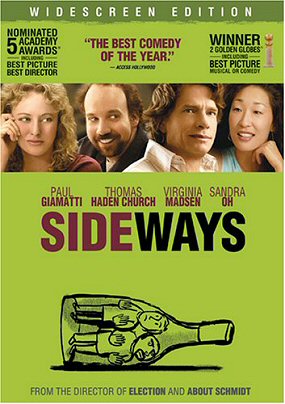
(Parker has a great listing of wine glossary terms on his website, by the way. I look at it every so often as part of my never-ending quest to broaden my vocabulary.)

One of the results of big guys having more and more control over an industry is that the smaller guys sometimes have trouble getting distributed.

Case in point: an inexpensive Sicilian table wine I used to like called Corvo Bianco. I first tried it after watching Ben Kingsley and Jeremy Irons throw down glass after glass during a scene in Betrayal (1983). It was buyable in this and that L.A. wine store during the ’80s, but I haven’t seen it around in well over a decade. (Has anyone?)
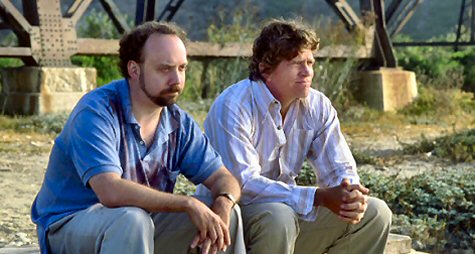

Nossiter has said that “where goes wine, goes the world” and that “people who go to see Mondovino are not necessarily wine people. It’s for people who never even imagined that wine was important to their lives.”

“The film provokes the notion that wine is linked to your life whether you drink it or not, and it’s an expression of the world you live in. The threat to the identity of wine is a threat to all of us.”
He also recently told a Reuters reporter that his documentary “is no feel-good wine film.” I disagree. I’ve seen Mondovino twice now and really enjoyed it both times.

For me it’s an earthy, nourishing travel flick about good people, lovely vineyards and quality-of-life issues. It’s about hanging with lots of very cool, cultivated winemakers in Burgundy, Bordeaux, Tuscany, Napa Valley, etc. I love the moods, aromas, bouquets. It made me miss Italy so much it hurt. It basically leaves you in a nice place.

I think it’s fair to say Nossiter has a dog fixation. The ratio of barking and panting to sipping and sniffing in this film is about ten to one. Every time he visits someone new, the camera goes right to the dog and then keeps cutting back to it.


Jonathan Nossiter during L.A. hotel room interview at Le Meridien.

I’m trying to lose at least 20 pounds on a diet of salmon, pineapple chunks, Lemon Diet Coke, fruit juice, energy bars and celery stalks, and I’ve also given up wine. I’m glad I’m doing this, but cutting wine out of my life hasn’t been very good for my personality. If I were told I couldn’t have another beer for the rest of my life, I would live…but not vino.

An expanded Mondovino will be offered as a ten-part, ten-hour DVD series next Christmas. It may feel a bit unwieldy to some, but at least it’s shorter than it was when it was shown in Cannes `04, when it was close to three hours long. That doesn’t seem so long when you consider the editing process began with 500 hours of footage.

It took Nossiter four years to film Mondovino. He spent less than two days in Los Angeles earlier this month promoting it. I found that astounding.

It’s not fair to say this but I’m going to anyway: Michael Mondavi seems like a nice, bright polite guy, but his eyes are a little scary. There’s something unworldly about them. If he wanted to try acting, he would have have a solid future in this town playing heavies. If I were a director I would tell him, “Don’t try and act like a ‘bad guy.’ Just do your regular thing — smile, tell jokes, maintain an upbeat mood. You’re perfect the way you are.”

High Times

I went to a cast and crew screening last night (i.e., Tuesday) of Bobby Roth’s new film, Berkeley. It took place at the Laemmle Fairfax, in the middle of an off-and-on rain storm. Doing this meant blowing off my latest shot at seeing Old Boy, which I’ll probably wind up seeing on video.

Roth wrote the Berkeley script and directed it over a two-week period last summer.
It’s about college kids going through changes, man, in the late `60s and dropping tabs and having lots of sex (the late’ 60s to early `80s was the greatest nookie era in U.S. history) and protesting the Vietnam War. It’s also, a little bit, about the shock all this activity to the parents of this generation — i.e., the straight-arrow, fairly patriotic World War II guys.

The star is Nick Roth, Bobby’s 20 year-old son. He’s a very good looking kid with a rock-steady gaze and an unaffected acting style.

My son Jett, 16, writes a column for this website (as well as one for a local newspaper, the Brookline Bulletin) so I know all about getting your son started and showing love and support, etc. But here’s the thing, and this is what makes watching movies with young unseen actors really interesting at times:


Berkeley costar Jake Newton after Tuesday night’s screening at the Laemmle Fairfax.

The actor who really has it in Berkeley…the one the camera likes, the dude with the “forget all that, just watch me” quality…is a 23 year-old actor from Sacramento with no credits and no apparent connections, by the name of Jake Newton.

He plays a political radical named Henry who gets more and more into militancy and winds up going on the lam after cops tie him to the famous 1970 burning of a Bank of America building in Isla Vista, near the University of Santa Barbara.

The dialogue isn’t great or terrible — it’s in the serviceable range, but it never feels as if Newton is fencing with it. He was acting, obviously, but I didn’t feel the strain of an effort or any uncertainty. The guy’s got it, whatever that is. He brings a current to the room.

I talked to him briefly in the lobby. A nice enough guy, tall, bright and alert. Hasn’t done anything else besides this film. No shorts, TV commercials, student films…zip.

Newton said he didn’t know last night that the film has its own website , and his female manager (in her mid 20s, it appeared) didn’t know either. She took my business card but didn’t offer hers. She barely looked in my direction, truth be told, over the two or three minutes when I tried to chat with her — she was focusing on Newton. And she never got around to e-mailing me either.

After Newton, the best actor in the film (and certainly the one with the best lines) is Henry Winkler, who plays Nick Roth’s dad. Henry was at the screening also, along with costars Sebastian Tillinger, Irvin Kershner, Laura Jordan and Sarah Carter.

Another solid performance was given by Wade Allain-Marcus, a good-looking kid who’s the son of Hustle and Flow producer Stephanie Allain, who was also there.


Berkeley writer-director Bobby Roth (center), costars Sarah Carter (second from right) and Laura Jordan.

The second half of Berkeley is about the the anti-war movement, and I was struck by the fact that the very last line is Bobby’s character saying, “We stopped that war.”

Maybe the protests hastened the peace process a bit, but it’s a stretch to claim that they “stopped” anything. The antiwar movement started in ’65, troop levels kept going up all through the late `60s, 58,000 U.S. soldiers died, things started to wind down in ’72 and the last chopper pulled away from the U.S. Embassy in ’75. Besides, I always thought it was the middle-class moms and dads and Vietnam Veterans (i.e., the Ron Kovics) joining the movement that had the biggest effect.

I wrote last Friday that Robert Rodriquez can always be counted on to get his actresses to take their outer garments off. This is generally true about Roth (Jack the Dog, Heartbreakers, The Man Inside), but no nude scenes in a film about this era and culture would be like doing a Vietnam film without M16s. And it all fits nicely.

All Them Nutters

“Please, please, please stick to movies. Your political analysis is frighteningly simplistic. The Schiavo case is much more complex than right vs. left. One of the strongest supporters of the Congressional initiative was Sen. Harkin of Iowa, a strong supporter of the rights of the disabled and certainly not a rightie. The Senate bill passed by a voice vote, the House passed it 203-58, with over 40 Dems voting for it.

“While I understand the GOP really took the issue and ran with it (and while I don’t agree with them inserting themselves into the debate), it couldn’t have been done without Democratic support.
“And don’t tell me that Dems felt forced to go along for political reasons….if you are against it, vote against it (you too John Kerry – Bush would be playing golf right now if you had shown a spine). I really enjoy your column — one of the highlights of my Wednesdays and Fridays — but as a Washington DC-based political consultant (nonpartisan, although I lean Dem) I get more than enough political analysis from people who actually know what they are talking about.


“You, like most armchair lefty (your term, not mine) commentators, are under the mistaken impression that everyone who voted for Bush is pro-life, and everyone who thought Kerry was an awful alternative is some sort of militant born-again Christian warrior that looks to Rick Santorum and the Family Research Council for direction.

“I just wish that you, Al Franken, Rush Limbaugh, Sean Hannity and Janeane Garafalo could respect that educated well-meaning people can disagree on a lot of these issues without making it so personal.” — C. Manion

Wells to Manion: You’re making sense on a lot of things, but please don’t try and muddy the waters about who’s making all the noise here. Right-wing Christian nutters are far and away the main force behind the don’t-kill-Terry-Schiavo, may-her-sad-vegetative-life-be-extended-indefinitely movement. I find it tedious to an extreme that you would waste your time and my time by writing me and challenging this baldly obvious fact.

All day long on MSNBC, spokespersons for righty nutters have expressed a clear and relentless horror about the idea of Terry going to meet her maker, should the courts decide to not interfere about the feeding tube withdrawal. This is an unquestionably ironic viewpoint for a group known for its unwavering belief in salvation after death through Jesus Christ, and the notion that there is heavenly choir music awaiting all believers at the end of the death tunnel.

“I can’t tell you how much I love it when you politicize your column. And I can’t imagine the disgusting e-mails you must be getting.

“You are, of course, totally right about Schiavo. Moreover, it shows how the right wants to overturn our system of justice and theocratize this country, and how, for them, theology trumps everything, including the Hippocratic oath. The sight of these so-called doctor/Congressmen making diagnoses based on a four-year old videotape is repulsive to the extreme. Someone should call the AMA and have Bill Frist’s license revoked.

“I am not much of a patriot, but I can say there have been two times I was utterly ashamed to be an American. One was the Hill-Thomas hearings. The other is this circus.” — Lewis Beale, New York-based entertaiment journalist.

“You really should stick to movies. Your comment about Terri Schiavo, and the way you used it to smear Christians and conservatives, is beyond repulsive. You’re a good writer about movies, but your ability to see beyond your ideology is awful. There are good and disturbing arguments on both sides, and your snide and simplistic post does neither side, nor yourself, justice.” — Michael D. Mayo

“You’re dead-on about the ring-winng Religious Wrong’s endless contradictions and hypocrisies regarding the Terri Schiavo case. Why is it that these people, who are always first in line to pull the lever on an execution or press the button on a war, suddenly so all-fired sympathetic towards a permanent vegetable down in Florida, who is of no use to anyone except as a symbol?
“I have nothing against Terri Schiavo, but hey, she’s the one who said she didn’t want to live that way. Can you say the words ‘personal freedom’?

“Ah…the culture of life! I mean, how many people did George W. Bush execute as Governor of Texas? How many civilians have died in his Iraq War (not to mention how many died in his Daddy’s ’91 prequel)? Between Desert Storm and Iraqi Freedom, I think the U.S. is up to around 200,000 civilians killed, which gives Saddam a run for his money in the dead-Iraqi sweepstakes!)


Pro-life protester arrested earlier today outside a hospice in Pinellas Park, Florida, when she tried to bring a cup of water to Terri Schiavo.

“And these lunatics have the nerve to talk about how they value the sanctity of life? At this point, I’m starting to believe to my absolute core that you have to be either incredibly stupid and/or ignorant, and possibly mentally ill, to be a religious conservative.

“Listen to the tape of Tom DeLay’s speech yesterday – how can these people possibly be otherwise? They’re running all three branches of government, they’re taking over the courts and the mainstream media, and they…are…INSANE! Invasion of the Brain Snatchers or what?” — Tim Merrill

“You and I have clashed before, to the point where I stopped frequenting your site for a while, but you’re dead-on about Schiavo. If my pathetic blog was more public, I might even say you swiped it from me.

“I wrote, ‘Damn the Religious Right for giving all conservatives such a bad name. Why are those who firmly believe in life after death so afraid to let a woman fulfill her destiny and pass naturally into ‘paradise’? Why confine her to an earthly hell when heaven awaits?

“‘In her natural state this woman would die. It is not akin to murder or premature death, as some have likened it to Dr. Kevorkian, but to nature and God’s will. Let this woman die, for Christ’s sake.'” — Chris Fontana, Philadelphia, PA.


This has almost nothing to do with wine or Mondovino, but it’s a terrific shot of the Foro Romano (I love the framing and the lighting) and writing about wine has put me in an Italian frame of mind, and I’ve been thinking about that part of the world anyway since I just sent in my Cannes Film Festival credentials so where’s the harm?

Sin Peeks Out

I’m moderately cranked about seeing Frank Miller and Robert Rodriguez’s Sin City (Dimension, 4.1) tonight, and doing the junket tomorrow on Saturday.
I’ve also been feeling a tiny bit wary, like before any comic-book movie. Does each and every one have to be about breathtaking visual coolness above all? That’s been the basic deal all along…but if this was the core attribute of the original graphic novels, would they have such loyal followings?
I do, however, respect films that have the confidence to stand their ground and be what they are. And according to a certain Midwestern journalist who saw it earlier this week, a fierce emphasis and sureness of purpose comes out of Sin City like sweat.


Mickey Rourke (l.), barely discernible, in Frank Miller and Robert Rodrigeuz’s Sin City.

Obviously, Sin City is going to be all about the sexy graphic aroma…the noir-to-the-max atmosphere…the relentless machismo…the hot slinky babes…those distorted faces all damp and glistening…know-it-all cool oozing off every frame.
The look and mood belong to Miller in terms of primal authorship, but the movie is also about Rodriguez doing the virtuoso hyphenate paw-prints thing…co-director, writer, cinematographer, editor, producer…so there’s a fairly uniform mentality.
< ?php include ('/home/hollyw9/public_html/wired'); ?>
Sin City looks sensational,” Midwestern guy begins, “duplicating precisely the exaggerated flair of Frank Miller’s panel drawings. This in itself makes it the best big screen comic adaptation since Batman Returns. Hardcore fanboys will be panting for a sequel before the first reel is over.”
He also declares, however, that “anyone unfamiliar with the comic is gonna get the shit shocked out of them.
“Will the film’s relentless nihilism turn off at least as many as it turns on? I knew Rodriquez and Miller were sticking to the [comic book] panels, but never in my sickest dreams did I think bits like a cannibal getting quartered and eaten alive by a dog would survive the translation in all their stomach-churning, grinning-skull ferocity.

“This is one of the most violent flicks in a long time, more savage than Kill Bill or The Passion…way more brutal than anything Rodriguez has ever done (except, maybe, The Faculty), so expect a lot of hysterics from old fogies who don’t know that Frank Miller comics aren’t for kiddies. Or pussies.
“The film intertwines four of Miller’s Sin City arcs into a backtracking loop a la Pulp Fiction, but it serves them up in the style of a straight anthology.
“Besides the recurring characters, what connects Sin City is a grotesque fatalism verging on splatterhouse horror that would make Raymond Chandler bawl like a little girl — violence as a way of life, of recreation, with each inevitable comeuppance more tortuous than the last one.
“This movie doesn’t just celebrate vengeful bloodlust and steamy sex — it wallows in them, gorges on them, and then goes back for seconds.
“Rodriguez, antsy as ever, may seem to string together torture sequences as if violence alone constitutes plot progression, but there is also the grace of Miller’s gutter poetry, offering enough glimmers of humanity to round things out. Okay, so some of it sounds a bit purple at times. Kind of goes with the territory, no?


Rosario Dawson, Clive Owen

“The best segment, and the best ‘Sin City’ comic, centers on beastly manimal Marv (Mickey Rourke, in heavy Dick Tracy make-up) stalking strip clubs, alleys and one seriously creepy country homestead to avenge a murdered whore (Jaime King) who, for one sweaty night, made him feel human.
“Even behind all the granite-faced Thing prostheses, Rourke gnaws on the role, making by far the strongest impression out of the stellar cast.
“Of course, Rourke makes a strong visual impression too — so does Elijah Wood as a pale, mute, choirboy of a serial killer, and Jessica Alba, undulating luscious sweetness as a stripper with a secret. Bruce Willis with a scar on his head is still just Willis playing another cop, without the primitive, stylish pencil slashes Miller used to transcend archetypes.
“There are occasional hollow notes in some of the acting — especially from live wires like Michael Madsen, Benicio Del Toro and Clive Owen — that unfortunately recall Sky Captain sucking the life out of Jude Law and Gwyneth Paltrow.
There’s also, however, the intrigues of Josh Hartnett, Rosario Dawson, Brittany Murphy…whatever this film may be lacking, grungy-cool, perfectly photographed actors are all over it like a cheap suit.
“As internally-driven movies go, Sin City is probably as good an effort as Rodriguez is capable of, barring some sudden love affair with plot and directing actors and…I don’t know, feelings?


Jessica Alba

“The unrelenting grimness of Sin City doesn’t give Rodriguez much range to work with, but you can imagine Tarantino (whose guest- directed scene stands out for nil) or the young Sam Raimi punching up the black humor, drawing more than just entrails out of the characters.
“Everything Rodriguez has done since picking up an HD-cam looks and feels insular. He has seemed stuck in his head and his Austin home movie factory. His films lost some nerve when he walked out on the verite thrills of El Mariachi‘s streets and into a cubicle.
“And yet here and there, Sin City recaptures some of that living, breathing, thrilling danger. For the first time in a decade, I felt almost as enthusiastic about a Robert Rodriguez movie as the filmmaker obviously does.”

Master Blaster

It was roughly 32 or 33 years ago, in the midst of some digression in a piece about Last Tango in Paris, when Norman Mailer wrote a line that has stayed with me ever since: “the ass wind is our trade wind.”
Mailer wasn’t forecasting any trends (he was speaking about general fascination with celebrities) but he was still prescient. Ass winds are so prevalent these days that no one thinks about them, much less considers that it’s only been over the last ten or fifteen years that ass consciousness has been allowed out of the cellar and given access to the living room.
People have been laughing at fart jokes since the days of Euripides, but posterior attitudes and activities are subjects of somewhat wider usage and discussion these days. Fart jokes, thousands of anal sex websites, Howard Stern’s Fartman, scenes like the bedsheet accident in Trainspotting, Toni Bentley’s “The Surrender,” etc. I don’t know what it all means, but I know there’s an ass thing happening in the culture these days that wasn’t around 20 or 30 years ago.


Johnny Depp

There is no way, I’m telling myself, that some of the anal imagery brought to mind by several big-name comics in Thinkfilm’s The Aristocrats (a doc about the same totally revolting, quite hilarious joke being told over and over again) would have been served up in a regular mainstream movie playing at your local theatre in the `70s or `80s.
Why bring this up? Because I was reminded yesterday that Johnny Depp was quoted twice in the `90s (once by a Vogue magazine interviewer, and then by a book author) as saying he would love to play Joseph Pujol, the greatest ass performer of all time. And I’m sensing…no, I’m certain the time is right for this.
Other actors have expressed the same longing to play Pujol, including Peter Sellers, David Niven and Ron Moody. The only one to have stood up and actually blown wind so far has been British character actor Leonard Rossiter.
But Depp would be perfect. Depp would kill. I can’t be the only one who believes that his starring in a movie about a true-life, Victorian-era superstar ass-blower would be huge.
Pujol, a pretty much forgotten belle √É∆í√Ǭ©poque Parisian entertainer known as “Le Petomane” (which translates into “the Fartiste”), had the ability to suck air into his anus and blow it out in such a way as to simulate on-key musical notes, imitate wildlife and blow out a candle from a foot away.


Joseph Pujol, a.k.a. “le Petomane” or “Fartiste”

Famed for having been a bigger draw than Sarah Bernhardt during his engagements at Moulin Rouge in the 1890s, Pujol was billed as “the Man With the Musical Derriere.”
Jim Dawson, the author of Who Cut the Cheese? — A Cultural History of the Fart (Ten Speed Press), writes that as part of his act, Pujol “would accompany an orchestra, farting well-modulated notes, on key, in the appropriate spots. He could also [make his ass] imitate the human voice, emitting a bass, baritone, tenor and lead parts, as well as the tones of his mother-in-law.
Pujol’s ass could also do “imitations of a little girl, a bride on her wedding night, and a dressmaker tearing two yards of calico.”
In the same book, Dawson apparently quotes Depp as saying, “You have to admire anyone with such great control of his instrument. I’d love to play him. It’s tragic that he left no successors. I’d play him in a minute.”
In a September 1994 Vogue interview, Depp told interviewer James Ryan that Pujol’s act was, to him, deeply impressive. “That’s courage,” Depp said. “A guy who says, ‘Here’s my talent…take it or leave it.’ Blows opera out his butt. That man was a true artist. I mean that.”
The story of Le Petomane has no tragic dips or turns. He got rich from ass-blasting, moved into a chalet with servants and had ten children. He died in 1945 at age 88.
I wish I could find a way to order a DVD of a 1998 documentary about Pujol, directed by Igor Vamos, called Le Petomane: Fin-de-Si√É∆í√Ǭ®cle Fartiste. (It’s mentioned online, but isn’t listed on Amazon or any of the other DVD order sites.)


British character actor Leonard Rossiter

Rossiter (Barry Lyndon, 2001: A Space Odyssey) played Pujol in a 1979 short film called Le Petomane, directed by Ian McNaughton and written by Ray Galton and Alan Simpson.
An online review contends that Rossiter’s portrayal “was nothing short of brilliant. Although he didn’t produce the sound effects himself, his actions and intensity of concentration for each ’emission’ made it hard to remember that he didn’t.”
The same website claims that Sellers and Niven “had expressed great interest in playing Le Petomane. Both had found it hysterically funny and both were advised by their agents against doing it. Because of the nature of the subject it was thought that it would be bad for their image.
“Sellers wanted to do it, but he was advised against it,” according to either Galton or Simpson. (It isn’t clear which one is being quoted.) “They said it would ruin his image. And then it was offered to Ron Moody, who turned it down for the same reason. Leonard saw it and he said, ‘Ooh yes please, I’ll have some of that!'”
No more farting around — the time is nigh for Depp to step up to the plate and do this thing before he gets too old and loses his nerve.
I’m staggered, the more I think about this, that Depp hasn’t sat down with Tim Burton and tried to get a Fartiste film up and rolling. It’s right up their alley.

Depp’s UTA agent, Tracey Jacobs, wouldn’t get on the phone and tell me if any Pujol scripts have ever come in for Depp’s attention. A source who has spoken to Jacobs about this says no screenwriter or producer has ever put a script or money on the table.
The “Fartiste” film I’m imagining would have the chops and focus of another Ed Wood, only much more commercial. Who wouldn’t go to see it? People in their 80s? Depp is the hottest quirky actor of our times, and he’ll always need to do movies like this to balance out crap like Pirates of the Caribbean 2.
Something’s telling me Depp and Burton may want very much to do something a bit more impudent and challenging after the opening of Charlie and the Chocolate Factory (Warner Bros., 7.15). Those Michael Jackson echoes (or should I say “intimations”?) are creepy.

Buenos Aires

I flew out of Mar del Plata last Sunday around 12:30 and landed at the smaller, slightly east-of-downtown aeropuerto an hour later, and went straight into town to nose around and explore. I had about nine hours before my plane for Los Angeles was due to take off around 10:45 pm.
I left my bags at the Hotel Intercontinental and walked over to the Casa Rosada, the ornate, three-story presidential residence with the famed second-floor balcony that Eva Peron addressed her followers from. (The paint isn’t exactly rose — it’s more like a fleshy off-pink).
I walked around the San Telmo district and visited the open-air flea market. A big crowd was watching a couple dancing the tango. I gave them ten pesos when they passed the hat.


Casa Rosada

Director Fabian Beilinsky (Nine Queens) told me to go to a restaurant in San Telmo specializing in Argentine beef, called La Brigada (Estados Unidos 465). The aroma of perfectly-broiled steaks was transporting. I could tell right away it’s a class joint, although a bit too popular with the local swells. People were milling around outside and some kind of ticketing system was in place that I couldn’t figure out. I eventually gave up.
I then rented a bike and peddled all the way up to Palermo, in the eastern section of town. Palermo is the emerging hip section, like Manhattan’s Soho was in the early to mid ’70s. Buenos Aires is almost completely flat all the way around town, so biking anywhere is no sweat. You just have to be fearless about buses and crazy cab drivers. I figured I travelled about five or six miles, all in.
I ate at a small caf√É∆í√Ǭ©/restaurant on a quiet, tree-lined street in south Palermo, called Viejo Indecente (El Salvador 4960). It has an alternate name of Maldito Salvador, which is what it’s called on the business card and on the website .
There was an attractive woman with Tourette’s Syndrome sitting behind me. She didn’t seem to be swearing as much as shouting. It was kind of a cross between a loud scream and a loud sneeze. (“Aaaggghh“!) I kept asking myself as I ate, “Do I want to move outside or something?”
Buenos Aires is a flat, somewhat hot and sweaty city with superb restaurants and deeply beautiful women, some with bedroom eyes and many with long slender toes. The best part for me was the absurdly low prices. Everything is one-third the cost. It put me in the greatest mood not to have to spend any serious money. I felt like a trust-fund kid.

I drove past the brick-walled cemetery where Eva Peron is buried, and the whole area around it was covered with T-shirted tourists, swarming all over like ants. The nearby restaurants were all cheap fast-food joints (McDonald’s, etc.). The vibe felt lurid and grotesque. I peddled on without stopping.
B.A. is very much the bustling, pulsing place — crowds, music, culture, intensity — but the buses spew out exhaust like there’s no tomorrow, and you’re forced to breathe in the fumes as you’re peddling along, and with all the heat and clamor and the lack of much in the way of old-world architecture I began to conclude that Buenos Aires isn’t as sexy or intriguing as Paris, Rome or Prague. Or Berlin, even.
But at least it’s gritty and alive, and I’m sure it’s a richer thing for X-factor people who live and work there and congregate at the right places.

Hollywood and 9/11

“I was absolutely horrified and fascinated with William Langerweische’s short description of Buzzelli’s story at the end of your Wednesday column. In a way I could imagine myself in this situation, and it felt terrifying. In a weird way it was riveting, of course, but it was perhaps the most gut-wrenching thing I’ve ever read. I had to stop at one point to catch my breath.
“I have no doubt there’s a great story there, but is it a really a movie, with a plot, three acts, etc? I haven’t seen Fearless, only parts of it on TV, but I think I can imagine the structure of it from what I’ve seen.
“With Buzzelli, I believe that as a two-hour movie, we could have a really great part there in the reenactment of his experience, but what about the rest of the movie? I think to show us his reactions prior and after the experience could somehow cheapen it, since it’d be treading into somewhat familiar territory. Besides, what can possibly be said about his experience?
“The really fascinating aspect of the story is what happened during those few hours on 9/11. I can see a wonderful documentary being made about what he went through, maybe in the vein of Touching the Void, but a movie with actors, a script, etc? I really don’t see it.

“Well…. maybe if Terrence Malick directs it? He’s more of a man-nature relation kind of director, and he’d be working in a very urbane setting, so maybe someone else who could give it that Malick humanistic approach? Well, anyway it’d have to be a damn good and special director and script.” — Fabio Augusto, Sao Paulo, Brazil.
“I guess it was inevitable, and I don’t think any tragedy should be so sacrosanct that we tip-toe around it, but does anybody really want to see a 9/11 movie?
“Sure we’ll go, but who wants to sit there and deal with the headache of analyzing the dialogue, the direction, the special effects, the casting, the score, and the overall vibe of a recreation of one of the worst days of all of our lives?
“Seriously, I’m already hearing myself think, `The second act was really intense but I kinda didn’t like Eric Bana’s character and the Hans Zimmer was a little overdone, especially after the first plane hit.’ And I don’t even want to think about Brian Grazer’s The 9/11 Commission Report: The Miniseries on ABC with commercials and pop-ups for Desperate Housewives.
“I’ll admit that some of the art that has come out of the tragedy has amazed me. The HBO documentary about 9/11 is absolutely fantastic, and there’s an amazing show about the Twin Towers (it describes the science behind the structures’ collapse and in which members of the staff, who were interviewed just before 9/11, are labelled `died in the attacks’ or `missing’) and I still get chills when I channel surf into the opening sequence of Spike Lee’s The 25th Hour.
“But, c’mon, do we really need this already? It’ll be forever before we figure out what the whole thing really means. Can’t we take a decade to assimilate the experience and let the whole thing cool, or is five years all we get? ” — Neil Harvey, Roanoke, Virginia.
Wells to Harvey: Five years….all right, maybe six…is all you get.
“Great job on those 9/11 movies. I think Buzzelli’s story is fascinating, and I believe you are right about the dramatic content in comparison of the two different rescues. His is more absorbing, and the other is a little familiar.” — Jim Kiehl
“Whatever 9/11 Hollywood movie gets made, it would be more realistic if they would show the actual horrors of this heinous, cowardly attack by the Islamofacist Al Qaeda bastards who flew those planes into the Twin Towers.

“Probably, sadly, the real 9/11 movie will never be made. After all, there are those in Hollywood who see terrorists are misunderstood freedom fighters with a beef against decadent America, and not as cold blooded killers. ” — Bill Hodges
“Who’s to say which is the “more important story of 9/11, anyway? You? Me? William Langeweische? Anyone. really? I can write this with a certain (very modest) degree of credibility because I happen to be a 9/11 “survivor” myself.
I was working that day on the 5th floor of a five-story building two blocks from the WTC. After the first plane hit, I went with an art director named Raoul up to the roof. There we collected weird stuff that wasn’t on the roof the previous day, when we’d had lunch there. What we found was little metal versions of old Tinkertoy sets, if you remember them. But they were hot to the touch.
“And then, in very close-up straits indeed, we saw the second plane hit. Nose-in and full-on. What I remember most is the sound — an amazingly loud, all-encompassing combination of [unintelligible] and a crunch, as if the very fabric of our existence was caving in. I can still hear that sound.
“I remember how everyone in midtown NYC, once I’d walked up there from downtown and found the bus terminal closed, seemed to be wandering dazedly through the streets. They couldn’t get home and they couldn’t comprehend how horrible things already were, how worse they’d turn out to be. I remember being with thousands of other people looking at a huge TV in Times Square which was showing CBS News, and finally realizing what the famous phrase `the lonely crowd’ really meant.” — Richard Szathmary.
Wells to Szathmary: I didn’t say Buzzelli’s story was “more important” than what happened to Jimeno and McLoughlin. I said their story seems familiar and doesn’t seem to be much more than a standard let’s-dig-these-guys-out rescue tale. I also said it “doesn’t have anything like the surreal, full-throttle, hand-of-God quality of what happened to Buzzelli.”

Translation

“Would it really have hurt you or Jon Doyle, the writer of your DVD column “Discland,” to call Michelangelo Antonioni’s film Eclipse as opposed to L’eclisse ?
“Obviously the Criterion Collection people are spelling it that way, but it just sounds so damned pretentious. Besides, it played in the US as Eclipse, to the best of my memory.” — Richard Szathmary
Wells to Szathmary: I wouldn’t have had a heart attack if Criterion had called it The Eclipse on the DVD. But would you also have them change the title of Antonioni’s L’Avventura and make it The Adventure? That would sound, like, way uncultured.


Alain Delon, Monica Vitti in Michelangelo Antonioni’s L’eclisse.

9/11 Pitch Meeting

This is going to sound odd, but Universal Pictures and Double Feature partners Michael Shamberg and Stacy Sher are planning on dramatizing the wrong 9/11 story.

I don’t mean it that way, exactly. How could “wrong” apply to a true-life story about surviving the World Trade Center disaster? But Shamberg and Sher are focusing on a generic rescue saga instead of (and this only a portion of it) a mind-bending divine intervention story that happened only a few dozen yards away from the subjects of their movie, and at precisely the same time.
The Shamberg-Sher story is about a couple of Port Authority police officers named Will Jimeno and John McLoughlin, who found themselves buried inside a small pit under 20 feet of rubble after the collapse of the North Tower, and were eventually found and dug out. They were the last two victims to be pulled alive from the rubble.
But as Jimeno and McLoughlin struggled to be heard and rescued, there was another Port Authority employee named Pasquale Buzzelli who was lying unconscious on a large piece of concrete 30 or 40 feet above them. And his story — what he was doing before the collapse of the North Tower, how he happened to survive it despite being on or near the 22nd floor, how he dealt with the aftermath — has all kinds of haunts and echoes.
< ?php include ('/home/hollyw9/public_html/wired'); ?>
Thank fortune Jimeno and McLoughlin survived, but dramatically speaking (and I realize that it sounds heartless to discuss a 9/11 story in terms of its audience- grabbing potential) theirs is a fairly standard scenario. I’m not trying to minimize or in any way dismiss the horror of what it was, but in movie terms it’s familiar.
Does anyone remember Dorothy Malone’s character being pinned under collapsed metal beams in 1960’s The Last Voyage, and finally getting carried out by husband Robert Stack and ship worker Woody Strode? Or the mineworker pinned under beams (and exploited by reporter Kirk Douglas) in 1951’s Ace in the Hole?
And how many times have we seen televised rescue dramas on local news shows about a kid who’s fallen into a well or sinkhole, etc.?


Louise and Pasquale Buzzelli, with their daughter Hope, in a photo that ran in New York magazine about 18 months ago.

Of course, the backdrop and circumstance of Jimeno and McLoughlin’s rescue will pack a wallop. But once you get past the 9/11 nightmare vibe (i.e., if you can step back and look at the story dispassionately), the story has a rote feeling.
Presumably Shamberg-Sher pounced on this because Jimeno and McLoughlin were the last people to be rescued from Ground Zero. Maybe someone can tell me what’s interesting about being the last. I mean, as opposed to being the first or the second-to-last or one of the guys in the middle group. Maybe it’s me.
The Shamberg-Sher project has no start date, but it has a completed script by Andrea Berloff. The project was brought to Shamberg-Sher by producer Debra Hill, who died from cancer less than two weeks ago.
Shamberg or Sher didn’t pick up, but according to critic and film historian Stephen Farber, who referred to this Universal-based project in a New York Times story that ran last Sunday (on 3.13), Universal is “happy” with the script. Farber passed along a sourced expectation that shooting will “hopefully start in the fall.”
There’s also a Columbia 9/11 project in the works, based on a recently acquired book by New York Times reporters Jim Dwyer and Kevin Flynn called “102 Minutes.” It’s basically about the chaos and mistakes in judgment that resulted in a lot of people needlessly dying inside the towers that day…people who might have gotten out if it weren’t for various dumb rules and bad calls.


American Ground author William Langeweische; one of the versions of the cover.

The Columbia film was reported about in a 2.1.05 Variety article by Mike Fleming and Nicole Laporte. (The link is impossible.) It will be produced by Mike DeLuca, Rachel Horovitz and Michael Jackson.
Variety has also reported that Imagine honcho Brian Grazer has a deal with NBC Universal TV for an eight-hour miniseries based on the 585-page 9/11 Commission Report.
But it’s looking like the Jimeno-McLoughlin story could be the opener — Hollywood’s first 9.11 dramatization/recreation to hit screens nationwide. And given what it is (or appears to be), I find this disappointing.
That’s because it doesn’t have anything like the surreal, full-throttle, hand-of-God quality of what happened to Buzzelli, who somehow wasn’t crushed or otherwise killed when the North Tower collapsed, but instead landed on a concrete slab 180 feet below and was later found and carried off by rescuers.
Remember that urban myth that went around just after 9/11 about some guy (a fireman, the rumors said) who had somehow surfed the collapse of one of the buildings from one of the highest floors and miraculously made it to the ground alive?


Retired Port Authority officer John McLoughlin with 60 Minutes reporter Vicki Mabrey during visit to Ground Zero.

Snopes.com, a smart urban-myth-debunker site, discusses the “building surfer” myth as follows: “Because this is a rumor of man triumphing over mayhem, lore remakes one of the cherished but doomed heroes of [9/11] into a survivor, changing his real fate into one that not only spares his life, but leaves him triumphant in the face of utter devastation. Our sense of justice is thus appeased.
“He’s a figment of our wishful imaginations, a fictional icon of indomitability we are quick to turn to in times of disaster. In our minds, we see his ride as a giant thumbing-off to the destruction raining down about him.”
My point is, Buzzelli was almost this guy.
Buzzelli’s wife Louise, whom I spoke with briefly this morning, says her husband “landed on top of where [Jimeno and McLoughlin] were. They were in this void, this pit, and Pasquale actually landed right on top of them. The rescue workers found the other two first and told Pasquale, ‘Hang tight, we’ll be back to get you.’ They thought he was a rescue worker, and then one of them finally said, ‘Holy shit, this is a civilian.’ They had no idea.”
In September 2002 I excerpted an extremely well written Atlantic Monthly article that told Buzzelli’s story. The author was William Langeweische, in the second of two articles (called “The Rush to Recover”) about the disaster and its aftermath.
There are no online links, but all of Langeweische’s aftermath-of-9/11 reporting was published in a book called “American Ground: Unbuilding the World Trade Center.”

Here’s a transcript of Langeweische relating Buzzelli’s story for a PBS documentary about 9/11.
I love Pasquelli’s story because it says that God or fate or whatever can sometimes show random compassion and make senseless exceptions in allowing this or that person to duck out the back door. I love the sheer exhilarating illogic of a guy being in a huge collapsing building and falling that far and coming out of it with just a few broken bones and bruises.
On top of which Buzzelli went through a phase after his brush with death that was not unlike the emotional journey taken by Jeff Bridges’ character in the 1993 Peter Weir film, Fearless .
Instead of feeling elated over having survived, Buzzelli felt guilty and was plagued by nightmares. He wound up spending several months in a TV-watching, weight-gaining funk. His story was told in a September ’03 New York magazine piece (“The Miracle Survivors”) by Jim Fishman.
I think that Buzzelli’s surviving the North Tower collapse is on the level of that guy bursting out of the bathroom in Pulp Fiction and blasting away at point-blank range at Samuel L. Jackson and John Travolta…and neither one getting hit.
There were 16 survivors who were on the stairwell when the North Tower collapsed who made it out alive. Fishman doesn’t mention Jimeno and McLoughlin in the piece, but it would be surprising if they didn’t experience some psychologically tough patches of their own. Maybe their experience with this will be woven into the Shamberg-Sher film…or not.
I just know I’d much rather see the Buzzelli story on a movie screen. There’s that hand-of-God element, and the second act out of Fearless…and I can’t help but imagine how stunning it would be to see a recreation of what this poor guy went through. It would be (how could it not be?) an aural-visual mindblower.

Here’s how Langeweische described it:
“Buzzelli had just passed the 22nd floor when the North Tower gave way. It was 10:28 in the morning, an hour and 42 minutes after the attack. Buzzelli felt the building rumble, and immediately afterward heard a tremendous pounding coming at him from above, as the upper floors pancaked. Buzzelli’s memory of it afterwards was distinct. The pounding was rhythmic, and it intensified fast, as if a monstrous boulder were bounding down the stairwell toward his head.
“He reacted viscerally by diving halfway down a flight of stairs, and curling into a corner of a landing. He knew the building was failing. Buzzelli was a Catholic. He closed his eyes and prayed for his wife and unborn child. He prayed for a quick death.
“Because his eyes were closed, he felt rather than saw the walls crack open around him. For an instant the walls folded onto his head and arms, and he felt pressure, but then the structure disintegrated beneath him, and he thought, ‘I’m going,’ and began to fall. He kept his eyes closed. He felt the weightlessness of acceleration. The sensation reminded him of thrill rides he had enjoyed at Great Adventure, in New Jersey. He did not enjoy it now, but did not actively dislike it either. He did not actively do anything at all.
“He felt the wind on his face, and a sandblasting effect as he tumbled through the clouds of debris. He saw four flashes of light from small blows to the head, and then another really bright flash when he landed. Right after that he opened his eyes, and it was three hours later.
“He sat up. He saw blue sky and a world of shattered steel and concrete. He had landed on a slab like a sacrificial altar, perched high among mountains of ruin.

“There was a drop of fifteen feet to the debris below him. He saw heavy smoke in the air. Above his head rose a lovely skeletal wall, a lacy gothic thing that looked as if it would topple at any moment. He remembered his fall exactly, and assumed therefore that he was dead.
“He waited to see if death would be as it is shown in the movies — if an angel would come by, or if he would float up and see himself from the outside. But then he started to cough and to feel pain in his leg, and he realized that he was alive.”
On the PBS documentary, Langeweische said at this point that Buzzelli was “lying on this altar. There’s no one around. It’s utterly silent. There’re no people around, nothing. It’s a wasteland desert in the middle of New York City. The buildings are gone, there’s smoke, and then there’s fire.
“At some point, he was quite certain — to make a long story short — that he was going to die from fire. So certain that he found a piece of jagged metal and was going to cut his wrists, in order not at least to burn to death. And he had gotten to that point when he was rescued.”