“Factory” final

Factory Final

I didn’t say very much about Factory Girl when I riffed on it last August (I’d seen an early, far-from-finished cut) — I mostly confined myself to praising Sienna Miller‘s performance as Edie Sedgwick, which I thought (and still think) is a deeply sad, near-perfect communing with the spirit of a proverbial damaged debutante.

Last night I saw a more-or-less complete version of Factory Girl (i.e., almost but not quite the exact same cut that’s opening today in Los Angeles), and guess what? This is a much better film — far more precise and filled in and rounded out — but I liked it a bit more when it was funkier, rawer and less “complete.” Strange but strangely true.
I realize, of course, that the choppier, more instinctual, not-quite-as-layered version that I liked or believed in a tiny bit more wouldn’t play as well with general audien- ces, and I also recognize that the current version is a more finely woven thing. I’m just saying that the old Factory Girl felt less self-conscious — it seemed hipper and more fuck-all Warholian. But no one else saw the August version so none of this matters.
Factory Girl is somewhere between a solid 7.5 and an 8 — it has sufficient dramatic potency, it’s atmospherically convincing and tonally accurate (for the most part), and it’s extremely well acted by the leads. And the rotely cautionary theme that speaks to every nocturnal scenester out there only adds to the brew. Beware of temporary coolness and clubbing around and endlessly shooting the shit with your homies over drinks — it’ll turn you into toast. Stay home more, get into your art, take walks with your dog…invest in yourself and don’t give it away.
There are two significant differences between last night’s Factory Girl and the version I saw five months ago. Miller is still uncannily on-target — she still has Sedgwick’s “fluttery debutante laugh, that mixture of Warholian cool and little-girl terror, the giddy euphoria, the cracked voice,” as I wrote last summer — but Guy Pearce‘s Andy Warhol performance has been beefed up to an extent that he’s no longer a distinct supporting character but a costar. And Hayden Christensen‘s Bob Dylan character (called “Danny Quinn” in the press notes but never called anything by anyone in the film) also seems a bit more assertive and sharply defined.
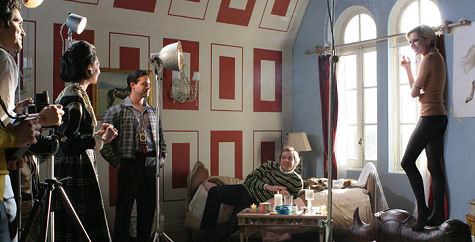
The old Factory Girl was basically a Sienna show with two strong supporting males. Now it’s become a three-character piece that’s using the myth-cliche of a romantic triangle (partly if not largely based on bullshit but so what?) to provide the dramatic tension.
The story is about gay, ultra-cool Andy — ex-advertising guy who’s made himself into a Manhattan artist legend — fascinated by Edie’s jaded spirit and making her famous for being famous and yet offering nothing solid except a momentary flash of hip notoriety. Taking, studying, gliding along, going with it…and never “there” as any kind of friend, supporter or colleague whatsoever.
Along comes heavycat “Danny” geninely liking Edie for who/what she was — seeing value in her essence — while tagging Andy as a kind of user-taker vampire poseur and trying to rescue Edie from her inevitable fate, which is to be cast aside for the next whatever. And yet realizing in the end that she’s too damaged and off-balance to really stand on her own.
And then Warhol, who’s come to resent Edie for pursuing a “Danny” relationship, throws her over for Nico (of the Velvet Underground), and Edie subsequently gets caught up in drugs and debauch, and ends up dead — the old drug habits — five years later.
Pearce’s Warhol may be grossly simplified compared to the real McCoy, but he’s trippy and absorbing in a darkly downtown sort of way. Half-comic and half demonic, he’s one of the most obliquely cool screen villains I’ve ever spent time with — no exaggeration. His malice and selfishness is cloaked in a kind of hip vacancy (i.e., the standard “oh, wow” Warhol of legend, which wasn’t who the guy really was), but there’s obviously something cold and almost monsterish about him — a guy so damaged and ruthless that he’s forgotten where he put whatever vestiges of common humanity he may have once had.
I believed Factory Girl‘s atmospheric details; it seemed right to me in all kinds of ways. But I had minor problem with costar Jimmy Fallon‘s hair, which goes from dark brown to light brown-orange in a single early cut. Abrupt hair shifts are never good for anyone in any realm! Harvey Weinstein should spend an extra $30,000 to give Fallon a CGI hair fix.
Edie Sedgwick may not have even slept with Bob Dylan, much less had a raging love affair with him….but “Danny’s” entry into the film does two things: it provides a semi-decent dramatic structure-conflict, and it allows Christensen to deliver the first better-than-decent performance of his life.
I’ve disliked each and every Christensen performance I’ve seen prior to Factory Girl (he’s the reason I can’t bear to watch any portion of the last two Star Wars prequels) but he somehow finds a way into the Dylan attitude and voice, and seems more or less relaxed and centered in it. He has a near-great scene when he’s posing for Warhol’s 16mm camera inside the Factory while looking around and asking if “this is where you paint your cans of beans,” and at the same time clearly implying that Warhol is a selfish prick. For the first time in his brief career, Christensen doesn’t seem to be straining for emotional intensity.
The end credits use some talking-head comments from the late George Plympton and (I think) one of Sedgwick’s brothers to moderately interesting effect, although it feels a wee bit tacked-on and superfluous.
Captain Mauzner’s screenplay feels right when it comes to the attitude dialogue, and the supporting performances from Beth Grant (as Warhol’s Polish mom), Armin Amiri, Mena Suvari and Illeana Douglas (as Diana Vreeland) are agreeable and bump-free. The only one that doesn’t feel quite right is Edward Herrman‘s as a Sedgwick family lawyer — his scenes seem sketchily written and too tidy.
Through a Forest Darkly

Through a Forest Darkly

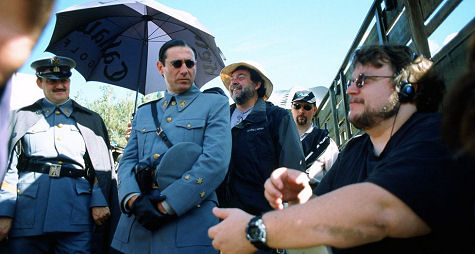
“Until I was ten years old, I lived an everyday life full of monsters….having lucid dreams at night in which they became real. As a Mexican I’ve seen my share of weird shit, and this has made me believe in monsters as really tangible, corporeal entities. To me monsters are real. I think they’re creatures of the spirit, and they live in a place deep within us where angels and demons dwell. And to me they are part of my spiritual life, as much as a Christian would accept Jesus into his heart. I accept monsters.”

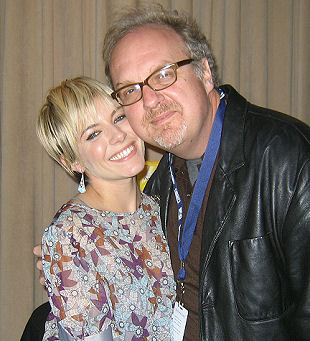
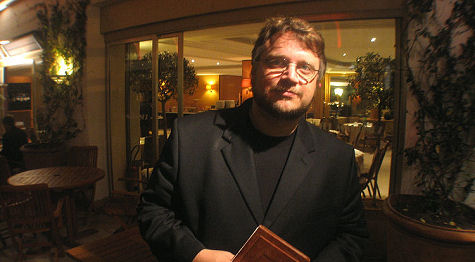
This is one of the better quotes from my chat earlier today with Pan’s Labyrinth director-writer Guillermo del Toro. I’ve known Guillermo since the mid ’90s — he’s one of the few filmmakers out there for whom I feel a genuine kinship and a sem- blance of real friendship — and I feel that he’s exceptionally wise and gifted and perceptive as hell. This is a commonly held view. He’s an old soul, endlessly generous, compassionate, insightful and possessed of a brilliant wit.
You can hear this in his voice, in his elegant phrasings and choice of words. The guy would kill on The Charlie Rose show.
< ?php include ('/home/hollyw9/public_html/wired'); ?>
I asked Guillermo right after he said the above if he has any conventional religious feelings. “I’m a lapsed Catholic, but, as they say, once a Catholic, always a Catholic,” he answered. “As Luis Bunuel once put it, ‘I’m an atheist….thank God.'”
These are good times for Guillermo and Pan’s Labyrinth, which I feel is his best film ever. It is not, as he calls it, one of his “Ritalin movies” — Hellboy, Mimic, Blade 2 — but then I’ve always been a bigger fan of his quieter, more socially grounded films like Labyrinth and Chronos and The Devil’s Backbone. A lot of film critics feel the same way. Last weekend Pan’s Labyrinth was named Best Foreign-Language Film by the Boston Film Critics, the San Francisco Film Critics Circle and the New York Film Critics Online.

Like The Devil’s Backbone, Pan’s Labyrinth is half-real, half-fantasy. The subtext is the brutal wounding of Spain by the fascist rule of General Francisco Franco, which began in 1939 after his victory over the Republicans. It’s obvious that Del Toro despises the fascists, but also that he knows and cares as much about the social conditions after the Spanish conflict as he does about creating underworld life forms.
The story, as everyone knows by now, is about a young girl named Ofelia (Ivana Baquero) who’s given to fantasy head trips, and how this both conflicts with and provides escape from her new stepfather — a cold-hearted fascist Army officer — Captain Vidal (Sergi Lopez) — whom her pregnant and sickly mother (Ariadna Gil) has recently married.
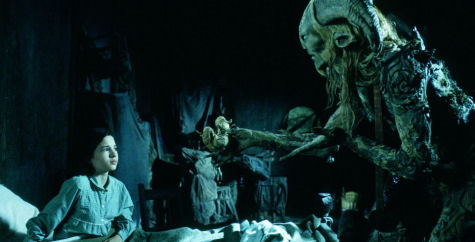
Soon after arriving at Vidal’s military-command outpost within a densely shaded forest, Ofelia soon conjures or encounters (you decide) a tall goat-like Pan figure — a faun — in a hidden-away labyrinth. This eloquent and fascinating creature (Doug Jones) tells Ofelia that she’s the reincarnation of a long-dead princess, but to prove her worth she must complete three dangerous tasks. To which she commits.
Meanwhile, Ofelia eventually learns that Vidal’s head servant Mercedes (Maribel Verdu, the doomed hottie in Y Tu Mama Tambien), is the sister of the leader of the remnants of the local rebellion, and that she’s been stealing Vidal’s supplies to help fortify the Loyalists. Also teaming with her is Vidal’s personal physician (Alex Angulo), who sneaks Mercedes medical supplies when Vidal isn’t looking.

Suffice that the real and the unreal eventually collide in a riveting way, and that the hard realities of the war take their toll on many characters, including Ofelia. The only beef I have with the finale is the storybook notion that by passing through the membrane of death one’s spirit is released into a better place where departed loved ones greet a new arrival. I didn’t buy a character’s death as a happy ending in Steven Soderbergh‘s Solaris, and I’m not buying it here.
Nonetheless, Pan’s Labyrinth is a beautifully woven fable — an adult fantasy film if there ever was one. It’s a kind of light-horror rhapsody — a sensitive and delicate fairy tale on one level, and a gripping political war drama on another. And it has some of the most startling and mind-bending images I’ve seen in any such film, ever.
Here, again, is the mp3 file, recorded off my cell phone as I stood under an awning at the corner of Montrose and Bushwick during a late-morning rainstorm. (The reception in Michael Arndt‘s third-floor apartment is piss poor. For T-Mobile sufferers, I mean.)


Pan‘s costar Sergi Lopez (l.), Guillermo del Toro (r.)

Run Through the Jungle

Run Through The Jungle

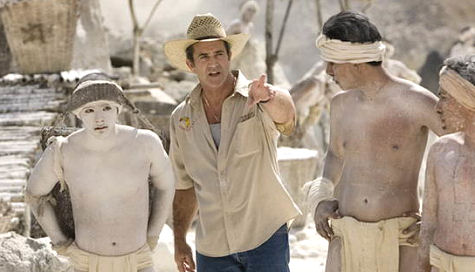
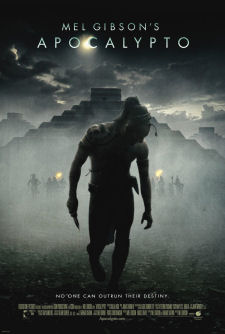
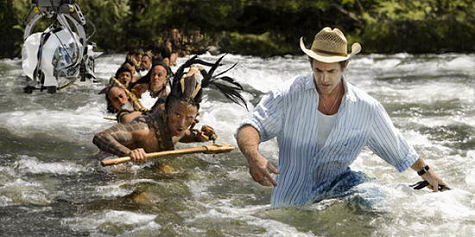
Mel Gibson has a thing — a big thing — about brutality. William Wallace’s climactic disembowling in Braveheart, the dozens upon dozens of terrible blows inflicted upon Jim Caviezel‘s Jesus in The Passion of the Christ, and now, in the obviously well made and extremely visceral Apocaylpto, all kinds of gougings, clubbings, belly-guttings, stabbings, disembowelings, animal attacks, ritualistic beheadings and tapir testicle- chewing are served up start to finish. And it’s gotten to be a bit much. Really.

Apocalypto is basically about a small village of nice-guy natives in ancient Mexico getting attacked and rounded up by a tribe of sadistic Mayan thugs and turned into slaves, and many of them later being killed for sadistic sport. One guy named Jaguar Paw (Rudy Youngblood) manages to slip their grasp, which leads to a third act that’s all about his being hunted down and outwitting his pursuers. You know from the get-go that Youngblood — a good-looking guy with soulful eyes and a buff bod — is going to survive in the end, and that Mel’s idea is basically to put him through jungle hell.
Apocalypto closely resembles Cornel Wilde‘s The Naked Prey, which I saw years ago on the tube. Wilde’s film isn’t as graphic or atmospheric as Mel’s, but it’s fairly primal, taut and disciplined. The latter, trust me, is not a term that will readily come to mind after you see Apocalypto.
< ?php include ('/home/hollyw9/public_html/wired'); ?>
I’m not saying that the agonies depicted are excessive in the context of the story. I don’t know zip about the rituals of the ancient Mayans, and I’m not arguing with the theme of social decay or saying that present-day echoes aren’t valid. But there’s no doubt that this is first and foremost another trek through the psychology of Mel, and that there’s something very odd about that. People having been riffing about this for years, Something to do with Mel being a very hard-core, black-vs.-white, good-vs.-evil type of guy who sees some kind of link between acute physical torture and the cleansing of the spirit.
Hence, the violence in Gibsonland never really feels like it originates from any natural-feeling story or theme or exploration of character based on research or creative construction. It’s about Gibson taking a story and time and again imposing his psychology upon it — about his feeling a need to repeatedly burrow into a world of pain that is mainly about him and secondarily about everything else. That’s what artists do, obviously, but the relentlessness of the violence in his films is lacking in profundity.

The more I watched Apocalypto the more this opinion sank in, and I just got sick of it after a while. It’s like Gibson and his co-screenwriter Farhad Safinia sat down and focused on creating a story that would heap on every ghastly form of torture, subjugation, mutilation and death known to or imagined by the most malignant Mayan psychopaths of all time. And because it’s mainly a mind-of-Mel film, I didn’t believe in the story or the characters or anything else. I just wanted it to be over. It enabled me, in fact, to see fresh virtues in the movies of Nancy Meyers.
Apocalypto is not schlock. It shows again that Gibson is nothing if not a totally go-for-broke, whole-hog, get-it-right filmmaker. He’s done an admirable job at recreating a rich, exotic, predatory world. The casting, costumes, set design, cinematography, cutting — all of it is of a very high order. But to what end?
About halfway through I started to see resemblances between Apocalypto and that old “kiki” joke. (Martin Mull told a version of it in The Aristocrats.) Two anthropo- logists are captured by a primitive tribe in some godforsaken no-man’s-land, and the chief goes up to the first guy and says, “You have a choice — death or kiki,” and the guy says, “Okay, kiki.” Hearing this, the excited tribesmen grab him and put him through one torture after another — roasting the guy alive, tearing his skin off, spearing him, gouging his eyes out, covering him with red ants and finally throwing him off a cliff into a pit of crocodiles. The chief goes to the second guy and says, “Death or kiki?” And the guy looks at his the remains of his pal and gulps and goes, “Uhm, yeah, well…I think I’ll take death.” And the chief, “Very well, death…but first, kiki!”

This analogy came to me somewhere between the third and the fourth severed head bouncing down the steep stone steps of a Mayan pyramid.
Variety‘s Todd McCarthy has written a rave of Apocalypto. I agree with much of what he says except for the part about “strong biz [being] possible” via “the blood-and-guts action crowd, Latinos, eco-political types and at least part of the massive The Passion of the Christ crowd.” Serious-minded film buffs will probably go. (I think they should.) But women are going to run the other way. Ditto the older sophisticated crowd. There is nothing here for Christians, and eco-political fans of Al Gore’s An Inconvenient Truth are going to take a pass also.
Gibson directed the hell out of this thing, and he deserves respect for that. But it’s a fairly unpleasant sit and is almost certainly doomed.

Genius Brand

“Best Picture of the Year” means different things to different folks. For some (most, I suspect) it means being the most fundamentally “entertaining” — the one that will most likely reach the largest middlebrow audience. (Which is why a lot of people are suddenly behind Dreamgirls.) For others, it’s the film that’s the most soul-soothing or life-capturing (Volver, Babel, Little Miss Sunshine, The Lives of Others ). Or that seems the most complete and fully realized according to its own particular rules (The Departed, The Queen, Pan’s Labyrinth, United 93).

But for me, the highest synthesis of Best Picture satisfaction means delivering on one or two of the above plus one other — it has to be visually historic. It has to knock your socks off by way of sheer visual energy or innovation. So much so that what you’re seeing becomes absolutely “real” and everything else drops away. The popcorn is put under the seat, notions of bathroom breaks are out of the question, and you almost stop blinking for fear of missing something.
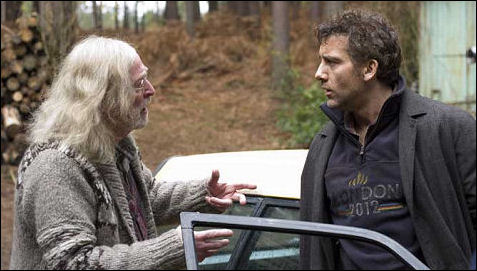
Alfonso Cuaron‘s Children of Men (Universal, 12.25) is that film, and is my choice so far for Best Picture of the Year.
This is a futuristic, dystopian end-of-the-world actioner and grim as hell, but what mainly comes through is how remarkably convincing it all looks and feels. Set in 2027 England, It’s one of the most exactingly detailed, full-on visions of a totally-fucked future — a world in which women have stopped having babies — that I’ve seen in any medium ever. Jim Clay and Geoffrey Kirkland‘s production design is so precisely composed that it easily trumps whatever down-head feelings the film may temporarily impart.
And yet Children of Men doesn’t push the moody atmospheric gloom-vibe of films like Dark City, The Handmaid’s Tale, 12 Monkeys or Blade Runner. Based on a 1993 novel by P.D. James, an elderly British woman who mainly writes murder mysteries, it’s a movie with underlying heart and hope — a vision of an Apocalyptic ruin that also delivers warmth and frailty and compassion, and a vision of life that actually includes a future.

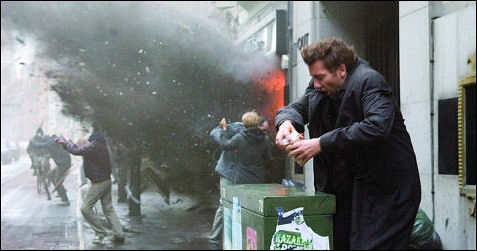
Understand this above all: Children of Men is the most excitingly photographed thing I’ve seen all year. It’s easily in the realm of Full Metal Jacket, Black Hawk Down and Saving Private Ryan, only more so. It’s basically one long take after another, but the standouts are three bravura sequences that each last four or five minutes (longer?) without a cut, and involve truly astonishing feats of sustained choreography and miraculous camera movement. This alone should trump any misgivings you may have about any other aspect (although there’s not much to beef about).
In short — it’s the photography, stupid. The dp is Emmanuel Lubezki and the camera operator was George Richmond. I don’t know who precisely did what but the hand-held lensing is the stuff of instant legend. If Stanley Kubrick were alive today he would absolutely drop to his knees.
Any film buff who doesn’t rush out and see this film at least twice (and drag along as many friends as possible both times) is a traitor to the cause. That’s all there is to it — see it or live in shame. There’s no third option.
Children of Men may not satisfy every sector of the audience (I talked to a white- haired guy after the big Thursday-night premiere who thought it was the worst thing he’s seen in years), or even a majority of the big-gun critics. Variety‘s Derek Elley, astonishingly, gave it a mezzo-mezzo review after catching it at the Venice Film Festival. And I’ve heard the usual beefs about Clive Owen not exuding enough warmth. And there is concern among Universal execs that Men may not make a whole lot of coin.


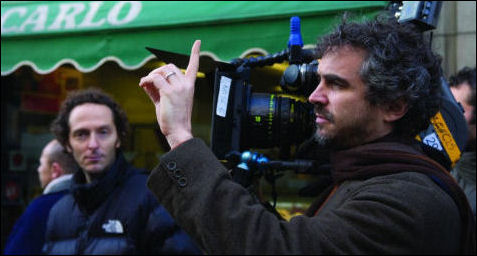
Children of Men director-co-writer Alfonso Cuaron (r.); the great Emmanuel “Chivo” Lubezki , the film’s dp, to the left

But ten, twenty or fifty years from now, long after the pure-fizz movies (the ones that sometimes make people giddy and chuckly when they’re first seen) have been forgotten, people who care about the eye-popping art and vitality of cinema at its finest will be watching Children of Men.
I guess that white-haired guy was brought down by Cuaron’s vision of a crumbling world — worldwide infertility, bands of terrorists, mass chaos, people in cages, roving criminals on every corner. Britain, however, is the last island of relative stability in this world of November 2027. All the other countries have collapsed into total ruin.
What rings so true about this polluted Orwellian atmosphere is that it’s not radically different from the England of today — it’s just a bit grimier and madder with more cops and bigger video-screen ads, and a lot more animals on the streets, and much dirtier exhaust coming out of everyone’s tail pipes. Soldiers and cops are roving all over the place, warnings are constantly broadcast and posted. Broken windows, rampant graffiti, kids throwing rocks and garbage at passing trains….all the signs.
The key plot point is that there have been no births in the world since 2009. It’s over — everyone has given up.


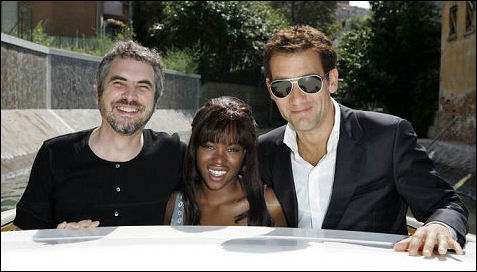
Cuaron, Ashitey, Owen during the Venice Film Festival

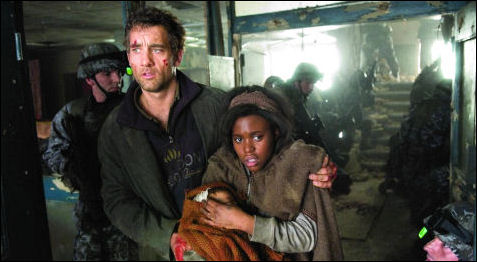
Owen’s arc is to go from being a bitter disllusioned milquetoast — a bureaucrat named Theo Faron who can only shuffle along and think of his own misery — to a fighting humanist-activist doing everything he can to protect an illegal refugee named Kee (Clare-Hope Ashitey), who, we soon learn, is miraculously pregnant. If it lives, the baby inside her will be the first child on the planet in 18 years. And it falls to Theo to smuggle Kee to a group called the Human Project, a group of scientists trying to find a cure for global infertility.
Michael Caine plays the only joyful character, a former political cartoonist-turned- pothead named Jasper who’s also Theo’s best friend. He’s in only two scenes but nonetheless lifts the film’s spirit significantly. Peter Mullan adds another energy jolt toward the end as a half-crazed cop friend of Caine’s.
The action starts with Theo being kidnapped by an immigrant-rights terrorist group run by Julian (Julianne Moore), a former lover of Theo’s who gave birth to their child only to see it die. She wants Theo to get hold of transit papers for Kee, which he does. But then things start to go crazy, and soon the film is pretty much one chase or high-peril situation after another.
That’s another reason people may pigeonhole this film as being less than it is — they’ll say it’s just another futuristic action flick.
I don’t think it matters at all if Cuaron and Timothy J. Sexton, who share script credit, have dealt with the various issues with sufficient or insufficient detail. It didn’t bother me that the infertility thing is never really explained — what mattered to me is that I absolutely believed it had taken hold.

The photography is legendary not just for the excitement factor, but because it’s fascinating to try and figure out how this and that sequence was shot. My favorite is an attack on a car in the countryside — it’s a single take that reportedly required a special mini-crane that allowed the camera to shoot both inside and outside the car. The big battle sequence at the finale is mind-blowing. It’s basically the final battle sequence in Full Metal Jacket on steroids.
I had thought of Cuaron mainly as a soulful-whimsical dramatist after Y Tu Mama Tambien. His Harry Potter and the Prisoner of Azkaban (’04) was better than the others, but I did what I could to ignore it. His short in Paris J’etaime (“Parc Mon- ceau”) was pretty good. Children of Men, however, is a huge leap forward. Now he’s one of the big-boy visionaries in the class of Kubrick, Orson Welles, Spiel- berg, Gregg Toland, Chris Nolan, Ridley Scott, et. al.

As Far As It Goes

As Far As It Goes

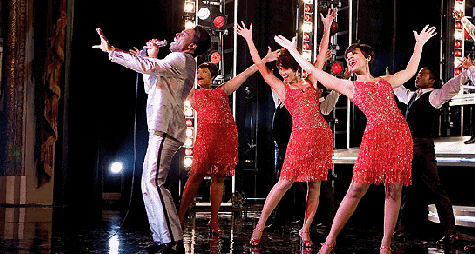
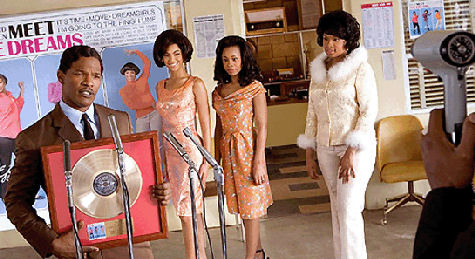
I predicted last August that Dreamgirls (Dreamamount, 12.15) would be a huge thing for costar Jennifer Hudson, who has the role (i.e., Effie White) with the most soul and punch and heartache. I was right. The Best Supporting Actress Oscar is probably hers for the taking. But my feelings are otherwise torn about Bill Condon and Larry Mark and David Geffen‘s period musical, which had its first big preview Wednesday night at the Academy theatre.

I was delighted with it in spurts and pieces — it has a knockout feeling from start to finish, and delivers an adrenalized rush that’s either going to get you or it won’t. It’s one dazzling, machine-gun-edited musical number after another that “sells” itself like there’s no tomorrow, and the sum effect is like something washing over you.
Like, say, a 100-gallon vat of Red Bull and 7-Up. Okay, with a little whiskey and heartbreak thrown in, and a lot of cigarettes and some bad substance abuse on the side.
This is the story of the Supremes — how it all began and came together, and then took off and went sour and finally shook down. It’s recognizably real and yet fast and fizzy — another of those hard-knocks, rough-and-tumble showbiz sagas, this time seasoned with heavy doses of Motown-Broadway pizazz.
< ?php include ('/home/hollyw9/public_html/wired'); ?>
But it didn’t feel to me like it really and truly sank in. After a while you feel so soaked with the stuff it’s selling that you start to go a little bit mad. It didn’t make me angry at all — this is not Chicago but somewhere around the half-hour mark I began to say to myself, “What’s with the push-push, go-go, pop-pop all the time? Why can’t we downshift and quiet down here and there, so we can possibly hear someone’s heart beating?”
That’s not the deal, I realize. This is essentially Michael Bennett‘s vision of Dream- girls re-dreamt and re-launched, and I knew what that probably would be. And I wanted to feel great about it. I really did.

It didn’t feel to me like a real river of a movie (and I trust I don’t have to explain that one — some films have a primal gravity feeling that tells you in a dozens of different ways that you’re into something earthy and fundamental) but for some, like those cheering and whooping in the Academy theatre last night, the razzle dazzle will be enuf.
I “liked” Dreamgirls, for the most part. I didn’t feel hostile in the least. I was entran- ced and smiling and going with a feeling of being among some very good and talented people who are doing everything they can to make me feel it (which I did, as far as it went). I had a much better time with it than I did with Chicago, which I despised to the depths of my soul. But at the same time I felt something missing.
I was going to sort out my feelings and shake it out before writing anything (it won’t open for another 29 days), but then I woke up this morning to a giddy bungee- jumping David Poland rave, and some of the things he said made my brain go into spasms. And then Roger Friedman jumped in, and then Tom O’Neil. But let’s bang up against the Poland.
Dreamgirls landed in Beverly Hills…last night, and left a giant crater in the Oscar season,” he began. My idea is that it was more of a meteorite that hit and then careened off and then hit and hit again, like a stone skimming across a pond. Dreamgirls is a wowser and not just in a spirited or “technical” sense — it’s a full-tilt, full-throttle thing all the way. It will no doubt turn a lot of people on (it definitely got me from time to to time) but I was there in the room and the feeling during the after-party was not that one of standing at the edge of a huge crater and going, “Wow…big one. I can still feel the tremors.”

The feeling was a mixture of some delight and merriment, contentment (“I went with it,” a journalist friend said) and a kind of “let’s talk this out” therapy session. I wasn’t confused but I felt a wee bit unresolved. I knew I had enjoyed it as much as I’m capable of enjoying an obviously first-rate Motown glitter-funk gay man’s extravaganza, but I was going from person to person and saying (with variations), “It’s not that I didn’t like it — I did for the most part and it’s a great sell. I loved Jennifer Hudson to death. But it feels like a two-hour sketch.”
I realize that there’s something inherently sketchy about all musicals — you’re never going to get Long Day’s Journey Into Night with songs — but for me, Dream- girls is too pat. Everything is in shorthand. Nothing is off or raggedy or haphazard. It doesn’t feel like Detroit, or like the ’60s or ’70s even. It feels like it’s happening in director-writer Bill Condon‘s head, and that’s fine. There’s no one who respects his talent and chops more than I.
“The film was everything promised and more,” Poland said. I would say it was everything promised and somewhat less. Not a crashing disappointment, but a film that simultaneously roused and satisfied in several ways, but didn’t quite bring it home.
Dreamgirls is a highly-charged moviefication of a hot stage musical that was (I’m told) all songs and sparkle (which benefitted from Michael Bennett‘s inspired staging), and nothing really acted or spoken. Condon has, I’ve been told, added narrative tissue and emotional intimacy and made it more of a people thing and less of a big, brassy presentation. I can half-see that, and I respect the effort.

And yet Hudson aside, I didn’t feel much for anyone. They’re all “on” and, as far as it goes, “terrific.” But I wasn’t rooting for Beyonce Knowles and her thin Diana Ross character, and as much as I liked watching Eddie Murphy, Jamie Foxx, Anika Noni Rose, Danny Glover, Keith Robinson and Sharon Leal, I felt pretty neutral about the fates of their characters.
Poland actually said (this was the biggest mindblower for me), “It’s like the old question, is Chinese food in China ‘Chinese food’ or just ‘food?'” A rave review should not, I feel, bring up this metaphor. The odd thing is that I don’t feel this way about Dreamgirls. I feel that the “all” of it, in a certain sense, is quite substantial.
But it’s not an emotional bath experience as much as an emotional car wash — you’re in a mint-condition 1970 Cadillac with the windows up and everything sealed tight, but instead of moving through the water and brushes and soap and hot air at 2 miles an hour, you’re moving at 80 or 90 miles an hour and the car-wash tunnel is almost 185 miles long. I’m saying that for all the application of craft and feeling and kick-out soul, the emotional moisture never really penetrates.
But Jennifer Hudson, at times, is in the car right next you and she’s the absolute real deal. I loved her. I love her now as I’m sitting here. I loved her hurtin’ stuff. I loved her singing “what about what I feel? what about what I need?” I loved the way she sang “Love You I Do,” a new number written by Henry Krieger. I loved the way she sang “One Night Only.” But anyone who says she should be pushed for Best Actress is insane. She’s the new kid and she’s not in Helen Mirren‘s or Judi Dench‘s or Meryl Streep‘s class…please.

Poland has written that Beyonce “absolutely deserves” a Best Supporting Actress nomination. It won’t happen. Her best moment comes when she sings another Henry Krieger song, “Listen,” but her character (like the real-life Diana Ross) is mainly about opportunism and eyelash-fluttering and going for the gold. The only reason she turns is because Jamie Foxx’s character turns into a shit and she feels she needs to go elsewhere to grow. But if he’d been a better, more sensitive partner, Beyonce’s character would be about complacency from start to finish.
Poland thinks Dreamgirls is going to win for Best Picture. It might, but I spoke to people last night who were four-square against it and they were saying “no way.” One guy even said it may not be nominated.
If it does win, I know I won’t go into convulsions like I did when Chicago took it. I know that Dreamgirls doesn’t have the human-condition current that makes films like The Lives of Others, Babel, Volver, Little Miss Sunshine, The Queen and United 93 truly special experiences. It has a musical current, yes, and that punch-it-out spritzy-wow thing, but….
I know that Condon has done as good a job at this kind of thing as anyone could. I don’t pretend to fully understand or support it 100% — I can only try to feel it as best I can and hope for the best — but as far as this kind of musical goes, the heart and effort that went into it has my respect. Let’s leave it at that. For now.

Reconsidering “Lives”

Reconsidering Lives

I spoke early Wednesday evening with Florian Henckel- Donnersmarck, the 33 year-old director of the gripping, pulverizing German-language thriller The Lives of Others (Sony Pictures Classics), which is all but a dead lock for a Best Foreign Language Film Oscar nomination.


Florian Henckel-Donnersmarck at the Beverly Wilshire hotel — Wednesday, 11.8.06, 6:05 pm.

A huge favorite at the Telluride Film festival and the biggest hit of the Toronto Film festival after Borat, The Lives of Others won’t open in a conventional commercial sense until 2.9.07. L.A. audiences will get an early peek in December, however, when it opens here for a one-week qualifying run. The idea is to qualify it for nom- inations in other categories, as Pedro Almodovar‘s Talk to Her and Roberto Begnini‘s Life is Beautiful managed a few years ago.
The Lives of Others is one of the most penetrating German-made “heart” films I’ve ever seen — the love story is tender and impassioned and ripely erotic — but it’s also a riveting drama about political terror.
< ?php include ('/home/hollyw9/public_html/wired'); ?>
I always tell people Lives has four selling points: (a) it’s a first-rate political thriller and a well-sculptured drama, (b) the story isn’t predictable, and it delivers strong arresting emotion at pretty much every turn, (c) it’s sexy as all get out (largely due to costar Martina Gedek, best known on these shores for her Mostly Martha role) and (d) it runs 2 hours and 17 minutes with credits, and yet it feels like maybe 100, 110 minutes at the most.
It’s a gray and dispiriting film now and then, but with a touching “up” element at the finale. It’s a political thriller with real compassion — a movie about spying and paranoia and the worst aspects of Socialist bloc rigidity and bureacratic thuggery, and yet one that delivers a metaphor that says even the worst of us can move towards openness and a lessening of hate and suspicion. Ugliness needn’t rule.


Sebastian Koch, Martina Gedek

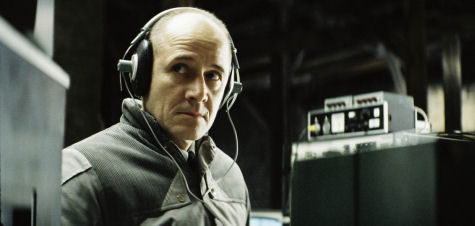
It’s about the turning of a bad guy — a Stasi secret policeman (Ulrich Muhe) who’s first seen as a bloodless and fiendish bureaucrat, but whose determination to spy upon and mangle the lives of a playwright (Sebastian Koch) and his actress wife (Gedek) for the sake of career advancement gradually weakens and erodes, and then flips over into something else entirely.
“It’s so easy to make a cynical film,” Henckel-Donnersmarck said early in our chat. “To write or play an unlikable part is easier still. But to write or play someone postive…a positive character…is much harder. Any kind of film with a message of hope, to convey that emotion…to deliver that is a real challenge.
“A film that empowers you is very important to me. Even if it’s painting a positive image just be painting a shadow. if ‘what’s next’ question dies in a viewer’s head …that makes a film drag. People always have to be asking “what’s next?”..you have to keep people awake in that respect, and that means you always have to keep surprising them.”
Set in Berlin, the story mostly takes place in 1984 and ’85, although it jumps to ’89 (the year the Berlin Wall came down) and then to ’91 and ’93. During the 50-year history of the German Democratic Republic (’49 to ’89), the thugs who held the reins of power kept the citizenry in line through a network of secret police called the “Stasi”, an army of 200,000 bureaucrats and informers whose goal was “to know everything.”

Captain Gerd Wiesler (Muhe) is a highly placed Stasi officer who is prodded by a superior, Lieutenant Colonel Anton Grubitz (Ulrich Tukur), to dig up anything negative he can on a famous playwright named Georg Dreyman (Koch) and his actress wife, Christa-Maria Sieland (Gedeck).
At first the suspicions are baseless — Freyman is a dedicated socialist who believes in the GDR. But his loyalties evolve when he discovers that his wife has been pressured into a sexual relationship with a government bigwig, and especially after a theatrical director pal commits suicide due to despondency over his being blacklisted and prevented from working. Eventually Wiesler, who has had their apartment thoroughly bugged, has evidence that Wiesler is working to undermine the state.
And yet his immersion in the lives of this playwright and his actress wife leads, ironically, to a gradual bonding process — a feeling of identification and sympathy for the couple as human beings, artists…people he’d like to know and perhaps share passions with, despite his constricted personality and shadowy Stasi ways. He knows he’s not in their league and probably not worthy of their friendship, but he feels what he feels regardless.
Others won 7 Lola Awards (Germany’s equivalent of the Oscar) — for Best Film, Best Director, Best Screenplay, Best Actor (Muhe), Best Supporting Actor (Ulrich Tukur) and Best Production Design.


Ulrich Muhe in The Lives of Others

Here’s the shorter first portion of our conversation and the longer second portion. It includes questions and comments from producer and longtime friend Victoria Wisdom, who’d met Henckel-Donnersmarck the night before.
Florian is definitely the tallest first-rate director I’ve ever spoken to — he’s 6’9″. He said he’s looking to direct a U.S.-funded film next, although he’s a ways from deciding what that will be. He’ll be in Los Angeles for the next few days. He said something about returning for the one-week December opening and then again in January to promote the early February opening.

Snarly Softie

I’ve tried and it’s impossible — there’s no feeling just one way about John Ford. His movies have been wowing and infuriating me all my life, and after seeing Peter Bogdanovich‘s Directed by John Ford — an expanded, unexpectedly touching documentary about the legendary helmer that will show twice on Turner Classic Movies Tuesday evening (and also at a special AFI Film Festival screening at the Linwood Dunn) — the muddle is still there.

But Bogdanovich’s film gives you a feeling — one that seems clear and genuine — that you’ve gotten to know the old coot better than ever before, that you’ve really and truly seen past the bluster and the scowl and the cigar, beyond the scrappy Irish machismo and into some intimate realm. After many years of saying “Ford sure made some great films but what a snappy old prick he was,” I’ve finally come to like the guy. And I feel I owe Bogdanovich a debt for that.

I tried to say this during my Monday afternoon phone chat with Bogdanovich. We spoke for 25 or 30 minutes. And I never quite said what I felt the film had taught me about Ford, which is that he was a shameless softie who used a snarly exterior manner to keep people from getting inside and discovering who he really was. But of course, his films made that pretty clear on their own.

Directed by John Ford is really and truly one of Bogdanovich’s best films. It’s right up there with The Last Picture Show, They All Laughed, Targets, Saint Jack and Paper Moon.

It reminds us once again that the director of The Grapes of Wrath, The Informer, How Green Was My Valley, She Wore a Yellow Ribbon, The Horse Soldiers, Drums Along the Mohawk and The Man Who Shot Libery Valance was a superb visual composer and one of Hollywood’s most economical story-tellers bar none. His films were always layered and understated with sub-currents that never flowed in one simple direction. His films always seemed fairly obvious and sometimes sentimental …at first. Then you’d watch them again and reconsider, and they always seemed to be about a lot more.

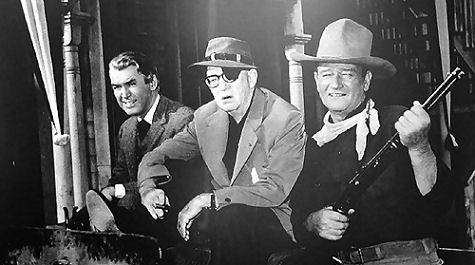
Bogdanovich actually made Ford in 1971, but he was never very happy with that earlier version. The current version still has the Orson Welles narration and a trio of warm, hilarious, fascinating interviews with John Wayne, Henry Fonda and James Stewart. These three alone make the doc worth seeing. The interviews were shot in 35 mm and very carefully lit and framed. The fact that Wayne, Fonda and Stewart have all moved on to the next realm makes it all the more affecting.

The additions include new interviews with Martin Scorsese, Clint Eastwood, Walter Hill and Steven Spielberg.

The other big extra is an audio tape of a 1973 heart-to-heart between Ford, then lying on his deathbed, and his lifelong love interest Katharine Hepburn (they fell for each other during the making of Mary, Queen of Scots). At one point you can hear Ford tell her that he loves her. It’s the kind of thing a guy like Ford would only say knowing that the clock is ticking and he’d better spit it out while he can still breathe.

I love Spielberg’s recollection about meeting Ford and being brusquely told how he’ll never be a decent director until he learns to frame landscapes without the horizon being dead center. I take pictures every day and I don’t think I’ll ever forget that lesson. I know I won’t.

I’m still bothered by the phoniness and jacked-up sentiment in just about every one of Ford’s films. The Irish clannishness, the tributes to boozy male camaraderie, the relentless balladeering over the opening credits of 90% of his films, the old-school chauvinism, the racism, the thinly sketched women, the “gallery of supporting players bristling with tedious eccentricity” (as critic David Thomson put it in his Biographical Dictionary of Film), and so on.

But I now feel that I’ve finally come to know and very much like Ford the man. Maybe some day the stuff that still irritates me about his films will cease; maybe not. But I know my attitude about the guy has definitely been altered by Bogdanovich’s film. I presume I’m not the only one, or at least that I won’t be after it airs tomorrow night.

Eat Me

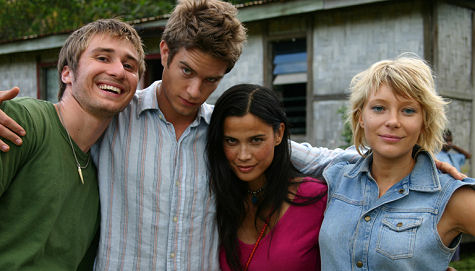
Yesterday I lucked into a screening of Jonathan Hensleigh‘s Welcome to the Jungle, a hand-held, Blair Witch-y, spookily atmospheric horror film about four kids looking for the remains of Michael Rockefeller in New Guinea (which they hope will lead to paydirt) and running into cannibals.

And I don’t mean nameless actors who’ve been wardrobe-fitted with animal-bone necklaces and loincloths and had the right kind of movie-set makeup applied so they’ll “look” like cannibals. I mean genuinely spooky feral types with muddy-milky skin and carrying hand-made weapons. We never see them all that clearly, but they’re glimpsed now and then, crouched and stalking through jungle flora and looking like the real deal. Yeah, I know…but I believed it. It creeped me out in a way that I’m not likely to forget.

Read more

Letter to Clint

Letter to Clint

Some feel that journalists aren’t supposed to make before-the-fact suggestions. They’re supposed be good sheep and just eat the grass that’s in front of them ….baahh! But I’ve got one anyway, and I think it sounds pretty neat. I mentioned it to a fairly big wheel at Paramount the other day and he thought it was pretty cool also, so please give it a think-through.

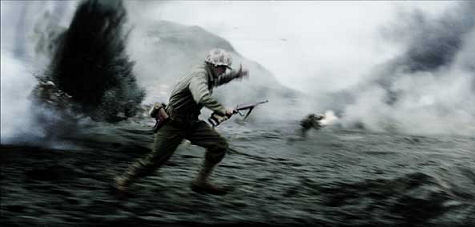
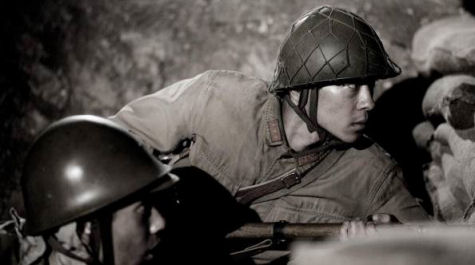
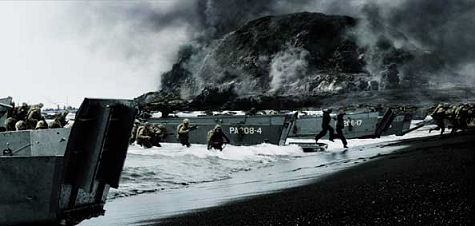
My dad, a Marine Lieutenant who fought all through the battle of Iwo Jima, saw Flags of Our Fathers last weekend. He didn’t like it that much. The combat footage was bulls-eye, he said, but he didn’t care for the cutting back and forth between the battle and the war-bond tour. I was sorry to hear this on some level. I felt the same way but I thought his reactions might nudge me into a fuller appreciation of some kind. Lamentably, we were pretty much on the same page.
But after we spoke last night, I said to myself, “Wait a minute.” That idea I had three weeks ago about someone re-cutting Flags and blending it with portions of Letters From Iwo Jima came back, and the more I kicked it around the better it sounded.
< ?php include ('/home/hollyw9/public_html/wired'); ?>
Six months ago…hell, six weeks ago your two Iwo Jima films were looking super- formidable. Not so much now. I’m not saying this with any relish whatsover, but the fact is that the tent has deflated somewhat. Flags is a pretty good film for the most part and certainly deserving of respect. But a little voice is telling me something better and fuller can be made from the footage you’ve shot.
A clear majority of the venerated critical community has done cartwheels over Flags of Our Fathers and it’s entirely possible (though not certain) that it will land a Best Picture nomination, but it’s sagging commercially all the same, and, let’s face it, this will have an effect on Academy nominations. You worked hard and long on Flags and put your heart into it, but facts are facts. It earned $6,300,000 on 2100 screens last weekend, which is a drop of just over 40% from last weekend despite an addition of 300 screens. I can’t be the only one thinking that Oscar glory may not be in the cards.

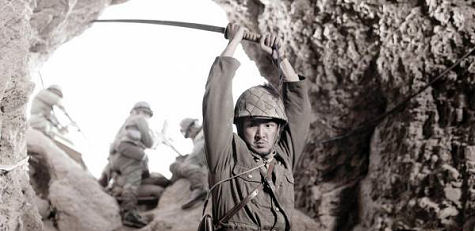
And Letters From Iwo Jima (Warner Bros., 2.9), a Japanese-troop POV drama about the same conflict, is being regarded by its handlers and marketers as a smallish art film — a sideshow. (There was a brief mention of it being offered to Sundance ’07.) I’m not saying it won’t be as widely admired as Flags; it may turn out to be even more so. But I’m sensing that however it’s received by critics, the industry and the paying public, it’ll be mainly regarded as a back-up maneuver. On these shores, at least.
My suggestion is this: sometime early next year go back to the Avid with your gifted longtime editor-collaborator Joel Cox (who cut Flags) and put together a third movie that willl be strictly about the battle of Iwo Jima — a new synthesis that will draw solely from the combat footage in both films, cutting back and forth between U.S. and Japanese troops.
It won’t even need a story. With experiences of this sort, “story” is over-rated. I’m thinking that the third film — rip off the title of that old John Wayne movie and call it Sands of Iwo Jima — could be a seriously kick-ass, impressionistic, here’s-how- the-battle-really-went-for-both-sides type deal.
The lack of a story will be a plus factor, actually — the terrible ragged honesty of the combat footage will be enough. That and the slamdunk theme, of course — the shared terror and common humanity between the U.S. and Japanese troops.

You don’t even need an “ending” to this film, or a beginning even. You just need to take us back there once again and just stay with the battle this time, and just let the raw truth of it soak in on its own terms.
In my Flags review I imagined that someone out there will someday take the DVDs of Flags of Our Fathers and Letters From Iwo Jima and recut them into Sands of Iwo Jima and put the finished product up on YouTube. I’m suggesting a recut third version because you should do it, not some kid from NYU film school.
Every director knows there’s no such thing as a final cut of any film — there’s only the version he/she has to settle for when it’s taken away by the distributor and duplicated into release prints. The deck can always be re-shuffled, and why not? We’re living in a fluid world of endless digital re-imaginings and alternate versions these days. And Flags of Our Fathers and Letters From Iwo Jima are your movies, your material. It should be yours to do or not do.
I’m not saying you need to commit to assembling and releasing a DVD of Sands of Iwo Jima. It may not work out. It may be a lousy idea. I’m saying you and Joel should at least try it and see what happens. If it doesn’t work, no harm done. But if it does, you’ll obviously be happy and satisfied that you gave it a go. And so will your fans.

Snap Judgment

Snap Judgment

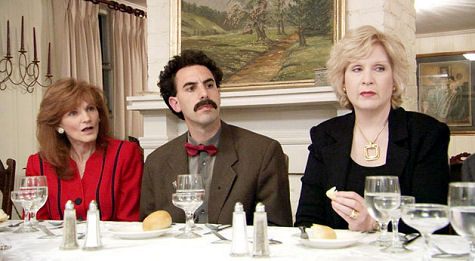
Just as Burt Lancaster‘s Ernst Janning character finally spills his true thoughts at the end of Judgment at Nuremberg, it is time after days of sober reflection to speak of the Borat playdate scale-back that was confirmed by 20th Century Fox last Wednesday. Instead of opening Sacha Baron Cohen‘s rollicking comedy on the previously decided-upon 2000 screens on 11.3, Fox will now start with an 800-screen debut and then bump the run up to 2,200 screens the following weekend (i.e., 11.10).

My basic feeling is that Borat: Cultural Learnings of America for Make Benefit Glorious Nation of Kazakhstan is one of the most live-wire concoctions to come along in years — as much of an essential American comedy as Preston SturgesSullivan’s Travels — and an absolute must-see for anyone with a pulse. But it’s not especially embracable or familiar-feeling, truth be told. It’s clever, witty, often hilarious in a dumb-ass way…but sometimes it’s more astonishing than anything else.
I was a bit more amazed by Borat than in love with it, although I’m recommending it to everyone I see. You can’t not see it any more than a half-aware moviegoer could avoid seeing Dr. Strangelove when it came out in early ’64. To not see Borat is to say to yourself or your friends on some level, “I am dead…I am out of the ’06 loop.”
< ?php include ('/home/hollyw9/public_html/wired'); ?>
The truth, I believe, is that red-state types (I’m sorry for ignoring the recently evolved p.c. decision that there’s no such thing as a red-state mentality…sorry, A.O. Scott!) may not find it as outrageous-funny as blue-state urbans. It’s a silly-goofy comedy, but Borat is fundamentally a satire about rural American values. It’s absurdist but snide. If nothing else, the Pentacostal conversion scene alone (which is more of a mind-blower than hah-hah “funny”) makes this fairly obvious.
Fox’s cutback happened, obviously, because the Borat awareness among regular Joe Schmoes wasn’t where it needed to be to support a big 2000-screen debut. I wrote about the sluggish tracking situation ten days ago (on 10.19). That 10.25 L.A. Times story by Josh Friedman and Lorenza Munoz said that a National Research Group tracking survey issued last Monday “showed that 27% of respondents were aware of Borat, well behind two competitors” — Disney’s The Santa Clause 3: The Escape Clause and DreamWorks’ Flushed Away” — opening the same weekend.


Sacha Baron Cohen

This may seem like an extreme analogy to some, but the answer to Borat‘s apparent low awareness, I believe, lies in Ernst Janning’s statement about the proverbial claim that average Germans didn’t know what the National Socialist government was up to in the 1930s and early ’40s. “Maybe we didn’t know the details,” he declares, “but if we didn’t know, it was because we didn’t want to know!” Same thing here, I believe, and the root factor, as in Nazi Germany, is about tribal persuasions and inclinations and snap judgments.
I’m not saying average Americans are Nazis, for heaven’s sake…calm down. I’m saying they make gut-level decisions about movies they want to see based on deep-down primal factors. Like you or me, like anyone.
Average Joes (and I mean the generally overweight slow-on-the-pickup types…the “late adopters”) are aware of Borat, all right — how could they have missed the hoopla out of Cannes and Toronto, the internet buzz, that recent Entertainment Weekly cover? But somewhere deep down they’ve considered Cohen’s appearance — rug-trader moustache, Middle-Eastern ethnicity, extremely geeky — along with the arch, deliberately “impersonal”, somewat anti-emotional attitude of an outsider-hipster who’s aiming his jokes at those hip enough to get where he’s coming from, and they’re saying to themselves, “This guy’s not me, and he’s not trying to talk to me — he wants me to get into him.”
In other words they’re taking one look, they’re sizing him up…and they “don’t want to know.” Instinctually. That’s what’s going on with Joe Sixpack, with older rurals, with lazy boomers, with the hundreds of thousands of shallow young girls who laugh too loudly when they sit together at Starbucks. The only people who are naturally into him are educated (or at least curious), ahead-of-the-curve (or abreast-of-the-curve) urbans. That’s where the 27% awareness is from.

Of course, all the resistors have to do is see the damn movie and everything will change. They’ll mostly laugh in an “oh my God!” sort of way, and they’ll tell their friends and Borat will be on its way to wherever, on its own speed. That’ll probably start to happen when the 800-theatre break happens next Friday. I know it’ll do well in most cities, but one should never underestimate red America’s xenophobia — the deep-seated unwillingness to consider an exotic attitude or mentality. They like what they like if the movie/record/TV show reaches out and talks to them, and if it doesn’t….later, dude.
In short, Borat is largely a satire of American rubes, and the commercial reception that awaits should, I feel, be read as a referendum on the American character circa 2006.

Tribute and Testament

Tribute and Testament

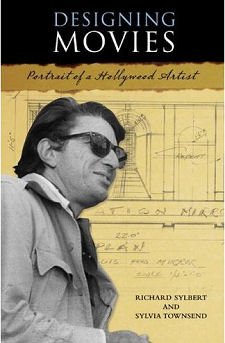
The late Richard Sylbert, one of the most gifted production designers in Hollywood history and a guy I was proud and very delighted to know, wrote a 200-page chronicle about part of his career before passing away in March 2002. Five or six years ago journalist Sylvia Townsend offered to edit what Sylbert had written. That never happened, but a year after he died his widow, Sharmagne Leland-St. John-Sylbert, cut a deal with Townsend to finish what Sylbert had begun and also fill in the missing pieces — i.e., to create a combination biography- autobiography.

The result is “Designing Movies” Portrait of a Hollywood Artist” (Praeger), a finely written history and an elegant tribute to a great man. But before getting into the substance of it, there’s some mucky-muck about authorship and credit-hogging that needs clearing up.
The front cover tells us that “Designing Movies” was written by Sylbert and Town- send. That’s a completely accurate statement. And yet on the inside front flap it says the authors are these two “with Sharmagne Leland-St.John-Sylbert,” who wrote only an “afterword” chapter. Sylbert’s widow also arranged for an insertion of a brief bio of herself along with Sylbert and Townsend on the inside back flap. Townsend, whom I spoke to Thursday night, told me a lot about Sharmagne Leland-St. John-Sylbert’s maneuvers over the last three years. Suffice that she inserted herself into the interview process to no discernible benefit to the book, and she often generated questionable claims and assertions that were later shot down during fact-checking.
< ?php include ('/home/hollyw9/public_html/wired'); ?>
And yet Sylbert’s widow has elbowed herself into the promotion of this book, and will be the one signing copies at a Book Soup event on Sunday, 10.29 at 4 pm. I gather Townsend will be elsewhere. I hope that this won’t dissuade anyone from dropping by and picking up a copy — it’s a robust and worthwhile read — but arro- gance and egotism of this sort needs to be recognized.
Townsend worked on the book for three years. She edited and added material to 13 chapters that Sylbert had written, covering the beginnings of his career in the 1950s and leading up to his work on The Graduate, Carnal Knowledge and China- town; Townsend wrote another nine (covering, among other films, Shampoo, Reds, The Cotton Club and Dick Tracy) plus an “introduction to Richard Sylbert” chapter. The result is a fascinating ride through the Hollywood glory days of the ”60s, ’70s and early ’80s — a candid, pungent, wonderfully detailed tour.

I don’t mean absolutely candid. Sylbert was a character and as we all know, char- acters have their curiosities. I loved his brilliance, his bluntness, his perceptions — he’d worked with everyone and was a great racounteur. But he was a bit of a bull- shitter, he wasn’t the most serene man in the world, and the ’60s sand ’70s were known for colorful behavior. It’s clear that Townsend has composed a very thorough study of a very complex man, and yet she hasn’t tried to mine the turf of Peter Biskind‘s “Easy Riders, Raging Bulls” — it’s an honest book, but far from a tell-all. But I didn’t read Townsend’s book in search of exotic tales. I wanted to revisit the life of a very gifted fellow, and on this level it fully satisfies.
In the few years that I knew him, I thought of Sylbert as a friend and a great source, and perhaps the greatest teller of Hollywood stories I’d ever been lucky enough to know. Every time we spoke he’d toss off a recollection or two about this or that heavyweight he’d known and worked with over the last 40-odd years, and I’m speaking of every top-ranked talent over the age of 50 who’s ever had a creative impact on this town — Warren Beatty, Robert Towne, Robert Evans, Jack Nicholson, Julie Christie, Dustin Hoffman, John Huston, Elaine May, Francis Coppola, Richard Gere, etc.
Sylbert wasn’t just an intimate witness but a first-class participant in Hollywood’s great creative ferment of the late ’60s to early ’80s. For him, production design was always about more than just dreaming up the look of a film — he was a conceptual collaborator whose input, he always claimed, went far beyond visual apppearance. I know that on a design level alone his creations — which first appeared in Nicholas Ray‘s Wind Across the Everglades (1958) and had their swan song with P.J. Hogan‘s Unconditional Love — were always striking and every so often were wondrous.

Sylbert designed the edgy, sometimes vaguely hallucinatory sets used for John Frankenheimer‘s The Manchurian Candidate (1962), worked with Saul Bass on that legendary title credit sequence for Walk on the Wild Side (also ’62), and imagined the somewhat rickety, constipated interiors of George and Martha’s home in Mike NicholsWho’s Afraid of Virginia Woolf? (’66). He came up with the jungle-like, zebra- and tiger-skinned interiors in Mrs. Robinson’s home in The Graduate (’67), as well as the black-and-white design of Benjamin Braddock’s home in that landmark Nichols comedy.
He also designed Rosemary’s Baby (’68), including the before-and-after interiors of the Woodhouse apartment in Roman Polanski’s as well as those wonderfully spooky nightmare visions seen during that demonic seduction sequence. And he did exquisite work for Nichols again on Catch 22 (’70) and Carnal Knowledge (’71), followed by his services on John Huston‘s Fat City and Elaine May’s The Heartbreak Kid (both in ’72). Then came Roman Polanksi‘s Chinatown, which Sylbert enhanced with perhaps the most luscious (but at the same time, somber and moody) re-creation of 1930s art-deco atmosphere ever savored on-screen.
He rendered the 1930s once again in Nichols’ The Fortune, and then late 1960s Beverly Hills in Hal Ashby, Warren Beatty and Robert Towne‘s Shampoo (’74). He did a brilliant job of capturing pre-World War I New York City in Beatty’s Oscar-winning Reds (’81), and won an Oscar nine years later for delivering a physical world of primitive, comic-book proportions in Beatty’s Dick Tracy (’90). He also delivered convincing period milieus for Francis Coppola‘s The Cotton Club (’84) and Lee Tamahori‘s Mulholland Falls (’96).
He also designed P.J. Hogan’s My Best Friend’s Wedding (’97), Brian DePalma‘s Carlito’s Way (’93) and The Bonfire of the Vanities (’90), Robert Towne’s Tequila Sunrise (’88) and Jon Avnet‘s Red Corner (’97). I remember marveling at his re-creation of a portion of Beijing’s inner city for Red Corner, and then listening to him tell me about the nuts and bolts over a breakfast we once shared at Swinger’s Cafe on Beverly Boulevard.

Sylbert won two Art Direction Oscars during his career for his work on Dick Tracy (shared with Rick Simpson) and on Who’s Afraid of Virginia Woolf?. He was also nominated for his work on Reds, The Cotton Club and Chinatown.
On top of all the priceless dish he shared with me over the years (he always picked up the phone, and he never told me he couldn’t help), I’ll always be grateful for his agreeing to drive out to Woodland Hills and speak to a film class I was moderating in ’97. And I’ll never forget how he always wore the same African safari jacket, whatever the occasion. It was a crying shame when he left. I miss him right now. He was an excellent guy to know and have a drink with.

Persistence of Sunshine

Persistence of Sunshine

The last few months have cast Little Miss Sunshine in its proper light. When it opened last July following an ecstatic debut at the Sundance Film Festival six months earlier, nearly everyone called it one of the most original and emotionally grounded family comedies seen in a long while. Quirky and perky, sometimes despairing in tone but intimate and knowing — a movie with smarts and verve and finesse.

Sunshine, of course, has hung in there commercially over the last three months (it’s up to $57-something million domestic) and is now even more broadly regarded as one of the year’s absolute finest. Because, I believe, it’s not a hah-hah comedy as much as a down-to-the-marrow family drama with horse laughs, and because of the quality of the humor. It feels so cleverly configured and well-blended that it doesn’t feel like anyone configured or blended anything.
The lion’s share of the credit for this belongs to three people — screenwriter Michael Arndt and directors Jonathan Dayton and Valerie Faris. I’ve made no secret over the last nine months about being an Arndt fan for reasons that have nothing to do with our having swapped apartments during the summer of ’05. (I sweltered in Brooklyn while he worked with Dayton and Faris during the Sunshine shooting, which was all done within 50 miles of Los Angeles.)
< ?php include ('/home/hollyw9/public_html/wired'); ?>
Arndt has been living in San Francisco and working on a script for Pixar over the last year or so, but he was in town earlier this week and asked if we could talk. His agent has been riding him about sitting down with the right journalists to keep his Sunshine script in play for a Best Original Screenplay nomination. I think it more than speaks for itself but you have to play the game. We met last Tuesday night outside a Coffee Bean on Beverly and Robertson (it was just after the Oliver Stone/World Trade Center shebang at Morton’s) and talked for an hour.
Scene for scene, beat for beat, line for line, the Little Miss Sunshine screenplay is damn near perfect. In Arndt’s own view it deserved a grade of 88 before it was shot, and then the Dayton-Faris collaboration along with the inspired input of the cast kicked it up to a grade of 93 — a solid A. (Only scripts on the level of Some Like It Hot and Tootsie deserve grades in the high 90s, he feels.)

Arndt didn’t want me to take his picture so I didn’t. He feels that “writers should never have their picture taken for the same reason that models should never be interviewed.” But he’s got an appealing, interesting face — there’s a wariness in his eyes, but every now and then something joyful and delighted seeps in — so after some reflection I decided to run the above shot, which was taken at Park City’s Eccles theatre just after the Sunshine‘s debut showing. I’m presuming that he won’t be pissed.
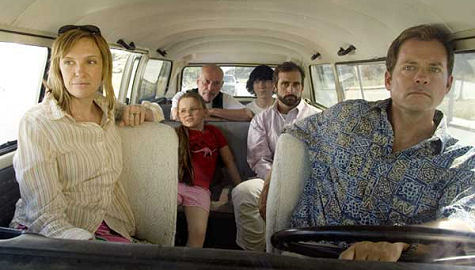
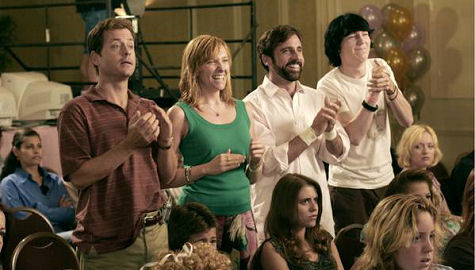
To appreciate this recording you have to know Little Miss Sunshine pretty well, and you have to remember the actors (Abigail Breslin‘s Olive, Greg Kinnear‘s Richard, Paul Dano‘s Dwayne, Alan Arkin‘s grandpa, Toni Collette‘s Sheryl, Steve Carell‘s Frank) and all the stuff they go through.
If you haven’t seen Sunshine, it’s basically about two days or so in the life of the can’t-catch-a-break Hoover clan during a car trip from hell in which they’re taking little Olive to a Little Miss Sunshine beauty pageant in Redondo Beach.
It also helps to know that it took Arndt and Faris and Dayton about five years to get this film off the ground. Why I can’t imagine, but this anecdote in itself reminds me how blind and clueless mainstream Hollywood can often be. What if they’d given up? How many people with scripts as good as this one have grown weary and thrown in the towel after getting turned down for the 27th time?

The Beverly Blvd. traffic was awfully noisy during our talk (trucks, motorcyles, sirens) so I was surprised that our conversation came out as clearly as it did. It lasts about 30 or so minutes, and has some very good stuff on it — trust me.