
Same Old Hero’s Journey

As I mentioned yesterday, the Dune trailer (which I saw last Friday in a Flagstaff multiplex) is somewhat impressive. Timothee Chalamet seems to be doing his own Paul Atreides. I recognize that the arc of Paul’s story in Frank Herbert‘s Dune trilogy is about more than fulfilling a head-spinning destiny and achieving heroism, but involves a gradual descent into a Messianic psychology. But that’s the second part, no?

The basic message of the Dune trailer is “here we go again with a story of a young lad imbued with a certain specialness, and discovering super-powers and carrying the old Joseph Campbell torch on a difficult path to greatness…leading a rebellion, defeating evil, ultimate triumph. Oh, and spices.”

In short it’s more or less the same old same old, and I’m astonished how the fanboys continue to cheer this musty, time-worn fable.

That aside, Greig Fraser’s subdued palette seems agreeable. And Chalamet’s costars appear to hold up their end — Rebecca Ferguson, Oscar Isaac, Josh Brolin, Stellan Skarsgård, Dave Bautista, Stephen McKinley Henderson, Zendaya Coleman, David Dastmalchian, Chang Chen, Sharon Duncan-Brewster, Charlotte Rampling, Jason Momoa and Javier Bardem.

Due respect, but I can’t wait to suffer through this thing. Seriously.

What Furmanek Helped Destroy

Earlier today I happened upon some YouTube clips from Alfred Hitchcock‘s Dial M for Murder (’54). To my delight and astonishment they’re presented within a “boxy” aspect ratio (1.37:1), which I happened to see theatrically during a special engagement at Manhattan’s Eighth Street Playhouse in ’80 or thereabouts.

The higher, boxier image doesn’t include unnecessary air space or superfluous material. No dead spaces or boom mikes. Director of photography Robert Burks frames each shot with immaculate balance.

Thanks to Bob Furmanek and the 1.85 fascist cabal, the only high-def version you can watch today (via the 2012 Warner Home Video Bluray or the streaming component) offers a cleavered 1.78:1 aspect ratio — the original with the tops and bottoms chopped off.

Eight years ago Furmanek posted an explanation or rationale for the cleavered version — I’ve posted it after the jump.

Yes, you can still watch the boxy version if you get your hands on a 2006 WHV DVD. But that’s in 480p, of course, which looks fairly weak by today’s standards. It would be so wonderful if HBO Max would present the boxy version in HD, as they recently did with Stanley Kubrick‘s Full Metal Jacket. Here’s hoping, at least.

Read more

Woke Shitheads Forever

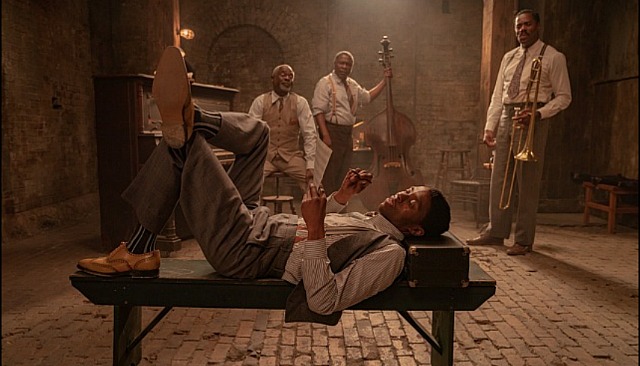
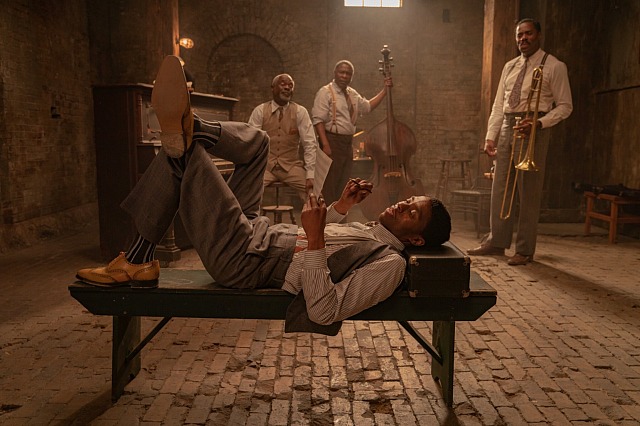
While contemplating the below images, consider “The Battle Over Biscuits and Gravy at the 11-Worth Cafe,” a 9.5 N.Y Times report by Dionne Searcey.

It’s about an old-time Omaha diner for Average Joes that was forced to close a couple of months ago, because of a furor over a gravy-covered sausage patty sandwich called the Robert E. Lee. Wokesters were enraged by the obviously racist allusion and demonstrated against the 11-Worth and its longtime owners, the Caniglia family. The Caniglias apologized and offered to remove the name of the dish, but somehow this wasn’t enough and negotiations broke down. Now the diner is history. A shame — I love unpretentious, down-home eateries like this.

Observation: The tweet from the Washington Post‘s Frederick Kunkle about D.C. wokesters “blocking the media from filming their demonstration, shining lights into a reporter’s face, blocking shots with umbrellas and following like minders” is a strong indication that they know the media narrative has begun to turn against them.

Spoken But Unheard

I’ve been a sucker all my life for scenes of long-delayed revelation or confession that are nonetheless inaudible due to directorial strategy.

Two of my top three are YouTubed below. My third favorite is Leo G. Carroll‘s remarkably concise explanation to Cary Grant about the whole George Kaplan decoy scheme in North by Northwest. The all-but-deafening sound of nearby aircraft engines allows Carroll to explain all the whats, whys and wherefores in roughly ten or twelve seconds; otherwise a full-boat explanation would take at least…what, 45 or 50 seconds? A minute or two?

My favorite is the On The Waterfront moment in which Marlon Brando‘s Terry confesses to Eva Marie Saint‘s Edie that he was unwittingly complicit in her brother’s murder. Because it’s not just an admission but a plea for forgiveness with Terry insisting it wasn’t his idea to kill Joey or anyone else (“I swear to God, Edie!”), and that he thought “they was just gonna lean on him a little,” as he says to his brother Charlie (Rod Steiger) in the film’s second scene.

I’m mentioned the Mississippi Burning moment between Gene Hackman and Frances McDormand a couple of times before. It’s arguably the most powerful moment in this racially charged 1988 thriller, which is based on the infamous 1964 murder of three civil-rights workers. A third-act fantasy spin was the main criticism when it opened, but it emotionally satisfied and that’s what counts.

There’s also that Foreign Correspondent moment inside the Butch windmill when Joel McCrea can hear the murmur of bad-guy voices but not what’s being said. Others?


Cary Grant, Leo G. Carroll during the Chicago / Midway airport confession scene.

In A Great Way, “Tenet” Is Completely About Itself

“The truth of a thing is in the feel of it, not in the think of it.” — Stanley Kubrick.

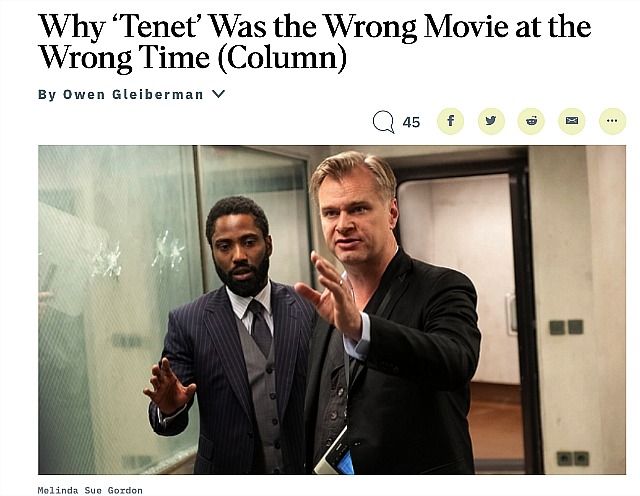
I don’t have much time to write (we have to leave for the airport by 12:15 pm) but Chris Nolan‘s Tenet turned out to be much, much more than I expected.

I kept muttering to myself, “I’ve never seen anything quite like this before.” It’s not intentionally “funny”, of course, but I was smiling quizzically and a few times literally guffawing with pleasure. It’s all but impossible to fully “understand” (certainly upon a first viewing, and even after reading the Wikipedia synopsis I was still going “wait, what?”) but my eyes, mind and expectations were constantly being challenged and blown. Pleasurably, of course.

Nolan being Nolan it’s a visceral eye-bath first and foremost as well as a cool and dry thing, of course, but it’s truly astonishing in spurts.

The important thing is it that it didn’t infuriate me like Interstellar did. Comprehension-wise I was less engaged than I was by Dunkirk, but then Tenet is a deliberate stretch and reach — intentionally designed to expand your boundaries and to some extent leave you confounded and feeling behind the eight ball.

This is a totally riveting, first-class, thinking person’s action film — brilliant, ahead of the curve, every dollar on the screen.

SPOILER WHINER WARNING: There are…oh, God, several knockout action sequences you’ll never forget. Four or five I can think of right off the top. Three of them — the first time-reverse fight scene (which also includes the dumping of gold bars on an airport tarmac followed by the 747 slowly crashing into a hangar), the multi-vehicle highway heist, the big military assault with bombs reverse-detonating and being sucked back into the ground — left me giddy with excitement and awe, and at the same time perplexed.

I understood so little of the dialogue that I threw up my hands about five or ten minutes in. The sound mix is, in a sense, “worse” than Interstellar‘s but this time I had been pre-warned and I didn’t much care. It was so incomprehensible in terms of actual “sure, of course, I get it” moments that I said to myself, “Fuck it…just go with the aural and visual energy of it and absorb what you can and then figure out the particulars when you read the Wikipedia synopsis.”

But after reading the Wiki…well, it helped a bit but if you asked me right now to repeat the plot in basic, high-school-dropout, proletariat-guy language I don’t think I could.

And I don’t want to hear any shit from any commenters about how I’m too slow or how I need a fucking hearing aid or anything along those lines. Tenet is not intended to be specifically understood in the way that 98% of the films out there are. It’s meant to be jumped into, submitted to, absorbed, bounced off, smeared with, drowned in.

And I was hugely impressed with the performances. I was totally flat on John David Washington after seeing him in BlacKkKlansman but he’s been goosed and made over and elevated by Nolan. RBatz “acts” less than he did in The Lighthouse, but he’s completely engaging and agreeable. Kenneth Branagh‘s Russian billionaire baddy-waddy is, by popcorn villain standards, one of the best (i.e., most Shakespearean) I’ve ever seen. And Elizabeth Debicki slams the hell out of her role as Branagh’s angry and resentful wife-mom-victim — in my mind it’s the absolute finest performance she’s ever given.

Branagh: “Perhaps you’ll tell me, are you sleeping with my wife?” Washington: “No.” (beat). “Not yet.” Branagh: “How do you want to die?” Washington: “Old.” Branagh: “You’re in the wrong profession then.”

And I love that Nolan didn’t make us endure even one scene with Debicki’s young son. Much obliged!

Kubrick again: “A film is — or should be — more like music than like fiction. It should be a progression of moods and feelings. The theme, what’s behind the emotion, the meaning…all that comes later.”

“It’s the ambiguity of all art, of a fine piece of music or a painting…you don’t need written instructions by the composer or painter accompanying such works to ‘explain’ them. ‘Explaining’ them contributes nothing but a superficial ‘cultural’ value which has no value except for critics and teachers who have to earn a living.”

Review excerpt, The New Yorker‘s Anthony Lane:

Horse Latitudes

My horse, Copper, didn’t like me at first. I gave him the old affectionate neck-pet, and he tried to kick me three times as I attempted to mount. The horse guys had to tie off his back legs to keep him from doing so. And he tried to shake me off twice during the ride. Plus he was lazy — his attitude was “get the fuck off me.” But he gradually gave in to the servitude. A big strong horse (i.e., gelding) but I could feel him struggle with my weight. I felt badly for the guy, especially when we had to ascend small hills.

Read more

Positive and Gumpy

It’s one thing to say “I’ve never seen Johnny Guitar” or “I was exasperated by Stephen FrearsThe Hit” or “I’ve never bothered to watch Three Days of the Condor.”

But it takes confidence, character and sand for a Variety columnist to say “I’ve never seen Casablanca.” That, ladies and germs, is called exposing your soft underbelly, and I admire any critic or columnist who does that on occasion. So here’s a toast to Clayton Davis, who’s posted his debut column.

That said, I have two disputes with Davis’s 9.2 essay, which is titled “How I’ll Be Predicting the Oscars for Variety.” Okay, not “disputes” but raised eyebrow reactions. Both, in a sense, are about the embrace of fair-minded, bend-over-backwards positivism.

Davis riff #1: “I’ve seen the grotesque districts of the internet in the form of message boards, comment sections and #FilmTwitter. We’ve seen and heard the noise and vitriol from all of them. Trolls and bot-like beings hiding behind a keyboard and throwing out vile descriptions of the subject being discussed. My objective in this space is to be as positive as possible with my casual moviegoers, celebrities and journalistic colleagues. How difficult can that be?”

Something in me goes “uh-oh” when I hear the phrase “try and be positive.” That sounds to me like a blend of “put on a happy face”, “I want to be happy” and “always look on the bright side of life.” All three are song titles, of course, but only the last, a Monty Python tune that was famously covered by Art Garfunkel, is ironically positive-minded. My basic motto is “never trust anyone who tries to put a positive spin on anything.” ** Because the hardest thing in the world is to be straight-from-the-shoulder but fair.

Davis riff #2: “In some ways, a pocket of the population might categorize me as ‘basic’ when sharing my top three films of all time: Dead Poets Society, Forrest Gump and Star Wars Episode V: The Empire Strikes Back. In other ways, my 10 favorite films of all-time also include Dial M for Murder from Alfred Hitchcock, the masterpiece of his career that no one mentions enough.”

It’s fine to champion Dead Poets and especially Empire, the universal consensus fave of all the Star Wars films, largely because it’s the only shadowy “noir” in that decades-spanning franchise. And I’ve long admired the way Hitchcock shot and cut Dial M for Murder (which I saw twice in a 3D boxy presentation at Manhattan’s Eighth Street Playhouse in ’80), because it manages to be visually gripping without ever leaving Ray Milland and Grace Kelly‘s apartment.

But praising the insipid rightist propaganda of Forrest Gump is…well, that’s worrisome.

Posted in October ’08: “I have a still-lingering resentment of that film, which I and many others disliked from the get-go for the way it kept saying ‘keep your head down’, for its celebration of clueless serendipity and simpleton-ism, and particularly for the propagandistic way it portrayed ’60s-era counter-culture types and in fact that whole convulsive period.

“Every secondary hippie or protestor character in that film was a selfish loutish asshole, and every man and woman in the military was modest, decent and considerate. These and other aspects convinced me that the film was basically reactionary Republican horseshit, and led me to write an L.A. Times Syndicate piece called ‘Gump vs. Grumps,’ about the Forrest Gump backlash.

“No offense to screenwriter Eric Roth, who’s a good fellow and a brilliant writer.”

In response to the above an HE reader named “hcat” said the following: “I have the same problem with Gump. While it flows well and is quite funny throughout, I hate the way it continually rewards Forrest for his stupidity and punishes Jenny for her exploration.

“What especially irks me is the fact that it criticizes the counter-culture and the hippies, but cues up their music every time they need a quick nostalgia hit. Forrest is a country boy and the soundtrack should have been wall to wall Oak Ridge Boys. But that way I can’t imagine it being anywhere near the hit it was.”

** Unless it’s an assessment of myself or Hollywood Elsewhere. In which case I heartily applaud positivism.

Monument Valley’s Drained Spirit

I’ve always avoided staying at Goulding’s Lodge in Monument Valley — storied history and great location but a bit too pricey for just a bland motel room. But Mexican Hat, where we stayed last night [Tuesday] and where I’ve bunked a couple of times previously, has been decimated by the pandemic. Relatively few visitors, no wifi, the color and vitality all but disappeared. So screw it — we’ve decided to move to Goulding’s later this morning. You only live once.

Deadline‘s Todd McCarthy: “You should go out to John Ford Point and take some snaps. The Gouldings, who homesteaded there in the 1920s, set up the trading post and eventually opened the lodge, drove their jalopy to Hollywood in the late ’30s to try to attract some Hollywood interest in filming there in order to raise some money for the locals. They somehow got in to see [producer] Walter Wanger, who brought Ford in to look at photos the Gouldings had brought along. The rest is history. With the Depression still on, just the short time the Stagecoach crew shot there helped the local economy considerably.

John Huston had some good stories about having visited there in the early ’30s.

“Of course no one living there now, including the people who run the lodge, knows anything about the Gouldings.

“I went there many times from the mid ’70s through the ’90s, and there were always far more foreign tourists there than Americans — first the French, then Italians and, at one point, Russians. The last time I was there, maybe 10 years ago (the food was terrible!), it was overrun by Japanese. For years there was a religiously affiliated hospital tucked into a little ravine just around the side and back from Gouldings, but for reasons that were never clearly explained to me they were asked to leave some years back, which was unfortunate for health care reasons.

“One indelble memory I have, probably from about 20 years ago, is being on the north side of the Valley in the shadow of one of the big buttes. It’s utterly still and quiet, but then I hear a roar, just a low distant rumbling at first that gradually becomes louder and louder until it feels like something is right on top of me. But I can see nothing. Then suddenly, from over the top of the butte roars a B-52 at probably no higher than 300 feet. Absolutely petrifying. Have no idea what the hell was going on, why it was flying so low or what it was doing around Monument Valley in the first place. Utterly surreal.

“Have a great time!”

Read more

Leapin’ Lizards

Tell me this isn’t real. Tell me hinterland battleground voters aren’t this psychotic. (Or that these numbers represent a Republican Convention bump.) Tell me the legend of BLM lunatics hasn’t spread this far. Michael Moore is trying to shake liberals out of complacency, of course, but tell me it’s not much more than that.

“But aside from the 42 percent or so who consistently approve of Trump no matter what he or those around him do, most other Americans will see for themselves whether COVID-19 has evaporated or their economic security has improved this fall. Those are realities that Trump, for all his subterfuge, cannot alter.

“But racial animus is a less tangible and more enduring factor in America’s political fortunes, and it has been a toxic wild card in every modern election.” — from Frank Rich‘s 8.28 Intellligencer column, “Trump Thinks Racism Is His Best Chance.”

Towel Bar Despair

I suffered for three and a half hours earlier today. Stress, fatigue, confusion, anger. All in an attempt to mount a towel bar on our bathroom wall. The guy who put this video together (“TheRenderQ“) says it’s a relatively simple process, and would take a half-hour or so. Not if you have a 30 year-old power drill that only runs in reverse, and not if your bathroom ceiling is so old and lumpy that the floor-to-ceiling measurements aren’t equal, and not if the package contains a micro-Allen wrench that doesn’t really fit the fastening screw, etc.

I hate assembling things because stuff always goes wrong, there are always misleading directions (even when you find guidance on YouTube) and there are always unexpected hassles. I almost did it correctly in the end, but not quite. It left me feeling hugely depressed.

I’ve always been pretty good at woodwork (when we owned a home in Venice I built an octagonal jacuzzi cover and a wooden front gate) and I have a nice old toolbox, etc. But I hate instruction pamphlets.

Keep It Up, See What Happens

Posted by Andrew Sullivan, around 2 pm today:

“I have to say I’m horribly conflicted on some issues. I’m supportive of attempts to interrogate the sins of the past, in particular the gruesome legacy of slavery and segregation, and their persistent impact on the present. And in that sense, I’m a supporter of the motives of the good folks involved with the Black Lives Matter movement.

“But I’m equally repelled by the insistent attempt by BLM and its ideological founders to malign and dismiss the huge progress we’ve made, to re-describe the American experiment in freedom as one utterly defined by racism, and to call the most tolerant country on the planet, with unprecedented demographic diversity, a form of ‘white supremacy’. I’m tired of hearing Kamala Harris say, as she did yesterday: ‘The reality is that the life of a black person in America has never been treated as fully human.’ This is what Trump has long defended as ‘truthful hyperbole’ — which is a euphemism for a lie.

“But here’s one thing I have absolutely no conflict about. Rioting and lawlessness is evil. And any civil authority that permits, condones or dismisses violence, looting and mayhem in the streets disqualifies itself from any legitimacy. This comes first. If one party supports everything I believe in but doesn’t believe in maintaining law and order all the time and everywhere, I’ll back a party that does.

“In that sense, I’m a one-issue voter. Because without order, there is no room for any other issue. Disorder always and everywhere begets more disorder; the minute the authorities appear to permit such violence, it is destined to grow. And if liberals do not defend order, fascists will.”