The general consensus is that Rod Lurie‘s The Outpost is still the top-streaming movie after three weeks of exposure. If you go by iTunes and Google Play rankings, that is, as reported by Forbes‘ Scott Mendelson.
On the other hand FandangoNow says that Trolls: World Tour was the #1 flick last weekend, followed by The Outpost. The Numbers also has Lurie’s film behind Trolls.
Mendelson: “The Outpost is technically the top movie on iTunes, while Google Play seems to [also] give the advantage to The Outpost.
“Over at Netflix NFLX +1.9%, it looks like a day-to-day battle between The Old Guard (which is allegedly on track to nab 74 million viewers in its first month) and Fatal Affair. The Charlize Theron comic book superhero movie is allegedly topping worldwide, while the 90s throwback thriller starring Nia Long and Omar Epps has been #1 since premiering on Thursday.”
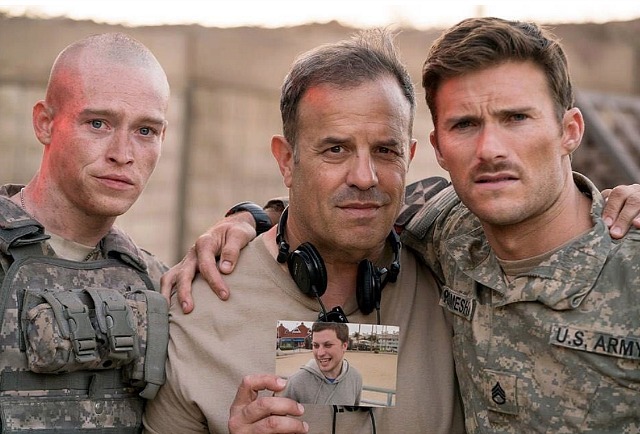
(l. to r.) Caleb Landry Jones, Rod Lurie, Scott Eastwood during filming of The Outpost.
Speaker Pelosi to Mika Breszinski on Morning Joe this morning: Orange Plague “will be leaving” the White House “following the 2020 election, whether he knows it or not. There is a process. It has nothing to do with a certain occupant of the White House [who] doesn’t feel like moving and has to be fumigated out of there.”
Fumigating is what people do to get rid of insects. Just so we’re clear on that.
“But it’s gonna happen. Either way, he’s goin’. I told you before, we tried everything to help him, you know that. He brought this on himself. And it’s landing on us.” — Joe Pesci in The Irishman, starting ar 1:37.
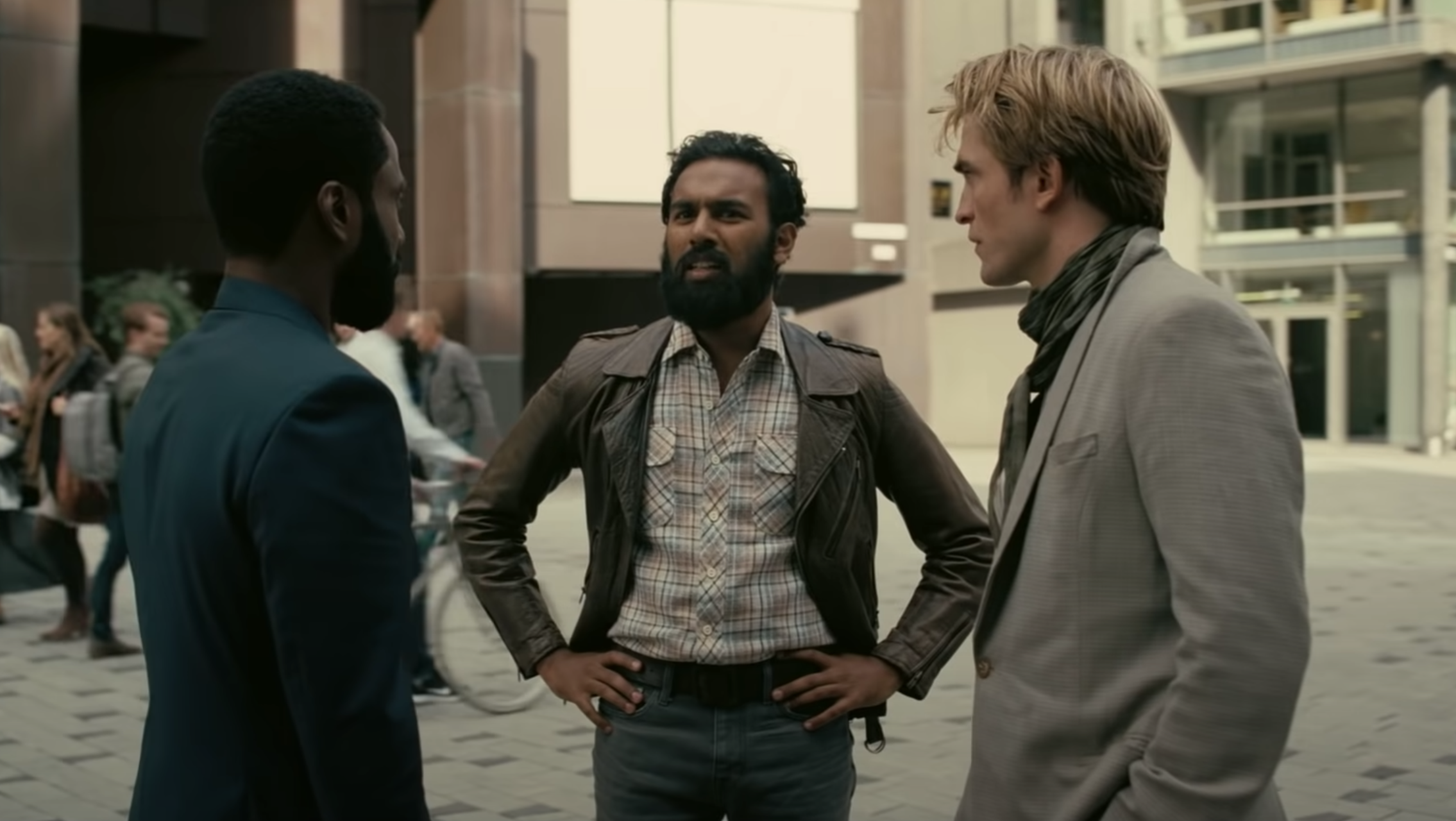
Warner Bros. hasn’t once again bumped the release date for Chris Nolan‘s Tenet — it’s taken the allegedly mind-blowing, time-game thriller off the release calendar entirely.
Rather than shift the release for a third time (the previous dates were 7.17 and then 8.12) WB distribution is basically saying “this is infuriating and borderline ridiculous…we don’t know when we can open Nolan’s brilliant film but we’re also getting tired of setting new dates only to see them fall by the wayside. This country has become an international joke as far as battling COVD-19 is concerned, but at least we can open it in Europe before too long.”
When will Tenet open domestically? Sometime in mid to late October or more likely November? Sometime before 12.31.20? “We will share a new 2020 release date imminently for Tenet,” WB chairman Toby Emmerich said in a statement.
Things couldn’t be much worse for moviegoers and U.S. exhibitors in particular, already cut off at the knees by the pandemic and recently praying for late summer re-openings. But arrogant under-40 asshats (along with southerners and rural bumblefucks nationwide) said “no” by continuing to party at bars and cafes and spreading COVID-19 willy nilly.
Exhibitors are dying and the country’s economy is suspended in a medically induced coma, and these guys are socializing like there’s no tomorrow…could their behavior be any more loathsome or despicable?
Those who want to see Tenet sooner rather than later might want to fly to Europe, as it seems likely to open there first. “We are not treating Tenet like a traditional global day-and-date release, and our upcoming marketing and distribution plans will reflect that,” Emmerich explained.
The coast-to-coast incendies of late May and early June have obviously chilled. BLM-ers in major cities across the nation have decided to downshift for the time being and take a breather.
But not in Portland. Or, to go by today’s reporting, Seattle. So what needs to happen before somebody calls a time out? Or is this a new and permanent way of life?
Do Portland protestors want some sort of no-confidence election? Mass resignations from local white officials? Resignations of the entire Portland police force so the city can be Camden-ized?
Demonstrators marching recently in Portland. [Photo credit: Dave Killen/The Oregonian, via Associated Press.]
Two days ago N.Y. Times opinion writer Charlie Warzelnoted that the Portland street demonstrations, ignited by the Minneapolis murder of George Floyd on 5.25, have been happening for 50 days straight. (53 as of today.) Warzel wrote about the stress of being in constant combat, and of likely PTSD down the road. Will the Portland actions still be going after 75 days? 100?
Posted on 6.3.20: “Terrible convulsive traumas have sadly happened to this country from time to time. But they’ve never been long-term. A few days or a week, and then everyone began to gradually emerge and resume basic routines.
“JFK was shot on Friday, 11.22.63 and buried on Monday, 11.25. Four days of emotional gloom and devastation. And on Tuesday, 11.26, the world slowly started again. The grief never went away, of course, but the wheels of commerce and culture began to turn.
“John Lennon was murdered on 12.8.80. The shockwaves of anguish were devastating. Everyone wept. But after a few days or a week, the clouds began to dissipate.
“The Los Angeles Rodney King riots lasted for six days (4.29.92 to 5.4.92). The aftermath seeped and simmered. Nobody ever forgot what happened. But on the seventh day the world began to move on.
Pretzels are junk, of course, but I lived for the damn things when I was a kid. (Along with red licorice, ice pops, Hershey bars and hot mashed potatoes.) Every now and then I’ll buy a small bag for old times’ sake, but they aren’t as liberally salted as they used to be. Without proper salting they taste dull. That all changed two or three days ago when I bought a bag of Good Health pretzels — gluten-free and sea-salted. My first thought was “my God, these are wonderful.” One bite and I was suddenly ten years old again. Not to mention free of gluten, wheat, egg, dairy, soy, cholesterol.
Yes, many older white voters have stopped supporting the Orange Plague, which is one reason why Joe Biden is ahead in national polling by double digits. But a hardcore contingent (roughly 37%) is sticking with this beast, and most of these voters are white. Mostly under-educated rurals but what a legacy for those of European descent. And for this I feel appalled and to some extent tribally ashamed, being a whitebread myself.
What kind of stubborn, intellectually stunted animal would vote for Trump at this stage, a stone sociopath whose denial, stupidity and mismanagement of the coronavirus threat caused or at least hastened the deaths of over 130,000 Americans and who clearly and obviously regards the world like a lying criminal?
The only defense I can offer is that there are millions of decent, fair-minded, well-educated American whites who despise Trump as much as I do. Descendants of decent, fair-minded forebears who lived politely and responsibly, paid their taxes, judged people by their character and mowed their front lawns on Saturday. Urban and suburban X-factor whites who currently watch MSNBC and read books and have visited Venice and Paris and wear Italian-made lace-ups, etc.
TRUMP: “I think mail-in voting is going to rig the election.”
WALLACE: “Are you suggesting that you might not accept the results?”
TRUMP: “I have to see.”
WALLACE: “Can you give a direct answer that you will accept the election?
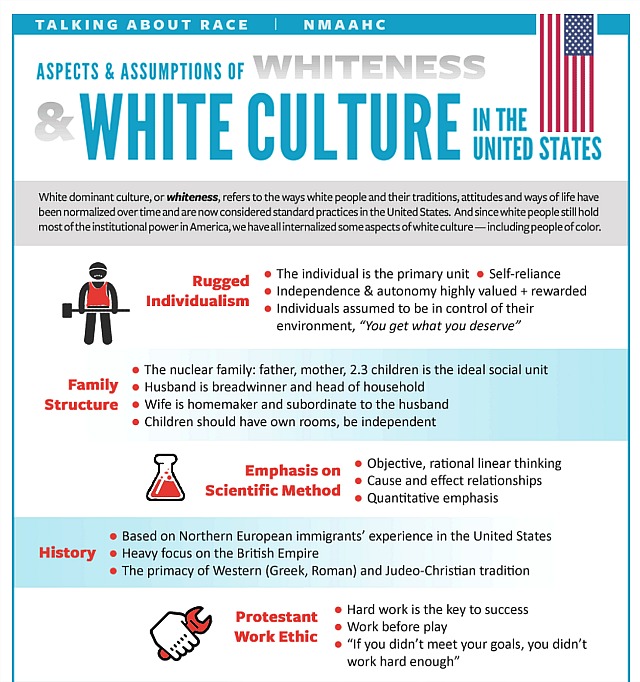
The National Museum of African American History & Culture, an adjunct of the Smithsonian, has posted some instructionals about white culture and behavior vs. non-white culture and behavior. Below is a portion of a NMAAHC chart that explains some of the basics. After looking at it, I couldn’t help but think “hey, I’ve seem something like this before.” It hit me a second later. The NMAAHC chart is in the same general vein as a September 1972 National Lampoon article titled “Our White Heritage,” which was written by Henry Beard, Michael O’Donoghue and George S. Trow. Not exactly the same, but they do seem cut from a similar cloth, certainly in terms of listing white traits and characteristics.
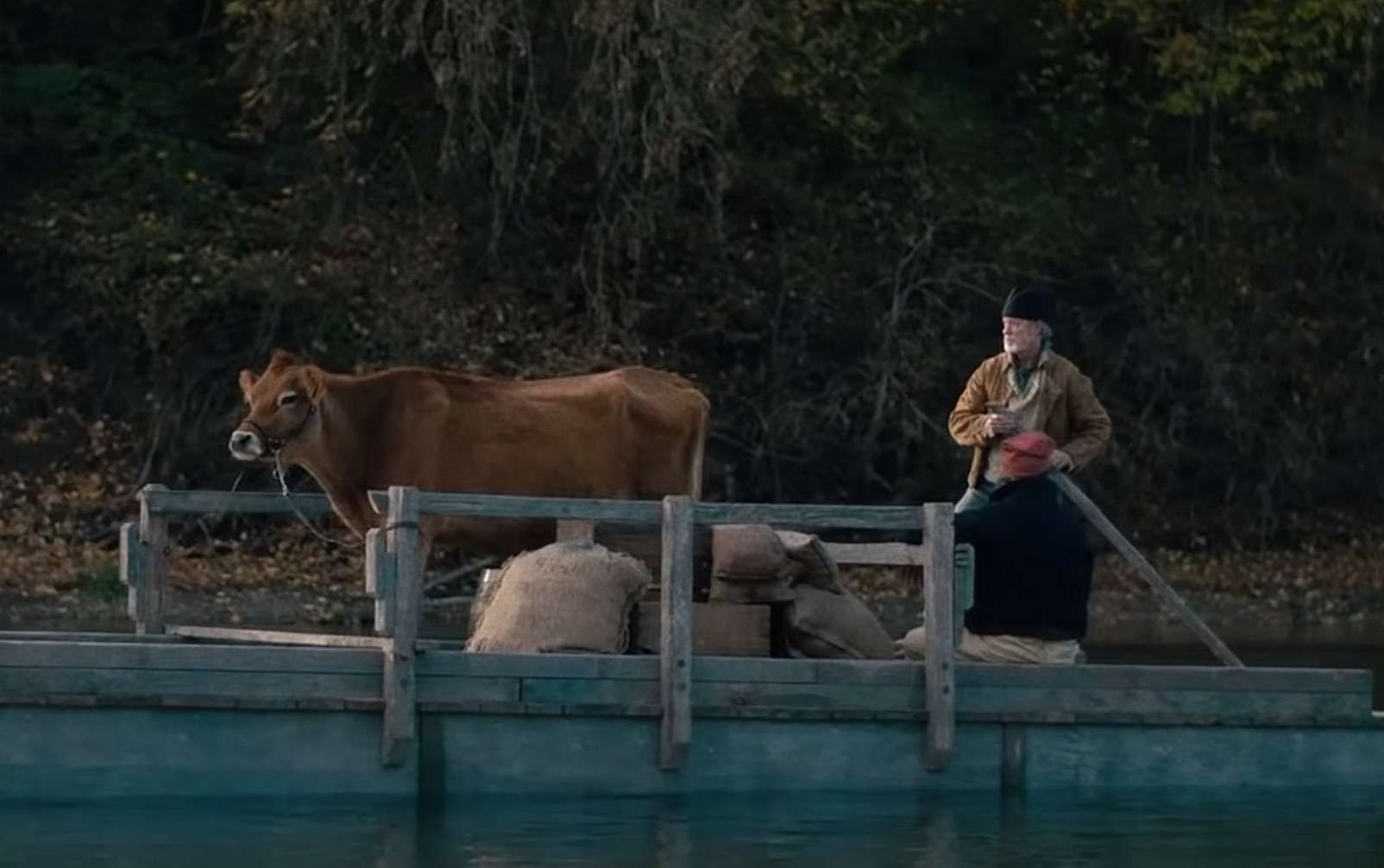
A couple of weeks ago I finally caught up with Kelly Reichardt‘s First Cow. I avoided it at the 2019 Telluride Film Festival and again when it opened theatrically last February, and you know why. I tried to write this review for days and days, but couldn’t. If I was to write a piece about composing this review, I would call it “I Died A Thousand Times.”
We’re all familiar with Reichardt’s minimalist, low-energy mise en scene (Wendy and Lucy, Meek’s Cutoff, Certain Women), and her longtime co-writing partnership with Jonathan Raymond (First Cow is an adaptation of his 2008 book “The Half Life“) and so on. I guess I was intimidated by the prospect of sitting through another under-lighted, fly-on-a-wall, watching-paint-dry flick, especially with an 1820s Oregon backwoods setting. The only thing I was looking forward was the boxy aspect ratio (1.37), which Reichardt always shoots with.
Alia Shawkat** appears in the first scene, which is set in the present-day Oregon woods alongside a large river with a cargo ship cruising by. Shawkat, who doesn’t say a word and disappears within two or three minutes, happens to discover a pair of buried skeletons lying side by side and apparently touching hands. How did this couple happen to expire at the same moment (were they killed? a suicide pact?). And why in the woods? And who were they?
Reichardt never answers the first question, but at least we get to know the couple, “Cookie” (John Magaro) and King Lu (Orion Lee), when First Cow flashes back to the 1820s.
Cookie is an inventive organic chef who’s been making meals for beaver trappers, and King Lu, an Asian immigrant, has killed a Russian guy or something and is hiding from authorities. They become friendly at some trading post, but not in a way that struck me as gay or even especially affectionate. They’re just comfortable with each other, mainly because they’re both unassuming and soft-spoken.
The only “plotty” thing that happens is when Cookie and King Lu, who are not larcenous by nature, decide to surreptitiously milk a skinny brown cow that belongs to a pompous rich guy (Toby Jones). Cookie uses the stolen milk to make tasty muffins of some sort, which they’re able to sell without effort to the local traders and miners (played in part by René Auberjonois, Ewen Bremner, Scott Shepherd, Gary Farmer).
All of a sudden the movie comes faintly (but only faintly) alive because they’re in business, and we actually care what might happen. Imagine!
We know, of course, that Jones will eventually realize where the milk is coming from, and then Cookie and King Lu will be in serious trouble. Do they deserve to be shot for milk theft? That seems to be the consensus among Jones’ pallies once the scheme is discovered, but all that really happens is that (a) Cookie suffers a bad cut on his forehead, which seems to make him weak and wobbly, and (b) an armed Jones ally or employee is seen hunting them in the woods.
This leads to a finale in which woozy Cookie needs to lie down in the woods, after which he appears to pass out and die. King Lu lies down besides him and…what? Wills himself to death for the sake of sympathy or friendship? King Lu: “If you’re going to die in the woods, Cookie…okay, your call. But you’ll need some company as you enter heaven, and maybe if I lie beside you my body will also get tired and give up the ghost? Worth a try. What have I got to live for anyway?”
Gus Van Sant‘s 1995 film, based on the 1990 Pamela Smart husband-murder case, struck most of us as a sardonic suburban drama about careless idiots rather than a head-turning noir comedy. It made you smirk from time to time, but it was never intended to be “amusing.” Unless you’re a misanthrope.
The article sells the idea that To Die For is some kind of masterpiece, but my recollection is that it was more in the realm of good — handsomely shot and edited (it was certainly one of Van Sant’s better looking films) and very dry and matter-of-fact — rather than great. The tone was cool and somewhat dismissive of the none-too-bright characters (Nicole Kidman‘s especially), and the feeling at the end is “jeez, what a bunch of delusionals.” The perpetrators, I mean.
We all admired Kidman’s performance as the robotic, icy-mannered Smart, and particularly the naivete and vulnerability conveyed by 20 year-old Joaquin Pheonix, who played Smart’s teenaged lover, Jimmy Emmett, and the killer of her husband Larry (Matt Dillon).
The two indelible images, for me, are (a) Phoenix’s lovestruck, heartbroken expression while being grilled by the cops about his motive for killing Larry, and (b) the frozen face of Smart, killed by a mafia assassin and carried along by river currents, captured through thin ice.
To Die For premiered in Cannes on 5.28.95, opened in Canada on 9.29.95 and then a week later — 10.6.95 — in the States. It cost $20 million to make but only earned $21.3 million at the end of the day,
I haven’t seen it since the Westwood all-media screening, but I’ll be watching it again tonight. Why haven’t I wanted to re-watch until now? I think I’ve explained that.
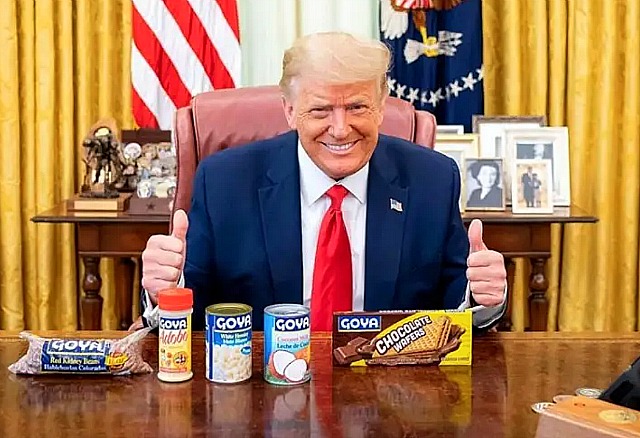
…you must be some kinda clueless whitebread whose mom never served Spanish dishes. I’ve loved Spanish-Mexican-TexMex cuisine in restaurants all my life, but over the last four decades I’ve never even glanced at a can of Goya beans while shopping. Not once. Until the Trump-Ivanaka thing came up I’ve never considered the option. In any event, cancel Goya beans! Send that company into bankruptcy! I’m serious. I shouldn’t say this as I despise cancel culture, but every rule is subject to amendments.
Two and a half years ago I wrote that I was “almost teary-eyed with nostalgia for the time I spent in New York City during the 2013 Christmas holiday.” That nostalgia has double-downed over the last few months, or since the world more or less slammed to a halt last March. And now with the “live free or die” red-state assholes and under-40 party animals having taken us all back to square one in terms of fighting the silent scourge, I’m pretty much weeping for a life that I used to take for granted.
My New York holidays were a regular thing, but seven years ago the furlough felt extra-special. It lasted six or seven days. Christmas isn’t really Christmas unless you’re roaming around midtown and lower Manhattan at night, and then maybe taking a train to visit friends in the suburbs for a day or two. (I seem to recall Jett and I visiting my mother, who passed in 2015, at her assisted living facility in Southbury, CT.) Or if you’re roaming around London, which I was lucky enough to do in December of ’80. Nippy weather, overcoat, gloves, etc. The chillier the air, the better the holiday.
The high point was when I took a friend to see The Wolf of Wall Street at the gone-but-not-forgotten Ziegfeld on a Saturday night. An alert, decent-sized crowd in attendance, and it was just heaven. Especially during the quaalude scene. The whole night was glorious. The energy, the air, the aromas…all of it.
Remember those dim-bulb Academy members who harangued Martin Scorsese and Leonardo DiCaprio after that first Academy screening because they didn’t get the satirical thrust behind all the coarse vulgarity (which was delivered both literally and within “quotes”)? And how Scorsese and DiCaprio had to attend screening after screening and patiently explain that they were depicting the louche adventures of Jordan Belfort and his cronies to make a point about the character of the buccaneers who have fleeced this country and will definitely fleece again? Remember the brief shining moment of Hope Holiday?
You don’t know what you’ve got ’til it’s gone. I would have that life again. Perhaps I will someday. Or maybe not.
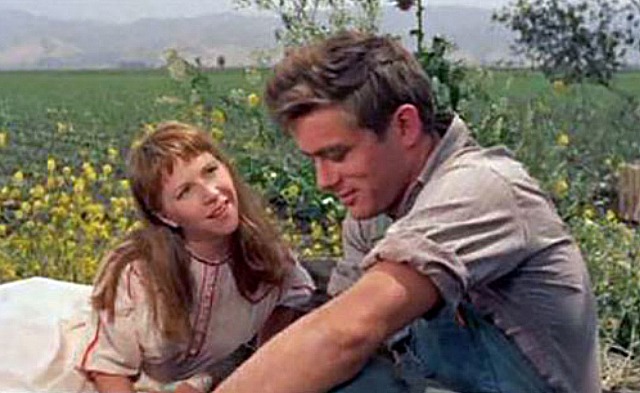
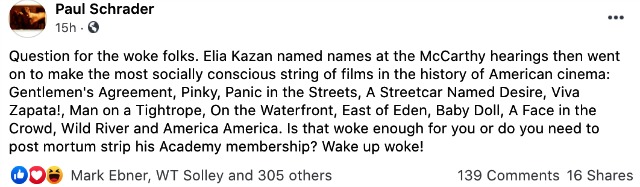
Late yesterday Paul Schrader (The Card Counter, First Reformed) ranted against an imagined (or real?) Elia Kazan cancel culture campaign. But even in his defense of the legendary helmer of East of Eden, On The Waterfront, Wild River, Via Zapata and A Streetcar Named Desire, Schrader passed along a misunderstanding that needs clarifying.
I’ve always understood (partly based on a 2005 Kazan bio by Richard Schickel) that Kazan didn’t “name” names but confirmed them. Specifically, according to Janet Maslin‘s 11.14.05 review of Schickel’s book, Kazan “gave names that were already known to the committee, [and] two individuals [who] were dead anyway.”
Some may argue that “confirming” and “naming” belong in the same ignoble bin, but the difference is worth noting
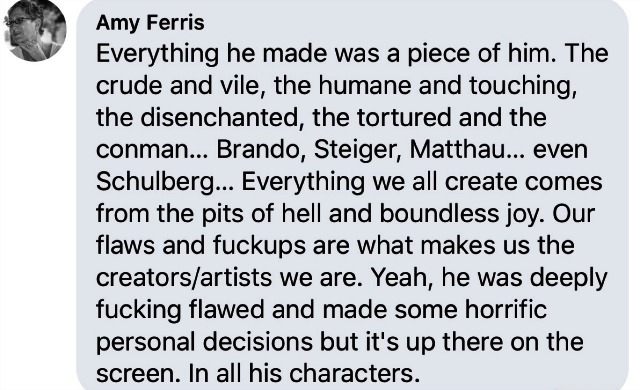
Amy Ferris‘s reply to Schrader is wonderful. It not only captured the Kazan contradictions but the contradictions that apply to just about every creative person on the planet — past, present and future.
Consider an excerpt from an August 2018 HE post (“Kazan Trip“):
“Martin Scorsese and Kent Jones‘ A Letter To Elia (’10) is a delicate and beautiful little poem. It’s a personal tribute to a director who made four films — On The Waterfront, East of Eden, Wild River and America America — that went right into Scorsese’s young bloodstream and swirled around inside for decades after. Scorcese came to regard Kazan as a father figure, he says in the doc. And after watching you understand why.
“Letter is a deeply touching film because it’s so close to the emotional bone. The sections that take you through the extra-affecting portions of Waterfront and Edengot me and held me like a great sermon. It’s like a church service, this film. It’s pure religion.