Conniving Ice Queen

I was fairly taken with Stacey Wilson Hunt‘s “To Die For at 25: An Oral History of the Risky Indie-Meets-Studio Triumph“, which posted earlier today.

Gus Van Sant‘s 1995 film, based on the 1990 Pamela Smart husband-murder case, struck most of us as a sardonic suburban drama about careless idiots rather than a head-turning noir comedy. It made you smirk from time to time, but it was never intended to be “amusing.” Unless you’re a misanthrope.

The article sells the idea that To Die For is some kind of masterpiece, but my recollection is that it was more in the realm of good — handsomely shot and edited (it was certainly one of Van Sant’s better looking films) and very dry and matter-of-fact — rather than great. The tone was cool and somewhat dismissive of the none-too-bright characters (Nicole Kidman‘s especially), and the feeling at the end is “jeez, what a bunch of delusionals.” The perpetrators, I mean.

We all admired Kidman’s performance as the robotic, icy-mannered Smart, and particularly the naivete and vulnerability conveyed by 20 year-old Joaquin Pheonix, who played Smart’s teenaged lover, Jimmy Emmett, and the killer of her husband Larry (Matt Dillon).

The two indelible images, for me, are (a) Phoenix’s lovestruck, heartbroken expression while being grilled by the cops about his motive for killing Larry, and (b) the frozen face of Smart, killed by a mafia assassin and carried along by river currents, captured through thin ice.

To Die For premiered in Cannes on 5.28.95, opened in Canada on 9.29.95 and then a week later — 10.6.95 — in the States. It cost $20 million to make but only earned $21.3 million at the end of the day,

I haven’t seen it since the Westwood all-media screening, but I’ll be watching it again tonight. Why haven’t I wanted to re-watch until now? I think I’ve explained that.

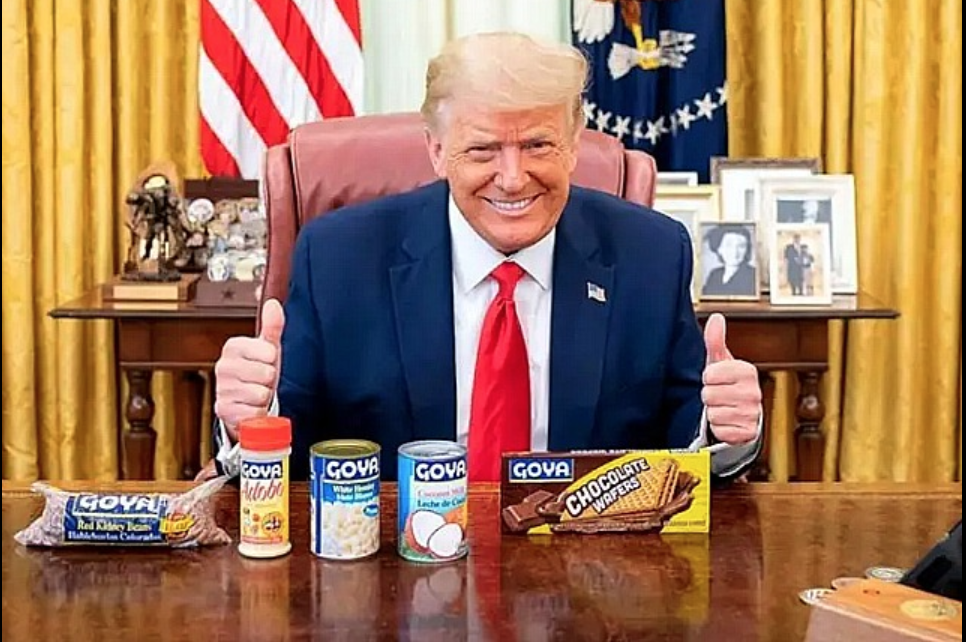
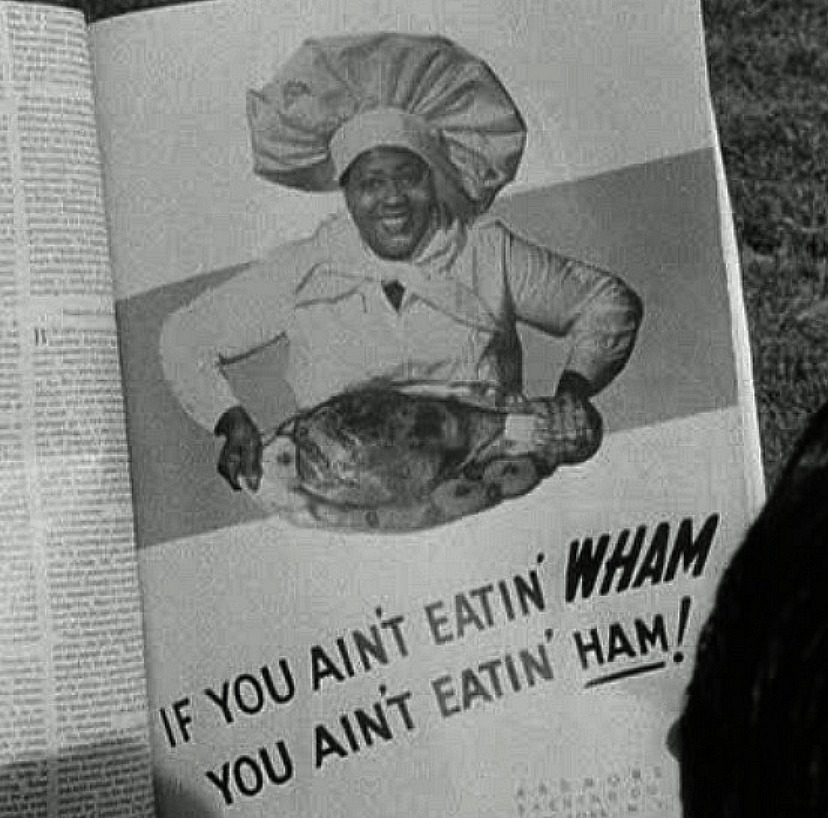
If You Ain’t Eatin’ Goya Beans…

…you must be some kinda clueless whitebread whose mom never served Spanish dishes. I’ve loved Spanish-Mexican-TexMex cuisine in restaurants all my life, but over the last four decades I’ve never even glanced at a can of Goya beans while shopping. Not once. Until the Trump-Ivanaka thing came up I’ve never considered the option. In any event, cancel Goya beans! Send that company into bankruptcy! I’m serious. I shouldn’t say this as I despise cancel culture, but every rule is subject to amendments.

Good Times

Two and a half years ago I wrote that I was “almost teary-eyed with nostalgia for the time I spent in New York City during the 2013 Christmas holiday.” That nostalgia has double-downed over the last few months, or since the world more or less slammed to a halt last March. And now with the “live free or die” red-state assholes and under-40 party animals having taken us all back to square one in terms of fighting the silent scourge, I’m pretty much weeping for a life that I used to take for granted.

My New York holidays were a regular thing, but seven years ago the furlough felt extra-special. It lasted six or seven days. Christmas isn’t really Christmas unless you’re roaming around midtown and lower Manhattan at night, and then maybe taking a train to visit friends in the suburbs for a day or two. (I seem to recall Jett and I visiting my mother, who passed in 2015, at her assisted living facility in Southbury, CT.) Or if you’re roaming around London, which I was lucky enough to do in December of ’80. Nippy weather, overcoat, gloves, etc. The chillier the air, the better the holiday.

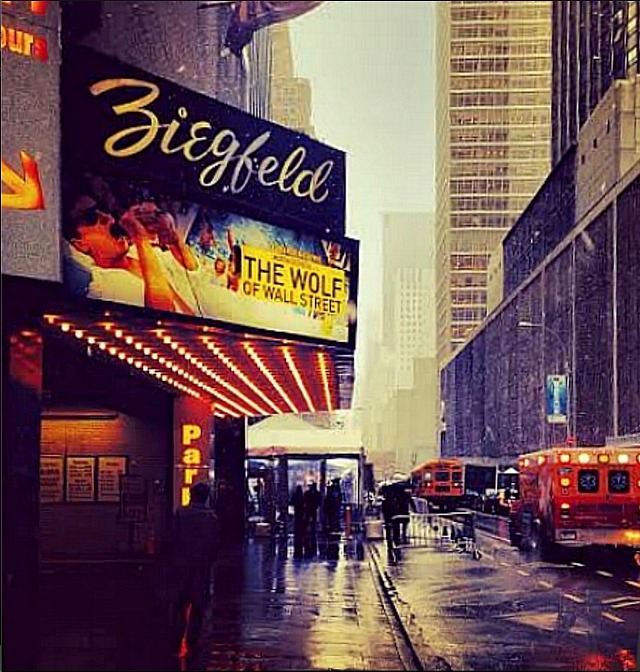
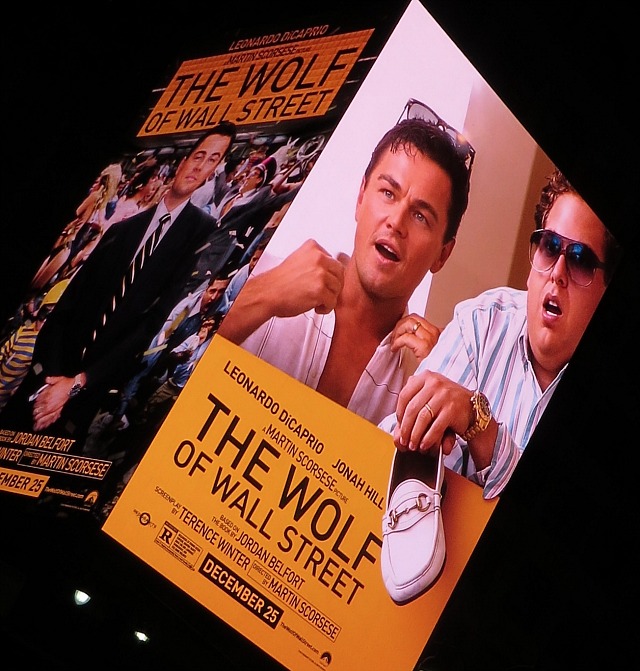
The high point was when I took a friend to see The Wolf of Wall Street at the gone-but-not-forgotten Ziegfeld on a Saturday night. An alert, decent-sized crowd in attendance, and it was just heaven. Especially during the quaalude scene. The whole night was glorious. The energy, the air, the aromas…all of it.

Remember those dim-bulb Academy members who harangued Martin Scorsese and Leonardo DiCaprio after that first Academy screening because they didn’t get the satirical thrust behind all the coarse vulgarity (which was delivered both literally and within “quotes”)? And how Scorsese and DiCaprio had to attend screening after screening and patiently explain that they were depicting the louche adventures of Jordan Belfort and his cronies to make a point about the character of the buccaneers who have fleeced this country and will definitely fleece again? Remember the brief shining moment of Hope Holiday?

You don’t know what you’ve got ’til it’s gone. I would have that life again. Perhaps I will someday. Or maybe not.

Read more

Kazan Again

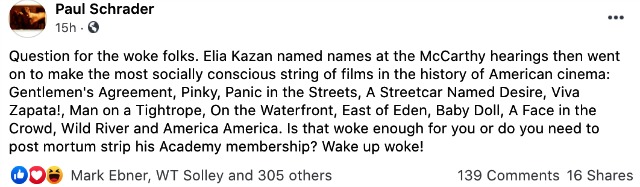
Late yesterday Paul Schrader (The Card Counter, First Reformed) ranted against an imagined (or real?) Elia Kazan cancel culture campaign. But even in his defense of the legendary helmer of East of Eden, On The Waterfront, Wild River, Via Zapata and A Streetcar Named Desire, Schrader passed along a misunderstanding that needs clarifying.

I’ve always understood (partly based on a 2005 Kazan bio by Richard Schickel) that Kazan didn’t “name” names but confirmed them. Specifically, according to Janet Maslin‘s 11.14.05 review of Schickel’s book, Kazan “gave names that were already known to the committee, [and] two individuals [who] were dead anyway.”

Some may argue that “confirming” and “naming” belong in the same ignoble bin, but the difference is worth noting

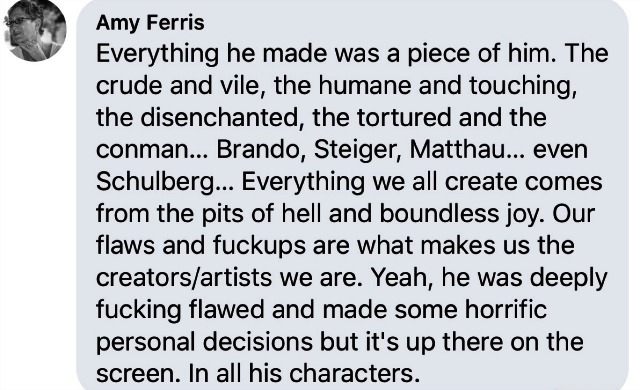
Amy Ferris‘s reply to Schrader is wonderful. It not only captured the Kazan contradictions but the contradictions that apply to just about every creative person on the planet — past, present and future.

Consider an excerpt from an August 2018 HE post (“Kazan Trip“):

Martin Scorsese and Kent JonesA Letter To Elia (’10) is a delicate and beautiful little poem. It’s a personal tribute to a director who made four films — On The Waterfront, East of Eden, Wild River and America America — that went right into Scorsese’s young bloodstream and swirled around inside for decades after. Scorcese came to regard Kazan as a father figure, he says in the doc. And after watching you understand why.

Letter is a deeply touching film because it’s so close to the emotional bone. The sections that take you through the extra-affecting portions of Waterfront and Eden got me and held me like a great sermon. It’s like a church service, this film. It’s pure religion.

Read more

Report: Telluride ’20 Loses Palm, Galaxy Theatres

Telluride News associate editor Suzanne Cheavens has reported about a July 9th meeting of the San Miguel Board of County Commissioners, which was mostly concerned with COVID-19 issues. It’s a fairly humdrum story, but then paragraph #13 comes along and suddenly you can feel the energy.

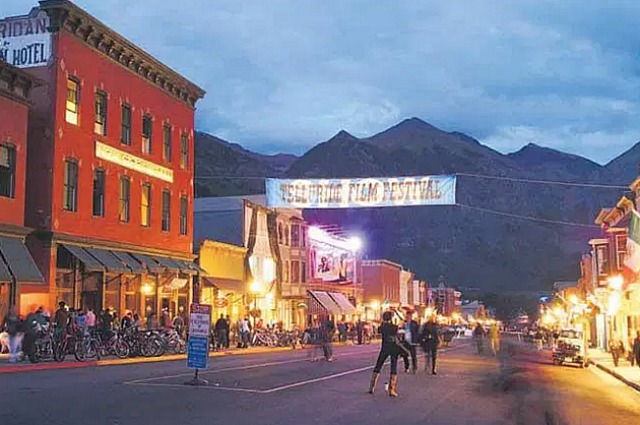
Cheavens writes that the “word” among Telluride officials is that the school district has declined to allow the 2020 Telluride Film Festival (if it actually happens) to use school facilities for screenings. That means that the Palm and Galaxy theatres will be off-limits during the Labor Day gathering.

Cheavans excerpt: “I have more questions and concerns that I have broached with [festival organizers],” said county public health director Grace Franklin. “The schools determined it’s not safe to be operating in any of those venues. It’s off the table.”

I’ve also been told (but have not heard directly) that the Werner Herzog theatre, the largest and grandest of all Telluride venues, may also be off-limits due to health concerns.

I had understood that Telluride’s Town Council would meet and make some important decisions about TFF on Wednesday, July 15th. But Telluride blogger Michael Patterson (“Michael’s Telluride Film Blog“) says this “doesn’t appear” to be correct. The Parks Committee “does have a meeting scheduled in Telluride on 7.15,” he says, “but the Town Council will not meet until Tuesday, 7.21.”

Take it with a grain.

Read more

Trump Saves Roger Stone From Slammer

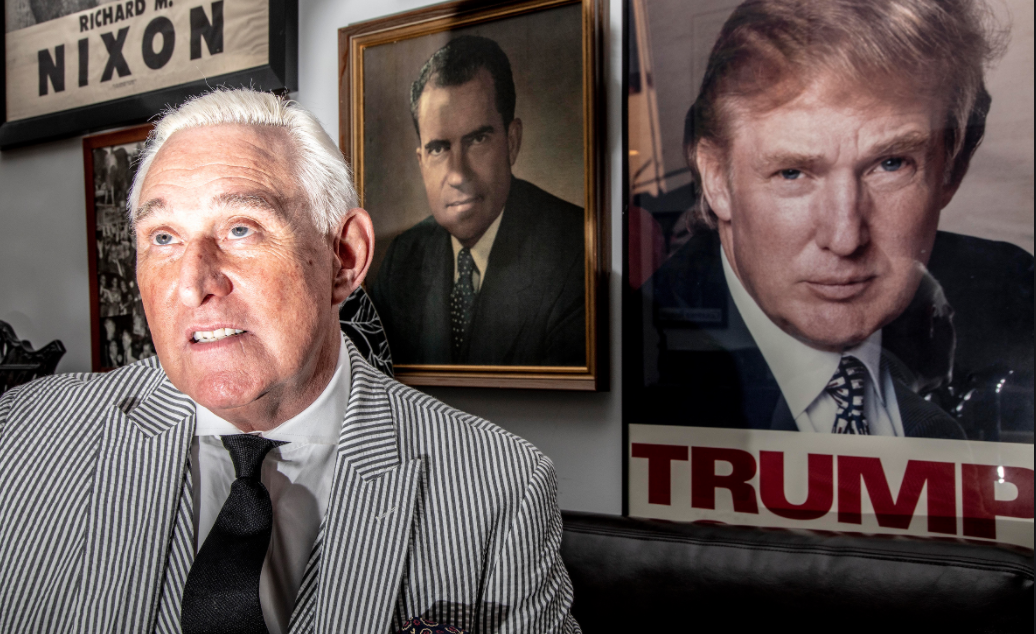
The Orange Plague hasn’t pardoned longtime pally Roger J. Stone Jr., but he’s commuted his 40-month sentence, a result of being found guilty on seven felony charges, including obstructing a congressional inquiry into whether the Trump campaign conspired with Russia to influence the 2016 election.

N.Y. Times: “In a lengthy statement released late on a Friday evening, the White House denounced the prosecution against Mr. Stone on what it called ‘process based charges’ stemming from ‘the Russia Hoax’ investigation. ‘Roger Stone has already suffered greatly,’ the statement said. ‘He was treated very unfairly, as were many others in this case. Roger Stone is now a free man!’

“These charges were the product of recklessness borne of frustration and malice. his is why the out-of-control Mueller prosecutors, desperate for splashy headlines to compensate for a failed investigation, set their sights on Mr. Stone.”

A Few Reasons Why “Palm Springs” Underwhelms

The second half of Max Barbakow and Andy Samberg‘s Palm Springs (Hulu, now streaming), a time-loop wedding comedy a la Groundhog Day, is less irksome than the first half — I’ll give it that.

But even during the second half I only laughed once. Okay, maybe twice. And there are no laughs at all during the first 40 or 45. Plus the central situational incident is a wedding, and I’ve always hated wedding flicks (except, of course, for The Wedding Crashers and Robert Altman‘s A Wedding).

I’d been hearing for months how wildly funny Palm Springs is (Sundance ’20 attendees went apeshit), and how it sold for $17 million and small change. And now there’s the Rotten Tomatoes and Metacritic ratings (94% and 84% respectively). And for all of it I sat on my couch like the Great Sphinx at Giza.

Groundhog Day was dry and deadpan and even nourishing in a mystical reincarnation sense, and all the richer and better for that. It didn’t explain why Bill Murray had fallen into this trap — it just pushed him into the pool and watched him try to figure it all out. But manic-surreal Palm Springs is hung up on all kinds of details and reasons and particulars, and it doesn’t have the slightest semblance of a mystical current. Plus it feels overly pushed and frantic and broad. Groundhog Day is at least 15 or 20 times better.

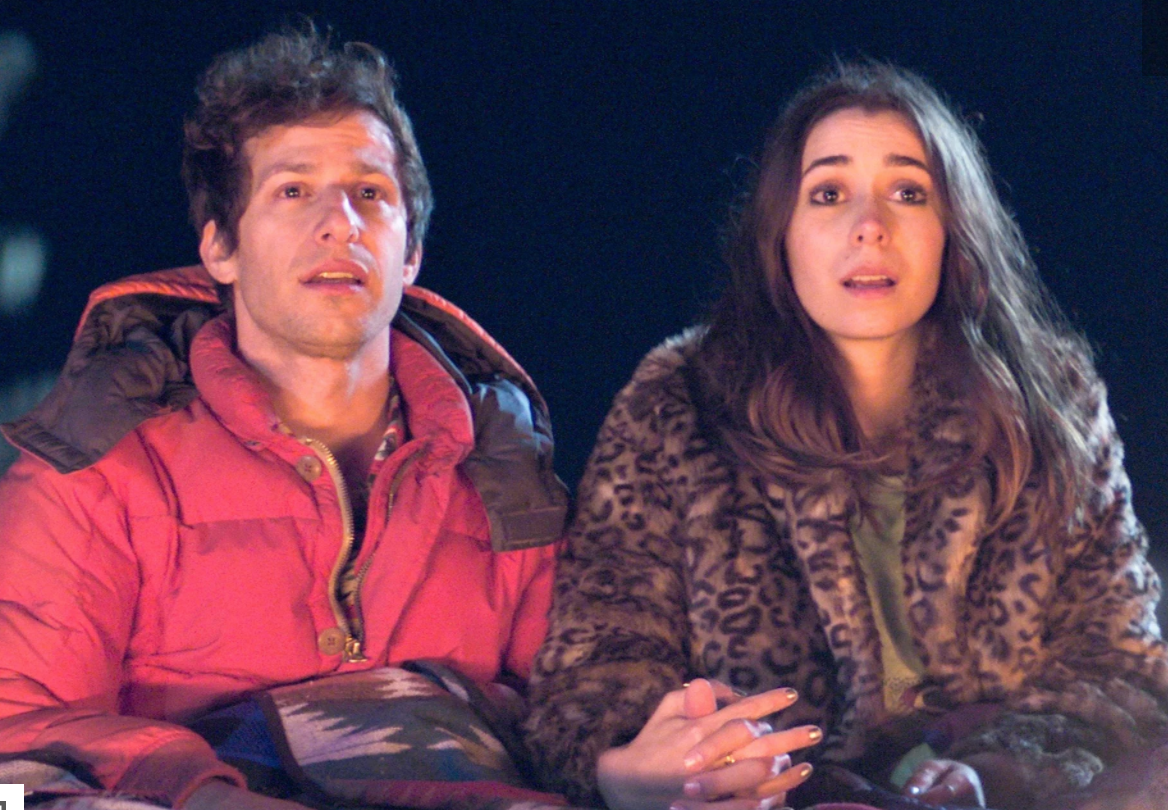
In the droll Murray role, Samberg has been stuck in the time loop for a long while (the source being some kind of churning inferno inside a cave), but in this outing the Andie McDowell romantic-interest character (played by Cristin Milioti) is also sucked in.

And so, of course, Milioti (whose character is the sister of the bride at the Palm Springs wedding in question) has to go through the usual stages — shock, disbelief, brittle facial expressions, eyes popping, shouting. In my book there are few things as unfunny as looks of stunned confusion — i.e., actors telling you over and over again that they’re staggered and at a loss for words (except for “what the fuck!”) when something extraordinary occurs.

You know Samberg and Milioti will challenge and irritate each other to death, but will fall in love by Act Three.

I understand, of course, that high-concept farce tends to go hand in hand with hammy acting, but this time almost nothing is funny. J.K. Simmons, another time-loop prisoner, shooting Samberg with real, flesh-piercing arrows isn’t funny. Samberg’s character says two or three times that despite the certainty of the same day being repeated that physical pain is nonetheless real, and so Milioti jumping in front of a speeding truck isn’t funny. Her younger sister falling and knocking her front teeth out isn’t funny. Strapping C4 explosive to a goat and blowing it into a thousand shards of flesh, blood, hair and bone isn’t funny.

Read more

Carlson for President in ’24

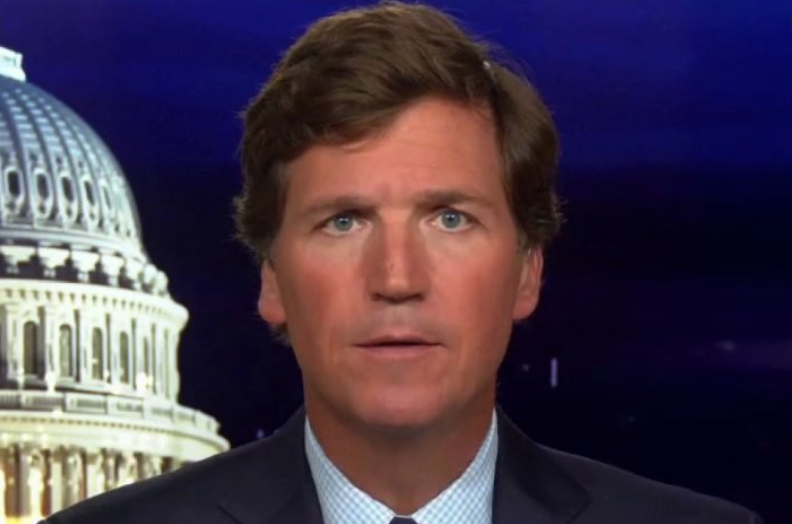
Most of us are presuming that for age reasons, Joe Biden won’t run for re-election in ’24. Nobody can even spitball who might be the official Democratic president nominee in ’24 (Kamala Harris, Gavin Newsom, Pete Buttigieg, Gretchen Whitmer) but rightwing media seems to believe that Fox News host Tucker Carlson, an instantly recognized brand who’s personable and no dummy, would be a formidable Republican candidate.

Shattered By Peter Sellers

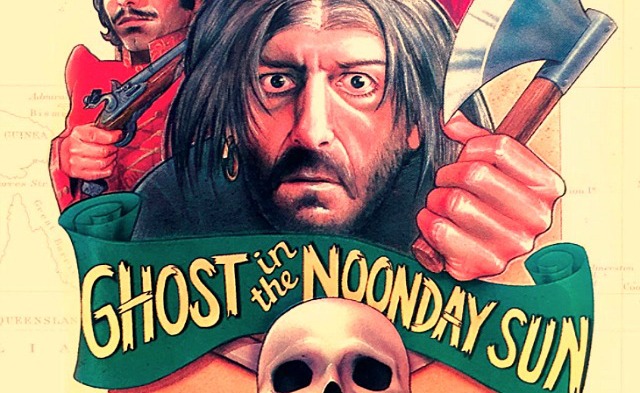
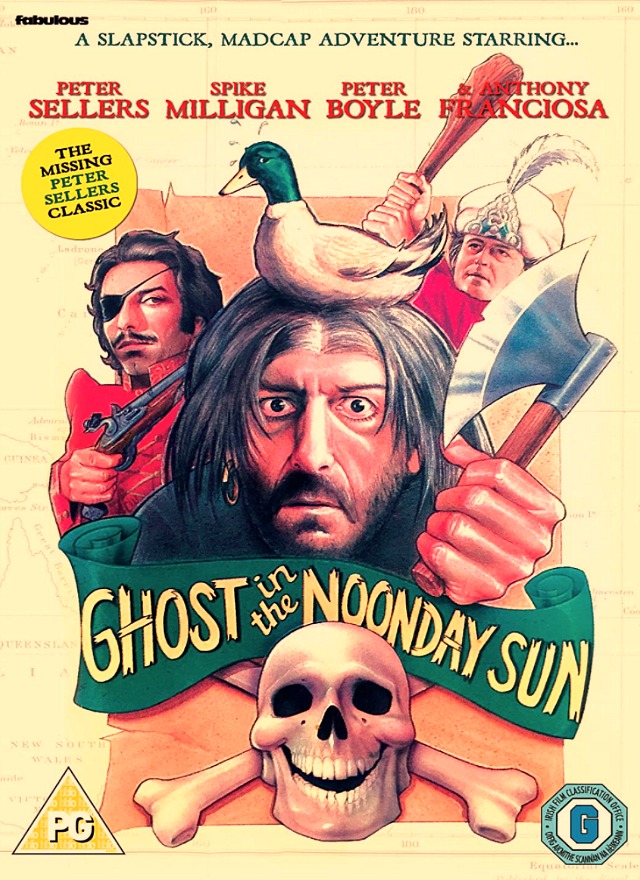
Peter Medak‘s The Ghost of Peter Sellers (currently streaming) is a fascinating documentary about the disastrous making of his own Ghost in the Noonday Sun, a 1973 Peter Sellers pirate comedy that turned out so badly it was never released theatrically.

It was, however, issued on VHS in ’85, and on a Region 2 DVD in 2016 — $7.98 to buy, $3.99 to ship.

The 36 year-old Medak, coming off the success d’estime of The Ruling Class (’72), agreed to direct Noonday Sun in order to work with Sellers, regarded worldwide as a comic genius who was worth his weight in gold. If, that is, the script was first-rate and everything else was in its proper place.

Alas, the Noonday script was allegedly shoddy and shooting at sea (off the coast of Cyprus) was sure to be technically difficult. But the torpedo that destroyed the movie (and which damaged Medak’s career) was the erratic, instinctual madness of his lead actor, who could be extremely skittish and difficult to work with.

Sellers often said that he couldn’t abide mediocrity. Apparently he inhaled a good whiff of the stuff (or so he believed) almost immediately upon arriving in Cyprus. And so he tried to escape by bringing hell.

The best disaster docs of this kind are George Hickenlooper, Fax Bahr and Eleanor Coppola‘s Hearts of Darkness (’91), Keith Fulton and Louis Pepe‘s Lost in La Mancha (’02), about the calamitous undoing of Terry Gilliam’s first attempt to make The Man Who Killed Don Quixote, and Les Blank‘s Burden of Dreams (’82), about the arduous making of Werner Herzog‘s Fitzcarraldo (also ’82).

The Ghost of Peter Sellers is just as good and as necessary as these three. You really do have to watch it.

I was going to write about Medak’s film earlier this week, but I was depressed about being late to the party. I could have seen it at the 2018 Telluride Film Festival but I didn’t. I could have obtained a press screener earlier than I did. Bummed, man. Couldn’t get it up. I finally got going today.

A week-old discussion with a colleague:

HE: “Sellers was obviously the lunatic villain in this bizarre saga. Yes, they shouldn’t have made the damn film. Yes, it was a bad idea with a script that allegedly blew chunks. The only thing that was ready was the money. But Sellers was a crazy man.”

Colleague: “Sellers was crazy at times, but I honestly don’t think it was his behavior that ruined the film. And if that’s the case, why is he the villain?”

HE: “A producer says in the doc, ‘We all knew Peter was crazy, but we didn’t know how crazy.’

“Sellers was miserable during the shoot, but he was the powerhouse. He knew the difference between a good script and a bad or weak one. He wanted to have fun and do The Goon Show with Spike Milligan. But he had to know that the whole thing had a basic dubiousness and fragility.

“Yes, Medak saw that also, but he trusted in Sellers’ genius. Which was absurd, of course — if it’s not on the page it isn’t worth doing. Sellers played the innocent when he met Medak later on. ‘It was you and me vs. them,’ he recalled. Medak replied, ‘No, Peter. It was you.’

Read more

Woo-Woo Welch’s

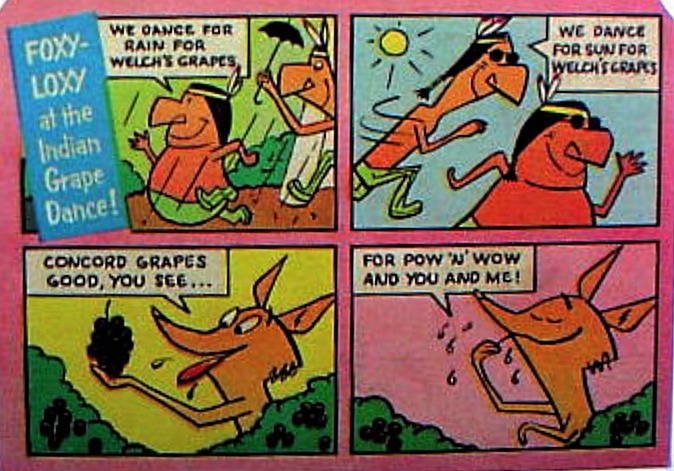
In addition to the Cleveland Indians and the Washington Redskins seriously contemplating a name change due to cultural concerns, a third topic of Native American identity and conversation is currently under review. Welch Foods Inc., the Concord-based company known for its grape juices, jams and jellies made from dark Concord grapes (as well as white Niagara grape juice), needs to gently, retroactively apologize for a racist advertising campaign from the 1950s than demeaned Native Americans. I’m speaking, of course, of the TV ads that featured the cartoon characters “Pow” and “Wow” and which utilized the slogan “woo-woo-woo-woo Welch’s!”**

** There are no YouTube capturing os the old Welch’s TV ads, but they were definitely made and broadcast. I’m not sure how many “woo”s were used in the ads — it could have been just two or three.

Desperation, Slim Pickens, Cricket Bats

Hollywood Elsewhere is hoping and praying that Telluride ’20 will happen, and that a facsimile of an actual, real-deal award season will begin to take shape sometime around late October or certainly by early November, and that all will eventually end well.

2020’s Best Picture nominees will be judged and supported according to five determining factors: (a) how woke or welcome they are, or to what extent they focus on non-white or female characters, (b) how un-woke and potentially unwelcome they might be due to focusing on white-male characters, which are a generic no-no among Khmer Rouge cadres, (c) how good they are in terms of basic craft (directing, acting, editing, cinematography…I know, old-fashioned concept!), (d) how “desperate” Academy voters might feel in a COVID-damaged, take-what-you-can-get realm, and (e) whether or not they seem to defy the categories by way of occupying their own realm and passing alone some aspect of fundamental human truth.

I know nothing, of course. I’m just spitballing (yes, again), and I’m probably going to have to correct this post 15 or 16 times before 9 pm this evening.

I’m presuming that the top 12 contenders right now are (1) David Fincher‘s Mank (Netflix), (2) Paul Greengrass‘s News of the World (Sony), (3) Tom McCarthy‘s Stillwater, (4) Thomas Kail and Lin Manuel Miranda‘s Hamilton (Disney), (5) Ron Howard’s Hillbilly Elegy (Netflix), (6) Steven Spielberg‘s West Side Story, (7) Aaron Sorkin‘s The Trial of the Chicago 7, (8) Chloe Zhao‘s Nomadland (Searchlight), (9) Spike Lee‘s Da 5 Bloods (Netflix), (10) George C. Wolfe‘s Ma Rainey’s Black Bottom (Netflix), (11) Rod Lurie‘s The Outpost (Screen Media) and (12) Lee Isaac Chung‘s Minari (A24).
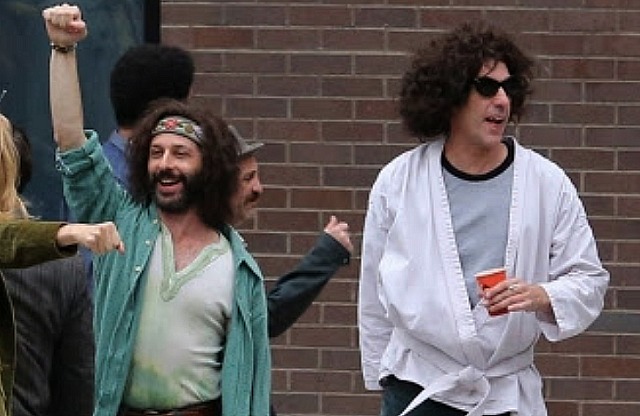

Jeremy Strong (Jerry Rubin) and Sacha Baron Cohen (Abbie Hoffman) between takes during filming of Aaron Sorkin’s The Trial of the Chicago 7.

Five of the 12 (Fincher, Sorkin, Howard, Lee, Wolfe) are Netflix releases, and three of these are paleface movies.

Contenders that focus on characters of color or women are Hamilton (non-European-descended actors portraying the Founding Fathers), Ma Rainey’s Black Bottom, Da Five Bloods, Minari (Korean-American family struggling to hang on and stay afloat in ’80s Arkansas) and Nomadland (Frances McDormand as a roaming 60something woman of the highway).

Three of the Netflix movies — Mank, Chicago 7, Hillbilly Elegy — are about white characters and set decades in the past.

Is West Side Story going to be processed as a partly Puerto Rican tale, or will viewers and voters default to a shorthand notion that it’s a 63 year-old adaptation of a classic white-guy creation (Steven Spielberg, Stephen Sondheim, Leonard Bernstein, William Shakespeare)?

I don’t think Hamilton has a chance as it’s not really a film and was shot four years ago to boot. So in terms of the African American experience Lee and Wolfe are the only players, and the presumption is that the only stand-out Bloods contender is Delroy Lindo for Best Supporting Actor. Am I wrong?

A gut feeling is telling me that the five finalists are likely to be Mank, Chicago 7, Hillbilly Elegy, Nomadland and Stillwater. What do I know, right? Obviously the old school never-Netflix crowd isn’t going to be comfortable with this but what can they do about it?

Year in and year out my thinking is that high-calibre craft and emotional involvement are the most important factors, and that the old Tom Stoppard/Real Thing riff about “cricket bats” still applies.

Stoppard: “I don’t think writers are sacred, but words are. They deserve respect. If you get the right ones in the right order, you can nudge the world a little or make a poem which children will speak for you when you’re dead.

“This [cricket bat] here, which looks like a wooden club, is actually several pieces of particular wood cunningly put together in a certain way so that the whole thing is sprung, like a dance floor. It’s for hitting cricket balls with. If you get it right, the cricket ball will travel two hundred yards in four seconds, and all you’ve done is give it a knock like knocking the top off a bottle of stout, and it makes a noise like a trout taking a fly

“What we’re trying to do is write cricket bats, so that when we throw up an idea and give it a little knock it might…travel.”

In short, my hunch is that the cricket-bat factor is likely to be strongest with Stillwater, Hillbilly Elegy, Nomadland, Mank and The Trial of the Chicago 7. Just spitballing.

Read more

The Great Marlon Injustice

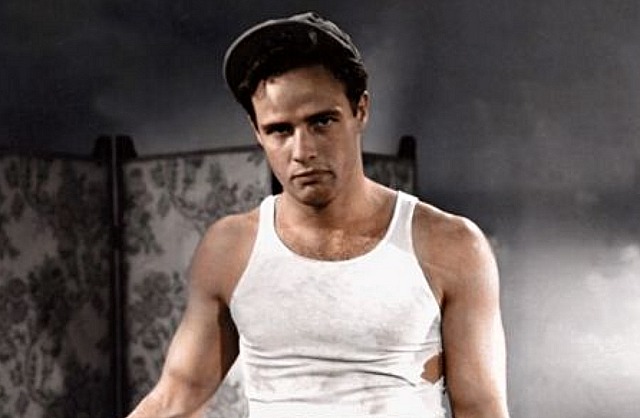
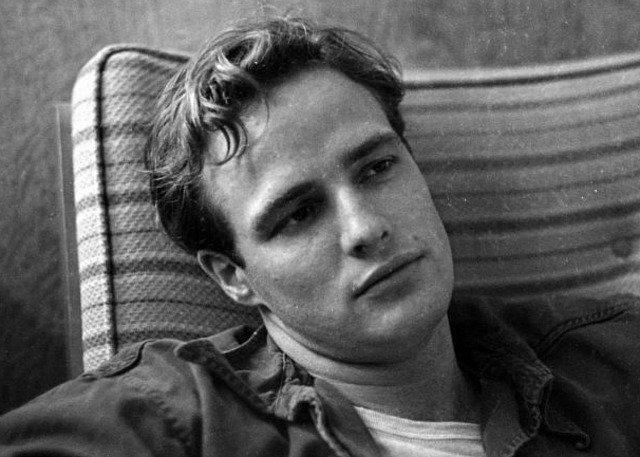
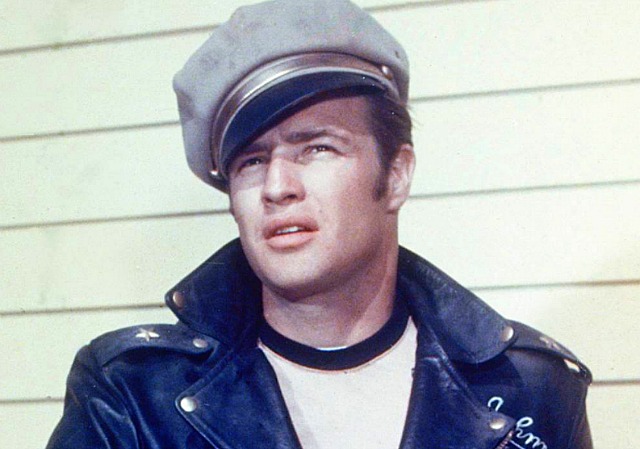
On the 16th anniversary of the passing of Marlon Brando, here’s a riff that I posted on 2.25.05: “You never cared about this stuff, and you really couldn’t care less from wherever you might be now, but I’m profoundly pissed that the Oscar show producers (Gil Cates and Lou Horvitz) didn’t give you a special tribute reel of your own last night.

“Pissed and ashamed and a little bit disgusted, to be honest.

“There’s no question you were the most influential actor of the 20th Century. No one had the same impact-grenade effect…nobody. You’ve been among the deity of reigning pop icons for as long as I can remember (along with Humphrey Bogart, Elvis Presley, James Dean, Marilyn Monroe, et. al.), and you’ll still be there 50 years from now. You rewrote the damn book.


Marlon Brando / 1924-2004

“But you were a bad (indifferent?) politician and a bit of a self-loather, and you let your unresolved, screwed-up stuff define too much of your life and image over the last 40-plus years.

“On the other hand Johnny Carson, whose departure happened just recently, was better liked by the industry and public, and he was a sublime Oscar host all those years. And so the Oscar guys decided to pay a special extended tribute to Carson and not you. They took, in short, the politically easy road and revealed their personal colors, not to mention the industry’s basic value system.

“Cates and Horvitz lumped the great Marlon Brando in with all the other dear and departed during last night’s ‘In Memoriam’ tribute…all right, they gave you the last slot at the end of the montage and used four stills instead of one or two…but it was still like someone saying matter-of-factly, minus any sense of sufficient sadness or reverence, that Marlon Brando is merely dead.

“The Brando tribute reel that Cates and Horvitz didn’t show (and probably never even cut together) should have proclaimed — trumpeted — that Marlon Brando lived. He lived and screamed and wept and re-ordered the universe as people knew it in 1947 in New York City, and then rocked Hollywood in the early to mid ’50s, and left them both in a state of permanent shakedown and reexamination by the time of his effective departure from creative myth-making in 1954 or ’55….and then shook things up again when he briefly re-emerged as The Man in the early ’70s (The Godfather, Last Tango in Paris).

“And all the Academy could muster was a more-or-less rote acknowledgement that you left the room in 7.1.04. Sorry, Bud, but you knew a long time ago what this town is basically about.”