Respect for Julie Adams

Julie Adams, the Creature From The Black Lagoon scream queen, has passed at age 92. Adams was 26 or 27 when the Universal cheapie was shot in mid or late 1953. It was released in early ’54.

Adams’ best role was opposite James Stewart in Anthony Mann‘s Bend of the River (’52), but after that she was stuck in mostly B movies — The Lawless Breed, The Mississippi Gambler, The Man from the Alamo, The Private War of Major Benson, The Gun. She also costarred in Slaughter on Tenth Avenue (’57), a semi-respectable, late-period film noir with Richard Egan.

Last August I saw Dennis Hopper‘s The Last Movie (’71) at the Metrograph, and lo and behold there was Adams, playing some sort of lady of leisure whom Hopper hits on.


I realize that red is often used as a design element in black-and-white films as it photographs well, but Gill Man looks fairly ridiculous with bright red lips.

Ongoing Metaphor of Anthony Fremont

Hollywood Elsewhere readers are requested to read a Hollywood Reporter piece titled “Critics’ Debate: What Is a ‘Sundance Movie’? 2019 Edition Broadens the Picture.”

It’s a discussion forum in which Todd McCarthy, David Rooney, Leslie Felperin, Jon Frosch and Beandrea July consider a few Sundance ’19 offerings.

Their comments frequently allude to the Sundance comintern platformrepresentation, diversity, political correctness, emerging female voices, LGBTQs, etc. They also cast subtle side-eyes in the direction of white-male filmmakers, who’ve been stinking up the joint for too many years.

Reaction from a journalist friend: “McCarthy reads like he doesn’t want to offend anybody. I understand his position, but that’s the thing about wokesters. Despite barely having any experience in writing, let alone cinema-watching, Beandrea’s resume is scant and only dates as far back as 2016 on Google, and yet she believes she has the authority to dictate what is right and wrong to veterans like McCarthy.

“Imagine if McCarthy, who’s been in the game since the ’60s and who made the definitive doc on cinematography (Visions of Light), spoke back to Beandrea about her opinions? She doesn’t care if he’s a film historian. He’s white and older and so she will set him straight.”

HE response: My impression is that McCarthy, Frosch, Felperin and Rooney sound like they’ve got loaded guns pointed at their heads. You can say what you think, fellas, as long as you don’t say the wrong things. McCarthy and friends are like that terrified family in that Twilight Zone episode, It’s A Good Life. Beandra and the wokesters are Anthony Fremont, and McCarthy, Rooney, Frosch and Felperin are the elders who are afraid to step outside the “happy” arena.

Rod Serling: “This particular monster can read minds, you see. He knows every thought, he can feel every emotion. His name is Anthony Fremont. He’s six years old, with a cute little-boy face and blue, guileless eyes. But when those eyes look at you, you’d better start thinking happy thoughts, because the mind behind them is absolutely in charge. For this is the Twilight Zone.”

Journalist friend again: “Throughout the fest I wanted journalists to be honest with me about why they thought this year’s program was lackluster, at least in terms of the narrative features. Almost all of them mentioned the fact that Sundance’s adamant stance on inclusivity was to blame. You won’t get these critics admitting this in print, of course, but many personally confessed that was a problem.”

Read more

Rami Malek Has A Special Light Around Him

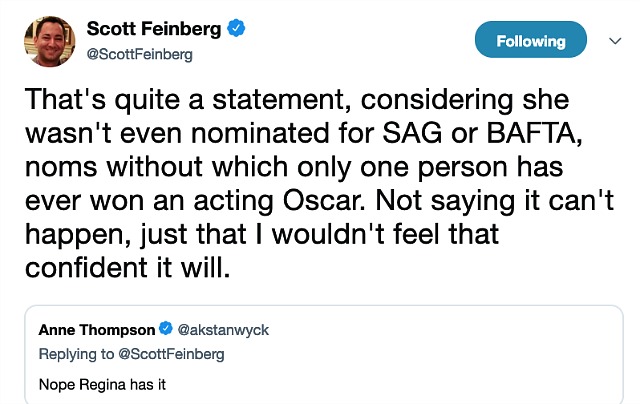
Earlier this evening Rami Malek and Scott Feinberg had a nice, easy chat on the stage of Santa Barbara’s Arlington theatre. Under the auspices of Roger Durling‘s Santa Barbara Film Festival. I had never really listened to Malek talk at length before, and I’m telling you he’s got it. He’s 37, educated, centered, gracious, confident, fairly wise for his years (he could be a guy in his mid 50s) and with a relaxed, sharp-toned voice. Plus he’s an excellent schmooze artist.

And I’m telling you he’s going to win the Best Actor Oscar. Okay, I don’t know anything but I can feel it. There’s a vibe around Malek. You should’ve seen the ridiculously long line to get into show tonight — down State and onto Sola and waaay down the block. In the rain. And the standing ovation when Malek came out…fuhgedaboudit.

We talked a bit during the after-party, and everything was cool and smooth. I had this idea that Rami’s kinda on the shortish side — he’s not. He’s 5′ 9″-ish, or only an inch shorter than the 5′ 10″ Freddie Mercury. And he’s friendly with my hairdresser, Phillip Rothschild. (They live near each other.)

By the way: Feinberg mentioned “the elephant in the room” — i.e., Bohemian Rhapsody director Bryan Singer. You could see Malek tightening at the mention. Most of what he said in response conveyed sympathy for Singer’s alleged victims. But he also said his relationship with Singer during the shoot was “not pleasant…at all.” He wouldn’t touch the subject beyond that, and who can blame him?

Anatole Litvak’s “Night of the Directors”

Hollywood Elsewhere attended a Santa Barbara Int’l Film Festival tribute to the five gents nominated for the Best Director Oscar — Roma‘s Alfonso Cuaron, Vice‘s Adam McKay, BlacKkKlansman‘s Spike Lee, Cold War‘s Pawel Pawlikowski and The Favourite‘s Yorgos Lanthimos. The moderator was Hollywood Reporter columnist Scott Feinberg. SBIFF board member Linda Weinman introduced him as Scott “Feinman.”

The evening’s tone was jovial, jaunty, collegial. Who seemed the most likable? All of them. Everyone had fun, everyone joshed, everyone smiled and quipped. For my money Lee had the most vivid answers. (My favorite: “It’s hard to make even a bad movie.”) Hollywood Elsewhere regrets to note that Lanthimos was the only director who wore sneakers with white midsoles, a 21st Century shoe design that I’ve previously described as “whitesides.”


(l. to r.) Scott Feinberg, Adam McKay, Pawel Pawlikowski, Alfonso Cuaron, Yorgos Lanthimos, Spike Lee.

It’s very nice — a relief — to attend a well-run, first-rate film festival that treats you with respect and even affection. Unlike (ahem) a certain lefty-progressive Stalinist festival with a passion for diversity and under-represented critics, and a stated concern about the prevalence of seasoned white-guy critics.

SBIFF director Roger Durling interviewing Alfonso Cuaron following a special screening of Roma at Santa Barbara’s Lobero theatre — Thursday, 1.31, 6:25 pm.

Yorgos Lanthimos’ footwear during Directors Tribute at Arlongton theatre.

Soderbergh-Havens Connection

The closing-credit sequence of Steven Soderbergh‘s High Flying Bird features the famous Woodstock recording of the late Richie Havens singing “Handsome Johnny.” It was a thrill to hear it again, especially on such a sharply tuned, well-amped sound system.

From Richie Havens Wikipage: “On 4.22.13 he died of a heart attack at his Jersey City home, at the age of 72. The BBC referred to him as a ‘Woodstock icon’ while Stephen Stills of Crosby, Stills, Nash & Young said Havens ‘could never be replicated.’ The Daily Telegraph stated Havens ‘made an indelible mark on contemporary music’ while Douglas Martin of The New York Times reported that Havens had ‘riveted Woodstock.’

“Pursuant to Havens’ request, his cremated ashes were scattered from the air over the original site of the Woodstock Festival, in a ceremony held on 8.8.13, the 44th anniversary of the festival’s last day.

“Havens was survived by his wife Nancy, three children, five grandchildren, and two great-grandchildren”

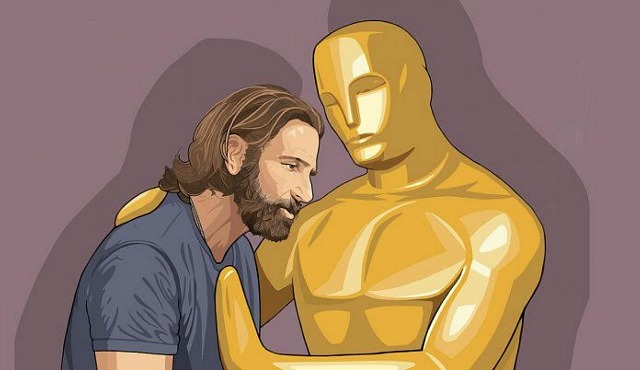
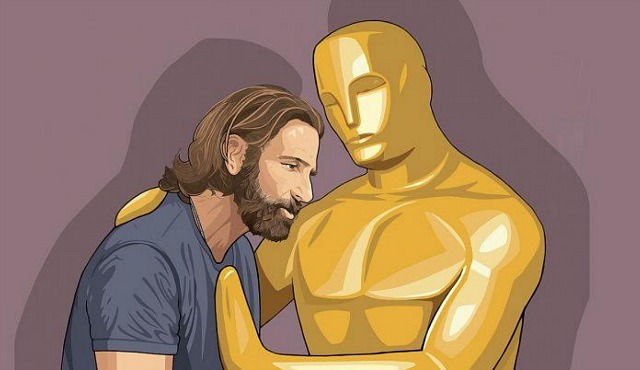
What Killed “A Star Is Born’s” Oscar Hopes?

I was fairly shocked when Bradley Cooper‘s A Star Is Born lost the SAG ensemble award last night. I also heard a resounding THUD sound. Because this, to me, seemed like the final kiss of death — i.e., SAG being unable to give this popular musical drama a “poor baby, we still love you” award.

An obviously well made, convincingly performed and hugely successful romantic tragedy, ASIB had consistently failed to win anything big — no Best Picture or directing or acting awards — at the Golden Globes, the Critics Choice Awards or the Producers Guild Awards. So before last night the thinking was “okay, no Best Picture Oscar and no acting Oscars for Cooper or Lady Gaga, but SAG members surely feel sorry for A Star Is Born, and so they’ll probably give it a Best Ensemble award as a kind of consolation prize.”

Nope!

Obviously no one knows anything for sure about the final Oscar tallies, but the Academy Award ambitions of Cooper’s grand musical opus are almost surely dead, dead, deader than dead.

So what killed the award-season chances of what had seemed — on paper at least — like a film that might do exceptionally well with award-season voters and handicappers — a film that was obviously well crafted, expertly refined, beloved by audiences and extraordinarily successful all over ($206 million domestic, $413 million worldwide).

In a phrase, A Star Is Born was way overhyped in the early stages, and that avalanche of pre-release praise produced feelings of irritation (at least as far as Hollywood Elsewhere was concerned) and a kind of “oh, yeah? show us!” attitude among many others.

That plus the fact that it just seemed wrong, wrong, WRONG to give a Best Picture Oscar to a remake of a remake of a remake of a 1932 original.

Warner Bros. publicity, obviously, was the architect of the overhype. Their hubris bears the responsibility.

The first clue came when Warner Bros. decided not to show ASIB in Telluride — a decision that said “we know this is basically a hoi polloi popcorn movie, so we don’t want any critical slams coming out of an elite rarified setting.”

But if you want to focus on overhyping faces and personalities, A Star Is Born was primarily killed by the Murderer’s Row quartet of Robert De Niro, Sean Penn, Variety‘s Kris Tapley and Barbra Streisand.

Read more

Gosling’s Gloomhead Performance Smothered “First Man”

I for one admired Ryan Gosling‘s minimalist approach to playing Neil Armstrong in First Man. Armstrong, yes, was an allegedly dull and undemonstrative fellow, at least according to some, but in my eyes (and surely in the eyes of director Damien Chazelle) Gosling was conveying a complete emotive universe…all kinds of feeling, anxiety, ache and seasoned-pilot attitude, but with the tiniest and fleckiest of paint dabs.

I found it a fascinating and courageous performance because Gosling and Chazelle had made a conscious choice to not use the standard-issue emotional strategies that Ron Howard and others have resorted to in similar “solitary man vs. incredible challenge” dramas.

Obviously the ticket-buying public didn’t agree; ditto the industry when it came to handing out awards and acting nominations. File the Gosling-Chazelle experiment under “noble but unsuccessful.”

But another angle on this failure came to light when I read Owen Gleiberman‘s 1.24 review of Apollo 11, the CNN documentary that screened a few days ago at Sundance ’19.

“Even as a die-hard First Man believer, I have to say [that] while Ryan Gosling’s clean-cut, clear-eyed terseness matches up neatly with Neil Armstrong’s, the documentary confirms what I’d always remembered: that Armstrong’s face was frequently graced with the angelic hint of a smile — he was the Eagle Scout as Mona Lisa. Maybe he was just that way for the cameras, but I somehow doubt it.

“In Apollo 11, he comes off as genial and inviting, the very soul of a more optimistic America. I think if he’d come off that way a bit more in First Man, the movie might have won more fans.”

Mood Stabilizers


Just after exiting 2:30 pm MARC screening of Matt Tyrnauer’s Where Is My Roy Cohn?, which is about smart and sturdy and engrossing as a doc about an old-school shithead could be expected to be.

Dinner at Cafe Terigo with director and dp Svetlana Cvetko and editor-producer David Scott Smith.

Hail and Hearty Fellows

Early yesterday afternoon I did another “what say ye about the Oscar race?” Gold Derby podcast chat with Tom O’Neil and Michael Musto. The usual usual but we had fun. I agreed with Musto that Roma is a lock to win Best Picture “with Green Book on the outside as a close runner-up.”

For my money we didn’t sufficiently discuss the all-but-total collapse of A Star Is Born and Bradley Cooper enough, but Tom was leading the discussion.

HE quote: “I don’t think there’s stopping Mahershala Ali (Green Book) in the race for Best Supporting Actor,” I said. “He’s been ahead since the get-go. I’d like to see Richard E. Grant win because I loved him in that role more than just about anyone else.”

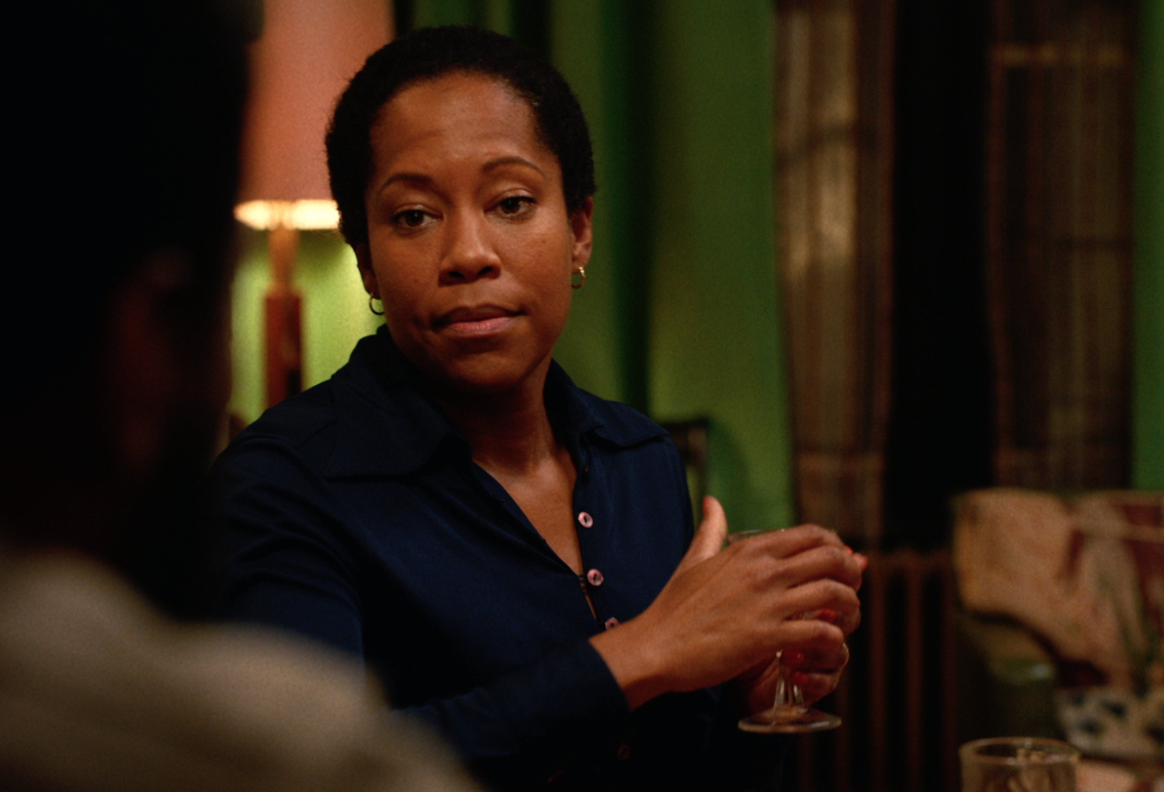
Musto quote: “It’s time for Glenn Close to get the freakin’ Oscar and everyone knows it! [Plus] Glenn plays a character who deserves the award that someone else gets. And she’s getting it this time. There is no chance for Lady Gaga!”

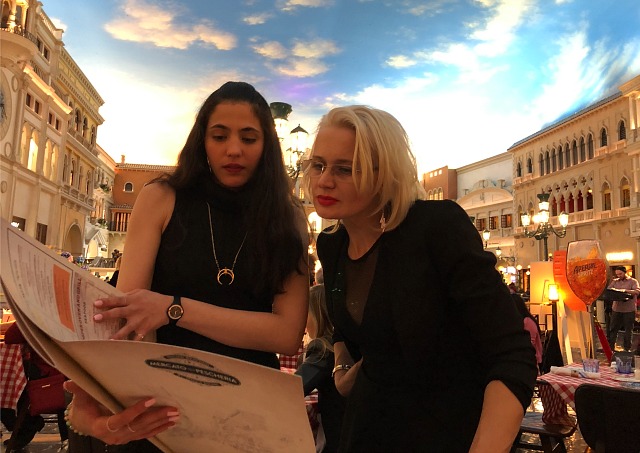
I was forced to participate from the lobby of the Park Regency because that’s the only spot in that otherwise comfy condo complex which the wifi is half decent. At the last minute I moved a small green palm plant right behind me for color design reasons — the green looked good along with the red glasses.

Sweet Gentle Monster

Leaving Neverland is a talking-heads horror film — an intimate, obviously believable, sometimes sexually explicit story of two boys — Wade Robson and Jimmy Safechuck, now pushing 40 — who became Michael Jackson’s special “friends” — i.e., lovers, masturbation buddies, fellators — while their more or less oblivious parents went along, thinking that the relationship was more of a kindly innocent bond.

Wake up: Jackson was a finagling fiend, a smooth predator, the kindest serpent.

You should have seen the faces of the audience members during the ten-minute intermission of Leaving Neverland at the Egyptian. They had that look of hollowed-out nausea, submerged disgust…trying to hide their revulsion.


Michael Jackson, Wade Robson sometime around ’88, when Robson was seven or eight.

The Jackson-guilt denialists are finished. Jig’s up. Once this four-hour doc hits HBO, forget it.

Leaving Neverland is also, of course, a very sad story. Damage and dysfunction are passed on and on. You’re only as healthy or sick as the amount of ugly secrets you’re carrying around. Oh, and the two complicit mothers of the victims are dealt tough cards at the end by their trying-to-heal sons.

From Owen Gleiberman’s Variety review: “[Director] Dan Reed forces us to confront the reality that the greatest pop genius since the Beatles was, beneath his talent, a monster. Leaving Neverland is no thriller, but it’s undeniably a kind of true-life horror movie. You walk out of it shaken, but on some level liberated by its dark expose.”

From David Ehrlich’s Indiewire review: “Steel yourself for specifics, as dancing around them would defeat the purpose of this documentary: Jackson was a man who convinced their most innocent relatives to bend over and spread their butt cheeks while he masturbated to the sight; who forced them to suck on his nipples while he serviced himself; who installed an elaborate system of alarm bells at the Neverland Ranch so that he would hear if anyone was going to walk in on an eight-year-old boy with the pop star’s penis inside his mouth.

“Penetration was a more complicated process, but one that got increasingly possible as the boys grew older. There was even a mock wedding ceremony at one point; the kid involved still can’t bear to look at the ring. The mothers chaperoned many of these vile trysts, oblivious to (or in denial about) what Jackson was doing to their sons behind closed doors. A teenage sibling even defended the pop star in court. She didn’t know any better, but will still regret that decision until the day she dies.”

Incidentally: I waited outside (25 degrees) in a ticket-holders line for 40, 45 minutes. Sundance staff & Park City police (checking bags, wanding everyone) didn’t exhibit the slightest interest in allowing the 9 am screening of Leaving Neverland to start on time. It started at 9:28 am — 9:30 am after the Sundance promos.

Read more

Close Enough To Taste It

16 months ago Björn Runge‘s The Wife premiered during the 2017 Toronto Film Festival. At Roy Thomson Hall, to be precise. I was there in the mezzanine, mesmerized by Glenn Close‘s slow-boil performance as a strong but resentful wife of a Nobel Prize-winning author (Jonathan Pryce). After it ended I was convinced — dead certain! — that Close would land her seventh Oscar nomination, and that she might actually win this time.

The Hollywood Reporter‘s Jon Frosch wrote that Close’s performance is “like a bomb ticking away toward detonation” — perfect. But she’s not just playing her husband’s better in terms of talent and temperament. She’s playing every wife who ever felt under-valued, patronized or otherwise diminished by a swaggering hot-shot husband along with their friends and colleagues as well as — why not? — society as a whole.

In the months that followed I kept re-stating my belief that Close’s Oscar-winning moment would finally be at hand. I said it again after catching a Wife screening in midtown Manhattan. The mostly over-50 crowd whooped and cheered, and you could just feel it.

“This Academy contingent is going to vote for Close en masse, no question,” I wrote. “Over the last 30-plus years she’s been nominated for six Oscars (The World According to Garp, The Big Chill, The Natural, Fatal Attraction, Dangerous Liaisons, Albert Nobbs) without a win — this will be the clincher.”

But deep down I wasn’t 100% sure. Noteworthy journos kept saying “yeah, maybe, Close is very good,” etc. My response was “no, not maybe — definitely.”

Early last November I felt slightly irked by an Eric Kohn and Anne Thompson Indiewire podcast about likely Best Actress contenders. Olivia Colman, Lady Gaga, Melissa McCarthy, Charlize Theron, Rosamund Pike and even Hereditary‘s Toni Collette were discussed, but not Close. This despite 22 out of 25 Gold Derby spitballers having predicted a Close nomination. What exactly was Kohn and Thompson’s blockage?

Read more

Hate, Vanity Feeds Virtual Mob

Excerpts from Damon Linker‘s “How Twitter Could Be The Death of Liberal Democracy,” posted yesTerday (1.22) on The Week:

“In 1984, George Orwell famously described a totalitarian political order in which people were kept as docile subjects in part by a daily ritual called ‘Two Minutes Hate’ in which the population directs all of its pent up fury at ‘Goldstein,’ a possibly fictional enemy of the state.

“Thanks to Twitter, we now know that the same dynamic can arise spontaneously, with fresh ire directed at a new manifestation of the partisan enemy nearly every day. It shows us that under certain circumstances — our circumstances — people can and will fasten onto an endless succession of real-life Goldsteins for the sheer, addictive joy of it — for the pure, delirious pleasure of denouncing manifestations of evil in our midst. Nothing, it seems, is quite as satisfying as singling out our fellow citizens for their moral failings and indulging in fantasies of their fully justified punishment.

“Too little attention has been paid to what may be the most potent facet of the social media platform: its ability to feed the vanity of its users. There’s always an element of egoism to intellectual and political debate. But Twitter puts every tweeter on a massive stage, with the nastiest put-downs, insults, and provocations often receiving the most applause. That’s a huge psychological incentive to escalate the denunciation of political enemies. The more one expresses outrage at the evils of others, the more one gets to enjoy the adulation of the virtual mob.”

“They display an impulsiveness and unhinged rage at political enemies that is incompatible with reasoned thinking about how we might go about governing ourselves, heal the divisions in our country, and avoid a collapse into civic violence that could usher in tyranny.”