For the sheer pleasure of it, I caught Pawel Pawlikowski‘s Cold War this morning for the second time. I sat in the third row of the Salle Deubssy, swooning once again to that velvety, needle-sharp black-and-white cinematography and that boxy aspect ratio that’s been breaking my heart for decades. Every shot is so exquisitely framed and lighted that it brings tears to your eyes. You could blow up any frame from this film and hang it on the wall of any snooty Manhattan art gallery.
And I love how cinematographer Lukasz Zal frames many of his shots with acres and acres of head room above the natural center of attention.
Cold War is so perfectly composed, a masterwork on every level. Pawlikowski’s story-telling instincts couldn’t be more eloquent or understated. Every plot point is always conveyed in the most discreet and understated terms, but you never miss a trick. And the economy! A story that spans 15 years ** is handled within 84 minutes, and you never sense that you’re being rushed along.
If I were deciding tonight’s Cannes Film Festival awards, I’d definitely choose Cold War for the Palme d’Or and Joanna Kulig, the femme fatale songbird whose in-and-out, hot-and-cold emotions propel this tragic love story, for Best Actress.
Earlier today I finally saw Gaspar Noe‘s Climax. It’s basically two movies, both running about 45 minutes, both scored to relentlessly pounding EDM and both about dancing bodies going to extremes — agile, mad, writhing, flailing around in dark places. And neither, I have to say, amounts to much.
The first half is “wheee!…lovin’ it!” and the second half is about “waagghhh, I’m gonna die!” But they’re both kind of shallow. Energetic, orgiastic, dullish. No dimensionality.
The first half, once it gets going after a 10- or 12-minute long video interview sequence, is far better. Climax is suddenly a wild, breathless, crazy-pump tribal dance flick — three (or four?) longish Steadicam shots of 20something dancers (Sofia Boutella is the only one I recognized), auditioning for a tour of some kind inside a modest-sized dance hall painted strawberry red (which half reminds you of the reddish gym-sized dance hall in Robert Wise‘s West Side Story), going gloriously nuts, letting loose and kicking out.
You could almost describe it as the first-act audition sequence from All That Jazz minus the grace and the dance-school training but set to EDM and with all kinds of push-push improv dancing, sweaty and hot and bursting with crazy legs and arms whirling with helicopter blades. None of it guided by a specific dance style, much less a theme or a structure of any kind, but it’s pleasing to just sink into the tribal throb and just, you know, go with it. Shallow but cool in a frenzied sort of way.
And then comes the second half, which is about the dancers reacting badly and in some cases horrifically to some LSD-spiked sangria.
The problem with this portion is that LSD is presented as some kind of evil-trigger drug, as a loosener of civilized behavior and a portal to hostility. It’s predatory, of course, to slip LSD into anyone’s drink without them knowing, and yes, it’s likely that most people, young or not, would react fearfully and perhaps even with panic. I get it.
But deep down LSD is not some kind of vicious-agitator substance. It’s a Godhead drug, and it struck me as unbelievable that each and every dancer goes a little bit nuts here. Nobody — not a single soul — connects with any form of inner divinity and blisses out. Nobody just stops with the crazy and walks outside barefoot and marvels at the night sky.
In the first half Noe is showing us that these kids are full of ecstasy when they dance, but in the second half he’s saying they haven’t the faintest notion what gentle spirituality is all about when they’re not dancing, and that they have absolutely nothing going on inside that would allow at least two or three of them to cope with the LSD experience in an Aldous Huxley sense.
Capharnaum director Nadine Labaki, Zain Alrafeea during filming.
Nadine Labaki‘s Capharnaum will win the Palme d’Or because of (a) the humanist-compassionate theme and (b) the director is female. The statements and actions of the Cate Blanchett-led jury indciates they’re almost certainly looking to give the top prize to a woman-directed film. Before Capharnaum came along I was presuming the Palme winner would be Alice Rohrwacher‘s Happy as Lazarro.
Capharnaum isn’t really about a child (Zain Alrafeea) who files a lawsuit against his parents for giving him birth, as the point is never vigorously or extensively argued in a courtroom setting. It is, however, a deeply affecting hard-knocks, street-urchin survival tale in the vein of Pixote or Slumdog Millionaire.
The IMDB says it’ll be titled Capernaum in the U.S. and other English-speaking markets.
I’m sorry but David Robert Mitchell‘s Under The Silver Lake (A24, 6.22), which I saw early this morning, is mostly a floundering, incoherent mess. Yeah, I know — Mitchell wanted it to feel this way, right? Ironically, I mean. Confusion and mental haziness were part of the impressionistic thrust.
It’s pretty much a textbook example of what happens when a gifted, financially successful director without much on his mind at the time…this is what happens when such a fellow comes to believe that he’s a version of Federico Fellini in the wake of La Dolce Vita or 8 1/2 and thereby obtains the funds to make whatever the hell he wants, and so he decides to create…uhm, well let’s try our hand at an impressionistic fantasia dreamtrip about L.A. hipster weirdness and…you know, dreamy fantasy women with nice breasts and impressionistic effluvia and whatever-the-fuck-else.
Two hours and 15 minutes of infuriating slacker nothingness…everyone’s vaguely confused, nobody really knows anything, all kinds of clues and hints about seemingly impenetrable conspiracies involving general L.A. space-case culture, bodies of dead dogs, cults, riddles and obsessions of the super-rich.
It’s basically about Andrew Garfield absolutely refusing to deal with paying his overdue rent, and neighbor Riley Keough, whom he tries to find throughout the film after she disappears early on, doing a late-career Marilyn Monroe with maybe a touch of Gloria Grahame in In A Lonely Place.
Under The Silver Lake is Mulholland Drive meets Fellini Satyricon meets Inherent Vice meets The Big Lebowski, except Lebowski, bleary-eyed stoner comedy that it was, was far more logical and witty and tied together, and with an actual through-line you could more or less follow.
I felt the same kind of where-the-fuck-is-this-movie-going?, wandering-fartscape confusion that I got from Paul Thomas Anderson‘s adaptation of Thomas Pynchon‘s novel of the late ’60s.
During the press conference Mitchell described Silver Lake as a “fever dream.” He said he wrote it fairly quickly, and that it began with his talking about his wife about “what’s really going on in those swanky-looking houses up in the L.A. hills?”
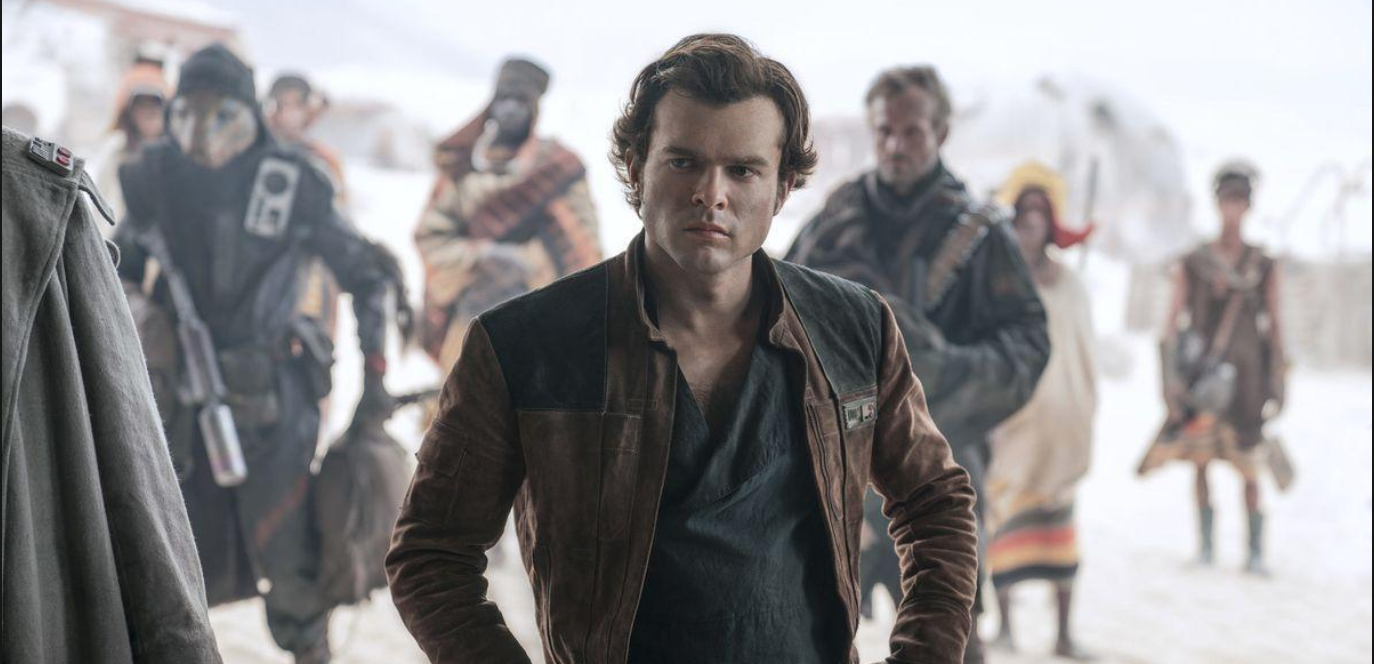
I saw Solo: A Star Wars Story (Disney, 5.25) earlier this evening at the Salle Debussy. A Han Solo origin story, and I really don’t give a damn about this heavily-milked realm. Same old “a long time ago,” same old dashing heroics, same old quips, same exotic creatures, same high-throttle chase scenes…formula, formula, plop-plop, fizz-fizz
How many years or decades does Disney plan on cranking out the same old sausage? The answer is “forever.” Six years ago Disney paid $4.6 billion to purchase the Star Wars universe, and that is the one and only reason you and your pallies are paying to see Solo the weekend after next. Because Disney wants the dough and because you’re a lemming, a zombie.
What did I get out of watching this light-hearted, fast-moving but rote-feeling Ron Howard flick, which attempts to reanimate the legend and spirit of Han Solo? HE regulars are sick of me saying that the rakish smuggler and adventurer has been personified by Harrison Ford for the last 42 years, but is now owned and operated by Alden Ehrenreich, whom I regard as “Little Han.”
The answer is “Not much, man…not much at all.”
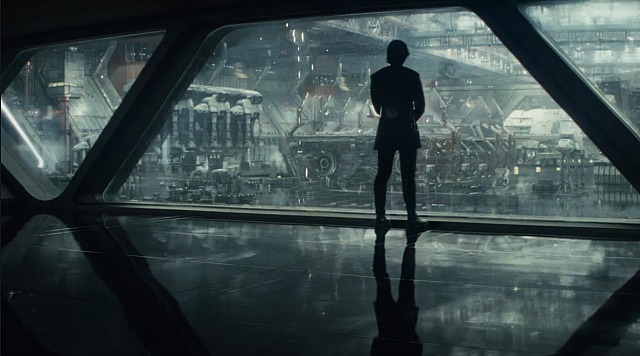
Seriously, I never felt turned on or lifted up or caught up in the flow of the thing, and I’m saying this as someone who half-enjoyed The Force Awakens, felt mildly engaged by Rogue One and was half-taken by portions of The Last Jedi.
I just can’t respond to this stuff any more. I couldn’t take the plunge. I was muttering to myself “oh, Jesus, c’mon…they’re shovelling and recycling the same crap here, over and over and over.”
I’ve said this seventeen or eighteen times, but Ehrenreich is Han Solo’s shorter wannabe cousin — a guy who’s trying like hell to fill Han’s boots but who lacks fundamental Hannitude. And in this context, he really is part of Short People Nation. Shorter than Woody Harrelson, way shorter than Chewbecaa, not much taller than Emilia Clarke (who looks kind of odd in a chubby-faced way), and always looking up at everyone, like he’s some kid in seventh grade.
Yes, Ehrenreich does a good job of pretending to be a young Han, and if you want to go along with this charade, be my guest. AE gives it everything he has, applying the acting lessons he was given during principal photography, but the effort simply doesn’t work. There’s no escaping the fact that he’s nowhere close to being a chip off the old block.
I’m not saying Lars von Trier‘s The House That Jack Built isn’t repellent in more ways than you can shake a stick at. It’s an odious, ice-cold exercise in homicidal perversity, and one for the record books at that. It should probably be avoided by anyone with a weak stomach or…oh, hell, by anyone who feels that films should exude some form of love or worship or celebration, which probably covers 99% of the moviegoing public.
But after last night’s build-up (tweets conveying disgust and rage, reports of people walking out of the black-tie premiere) I was expecting a diseased horror-murder tale so excessive that it might make me physically sick or prompt me to walk out or get into a fight with one of the security guys.
It didn’t do that. It turned out to be more of a meditative guilt confessional — about LVT more or less admitting that he may not be a good enough artist to deliver worthy, lasting art, and that all he really knows how to do is shock and agitate. (That’s what I got from it, at least.) I’m not saying it’s a better film than I expected, but it’s dryer and more meditative and not as heinous as I feared.
Portions of Jack are awful to sit through and the overall tone may be an equivalent to the professionally distanced, carefully maintained mindset of a psychological counselor in a hospital for the criminally insane. But for all the innate ugliness and sadistic cruelty on-screen, Von Trier is basically analyzing himself by way of Matt Dillon‘s Jack, a serial killer based in the Pacific Northwest, and casting a cold eye upon his shortcomings as a filmmaker.
Dillon is a would-be architect but is only gifted enough to be an engineer, he gradually admits. This is Von Trier talking about himself, of course — admitting to his audience that he’s “not quite Ivy League”, and that after shooting his wad on Breaking The Waves, The Idiots, Dancer in the Dark and Dogville that all he really knows how to do now is make shock-and-appall movies like this, Antichrist, the two Nymphomaniac films and so on.
I’m not saying Jack gets a pass, but at least LVT has tried to make it into something more thoughtful and meditative than just a series of clinical, cold-blood episodes showing recreations of this and that method of murder. It’s ugly and rancid, but about more than just that.
Spike Lee‘s BlacKkKlansman (Focus Features, 8.19) isn’t a great film, but it’s his strongest since Inside Man (’06) and before that The 25th Hour (’01), and easily his most impassioned, hard-hitting film about the racial state of things in the U.S. of A. since Malcom X (’92).
You can feel the fire and rage in Lee’s veins in more than a few scenes, and especially during the last five minutes when Lee recalls the venality of 2017’s “Unite the Right” really in Charlottesville, which ended with the death of protestor Heather Meyer, and reminds that Donald Trump showed who and what he is with his non-judgmental assessment of the KKK-minded demonstrators. Lee paints Trump with the racist brush that he completely deserves, and it makes for a seriously pumped-up finale.
But that doesn’t change the fact that BlacKkKlansman is basically a police undercover caper film, based on Ron Stallworth’s 2014 novel (“Black Klansman: Race, Hate, and the Undercover Investigation of a Lifetime”).
Nor the fact that tonally it sometimes feels like Starsky and Hutch or even to some extent like John Badham‘s Stakeout, especially as it involves the main cop protagonist falling in love with a girl (in this case an Afro’ed black activist played by Laura Harrier) who shouldn’t know what he’s up to, but whom he eventually confesses to. In this sense John David Washington‘s Stallworth is Richard Dreyfuss in the Badham film, and Adam Driver (as partner Flip Zimmerman) is Emilio Estevez.
Set in 1972, pic isn’t literally about Stallworth joining the Ku Klux Klan but a stealthy undercover investigation of the Klan, initiated when he was the first black detective in the history of the Colorado Springs Police Department.
After initial correspondence with the Klan, Stallworth received a call in which he was asked if he wants to “join our cause.” Stallworth answered affirmatively, and in so doing launched an audacious, fraught-with-peril inquiry.
SPOILER-ISH BUT NOT REALLY: Right away you’re telling yourself, “Yes, I know this actually happened and that Lee is using the facts in Stallworth’s book, but it made no sense for Fallworth to be heavily involved in this operation.” And it just feels crazy as you’re watching one crazy incident after another.
Alice Rohrwacher‘s Happy as Lazzaro, which I saw this morning at the Salle Du Soixantieme, may win the Cannes Film Festival’s Palme d’Or next weekend. It’ll almost certainly win something big as it’s quite the spiritual film, and it delivers the kind of humanist current that can lift all boats.
In this stand-up-for-women moment on the Cote d’Azur, the deciding factor, I suspect, may simply be one of gender. I’m not saying Happy as Lazzaro is a woman’s film — the spiritual current is universal and gender-less — but it’s very much a “heart” film, and I’m sensing that this plus a “let’s give the big prize to a woman director if we can” factor will penetrate.
Set sometime in the late ’80s, Rohrwacher’s third film is about a late-teen or twentysomething farmworker named Lazzaro (Adriano Tardiolo), who at first resembles a cross between a pure-of-heart innocent or, if you want to brusque about it, a seemingly charmed simpleton. But that impression changes as the film develops, especially during the second half.
While Happy as Lazarro takes place in two distinctly different realms, they share a tone of exploitive cruelty and a look at the harsh plight of the hurting poor — a rural and almost medieval tobacco farm in central Italy in the first half and a large Italian city in the second half.
The dividing line between the two is a startling event that happens halfway through, and after this the true scheme of Happy as Lazzaro kicks in.
For this is basically the story of a kind of saint who refuses to respond with even a trace of guile or calculation. Lazzaro is very much a lamb-like (or donkey-like if you consider his resemblance to the Christ-like beast in Bresson’s Au Hasard, Balthazar) figure of faith and trust, and the resulting current of kindness and compassion becomes more and more affecting.
Happy as Lazzaro is my second favorite film of the festival so far, second only to Pawel Pawlikowski‘s Cold War. It’s quite the mixture of fabulism and a certain kind of grim, social-critique drama, shot in 16mm with a hand-held, rounded-edges aesthetic.
I’m not saying Rohrwacher is copying anyone, but I felt the influence of the Taviani brothers‘ Padre Padrone and Bernardo Bertolucci‘s 1900 in the first half, and then a whole different kettle of fish (urban poverty) in the second half. But it’s always about purity vs. venality and indifference, and it’s really quite magical.
Among the costars are Alba Rohrwacher (the director’s older sister) and Spanish actor Sergi Lopez (Pan’s Labyrinth), whom I didn’t even recognize at first.
The rural portion (i.e., the first half) was shot in Bagnoregio, a small commune in the Lazio section of Italy.
I have to leave for a screening of Spike Lee‘s BlacKkKlansman, but there’s something very special, trust me, about Happy as Lazzaro.
It was wonderful to see the half-century-old 2001: A Space Odyssey tonight at the Salle Debussy, and under such regal circumstances with such sterling company (Chris Nolan, Keir Dullea, Jan Harlan, Suzanne Fritz of Warner Bros. publicity) and with several high-perspective, hail-fellow-well-met critics in attendance — Owen Gleiberman, Peter Howell, etc.
But the film lacked the required needle-sharp detail (which is definitely there in the photographic elements) and it suffered from overly dark images with slightly muddy textures, not to mention that teal-blue sky when Moonwatcher smashes the bones and that gray face of Dave Bowman behind the space-helmet visor during the French chateau sequence at the very end. It proved once again that the myth of 70mm projection being the ultimate visual experience in a theatre is just that — a myth.
What we saw tonight was fine if you weren’t being too demanding, but it didn’t deliver anything close to the crisp detail and clarity of the 2007 Bluray version, and don’t even talk about the forthcoming 2001 4K Bluray, which will almost certainly blow everyone away.
Chris Nolan wanted us to experience the 2001 he fell in love with when he saw it at age 7 or 8 with his father in Leicester Square, and which he seems to truly believe is still the greatest way to experience Stanley Kubrick‘s epic. But digital technology has bypassed 70mm for the most part, and I’m sorry but 70mm photography and projection just isn’t the cat’s meow any more. It hasn’t been for some time. The 70mm myth has to be recognized for what it is — a dream, a notion that no longer applies, a celluloid nostalgia trip.
The absolute infinite blackness of space and the visual punctuation of each and every little star look wonderful, on the other hand. And the well-amplified digital sound, pumped by the Salle Debussy’s superb sound system, was great. And I loved that old 1968 first-run program that they reprinted and handed out tonight.
6:50 am Cannes update: The usual tut-tutters and harumphers commented that I’m still failing to understand the difference between quality-level 70mm celluloid projection vs. 1080p Bluray resolution on a 65-inch 4K HDR monitor. “Nice bullshit qualifying,” I replied. “You’re basically saying that Nolan’s 70mm celluloid 2001 can’t look as breathtakingly sharp or clean as the 2007 Bluray, but it’s better nonetheless. I’ve been watching films my entire life, and my eyes know when they’re truly satisfied and when they’re not, and I’m sorry if this displeases the 70mm purist crowd but my eyes want what they want. In my book, a little tasteful grain-scrubbing is a VERY good thing. The 2007 Bluray is perfect.”
From Cate Blanchett‘s speech on the steps of the Palais: “Women are not a minority in the world, yet the current state of the industry stays otherwise. As women, we all face our own unique challenges, but we stand together on these stairs today as a symbol of our determination and commitment to progress. We are writers, producers, directors, actresses, cinematographers, talent agents, editors, distributors, sales agents…all involved in the cinematic arts.”
The unrestored, original-elements Chris Nolan version of 2001: A Space Odyssey screens early tomorrow evening (6:45 pm) at the Salle Debussy. Remember that the trailer for this looked yellowish, teal-tinted and minus the sharpness found on the 2001 Bluray. If Nolan’s version looks yellow-teal on the big screen, bombs away.
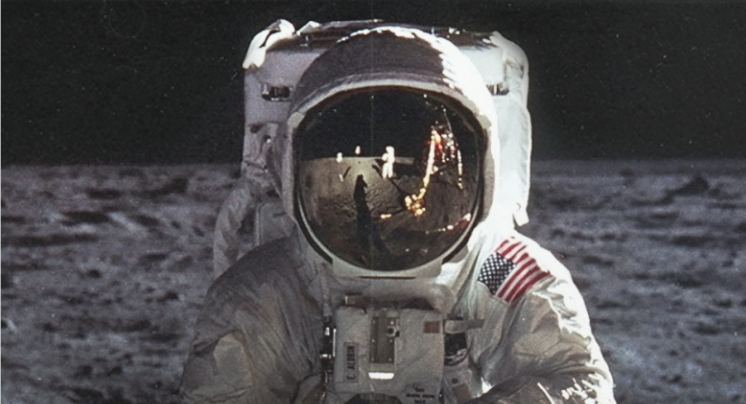
Examine the 2007 Bluray version of Dave Bowman‘s face through his red space-helmet visor vs. the far less distinct Nolan version. Anyone who says Nolan’s is preferable needs to be hunted down by men in white coats right now.
2007 Bluray capture above; unrestored Nolan version below.
Nolan discussing his non-restored 2001 at the Salle Bunuel earlier today.
Remember what film restoration guru Robert Harris told me on 3.28.18 (“Not So Fast On That 70mm 2001 Mastering”): “The new 70mm print they’ll be showing in Cannes will not look like 2001 did in 1968. It can’t be an authentic recreation of how the film looked 50 years ago for any number of reasons. Color stocks, black levels and grain structure are different now, color temperature of the lamps has changed but can be adapted. They were using carbon arc lamps in ’68 and they aren’t now, and on top of everything else the film stock is different — the stock used for original prints was a stock that arrived back in 1962. And so the images [may] ironically look too clear.
“What they show may be beautiful, but they’re not working from the original camera negative, which has been badly damaged. They’re working from ‘new printing elements’ taken from the original negative, which basically means a fourth-generation print. All original prints were struck from the camera original. They won’t be using the original film stock that the original 2001 was printed on, which was Eastman 5385, a 1962 film stock, that had appropriate film grain to the way the film had been designed. So it’s not off the negative, they don’t have the original film stock, and they’re be making it off a dupe rather than using 4K or 8K files.