God Is My Tormentor

What defines a spiritual film? In my dictionary it’s any movie in which the main character is constantly communing with (i.e., pondering, meditating, wondering about) his/her inner life or more particularly that voice that seems to be talking to him/her in such a way that the main character is haunted, bothered, unsettled, off-balance and searching for the right thing to do or the right way to be.

In this sense Paul Schrader‘s First Reformed (A24, 6.22) — an absolute must-see — is a spiritual film in spades. But then so is Taxi Driver, which Schrader wrote some 43 or 44 years ago. And so are a bunch of others.

I don’t want to sound like an easy lay, but I regard Field of Dreams as a spiritual film. I think The Exorcist is a spiritual film, at least as far as Damian Karras‘s character is concerned. Days of Heaven is a spiritual film; ditto The Tree of Life. Obviously Martin Scorsese‘s The Last Temptation of Christ (the screenplay for which was written by Schrader) and Pier Paolo Pasolini‘s The Gospel According to St. Matthew, but not — I repeat, not — Scorsese’s Kundun. (Too suffocating.) It would piss me off to hear someone call Batman Begins a spiritual film, but I suppose the argument could be made.

Is Bernardo Bertolucci‘s Little Buddha a spiritual film? I haven’t decided. Is Moby Dick a spiritual film as far as Gregory Peck‘s Captain Ahab is concerned? I’m still mulling that one over.

I got into this after reading a 3.15 Den of Geek interview with Schrader, the director-writer of First Reformed, and star Ethan Hawke. The sit-down happened last week in Austin during South by Southwest, where First Reformed (A24, 6.22) screened once or twice. It was showered with hosannahs last fall when it played the Venice and Telluride festival; it also played Toronto.

Make no mistake — First Reformed is Schrader’s best film in ages.

From my 9.1.17 rave: “I can’t over-emphasize how amazing it feels to watch a fully felt, disciplined, well–ordered film by a brilliant guy who had seemingly lost his way or gone into eclipse, only to be startled when he leaps out from behind the curtain and says ‘Hah…I never left!'”

Read more

20 Superhero Egos In One Movie

How many superheroes elbowing each other in Avengers: Infinity War…22 or 23? Robert Downey Jr. as Tony Stark, Chris Hemsworth as Thor, Mark Ruffalo as Hulk, Chris Evans as Steve Rogers, Scarlett Johansson as Black Widow, Benedict Cumberbatch as Stephen Strange, Don Cheadle as War Machine, Tom Holland as Peter Parker, Chadwick Boseman as Black Panther and Paul Bettany as Vision…that’s ten.

Plus Elizabeth Olsen as Scarlet Witch, Anthony Mackie as Falcon, Sebastian Stan as White Wolf, Tom Hiddleston as Loki, Idris Elba as Heimdall, Benedict Wong as Wong, Pom Klementieff as Mantis, Karen Gillan as Nebula, Dave Bautista as Drax, Zoe Saldana as Gamora, Vin Diesel as Groot, Bradley Cooper as Rocket, Chris Pratt as Peter Quill / Star-Lord…that’s thirteen or 23 total.

Plus Gwyneth Paltrow as Pepper Potts, Josh Brolin as bad-guy Thanos and Peter Dinklage as you-tell-me.

All of these hot-shots trying to out-quip each other. I’m exhausted just thinking about it. What’s the running time, 165 minutes? Longer?

The Horny Ape

Posted four years ago: Nobody remembers Richard Franklin‘s Link (’86), but it was a witty, better-than-decent genre thriller with a nice sense of tongue-in-cheek humor, and shot with a great deal of discipline. Clever, dry, smarthouse. And nobody saw it.

Shot in Scotland in ’85, Link was basically about a watchful, intelligent and increasingly dangerous chimpanzee who develops a sexual obsession for a junior zoologist played by young Elizabeth Shue (who was 22 or 23 during filming).

A Thorn EMI production that was acquired by Cannon, Link costarred Terrence Stamp, was fairly well written by Everett De Roche, and was very carefully composed. Franklin (who died young in ’07) shot it with a kind of Alfred Hitchcockian style and language. I wrote the Cannon press notes and in so doing interviewed Franklin. The then-39-year-old director worked very hard, he told me, to put Link together just so. Franklin made no secret of the fact that he was a lifelong Hitchcock devotee.

Unless you own a Region 2 Bluray/DVD player, you can’t see Link under any circumstances. You can buy a decade-old Region 2 DVD, but no NTSC version. And you can’t stream it on Amazon, Netflix or Vudu.

Boilerplate: “Jane, an American zoology student, takes a summer job at the lonely cliff-top home of a professor who is exploring the link between man and ape. Soon after her arrival he vanishes, leaving her to care for his three chimps: Voodoo, a savage female; the affectionate, child-like Imp; and Link, a circus ape trained as the perfect servant and companion.

“A disturbing role reversal takes place in the relationship between master and servant and Jane becomes a prisoner in a simian house of horror. In her attempts to escape she’s up against an adversary with several times her physical strength, and the instincts of a bloodthirsty killer.”

I helped out with Link screenings at Cannon headquarters on San Vicente Blvd., and I remember playing The Kinks “Ape Man” (a portion of which is heard in the film) as a kind of overture for invited guests.

Terrence Stamp, who starred in Link, told me during a Limey interview in ’99 that Franklin was very tough on film crews.

Read more

What Say Ye About Simon?

Nobody had much to say about my 3.15 review of Greg Berlanti‘s Love, Simon, but it opened yesterday so what’s the reaction? By any measure an antiseptic, intensely suburban gay teen romance, I described it as (a) “definitely half-decent,” (b) “smartly written” but a little “too tidy, too dream-fantasy, too TV-realm and not laid-back enough.” But at the same time not bad. I mentioned that it’s the first big-screen adaptation of a YA novel (Becky Albertalli‘s “Simon vs. the Homo Sapiens Agenda”) that I’ve half-liked, but it still feels a little too YA-ish.

More Strangelove Color

Two years ago I posted “Strangelove Color Trip,” which consisted of seven color snaps (in the old HE format width of 460 pixels), all taken during filming of Stanley Kubrick‘s Dr. Strangelove in early 1963. This morning I came upon several more; I’ve also re-rendered four or five shots from March ’16 in HE’s current (640 pixel) column width. I let one black-and-white shot slip in (i.e., Kubrick hand-drawing Lolita glasses on a nuclear warhead), but only because I’d never seen it before today.

Read more

Locked In

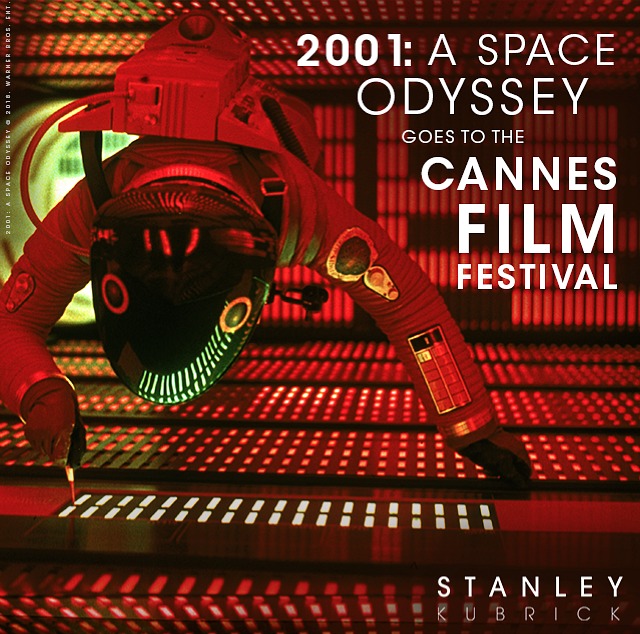
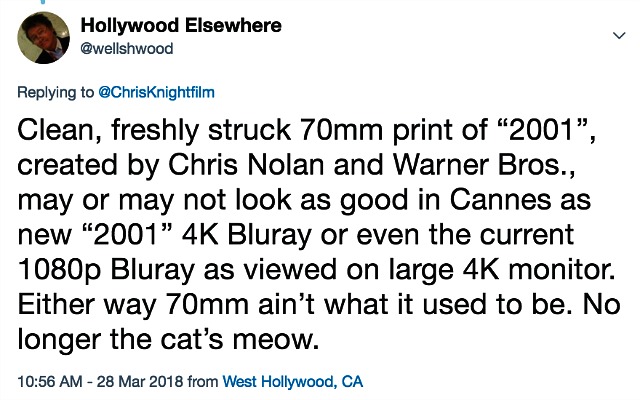
Three weeks ago I referenced a Digital Bits report from Bill Hunt about Warner Home Video planning to release a 50th anniversary 4K Bluray of 2001: A Space Odyssey. As Stanley Kubrick‘s classic opened in the U.S. on 4.3.68, it seemed reasonable to assume it would “street” sometime next month.

Well, it’s not — the 4K 2001 will pop on 5.8.18. And the Amazon price is $41.99 — gougers! The perfectly rendered 2007 Bluray version sells for $22 to $28 less, depending on where you buy it. An HD streaming version sells for $12.99.

The alleged jacket art that I posted on 2.22 looked suspicious, I said, because it lacked any mention of “remastered UHD 4K,” and then HE commenter Carl LaFong explained that the jacket art was from a French steelbook Bluray release from 2015. Except the WHV 4K disc is using it anyway — the final jacket art is below.

Read more

What’s Up With Cameron Diaz?

Last weekend Selma Blair was quoted by Metro‘s Katie Bailey saying that Cameron Diaz, who hasn’t made a film since Will Gluck‘s Annie (’14) and whose last good film was Ridley Scott‘s The Counselor (’13), has more or less bailed on her film career.

“I had lunch with Cameron the other day,” Blair reportedly said. “We were reminiscing about [The Sweetest Thing]. I would have liked to do a sequel but Cameron’s retired from acting. She’s like ‘I’m done.'” Blair was presumedly screamed at that night by Diaz and her reps, and so she tweeted the following day (Monday, 3.12) that Diaz “is NOT retiring from ANYTHING.”

Today, or four days after Bailey’s Metro story, People‘s Mike Miller posted a story about how the 45 year-old Diaz “is loving her life outside the Hollywood spotlight.” Quoting “a source”, Miller writes that Diaz and her 39 year-old, tattoo-covered musician husband Beji Madden are “great” and “both very happy living the quiet life.”

Translation: Diaz’s career is in eclipse but she doesn’t want anyone thinking she’s not ready to return if the right part comes along.

Diaz’s career started to lose steam as she got older and her looks started to fade. You can’t say she didn’t appear in better films during the ’90s and early aughts. We all know that actresses often have a rougher time when they start to show mileage. Or something like that. I didn’t invent the system. I deplore it. But that’s how it goes in some cases.

The same thing happened with Brendan Fraser — career peak between ’92 and ’05, and then he began to age out.

If you ask me Diaz peaked from ’94 to ’05, or from age 22 to 33 — from her breakout debut in Chuck Russell‘s The Mask (’94) to Curtis Hanson‘s In Her Shoes, in which she gave her career-best performance.

Read more

Rainy Day In Cannes Needs To Happen

Yesterday Variety‘s Peter Debruge and Elsa Keslassy spitballed about possible 2018 Cannes Film Festival selectionsAlfonso Cuaron‘s Roma, Jennifer Kent‘s The Nightingale, Luca Guadagnino‘s Suspiria, Asghar Farhadi‘s Everybody Knows (in Spanish) and Olivier AssayasE-Book.

Not to mention Jacques Audiard‘s The Sisters Brothers, Paolo Sorrentino‘s Loro, Laszlo NemesSunset, Terrence Malick’s Radegund (in German), Matteo Garrone‘s Dogman, Terry Gilliam‘s The Man Who Killed Don Quixote and Xavier Dolan‘s The Death and Life of John F. Donovan.

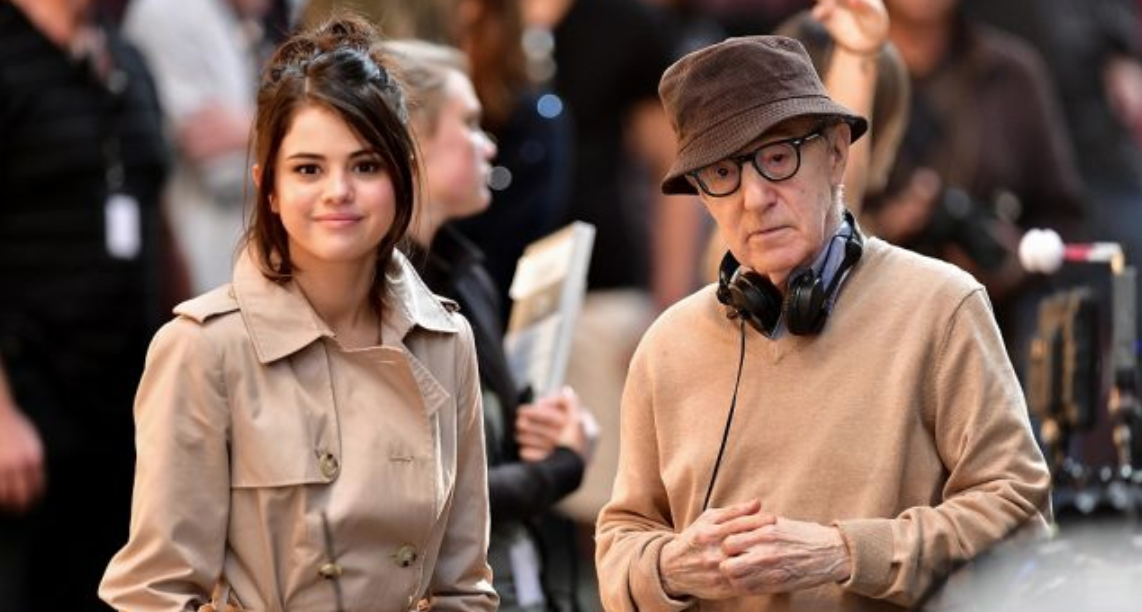
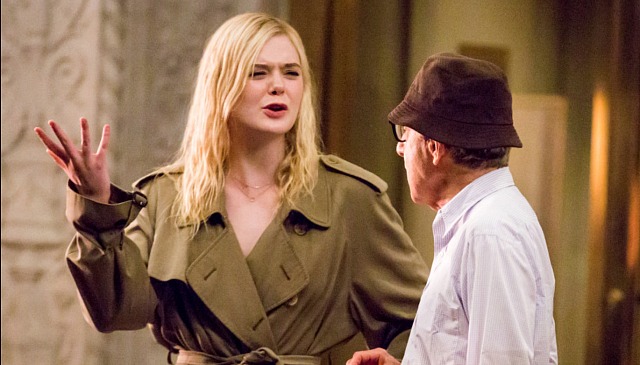
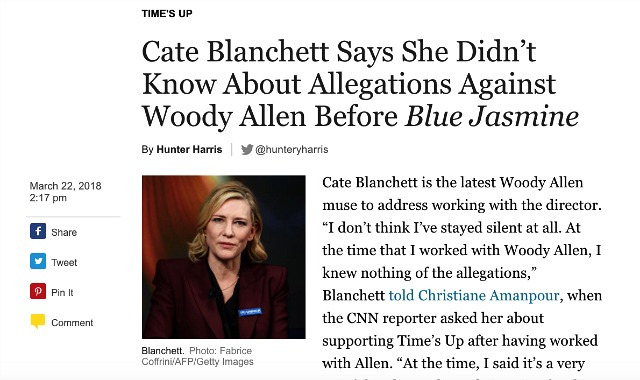
It’s worth noting that Debruge and Keslassy, mindful of antsy industry currents, didn’t mention an especially enticing possibility — Woody Allen‘s A Rainy Day in New York, which will probably be dumped by Amazon (those antsy currents!) but which would be a major score for this world-class Cote d’Azur festival.


Timothee Chalamet, Selena Gomez in Woody Allen’s A Rainy Day in New York.

Woody’s films have played Cannes three or four times in the recent past, and a booking of his most recent effort, which partly deals with an inappropriate-age-gap relationship between Jude Law and Elle Fanning, would be a way for festival topper Thierry Fremaux to not only honor a relationship with a still-important filmmaker but declare that Cannes is about cinematic art first and nervous-nelly politics second.

Because you just know that a certain sector of American journalists will freak out if and when the Woody is chosen. Does Fremaux have the balls? Will Allen have the sand to face the Cannes press corps?

Debruge and Keslassy also suggest in their piece that Cannes should adhere to a gender quota system. “From the international success of Wonder Woman to the #MeToo and #TimesUp movements, the world is a much different place than it was in May 2017,” they remind. “Will Cannes delegate general Thierry Fremaux get with the program and include more female directors?”

I would imagine that Fremaux would indeed want to increase the presence of female directors this year, but HE’s Jordan Ruimy has a response to Debruge and Keslassy that I agree with 110%:

“Cannes is not a quota festival. It recognizes excellence in cinema. If a smaller number of female directors fail to produce excellent movies in a given year, that fault is on those directors, not Cannes. Lowering the bar to meet some dumb quota hurts women, not helps them. Festivals are supposed to be merit-based, and Cannes most of all in this regard.”

Read more

How Would Female-Driven Classics Fare Today?

It’s understood that middle-class, middle-budget reality dramas have been consigned to cable and the indie realm. (Speaking of which you can’t do much better on that score than Collateral, the recently popped Netflix series with Carey Mulligan as a police inspector). This means, I presume, that sturdy, well-written dramas about women, even in this revolutionary era, are still having a tough time being funded above the Spirit Award level (i.e., $20 million tops).

I’m not saying it’s impossible to score backing for a mildly expensive, character-driven drama about a woman character played by a mid-range star, but the usual resistance doesn’t seem to have changed, at least in the realm of theatrical make-or-break.

Erin Brockovich, which was made 19 years ago for $52 million (or roughly $75 million in 2018 dollars), probably wouldn’t be made today as a theatrical film — it would be produced by Netflix or Amazon. The Steven Soderbergh-directed film, which opened in March 2000, earned $125.5M domestic and $256.2M worldwide.

And Alan Parker‘s well-respected Shoot The Moon, which cost $12 million to make in ’81 or nearly $31 million by the 2018 economy, would probably have to go Netflix or Amazon also, and even then who knows? Theatrically the Diane Keaton-Albert Finney marital drama was a bust — it only made $9.2 million domestic.

On the other hand a version of Paul Mazursky‘s An Unmarried Woman, which cost $2,515,000 (roughly $10 million in 2018 dollars) to shoot in 1977 and went on to earn $24 million in ’78 or just under $100 million by the ’18 economy, would probably be funded today.

Ditto a version of Alan Pakula‘s Klute, which was made in 1970 for $2.5 million or $16 million by the measure of 2018, would probably be funded today. Maybe. The urban thriller wound up earning $12,512,637, which translates into $80 million today. (The 1970 to 2018 multiple is 6.42.)

Red Irishman Ink?

Yesterday “Page Six”‘s Richard Johnson reported in the N.Y. Post that a “source” is claiming that Martin Scorsese‘s The Irishman, the likely swan song of Scorsese’s career as far as mafia wise guys are concerned, may cost $175 million, and that’s without marketing.

On 2.9.18 Deadline‘s Anita Busch reported that “we are now hearing from multiple sources that the film’s budget is well over $125M and more in the $140M range (and climbing).” In late February ForbesScott Mendelson echoed Busch’s report that the Irishman is costing $140 million or thereabouts.


Al Pacino, Robert De Niro during filming.

Add the standard marketing costs (usually $85 to $100 million for a major feature) to Johnson’s $175 million figure and the total Irishman tab is in the vicinity of $250M. Add the same to Busch/Mendelson’s $140M and you’ve got $225M or thereabouts.

Being a Netflix release that almost certainly won’t have an extensive theatrical run, The Irishman isn’t subject to the usual financial arithmetic of a typical feature from a mainstream distributor, but $175M or $225M or $250M tabs are certainly stand-outs in the realm of a non-fantasy, straight-goombah period drama.

Robert De Niro, Al Pacino, Joe Pesci, Bobby Cannavale, Harvey Keitel and Ray Romano are the Irishman costars. Anna Paquin is apparently the only actress of any note in the film.

Netflix is flush enough to handle the Irishman tab without breaking too much of a sweat. It’s interesting nonetheless to consider that Cleopatra‘s $31 million budget, which broke 20th Century Fox in ’63, inflates into roughly $248M in 2018 dollars. ($100 in 1963 = $800 in 2018.)

Read more

Successful White Voice

I wanted to see Boots Riley‘s Sorry To Bother You (Annapurna, 7.6) at last January’s Sundance Film Festival because of Lakeith Stanfield, but then I began to think that a director whose first name was “Boots” might be more into diversion and razmatazz and shuffling the deck than dealing straight cards.

But The Guardian‘s Jordan Hoffman saw Sorry and said it “shows a great deal of spirit and promise” and that “it may even become a cult classic.” Those are critical code terms for “doesn’t quite do it or get there but maybe next time.”

On the other hand a 70% Metacritic score means you’ve gotten…well, a few things right.

Indiewire‘s Eric Kohn said it’s “loaded with capricious details that shimmer with the exuberance of inspired social commentary at hyperspeed”….huh? Variety‘s Peter Debruge complained that “the more ridiculous Riley’s gonzo social critique gets, the more boring it becomes, to the point that its out-of-control second half starts to feel like some kind of bad trip.” Financial Times critic Damon Wise said “it has its moments…but Riley’s vision needs a little more refining.”

OG on RPO: Virtual Whoo-Whoo Competes With Banality

It is axiomatic that trade critics will be as hospitable as honesty allows when it comes to major studio releases, especially those aimed at fantasy geekboys and especially when directed by a legend like Steven Spielberg. And so Variety‘s Owen Gleiberman is most likely fulfilling expectations in his review of Ready Player One, which premiered last night at SXSW.

But even under these conditions OG offers terms like “banal” and “slippery mutating synthetic digital imagery” and — this is probably key — “more occupied than invested.” OG was gripped by RPO, but his review also indicates that the general SXSW reaction (“We’ve found God! The entire crowd was levitating…shrieking with pleasure!”) was over-the-top.

And yet I love hearing that there’s a sequence in which Tye Sheridan‘s Parzival, Olivia Cooke‘s Art3mis and a Shrek-like avatar named Aech visit Stanley Kubrick‘s Overlook hotel.

“In Ready Player One, everything you could call virtual is clever and spellbinding,” he writes, “[and] everything you might call reality is rather banal.” Spielberg’s “dizzyingly propulsive virtual-reality fanboy geek-out” is “an accomplished and intermittently hypnotic movie [but],” he qualifies, “you may feel like you’re occupied more than you are invested.”

Ready Player One tells a breathless and relatively coherent story — essentially, the future of civilization is riding on the outcome of a video game — but the movie, first and foremost, is a coruscating explosion of pop-culture eye candy. Never is that more spectacularly true than in the irresistible sequence in which [three virtual leads] enter the Overlook Hotel from The Shining.

Read more