Killer of Ducks

There’s a new Region 2 Bluray of Tony Richardson‘s The Border, but no Region 1 version for the U.S. The Universal release was a bust (cost $22 million, grossed $6 million). Possibly because Jack Nicholson was somewhat miscast as a mopey border guard who experiences a compassionate moral epiphany after witnessing brutal treatment of Mexican immigrants by his colleagues.

Miscast because Nicholson was too closely identified with perverse behavior at the time, mostly due to his Jack Torrance role in The Shining, but also because of a series of jaded, cynical malcontents like Bobby Dupea in Five Easy Pieces, Badass Buddusky in The Last Detail, Jake Gittes in Chinatown, Randall P. McMurphy in One Flew Over the Cuckoo’s Nest, the horse thief in The Missouri Breaks, etc.


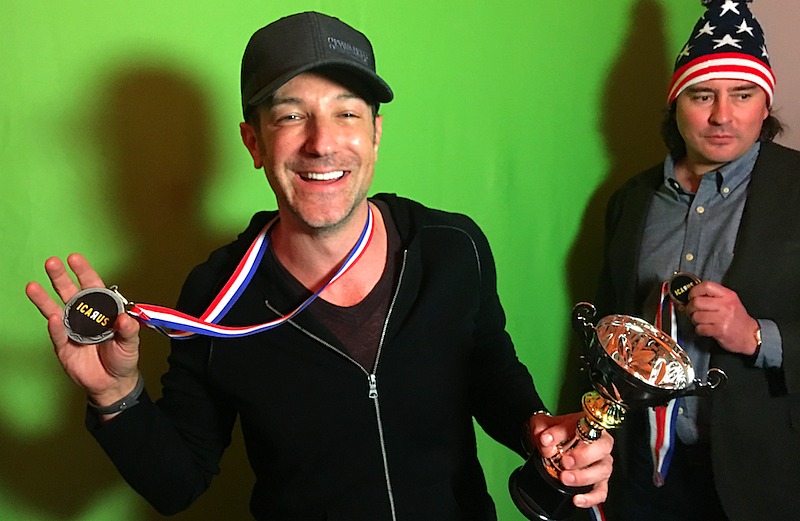
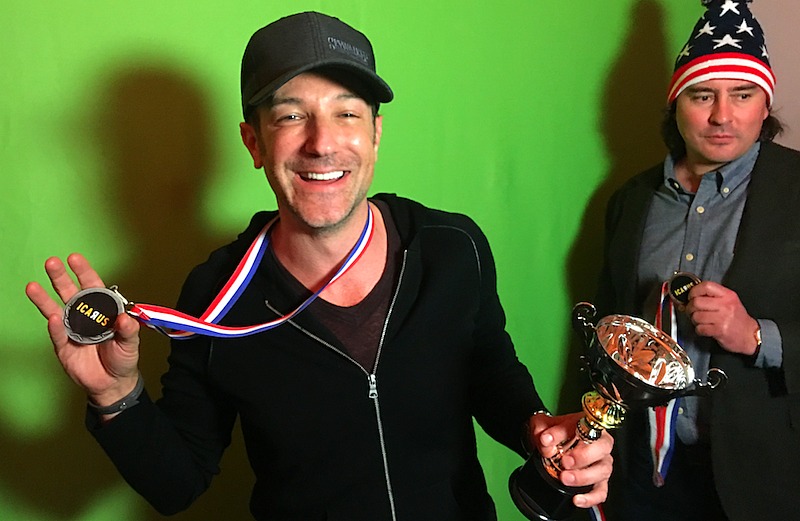
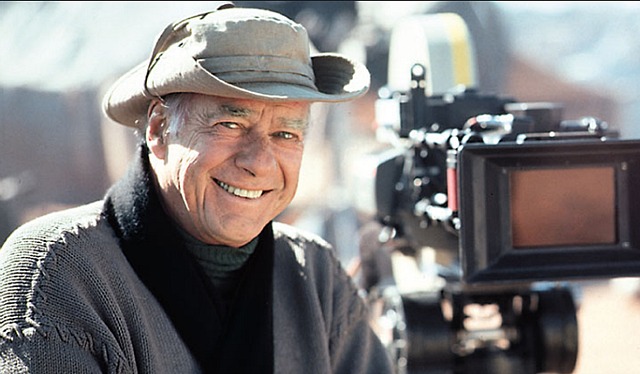
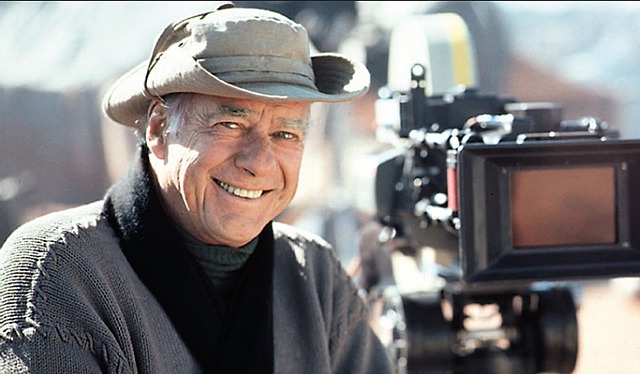
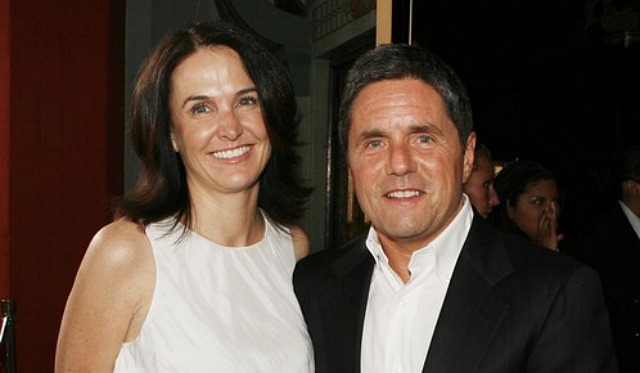
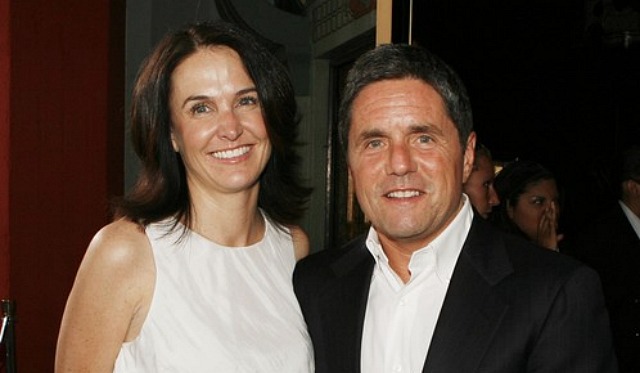
Photo taken by Mitch Neuhauser, who’s now managing director of Cinemacon.

This issue arose when I interviewed Nicholson on a very cold January morning at the Carlyle hotel, way up on the 23rd floor. I asked for his reaction to Richard Corliss‘s Time review of The Border. Jack said he hadn’t read it so I showed it to him. The review began as follows:

“When, early in The Border, Nicholson muses about how, back in California, ‘I liked feeding those ducks,’ one’s first reaction is: ‘Feeding them what? Strychnine?’ Nicholson’s voice, with the silky menace of an FM disc jockey in the eighth circle of hell, has always suggested that nothing in the catalogue of experience is outrageous enough to change his inflection. Even when he goes shambly and manic (Goin’ South, The Shining), Nicholson’s voice and those tilde eyebrows give the impression…” and blah blah.

Nicholson chuckled faintly and rolled his eyes when he read it, and then went into a minor tirade about how he was “mad” that he’d convinced the public he was a murderer, and about being stuck in that box. This image disappeared the following year, of course, after he played Garret Breedlove, the randy ex-astronaut, in James L. BrooksTerms of Endearment.

Yeah, this was the same Carlyle interview that I’ve mentioned two or three times in this space. The one in which I told Nicholson that aspects of his Shining performance seemed, to me, to be a kind of inside joke. Nicholson disputed this. He wasn’t rude but his response was basically who was I, a mere journalist, to assume I had an inside view of things? He was relaxed and droll about it, but his point was that he was “inside” and I wasn’t.

Read more

Riff and Bernardo Turning In Their Graves

On 3.5.14 Deadline‘s Michael Fleming reported that Steven Spielberg was pondering a remake of West Side Story for 20th Century Fox. Two days ago a West Side Story casting notice was posted on Twitter by casting director Cindy Tolan, announcing that Spielberg and screenwriter Tony Kushner were the principals, and that they’re looking for Caucasian actors to audition for Tony (i.e., Richard Beymer‘s part in the 1961 Robert Wise big-screen version) and Latino actors to play Maria, Anita and Bernardo (played by Natalie Wood, Rita Moreno and George Chakiris way back when).

Remaking West Side Story for the screen is a bad enough idea on its own. It would have zero connection to any aspect of today’s culture, for one thing. There’s certainly no trace of gang culture in 2018 Manhattan. Maybe the angle behind the Spielberg-Kushner version is to shoot it in period (i.e., sometime in the early to mid ’50s)? If so that could work. But will Kushner dispense with phrases like “play it cool, daddy-o”? Some of the dialogue in the ’61 film made horses choke even back then.

Who except boomers and older GenXers would be interested in a reboot of (take your pick) the original 1957 stage musical or the ’61 screen version? In the case of those who were teenagers in the mid ’90s and are now pushing 40, who’s clamoring for a Stephen Sondheim-Leonard Bernstein musical version of Baz Luhrman‘s Romeo + Juliet (’96)?

True, Wise’s ’61 version seems stiff and inorganic and overly theatrical by today’s standards. The challenge, I suppose, would be to make a version that feels more “street” and set it against a real-life culture where gang warfare, turf battles and racial animosity are (or more precisely were) regular facts of life.

But this kind of thing seems way out of Spielberg’s wheelhouse. What does a suburban Jewish kid from Arizona know about mid 20th Century gang culture anyway? Of all the directors in all the world who could possibly pull this off, Spielberg would have to be at the bottom of the list. Helming a new West Side Story would arouse every treacly, gooey, sentimental impulse in his system.

Read more

James Franco, Invisible Man

James Franco‘s un-person status in the Hollywood realm, a result of five allegations of sexual misconduct that broke on 1.11.18, led to his being digitally removed from Vanity Fair‘s special Hollywood issue cover, according to a story by The Hollywood Reporter‘s Chris Gardner.

“According to multiple sources familiar with the shoot, Franco sat for [the] photo shoot and interview and was to be featured in the magazine’s Annie Leibovitz-shot portfolio,” Gardner writes. “He was removed from the cover digitally, however, due to allegations of sexual misconduct that surfaced in the wake of his Golden Globe win for The Disaster Artist.

“Subjects for the Vanity Fair cover are often photographed separately in small groups and combined via digital imaging — Franco’s removal, then, did not require a reshoot. That said, it’s highly unusual for a star to be removed from an elaborate photo layout, especially so close to publication.”

Wounded Aging Warrior Trudges On

Christopher McQuarrie and Tom Cruise‘s Mission Impossible — Fallout (Paramount, 7.27) has to try and top the last MI film and the one before that and before that and yaddah yaddah. And yet stunt-wise, the bell tolled twice for Cruise during the shooting of this latest installment. He was seriously injured last August and — according to TMZ — got hurt again a few days ago. The man is 55 — he’ll be 56 in July. Tragic as this may seem, Cruise is being told by God, biology and fate to steer his energies away from energizer-bunny action flicks.

Read more

Why Metcalf Is Losing to Janney

Oscar-wise, it appears as if Laurie Metcalf‘s neurotic, tour de force Lady Bird performance is going to lose to Allison Janney‘s cigarette-smoking monster mom in I, Tonya. I wish it were otherwise, but the writing is clearly on the wall.

And the reason has just hit me. People don’t just vote for performances but for the characters, and most Academy members like largeness and intensity. They’ll vote for characters who are lovable or emotionally vulnerable on some level, and also for ones who’ve delivered a certain eccentric theatricality or campy trippiness. But they won’t vote for characters who make them feel badly or remind them of unpleasant frictions.

I suspect that Metcalf’s caring but high-strung and badgering mom hits too close to the bone for a lot of voters out there, particularly women who had contentious relationships with their own mothers when they were younger. They’re sensing emotional reality in her performance, of course, but also the guilt-tripping, shade-throwing and high-strung agitation, and they can’t quite “like” her character because it stirs unpleasant memories.

Janney’s character is a fiend — an awful mother and far more dislikable than Metcalf but also safely broad and evil and grand guignol-ish. In this sense she’s less real and relatable and less disturbing than Metcalf, and at the same time offering more of a show — “Look at how detestable I can be! Am I a hoot or what?”

Song Of A Poet Who Died In The Gutter

Late this afternoon I caught Ethan Hawke‘s Blaze, a seriously authentic-feeling biopic about the still relatively unknown country-soul singer Blaze Foley, who died from a gunshot wound in 1989.

It almost goes without saying that films about musicians will focus on boozy, self-destructive behavior — Walk The Line, Bird, I Saw The Light, Payday, Michael Apted‘s Stardust, The Joker Is Wild, etc. But Blaze feels home-grown and self-owned in a subdued sort of way. It has a downmarket, lived-in vibe. I wasn’t exactly “entertained”, but every line, scene and performance felt honest and unforced.


(l. to r.) Blaze star Ben Dickey, cowriter Sybil Rosen, director-cowriter Ethan Hawke.

Gifted but temperamental with a serious booze problem, Foley (Ben Dickey) never really got rolling as a recording artist, but he was a well-respected outlaw artist with a certain following in the ’70s and ’80s. Dickey’s purry singing style, similar to Foley’s, reminds me of a sadder Tony Joe White (“Polk Salad Annie”).

Hawke focuses on the guy’s soft, meditative side and particularly his relationship with real-life ex Sybil Rosen (Alia Shawkat). He gets a truly exceptional performance out of Dickey, a hulking, elephant-sized musician who’s never acted prior to this. Dickey’s Foley is such a good fit — centered, settled, unhurried — that I nearly forgot about the bulk factor.

Blaze offers noteworthy supporting perfs from Kris Kristofferson (as Foley’s dad), Sam Rockwell, Richard Linklater, Steve Zahn (as a trio of record company partners) and Josh Hamilton, among others.

The script was co-written by Hawke and Rosen, author of a relationship memoir titled titled “Living in the Woods in a Tree: Remembering Blaze Foley“. You can just sense that Hawke knows musician behavior like his own. Hell, I was one myself (i.e., a mediocre drummer) for a while, and know the turf to some extent, and it all feels right.

Does the 127-minute length seem a bit long? Maybe. I was talking to a couple of critics who felt this way. I wasn’t bothered — the laid-back pacing agrees with the rural milieu and contemplative, occasionally surly country-dude attitude.

There’s a documentary called Blaze Foley: Duct Tape Messiah, directed by Kevin Triplett and released in 2011.

Read more

Four Days and a Wakeup

I’m not feeling the hunger today. I feel a bit drained. I’m just gonna see what I can at a casual pace. Nobody’s in a hurry, everyone’s an adult. Jason Reitman‘s Tully (Focus, 4.20) will screen at the Eccles early Thursday evening (6:30 pm).


The weather has been in the low 30s and 20s and even the high teens late at night. These shorts were being worn yesterday by a Sundance volunteer.

Read more

2018 Oscar Noms Fall Mostly Into Line

The Oscar nominations for the 90th annual awards were not only announced this morning from the Samuel Goldwyn Theater but in a few instances mispronounced, eccentrically personalized and generally murdered by the colorful Tiffany Haddish. Her inwardly grimacing co-presenter Andy Serkis helplessly stood by.

Is it too much to ask presenters to rehearse or otherwise summon the elocutionary discipline to pronounce names and titles correctly? Haddish conveyed disrespect, stress, indifference, “too much for my realm,” etc.

HE readers who didn’t sink into a 1.14.18 HE piece called “Oscar Bait Hinges on Tribal Identity” are advised to give this a looksee. It explains a lot of what happened this morning and then some.

13 nominations for Guillermo del Toro‘s The Shape of Water, eight noms for Chris Nolan‘s Dunkirk, seven for Three Billboards Outside Ebbing, Missouri and a general inclination to diminish the traditional classy sheen and to transform the Oscars into the People’s Choice Awards, at least on a here-and-there basis.

Hooray for Lesley Manville‘s Best Supporting Actress nom for her perfect Phantom Thread performance.

All hail Mudbound dp Rachel Morrison for landing the first Best Cinematography nomination for a woman in Oscar history, and cheers to Lady Bird‘s Greta Gerwig for becoming the fifth woman in Academy history to snag a Best Director nom.

Best HE comment so far from “alexandercoleman“: “So the two big frontrunners are The Shape of Water, which failed to receive a Best Ensemble Award nomination at SAG, and Three Billboards Outside Ebbing, Missouri, which failed to receive a Best Director Oscar nomination. Though the former seems to have the momentum, for whatever that is worth, by traditional standards both would seem to have clay feet.”

Best Picture:

“Call Me by Your Name”, “Darkest Hour”, “Dunkirk”, “Get Out”, “Lady Bird”, “Phantom Thread”, “The Post”, “The Shape of Water”, “Three Billboards Outside Ebbing, Missouri.”

Best Director:

“Dunkirk,” Christopher Nolan
“Get Out,” Jordan Peele
“Lady Bird,” Greta Gerwig
“Phantom Thread,” Paul Thomas Anderson
“The Shape of Water,” Guillermo del Toro

Best Actor:

Timothée Chalamet, “Call Me by Your Name”
Daniel Day-Lewis, “Phantom Thread”
Daniel Kaluuya, “Get Out”
Gary Oldman, “Darkest Hour”
Denzel Washington, “Roman J. Israel, Esq.”

HE comment: Denzel deserves this nomination (I loved his Asperger’s savant legal-eagle performance) but how many saw a nomination coming? Denzel took over, I guess, in the wake of the apparent James Franco snub in the wake of sexual misconduct allegations. Right?

Best Actress:

Sally Hawkins, “The Shape of Water”
Frances McDormand, “Three Billboards Outside Ebbing, Missouri”
Margot Robbie, “I, Tonya”
Saoirse Ronan, “Lady Bird”
Meryl Streep, “The Post”

Read more

Lessons of SAG Awards

Guillermo del Toro‘s Creature From The Love Lagoon took a back seat as Three Billboards outside Ebbing, Missouri won three SAG awards last night (Sunday, 1.21).

Martin McDonagh‘s film won Outstanding Performance by a Cast, Outstanding Performance by a Female Actor in a Leading Role (Frances McDormand) and Outstanding Performance by a Male Actor in a Supporting Role (Sam Rockwell). Here are my lessons and takeaways:

#1: The Florida Project‘s Willem Dafoe is really and truly finished — Rockwell has the Best Supporting Actor Oscar in the bag.

#2: I’ve been thinking that when it comes to the general Academy vote, the votes for The Shape of Water (a.k.a. Aqua Man) and 3BB might split and come up short, allowing Lady Bird to sneak in for the Best Picture win. Now I’m wondering if Greta Gerwig‘s film has any shot at all. Lady Bird didn’t win a damn thing last night.

#3: 3BB‘s Frances McDormand totally owns the Best Actress Oscar. Nothing’s going to change — she’s got it.

#4: Ditto Darkest Hour‘s Gary Oldman and I, Tonya‘s Allison Janney, locked. It’s a real shame that Lady Bird‘s Laurie Metcalf, who should win, isn’t going to make it. I’m very sorry.

Sundance ’18 Feels Sluggish, Listless, Agenda-Driven

After four days of the 2018 Sundance Film Festival, I’m tempted to call it weak tea. So far there’s been no Call Me By Your Name, no Mudbound, no Big Sick. By my sights the only moderately pleasing narrative films have been Tamara Jenkins‘ lightly comedic Private Life and Jessie Peretz‘s Juliet, Naked. And that’s it.

Update: I saw Lynne Ramsay‘s You Were Never Really Here late Sunday evening, and it’s easily the strongest film — half narrative, half fever-dream — I’ve seen so far in Park City, hands down. It’s bloody and gooey, bothered and nihilistic, but it’s so beautifully shot and unto itself, so self-aware and finely controlled — an arthouse rendering of a Taken-style flick.

Otherwise this festival seems to be largely about “woke”-ness and women’s agenda films — healings, buried pain, social ills, #MeToo awareness, identity politics, etc. Sundance ’18 is like being at a socialist summer camp in the snow.

Headstrong critics have been embracing this or that narrative film and trying to make hay, but generally speaking the ones I’ve seen (or have read or heard about from trusted colleagues) have fallen under the headings of “not bad, awful, meh, fair” or “extremely tough sit”…none have that special propulsion.

You can’t count Mandy, the Nic Cage wackjob thing. Too specialized, cultish, bloody.

Tweeted last night by MCN’s David Poland: “Sundance has never really been a sausage party, as films go. It’s also embraced inclusion for decades. The festival business is changing…full stop. The crazy amounts streaming companies are paying is one thing. But also, high-quality unseen product gets more and more rare.”

So far the only films I’ve felt truly touched and levitated by are three highly intelligent, smoothly assembled but very conventional documentariesSusan Lacy‘s Jane Fonda in Five Acts, Marina Zenovich‘s Robin Williams: Come Inside My Mind and especially Matt Tyrnauer‘s Studio 54.

I’m pretty familiar with the Studio 54 saga (I went there three or four times in ’78 and again in the early ’80s after it reopened under Mark Fleischman), but Tyrnauer’s doc has landed the elusive Ian Schrager, one of the two founding partners of this legendary after-hours club (the other being the late Steve Rubell). This perspective alone is worth the price.

The film itself is a brilliant, levitational recapturing of a quaalude dreamland, a pre-Reagan, pre-AIDS vibe, a culture of nocturnal abandon that bloomed and thumped and carried everyone away but is long past and gone forever. (Naturally.) It’s sadly beautiful in a certain way.

I liked Studio 54 so much I’m thinking of catching it a second time on Friday morning, just before I leave town.

I wish I could say I’ve been aroused or energized by something more daring, but so far the reachy stuff has felt flat or frustrating or slightly disappointing. Tell me I’m wrong.

Black Street Cred

In the ambitious but mediocre Blindspotting, the sympathetic, Oakland-residing Colin (Daveed Diggs) is trying to stay out of trouble over the final three days of his parole status. Unfortunately, his longtime best friend is a violent, hair-trigger, gun-wielding asshole named Miles (Rafael Casal) so right away you’re wondering “is Colin as stupid as he seems, or is he just temporarily stupid?”

Even more unfortunately for the audience, Casal, a 32 year-old playwright and performance poet, relies on a broad caricature of Oakland street blackitude — machismo shit talk, constant strut, a mouthful of gold fillings, flashing pistols, drop-of-a-hat hostility, etc.

In the view of Hollywood Reporter critic Todd McCarthy “the volcanically emotive Miles” is “a character so brainlessly compulsive and violent that he becomes pretty hard to take after a while.”

White guys adopting the posture of angry, ready-to-rumble street brahs is an old bit. Hip white kids have been pretending to be urban desperados since at least the early ’90s. Gary Oldman as Dretzel in True Romance (’93). Josh Peck in Jonathan Levine‘s The Wackness (’08). The best comic reversal of this was Richard Pryor‘s imitation of dipshit white guys in Richard Pryor — Live in Concert (’78).

Casal’s Miles is easily the most irritating variation I’ve ever seen. I was hating on him 15 minutes into the film.

Read more

Sidestepping Candy Ass

Colin Firth has told the Guardian that he “wouldn’t” work with Woody Allen again, blah blah. So Moses Farrow is lying…right, Colin? The bottom line is that Firth, like Timothy Chalamet and other character-challenged thesps, is simply too scared to say anything else. In a 1.19.18 Guardian piece, Los Angeles p.r. crisis expert Danny Deraney says that working with Allen now would be “extremely toxic, and why would you want to surround yourself and your career with potential damaging consequences? I don’t think your performance will be taken seriously. Everyone will be [asking] why did you do it?” We’re living through bad times, scoundrel times.