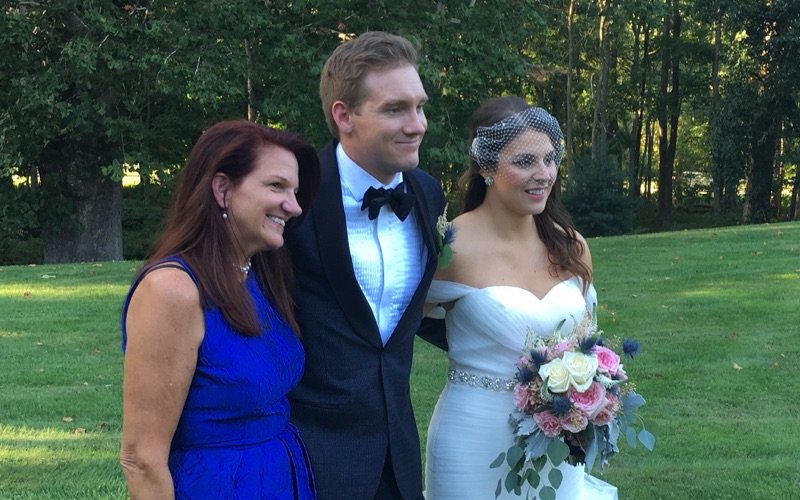
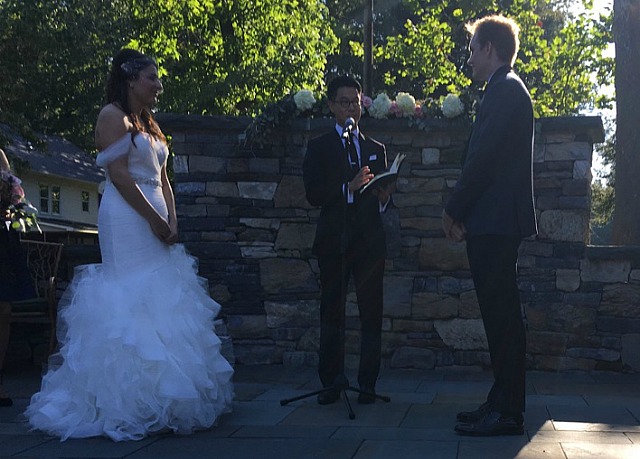
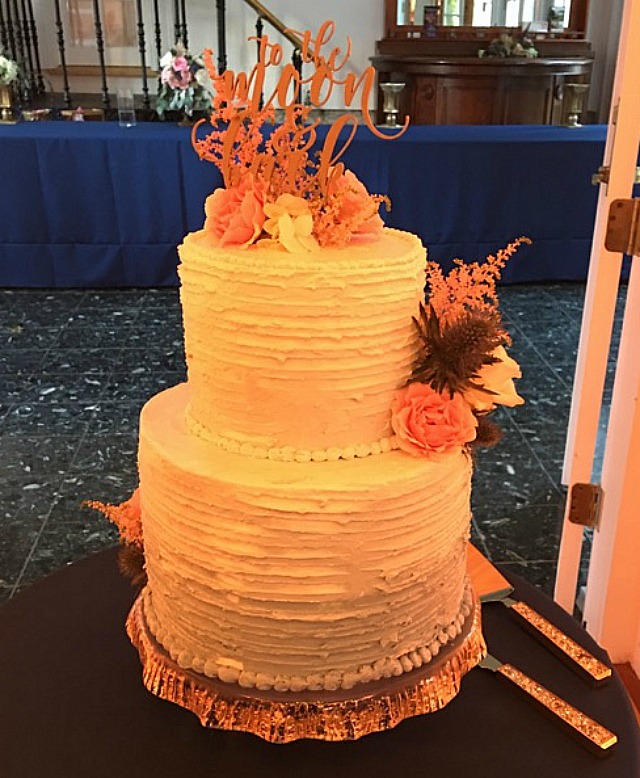
Jett Wells and Caitlin Bennett tied the knot around 4:25 pm today. Beautiful ceremony, warm weather, heartfelt vows, serene vibe, sniffles and hugs…the day couldn’t have been more note-perfect. Including the dinner, dessert, champagne for those who were drinking, etc. Congrats to the newlyweds and anyone else who had anything to do with this atmosphere of balm and cheer. Yes, thanks…another piece of wedding cake!
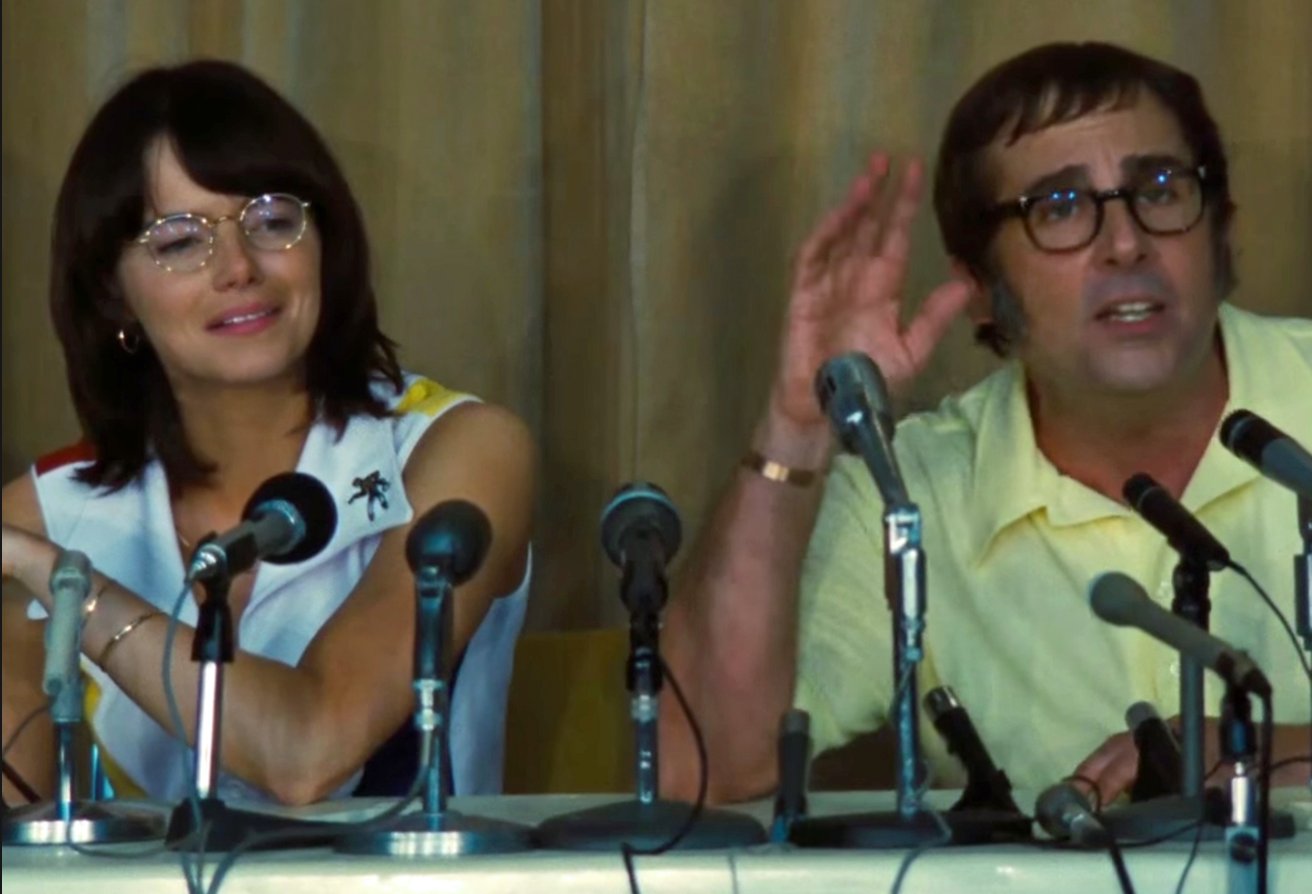
Jonathan Dayton and Valerie Faris‘s The Battles of the Sexes (opening today) is fine as far as it goes. And I’m not saying “fine” as a dodge. It really is an acceptable, good-enough thing.
During my one-and-only Telluride viewing I never once said to myself “this isn’t working” or “why isn’t this better?” I was engaged in the true story as far as it went. I never felt bored or irked. Okay, perhaps a little let down when I began to realize that it wouldn’t be delivering any big knockout moments and that it was basically an acceptable, competently made sports drama with five or six good scenes. But I was always “with” it. No checking the watch, no bathroom breaks.
I wasn’t knocked out by Emma Stone‘s performance as tennis great Billie Jean King, but neither was I disappointed. I believed her; she’s fine. Ditto Steve Carell‘s performance as the occasionally clownish, gambling-addicted Bobby Riggs. Honestly? The performance that touched me the most was Austin Stowell‘s as Billie Jean’s husband, Larry, who shows grace and kindness as he realizes that his marriage is on the downslope due to his wife’s emerging sexuality, and that there’s nothing to be done about it.
Nobody at Telluride was over the moon about Battle of the Sexes, and a few were underwhelmed. But nobody put it down either. There’s nothing wrong with a film that rates a solid 7.5 or thereabouts. I wish more films were as moderately satisfying. I am not damning with faint praise here. Not every worthwhile film has to be brilliant.
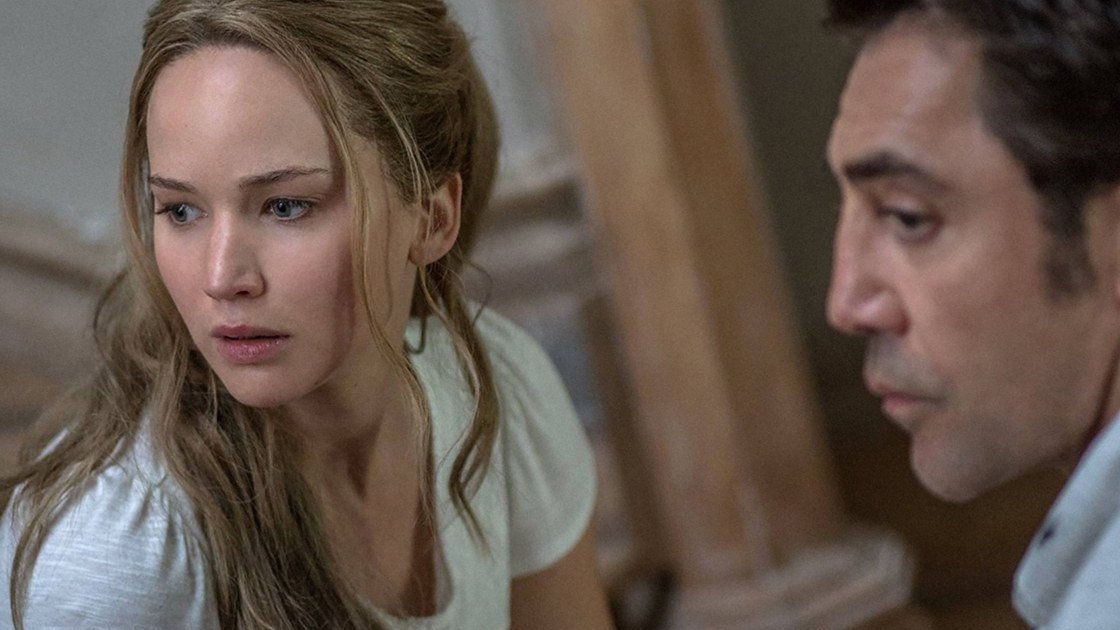
“mother! is Darren Aronofsky’s Stardust Memories, his vehemently exaggerated satire on the burdens of fame. And for anyone who thought that Woody Allen’s 1980 film looked a gift horse in the mouth, critiquing fame from within its comfortable confines, mother! tops it — it’s a cinematic version of an equine root canal. The films’ similarities in intent and differences in degree emerge in one aspect in particular: while Stardust Memories doesn’t exactly flatter Allen’s character, in Aronofsky’s film the artist — freed from direct identification with Aronofsky’s own persona — comes off as an ingratiating monster.
“mother! is the story of a mid-career male artist — a writer, played by Javier Bardem — whose conjoined qualities of celebrity and vanity give rise to a uniquely destructive power. For Aronofsky, the calculus is cruel: the adoring crowd is motivated by a greedy and cavalier selfishness that is sought, enabled, nourished, sustained, and encouraged by the artist himself. His film flirts with the ridiculous and sometimes falls into it — though to ridicule it, or Aronofsky, for doing so is to miss both the point and the pleasure.” — posted by The New Yorker‘s Richard Brody on 9.18.
I’m kind of fed up with traumatic recovery movies. Hard-knock tales about the resilience of the human spirit, I mean. Protagonists walloped and nearly destroyed by some godawful tragedy only to gradually fight their way back to a semblance of a normal life.
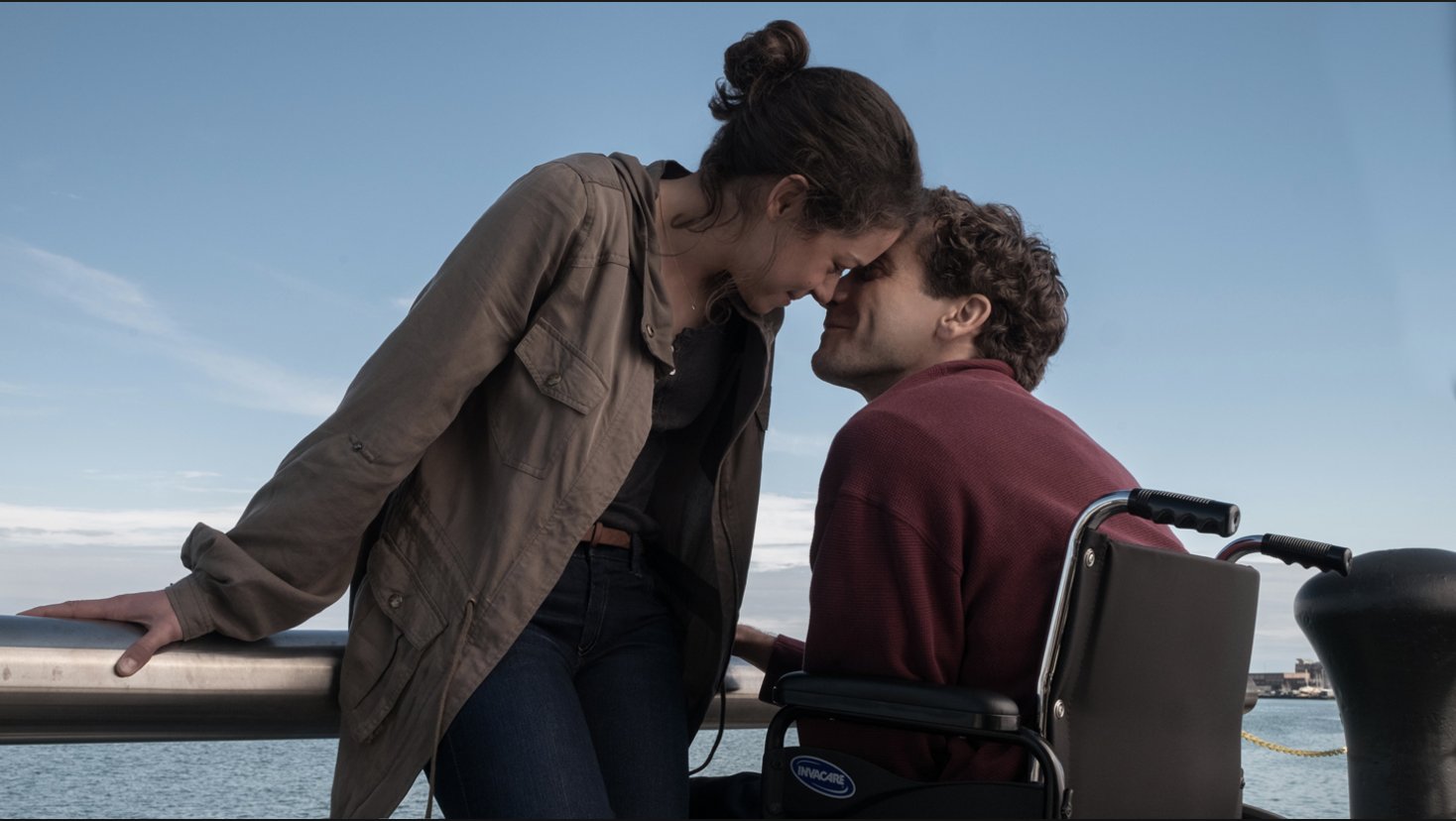
And so I sat down to watch David Gordon Green and Jake Gyllenhaal‘s Stronger (Roadside, 9.22) with a guarded attitude. Here we fucking go again, I told myself — the story of real-life Boston bombing victim Jeff Bauman (played by Gyllenhaal) overcoming the loss of his legs and becoming a hero of perseverance. This is certainly what’s been sold by the trailer, which is full of rah-rah uplift.
Well, guess what? Stronger includes a few inspirational moments in the third act, but mostly it’s a darker, grimmer and more despairing thing than you might expect. It’s been shot and cut in an intimate, off-angled way, and it certainly doesn’t unfold in the usual manner, at least in terms of rousing third-act recovery music and scenes designed to tug at your heartstrings. And Gyllenhaal, it must be said, really drills into Bauman’s pain, shock and despair, and I mean in a Robert De Niro-as-Jake LaMotta sort of way.
Is this Gyllenhaal’s most award-worthy performance ever? That’s a tough call for a guy who’s slammed it out of the park four or five times over the last dozen years (Brokeback Mountain, Zodiac, Nightcrawler, Demolition, Nocturnal Animals) but I honestly think it might be.
Augmented by some first-rate CG that totally convinces you that his legs are truly absent, Gyllenhaal’s Bauman is certainly more intense and blistering than Gary Oldman‘s Winston Churchill, I can tell you that. And I really admire that he never seems to be trying to charm the audience into liking him. That’s partly an aspect of John Pollono‘s script, which is based on “Stronger,” a personal recollection book by Bauman and Bret Witter, but it also comes from Gyllenhaal’s bravery.
The overall emphasis is a lot more on “fuck me” and “this really sucks” than “I not only have the strength to improve my life and make things better all around, but I will make you, the popcorn-munching audience member, feel better about your own life in the bargain.”
Maslany is not…how can I put this?…she’s not exactly my idea of an actress I’d like to hang with for long periods of time or, you know, have a couple of drinks with or whatever, and she’s certainly not the birds-of-a-feather equal of Gyllenhaal in terms of basic attractiveness, but she knows how to make difficult situations and emotions play in relatable dramatic terms. (Last February’s announcement that Bauman and Hurley intend to divorce is ignored by the film.)
The degree to which Stronger is not a formula recovery flick can’t be over-emphasized. The trailer makes it seem like an uplift thing but the trailer lies.
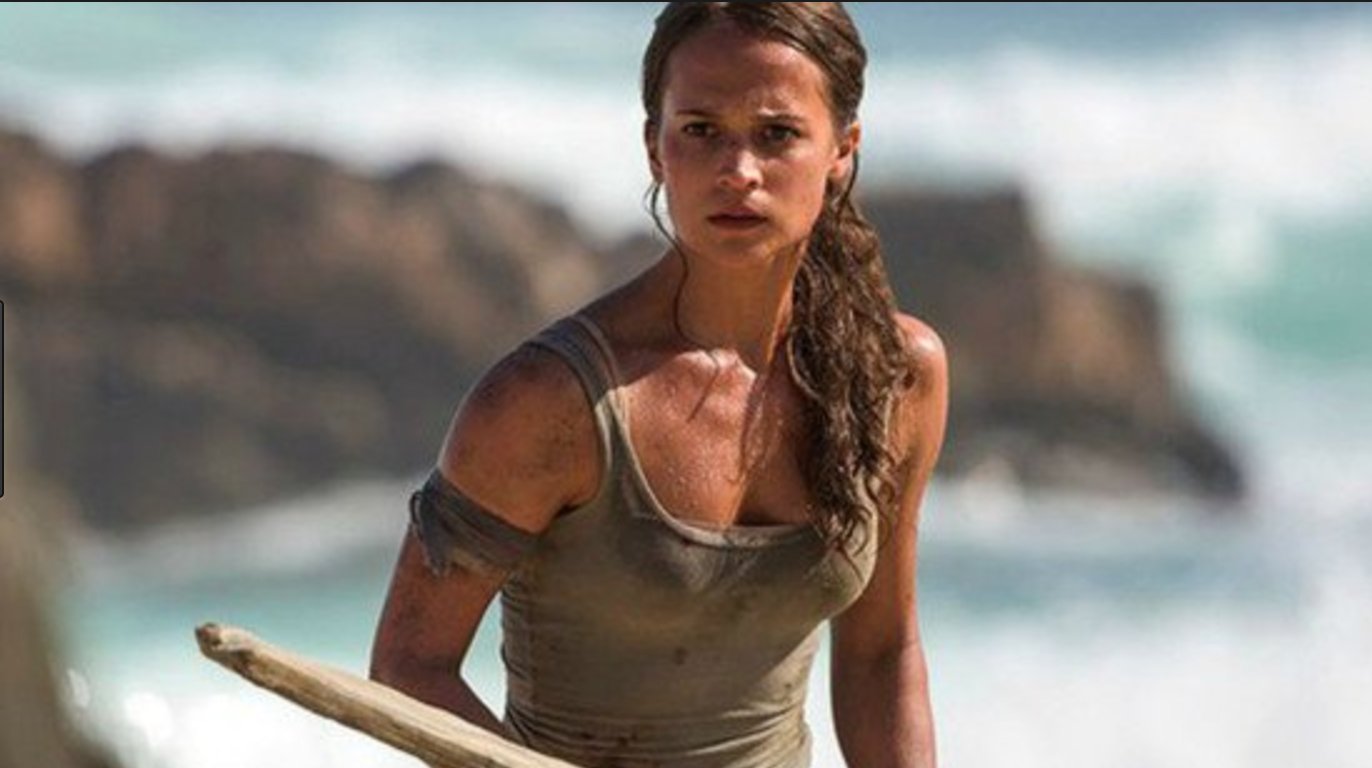
I’ve chatted with Alicia Vikander at a couple of social events. She’s a fine actress (loved her to death in Anna Karenina and Ex Machina) but she’s no more of a muscular, martial-arts badass than Angelina Jolie was when she made Salt. Like Jolie, Vikander is wirey and slender and on the petite side. Unlike Gal Gadot or Gina Carano, she’s no one’s idea of an Olympian, Amazonian badass. So that’s an instant “no sale” on her Tomb Raider, which will on 3.16.18.
I am Yul Brynner‘s Ramses, standing in my gleaming blue-and-white chariot and holding three golden arrows above my head as I attempt to rouse the fighting spirit of the Egyptian army: “Death to Tomb Raider! Death to the executives who pushed this through the Warner Bros. bureaucracy! Death to any and all attempts to make super-muscular action heroes out of 110-pound actresses whom I could personally take with one hand tied behind my back!”
I suffered through a few recurring-theme nightmares in my early childhood. Gorillas, drowning in quicksand, boxer dog chefs walking around on their hind legs and wielding carving knives, frying in the electric chair. But none of these generated the feelings of dread and terror that I developed in my teens and 20s over the prospect of a blue-collar, wage-earning life.
For many years I was absolutely horrified by the idea of having to get up at 6 am and report to work by 8 am or earlier, and being stuck with a physically demanding manual-labor job, especially in cold weather. My father was an advertising guy who always wore a suit. He commuted on a train and was never expected at the office before 9 or 9:30 am. That, to me, was a civilized, managable approach to work and earning a salary. Grunt-level blue-collar work always struck me as a brutal, punishing activity — the kind of work that was guaranteed to make you feel miserable and frustrated and drive you to drink in your off-hours.
I was stuck with miserable jobs in my late teens and early to mid 20s (working for a furniture company, driving a delivery truck for a lumber yard, chain-link fence, tree surgery). I was finally freed from that treadmill when I broke into New York journalism in the late ’70s. If I’d never broken out of that blue-collar cycle…I don’t want to think about it. But it would’ve been awful.
On 11.21 Kino Classics will release a Bluray of David O. Selznick and John Cromwell‘s Since You Went Away (’44), a domestic wartime drama that runs nearly three hours. The Bluray contains the 177–minuteroadshowversion while Wikipedia lists a general release version running 172 minutes.
I can watch The Best Years of Our Lives over and over, but I can’t invest in watching a nearly-three-hour woman’s film starring Claudette Colbert. She was mildly alluring in the ’30s (Cleopatra, It Happened One Night, Midnight) but something intensely stodgy and conservative overtook her in the ’40s. Plus she was a Republican and a Reagan supporter, and she had a short neck.
Since You Went Away is famous for a sentimental railway station goodbye scene between costars Jennifer Jones and Robert Walker, who’d been married for four or five years at the time of filming. But Jones had been having an affair with Selznick since ’43, and the couple was going through a bitter divorce; they parted soon after Since You Went Away was completed. The farewell scene was parodied in Airplane! (’80 — clip after the jump)
The father of actor James Cromwell, the elder Cromwell was a kind of house director who churned out audience movies in the ’30s and ’40s (The Prisoner of Zenda, In Name only, Abe Lincoln in Illinois) before shifting into film noir (Dead Reckoning, The Racket). The poor guy was blacklisted from ’51 through ’58. His last significant film was The Goddess (’58), which was thought to be based on the unhappy personal life on Marilyn Monroe.
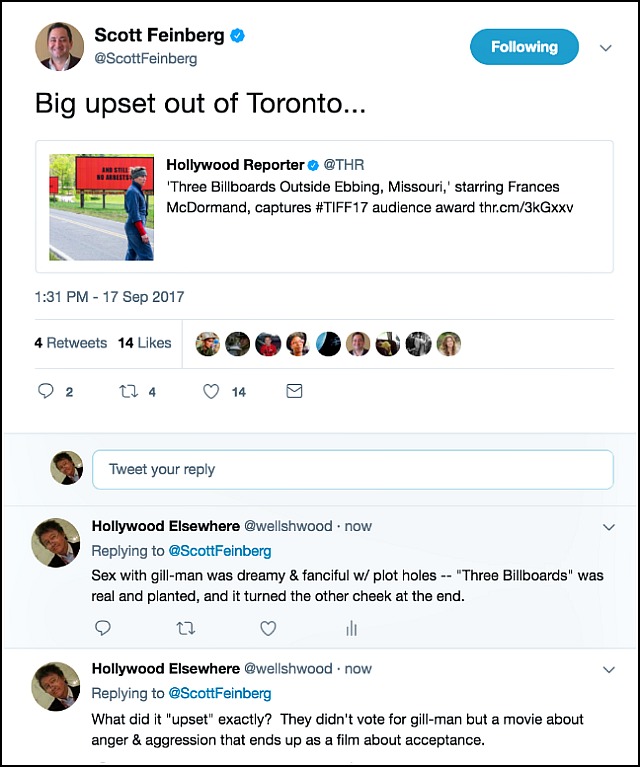
Hollywood Reporter award season pulse-taker Scott Feinberg called the Three Billboards win an “upset” because he’d been predicting Guillermo del Toro‘s The Shape of Water for the win. I suspect that TIFF audiences appreciated Shape as far as it went (i.e., sex with gill-man) but they really liked where Three Billboards went at the end — away from anger, turning it down, acceptance.
The Midnight Madness Award went to Joseph Kahn’s Bodied (winner), Craig Zahler’s Brawl in Cell Block 99 and James Franco’s The Disaster Artist.
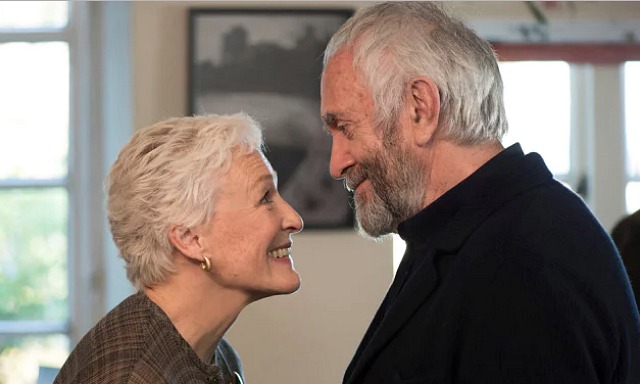
I didn’t attend this morning’s 8:45 am screening of Bjorn Runge‘s The Wife, but The Guardian‘s Peter Bradshaw did, and his review goes nuts for Glenn Close‘s performance as a “charming, enigmatically discreet and supportive wife” of a world-famous author and New York literary lion (played by Jonathan Pryce.
Close’s performance as Joan Castleman “may be [her] career-best,” Bradshaw says, and “a portrayal to put alongside Close’s appearances in Dangerous Liaisons and Fatal Attraction.” He describes her character as “unnervingly subtle, unreadably calm, simmering with self-control…a study in marital pain, deceit and the sexual politics of prestige.”
That sounds like something strong enough to launch Close into the Best Actress derby, but we’ll need to hear from a few more critics before going down that path. No Rotten Tomatoes entries as we speak.
Hollywood Elsewhere is going to try to attend a 6:30 pm screening of The Wife on Thursday evening at Roy Thomson Hall. So dar I can’t find a publicist who’s repping the film. If anyone knows anything and could lend a hand, please get in touch.
Close and Pryce aside, The Wife costars Christian Slater, Annie Starke, Max Irons, Elizabeth McGovern and Harry Lloyd.
Abuse begets more abuse, and abused victims sometimes (often?) seek out fresh replacement abusers. And so Tonya Harding‘s bitter, chain-smoking mom, Lavona, beat and belittled her daughter from age of 7 onward, and as teenaged and then 20-something Tonya ascended in the figure-skating realm she became a ferociously angry abuser herself with a huge chip on her shoulder…what else?
Tonya married and then separated from an abusive, moustache-wearing asshole, Jeff Gillooly, who conspired to have Harding’s skating rival Nancy Kerrigan temporarily disabled with a police-baton blow to the knee, and with many presuming, fairly or unfairly, that Harding was aware of Gillooly’s plan and was more or less down with it.
Craig Gillespie‘s I, Tonya, an exaggerated, pugilistic black farce that some are calling grimly comedic, is all about the Harding catastrophe, and it’s definitely the Toronto Film Festival movie to see and get walloped by right now.
I, Tonya press-screened this morning at 10:45 am. Well, actually 11:05 am because it took so long to get everyone in. I was there and dealt with the long, horrible, hope-crushing line that stretched east along Richmond and south down John Street. I saw it and I ate it, suffering the blows and bruises and the eye-popping realization that I, Tonya currently has a 100% Rotten Tomatoes rating.
The cool kidz love it, but I’m telling you that unless you have a strange liking for the company of losers, abusers and total dipshits, you’ll definitely want to steer clear of this cesspool exercise. It lasts 119 minutes, and it feels, trust me, like 139 or 149.
When it ended I turned to the guy next to me and said, “How long was that?” “Two hours,” he said. “Good God,” I replied.
Am I the only honest, straight-shooting journo-critic in Toronto right now? I, Tonya is cinematic abuse, pure and simple. It’s an ugly pill from hell — a violent, vulgar, relentlessly profane assembly of lower-middle-class white-trash types beating on each other and smoking and swearing and losing their tempers and causing cuts and swellings. It’s a tacky portrait of American self-loathers, brawlers, grotesques, hungry-for-famers, human garbage, etc.
I tweeted the following just after 1 pm today: “I, Tonya is an ugly, abusive, lower-class tale about a demimonde of ugly, abusive, lower-class people. A movie full of rage and resentment. A toilet-bowl downswirl of wretched, lower-middle-class misery.
Thirteen months ago I threw some praise at a 5.11.16 draft of Taylor Allen and Andrew Logan‘s Chappaquiddick. I tore through it in no time. It’s the kind of well-finessed backroom melodrama that I love — no bullshit, subdued emotions, no tricks or games. It’s tense and well-honed, and, like I said on 8.18.16, a nightmare that had me shaking my head and muttering “Jesus H. Christ”.
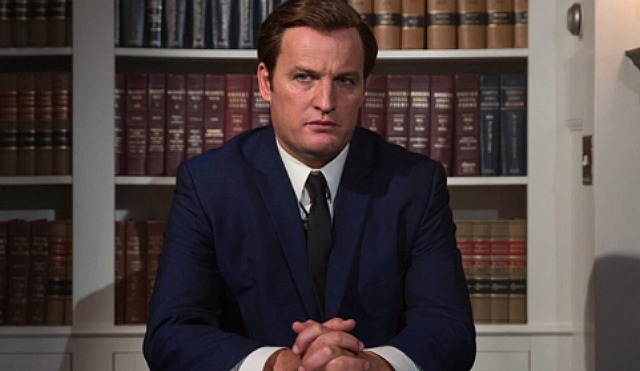
Like the script, the film (which I saw this morning at 8:30 am) is a damning, no-holds-barred account of the infamous July 1969 auto accident that caused the death of Kennedy family loyalist and campaign worker Mary Jo Kopechne, and which nearly destroyed Sen. Edward Kennedy‘s political career save for some high-powered finagling and string-pulling that allowed the younger brother of JFK and RFK to more or less skate.
Jason Clarke as the late Senator Edward M. Kennedy in John Curran’s Chappaquiddick.
Just about every scene exudes the stench of an odious situation being suppressed and re-narrated by big-time fixers, many of whom are appalled at Ted’s behavior and character but who do what’s necessary regardless.
There’s no question that director John Curran, dp Maryse Alberti and editor Keith Fraase are dealing straight, compelling cards, and that the film has stuck to the ugly facts as most of us recall and understand them, and that by doing so it paints the late Massachusetts legislator and younger brother of JFK and RFK in a morally repugnant light, to put it mildly.
All along I’ve been hoping that Curran would just shoot the script efficiently, minus any kind of showing off or oddball strategies that might diminish what was on the page. This is exactly what he’s done. Curran has crafted an intelligent, mid-tempo melodrama about a weak man who commits a careless, horrible act, and then manages to weasel out of any serious consequences.
Chappaquiddick may not be the stuff of monumental cinema (stylistically it feels like a respectable HBO-level thing), but it’s a frank account of how power works (or worked in 1969, at least) when certain people want something done and are not averse to calling in favors. EMK evaded justice by way of ingrained subservience to the Kennedy mystique, a fair amount of ethical side-stepping and several relatively decent folks being persuaded to look the other way.
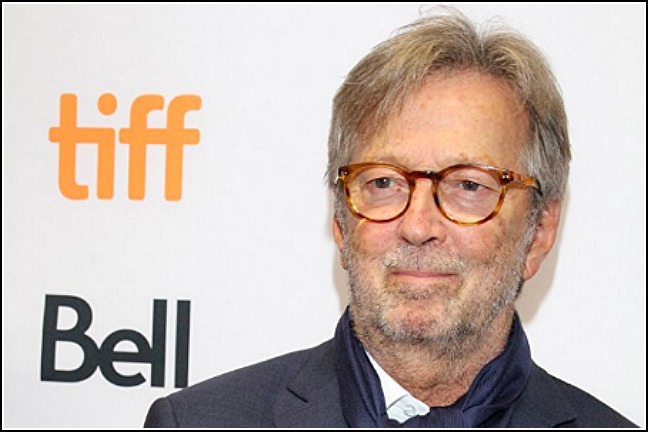
Lili Fini Zanuck‘s Eric Clapton: A Life in 12 Bars illustrates a rule about documentaries and particularly talking-head footage that bears repeating.
If you have an ample supply of alluring, great-looking, non-grainy footage, you’re free to forego talking heads. Just hire a top-tier editor, overlay some wise, insightful narration and you’ll probably be fine. But if your footage is mainly composed of grainy, shitty-looking photos mixed with black-and-white TV footage, you definitely need to intercut with well-recorded, high-def color footage of this and that knowledgable, insightful authority.
The reason, obviously, is that you’ll want to occasionally free the viewer from the prison of fuzzy, shitty-looking stills and black-and-white TV footage, and you’ll also want to heighten the impact of your vocal observations as a way of adding intellectual intrigue and fighting the general monotony.
I’ve just walked out of a screening of Eric Clapton: A Life in 12 Bars because the portion I saw (a) was almost all grainy, shitty-looking photos and black-and-white TV footage (it really needs a roster of well-lighted talking heads) and because (b) the cutting felt uninspired and inelegant and (c) I began to feel hugely irritated and then angry from the generally sloppy, substandard feel of it.
Granted, I only lasted from the beginning of Clapton’s guitar-playing career to the dawn of musical psychedelia, or from late ’63 to early ’67 (Yardbirds, John Mayall & the Bluesbreakers, Cream). But Zanuck didn’t even touch upon the musical influence of pot and LSD and particularly the mystical-psychedelic consciousness that began to spread all through the music industry starting in late 1965, and which flourished in ’66, ’67 and beyond.
Cream wasn’t just another band for Clapton (or Jack Bruce or Ginger Baker) — it represented a whole spiritual changeover, a new way of living and seeing…everything top to bottom. To quickly transition from being a hard-core blues purist to a psychedelic pioneer was huge for a guy like Clapton, and yet the doc just cuts from shitty-looking black and white stills and footage of Clapton hanging and playing with Mayall and the gang to shitty-looking black and white film of Clapton, Bruce and Baker playing “I Feel Free,” which was among the strongest cuts from Fresh Cream.
All of a sudden I said to myself, “Fuck this movie…Zanuck and her producers and editors are just going through the motions, running footage, hanging wallpaper.” I suddenly needed to feel free, and so I got up and left.
I may catch the rest of Eric Clapton: A Life in 12 Bars when it plays on Showtime. Maybe. If I feel like it. We’ll see how that goes.