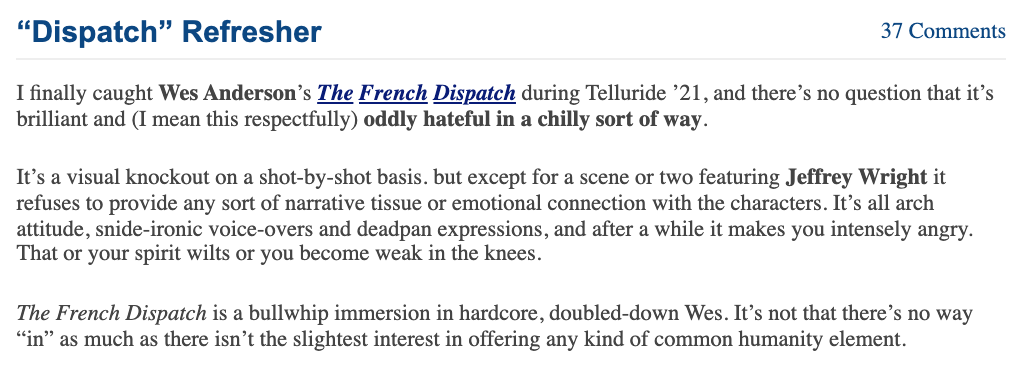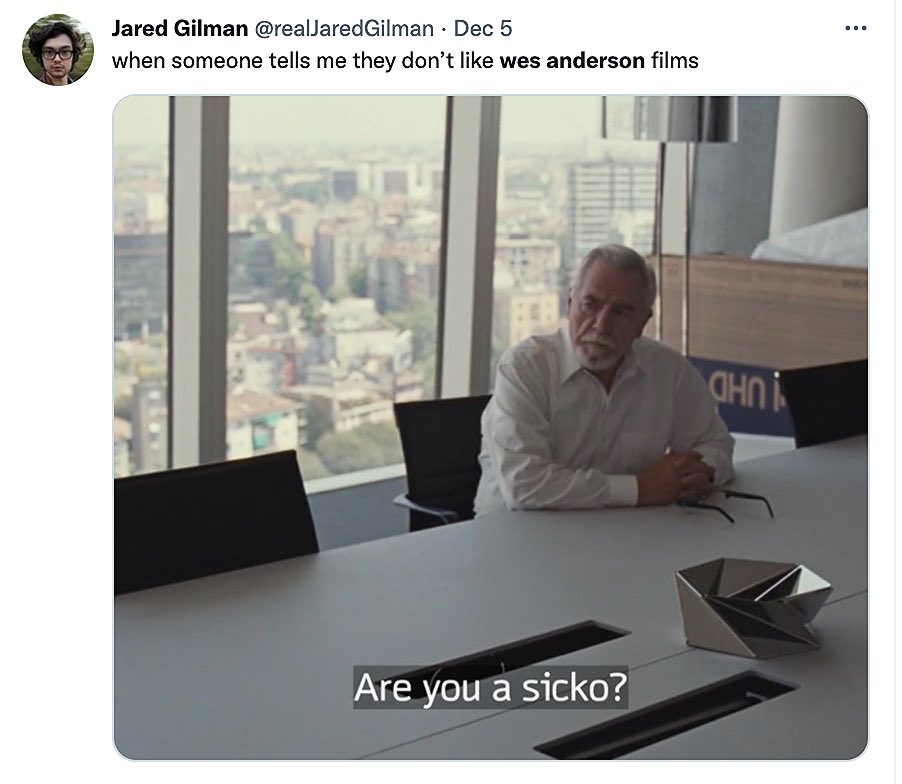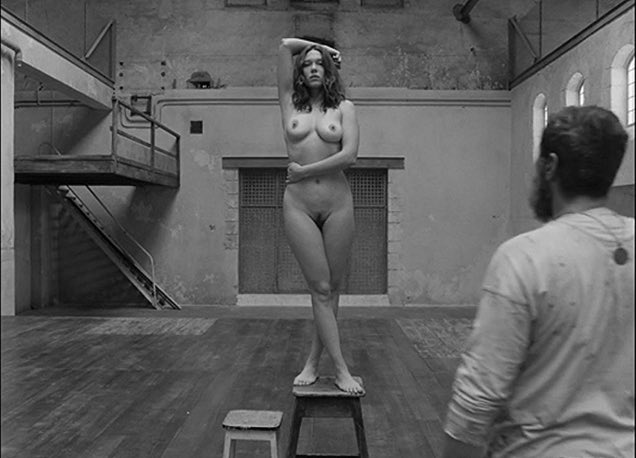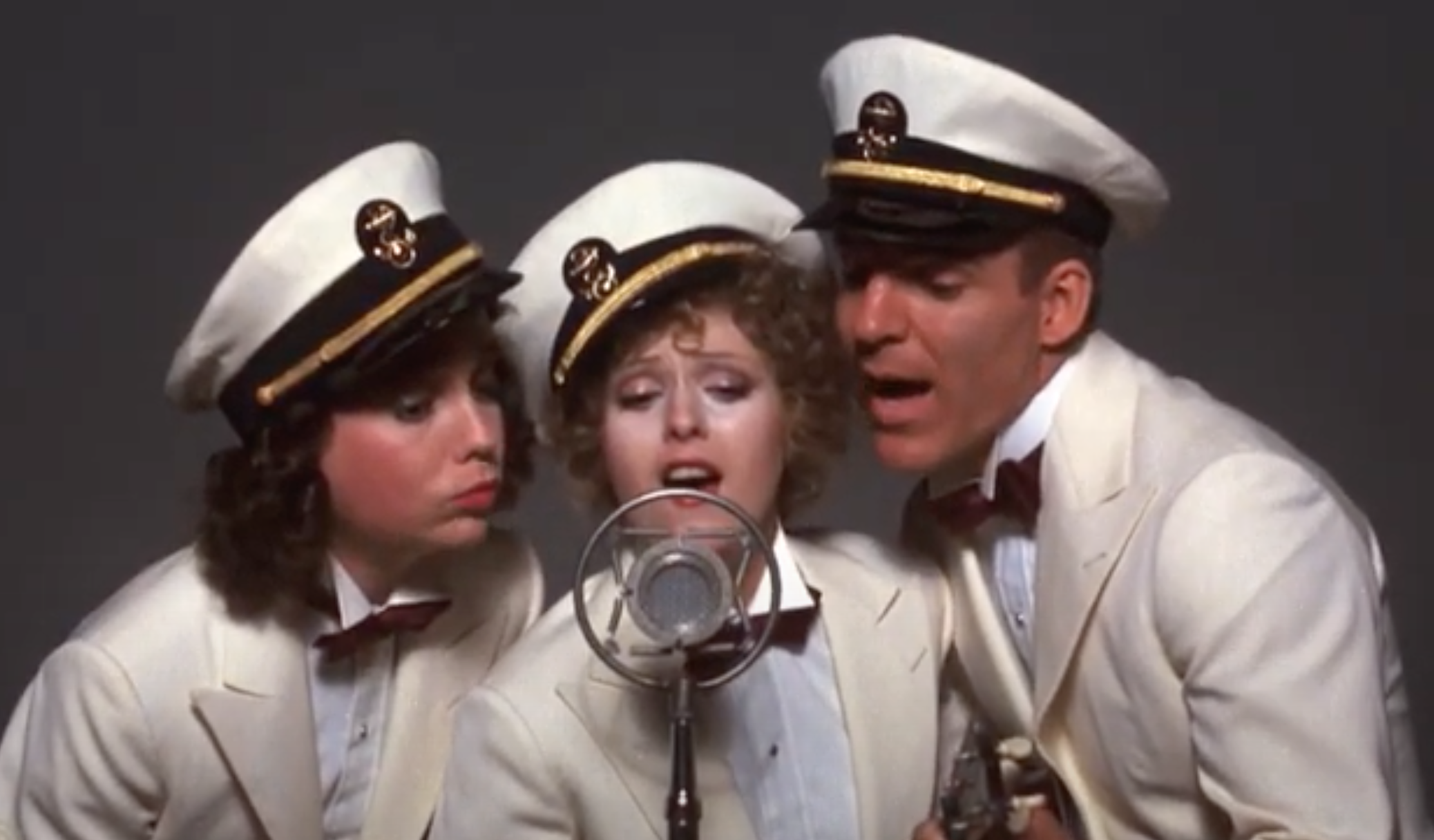
Of course I love Wes Anderson creations…of course I do! It’s just that many of my Anderson faves are his commercials, and those dozens upon dozens of YouTube parodies. Feature-wise I’ve always been and will always be fully respectful of Anderson’s brand or stylistic stamp, and that includes, believe it or not, The French Dispatch, which I had a mostly unpleasant time with at Telluride last September.
But I am a genuine, whole-hearted fan of only a handful of Wes’s films — Rushmore (which I’ve always adored like a brother), Bottle Rocket, The Grand Budapest Hotel, the original black-and-white Bottle Rocket short, most of The Royal Tenenbaums. But I dearly love the Wes signage, specifically the shorts and parodies. The SNL Anderson horror film short is heaven.
I will always be on Team Anderson, and I will never resign. Partly because I’m 100% certain that one day he’ll reach into his heart and decide to broaden his scope, or perhaps even re-think things somewhat. (Wes is still relatively young.) He has to — artists have no choice. I just hope and pray he’ll make more of an effort to blend his hermetic Wesworld aesthetic with the bigger, gnarlier, more complex world that’s been there all along.
Two and a half years ago I suggested that 2007 was and is one of the great film years, or roughly at par with 1999, 1971 and 1962 and 1939.
I listed 25 2007 films of serious merit — American Gangster, Before The Devil Knows You’re Dead, No Country for Old Men, Once, Superbad, Michael Clayton, There Will Be Blood, Things We Lost in the Fire, Zodiac, The Assassination of Jesse James by the Coward Robert Ford, Atonement, 4 Months, 3 Weeks, 2 Days, I’m Not There, Sicko, Eastern Promises, The Bourne Ultimatum, Control, The Orphanage, 28 Weeks Later, In The Valley of Elah, Ratatouille, Charlie Wilson’s War, The Darjeeling Limited, Knocked Up and Sweeney Todd. Just as strong as ’99, and perhaps even a touch better.
The idea in re-posting this is to note that 15 years have elapsed since ’07, and to ask if anyone feels that any of these annums have measured up to ’07 or any of the previous banner years.
I happen to believe that everything started to go badly the following year — 2008 — with the debut of Iron Man and the subsequent increasing power of the superhero genre (DC Extended Universe, Marvel Cinematic Universe), and that “my” kind of movies haven’t been the same since. Strong, distinctive films have broken through every year, of course, but the pickings have been getting slimmer and slimmer since ’08, and especially since the Robespierre thought plague began to poison the water in ’17.
But don’t let me stop anyone. If you’re persuaded that ’09 or ’11 or ’16 were up to snuff, please make your case.
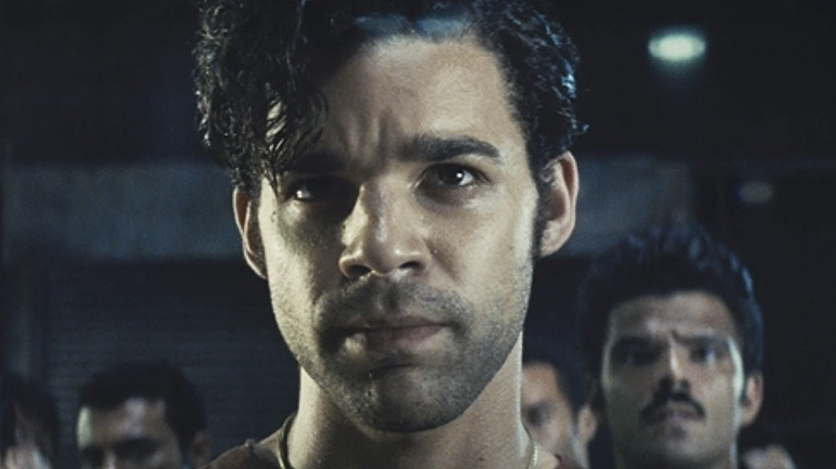
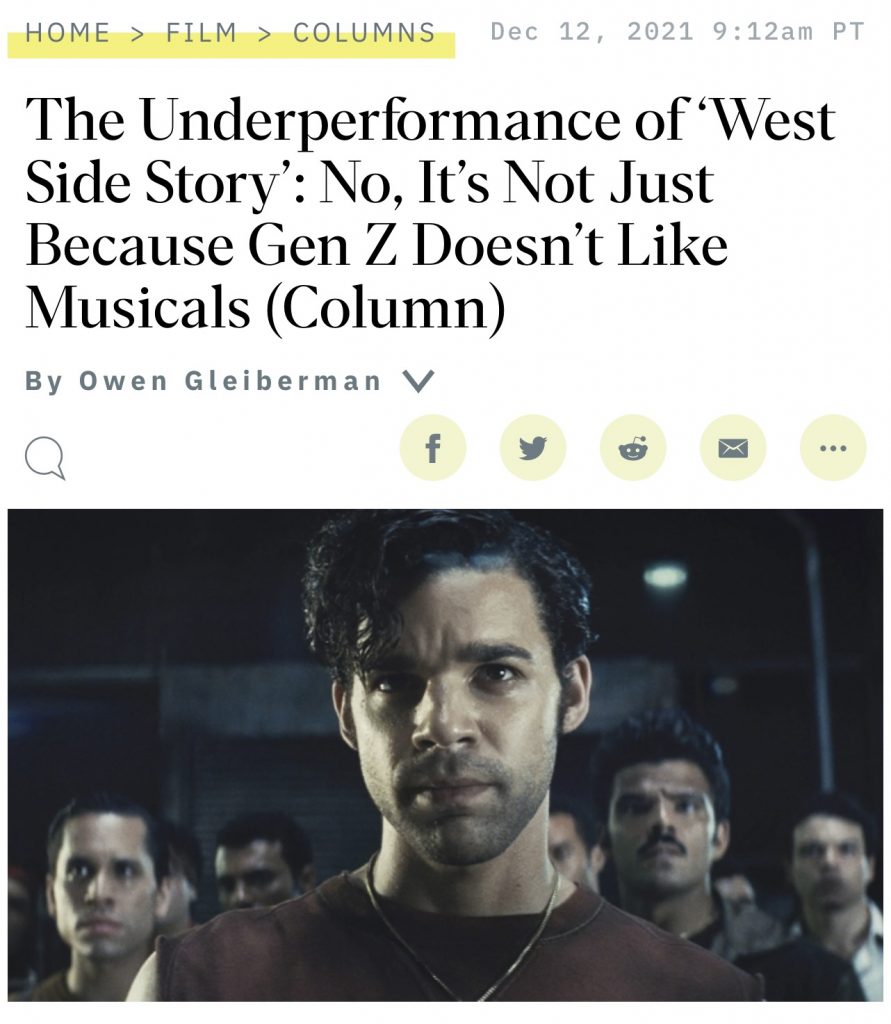
Herewith a toughbutfairassessment from Variety’s Owen Gleiberman about why West Side Story (and it breaks my heart to say this) appears to be a flopperoo, at least as far as viewing appetites outside your X-factor Millennial, older GenX and boomer demos are concerned.
Not technique- or chops-wise but vision-wise in terms of reading the cultural zeitgeist, Gleiberman is saying that Spielberg’s instincts are perhaps no longer in synch with things, at least notinarazor–sharpway and certainly not like they were between Duel and Schindler’sList/Jurassic Park. He’s gotten older. It happens.
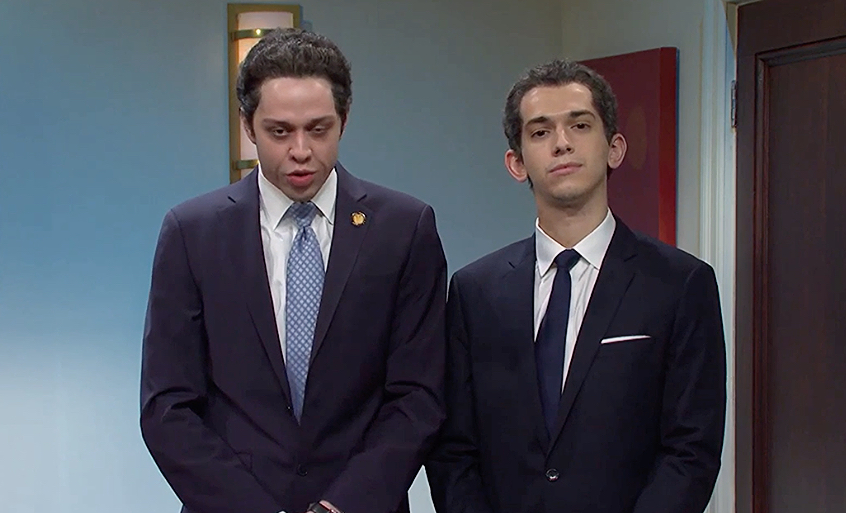
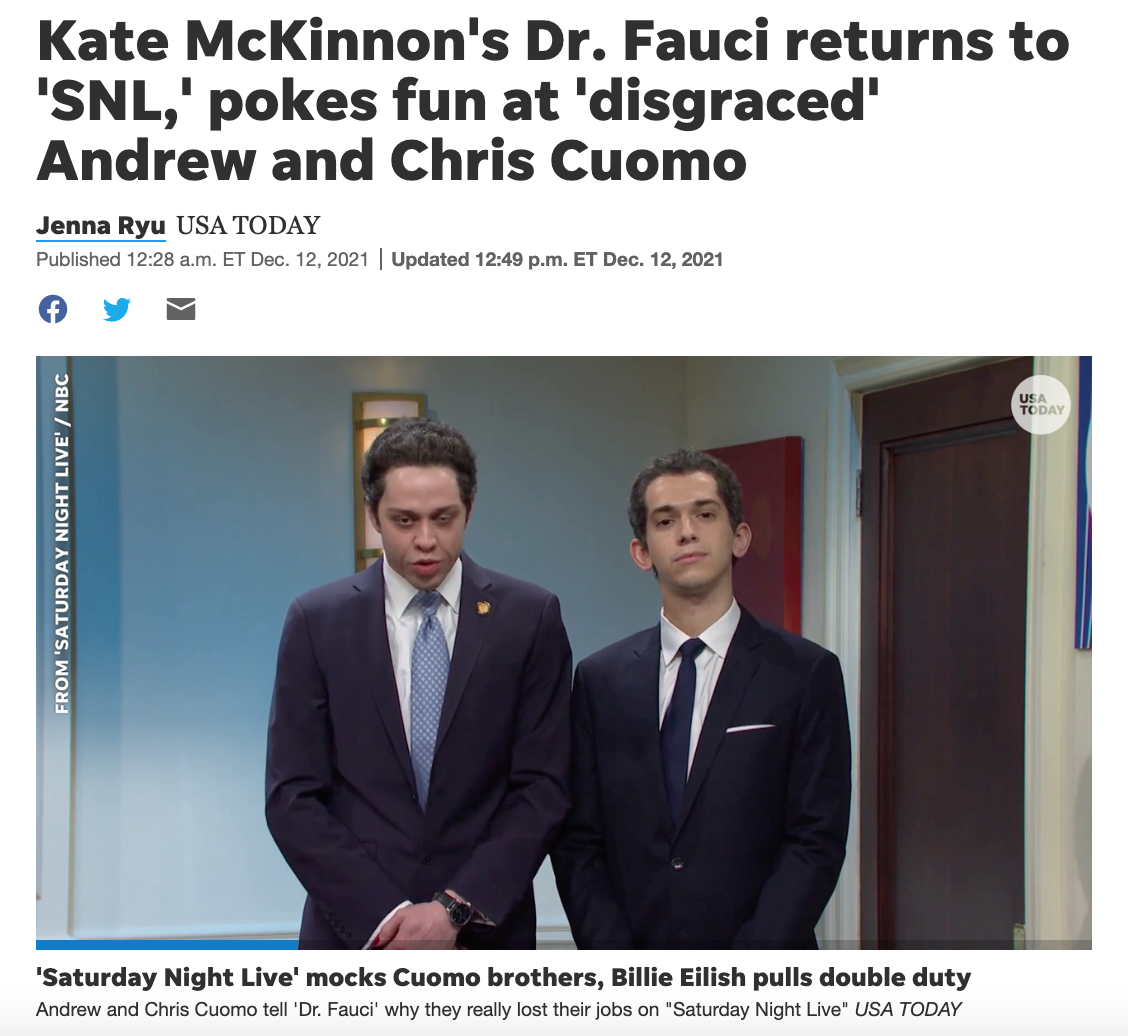
Arrogant assumptions + klutzy presumptions that it wouldn’t all come out in the wash don’t translate into “disgrace” for ex-CNN anchor Chris Cuomo. He’s not a panting sexual animal, and isn’t in the same league with brother & ex-governor Andrew at all. It was rash and sloppy for the SNL team to slander him with the “d” word.
By the way, with Chris Wallace resigning from Fox is it feasible for the Trump-loathing Chris to fill his slot? Probably not, I would imagine.
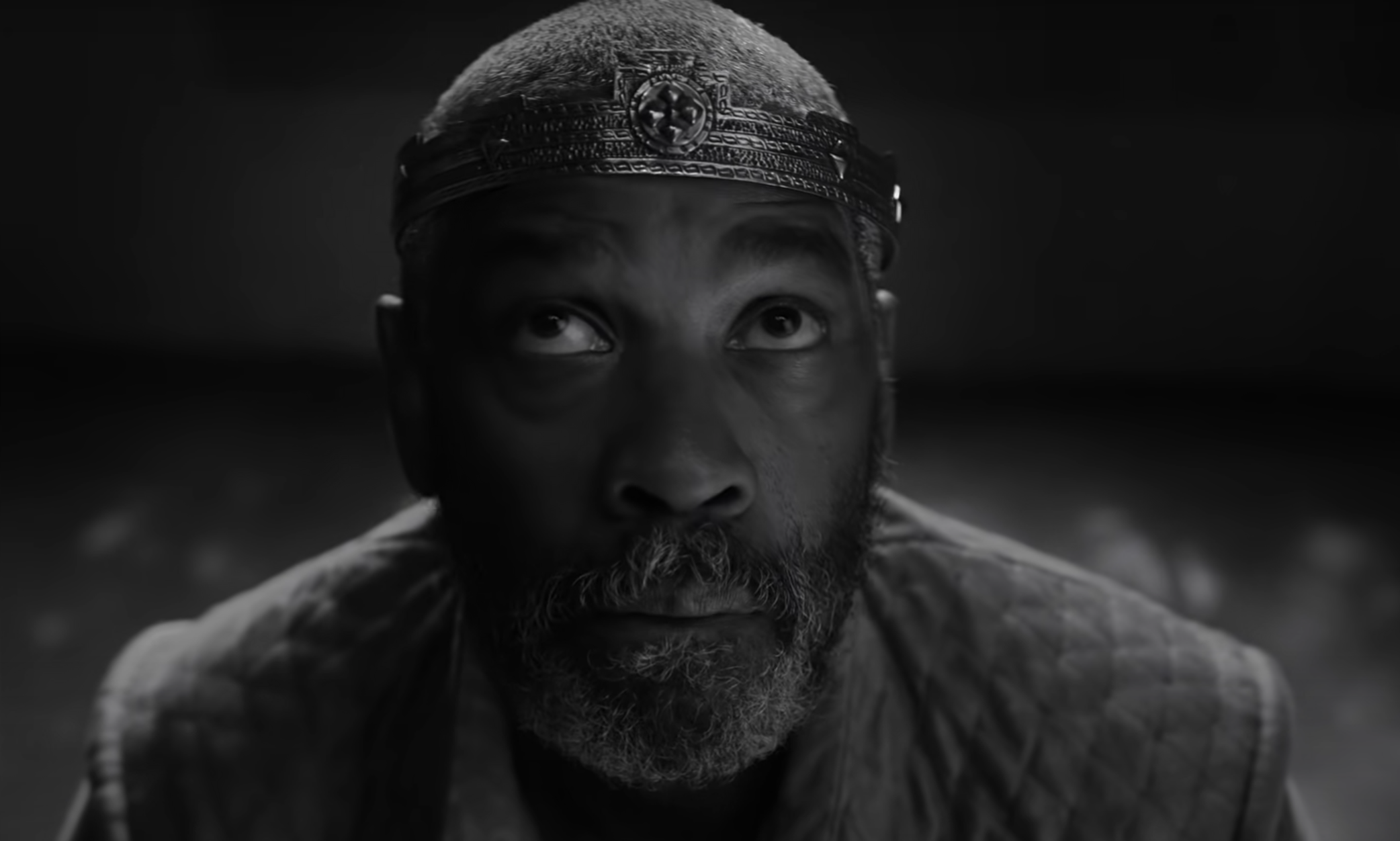
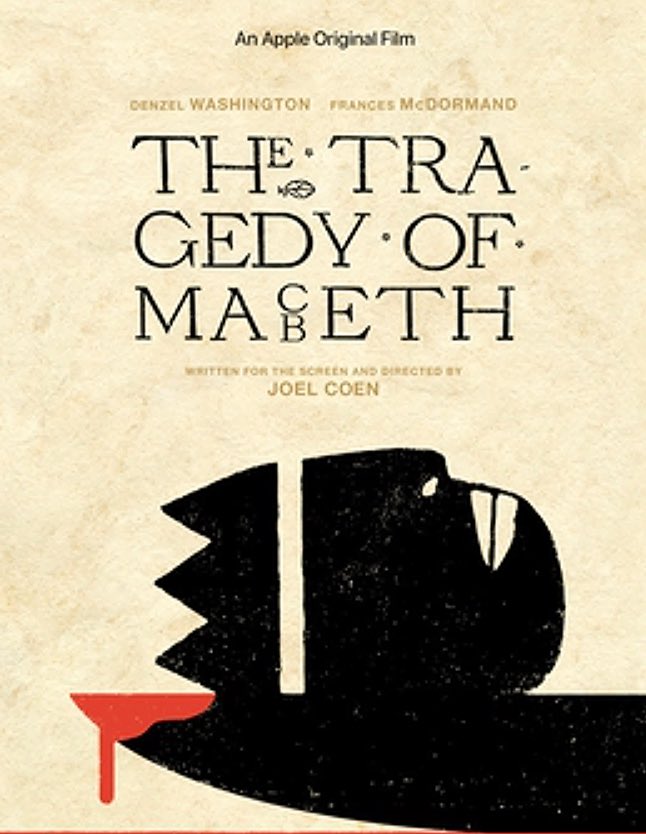
Last night I watched Joel Coen and Frances McDormand‘s The Tragedy of Macbeth (Apple, 12.25). For some reason I woke up at 4:30 this morning, and just as my head was clearing a friend texted to ask what I thought.
“Not half bad!,” I replied. “I found it striking, gripping, strict and to the point. The grim grip of horror that resides in the human heart. A literate, thinking person’s story of doom foretold. The austere approach was more captivating than expected, given the Venice turndown and the spotty word of mouth.
“It’s relatively short (105 minutes), so much so that it almost felt like Macbeth’s greatest hits (abridged). I loved the spooky sets and the dense fog and the circling hawks and definitely the performance by recent NYFCC award-winner Kathryn Hunter, who plays the three creepy witches. And I was very impressed with Alex Hassell’s highly disciplined performance as Ross. And I adored Bruno Delbonnel’s sharp and silvery cinematography.
“McDormand really nailed her eerie, obsessive, sharp-taloned Lady Macbeth — she was almost coming from the same place as Hunter. Now and then Denzel’s delivery of this or that passage was quite affecting; at other times (“Cans’t thou not minister to a mind diseased…pluck from the memory a rooted sorrow?”) a bit under-nourishing. But he’s still The Great Denzel.
“I still vastly prefer the 1971 Polanski version but Coen and McDormand definitely found their own tone and approach. It’s a film that warrants respect.”
The cast of Joel Coen‘s The Tragedy of Macbeth, a play about medieval Scotland, is pretty close to one-third African American. Presentism is par for the course these days, of course, but Coen and wife-producer-costar Frances McDormand seem to have moved beyond your obligatory woke casting requirements.
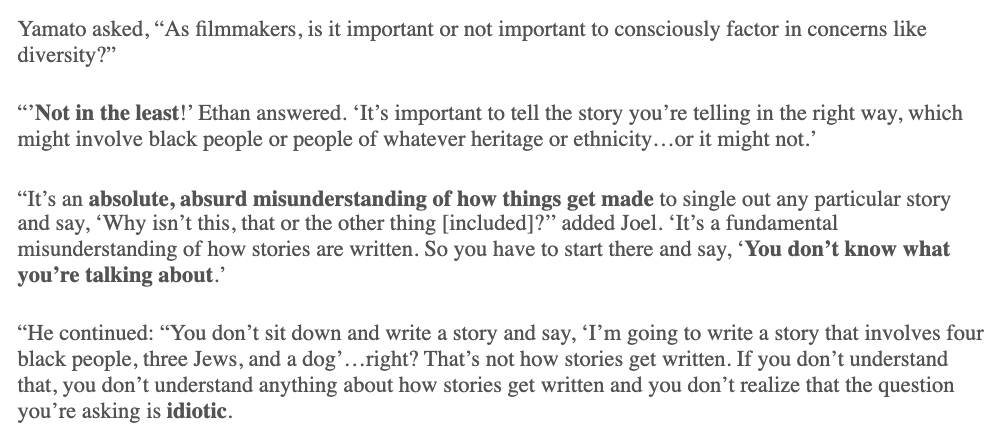
Yamato had brought up the issue of diverse casting and multi-ethnic representation. Even though Hail Ceasar was set in the racially illiberal early ’50s, her beef was basically #WhyIsHailCaesarSoWhite? Joel’s attitude was quite resistant and in fact fairly dismissive. Boiled down, his view was “why should I ethnically mix up my cast just for political reasons?”
It’s probably fair to say that a different Joel was at the helm when it came to casting The Tragedy of Macbeth. I know nothing, but I suspect that McDormand told him “you can’t really play it that way now, plus there are so many great actors of color out there…you should get in on this.”
Obviously Joel could have ignored the presentism requirement and made Macbeth as a traditional all-paleface play a la Roman Polanski and Orson Welles, and if anyone had complained he could have used the same argument he threw at Yamato. So why didn’t he? Because the Yamato mindset is industry-wide now, and he figured “well, I guess I need to get with the program…why make trouble for myself?…why not just embrace presentism and turn it into a plus?”
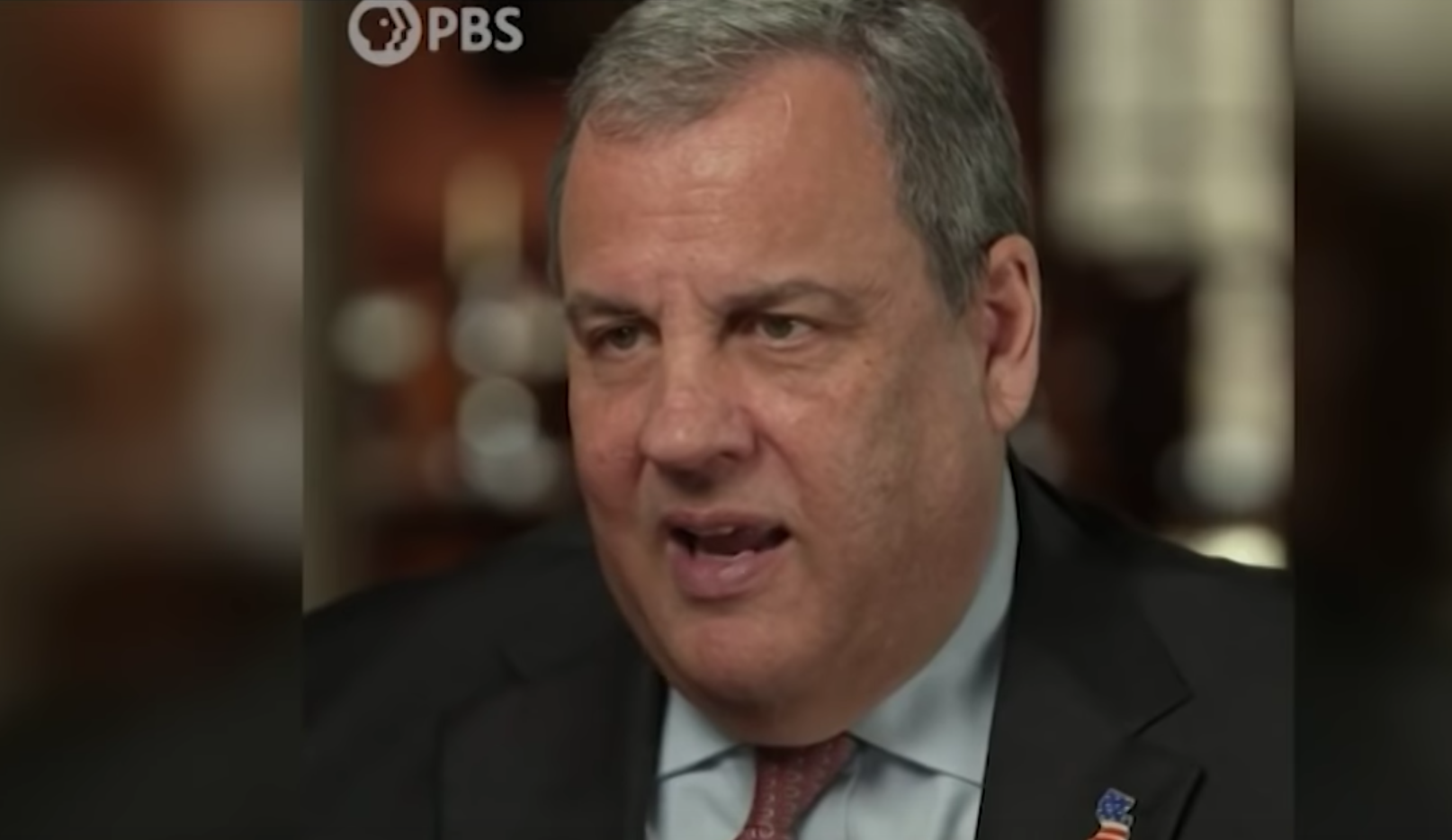
During his four days of debate prep with the secretly infected Donald Trump, Chris Christie got Covid and wound up in the hospital and in serious trouble. Apparently chief of staff Mark Meadowsknew Trump was infected during those four days. A pig, an animal and a complete sociopath, Trump may have infected as many as six people during that prep. And Meadows, says Christie, kept this information under wraps “for a book…he saved it for a book.”
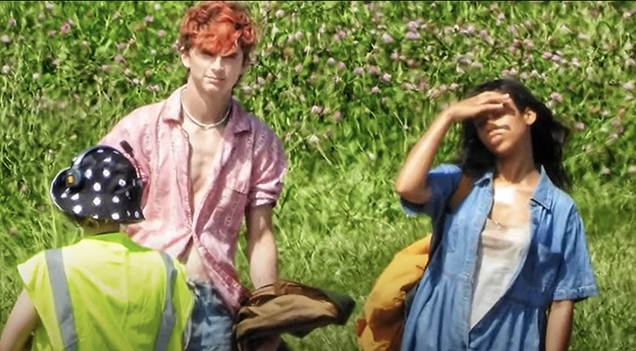
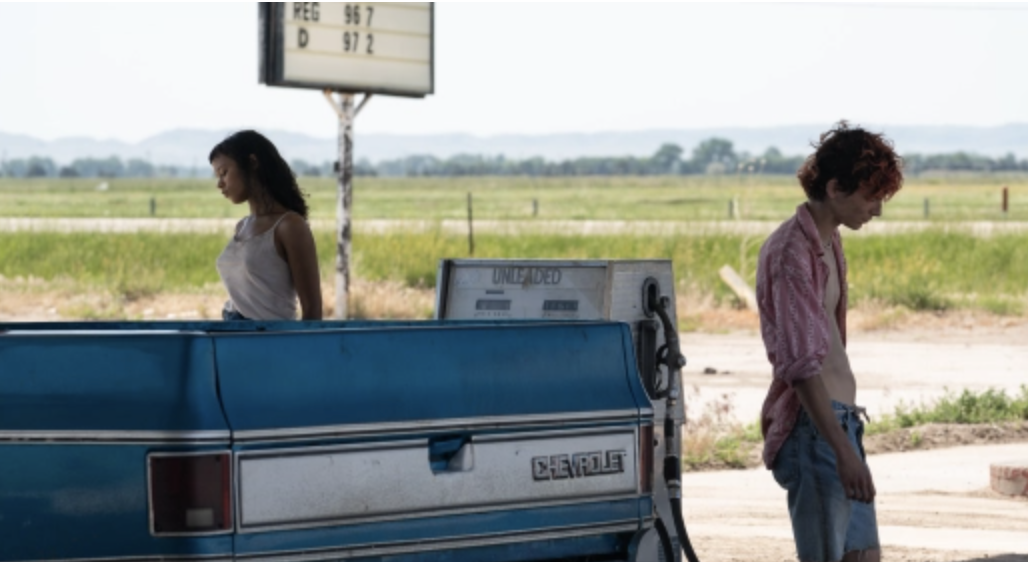
Sundance ’22 will announce the slate tomorrow (12.9)…I think. Late last month Indiewire‘s Kate Erbland and Eric Kohnspeculated that Luca Guadagnino‘s Bones and All, a cannibalism in the ’80s love story starring Taylor Russell and Timothee Chalamet, might debut there.
But it won’t. An authoritative source told me this morning that Bones “is still in the works and will not be ready for months.” Which sounds to me like it might not even be ready for Cannes — more likely the early fall festivals (Venice/Telluride/New York)?
I thought Bones might be a Sundance fit given that Guadagnino’s Call Me By Your Name enjoyed a triumphant Park City debut in January 2017, or nearly five years ago. But of course Sundance was an entirely different equation back then. The Park City gathering was still a powerhouse indie launch thing (Manchester By The Sea was the big explosive film of Sundance’s 2016 fest.) Since then, of course, Sundance has changed identities. It’s now the Sundance Wokester Festival….a secular event for people of the wokester faith & cloth.
In short, even if Bones was ready for Sundance ’22 it probably wouldn’t be a great idea.
Aaron Sorkin‘s Being The Ricardos opens theatrically on Friday (12.10); Prime Video streaming starts on Tuesday, 12.21. I caught it a second time a few days ago — it’s still a tightly constructed, well-written period dramedy with good zotzy performances all around, especially from Nicole Kidman**.
Anyway, here’s an I Love Lucy tidbit I was never aware of until yesterday…
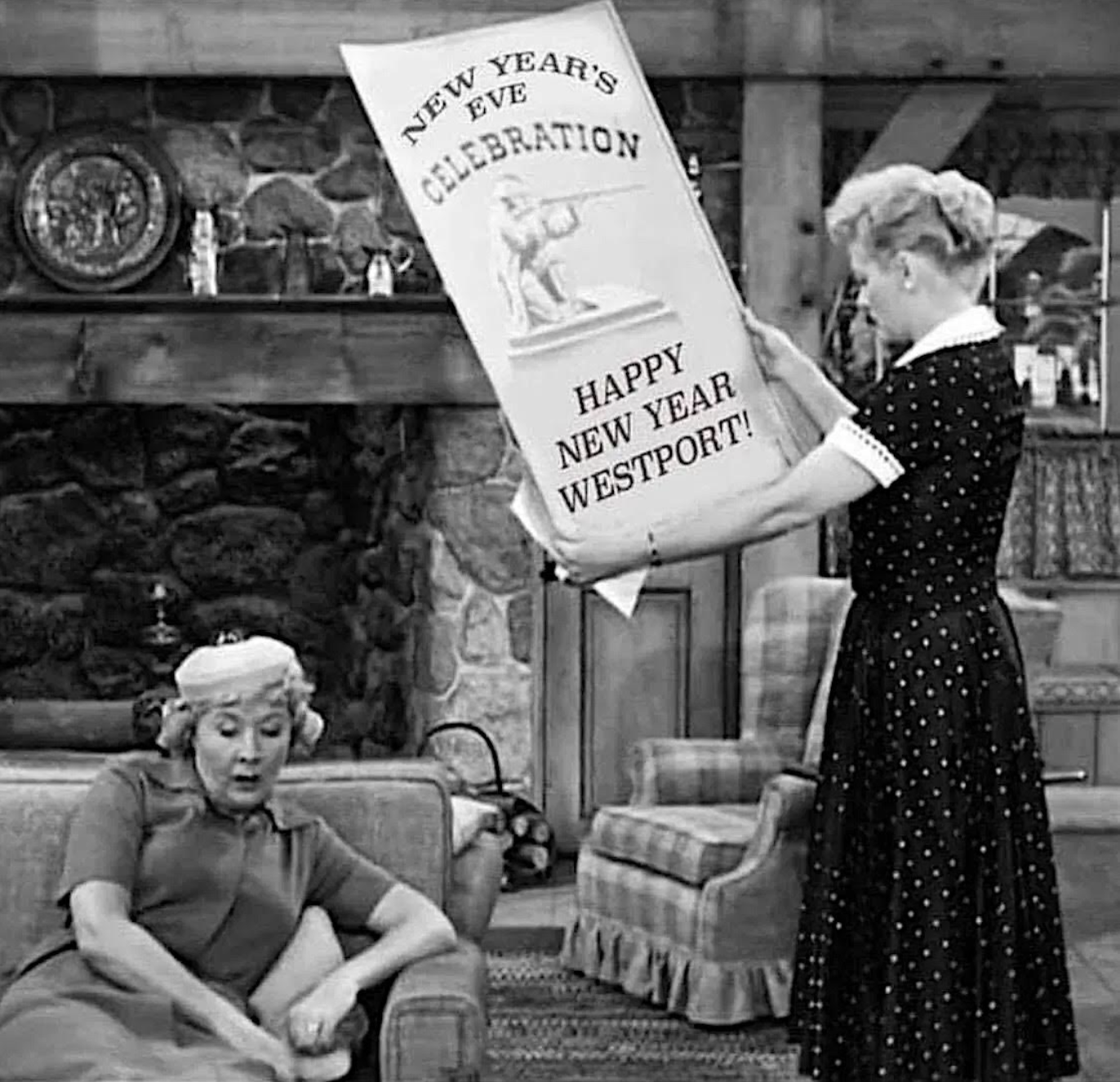
During the first five seasons (’51 through ’56) I Love Lucy was set in a mythical apartment building on Manhattan’s East 68th Street. For the sixth and final season (’56 to ’57) the Richardos and the Mertzes moved to Westport, Connecticut, a flush Fairfield County hamlet that’s directly adjacent to my hometown of Wilton. The show continued to be shot in Hollywood, of course, but the producers, sticklers for accuracy, based the Ricardo home on an actual colonial abode located at 1 Old Hill Road.
Posted on Fairfield’s Hamlet Hub, 9.14.15: “According to the filing information for the district’s National Register of Historic Places certification, ‘The two earliest houses in the district are the 1730 Lt. John Taylor House and the 1736 Daniel Freelove Nash House.’ The Taylor house [1 Old Hill Road, just west of downtown] was destroyed by fire in 1935 and replaced by a replica on the original foundation. It was the home of film and stage actor Arthur Kennedy during the 1950s and served as the model for the home of Lucy and Ricky Ricardo when I Love Lucy moved to Westport for its final season.”
Arson is a ghastly crime, of course — menacing, malicious. And it’s good to hear that last night’s burning of the Fox Christmas tree resulted in no harm to any fire fighters or passersby. The 49 year-old arsonist, a Brooklyn resident, was arrested soon after the tree ignited. The initial presumption, of course, was that the tree was torched as a political statement by a Fox hater. There are flammable Christmas decorations all over midtown Manhattan, but the arsonist chose the Fox tree. Do the math.
David Fincher and David Prior‘s Voir (Netflix, currently streaming) is a collection of six essays about film worship. I’ve watched four and they’re all finely wrought, but I have to spit something out. Despite my long friendship with Sasha Stone I can’t not say what I know to be true, which is that her autobiographical piece — “Summer of the Shark” — is the most eloquent and well-produced of the lot.
It’s the only one that reaches out and says “this, once upon a time, was me” plus “this was all of us back in the fanciful, doobie-toke Gerald Ford era, and what an impressionable time it was.” It’s about what’s gone forever and will never come back, but in another sense about what’s lasted forever.
“Shark”‘ tells a modest but fascinating little saga about young Sasha (played as a ten-year-old by Eva Wilde, and as a 17 year-old by Shannon Hayes) and her sister Lisa sinking into the captivating vortex of Steven Spielberg‘s Jaws, and how that film lit a certain fascination and devotion in both of them, and in Sasha especially.
The essay paints a swoony, sun-dappled portrait of hippie-ish Topanga Canyon and San Fernando Valley teen culture in the ’70s…detailed, lulling and just as time-trippy as Licorice Pizza in this respect…and tells how Sasha and her sister came to worship the refuge and sanctum of movies in that era (partly for the Spielberg and Star Wars-ian coolness, partly to escape from the turmoil of their mom’s bad boyfriends), etc.
Prior (whose involvement was more hands-on than Fincher’s) does a killer job of blending Jaws beach footage with recreations of Sasha’s own beach time — he and dp Martim Vian even mimic that famous zoom in-track back shot of Roy Scheider.
All in all, “Summer of the Shark” is a great little short (only around 12 minutes…longer?). I’m very proud of Sasha for having written from her heart and narrated it just so and worked so hard for so long on this thing, and (with Fincher and Prior’s expert assistance) having given it just the right touch and spin.
Walter Chaw‘s “Profane and Profound”, a delicious take on Walter Hill‘s 48 HRS., and Drew McWeeny‘s “But I Don’t Like Him”, about unlikeable protagonists, are very fine essays also.
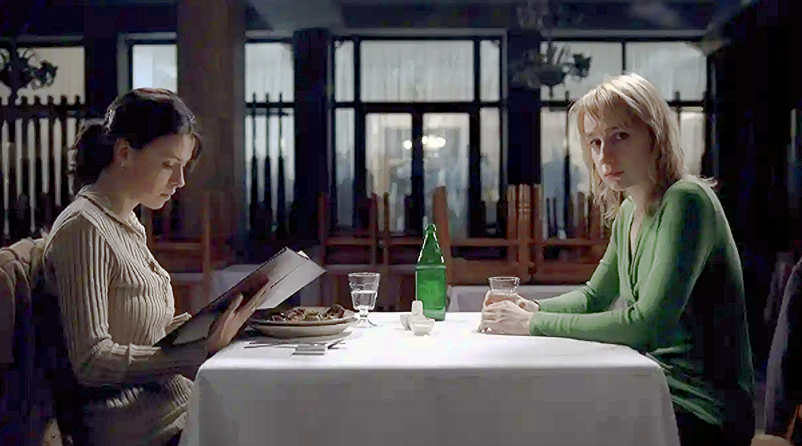
I didn’t care for Taylor Ramos and Tony Zhou‘s “The Ethics of Revenge”, a piece about Park Chan-wook‘s Lady Vengeance (’05) — it struck me as cold and creepy. And I haven’t watched “Film vs. Television,” although I hear it’s admirable.
Friendo: “Watching Voir….your pal Sasha’s episode was good…looks like they spent some money on that one recreating the ’70s. Then again Fincher doesn’t do anything cheap.”
Previously: “Some of our greatest cinema challenges us to really confront our own hearts in the safety of that darkened theatre. That’s part of the purpose of filmmaking.” — quote from Voir trailer.
2021 Reality Check: Movies stopped challenging or even slipping into the hearts of filmgoers with any regularity a long time ago. The only current movies that even flirt with this aesthetic are West Side Story, King Richard, Cyrano, Pig, A Hero and one or two others. Voir is therefore a nostalgia flick to a certain extent.
The dual purpose of 90% to 95% of movies is to (a) repeat and reenforce woke narratives and (b) enhance corporate revenue.
Ex-CNN headliner Chris Cuomo crossed ethical lines by helping his brother, ex-New York governor Andrew Cuomo, to dispute, challenge or circumvent the latter’s accusers in the realm of alleged sexual harassment. A very stupid decision, in short, to choose brotherly love over journalistic integrity. And now it’s time to paythepiper. So what should Cuomo do next?