


I’m still wearing my USA flag mask and washing my hands like Howard Hughes, but out in the big West Hollywood world people were congregating and celebrating and basically saying “fuck it…enough!” I was rumblehogging up and down the Sunset Strip around 5 pm yesterday afternoon, and you should have seen the outdoor crowds and the capacity-filled tables and sensed the general merriment…the relief! It was like being in Arkansas or Arizona or, better yet, Paris! Just about every significant cafe and eatery was open to capacity business. (Outdoors, at least.) Urth Caffe, Pink Taco, Mel’s Drive-In, Wahlburgers, Coffee Bean. And you know what percentage of the customers were wearing masks? Maybe 15%, if that. Okay, 20%.
Most Wowser Oscar Year Ever

In yesterday’s “Oscars in April ’21…But Of Course!” piece, I speculated (and not all that brilliantly) that with the Sunday, 2.28 Oscar telecast expected to be postponed “by as many as eight weeks,” the new Oscar date will either be 4.18.21 or 4.25.21, which of course are both Sundays.
It was announced this morning that the Oscar telecast will indeed air on 4.25.21, and that the 2020 release year will be extended for a full two months, or until Sunday, 2.28.21. I’m assuming that the Academy voting deadline will come a week or so before 4.25. Let’s say Friday, 4.16 or Monday, 4.19. That will leave roughly seven weeks of campaigning between 2.28.21 and the voting cut-off.
What will this mean as far as the Phase One (pre-Oscar nomination) and Phase Two (post Oscar nomination) mindsets are concerned? I’ll tell you what it means. It means there will be two (click!), two (count em!), two Phase Ones and one Phase Two.
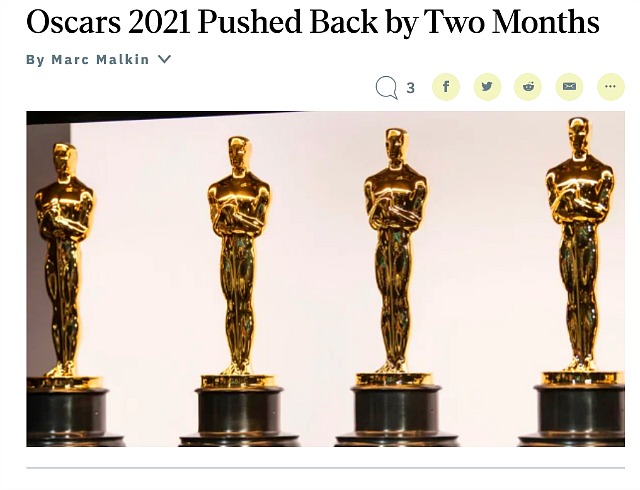
It also means that with the Telluride, Toronto, Venice and N.Y. film festivals sticking to their usual early fall dates, we’re looking at an extended award season that will last nearly eight months instead of the usual five-and-a-half or six (Labor Day to late February).
This is a one-off situation, remember. It’ll be back to business-as-usual for the ’21 and early ’22 Oscar year. We’re in uncharted territory, yes, but it’s not that hard to figure the angles and strategies.
To repeat, Phase One is not going to be shortened or pushed back — it’s going to expand. Remember that a good portion of the Oscar contenders are still going to “open” (even if that means a streaming debut) by 12.31.20. Today’s announcement is about accommodating the overflowers whose post-production skeds have been delayed by COVID.
But there won’t be any backing away from the traditional Phase One promotions of November and December. Parties and promotion-wise, people are 100% accustomed to Oscar season happening in November and December, partly if not largely because the holiday period is when the non-devotional dilletantes go to the movies (along with the summer).
So the traditional Phase One (call it Phase One A) will still happen in November-December, and then the brand-new Phase One B (which will naturally include some Phase One A repeats and redoublings) will kick off in late January and February.
And then, after the nominations are announced in early to mid-March, Phase Two will kick in, lasting from mid March to roughly April 16th or 19th, give or take.
So to summarize, we’ll be seeing two Phase Ones followed by a two-months-later-than-usual Phase Two. And then comes the most glorious Oscar telecast of all time on 4.25 — a Night of a Thousand Superstars with an up-with-Hollywood, “America needs movies and movies need America!”, rally-round-the-flag-boys esprit de corps that will be awesome to behold.
Tough All Over
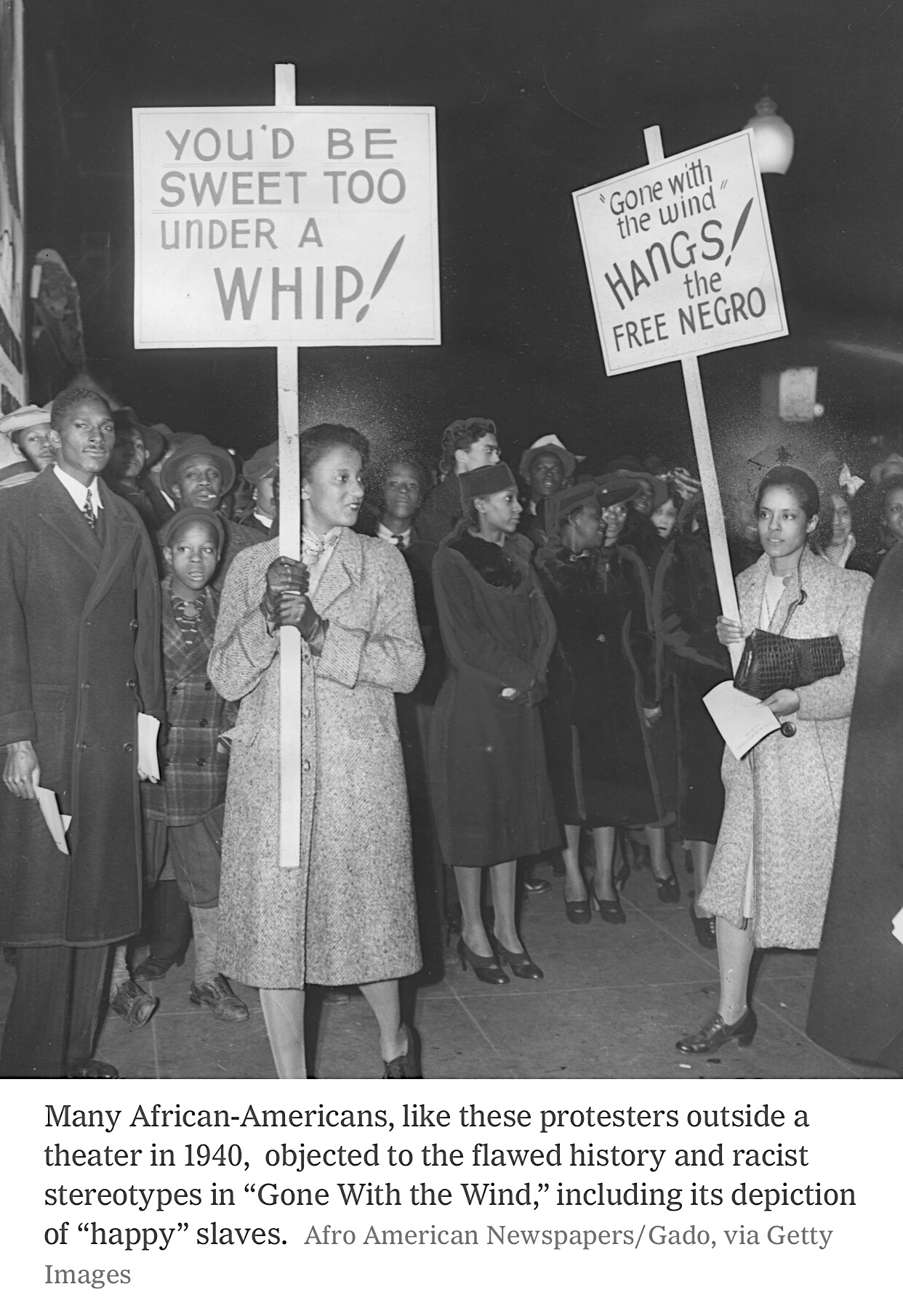
Jennifer Schuessler‘s “The Long Battle Over Gone With the Wind,” a perceptive and mostly fair-minded summary of the varied reactions to David O. Selznick‘s 1939 classic over the decades, appeared in yesterday’s N.Y. Times.
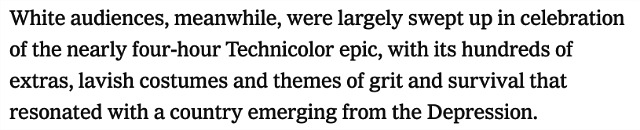
I felt conflicted about paragraph #24, which says that when GWTW opened “white audiences…were largely swept up in celebration of the nearly four-hour Technicolor epic, with its hundreds of extras, lavish costumes and themes of grit and survival that resonated with a country emerging from the Depression.”
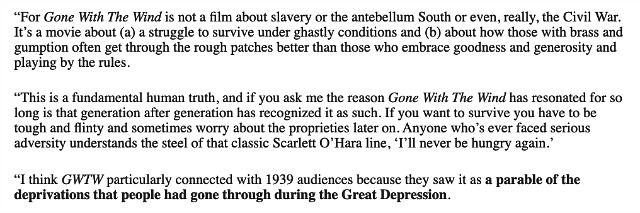
I said roughly the same thing in my 6.9 piece about reactions to the film (“A Minor Point At Such A Moment“). As a parable about the deprivations of the Great Depression, I wrote, GWTW “is fundamentally about how life separates the survivors from the victims when the chips are down, and about the necessity of scrappy, hand-to-mouth survival under the cruelest and most miserable of conditions…it basically says ‘only the strongest and the most determined survive.'”
But how was this something that only “white” audiences understood?
True, African Americans have long dealt with far more hardships and uphill situations than whites, and especially during the 1930s, but grit and steel are necessities within any tribe or culture in any time period. “Survival of the toughest” is a recognized rule all over the world.
From “A Minor Point At Such A Moment,” posted on 6.9.20.
Monday Morning Davidson
Presumably a fair-sized percentage of the HE community saw Judd Apatow and Pete Davidson‘s King of Staten Island over the weekend. So what’s the verdict? I wasn’t sure during the first 45 or so, but then I realized it was dealing honest cards and became a staunch fan, especially after catching it a second time.
There’s almost a 20 point disparity between between critics and Joe Popcorn on Rotten Tomatoes (71% critics, 90% ticket buyers). What are critics missing that ticket buyers aren’t? Say what you want, but I believed every word of it…every line, emotion, situation, character.
HE reaction, posted on 6.8.20: “You can give the side-eye to The King of Staten Island all you want. You can say it’s too oddball fringe-y, too lower-depths, too submerged on its own weed planet and too caught up in nihilism and arrested development to connect with Joe and Jane Popcorn. But because it’s funny and plain-spoken and doesn’t back off from an unusual milieu and mentality, and certainly from Pete Davidson‘s ‘Scott’, a layabout for the ages, I strongly disagree.
“KOSI made me smile and guffaw and even laugh out loud several times (highly unusual for an LQTM-er). It’s peddling sardonic humor that doesn’t feel schticky, although I guess it is. The tone is low-key raw, kinda nervy, certainly unpretentious and almost entirely bullshit-free.”
Monday Morning “Bloods”
Presumably a fair-sized percentage of the HE community saw Spike Lee‘s Da 5 Bloods over the weekend. So what’s the verdict? I was moderately down with it, one or two reservations aside, and I recognize that those who enjoyed and/or admired it are very impassioned. Then again there’s still a significant disparity of reactions between critics and Joe Popcorn on Rotten Tomatoes and the IMDB.
From a sporting perspective it has to be acknowledged that Lee and Netflix have either (a) lucked out from a sociological perspective, given the events of the last three weeks, or (b) played the marketing brilliantly by reminding viewers that echoes of our current malaise are reflected in the film. Or a combination of the two.
I respect the apparent fact that Delroy Lindo‘s performance has become a potential Oscar contender, although there’s some dispute as to whether he belongs in a lead or supporting category. As the film is basically an ensemble with no real leads, I think he belongs in supporting.
As much as I’m personally disappointed in Spike for failing to mention uncontested facts in his initial defense of Woody Allen last Friday, I don’t hold it against him for apologizing when #MeToo wokesters pressured him. His initial support for Allen was phrased in a way that seemed to under-appreciate the seriousness of sexual assault, and he had to correct that.
It’s just too bad that he didn’t state plainly and simply that there’s no basis for believing that Allen is guilty, especially if you read the Moses Farrow essay.
Oscars in April ’21…But Of Course!
The 2021 Oscar telecast will probably be bumped into April, according to a story by The Hollywood Reporter‘s Scott Feinberg. I began suggesting this last month. What choice does the Academy have?
During tomorrow’s Academy board of governors meeting the date of the 2021 Oscar ceremony, currently set for Sunday, 2.28, “may be delayed by as many as eight weeks,” Feinberg is reporting. Which would mean a new Oscar date of 4.18.21 or 4.25.21, which of course are both Sundays.
This would also mean “extending the eligibility window beyond Dec. 31, 2020,” probably to sometime in mid-March and perhaps even 3.31.21. Why not?
The delay will be prompted by the fact that the coronavirus has not yet receded and, according to some, could surge again with a second wave sometime in the fall.
Feinberg: “The governors are not expected to determine the format for the ceremony yet — in-person or virtual — as they feel they still have time to see how the pandemic unfolds before making that call. They did, however, need to put a hold on a new date on the calendar of its broadcasting partner, ABC.
“While highly unusual, these moves by the Academy are not unprecedented. The Oscars has been delayed three times before — due to LA flooding in 1938; following the assassination of Dr. Martin Luther King, Jr. in 1968; and after the attempted assassination of Pres. Ronald Reagan in 1981.
Keep in mind that the Oscars were held in April between ’59 and ’72, and then seven or eight more times after that. The last April telecast happened on April 11, 1988.
Suspicion of Murder
Two or three times in my teens I ran away from home. Briefly, I mean. My friends and I wanted to see the world by way of hitchhiking adventures during spring vacation or summer holiday.
I never asked for my parents’ permission as it was understood they’d never approve. Everything was always “no, no, too dangerous, too late, too reckless, too rowdy,” etc. Not to mention “you need to buckle down and study harder or your life will be ruined.” My 16 year-old view was “how could my life be any worse?”
I would be grounded when I returned, of course, but at least my friends and I got to be Jack Kerouac and Neal Casady for a few days. Kings of the road.
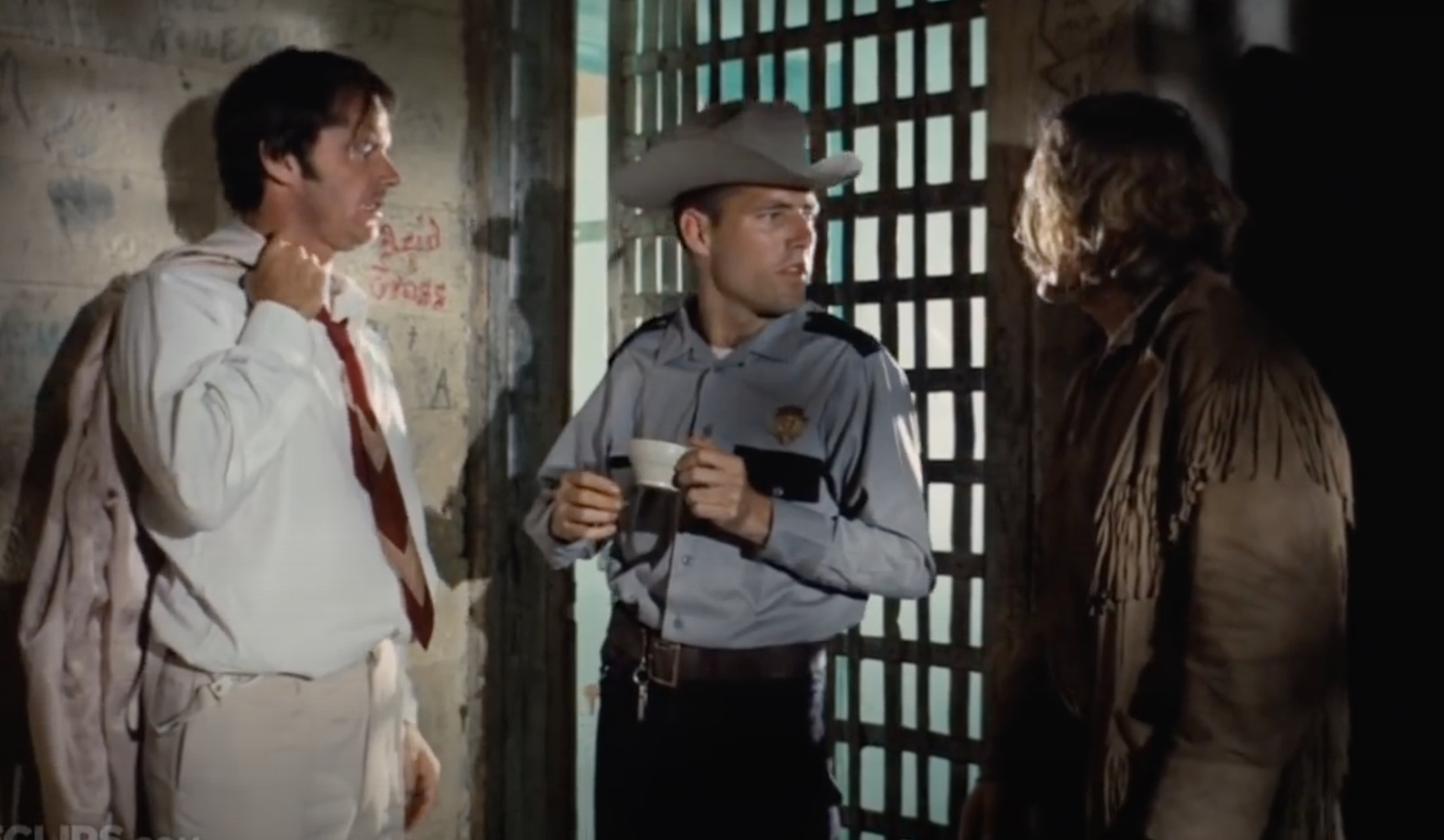
Anyway it was this impulse that led to a brief episode when I sat in a rural South Carolina jail for a day and a half on suspicion of murder. In the mid ’60s.
A friend and I were hitching in some off-the-highway area west of Charleston. The cops, we later learned, were on the lookout for some guy with longish hair who had killed a middle-aged woman, or something like that. Beatle-length hair was a semi-exotic thing in the rural south back then. My hair was John Lennon-on-the-cover-of-Rubber Soul-styled, and that was all the local fuzz needed. They pulled over, asked where we were headed. One of the cops, adorned in a jacket and tie and a pair of reflector shades, smiled and said he needed to take us in and check our stories out. He called me “Ringo.”
We were booked on a vagrancy charge and put into a two-bunk cell. It was one of those mid-sized jails with eight cells, four on either side of a middle walkway. The lighting was on the darkish side. There was a young African American dude in the cell across from ours, and he, too, was impressed by my Lennon hair. He was staring and grinning as his hands gripped the bars of his cell. The light was such that his white eyeballs and white teeth stood out as he smiled and sang “she loves you, yeah yeah yeah…she loves you, yeah yeah yeah.”
After 36 hours I somehow managed to get myself verified as non-dangerous and law-abiding without giving the cops my parents’ phone number. Maybe my friend’s father vouched for me. Or a cousin or someone. I forget.
Mandatory Bruh Uniform
Now that the pandemic is “over” [sic] and we’re all BLM marching, hiking, attending outdoor street parties and planning to hit the multiplexes in July, it’s time to reconsider our outdoor summer wardrobes.
I’m kidding. Nobody except X-factors like myself would ever dare step outside the regimented norm.
“Bruh Uniform,” posted on 7.21.18: I have flaws and issues. I am far from perfect. But at the very least I will never be accused of wearing the universal “bruh uniform” that each and every male from the age of 5 to 85 wears during warm weather. No variations or enhancements of any kind. The U.S. Army salivates over this level of sartorial regimentation. A worldwide submission to a casual-dress style that any non-invested observer would describe as absolutely totalitarian and Orwellian.
The warm-weather bruh uniform consists of (a) a loose-fitting, low-thread-count T-shirt (or Lacoste polo shirt or short-sleeve shirt with crazy-sick patterns), (b) preppy, knee-length cargo shorts (Ralph Lauren, Urban Outfitters, Patagonia), (c) unstructured baseball cap, knit cap or lightweight pork-pie hat and (d) sockless sandals, slip-ons, huaraches, white athletic sneakers or Crocs.
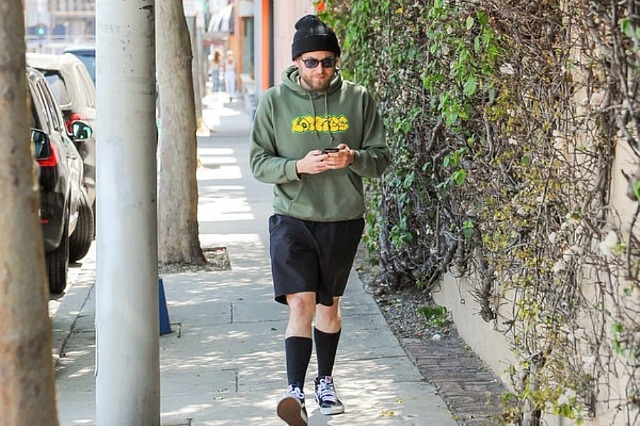
Warm weather HE dress code (i.e., anti-bruh): NEVER shorts. European-style, high-thread count black T-shirt. High-thread-count white T-shirt. Slim-fit, long-sleeve unbuttoned shirt with a banded collar. NEVER knit caps. NEVER a baseball cap. (But cowboy hat in the winter months is allowable.) Italian lace-ups or suede slip-ons or black leather loafers. NEVER mandals or flip-flops. NEVER anything maroon or burgundy.
I’m not alone in this view. An eastern-seaboard film critic friend who recently moved to Los Angeles wrote the following last week: “I still cannot believe the way grown men dress in this town.” HE reply: “I guess I’m used to it. My initial thought was that you’re mostly talking about young GenXers, Millennials and GenZ, but now that I’ve thought it over, yeah…pretty much every male on the planet of whatever age wears this exact same outfit.” Critic friend: “They dress like they’re eight years old.”
Well, yeah, but to play devil’s advocate, I sorta get it. The bruh uniform is comfortable so why not? It’s not what you wear that counts, but who you are inside, etc. And who are you, by the way, to tell us what we should or shouldn’t wear, asshole?
Answer: I’m not saying you can’t or shouldn’t wear your bruh outfit, but does the fact that tens or even hundreds of millions are wearing the same identical threads and the exact same type of footwear and headgear…does that bother you in the slightest?
Does it ever occur to you to occasionally not dress like an obedient little factory drone? Does the fact that there used to be many different approaches to warm-weather dress before the brah uniform took hold…does that bother you in the slightest? The fact that individual style used to be an actual thing?
“Defund” Slogan Is Huge Gift to Republicans
Re-Imagine The Police. Remake the Police. Camden-ize The Police. All of these slogans, which reference the re-building of the Camden, New Jersey police department, could work.
Have Black Lives Matter activists endorsed any of these? Of course not. They’ve chosen “Defund The Police,” which amounts to a big, beautiful gift to the Trump campaign.
Bill Maher, the night before last: “Liberals want to take police money, police funds and divert it to community services, which sounds like a very good thing, good idea. But they’re calling it ‘Defund the police,’ which sounds bad.
“That’s so ‘Democrats’ for you. You know, they must have meetings to be this fucking stupid about politics. ‘Hey guys, we’re making some headway here, how could we turn this into something that makes people have to vote for Trump?'”
Noting in a discussion how “only a third” of black Americans support the idea of defunding the police, Maher reiterated that the “defunding” branding was a “terrible way to put it”, adding that “I worry that Democrats are wandering into another purity test that’s not going to serve them well. And it’s going to be about how much you want to get rid of police altogether.”
“The Democrats [are] horrible. They put themselves in this no-win box and they did it to themselves.”
Calling All Newlywed Monsters
You can stream I Married A Monster from Outer Space on Amazon Prime for free, but if you’re a serious fetishist you can buy an Imprint Bluray for $40 bills.
“Honeymoon of Terror,” posted on 4.25.14: “Gene Fowler, Jr.‘s I Married a Monster From Outer Space (’58) is a typical ’50s sci-fi invader-metaphor flick in the vein of Don Siegel‘s Invasion of the Body Snatchers (’56) and Invaders From Mars (’53).
“But if you consider that star Tom Tryon (who later became a successful author) came out of the closet in the late ’60s, and if you momentarily regard homosexuality as a metaphor for the social convulsions of the ’60s and ’70s, I Married A Monster From Outer Space could be interpreted as being about the unravelling of staid middle-class normality and the coming of social upheavals that would begin to disturb American culture around ’64, or six years after its release.
Wiki synopsis: “The story centers on freshly married Marge Farrell who finds her husband Bill strangely transformed soon after her marriage: He is losing his affection for his wife and other living beings and drops various earlier habits. Soon she finds out that Bill is not the only man in town changing into a completely different person.”
The Wiki page repeats a 1991 Aurum Film Encyclopedia theory that “while the film was clearly fueled by the Cold War mentality of the ’50s, in retrospect its sexual politics…are more interesting and disturbing”. German critic George Seeblen said the 1958 film is about “the distrust between the sexes and the depiction of marriage as a trap where the death of one partner seems inevitable.”
Emphatically Rejected by BLM
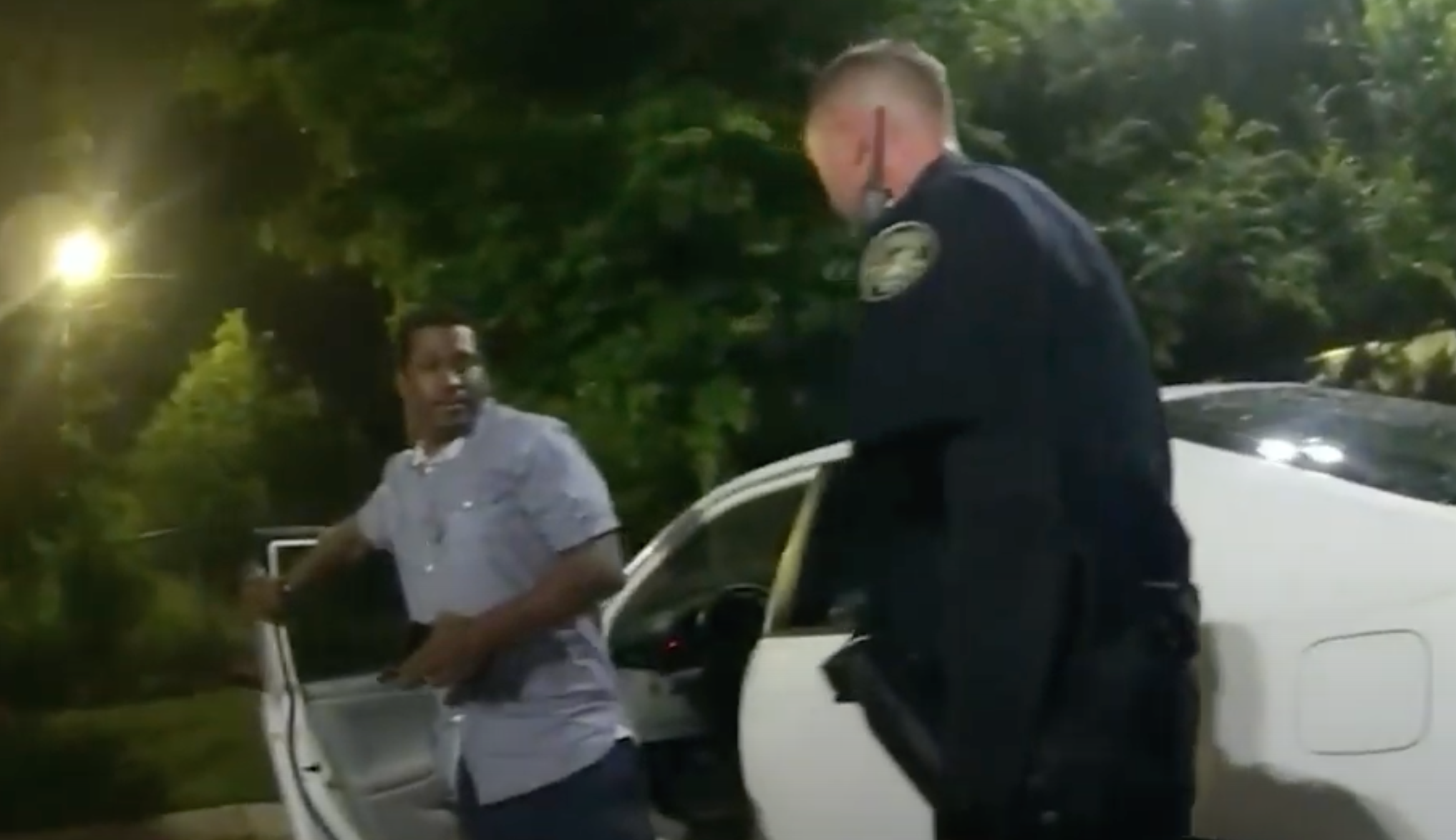
In his latest (6.12) “Making Sense with Sam Harris” podcast, we are presented with a highly thoughtful litany of observations, ruminations, fatalisms, meandering questions, laments, analyses, downbeat fragments, etc. And then, finally, just before the 1:10 mark, Harris finally gets down and actually makes a couple of points. About the whole “violent cops vs. innocent persons of color who are being killed indiscriminately” thing.
Harris starting at 1:09: “Most cops are not confident in their ability to control a person. They’re continually confronting people who are bigger or younger or more athletic or more aggressive than they are. Cops are not super-heroes. They’re ordinary people with insufficient training. And once things turn physical, they can’t afford to give a person who is now assaulting a police officer, the benefit of the doubt.
“And this is something that people seem totally confused about. They see a video of someone fighting with a cop, and punching him or her in the face. And the person is armed. Many people think that cop should just punch back. And that any use of deadly force, at that point, would be totally disproportionate. But that’s not how violence works. It’s not the cop’s job to be the best bare-knuckled boxer on earth, so that he doesn’t have to use his gun. The cop can’t risk getting repeatedly hit in the face and knocked out, because there’s always a gun in play.
“This is the cop’s perception of the world, and it’s a justifiable one, given the dynamics of human violence.
“Now, you might think that cops shouldn’t carry guns. Why can’t we just be like England? That’s a point that can be debated, but it requires considerable thought in a country where there are over 300 million guns in circulation. The United States is not England.
“Again — really focus on what is happening when a cop is attempting to arrest a person. It’s not up to you [the alleged law-breaker] to decide whether or not you should be arrested. And does it matter that you know you didn’t do anything wrong? How could that fact be effectively communicated in the moment by your not following police commands?
“I’m gonna ask this again: how could the fact that you’re innocent, that you’re not a threat to the cop, that you’re not about to suddenly attack him or produce a weapon of your own…how could those things be effectively communicated at the moment he’s attempting to arrest you, by your resisting arrest?
“And unless you call the cops yourself, you don’t really know what the situation is. If I’m walking down the street I don’t know if a cop who’s approaching me didn’t just get a call that a guy who looks like Ben Stiller just committed an armed robbery. I know I didn’t do anything. I know I’m mystified as to why the cop is paying attention to me at that moment. But I don’t know what’s in the cop’s head.
Horse’s Mouth
Sen. Lindsey Graham is a rightwing toadie, flunkie, pilot fish. But he did offer these uncoerced opinions.