4K Classic Film Market Feels Anemic

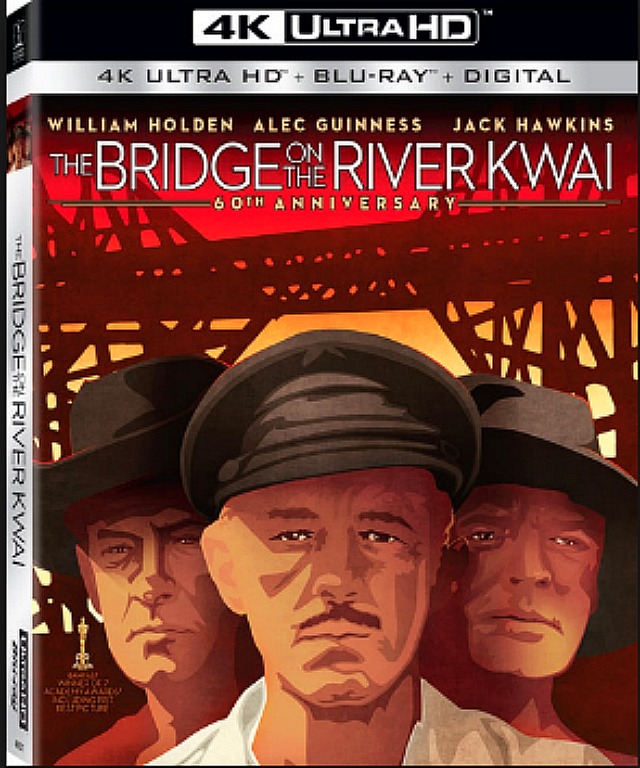
4K resolution has been part of the real-world, Best Buy consumer market for roughly five years, and it’s just starting to hit me that the big 4K changeover (raw data remastered in 4K or 8K for streaming purposes) has more or less stalled. Certainly as far as films in my realm are concerned.

[Click through to full story on HE-plus]

Pre-Release Fanboy Comments Junked by Rotten Tomatoes

In response to negative sexist-fanboy-troll comments about Captain Marvel (i.e., Brie Larson allegedly hates fanboys and allegedly doesn’t actually want them to see Captain Marvel because it’s really for women), Rotten Tomatoes has decided to (a) eliminate the “want to see” percentages as well as (b) pre-release comments.

In other words, RT has decided to buddy up to Marvel and go all candy-ass.

In a 2.25 editorial, RT explains why the pre-release comment section has been deepsixed: “Unfortunately, we have seen an uptick in non-constructive input, sometimes bordering on trolling, which we believe is a disservice to our general readership. We have decided that turning off this feature for now is the best course of action.

“[But] don’t worry — fans will still get to have their say: Once a movie is released, audiences can leave a user rating and comments as they always have.”

Presumably the remarks that triggered the change were from the same anti-female fanboys who trashed Paul Feig‘s all-girl Ghostbusters (’16) and the casting of Kelly Marie Tran in Star Wars: The Last Jedi.

RT comment from “Dirty D”, posted Tuesday morning: “When you tear out a man’s tongue, you are not proving him a liar — you’re only telling the world that you fear what he might say.”

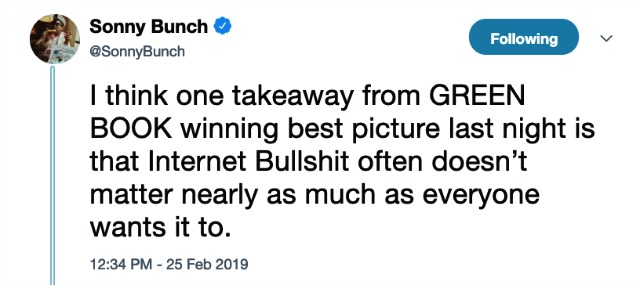
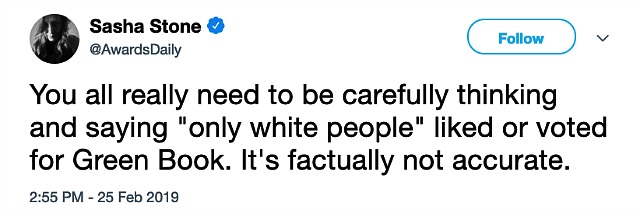
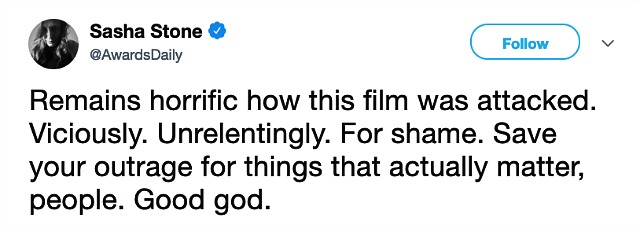
Sasha Stone vs. Brooks Barnes Over “Green Book”

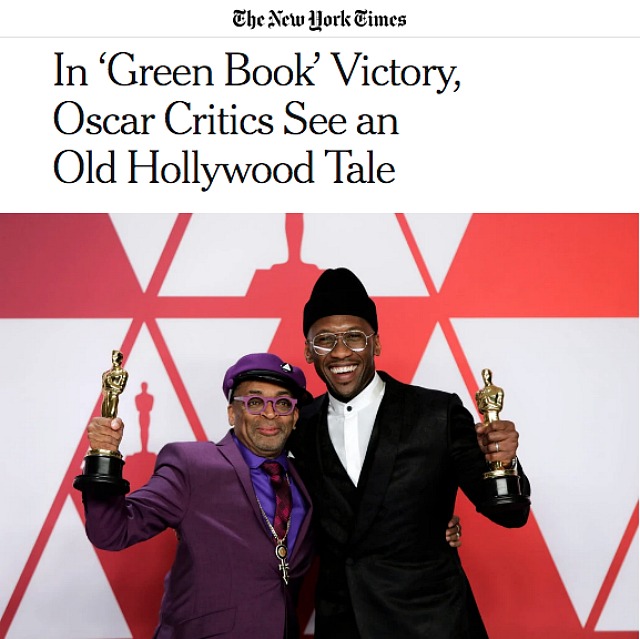
Yesterday N.Y. Times Hollywood correspondent Brooks Barnes posted a piece that echoed what Barnes claimed is the general morning-after industry view about Green Book having won the Best Picture Oscar, that it was nothing less a social-political tragedy — a mortifying act that angered, outraged and depressed not just Spike Lee but everyone in town, including the mail-room guys.

I knew this was a bullshit take from the get-go, but Awards Daily‘s Sasha Stone put her objections into words faster than I. This morning Sasha forwarded a draft of a letter that she’d sent to the Times, and I suggested…I don’t know, three or four edits. Sasha gave me permission to post it here, but wants it understood that the use of certain explicit terms (“too white, vaguely racist”) was my idea, not hers. It’s a smart, well-reasoned response — please read:

“It’s disappointing that the Times did not offer more balanced coverage of Oscar night than what is contained in Brooks Barnes’ 2.25 article (“In Green Book, Oscar Critics See An Old Hollywood Tale“). It is misleading, on one hand, to point to a small but loud group of people protesting the film’s win but not, on the other, to report how popular Green Book was across the board.

“Two years ago, La La Land’s momentum was slowed because of politically correct protests online. (It was inauthentic, they claimed, for a white guy to be a jazz buff.) The Best Picture Oscar went to Moonlight. The following year, Three Billboards Outside Ebbing, Missouri was met with protests over its rural insular whiteness. It, too, was derailed — The Shape of Water won. This year Green Book was repeatedly assaulted for being old-fashioned, too white and even vaguely racist.

But this time the protests didn’t work. This may reflect an exhaustion with the hive mind continually pushing the red button of alarm.

Green Book won the Toronto Audience Award in September, beating Roma, A Star is Born and every other film that played there. Green Book also defeated BlacKkKlansman, Black Panther, Roma, Bohemian Rhapsody and The Favourite at the Producers Guild of America Awards. It triumphed at the Golden Globes as well. If you ask me that show’s broad support counters your headline, and the narrative going forward.

“The fact is that for a film to win on a preferential ballot, as Green Book did at both the Producers Guild and the Oscars, it had to have broad support across all markers. That meant it could not have won with just ‘old white guys.’ Moreover, if ‘old white guys’ led that vote, how do you explain the unprecedented array of diversity and inclusion in the other categories?

Read more

Harris vs. Poland

Author and Vulture columnist Mark Harris is generally a temperate, perceptive, well-phrased Twitter fellow. His posts are usually on the sensible, carefully measured side.

But let’s also call a spade a spade: Harris has been fully in league with the SJW Stalinist scolds who attacked Green Book all through the ’18 and ’19 Oscar season.

Last night Harris blew a kind of gasket after David Poland let him have it between the eyes (“So angry…so much the victim…and so willing to assume the arrogance of others”), and particularly over Harris’s irritation over the liberal use of the term “virtue signaller.” I enjoyed the rancor — good stuff.

Mark Harris (‪@MarkHarrisNYC‬) / 2/25/19, 7:25 AM:

“Re-sharing the Oscars piece I wrote for Vulture right after last night’s show. Click on it to see the much darker second half of that headline! (https://www.vulture.com/2019/02/the-oscars-made-progress-this-year.html?utm_campaign=nym&utm_source=tw&utm_medium=s1)”

Mark Harris (‪@MarkHarrisNYC‬) / 2/25/19, 7:31 AM:

“I’ll add: Since criticizing Green Book I’ve been called a Stalinist, a fake white woke liberal, a virtue signaller, all the usual nonsense. But not one person has said to me ‘It’s the year’s best movie.’ For a lot of them, it’s not about loving GB but about hating its critics.”

Wells to Harris insert: Correct!

Mark Harris (‪@MarkHarrisNYC‬) / 2/25/19, 4:10 PM:

“Okay, I REALLY will let this go after today, but this “virtue signaler” shit is snapping me. No, you superannuated Bill Maher fetishists. Every white person to the left of you on any issue of race, culture, and/or representative is not performatively faking it for the crowd.”

Mark Harris (‪@MarkHarrisNYC‬) / 2/25/19, 4:13 PM

“And when you talk that way — when you reveal that you can’t tolerate a political/cultural disagreement about a film without parroting ad hominem horseshit — you expose yourself as a fragile mewling whiner terrified that your view of the world isn’t permanently chiseled into law.”

Mark Harris (‪@MarkHarrisNYC‬) / 2/25/19, 4:15 PM

“This has been a loud subtweet of literally everyone who drops this particular log and than acts like they hatched an original manifesto and are now clearing shelf space for a Pulitzer. And with that, I will go rearrange myself and come back a pleasanter and more cheerful person.”

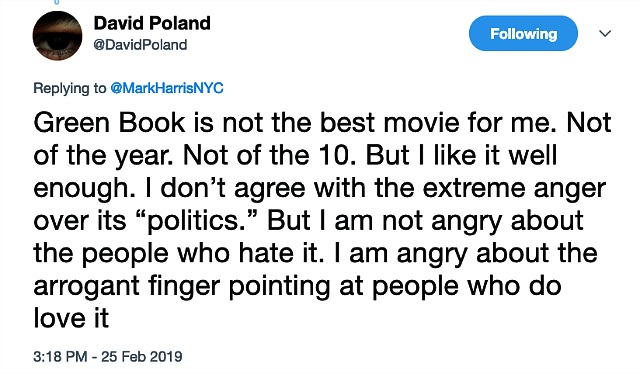
David Poland (‪@DavidPoland‬) / 2/25/19, 6:36 PM:

“Honestly, Mark — those 3 tweets seem an honest assessment of how you judge others who disagree with you in the details of your politics. So angry. So much the victim. And so willing to assume the arrogance of others. I don’t know if it’s fixable. But I feel like you defined it.”

Mark Harris (‪@MarkHarrisNYC‬) / 2/25/19, 6:52 PM

“We’re done now, David. Best of luck to you.”

David Poland (‪@DavidPoland‬) / 2/25/19, 6:55 PM

“Wow.”
Following The Script

At the end of the third paragraph in Michael Schulman‘s New Yorker piece about attending the Oscars (“An Oscars-Night Diary,” 2.25), the author speaks “to an Oscars attendee from Eastern Europe” (presumably Cold War director Pawel Pawlikowski or somebody on his team) at the Vanity Fair after-party. Schulman asks for a summary of the just-concluded telecast.

“It was all either corporate spin or political correctness,” the Eastern European fellow replies. “Everybody said what they were expected to say. It was very Soviet.”

Once Upon A Time in Cannes?

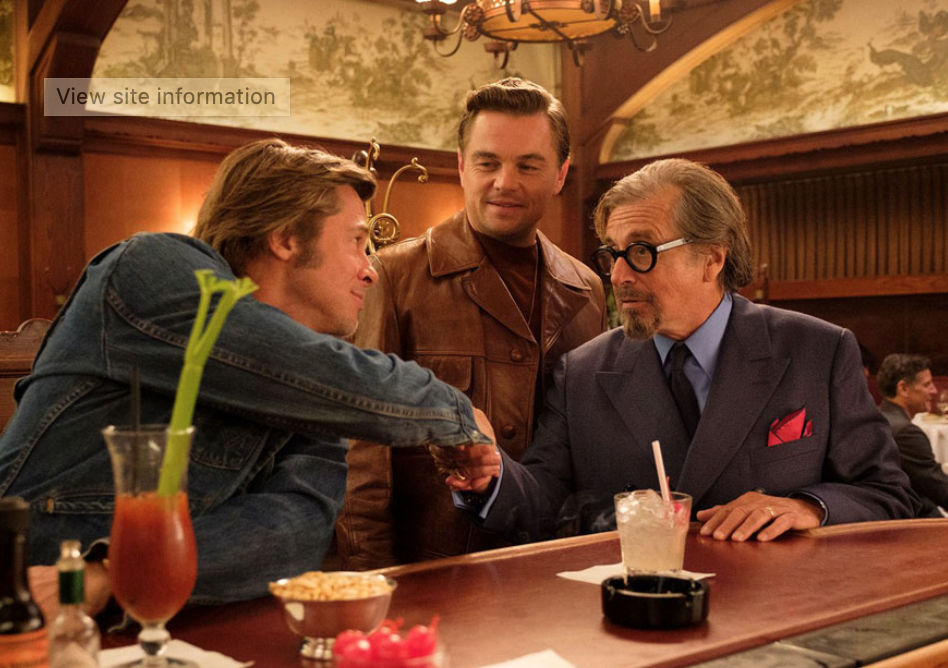
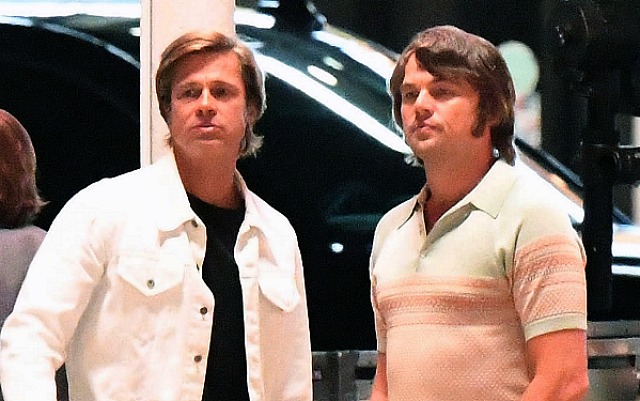
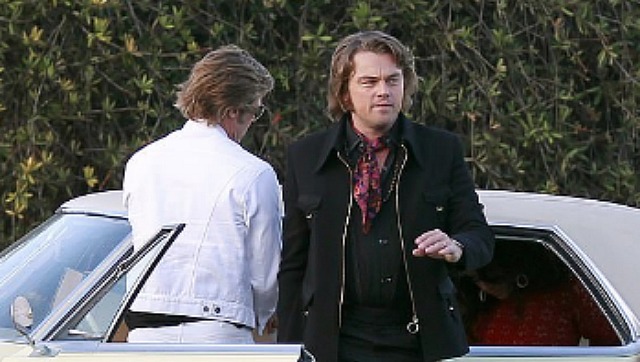
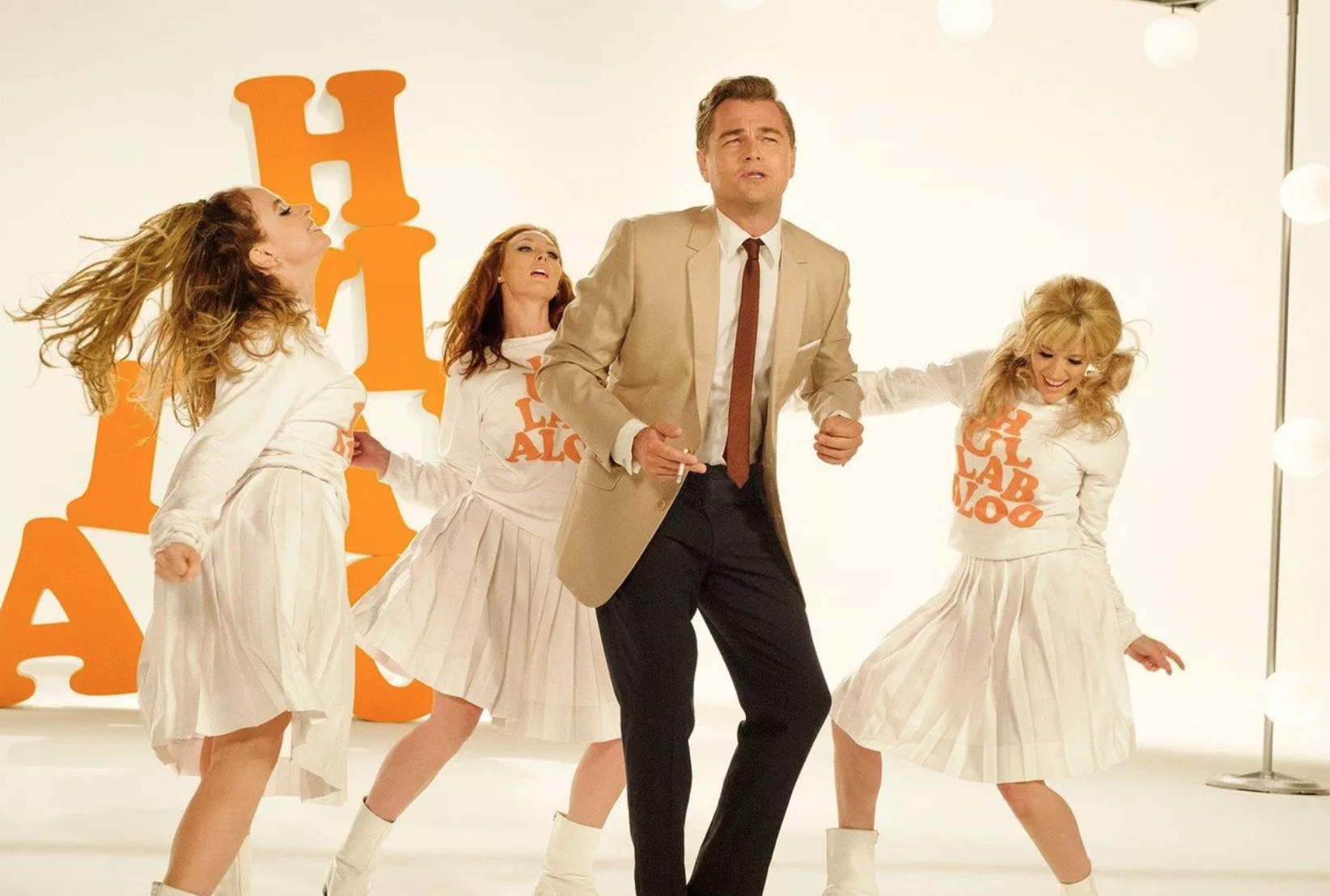
I’m not predicting that Quentin Tarantino‘s Once Upon A Time in Hollywood (Sony, 7.26) will have its big worldwide debut at the 2019 Cannes Film Festival (May 14-25), but it wouldn’t surprise me if it happens. The film already has a huge want-to-see, granted, but Tarantino, Hollywood and the stellar cast (Leonardo DiCaprio, Brad Pitt, Margot Robbie, Al Pacino, Emile Hirsch, Damian Lewis) descending upon the Cote d’Azur would have a seismic worldwide impact.

Tarantino has been a devotee of this storied festival for nearly three decades, several QT films have premiered there (Reservoir Dogs, Pulp Fiction, Kill Bill, Inglorious Basterds) and Cannes is the only world-class launch pad that makes sense for Once Upon A Time in Hollywood‘s editing schedule. The 1969 hippie-era drama wrapped on 11.1.18, and would presumably be in some kind of viewing shape by mid May.

Remember that Inglorious Basterds premiered in Cannes on 5.20.09, and opened stateside three months later — Hollywood‘s commercial opening would arrive only two months after Cannes.

Likeliest 2020 Best Picture Contenders

Said it before, repeating for emphasis: Dexter Fletcher‘s Rocketman (Paramount, 5.31) may meet with commercial success, but it’s absolutely not going to become a Bohemian Rhapsody-like awards contender.

As I wrote a few days ago, Taron Egerton‘s imitation of Elton John‘s signing voice doesn’t cut it — and nobody will buy into a John biopic in which “Elton” sounds like a cruise-ship imitator. On top of which Hollywood Elsewhere despises Egerton for the two Kingsman movies plus the Robin Hood debacle. So forget it — Rocketman is strictly a commercial playdate.

But the following seven films are almost certain to be Best Picture-nominated (except for the Tarantino, which I have vague doubts about):

[Click through to full story on HE-plus]

No Excuse for Donen Absence

Last night’s death-reel sequence ran 4:21, but the cavalcade of faces only lasted for 3:29. It began with Susan Anspach at the 24-second mark and ended with Albert Finney at 3:43. The Academy had a little less than a minute’s worth of wiggle room. They surely could have fit in the great Stanley Donen, who passed the day before yesterday.

I know enough about editing and re-editing a video piece that adding a single visual element isn’t a big deal these days. If they had wanted to include Donen, they could have done it. They were lazy, plain and simple.

And while they were at it, they could have included Andy Vajna, Gary Kurtz and R. Lee Ermey. I understand about omitting Carol Channing — she was a Broadway gal.

Gleiberman’s Final Word

In the eyes of history, the SJW toxics (or, if you will, the virtue-signalling Stalinists) lost last night. Their bullshit is evaporating into vapor as we speak. They can stomp and whine and punch the refrigerator all they want, but Green Book took all their slings and arrows and won the Oscar anyway.

But before we put this stinking battle to bed, a final word from Variety‘s Owen Gleiberman, who liked Green Book as much as I did and lamented the relentless p.c. putdowns:

“Set in 1962, Green Book is a feel-good liberal buddy movie that’s like a cross between Driving Miss Daisy and Rain Man, and 20 years ago it would have been a slam-dunk Oscar triumph.

“But it came up against a newly purist and progressive mindset, one that said, in essence: If you take a white character’s struggle and make it the moral/spiritual ‘equivalent’ of a black character’s struggle, you’ll be saying that the pain of the oppressor is equal to the pain of the oppressed — and that, in itself, is a racist lie.

“As someone who believes that Green Book is a powerful, moving, and emotionally complex film, I’d push back against that argument by saying: The movie isn’t equating the experience of black oppression and white blindness. It’s saying that they co-exist in the world — and that for the purposes of this movie, it will give them equal screen time.

“My point here is not to re-fight that fight; it’s simply to say that Green Book is a film that got transfigured in the culture. It started off as unabashed liberal comfort food; it ended up as a movie that divided as much as it united. It became a political hot potato, and so voting for it wasn’t simply like pulling the lever for Driving Miss Daisy or Rain Man — for the kind of intimate and uplifting relationship-of-opposites heart-tugger that has often triumphed at the Oscars. Voting for it became, at least for some Academy members, a political act in a different way: a knowing defense of what’s left of the Hollywood status quo. It became a rebellion against the rebellion.

“You could say, of course, that the victory of Green Book came down to one elemental thing: A lot of people in the Academy really loved Green Book. Fair enough. But my point is that its win last night still played as an upset, as the triumph of the underdog.

Read more

110% Agreement

“Without a host to guide the writers’ room, the banter doled out to presenters can feel a bit aimless. Trust Awkwafina and John Mulaney to make so much of their time presenting two short films that viewers at home were surely asking, ‘Why didn’t they host?’ From the nerves they cutely faked to the surprise they evidenced when, yes, they got to present a second category, let this be considered their audition tape for next year.” — N.Y. Times “carpetbagger” Kyle Buchanan in a 2.25 “Oscar’s Best & Worst Moments” piece.