

How Degraded Thou Art
Late November is a good time to catch films in cinemas, of course, but otherwise the megaplex experience is generally a must-to-avoid, or at the very least a touch-and-go thing. Mainstream movies have been declining for many decades, and always because of stupid audiences.
In the early ’50s Manny Faber wrote an influential essay called “Blame the Audience,” although if you consider what was playing in Manhattan in the late summer of 1953 it’s hard to understand what he was on about.
In 1964, Pauline Kael asked “Are the Movies Going to Pieces?” in The Atlantic Monthly, claiming that “the younger generation’s embrace of crudely made films and the intelligentsia’s fondness for intentionally confusing ones was responsible for Hollywood’s decline.”
On 1.21.72, right in the middle of the grandest, funkiest and most fabled era of auteurist glory, Dick Cavett asked four directors — Robert Altman, Mel Brooks, Peter Bogdanovich and Frank Capra — if Hollywood was dead. He didn’t mean L.A.-centric filmmaking but the big-studio system that reigned from the ’20s through the ’50s. He was also observing that corporations and corporate-think had taken over from old-school moguls like Harry Cohn, Daryl F. Zanuck and Louis B. Mayer.
On 6.23.80 Kael published her famous New Yorker broadside — “Why Are Movies So Bad or, The Numbers” — about the increasing corporate influence upon Hollywood filmmaking culture.
I first began to sense the onset of megaplex theme-park cinema and the general loss of the spiritual in the early ’90s…a general feeling of alienation from the concept of theatres-as-churches and a gradual slide into the swamp.
12 and a half years ago I wrote that “movies are a religion and, whether some of you get this or not, going to see the best movies is the same thing as going to church and, in a manner of speaking, taking Holy Communion. They’re about values (philosophical or otherwise) and emotion and contemplation and quality of life. Even the shallowest people out there understand that the best movies contain and in fact propel notions of spirit and emotion and transcendental recognition.”
Movies are doing well enough in some respects (via this and that format), but that communal, church-like atmosphere in theatres…when was the last time you felt it?
I honestly wonder if deep-soul qualities in films (i.e., the kind of thing you can sense in abundance from Alfonso Cuaron‘s Roma) are of any importance to the New Academy Kidz, the p.c. militants, the representation and identity-politics crowd.
On 7.17.06 I wrote that “some may see going to a just-opened movie as a kind of cathartic Southern Baptist service (talking back to the screen, letting it all out, etc.), but most people probably see movies as a kind of sporting event or mass video game or amusement ride.
Kael vs. Eastwood
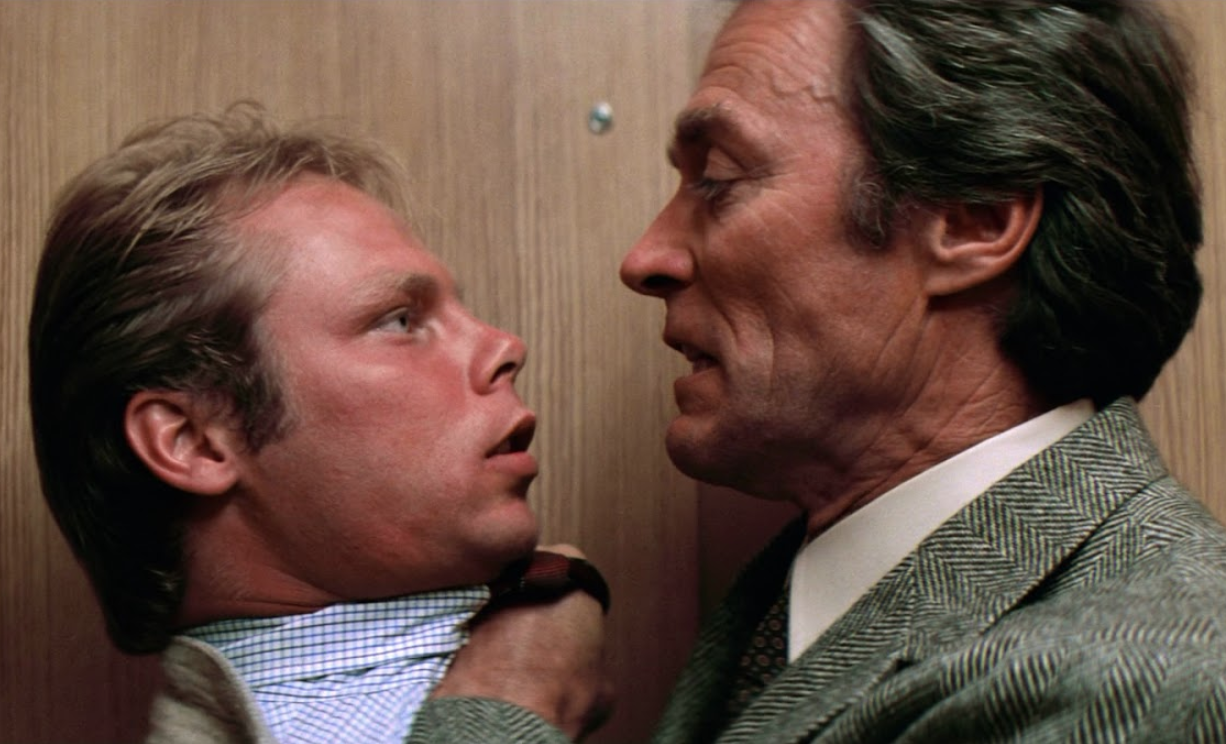
Clint Eastwood made his bones in the ’60s and ’70s with brutal, emotion-less dispensations of violence — by projecting a capability and willingness to drill the bad guys between the eyes without blinking an eye and certainly without giving it much thought. He wasn’t as much two-fisted as big-gunned, and he sure as hell blam-blammed a whole lot of guys during his “Man With No Name” meets Dirty Harry heyday, and with rightwing justifications, of course. “You fuck with me, you’ll pay the price.”
He was never anyone’s idea of a great or highly skilled actor, but he always knew how to deliver that silent, steaming-radiator thing and was certainly effective within his range. I think his Unforgiven performance (i.e., the snarly Bill Munny) was actually pretty close to great, partly because of (a) “helluva thing, killin’ a man,” “(b) “we all got it comin’, kid” and (c) how that final shoot-out scene draws upon our collective memory of the snarly guy he was in the Nixon, Ford and Carter eras.
But when we think of Eastwood we mainly sink into a soothing impression that took hold in the early to mid ’90s, which was when he suddenly became this exalted, almost mythical-level actor and director — one on hand with his aging, guilt-ridden secret service agent in Wolfgang Petersen‘s In The Line of Fire (’93) and on the other as the director who delivered the one-two punch of Unforgiven (’93) and The Bridges of Madison County (’95).
And at the same time his reputation as a likable, laid-back, salty-haired guy who always shot films fast and unfussy and who occasionally described himself as an Eisenhower Republican…all of that sunk in too. Even his briefly warming to Sarah Palin + talking to the empty chair thing…even that didn’t dispel the genial vibe.
And here we are on the 2018 home stretch and still no word of any Mule screenings, which reenforces suspicions that it’s probably nothing too special, even with Eastwood giving what may be his last performance…who knows?
Van Helsing and the Stake
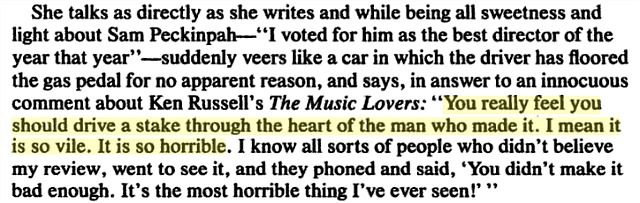
The idea of driving a stake through the heart of a filmmaker is a bit extreme. I do, however, understand a brief impulse (i.e., flirted with but not acted upon) to inflict pain upon a director or producer for having made what you may feel is a bad or hateful or hard-to-sit-through film. I definitely felt this way about James Wan after sitting through Furious 7.
From page 28 of “Conversations with Pauline Kael“:
I Want To Be Free
18 years and 2 months after the debut of Nancy Meyers‘ What Women Want, in which the rakish Mel Gibson discovered an ability to divine what women are thinking, comes Adam Shankman‘s officially sanctioned. gender-reversed remake. In a rough facsimile of the Gibson role, Taraji P. Henson is a struggling businesswoman, coping with corporate sexism and the usual hindrances to advancement, imbued with an ability to hear what men are thinking. Is this a movie for dudes? Just asking. It feels broad.
“Congenial Is The Word”
Over the last few weeks I somehow managed to miss three Manhattan press screenings of Jon S. Baird‘s Stan & Ollie. I have another one late Monday afternoon, and I’m determined to attend this time. This trailer underlines what all the critics have been saying, which is that the performances by Steve Coogan and John C. Reilly are worth the price.
Sony Pictures Classics will open Stan & Ollie on 12.28 in New York and Los Angeles.
“By the time of the touching conclusion, one has come to like and care about these sweet old guys a good deal. Everything the film has to offer is obvious and on the surface, its pleasures simple and sincere under the attentive guidance of director Jon S. Baird; these good men have their differences but well understand that whatever they might have accomplished individually would never have remotely equaled what they were able to do together. This is clear from the fact that, after Hardy’s death, Laurel never acted again despite many offers, even if he did continue to write.” — from Todd McCarthy’s 10.21 Hollywood Reporter review.
Who Today Is At Least Trying To Write on Chayefsky’s Level?
Diana Rigg: If you love me, I don’t see what other choice you have.
George C. Scott: What do you mean, ‘if I love you’? I raped you in a suicidal rage. Where did you get love and children all of a sudden?
Rigg: I think I should know if a man loves me or not. You must have told me a hundred times last night. You murmured it, shouted it. One time you opened a window and bellowed it out into the street.
Scott: Well, I think those were more expressions of gratitude than love.
Rigg: Gratitude for what?
Scott: Well, my God, for resurrecting feelings of life in me I thought dead!
Rigg: Well, my God, what do you think love is?
Scott: All right, I love you! And you love me. I’m not about to argue with so relentless a romantic.

MCN Zombie Digs Itself Out of Grave, Staggers Back To Life
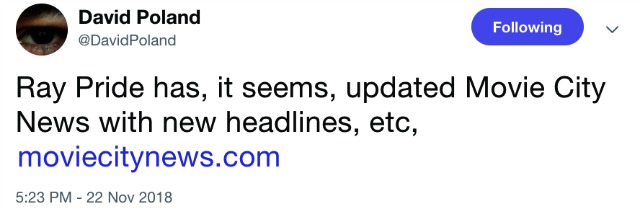
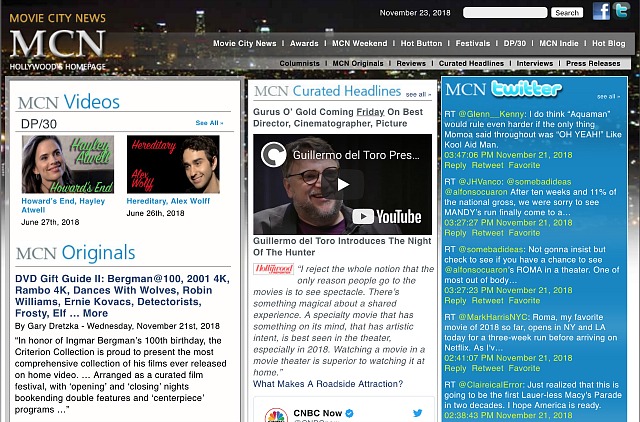
With David Poland cruising along and fancy free, Ray Pride has rebooted Movie City News…and it’s not bad! Same old MCN, same headline links, up to date, reasonably on top of things, etc. Ladies, it’s okay with me.
Whole ’19 Shebang
Here’s the latest HE rundown of 2019 films of a certain preferred quality. 88 as we speak. Possible critical faves, perhaps even award-season contenders. The two main categories are (a) general appeal flicks with bigger names and budgets (29), and (b) smarthouse, upmarket films for particular congregations (59). Further refinements to come. What have I missed?
GENERAL APPEAL, BIGGER NAMES, BIGGER BUDGETS. etc. (30)
1. Martin Scorsese‘s The Irishman — A mob hitman recalls his possible involvement with the slaying of Jimmy Hoffa. (Robert De Niro, Al Pacino, Joe Pesci, Jesse Plemons).
2. Quentin Tarantino‘s Once Upon A Time in Hollywood — A faded TV actor and his stunt double embark on an odyssey to make a name for themselves in the film industry during the Helter Skelter reign of terror in 1969 Los Angeles. (Leonardo DiCaprio, Brad Pitt, Margot Robbie).
3. Ang Lee‘s Gemini Man — An over-the-hill hitman faces off against a younger clone of himself. (Will Smith, Clive Owen, Mary Elizabeth Winstead, Benedict Wong).
4. Jon Favreau‘s The Lion King — CGI and live-action re-imagining of the 1994 Disney classic. (Voice-acting by Donald Glover, Alfre Woodard, Chiwetel Ejiofor, Seth Rogen).
5. Todd Phillips’ Joker — Joker origin story, you know the drill. (Joaquin Phoenix, Robert De Niro, Shea Whigham, Zazie Beetz)
6. Marielle Heller‘s You Are My Friend — The story of Fred Rogers, the honored host and creator of the popular children’s television program, Mister Rogers’ Neighborhood. (Tom Hanks, Matthew Rhys, Susan Kelechi Watson, Tammy Blanchard)
7. J.C. Chandor‘s Triple Frontier — Five friends team to take down a South American drug lord. (Charlie Hunnam, Ben Affleck, Pedro Pascal, Oscar Isaac.) Netflix.
8. J.J. Abrams‘ Star Wars: Episode IX — The conclusion of the new ‘Star Wars’ trilogy. (Daisy Ridley, Adam Driver, John Boyega, Oscar Isaac, Lupita Nyong’o, Domhnall Gleeson, Kelly Marie Tran, et.al.)
9. Joe Wright‘s The Woman in the Window — An agoraphobic woman living alone in New York begins spying on her new neighbors only to witness a disturbing act of violence. (Amy Adams, Wyatt Russell, Gary Oldman, Julianne Moore)
10. All You Need Is Love (aka “Untitled Danny Boyle/Richard Curtis Film”) — Set to the music of the Beatles, it’s about a musician who thinks he’s the only one who can hear the Beatles’ music. (Lily James, Ed Sheeran, Ana de Armas, Kate McKinnon, Lamorne Morris) Sheeran plays himself discovering a rising young musician. Mckinnon plays a talent agent. Hamesh Patel costars.
11. Greta Gerwig‘s Little Women — Four sisters come of age in America in the aftermath of the Civil War. (Florence Pugh, Timothée Chalamet, Emma Watson, Saoirse Ronan)
12. James Mangold‘s Ford v. Ferrari — The true story of the battle between Ford and Ferrari to win Le Mans in 1966. (Christian Bale, Matt Damon, Jon Bernthal).
13. Jordan Peele‘s Us — A “social thriller” set between two couples — one white, one black. Starring Winston Duke (Black Panther) and Lupita Nyongo’o — L.A. Daily News critic Bob Strauss champing at the very bit. (Anna Diop, Elisabeth Moss, Kara Hayward)
14. Aaron Schneider‘s Greyhound — During World War II, an international convoy of 37 Allied ships, led by Commander Ernest Krause (Tom Hanks), cross the treacherous North Atlantic while being hotly pursued by wolf packs of German U-boats. (Elisabeth Shue, Karl Glusman, Stephen Graham)
15. Gavin Hood‘s Official Secrets — The true story of a British whistleblower who leaked information to the press about an illegal NSA spy operation designed to push the UN Security Council into sanctioning the 2003 invasion of Iraq. (Matthew Goode, Keira Knightley, Ralph Fiennes)
This Producer Saw “Widows”
CONTAINS MASSIVE SPOILERS: “Saw Widows at Academy last Sunday. Room half empty. Whole cast, producer, director, etc. for the q and a. Half of the room left before they spoke.
“Consensus: Too many plot holes. Big suspension of disbelief of both the Neeson character and the widows arc. Neeson has a passionate relationship with Viola, but we find out he’s sleeping with/in love with some other pasty white chick. Huh? Because their son was half black and was murdered. Her fault? Huh?
“He kills his whole crew, friends and comrades for decades. Huh? Just for the 2 million? He certainly seems talented enough to get it another way. Not believable.
“Question: How did he manage to set up the van explosions without anyone noticing? Put in a life-size dummy in the front seat without anyone noticing? Sneak the satchel of $2 mil by the whole team without anyone noticing?
“More: Do we buy these four women being capable of learning how to pull off a complicated heist in one or two weeks? No. Load and shoot glocks in minutes. No. Etc. etc.
“Additional problems: Robert Duvall overacting. Ouch. Lots of spitting. Way too hammy. Colin Farrell trying to find the way to deal with this in their scenes together. Just struggles. Tough.
“The script was too uneven. Felt like ten different people writing it. Ten different tones. And the flashy technical direction — why are we listening to an entire conversation of people in a car while watching the corner of the hood?” [HE interjection: I loved that shot.]
“It’s all over the place. The script wasn’t ready. Steve McQueen got a great editor, great dp, and his previous work got him terrific actors, but they couldn’t save a plot that had no ground floor.”