Gilda, Spirit, Cancer, Death

Lisa D’Apolito‘s Love, Gilda will open the 2018 Tribeca Film Festival on 4.18. The late Gilda Radner made millions laugh, but like any half-decent comedian she always told the unfettered truth. And she apparently never side-stepped or shilly-shallied when she was diagnosed with cancer in late ’86, at age 40. She wrote about it candidly in “It’s Always Something,” a 1989 autobiography. To go by a 2014 fundraising trailer [after the jump], the primary focus of Love, Gilda focus is Radner’s four-year battle with cancer. It’s also about Gilda’s Club, a community organization for cancer copers.

Read more

Friends and Admirers Always Lie

I’ve watched this old Steven Spielberg clip a few times. I love it because it’s a reminder that serious artists have no interest in hearing nice bullshit from their alleged friends and admirers. Give it to me straight or don’t say anything at all.

Stanley Kubrick had to sit on Spielberg’s chest and force him into being honest about his true, deep-down feelings about The Shining. He had to grill and interrogate the truth out of him, otherwise Spielberg (who has since come to love The Shining) would have never given it up.

Husbands and wives are like this also — they always lie to protect each other’s feelings. The only way you get the real truth from a husband or wife is when you’re arguing with them and they’re really angry at you and losing their temper, and so they’ll tell you some uncomfortable fact or observation they would otherwise keep quiet about.

Before I stopped drinking (I’ve been sober since 3.20.12) I told an ex-girlfriend that I was starting to feel horrified about my weight and that I was starting to resemble a 50ish lesbian in a cowboy hat. “Stop it…you look fine!” she insisted. She lied — I was turning into Wallace Beery in Min and Bill. Hell, I was turning into Marie Dressler. Everybody lies about everything, including your enemies.

Artsy French Zombies…Mai Oui, Bien Sur!

Once upon a time zombie movies were cool. Certainly between the debut of George Romero‘s Night of the Living Dead (’68) and Dawn of the Dead (’78), his first sequel. Since then mongrels have taken over the genre. As a matter of routine policy Hollywood Elsewhere spits on 21st Century zombies. I haven’t paid the slightest attention since Juan Carlos Fresnadillo‘s 28 Weeks Later (’07) and before that Danny Boyle and Alex Garland‘s 28 Days Later (’02).

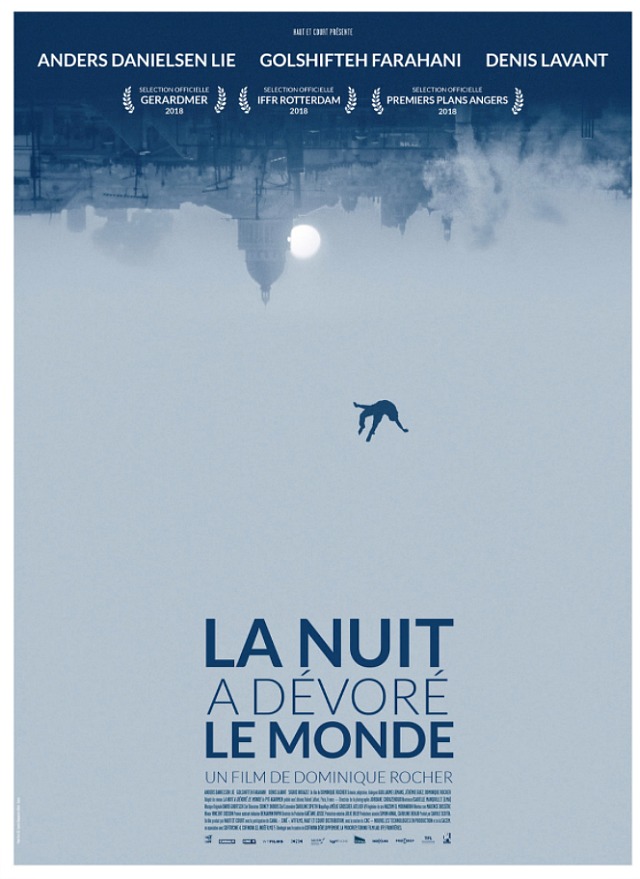
But I’m down for Dominique Rocher‘s Night Devours The World (La Nuit a devore le monde) because (a) it’s French, (b) it has a great poster, and (c) it avoids standard zombie movie tropes like the plague. This in itself wins my absolute allegiance.

From Jordan Mintzer‘s 3.7.18 Hollywood Reporter review: “Imagine 28 Days Later without the action, The Walking Dead without the ensemble cast or [Rec] without the video camera and white-knuckle suspense, and you’ll get an inkling of what goes on in The Night Eats the World.

“A minimalist arthouse zombie movie set almost entirely inside a Paris apartment building, this debut feature from director Dominique Rocher has some clever ideas and well-crafted moments, but in terms of horror fodder, it’s so pared down you’ll practically miss it if you blink. Still, it probably deserves a lower-case ‘z’ for “zeal,” taking the subgenre to a place it hasn’t quite gone before. You’ve got to give the filmmakers some credit for eschewing the predictable gory antics in favor of something more artsy and contemplative.”

Slight Pang of Worry

Six years ago Wes Anderson‘s Moonrise Kingdom opened the 2012 Cannes Film Festival. A great honor and much red-carpet hoopla, for sure, although an opening-night choice is sometimes excluded from festival competition.

At a mid-festival press conference Anderson told a story about sharing the news with a Parisian cineaste friend. “Competition is better,” the friend said. As it turned out Moonrise Kingdom was slotted as a competition film, but a film chosen to open the festival is always presumed to be slightly less consequential than a competition film…a tiny bit underwhelming or off-the-mark in some way. Or a political “gimme” of some kind. Always a cause for concern.

It is in this context that the selection of Asghar Farhadi’s Everybody Knows, a “psychological thriller” with Penelope Cruz, Javier Bardem and Ricardo Darin, as the opener at next month’s Cannes Film Festival…it is in this context that the announcement needs to be processed.
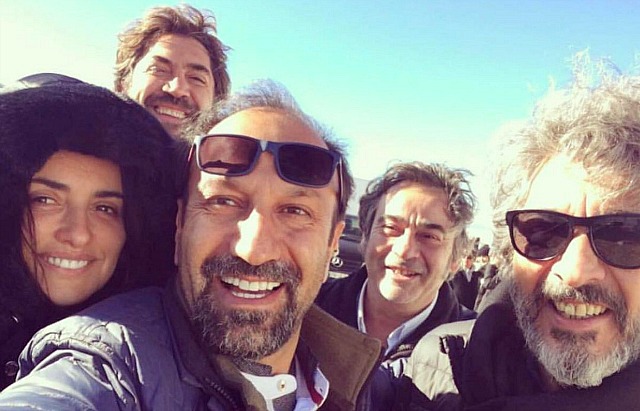

(l. to r.) Everybody Knows selfie: Penelope Cruz, Javier Bardem, Asghar Farhadi, Eduard Fernandez, Ricardo Darin.

A Separation, About Elly, The Past, The Salesman — nobody worships Farhadi like Hollywood Elsewhere. The man is hardcore and ultra-meticulous and thoroughly invested in character-driven stories, and is all but incapable of making a mediocre film, much less a bad one. It is a near certainty that Everybody Knows, a Spanish-language family reunion film about disturbances and disruptions, will be a strong, satisfying film. But the opening-night thing is scaring me a teeny-weeny little bit. A hint of slight foreboding.

Everybody Knows (aka Todos Lo Saben) is only the second Spanish-language film to open Cannes. Pedro Almodovar’s Bad Education (’04) was the first. It’s also a departure for the Iran-based Farhadi, having made his first film in Spanish and his second not in his native Farsi.

I’m in no way dismissing Everybody Knows because of its opening-night selection. It’s just that I know what “opening-night selection” tends to mean. Will it be better than last year’s opening-nighter, Arnaud Desplechin‘s Ismael’s Ghosts (Les fantomes d’Ismael), which, apart from Marion Cotillard‘s nude scene, was agony to sit through? Almost certainly.

A friend: “Moonrise Kingdom was in competition. Other opening nights, like Moulin Rouge, have been too. It’s at the determination of the festival and the filmmakers. The problem is that because most opening-night films at most festivals are NOT in competition, somehow even when you are in competition the film tends to get disregarded by the jury anyway. So it’s something of a double-edged sword, but those are the facts.”

Sounds Like It Stinks

Principal photography on John Cameron Mitchell‘s How to Talk to Girls at Parties (A24, 5.18) began on 11.9.15 in Sheffield, England. Elle Fanning, Nicole Kidman, Ruth Wilson. Synopsis: Female alien (presumably Fanning) hooks up with two earthling girls in London suburb of Croydon. HE suspicion/presumption: 21st Century Earth Girls Are Easy without the music? Bottom line: Iffy, don’t count your chickens. 26% on Rotten Tomatoes, 44% on Metacritic.

2018 Is 25% Over

With one-fourth of 2018 completed, it’s time to assess. What was the best film to open between January 1st and March 31st? Although nothing really rang my bell, I was mostly pleased with the last hour of Ryan Coogler‘s Black Panther. With everyone insisting that the hugely successful Disney release has to be ratified as a Best Picture nominee next January, I suppose I could call it 2018’s best film so far without sounding like too much of a whore.

Curious as it sounds, I was a little more admiring of Steven Spielberg‘s Ready Player One — another rousing third act but also with a relatively decent beginning and middle. “I came to scoff but came away placated, and even mildly enthralled by certain portions,” I said the other day. “For what it is, you could do a lot worse than Ready Player One…strange as this sounds there were times when I actually enjoyed the ride.”

But in terms of serious goodness and elemental nutrition, four foreign language releases share the prize — Sebastián Lelio‘s A Fantastic Woman, Andrej Zvyagintsev‘s Loveless and Samuel Maoz‘s Foxtrot (all from Sony Classics) and Ziad Doueiri‘s The Insult (Cohen Media Group).

Armando Ianucci‘s The Death of Stalin may have assembled the highest Rotten Tomatoes rating outside of Black Panther (95%) “I’ve no argument with the critics who are doing handstands and cartwheels,” I wrote on 3.8, “except for the fact that it’s more LQTM funny than the laugh-out-loud kind. There’s nothing wrong with LQTM humor, which I’ve also described as no-laugh funny — you just have to get past the idea of expecting to go ‘hah-hah, ho-ho, hee-hee’ because that never really happens.”

Alex Garland‘s Annihilation was easily the most overpraised film of 2018’s first quarter. “A visually imaginative, microbe-level, deep-in-the-muck monster-alien flick that will bring you down, down, down,” I wrote on 2.21.18. “Inventive in terms of the day-glo tree tumors and in a generally fungal, micro-bacterial, fiendish-mitosis sort of way, but it’s unrelentingly grim…basically a film about lambs to the slaughter.”

The 15:17 to Paris was half-tolerable but mostly underwhelming. “Weak docudrama tea and weirdly Christian to boot, but I didn’t hate it,” I wrote on 2.11. “Most of it felt like I was sitting in the back seat of an Uber or on a high-speed European train, waiting to reach my destination…was it horrifically boring? No, but it wasn’t what anyone would call engaging or riveting…it’s mildly weightless.”

Read more

First Female Shooter Since San Bernardino

Two different sources have told a CBS source heard that the “active shooter” situation at You Tube offices in San Bruno is a “white female.” “Multiple law enforcement sources” have told NBC News that the female shooter “is down.” Another says dead of a self-inflicted wound. Somewhere between 10 and 15 shots. Ten or eleven victims including a woman who was shot “multiple times.” Obviously a highly unusual occurence as shooters are almost invariably male. The last female shooter, Tashfeen Malik, was one of the two participants in the 2015 San Bernardino terrorist incident.

Way Down Below The Ocean

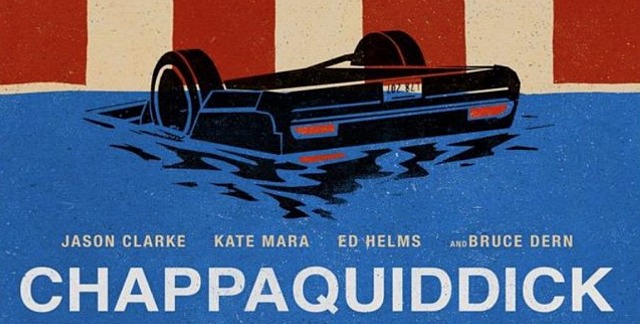
At the recent Los Angeles premiere for Chappaquiddick, Entertainment Studios honcho Byron Allen told Variety that “there are some very powerful people” — one of them being Chris Dodd? — “who tried to put pressure on me not to release this movie. They went out of their way to try and influence me in a negative way. I made it very clear that I’m not about the right, I’m not about the left. I’m about the truth.”

Chappaquiddick is truthful, all right. It could have been even more damning, in fact, but it conveys the necessary facts. It doesn’t slap you across the chops, but it delivers and lingers. There’s no forgetting it the next day.

It’s about how Sen. Edward M. Kennedy (Jason Clarke) suffocated his soul late at night on 7.18.69, and thereafter showed his family and colleagues (and eventually the world) what kind of person he was. About how he recklessly and probably drunkenly drove his Oldsmobile off a small wooden bridge around 11 pm that night, plunging into the black seawater, somehow climbing out of the vehicle but failing to save his passenger, a 28 year-old campaign worker named Mary Jo Kopechne (Kate Mara). And about how Mary Jo, stuck inside the submerged, upside-down vehicle, didn’t drown but almost certainly died of gradual suffocation in an air void.

In my view (and probably in the view of those who see it this weekend), Chappaquiddick is about how irresponsible, well-connected rich guys call their friends and cover their tracks, and about how average bystanders sometimes stand by and shake their heads or shrug their shoulders and perhaps say to themselves “not mine to judge or condemn…I merely have my life to live, but the rich and powerful have their agendas to serve.”

In the late summer of ’16 I threw some praise at a 5.11.16 draft of Taylor Allen and Andrew Logan‘s Chappaquiddick script. I tore through it in no time. It’s the kind of well-finessed backroom melodrama that I love — no bullshit, subdued emotions, no tricks or games. It’s tense and well-honed, and, like I said on 8.18.16, a nightmare that had me shaking my head and muttering “Jesus H. Christ”.

Like the script, film is a damning, no-holds-barred account of the infamous July 1969 auto accident which nearly destroyed Ted Kennedy‘s political career save for some high-powered finagling and string-pulling that allowed the younger brother of JFK and RFK to wiggle out of serious trouble and more or less skate.

Just about every scene exudes the stench of an odious situation being suppressed and re-narrated by big-time fixers, many of whom are appalled at Ted’s behavior and character but who do what’s necessary regardless.

Read more

20 Years Have Taken Their Toll

Last weekend I watched a 4K streaming version of Steven Spielberg‘s Saving Private Ryan. There’s no question that this 1998 WWII drama is one of the most brutally realistic and emotionally affecting war films ever made, and is certainly among Beardo’s finest. And yet I found myself flinching at the occasionally forced or unlikely moments, at the too-broad “acting” and emotional button-pushings. It kept ringing my phony gong. “Jeez, I don’t know if I even like this movie any more,” I said to myself. “Even the Omaha Beach landing sequence is starting to bother me.”

I had the same kind of reaction when I rewatched Close Encounters of the Third Kind in ’07, or 30 years after it opened. The bottom line is that Spielberg’s sentimental or overly theatrical instincts aren’t aging any better than John Ford‘s similar tendencies.

The greatest offense comes from Harrison Young‘s awful over-acting as the 75-year-old Ryan. His face is stricken with guilt as he shuffles through the Omaha Beach cemetery, and he walks like a 90-year-old afflicted with rheumatism. In ’87 I visited this same cemetery with my father, who’d fought against the Japanese during WWII. He was quietly shaken, he later said, but he held it in because that’s what former Marines do under these circumstances. They show respect by behaving in a disciplined, soldier-like way. They don’t moan and weep and flail around like some acting-class student.

I almost lost it when the teary-eyed Young collapsed upon the grave of Cpt. Miller (Tom Hanks). “Oh, for God’s sake!” I said out loud. “Show a little dignity…be a man!” Kathleen Byron‘s performance as white-haired Mrs. Ryan is almost as bad. All she does is eyeball her doddering, bent-over husband. The whole family, in fact, is staring at the old coot like he’s about to keel over from a heart attack.

Then comes one of the most dishonest cuts in motion picture history, going from a close-up of Young’s eyes to the D-Day landing craft carrying the Ryan squad — Hanks, Tom Sizemore, Edward Burns, Barry Pepper, Adam Goldberg, Vin Diesel — as they approach Omaha beach. Matt Damon‘s Ryan (Young’s 21-year-old counterpart) won’t meet them for another couple of days, when they’re inland a few miles.

I don’t believe that loaded-down soldiers drowned after being dropped by landing craft into 15 feet of water. That might have occured in real life, but I didn’t believe this in Saving Private Ryan — it just seemed absurd. I didn’t believe that bullet wounds would cause the water off Omaha Beach to turn red with blood — in fact Spielberg’s crew poured 40 barrels of fake blood into the water to achieve this effect. The basic effect is one of Hollywood exaggeration blended with historical, real-life horror.

Then comes Hanks’ big zone-out moment when he hits the beach. He’s an Army captain in the thick of battle with machine-gun bullets whizzing by and guys getting drilled and blown apart, and he chooses this moment to go “Ohhh, I can’t think or move…it’s too much…I’m so upset by war and its carnage that I need to go catatonic for a couple of minutes…don’t mind me…I’ll come back to life after this sequence is over.” I’m sitting there going “get it together, man! You wouldn’t do this in a Samuel Fuller or Howard Hawks film…you’re only zoning out because Spielberg likes the idea of spacing out and turning the sound down.”

Read more

How Do You Feel

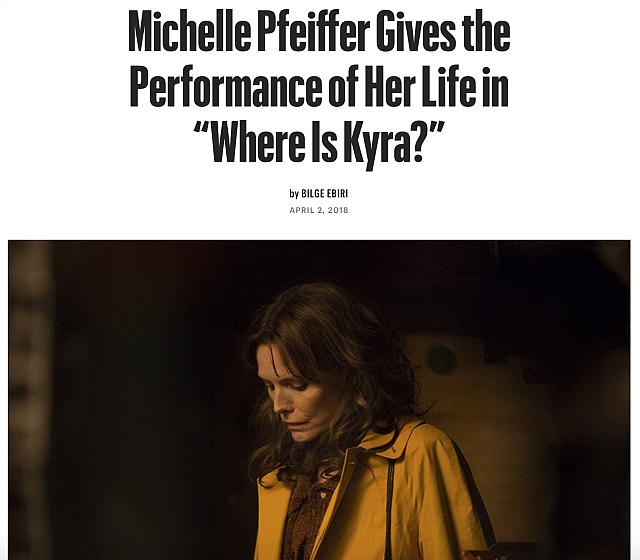
15 months after debuting at the 2017 Sundance Film Festival, Andrew Dosonmu‘s Where is Kyra? is opening this Friday (4.6). I’ve been saying all along that it’s “grade A within its realm” and that Michelle Pfeiffer‘s performance is quite the tour de force, but it’s the kind of film that will empty your soul and drain you of any will to live.

I’m not disagreeing with Village Voice critic Bilge Ebiri, whose just-posted article, “Michelle Pfeiffer Gives the Performance of Her Life in Where Is Kyra?“, teems with high praise; I’m saying “yeah, it’s very well made but don’t see it if you’re the type that occasionally thinks about suicide because it’ll push you into the abyss.”

I mentioned this impression to Ebiri this morning, and he replied “good…a movie that can convey the exhaustion and desperation of poverty to that degree is essential, and rare.” Yeah, it conveys that, all right, but I know if I consider this kind of creative deliverance to be “essential.”

Here’s how Ebiri puts it in his Voice piece: “[Dosunmu] and cinematographer Bradford Young sheathe Kyra in oppressive darkness, and they hold on her for extended periods, even when other characters are speaking or acting. Close-ups often show her half-concealed in the gloom, emerging from pitch-black corners of the screen. No lamp gives off enough light, no street scene is bright enough. A pall has descended over this woman’s life. Rarely on film has the sheer debilitating exhaustion of poverty been conveyed so clearly.”

Here‘s how I put it on 1.24.17: “A funereal quicksand piece about an unemployed middle-aged woman (Pfeiffer) in a terrible financial jam, and about a relationship she has with a fellow down-and-outer (Keifer Sutherland), Where Is Kyra? is a carefully calibrated, well-acted gloomhead flick that feels like it’s happening inside a coffin or crypt.

“This is Dosunmu’s deliberate strategy, of course, but the end-of-the-road, my-life-is-over vibe is primarily manifested by the inky, mineshaft palette of dp Bradford Young — HE’s least favorite cinematographer by a country mile.”

Read more

Sullivan Travels

Most of yesterday afternoon was about hiking in Sullivan Canyon, a leafy, horse-trail community just west of Mandeville Canyon. We defied the posted warnings and parked on Old Ranch Road, about 1/2 mile north of Sunset. We walked up a horse trail to Sullivan Canyon trail, which goes on and on. By the time we were back to the junction of Sunset and Old Ranch we’d hiked five miles.

We also checked out Diane Keaton’s super-sized, industrial-chic home, which was written about last October in Architectural Digest. Keaton also published a book about it — “The House That Pinterest Built.”

We only scoped out the exterior, of course. It’s magnificent and exacting, so beautifully textured and all of a piece in so many ways, but at the same time (here it comes) so immaculate that it feels more like the workspace of an enlightened, forward-thinking company (it reminded me a bit of J.J. Abrams‘ Bad Robot headquarters) than what most of us would call a “home.”

Homes need to feel imperfect and lived in and just a little ramshackle — a tad sloppy and messy with the scent of white clam sauce and peanut butter and sliced lemons, and maybe a hint of cat poop. A good home always has magazines and books and vinyl LPs all over the place, not to mention flatscreens and blankets draped over couches and at least three or four cats and dogs hanging around. Keaton’s place might feel homier inside, but the exterior seems a bit too precise.

Oh, and there’s hardly any tree-shade in the front yard of Keaton’s place. Warren Beatty once said that great-looking hair constitutes 60% of a woman’s attractiveness; by the same token a great-looking home needs great trees (sycamores, jacaranda, lemon eucalyptus, pin oak) to drop a few thousand leaves and shade the place up.

6:15 pm update: I just ran into Warren Beatty and Annette Bening at Le Pain Quotidien on Melrose…honest! I told him I loved the quote about hair constituting 60% of a woman’s beauty or appeal, and he said, “I don’t think I ever said it.” Huh. “You read this somewhere?,” he asked. Yeah, I said. In an article about Diane Keaton or about her home, and just this morning. I definitely didn’t invent it, I emphasized, but I love the observation regardless.


Diane Keaton’s spacious, self-designed home, just around the corner from Old Ranch Road and exactingly designed like nothing you’ve ever seen.

Built in Sullivan Canyon in 1956, Mandalay (2200 Old Ranch Road) was a sprawling, one-story home designed by architect Cliff May, who is regarded as the creator of the California Ranch-style house (i.e., early 1930s). May died in 1989. The Mandalay property was bought, destroyed and redeveloped. The big gate looks like the entrance to Jurassic Park.

Read more