“Women like romcoms precisely because men do change. I’m not saying men act the way they do primarily because of movies, but they have been getting this message for a long time, that this is what women want. And it is what women want. But only from the men they want it from! Problem is, we don’t know which one we are.
“Tom Cruise barges uninvited into the home of the woman he’s hired and had sex with and says, ‘I’m not letting you get rid of me…how about that?’ Adorable. But if it was Ted Cruz, not so much.
“Love Actually is somehow a lot of people’s favorite movie, but if it was made today, it would have to be called Inappropriate Actually. It’s nothing but men hitting on their underlings…”
I’m no fan of Andrew Dosunmu‘s Where Is Kyra? (Great Point Media/Paladin, 4.6). After catching it 13 months ago during Sundance ’17, I called it “more or less a bust…a funereal quicksand piece about an unemployed middle-aged woman (Michelle Pfeiffer) in a terrible financial jam, and about a relationship she has with a fellow down-and-outer (Keifer Sutherland). It’s grade-A within its own realm — a carefully calibrated, well-acted gloomhead flick that feels like it’s happening inside a coffin or crypt. This is Dosunmu’s deliberate strategy, of course, but the end-of-the-road, my-life-is-over vibe is primarily manifested by the inky, mineshaft palette of dp Bradford Young — HE’s least favorite cinematographer by a country mile.”
Never in Oscar history has a director-writer written an Oscar-winning original screenplay (as a solo writer) that has also won Best Picture…never.
Reworded: If the director-writer of a Best Picture contender is the sole author of a Best Original Screenplay nominee and that screenplay goes on to win an Oscar, the film will almost certainly not win Best Picture.
That, at least, is what 89 years of Oscar history tells us. Yes, the screenplay for Annie Hall won Best Original Screenplay, but that was co-authored by Woody Allen and Marshall Brickman. Spotlight won for Best Original Screenplay also, but again, it was co-authored. Any exceptions?
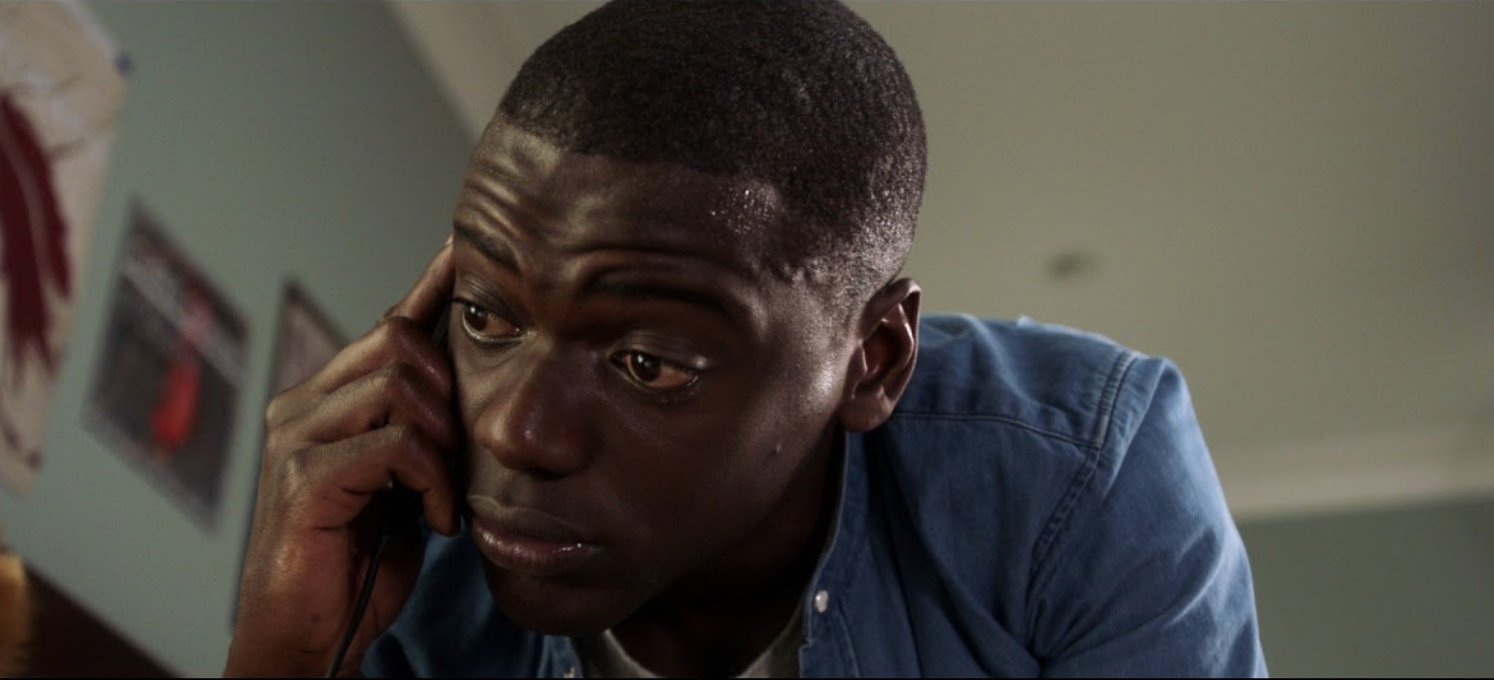
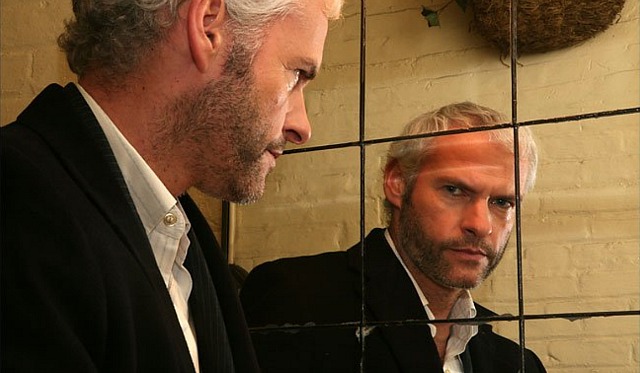
The solo-authored nominees for Best Original Screenplay are Greta Gerwig‘s Lady Bird, Jordan Peele‘s Get Out and Martin McDonagh‘s Three Billboards Outside Ebbing, Missouri. (The Big Sick and The Shape of Water were co-authored.) So if Martin McDonagh wins the Oscar, you can pretty much count on Three Billboards not winning for Best Picture.
Three Billboards director-writer Martin McDonagh.
I’m not sure if Three Billboards or Get Out will win Best Original Screenplay. Is anyone? An Oscar-handicapping friend believes that McDonagh has it in the bag, and that Get Out, which he regards as little more than a racially-themed knockoff of an Ira Levin Stepford Wives deal, will go home empty-handed. If this happens, the “woke” crowd will be staggering around in a state of shock.
We all know that The Shape of Water will win the Best Picture Oscar, and that Guillermo del Toro will take the prize for Best Director. Fine with me, go with God, everyone loves Guillermo, etc.
But if you apply the Howard Hawks rule of film excellence (three great scenes and no bad ones), there’s no getting around the fact that 70% of Michael Shannon‘s scenes are “bad ones” — darkly obsessive, fiendishly sadistic, unfocused. My favorite scene, which I’ll gladly call a great one, is the black-and-white, 1930s-style dance number between Sally Hawkins and gill-man. And the underwater lovemaking scene with Sally in a red dress — another goodie. But what’s the third?
Both Lady Bird and Get Out have no below-the-line nominations. For a Best Pic winner with no BTL nominations, you’d have to go back 37 years to a Best Picture winner, Ordinary People, with that handicap. On top of which neither Lady Bird nor Get Out are up for Best Film Editing and again, you need to go back 38 years for that winner.
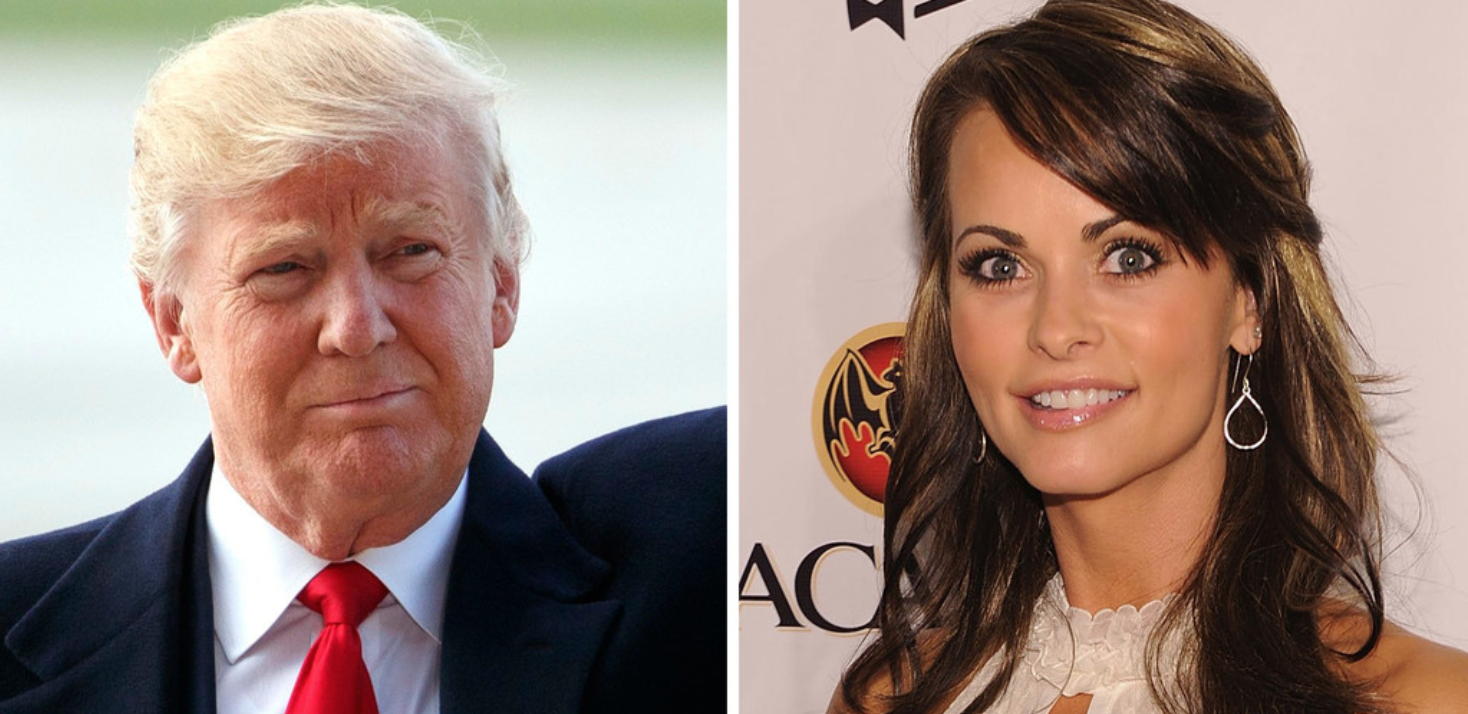
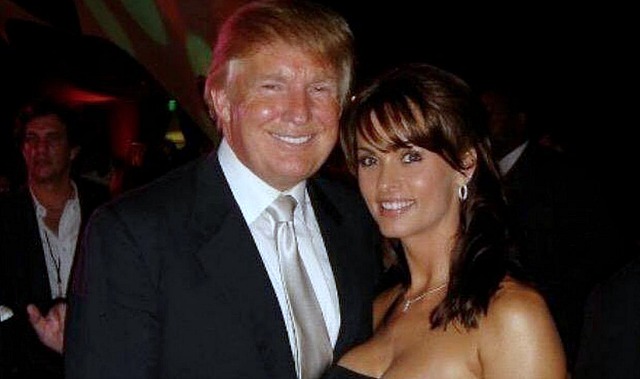
Karen McDougal, Stephanie Clifford aka Stormy Daniels, Alana Evans, Jessica Drake, Summer Zervos…I’m starting to get confused. Let’s just focus on Ronan Farrow’s New Yorker piece about Donald Trump’s thing with McDougal (or vice versa), which lasted from June 2006 to April 2007. The proof was an eight-page handwritten “document” that McDouglas wrote about her relationship with Trump, and which was fed to Farrow by John Crawford, a friend of McDougal’s. But that handwriting! I got a headache just from reading a few lines.
Excerpt: “’I was so nervous! I was into his intelligence + charm. Such a polite man. We talked for a couple hours – then, it was ‘ON’! We got naked + had sex.’ As McDougal was getting dressed to leave, Trump did something that surprised her. ‘He offered me money,’ she wrote. ‘I looked at him (+ felt sad) + said, ‘No thanks — I’m not ‘that girl.’ I slept w/you because I like you — NOT for money’ — He told me ‘you are special.’ ”
The cyberverse offers ample opportunities for wackos to post thoughts about how diseased they are, and there doesn’t seem to be any debate that Parkland shooter Nikolas Cruz did just that. Using his own name, Cruz said last September on a YouTube comment thread that he was going to become “a professional school shooter.” Some guy from a Southern state (i.e., not Florida) tipped the FBI through some kind of hotline but the FBI somehow flubbed it. Brilliant.
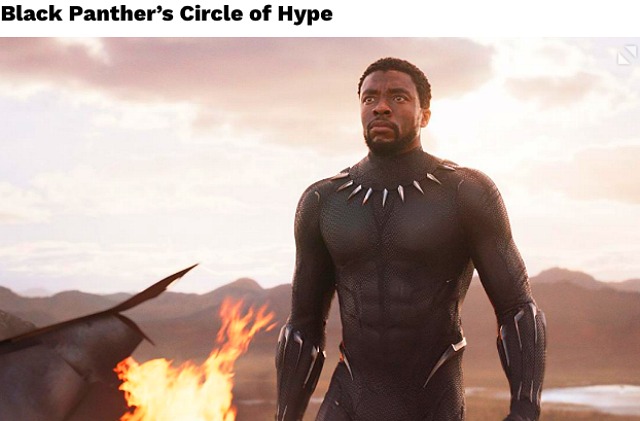
Who’s surprised that New Republic critic Armond White, the most reflexively contrarian critic around, has gone after Black Panther, calling it an “overhyped race fantasy”? But I have to say in all fairness that he’s not sounding all that reflexive this time, and could even be accused of being perceptive.
Give it a read-through and tell me White is completely or even largely wrong.
White begins by stating that “the Marvel Cinematic Universe (MCU) first infantilizes its audience, then banalizes it, and, finally, controls it through marketing” — yep, that it does.
Favorite passage: “T’Challa’s superpowers, tight-fitting Panther outfit, and Shangri-La-style homeland (transferring the fabled El Dorado from the Western Hemisphere to Africa) distort actual history and anthropology the same way that TV, comic books, video games, and movies have supplanted traditional education and learning.
“Utopian Wakanda, hidden behind clouds and mountains away from European colonizers, resembles the faux-naïve heaven of the 1936 negro musical Green Pastures. But the old-timey Christianity in that film is now replaced by faux-naïve Afrocentricity, including clichéd tribal customs (T’Challa must fight challengers to his throne).
“During the radicalized 1960s, Green Pastures’ stereotypes were considered an outrage. Black Panther would seem similarly fake if people weren’t falling for it without question.
“Black Panther offers no mystical alternative to racism’s threat, or the helplessness engendered by the tragedy of slavery (the original sin of removing Africans from their real and imagined roots). Instead, the movie offers a panacea, a comic-book fantasy of black empowerment that exchanges the actual history of the ’60s Black Panthers for a superficial commercial remedy.
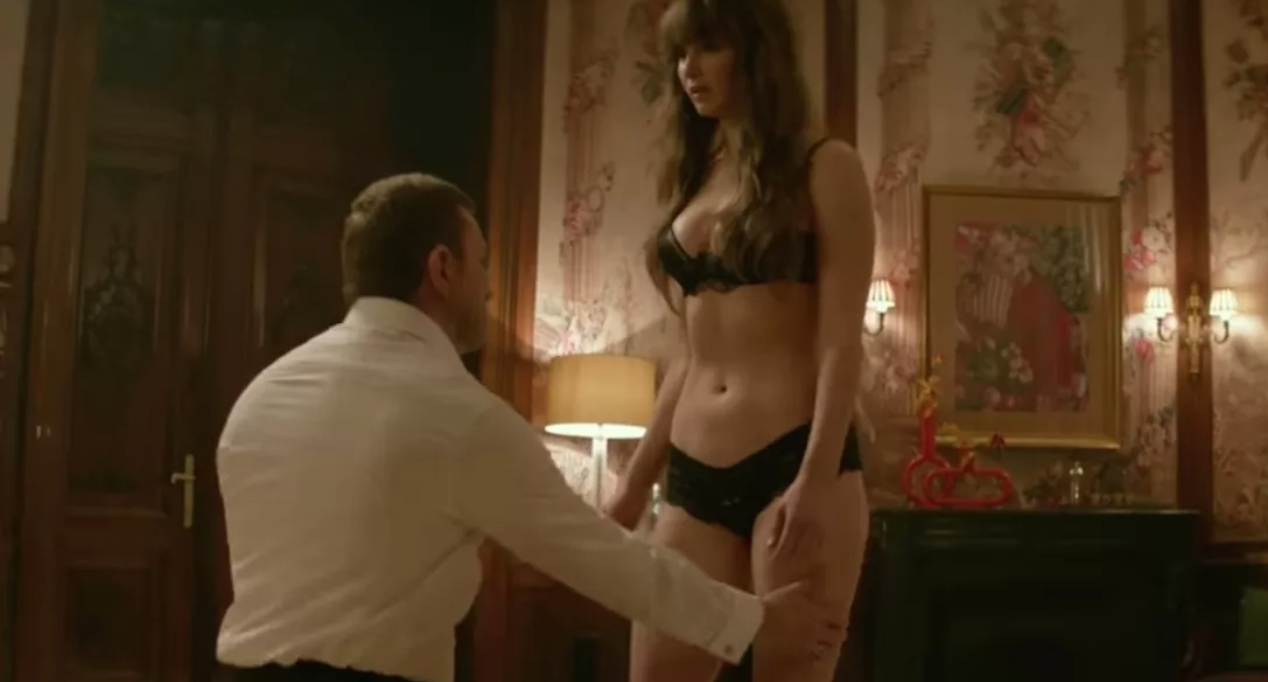
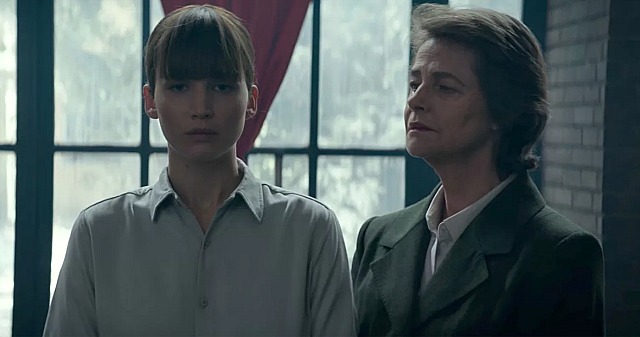
The first term that comes to mind when thinking of Francis Lawrence‘s Red Sparrow (20th Century Fox, 3.2), which I saw last night, is “ice-cold,” and I don’t just mean the simulations of snow-covered Russia. (The film was shot in Hungary, Slovakia, Austria and, very briefly, London.) Almost everything that happens in this 139-minute, Americans-vs.-Russians spy thriller is coated with malice and arctic frost — just about every line, expression, motivation or attempt at manipulation, and every act of sadistic brutality, sexual or otherwise.
No one expects a film about a beautiful, poker-faced Bolshoi ballerina (Jennifer Lawrence‘s Dominika Egorova) being forced, after a horrid physical injury, to enroll in “whore school” (Lawrence’s term) to become a government-controlled seductress or “red sparrow,” and then graduate into the realm of double agentry, to provide any kind of emotional balm. But for the most part Red Sparrow goes out of its way to avoid even a faint hint of humanity.
Except, that is, for a couple of brief scenes between Dominika and Joel Edgerton‘s Nathaniel Nash, a CIA agent with a semblance of a heart. (The story begins with Nash on the outs with his bosses for behaving stupidly during a nighttime incident in a Moscow park, and then he attempts to redeem himself by recruiting Dominika into working for the Americans.) There are two or three scenes of domestic bonding between Dominika and her irritatingly dependent mother (Joely Richardson), but honestly? I was kind of hoping mom would get rubbed out as all she does is sit around and serve as a kind of albatross.
This is not, to put it mildly, a double-agent film with the finesse and subtlety of, say, Martin Ritt‘s The Spy Who Came In From The Cold (’65), which was regarded as a rather cold-hearted piece when it opened a half-century ago. The focus on cruelty in Red Sparrow makes that John Le Carre adaptation seem rather mild in this regard. At every turn Sparrow says “try a little heartlessness.”
Red Sparrow is more in the realm of Atomic Blonde, the period (late ’80s) spy film with Charlize Theron, minus the gymnastics. It’s an aggressively sexual thing, I mean, but is mainly about all kinds of physical brutality, including a pair of attempted rapes and two especially savage beating-and-torture scenes that would, in the real world, result in God-knows-how-many-weeks in a hospital.
Most of the violence, sexual and otherwise, happens to poor Dominika, and after the third or fourth assault I was asking myself, “Is this a movie for the #MeToo era?” I suppose it is, in a way, as it does allow for a form of satisfying fuck-him revenge at the finale. But in my seventh row seat in a 20th Century Fox screening room, I was as much of a recipient of the brutality as Lawrence, and after a while I felt covered with bruises. Sorry but I empathize. It’s in my nature.
It’s time once again to measure the year’s Best Picture nominees against the famous Howard Hawks criteria for a good film — “one with three great scenes and no bad ones.” Which of the 2017/2018 Best Picture contenders meet Hawks’ definition of a quality-level film and which don’t?
You need to do two things: (1) List the three good scenes in Call Me by Your Name, Darkest Hour, Dunkirk, Get Out, Lady Bird, Phantom Thread, The Post, The Shape of Water and Three Billboards Outside Ebbing, Missouri, and (2) answer honestly if any of these films have any bad scenes.
HE nitpickers have tried to dismiss the Hawks criteria, but a movie that delivers three great scenes and no shitty ones is always a very good film. Because people always tend to remember those extra-powerful or poignant moments. Because they always sink in.
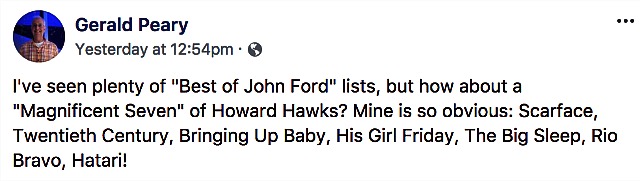
HE’s list of Hawks’ seven best films (in this order): Red River, Only Angels Have Wings, The Big Sleep, Bringing Up Baby, His Girl Friday, Air Force, Scarface.
First, even if there was some kind of half-rekindled relationship between the two (which is almost certainly imaginary) there would be no reason for Aniston to trust Pitt. The fact that he cheated before means the odds are at least 50/50 that he’ll cheat again. Second, Pitt would never go back to Aniston for reasons of pride, partly because of the trust issue and partly because you can’t go home again. Third, Brad’s next serious girlfriend or wife needs to be someone better than Angelina Jolie and way better than Aniston, and by that I mean someone like Amal Clooney…a lawyer or a diplomat, a brilliant book author or stage director or brain surgeon, someone classy and accomplished but without Jolie’s curious history.