Another One Bites The Dust

Two days ago it was reported that Dan and Toby Talbot‘s Lincoln Plaza Cinema, an arthouse sixplex and an Upper West Side cultural haven since it opened in 1981, has been given the heave-ho by its landlord, Milstein Properties. The theatre will close in January.

In an email a Milstein spokesperson told the N.Y. Times that “vital structural work” was needed to repair and waterproof the plaza around the building. “At the completion of this work, we expect to reopen the space as a cinema that will maintain its cultural legacy far into the future.” The rep added that it’s unclear “if the cinema [will] reopen with the Talbots in charge.”

This sounds like Milsteins want to sever ties with the Talbots. Maybe not.

Honestly? I’ve always kind of hated this little basement-level plex. Tiny shoebox theatres, small screens, seats mounted too close together, no leg room. The last time I saw a film there was…oh, six or seven years ago. It was raining outside (which was part of the reason I’d bought a ticket) and as I sat in one of those crummy little theatres, which felt damp and stuffy that day with the odor of soaked umbrellas and raincoats, I remember saying to myself, “What am I doing here? I don’t like the movie and the atmosphere is down-at-the-heels and the seat is too uncomfortable to take a nap in.”

But I always respected the Lincoln Plaza. A film-buff haven, a small business that has long fed the aura of Upper West Side knowingness. Every time I’d walk by I’d look up at that shitty little marquee and say to myself, “Good, it’s still there.” So the closing is a very sad thing. A shame. Diminishes the character of the city, makes the neighborhood a little less vibrant.

Smarthouse cinemas have always been good for the soul. Manhattan was a repertory cinema boom town in the ’60s, ’70s and ’80s. They’re all pretty much gone now, although there’s still the Metrograph, the 13th street Quad Cinema as well as the Cinema Village, the Film Forum, MoMA, the Film Society of Lincoln Center, the Museum of the Moving Image, BAM, et. al.

At the same time people have been lamenting for the last 20 years that NYC is becoming more and more corporate, and less and less accomodating for small- and mid-sized businesses, not to mention anyone earning less than a hefty six-figure income. Remember the death of Pearl Paint on Canal? Same kind of sadness.

Read more

Solution To A Problem

On 12.14 The Hollywood Reporter‘s Borys Kit reported that Benny and Josh Safdie (Good Time) will direct a remake of Walter Hill‘s 48 HRS (’82). The original script, co-written by Hill, Roger Spottiswoode, Larry Gross and Steven de Souza, is about a racist tough-guy cop (Nick Nolte) springing a black convict (Eddie Murphy) from jail in order to gain an inside advantage in tracking down a pair of cop killers.

The problem, it seems to me, is that the racial epithets that came out of Nolte’s mouth 35 years ago will sound over-the-top horrendous by today’s cultural standards. Nolte’s Jack Cates calls Murphy’s Reggie Hammond the “n” word, for one thing, not to mention “spearchucker” and a couple of other terms that haven’t been heard in commercial films in a long time.

How to get around this? Reverse the ethnicity of the leads. Use a snarly, middle-aged black actor to play Nolte’s detective, and a younger white actor to play Murphy’s convict, except make him an under-educated alt-right guy.

Polka Refrain

After debuting 11 months ago at the 2017 Sundance Film Festival, Maya Forbes and Wallace Wolodarsky‘s The Polka King, a reasonably decent real-life dramedy, will begin airing on Netflix on 1.12.18.

I called it “a briskly paced, broad-brush tragicomedy that’s aimed at the none-too-hips. It’s funny and engaging as far as it goes — a kind of regional (i.e., Pennsylvania-based) farcical screwball thing. It has a tightly sprung comic attitude, and is packed (as you might presume) with traditional polka music, colorful, behind-the-eight-ball characters and all kinds of local douchebag flavor.

“It’s a bit like The Wolf of Wall Street in that it’s about a manic, larger-than-life polka-singing hustler — the real-life Jan Lewan — who ponzi-schemed his way into a five-year jail sentence about 15 years ago. The difference is that while Wolf was a half-satirical portrait of predatory financial-market culture, Polka King is about a guy who tries to flim-flam his way out of financial difficulty only to wind up in an even deeper hole.

“You know going in that the buoyant, Polish-born Jan (entertainingly nailed by the great Jack Black) is headed for a fall, so the movie is basically a waiting game — how long before Jan’s bullshit finally catches up with him? The Polka King therefore lives or dies based on how diverting or hilarious you find delusion and denial as the hallmarks of a business plan.

“I for one didn’t find it hugely amusing –the only film about relentless lying and flim-flammery that I’ve liked was Robert ZemeckisUsed Cars — but I took the ride and had a decent-enough time. I recognize that others who caught The Polka King last night (as I did) are down with it more than I, and that it may well prove a commercial success.

Read more

“Here’s To Old D.H. Lawrence…”

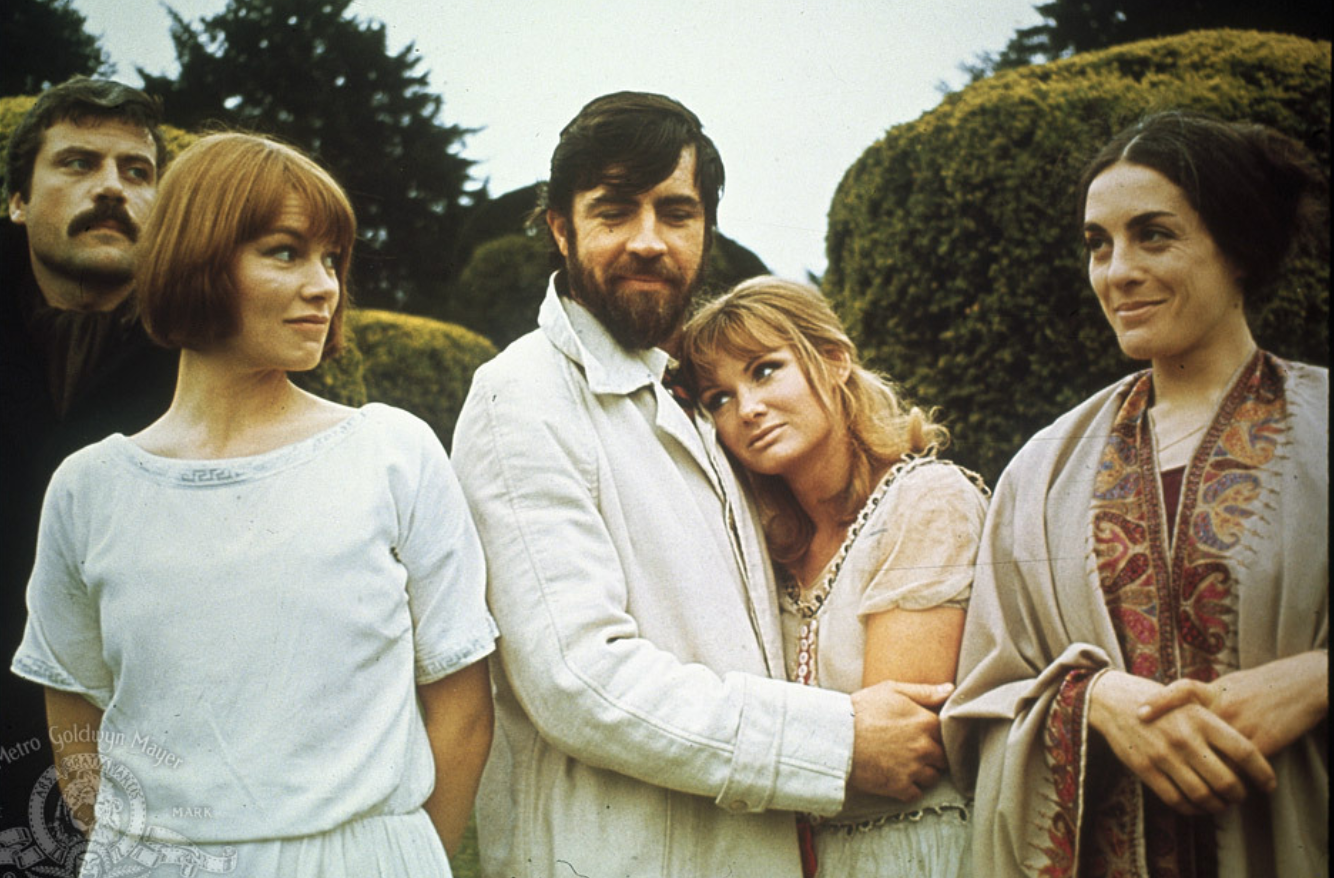
I’ve had the BFI Bluray of Ken Russell‘s Women In Love (’69) on my bookshelf since August 2016. Yesterday it was announced that Criterion will be releasing its own version on 3.27.18. The Criterion will almost certainly look identical to the BFI. Both are 4K scans of a BFI-restored print from 2015; both using a 1.75:1 aspect ratio and running 131 minutes.

The Criterion jacket features a painting of drowned lovers, taken right from the film. More alluring than the still images on the BFI Bluray.

Women in Love is Russell’s greatest work — a perfectly captured, brilliantly written period romance that pulls you in immediately with a feeling of Lawrentian eloquence and authenticity. Not as shocking or inflammatory as The Devils but richer and more flavorful and more spiritually open, not to mention erotic. Billy Williams‘ cinematography is dazzling — the pictorial detail and robust colors on the BFI Bluray are worth the price in themselves.

Released just over 48 years ago but looking fresh from the lab, Women in Love is one of the most lusciously captured films ever made about men, women and relationships (and I’m not just talking about the nude wrestling scene between Alan Bates and Oliver Reed), and one of the most articulate portrayals of the sadnesses and frustrations that plague so many lovers.

It’s also one of the first mainstream films to fully explore and dramatize the lives and longings of free-spirited, semi-emancipated 20th Century women (i.e., Glenda Jackson‘s Isadora Duncan-like Gudrun and Jennie Linden‘s more conservative Ursula) in a historical context.

Posted on 8.21.16, but applicable right now: “If Women in Love had never appeared in ’69 and yet was somehow recreated by a fresh creative team and released this fall by Focus Features or Fox Searchlight, it would instantly vault into the Best Picture category. Because nobody and I mean nobody makes brainy, pulsing period dramas as good as this for the theatrical market any more.”

Read more

Feinberg Buying Get Out Hype

This morning The Hollywood Reporter‘s Scott Feinberg posted a pre-holiday Oscar race chart. One standout call was Feinberg’s decision to throw in with Variety‘s Kris Tapley by describing Darkest Hour as a “maybe not” in the Best Picture race. In Feinberg parlance and especially in mid-December, “maybe not” contenders are given a “major threat” designation…same difference.

But even more striking is the sudden influence of the just-announced SAG Ensemble Award nominees, and particularly Feinberg’s decision to place Get Out at the very top of the Best Picture list.

Everyone realizes that Get Out is a tenacious contender that has struck a nerve, and that a Best Picture nomination is 100% locked. But placing it ahead of everything else seems….what, excessive? Delusional?

Do I have to say again that the three most Oscar-deserving films of the year — Call Me By Your Name, Lady Bird and Dunkirk — are the most independent-minded and very much singing their own tune, and are far more adventurous and accomplished than Get Out?

HE readers are probably sick of this opinion, but what am I supposed to say about Feinberg going apeshit for Get Out? Declare what a seer he is?

As for the mystifying Daniel Kaluuya for Best Actor thing, I riffed on that the other day.

Two friends disagree. “Scott’s call isn’t delusional at all,” says critic #1. “I have a feeling Get Out is going to win too. I just need more intel to make a full prediction. Right now it’s down to three: Get Out, Lady Bird and Three Billboards outside Ebbing, Missouri.”

Critic #2 says that Kalyuua gives “a strong performance in an important film, and [the Kaluuya talk] is retroactive justice for Sidney Poitier NOT getting a Best Actor nom for In the Heat of the Night 50 years ago, while costar Rod Steiger did and won the category.”

So 2017 is not the year of women pushing back at the patriarchy and sexual misconduct, and we’re still offering make-up apologies for #OscarsSoWhite?

“I don’t see it that way,” critic #2 replied. “Get Out overcame its genre stereotyping to become one of the most significant and talked-about films of 2017.”

For the 37th or possibly 38th time, Get Out is just a hooky genre film — a satirical horror-thriller that delivers a social metaphor message a la Don Siegel‘s Invasion of the Body Snatchers, and is pitched squarely at mainstream liberals. That’s really ALL IT IS. But when you add the cheering section factor, Get Out begins to morph into this on-target, Bunuelian, capturing-of-a-zeitgeist film. Sizzle overwhelming the actual flavor of the steak.

Read more

Kindness of History

A few hours ago I was pulling out of the Real D parking lot and onto Crescent Drive, and right in front of me — hah! — was a “President Nixon — Now More Than Ever” bumper sticker on a recent-model Beemer. I laughed, of course — best one of the day. I wasn’t fast enough to take a photo, but this 1972 bumper sticker is all over the web.

Richard Nixon was in some ways a resentful, paranoid and self-destructive fellow, and he’ll always have a shadowy rep for having inaugurated the “Southern Strategy” — i.e., conservative Republicans appealing to rural Southerners on racial grounds. But in other ways and certainly in comparison to the wildly intemperate Donald Trump, Nixon was almost a liberal moderate.

Six and half years ago I wrote that “if Nixon were to return to earth with the same mind and spirit and perspective that he had before he died in the ’90s but in the body of a go-getter Congressman from Southern California, and he’d probably have a tough time getting re-elected because he’d be considered too moderate, too thoughtful, too practical.”

Read more

Toughest Hombre In Town

I can’t say anything about Ridley Scott‘s All The Money In The World (Sony, 12.25), but I sure as hell saw it this afternoon.

I can at least say it felt like a special, very historic occasion, watching a brand-new, big-studio, major-league film that had just re-shot significant portions (i.e., all of Christopher Plummer‘s scenes, which happened mostly in England) less than a month ago. And then came the pleasure of talking to Scott right afterwards during a q & a and then over drinks and hors d’oeuvres in the lobby.

May I also say…? Okay, not allowed. But I was in a pretty good mood when the lights came up.

Ridley was asked about the high stress levels that came with the hasty re-shoot period (11.20 to 11.30). He replied, “If you don’t enjoy stress, don’t do the job…I thrive on stress. For me stress is [figuring] what to do on the weekends.”

What an adventurer, what an El Cid this guy is! He eats this shit for breakfast. A special Oscar is warranted, Academy members.


All The Money In The World director Ridley Scott talking to Bill Desowitz in lobby of Real D screening room following this afternoon’s 3 pm screening.

Read more

Not Turning Out As Expected

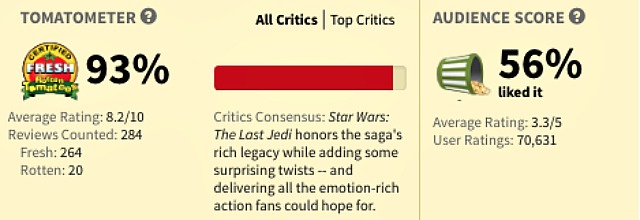
Rotten Tomatoes critics have given The Last Jedi a 93% approval rating, but this evening or near the end of the first full day of public screenings, Rian Johnson’s film has a 56% “like” rating from Joe and Jane Popcorn. Correct me if I’m wrong but this doesn’t seem like a good sign. Saturday update: 86,634 viewers have now voted, and the rating is at 57%.

The “likes” on almost all the other popular movies are in the 80s and 90s. 71,000 people voted, and I don’t see how a 57% or 58% “like” is anything but a huge whoa! for Disney, Johnson, Kathy Kennedy, Bob Iger, et. al.

Who saw it today and what was the room temperature as everyone was exiting the theatre?

Why The Maher Disappearance At Year’s End?

Bill Maher and his Real Time pallies are family to me. I was just shooting the shit with Ridley Scott at the Real D screening room, but I don’t have a social clique to speak of and I don’t chew the fat with my Shenandoah Valley neighbors on my front porch and I don’t drink and socialize in Manhattan bars and cafes, which is another kind of “family” activity. All I have or had, I should say, on Friday nights was Real Time, but it’s currently on hiatus until mid January. And this is the time of year when you really value family get-togethers so I’m really not very happy about this.

Rag & Bone Asshats

This is real. Nobody’s kidding around here. There are actually people out there who will (probably) pay to wear Rag & Bone clothes borrowed from wardrobe stylings of previous Stars Wars films. (Choke, cough.) I would actually consider wearing Han Solo‘s outfit (vest, boots, tight jeans) from A New Hope — I could see myself in that.

Read more

Give Chumps What They Want?

It’s significant, I think, that at the end of this months-old Vanity Fair video that Mark Hamill talks about the joy and satisfaction of “giving Star Wars fans what they want,” or words to that effect.

Monumental, world-class cinema had never been about giving ticket buyers what they think they want because they don’t know what that is, not really. They only know what they liked before, and so an attitude of “give them what they want” amounts to a kind of creative death sentence.

It’s always been the task of first-class filmmakers (and innovators in other industries, for that matter) to deliver the next essential thing — to give the public what it will want once it sees and hears and understands what that thing is. [Video after jump.]

Read more

Historical Moment

An hour from now (3 pm) I’ll be sitting down with Ridley Scott‘s All The Money In The World (Sony, 12.25), followed by a Scott q & a and then a sip-and-munch reception. Reactions are embargo’ed until Tuesday, 12.19, but I’m saying this again loud and clear to all responsible parties — don’t destroy or hide the Kevin Spacey footage. Please incldue it on the ATMITW Bluray.

Sony and Scott didn’t decide to re-shoot Spacey’s scenes with Christopher Plummer over aesthetic difficulties with Spacey’s performance. They did this due to understandable political reasons, but it’s not the craziest notion in the world that five or ten or perhaps 20 years hence Spacey might not be considered a total pariah, as he is now. History insists that Scott and Sony preserve Spacey’s performance and let history consider the merit of what he delivered.

Read more