Devin Faraci, Cinefamily’s Shadie Elnashai and Hadrian Belove, Ain’t It Cool‘s Harry Knowles have walked the plank for alleged sexual assault and/or harassment…and now Harvey Weinstein, the swaggering king of the indie world in the ’90s and most of the aughts until ’13 or thereabouts, is being threatened along similar lines.
Variety‘s Brent Lang, Gene Maddaus and Ramin Setoodehreported earlier this afternoon that the Weinstein Co. honcho “has hired a high-powered team of attorneys to push back on soon-to-be-published bombshell stories from the New York Times and the New Yorker detailing sexual allegations and improper workplace behavior against him.”
Variety says that “some women making the charges are believed to be on the record.”
“Multiple individuals with knowledge of the situation” have told Variety that Jodi Kantor and Megan Twohey are the authors of the Times story, and that former MSNBC host and Woody Allen accuser Ronan Farrow is penning the New Yorker piece. One of the stories could appear as early as this week, the article says.
In a brief interview with Variety, Weinstein “declined to comment on the charges.”
I just flashed on the finale of Brian DePalma‘s Scarface with Harvey as Tony Montana and Kantor, Twohey, Farrow and Harvey’s alleged accusers as the Columbians scaling the fence of the Montana estate.
I don’t understand how anyone can dismiss Fatih Akin‘s In The Fade (Magnolia, 12.27), a traumatic-loss-and-revenge drama starring Diane Kruger, whose performance won the Cannes Film Festival’s Best Actress award last May. You can criticize the film, I suppose, for what it doesn’t address (i.e., European Islamic terrorism) but taken on its own terms, it’s close to unassailable.
In The Fade dispenses chilly, carefully measured hardball realism, and does so in a gripping, emotionally jarring way that I believed top to bottom. It’s now the official German entry for the Best Foreign Language Film Oscar at next March’s Academy Awards telecast (3.4.18).
Set mostly in Hamburg, Fade starts with Katja (Kruger), her clean-living Kurdish/Turkish husband Nuri (Numan Acar) with a drug-dealing past, and their young son Rocco in happy-family mode. That lasts less than ten minutes. A home-made nail bomb outside Nuri’s office explodes, and Katja is suddenly a child-less widow. She wilts under agonizing pain and a near-total emotional meltdown, and understandably decides to temporarily medicate with drugs, and then nearly ends it all by slitting her wrists.
But a suspicion she’d shared with her attorney, Danilo (Denis Moschitto), about anti-immigrant Nazis having planted the bomb turns out to be accurate. Katja learns that evidence she had given the police has led to the arrest of Andre and Edda Moller (Ulrich Brandhoff, Hanna Hilsdorf), a pair of young neo-Nazis with international connections. There’s no doubt these two are the culprits — Katja had seen Edda leave a bicycle near her husband’s office two or three hours before the blast.
Then comes a second-act portion dealing with a trial of the accused that doesn’t end satisfactorily, and finally a third act in which the acutely frustrated Katja travels to Greece to carry out her own form of revenge-justice.
Back in the days of print and paper, or roughly 27 years ago, I was talking…okay, arguing with a guy who was in charge of printing Prime, a Music-Plus contract monthly about music and movies that I was the senior editor of. He got off the line for a bit, and a second or two later I murmured to a friend nearby that the guy I was squabbling with was a moron. The printer heard me. Our conversation proceeded as follows:
Printer: You just called me a moron. Me: I did? Printer: I heard you! You just said “he’s a moron.” Me: Well, okay, but I wasn’t describing you in an altogether sense. What I meant — I’m sure you’ve done this yourself — was that my impression of you at that particular point in time was that you were a moron. A moment in time. Two minutes later you could say or do something that would totally change my mind. Just a figure of speech. Printer: Well, here’s another figure of speech. You’re a judgmental shit. Me: Not really. I’m apologizing and trying to build bridges here. Printer: You’re apologizing? Me: Well, yeah. I mean, I said it, okay, but it was like I said, a brief, transitional impression. Speaking here and now in the present tense, I’m not calling you a moron. I’m just trying to work with you.
Same thing with Secretary of State Rex Tillerson. I don’t think he mutters “Donald Trump is a moron, Donald Trump is a moron” on a 24/7 basis. He said it once in a meeting last July. It slipped out because he was thinking that at the time, but once he’d said it he moved on to other things. And that was that.
There’s a hint of a menacing goombah vibe in this trailer for Woody Allen‘s Wonder Wheel. That plus Justin Timberlake saying “I know what you did” to Kate Winslet…do the math.
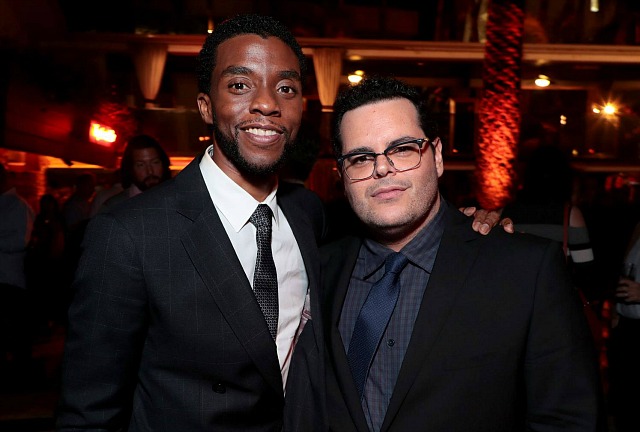
Last night I spoke briefly with Chadwick Boseman following the TCL Chinese premiere screening of Reginald Hudlin‘s Marshall. Apart from offering congratulations for his having portrayed Thurgood Marshall with conviction and pizazz, all I could talk about was about how big Ryan Coogler‘s Black Panther (Marvel/Disney, 2.18) might be. I asked “is it mostly done?” and “have you seen it yet?” and to both Chad said, “No, not yet, we’re still doing it.” I told him that my insect antennae are sensing something really special. (Maybe.) He hopes so, he said, smiling softly and clearly cranked about the possibility. Four and a half months.
Marshall costars Chadwich Boseman, Josh Gad during last night’s Roosevelt hotel after-party following premiere screening at TCL Chinese.
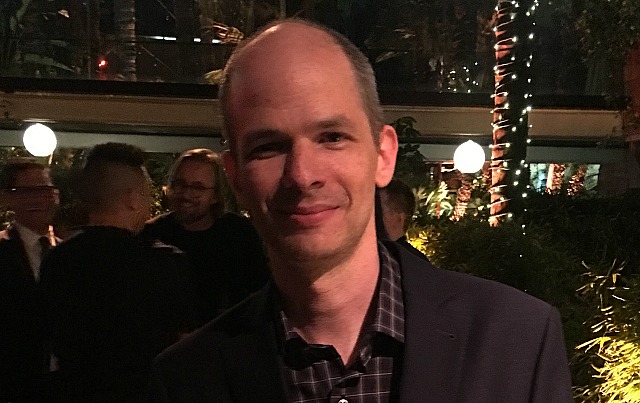
Marshall co-screenwriter Jacob Koskoff, who partnered with his father, civil-rights attorney Michael Koskoff.
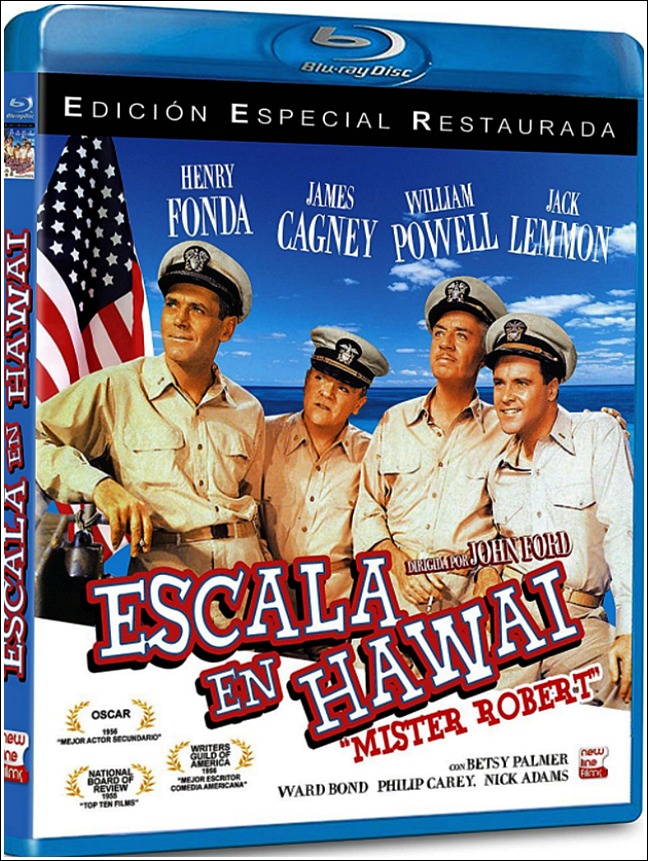
This morning I happened to stumble upon a Spanish Bluray of Mister Roberts (Escala en Hawaii), and I was instantly reminded how much I despise this painfully sentimental and simple-minded 1955 film. None of it is funny. It just lies there like a dead fish. Okay, there’s one amusing moment, when James Cagney rants about how he loathes upper-crust college boys, and how he once felt humiliated by a couple of them while working as a bus boy…”Oh, bus boy? It seems my friend has thrown up all over the table…clean up the mess, bus boy…will ya?”
With very few exceptions military service comedies of the ’50s and ’60s have aged very, very badly, especially those influenced by Mister Roberts. That starchy vibe of official conservatism and sexual repression, the tone of adolescent idiocy, the constant emphasis on stupid frat-boy attitudes and anti-authoritarian behavior, and most of them painful as fuck to sit through.
Operation Petticoat, Kiss Them For Me, Onionhead, Rally Round The Flag Boys, Ensign Pulver, A Private’s Affair, The Wackiest Ship In The Army, Soldier in the Rain, The Honeymoon Machine, The Last Time I Saw Archie, etc. Every last one a stinker.
Even P.T. 109, that mediocre Cliff Robertson war drama that was produced in tribute to President Kennedy, adopted the tone of these awful service comedies because it seemed like a commercial way to go. Doing so made it seem even worse.
Decent military comedies: Operation Mad Ball, What Did you Do In the War, Daddy? MASH, The Last Detail, No Time for Sergeants, King of Hearts. Others?
During last May’s Cannes Film Festival I calledJonas Carpignano‘s A Ciambra a good-as-it-went, respectably compelling sequel to Mediterranea about a young teenaged thief (Pio Amato) coping with character and loyalty issues in a hardscrabble town in Southern Italy. A kid with a beagle-boy nose, up to no good, struggling to make his mark but at the same time all but fucked for life. Definitely earns your respect for the verisimilitude alone, but what are you supposed to do with a story like this?
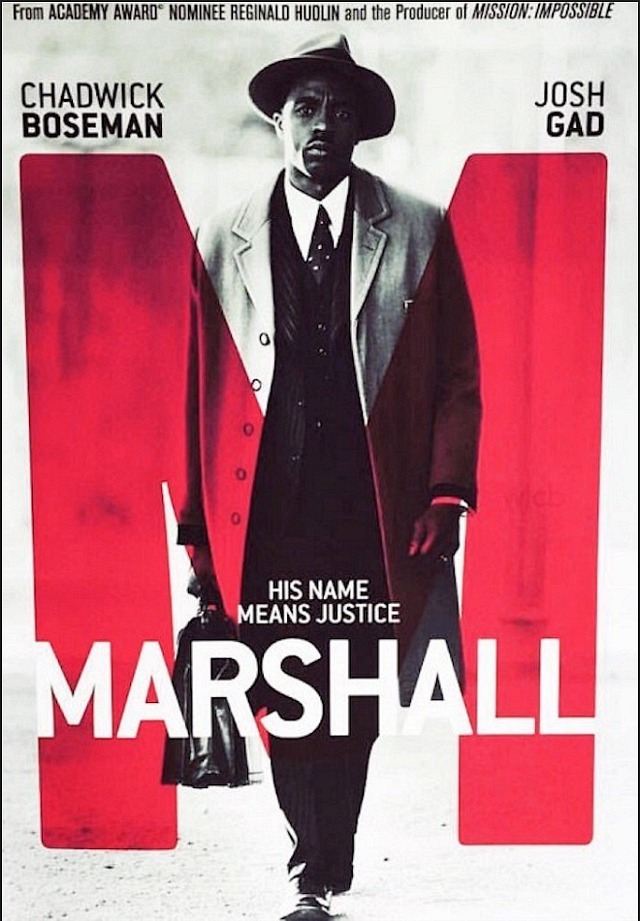
Reginald Hudlin‘s Marshall (Open Road, 10.13) is a reasonably engaging, racially-charged courtroom drama in the classic mold, and by that I mean it follows a certain scheme (good-guy underdog vs. tainted establishment) and a certain path (things look shaky and then dispiriting for the good guys before the clouds part and God smiles). You can say “I’ve seen this kind of thing before” but it’s the singer, not the song, and anyone with a fair-minded attitude would have to conclude that Marshall is at least somewhat different, and that Hudlin (who hasn’t directed a feature since ’02’s Serving Sara) has done a better-than-decent job of fusing it all together.
Marshall doesn’t re-invent the wheel, but it’s a moderately okay, good-enough thing. It’s intelligent, efficient, well-shot, not a burn, contains decent performances, etc.
Marshall is about an innocent black defendant charged with raping a white woman, and defended by a heroic, soft-spoken, highly principled attorney, and with the locals 100% convinced, of course, that the black guy did it, but with late-arriving testimony eventually pointing to the defendant…well, not being exactly “innocent” but at the same time not guilty of having initiated contact, much less sexual assault.
Sound familiar? The same kind of rape trial served as the dramatic centerpiece of To Kill A Mockingbird, except here it’s (a) a true story, (b) set in 1940s Bridgeport, Connecticut instead of early 30s rural Alabama, and (c) focuses not on some noble Atticus Finch-like character but young NAACP attorney and future Supreme Court Justice Thurgood Marshall (Chadwick Boseman) as the principal defender.
Assisting Marshall (76 years ago as well as in the film) is another real-life figure, Jewish civil attorney Sam Friedman, who was forced to handle the case verbally and procedurally when the presiding judge (James Cromwell) forbade Marshall from speaking during the trial due to his not being a member of the Connecticut bar.
Boseman (Black Panther, 42, Get On Up) plays Marshall like a brilliant, well-mannered hotshot who’s just parachuted in from 2017. A very good-looking, well-dressed black attorney with a low-key, “everything’s cool but don’t fuck with me” attitude like Steve McQueen‘s Lieutenant Bullitt. He talks tough, throws some punches in a bar, drinks water from a “whites only” fountain, winks at the ladies, and says “fuck you” to a fellow attorney in a rare moment of anger.
Given the unenlightened racial attitudes that unfortunately prevailed in the early 40s, you might expect Boseman to sprinkle a little Sidney Poitier into his performance, but nope. He’s well-mannered but blunt-spoken, confident, straight from the shoulder, no pussyfooting around. A cool-cat fantasy figure.
“Right from the beginning, this governor [Ricardo Rossello]…who isn’t even from my party, did not play politics [unlike San Juan mayor Carmen Yulin Cruz]…I hate to tell you, Puerto Rico, but you’ve thrown our budget a little out of whack because we’ve spent a lot of money on Puerto Rico, and when you look at a real catastrophe like [Hurricane] Katrina, and the hundreds and hundreds and hundreds of people that died [from Katrina]….what is your death count now? 16 people? 16 people vs. deaths in the thousands [from Katrina]….everybody here can be really proud.”
Trump translation: “You cost us tons and tons of money and you only had 16 people die? Don’t even talk about your catastrophic deaths in the same breath as Katrina. 16 deaths do not impress me. Hell, no one is impressed. 16 ants stepped on…barely registers on the cosmic scale. Just ask Orson Welles‘ character, Harry Lime, from The Third Man…that scene in the ferris wheel.”
From A.O. Scott’s N.Y. Times review of Blade Runner 2049: “[Warner Bros.] has been unusually insistent in its pleas to critics not to reveal plot points. That’s fair enough, but it’s also evidence of how imaginatively impoverished big-budget movies have become.
“Like any great movie, Ridley Scott’s Blade Runner (’82) cannot be spoiled. It repays repeated viewing because its mysteries are too deep to be solved and don’t depend on the sequence of events.
“Denis Villeneuve’s film, by contrast, is a carefully engineered narrative puzzle, and its power dissipates as the pieces snap into place. As sumptuous and surprising as it is from one scene to the next, it lacks the creative excess, the intriguing opacity and the haunting residue of its predecessor.
“As such, Blade Runner 2049 stands in relation to Blade Runner almost exactly as K stands in relation to Deckard before the two meet: as a more docile, less rebellious ‘improvement,’ tweaked and retrofitted to meet consumer demand.
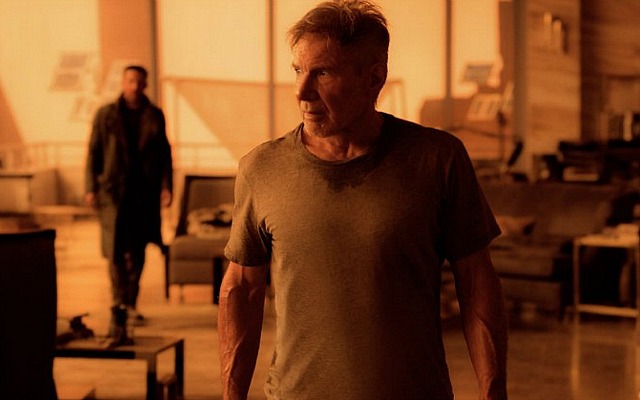
“But now and then — when Ryan Gosling‘s K and Harrison Ford‘s Deckard are knocking around the old gambling palace; when K visits an enigmatic mind-technician played by Mackenzie Davis — you get an inkling that something else might have been possible. Something freer, more romantic, more heroic, less determined by the corporate program.”
There are very few aspects or side-angles that elude Deadline‘s Pete Hammond when it comes to assessing a new film or, if the shoe fits, its award-season potential. At the same time he’s always had a fairly generous, big-of-heart attitude about the movie realm. (As do I on a certain level.) It’s precisely because Hammond is not a neghead Addison DeWitt type that I trust his impressions about Blade Runner 2049 much more than Jordan Hoffman‘s or David Ehrlich‘s.
Hammond observation #1: Blade Runner 2049 has “an overly long and drawn-out running time of 2 hours and 44 minutes that could have used some trimming. The storytelling takes its sweet time and quite frankly can be a bit confusing to see where it is all going, but maybe that’s the point.”
Hammond observation #2: “Even if I was submitted to waterboarding techniques I probably couldn’t reveal the details of this byzantine plot.” Wells interjection: The very mention of waterboarding obviously alludes to movie-watching torture, which was presumedly in Hammond’s mind.
Hammond observation #3: “Suffice to say this deliberately-paced film really comes alive once Harrison Ford comes on board about an hour and a half into it.” Wells interjection: It can be safely presumed that “deliberately paced” means slowly paced, leadenly paced, slightly boring, etc. In short, Blade Runner 2049 is more or less a stiff until Ford arrives.
From another critic friend: “Too much movie for how little story there was. A great looking movie; if I had the slightest interest in virtual reality (which I don’t), that’s a world I would want to walk around in. I assumed that the same climate dysfunction that caused the constant rain in LA in the first film had simply gotten worse so that, this much farther into the future, it alternately rains and snows.”
Sidebar: Hammond mentions that it snows in Blade Runner‘s futuristic Los Angeles. Which is quite the rarity as snow hasn’t fallen here since 1962. A 12.9.16 KCET.org article by Nathan Masters reports that snow once fell on the Los Angeles coastal plain with some regularity — about once per decade. Since official records were first kept in 1877, the downtown Los Angeles weather station observed measurable snowfall three times, in 1882, 1932 and 1949, and news reports recorded snowfall elsewhere in the Los Angeles Basin in 1913, 1921, 1922, 1926, 1944, 1957, 1962 — and then never again, for 54 years running.”
A draft I once read of Robert Towne‘s script for The Two Jakes, which took place in in 1948 Los Angeles, ended with a snowfall that actually happened in January ’49. I can’t remember if a snowfall appeared in Jack Nicholson‘s 1990 film version or not.