The answer, believe it or not, is George Clooney, who was 34 when this December 1995 Premiere cover story ran. The story, written by Tom Friend, was about Clooney’s transition from “Joe Television” to the big-screen via Robert Rodriguez‘s From Dusk till Dawn, which opened on 1.19.96. I always liked Clooney’s blunt vibe in that film, and I remember telling him so during a 2000 Cannes Film Festival round-table interview at the Hotel du Cap. Clooney interpreted this to mean I wasn’t as much of a fan of his softer, charming guy roles in One Fine Day, Out of Sight and O Brother, Where Art Thou? He thought about this for eight or ten seconds and said “fuck you.” This of course conveyed respect. If a celebrity swears at you in front of others, you know you’re “in.”
Except for The Hollywood Reporter, that is. There’s been no coverage — not a peep, not a whisper — from that venerable trade over the last day and a half. Presumably they were angry about getting scooped by Deadline/Variety, but you’d think they’d at least weigh in. I’m guessing they’re assembling a Parker story of their own as we speak with intentions to publish on Monday morning.
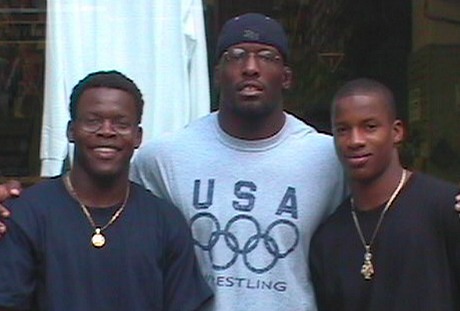
(l. to r.) Jean Celestin, Kerry McCoy, Nate Parker back in the day.
The Parker thing is not, in my judgment, a fair-minded thing to get into. If it had been my call I would have left it alone, but now the cat is out of the bag. And it just seems weird that the Reporter staff (particularly award-season columnist Scott Feinberg) would just be silent about the whole matter. It’s surely going to reverberate.
I was discussing the Parker thing earlier today with an east-coast friend, and he said the following: “Whether The Birth of a Nation is a good or bad film is irrelevant. But I do think Parker’s recent comments — ‘I can’t go back there’, ‘it happened 17 years ago’, ‘that’s that’ — are not how he should address the case. He almost seems to be in denial about the whole thing.”
My reply: “He’s not ‘in denial’ as much as just living in the now. You can’t carry your mistakes and your ugly deeds around with you. You have to shed them like a snake sheds skin. You have to clean up, shake it off.
Director Morten Tyldumspeaking to EW‘s Sara Vilkomerson about Passengers (Columbia, 12.21): “Every generation has its love story. I feel like this is it. And [making it was] exhausting. It’s big emotions, it’s desperation, it’s love, it’s happiness, it’s fear, it’s anger. You will laugh and cry and hold your breath and be at the edge of your seat. It has chills. It also will make you smile and laugh a lot. We wanted a playful movie.”
Got that? Big love, big fear, big anger, big desperation, big chills, big smiles, big playful. All on a super-big, super-luxurious space ship with artificial gravity plus swanky lounges, grade-A bedroom suites, gyms, swimming pools, a droll robot bartender (played by Michael Sheen), all kinds of great coffee and cappucino, etc.
As noted, I’ve a read a revised draft of Jon Spaihts’ Passengers script, and as far as I know it’s more or less what was shot last fall by Tyldum and costars Chris Pratt, Jennifer Lawrence and Laurence Fishburne. Maybe the script has been significantly rewritten. If the film plays according to the synopsis in Vilkomerson’s piece, then plot cards have indeed been reshuffled. And that’s fine.
Almost immediately after the ecstatic Sundance response to Nate Parker‘s The Birth of a Nation last January, I was sent links to articles about Parker’s 1999 Penn State rape case. I had two reactions. One, although Nate’s friend Jean Celestin, who was also involved in the PSU assault of a 20 year old female student and who currently shares story credit on The Birth of a Nation, was sentenced to six months (which he never did the time for), Nate walked so I figured “leave it alone, happened 17 years ago, drinking was involved, it has nothing to do with here and now.” Two, I knew somebody reputable would jump on it sooner or later.
How is Parker explaining the case? What new light is he shedding? What particulars has he decided to share? Answer: No details, no particulars…nothing. Parker is basically saying that it happened 17 years ago, he walked, it happened under difficult circumstances but he’s moved on and that’s that.
Parker to Setoodeh: “Seventeen years ago, I experienced a very painful moment in my life. It resulted in it being litigated. I was cleared of it. That’s that. Seventeen years later, I’m a filmmaker. I have a family. I have five beautiful daughters. I have a lovely wife. I get it. The reality is…I can’t relive 17 years ago. All I can do is be the best man I can be now.”
Robert Zemeckis‘ Allied (Paramount, 11.23) looks lively — I’ll give it that. The dp is Don Burgess (42, Flight, The Polar Express). Sex, soft-amber lighting, smooth vibes, flying plaster, flashbulbs, Nazi armbands, automatic weapons (?), more sex, etc. Gut reactions?
Trailers for noteworthy early-fall films are starting to appear here and there, or will be soon. So why hasn’t IFC Films posted a fresh trailer for Olivier Assayas‘ Personal Shopper? I’m tired of watching that subtitled one that popped during the Cannes Film Festival. The Paris-based ghost story will, as noted, be playing at the Toronto and New York film festivals, and looks like an opportune release for Halloween or thereabouts, and yet IFC Films hasn’t even announced a release date.
Remember what Variety critic Guy Lodgesaid two months ago about the Personal Shopper naysayers:
“Like you, I’m disappointed by the number of dismissive reviews out there for Personal Shopper, though pleased it has a distinguished core of champions — a group I’m sure is going to grow over time. Assayas’ Clouds of Sils Maria (of which I wasn’t actually a big fan) also played Cannes to mixed reviews, though by the time its U.S. release rolled around, there had definitely been an uptick in its reception.
“I’m not surprised, however, by the Cannes dissenters. Within the opening minutes of the film, I had a strong instinct that (a) I would really be into it, and (b) that it would receive boos.
“The ectoplasm in the possibly haunted house was the giveaway for me: many Cannes critics like genre [material] when it’s postmodern or symbolically self-aware or otherwise above convention, but when Assayas starts engaging directly and sincerely with ghost-story tropes, those critics sneer.
Here’s a re-blending of HE’s Best of 2016 tally, including the not-yet-released festival films that really bonged my gong. There are a few I still haven’t seen, but this more or less represents my assessment of the first two-thirds of 2016 — ten biggies in all. Okay, make it eleven if you count Sausage Party. I’m presuming War Dogs (which I won’t see until next week) isn’t going to rank as a top-tenner.
Kenneth Lonergan‘s Manchester by the Sea (Sundance, Telluride, Toronto, NYFF) is still the king, and will definitely be among the top ten by year’s end, no matter what. The new #2 is David Mackenzie‘s Hell or High Water, which opens today. Olivier Assayas‘ Personal Shopper is #3, baby, and I don’t what some of the mainstreamers have said. This thing drilled right down and got me like no other film this year except for Manchester.
The third group includes Paddy Breathnach and Mark O’Halloran‘s Viva (#7), Karyn Kusama‘s The Invitation (#8), Bob Nelson‘s The Confirmation (#9) and Ben Wheatley‘s High-Rise (#10), which I saw 11 months ago in Toronto.
At first I was only marginally interested in David Mackenzie‘s Hell or High Water (CBS Films, 8.12), mostly due to the familiar genre feelings contained in the first teaser. Bank-robbing desperadoes, low-key sardonic cops on their trail, sunbaked Texas plains. Then I saw it in Cannes and went “whoa, better than expected, the buzz is correct.” It’s a 2016 social undercurrent drama disguised as a cops vs. bank-robbers movie. The social undercurrent element refers to mass hurt — i.e., the financial blight afflicting the hinterland struggling class (in this case rural Texas), caused by 2009/10 meltdown and worsened by banksters — and the need to pay off a mortgage. Hence the bank robberies by a couple of hard-luck brothers (Chris Pine, Ben Foster).
Then I saw it again Wednesday night at the Arclight, and was able to savor a bit more of the dialogue (I’m sorry but the sound system at the Arclight is a notch better than that of the Salle Debussy) and it all just clarified and upticked and grew in my head.
Just call me woke: Hell or High Water is the best film of 2016 as things currently stand. I don’t care what happens between now and 12.31.16 — it deserves a place at the Best Picture table. It opens today with a 99% Rotten Tomatoes rating and an 88% rating on Metacritic.
On top of which I can easily see a little Best Actor action for Pine and/or gurgle-speak Jeff Bridges, and definitely some Best Supporting buzz for Foster, whose working-class scuzziness — chunky physique, scratchy face, seriously thinning thatch — put me off at first, but then I manned up and got past that. At least Foster owns the beer-swilling, two-week-beardo thing, and I was marvelling at the careful English he gave to each and every line. By the finale Foster is quite the tragic working-class hero — a malcontent who has to go down but is nonetheless selfless, sacrificing, a good ole brother with a gun. Hell, he’s almost Ray Hicks in Who’ll Stop The Rain.
If I was Seth Rogen and Bill Simmons had asked me to reflect on the Sony hack, I wouldn’t have mentioned concerns about personal emails being revealed or even poor Amy Pascal getting whacked. I would have definitely mentioned the shameful corporate cowardice factor — the way Sony and theatre chains trembled before anonymous hackers and let their cheap threats dominate the situation. Until the indie chains stood up and pushed back. The candy-ass corporate guys showed what they were made of, all right, and it wasn’t true grit.
“‘Sony isn’t yet cancelling the Christmas release of The Interview,” Yamato wrote, ‘but the embattled studio has given its blessing to concerned theater owners who choose to drop the controversial comedy.’
I respect the Rogue One screenwriters, Chris Weitz and Tony Gilroy, and I’m presuming that Disney’s decision to put Gilroy in charge of five additional weeks of shooting and give him final editing authority over original director Gareth Edwards was well motivated. The multicultural makeup of the characters feels p.c. minded, but what else is new? Felicity Jones and Diego Luna have a certain panache, but the rest of the cast feels second-stringish. Okay, ForrestWhitaker excepted. Let’s leave Ben Mendelsohn alone for now. The Chinese characters/actors — Jiang Wen‘s Baze Malbu and Donnie Yen‘s Chirrut Imwe — were naturally written and cast to energize the Chinese market. Cold calculation.
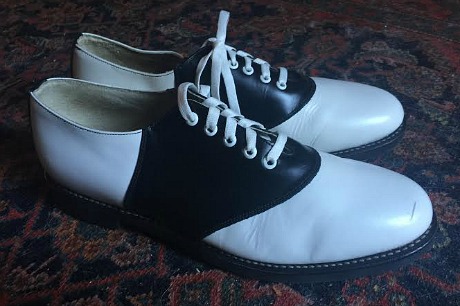
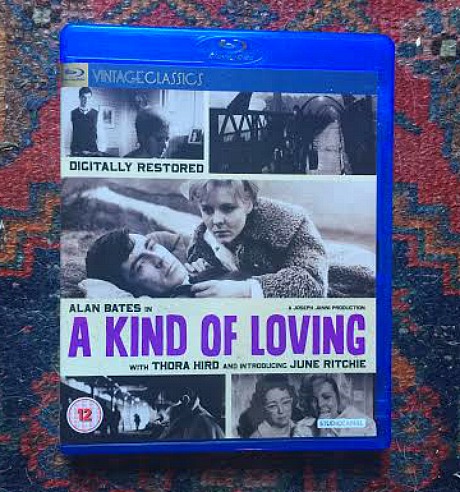
I’ve just been through nine hours of soul-draining tedium — a Florence Foster Jenkins review that took forever to get right + increasingly sluggish systems on all three Macs (two Pros, one Macbook Air) + a mutiple ad-loading problem that’s been slowing the site down to a crawl (but which is being fixed as we speak). It was awful, the whole day. And then things suddenly brightened when the UPS guy dropped off two packages — a British Bluray of John Schlesinger’s A Kind of Loving (which I ordered last June) and a pair of saddle shoes that aren’t Tony Curtis-approved but aren’t too bad.
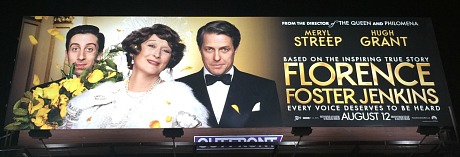
Stephen Frears‘ Florence Foster Jenkins (Paramount, 8.12) is about the willingness of people to tolerate a musical atrocity in the name of kindness and compassion, but mainly because the titular offender — a real-life millionaire socialite (Meryl Streep) who couldn’t sing a lick but nonetheless insisted on performing opera in front of elite audiences from 1912 until her death in late 1944 — was stinking rich.
Because Jenkins was flush her common-law husband, St. Clair Bayfield (Hugh Grant), protected her from the truth. Because his lifestyle depended on it and because his attitude was “well, she loves music so where’s the harm?” That’s all the movie is, boiled down — a harmless indulgence. Bayfield indulged Florence, and now you, the audience, get to indulge Florence Foster Jenkins. I’ve seen it twice, and I’m not down on it. It’s a curiosity, and yet nimble and nicely made. Not precisely my cup but not bad. No animus.
The most winning performance is given by Simon Helberg as Cosme McMoon, Jenkins’ patient and compassionate pianist. Rebecca Ferguson, Nina Arianda and John Kavanagh costar.
Streep’s performance is well honed and appealing, in part because she allows you to feel that Jenkins was merely a deluded music fan and not, as I suspect was the case in real life, one of the most arrogant non-singers in world history. Streep will probably be nominated for Best Actress, but Grant almost certainly won’t be Best Supporting Actor nominated, as a Janelle Riley story in Variety suggested earlier today. It’s just too slight of a role.
You could say that Frears’ film is about an extremely perverse definition of love and sensitivity. It basically says that if a woman you care for a great deal is (a) absolutely dreadful at singing opera, (b) unable or unwilling to recognize how bad she is, and (c) insists upon singing for audiences nonetheless, the truly loving husband or friend will not only avoid confiding the awful truth but will do everything in his/her power to allow the singer to live inside her fantasy bubble, mainly by shielding her from honest reactions.