I’m Not What I Appear To Be

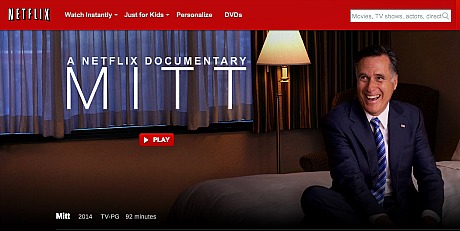
I didn’t want to see Greg Whiteley‘s Mitt at Sundance because I didn’t want to see a softball portrayal of a guy I’ve always regarded as one of the most clueless assholes of all time. But a Romney quote, posted by New Yorker columnist Ian Crouch, has changed my mind. “I have looked, by the way, at what happens to anybody in this country who loses as the nominee of their party,” Romney reportedly says. “They become a loser for life, all right? That’s it. It’s over.” That’s right! This is probably the most candid and appealing comment from Romney ever. I’m now feeling a certain limited respect for the guy. I’m watching Mitt on Netflix tonight. (Romney also says that “Mike Dukakis can’t get a job mowing lawns.”)

Update: Salon‘s Blake Zeff watched it, disliked the lack of political candor, regarded the “focus on the family” material as a dodge.

Read more

Lost, Gone, Blown

“And they lived happily ever after” finales in romantic films never work. They never stick to your ribs. If they seem to half-deliver they certainly don’t last in the memory. The best endings, as Sydney Pollack pointed out time and again, are ones in which it hasn’t worked out and the lead protagonists realize it’s gone for good. Final, irreparable. My three favorites are the finales of Ang Lee‘s Brokeback Mountain, Hal Ashby‘s Shampoo and Pollack’s The Way We Were. What are some of the others? Remember — we’re talking about a feeling of absolute romantic failure and loss. Death can’t be a factor — the lovers have to realize and accept that it’s their fault.


Warren Beatty’s George Roundy watching the love of his life, Julie Christie’s Jackie Shaw, drive off to Acapulco with Jack Warden’s Lester Karp in Shampoo (’75).

Read more

Say It Plainly

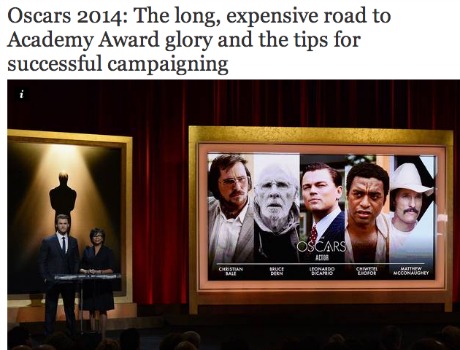
The best quote in Tom Teodorczuk‘s 1.26 Independent piece about Oscar campaigning is from The Hollywood Reporter‘s Scott Feinberg, to wit: “The deep, dark secret is that a lot of Academy members don’t watch a lot of the movies. To get them to watch the movies is the biggest challenge.” This can’t be repeated enough — whatever respect and credibility the Academy has among the cognoscenti is constantly being undermined by the deadwoods, who are generally older and sleepier and who tend to think and vote more conservatively.

Read more

Brush It Aside

I’ve never paid the slightest attention to the Best Song category. Even when I was ten I thought it was inane. That aside, I presume that “Let It Go,” the tune from Frozen, is going to win. Not that anyone except for the composers, performers and their families give a shit. “Alone Yet Not Alone” sounds inelegant. “Happy,” the Despicable Me 2 song, sounds sappy. I don’t even remember “The Moon Song” from Her or “Ordinary Love” from Mandela: Long Walk to Freedom.

Once Captured

Once a respected big-time actor has been well imitated, a certain mystique falls away. They shift into meta mode. Their screen manner or personality becomes a reflection of the imitators and vice versa and into infinity — a hall of mirrors. One of the first actors to experience this was James Cagney with every other nightclub comedian doing him in the ’50s and ’60s. (“Cagney” went full meta in One, Two, Three when (a) Red Buttons did him and (b) he parodied his own Public Enemy grapefruit scene.) When Rob Brydon and Steve Coogan did Michael Caine in The Trip, something snapped — I’ve never been able to believe in Caine’s older-guy performances since (particularly his Batman appearances). This guy’s Matthew McConaughey drawl isn’t perfect but it’s pretty good. And with this, the Real McCoy’s Dallas Buyer’s Club performance has been simultaneously mythologized and taken down a notch.

Dullest Then-and-Now Location Doc Of All Time

One of the promotions for Criterion’s recently released Bluray of Stanley Kramer‘s It’s a Mad, Mad, Mad, Mad World (’63) is a then-and-now location reel. Shot and assembled by George Ann Muller and Paul Scrabo, it conveys how numerous desert locations haven’t changed much over the last 50 years, and how the areas around some commercial outpost locations (remote gas stations, etc.) have been developed and are now greener. The descriptive term, no offense, is “underwhelming.” Which isn’t to say location pieces can’t be interesting. You just have to choose films that weren’t largely shot in the desert. Downer: The “big W” (i.e., the crossed palm trees over the buried loot) has been cut down.

Read more

No Music, No Cutting, No Goosing

I’m trying to compile a list of movies with longish silent scenes — not atmospheric mood passages but scenes in which important story information is conveyed. No music, no dialogue, no urgent cutting — no prompts of any kind to tell the viewer that they need to pay attention. Prime examples are the cropduster sequence in North by Northwest, which uses music only at the very end, and the photography in the park scene in Blow-Up, in which the only thing you hear is the wind in the trees and bushes and the shutter-click of David Hemmings‘ Hasselblad. I’m just trying to get my brain working. There must be at least a short list of these scenes. The basic compositional tendency of the last 30-plus years, of course, is to assume that audiences are ADD-afflicted and to constantly goose and prod them into paying attention to this or that.

Same Anger Impulse

If Quentin Tarantino hadn’t thrown a hissy fit over someone within a group of six sending out his Hateful Eight script, he’d be preparing to make the film right now, Bruce Dern would have a new job and everything would be jake. What was the big deal about some non-essentials reading it? Although it’s not unheard of, it’s relatively rare for the script of a high-profile project to not be discreetly shared with outsiders. It was obviously the tantrum — “That’s it…I’m not making this film!” — that started the ball rolling and devalued the project. The Gawker posting was obviously ill-advised, but the Eight script was a dead duck at that point. What kind of damages are Tarantino and his attack-dog attorney Marty Singer seeking from Gawker? Will they cut some kind of deal or are they out for blood?
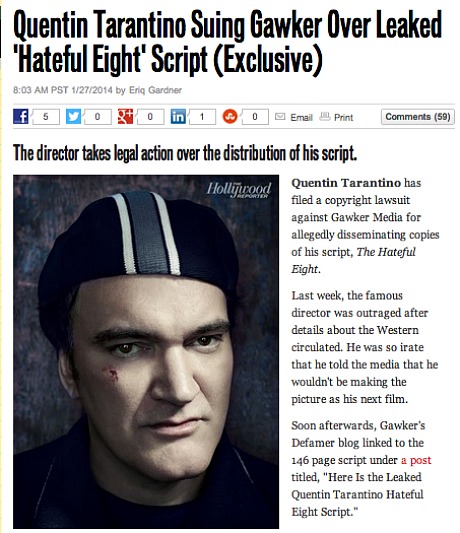
Update: Gawker‘s John Cook has posted a response to the Tarantino/Singer filing. He’s stating that (a) Gawker didn’t “leak” Tarantino’s script but merely posted a link to the script on Anonfiles “because it was news,” and that (b) Tarantino “deliberately turned the leak into a story” and that he “wanted The Hateful Eight to be published on the internet,” having told Deadline‘s Mike Fleming that “I do like the fact that everyone eventually posts it, gets it and reviews it on the net. Frankly, I wouldn’t want it any other way. I like the fact that people like my shit, and that they go out of their way to find it and read it.”

Cook also stated that Gawker “is not being sued for copyright infringement — we are being sued for contributory copyright infringement for linking to a site that is being sued for direct copyright infringement. We are not being sued for publishing copyrighted information.”

DeNiro-Cusack Cheese

The Bag Man‘s original title was Motel,” a New Orleans friend says. “It was shot here a couple of years ago. I was just talking to a friend who worked on it. Has so many behind-the-scenes stories that are hilarious. The director and co-writer, David Grovic, is some Russian actor who never made a film before. The girl in the film, Rebecca Da Costa, is his girlfriend apparently.” (They both worked on Freerunner, a 2011 release.) The IMDB lists the production entity is the Nassau-based TinRes Entertainment.

Crash

I’ve seen too many sudden car crashes over the last two or three years. I just saw one in Whiplash up in Park City. It’s gotten so I don’t trust movies when the main characters get into a car. I brace myself and get ready for it. Car crashes are the new cheap trick — the latest version of the “main character does a swan dive off a 50-story skyscraper” routine that we’ve seen in at least 25 or 30 films since Tim Burton‘s original Batman. CG is the big enabler, of course. I’m trying to remember the first time I was really jolted by a CG car crash that came out of nowhere. Was it Adaptation? Now they’re a cliche.

Creepy

I own season #1 of Rod Serling‘s The Twilight Zone on Bluray. I was just watching a few episodes. Many play like creaky timepieces (53 years old and counting) but some hold up . I’m thinking of Walking Distance,” “A Stop at Willoughby,” “Escape Clause,” “The Monsters Are Due on Maple Street.” A few are still unsettling — “Where Is Everybody?,” “Mirror Image” and especially “The Purple Testament.” Written by Serling, it’s about a World War II Army officer (William Reynolds) who realizes he can tell who will soon die. The doomed have a weird light on their faces. Powerful concept. Gets under your skin.

Read more

DiCaprio’s Greatest Performance

No matter how many times you’ve seen The Wolf of Wall Street, watch this clip and tell me you’re not disappointed that it ends before Leo staggers inside the house, wrestles with Jonah Hill over talking to Jean Dujardin on the phone with that long white cord snapping like a bullwhip, and then Jonah collapsing and choking to death and Leo realizing that he needs “spinach” after watching a Popeye cartoon, etc. That “awww, shit” feeling you get when this clip ends is all the proof you need. “This feat of elaborate physical comedy, more than any other, is why Mr. DiCaprio won a Golden Globe for best performance in a comedy,” Jason Zinoman wrote in a 1.24 N.Y. Times piece. “In The King of Comedy, Mr. Scorsese teased a dramatic performance of gravitas out of Jerry Lewis. But here he pulled off a more unlikely achievement: transforming Mr. DiCaprio into Jerry Lewis.”