

You might presume that Jules Stewart, a script supervisor since ’88, landed the gig to direct K-11, a jailhouse melodrama, because she’s the mother of Kristen Stewart. And you might be half-right. But this Breaking Glass release, which opens limited (NY, LA, Denver, Phoenix, Philly) on 3.15, looks interesting in a gnarly sort of way. Stewart also wrote the script.
In So Many Words
“The message of Dror Moreh‘s The Gatekeepers, formed from the collective wisdom of the six living former Shin Bet leaders, is this: The occupation is immoral and, perhaps more important, ineffective. Israel should withdraw from the West Bank as it did from the Gaza Strip in 2005. And the prospect of a two-state solution to the Palestinian conflict diminishes daily, threatening the future of Israel as a Jewish democracy.” — from Jodi Rudoren‘s 1.25 N.Y. Times piece, titled “Most Israelis Are Not Listening.”
Wall of Death
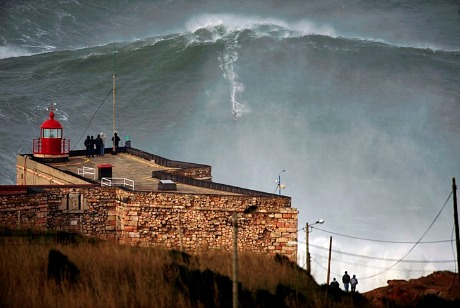
Is this not the greatest big wave shot ever taken? If not it’ll do until the greatest gets here. It was shot two days ago — Monday, 1.28 — off Praia do Norte beach in Nazare, Portgual, as U.S. surfer Garrett McNamara rode a wave reported to be 100 feet tall. In so doing McNamara beat his previous record of riding a 78-footer in the same spot in November 2011.
Clash of Aspect Ratio Titans
Yesterday Bob Furmanek politely declined my aspect-ratio podcast invitation, but he suggested that I get in touch with Jack Theakston, organizer-producer of Capitolfest (August 9th, 10th and 11th in Rome, New York) as well as an archivist, an AMIA member and Furmanek’s associate and partner in aspect ratio research. So I did, and Jack and I kicked it around for about an hour this morning. It’s a knowledgable and stimulating discussion. Recommended.

Six Characters In Search Of The Next Thing
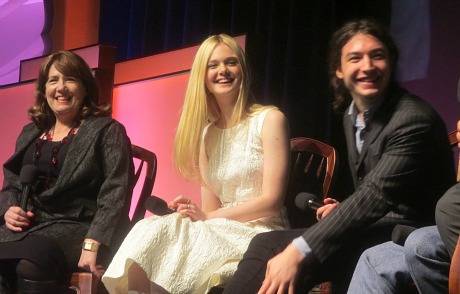
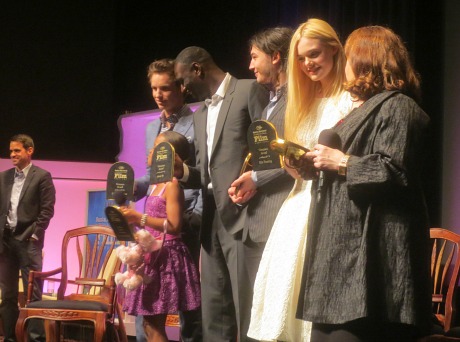
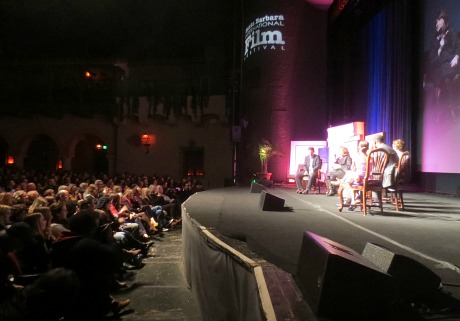
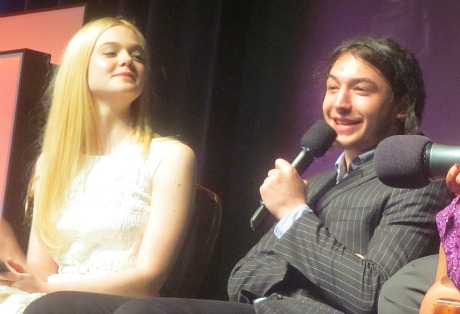
Last night’s Virtuosos Award Ceremony at the Santa Barbara Film Festival honored six actors who delivered noteworthy 2012 performances — Ginger & Rosa‘s Elle Fanning, Compliance co-star Ann Dowd , The Intouchables‘ Omar Sy, Perks of Being a Wallflower‘s Ezra Miller, Beasts of the Southern Wild‘s Quvenzhane Wallis and Les Miserables‘ Eddie Redmayne.
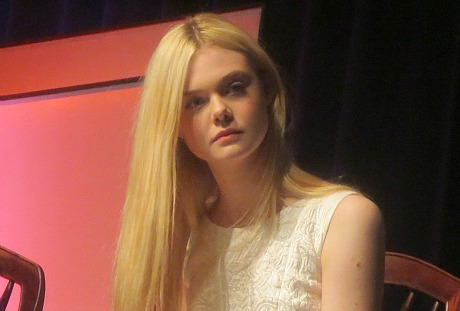
Ginger and Rosa star Elle Fanning during last night’s Virtuoso Ceremony.
Fanning felt like a surprise to me because she conversed with emcee Dave Karger in a bubbly, giggly, teenage-girlish way. And all this time I’ve been under the impression that she’s old for her age. I know that when the role demands it, Fanning projects soul and depth and maturity. Acting! But she sure was a teenager last night.
Dowd was by far the wittiest guest. If I’m not mistaken I think I spotted Magnolia Pictures’ Eammon Bowles in the audience, offering a little moral support in the wake of that episode in which Dowd decided to pay for her own Compliance-screener mailings when Magnolia said that it made no financial sense because Compliance was a bust for them. Dowd was hanging at the after-party with friend and ally Scott Feinberg. She’s a classy lady, a mensch.
The best moment happened when Karger was speaking to Wallis about something or other, and she made a kind of squeaky sound. Karger asked what what kind of animal she’d just imitated, and Wallis said it was “a donkey…didn’t you get that?” (Publicist Carol Marshall says it was a dolphin noise.) Karger asked her to do it again and Wallis looked at him, shook her head slightly, sighed and said, “It’s not worth it.” Gales of laughter from the audience. This kid is a star!
The eternally weird Miller, 20, leaned forward in the interview seat, hunched forward like a cat about to chase a mouse. I half-expected him to leave the stage on all fours. Miller has Haight-Ashbury hippie hair now, and was wearing a pair of almost shapeless brown serf shoes. And he smiled a lot.
Redmayne may have gotten the biggest applause. (There were a lot of young girls in the audience.) And the French-born Sy (who’s just signed to costar with Bradley Cooper in a Derek Cianfrance film called Chef) managed to be charming and funny despite a limited command of English.
The Shape We’re In
Recently resigned Arizona Congressperson Gabby Giffords delivered the opening statement at today’s Senate gun hearings. Nothing I could write could add to the import of this clip. I can’t imagine a more profound argument against the rank evil of Wayne LaPierre and the NRA gun lobby.
Quentin Tarantino is being honored at Santa Barbara Film Festival this evening. If and when he takes questions, I will ask the following: “If you were presented with a Lars Von Trier-styled filmmaking exercise in which you had to write a film that didn’t use flip, cynical, grindhouse-style, cartoon-panel violence in movies — no handguns, machine guns, samurai swords, grenades or violence of any kind, either naturalistic or ‘in quotes’ — what would your movie be about? What would you come up with? Or would you just throw up your hands?”
Booze & Broads
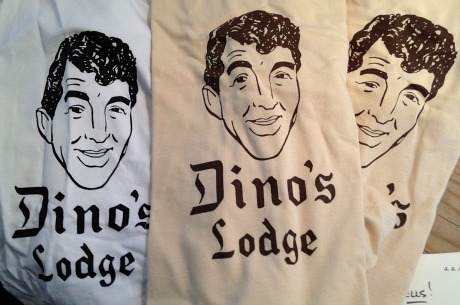
A friend made these and sent a few over. He knows I’m grateful but I’ll say it anyway — thanks! I have an idea that less than five people in the world own this T-shirt, and maybe less than two or three. I also have an idea that Glenn Kenny (a fan of Nick Tosches‘ “Dino: Living High in the Dirty Business of Dreams“) would like to own one.
Highway Blues
The kids doing the “drifting” here [go to jump] are assholes, but this is about another form of highway obstruction. I hate it when you’re doing 70 mph on a crowded road when all of a sudden traffic slows and then comes to a halt. Not because of an accident or road construction or the road merging with another. No reason — everything just stops. Then you’re nudging along at 5 or 10 mph, and then a few minutes later traffic starts up and then you’re going 70 again. Why the slowdown? Nobody knows. I really hate it when that happens.
Sneider Goes Down
Almost three weeks ago Variety reporter Jeff Sneider got angry about publicist Kelly Bush having supplied an exclusive production story — i.e., Christopher Nolan deciding to direct Interstellar, a Paramount project based on his brother Jonathan’s script — to the Hollywood Reporter‘s Kim Masters instead of himself. Masters filed her story about Interstellar on Wednesday, 1.9, at 6:44 pm, and Sneider filed a terse follow-up version at 6:55 pm.
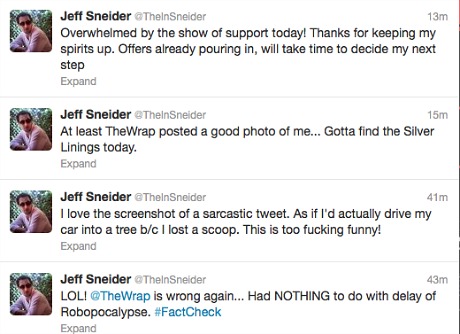
Sneider expressed harsh words about this to a certain party during Sundance, and somebody complained about Sneider to Variety owner Jay Penske, who was giving Sneider death-ray looks to begin with. In any case Sneider was whacked today for what TheWrap‘s Alexander Kaufman has described as “unprofessional” behavior. This refers to a flash of temper. Sneider tweeted news about the firing this afternoon around 2 pm. Sneider also tweeted that Kaufman got the story wrong by saying it had something to do with Masters beating Sneider on a story about Steven Spielberg indefinitely delaying Robopocalypse.
Sneider is a good and gracious fellow in HE’s book. Best wishes, best of luck, nothing changes.
Podcast Invitations
I’m hereby offering to debate Bob Furmanek and/or Pete Apruzzese and/or C.C. Baxter — anyone who believes in cleavering ’50s and ’60s films down to 1.78 or 1.85 when there’s a full-frame aspect ratio to work with — in a podcast format within a day or so. I’m talking about The Mother of All Aspect-Ratio Battles in an audio format. 30 to 45 minutes. Get in touch and we’ll figure it out.
I’d also like to do a four-way podcast debate between, on one side, myself and at least one other ardent supporter of Zero Dark Thirty and, on the opposing side, two Stalinist scolds who supported the takedown effort and felt it was right and proper to tarnish the film’s rep as having endorsed torture, etc.
Stats Man vs. Max Headroom
I thought I’d post this back-and-forth between myself and Bob Furmanek, which happened yesterday morning (or Monday, 1.28). It shows the difference between the mentality of a neutral-attitude, data-chip statistician vs. that of an emotional film lover like myself. Never the twain shall meet.
It’s interesting because Furmanek has been a noted provider of meticulous research that has convinced certain Bluray distributors to present 1950s-era films within a 1.85-to-1 aspect ratio because this is how films were generally projected starting in mid 1953. The point of contention was a 1.27 HE story called “Historical Precedent,” which concerned the forthcoming Criterion Bluray of On The Waterfront.
Furmanek: In case you’re wondering, On The Waterfront was originally presented theatrically in 1.85:1.
Wells to Furmanek: I’m not wondering about this because it’s common knowledge, thanks to your research. I stated in the piece that OTW was shot with the understanding that it would be shown at 1.85 in urban theatres. Under duress, of course, but Kazan did frame each scene so it would look good within a 1.85 to 1 aspect ratio. But Kazan also composed for TV. Because he knew his film would be shown on the tube down the road, and because he was used to shooting boxy going back to A Tree Grows in Brooklyn. Remember that WOR TV’s Million Dollar Movie began airing in 1955, or a year after OTW opened. The writing was on the wall.
Back to Furmanek: However, Grover Crisp‘s recommended ratio is 1.66:1. His credentials are exemplary and I respect his opinion.
Wells to Furmanek: Good for Grover, but what do you think, Bob? What do you want? How do you feel? You call yourself a neutralist and a stats man, but do you have a secret yen to see everything cleavered down to 1.85? You say you’re not on a campaign to see naturally boxy (1.33) or at least somewhat spacious 1950s and early ’60s compositions compressed into a 1.85 to 1 space? Who cares what exhibitors and distributors wanted to see in 1954 in order to make films of the day look cooler than television? Who gives a shit? Why should that be a factor in how we see films of the ’50s and early ’60s today?
Are you a boxy-is-beautiful type of guy (like me) or at least a 1.66-is-better-than-1.85 type of guy or what? Or are you strictly a neutral-minded research guy without any aesthetic preference? Because you never explain what you like and why. You never express who you really are.
You’re a very mellow, meticulous and well-mannered guy, Bob, but you seem to be comme ci comme ca about cleavering the tops and bottoms of iconic images, and for the life of me I don’t see why anyone who ostensibly cares about motion pictures would want images chopped down or otherwise reduced.
I am a boxy-is-beautiful guy, and if not that at least a 1.66-is-better-than-1.85 guy, and I’m extremely proud of being that. I say eff what the exhibitors and distributors wanted in 1954. Eff their priorities and their fears and their mid ’50s thinking. I am here now in 2012 and I like fucking breathing room or headroom, and if it’s viewable on the negative I said open it up and let God’s light and space into the frame. I really don’t like that horrible Being John Malkovich feeling of the ceiling pressing down upon actors, of walking around in a bent-over position like Orson Bean and his employees in order to exist within a 1.85 realm. I hate, hate, hate 1.85 fascism. Stop being a stats man, Furmanek, and let your real self out of the box. Who are you? What are you? What kind of a visual realm do you want to live in?
Back to Furmanek: Columbia — as a matter of studio policy — never utilized or recommended 1.66:1 as a presentation ratio. Beginning with principal photography of Miss Sadie Thompson on March 31, 1953, they were 1.85:1 for all non-anamorphic widescreen films.
If you are looking to experience the film as it was seen in first-run theaters around the country, including the world premiere at New York’s Astor Theater on July 28.1954, I would go with 1.85:1. The Astor had re-opened with a new panoramic screen on June 30, 1953.
In the UK, it was probably seen in most major theaters in 1.65:1 which was their widescreen standard at that time of release.
For the record, I have never endorsed an overall non-anamorphic widescreen standard of 1.85:1. I have always recommended honoring the ratio intended by the director and DP which would have been dictated by studio policy at the time of production. That can vary anywhere from 1.65:1 to 2.00:1.
Paramount was the first studio to officially adopt 1.66:1 as their house ratio on March 24, 1953. The only other studios to utilize that ratio domestically were RKO and Republic, both converting to widescreen cinematography in May of 1953.
Paramount retained 1.66:1 as their house ratio until September 21, 1953 when White Christmas began filming in VistaVision and was recommended for 1.85:1.
Sabrina is the odd AR title in Paramount’s output at that time. Wilder initially announced 2.00:1 but settled on 1.75:1 as his preferred ratio when production commenced in New York on September 28, 1953.
In the UK, the initial widescreen ratio was 1.65:1. That remained in effect from June 1953 until late 1954 when it changed to 1.66:1. At that time, the Cinema Exhibitors Association recommended the UK standardization of 1.75:1 which would remain in effect throughout the 1960’s. Documents can be found on this page: http://www.hometheaterforum.com/t/319469/aspect-ratio-research/1140#post_3989270
Every studio had their own policy. For information on Warner Bros, check out http://www.3dfilmarchive.com/dial-m-blu-ray-review
Information on Universal-International can be found here: http://www.3dfilmarchive.com/an-in-depth-look-at-creature-from-the-black-lagoon-1
You might like to know that shorts, cartoons and newsreels were also changed to widescreen composition in 1953: http://www.hometheaterforum.com/t/319469/aspect-ratio-research/720#post_3974959
I hope this answers your questions. If not, please contact me through the website and I’ll be glad to help in any way that I can.
Best,
Bob Furmanek
www.3dfilmarchive.com