El Guard-o

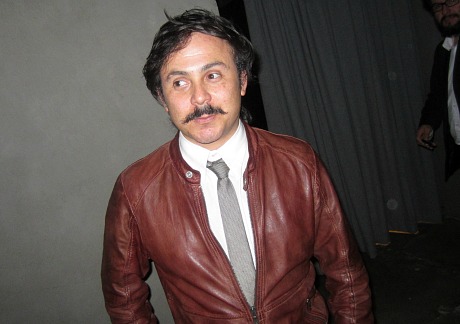
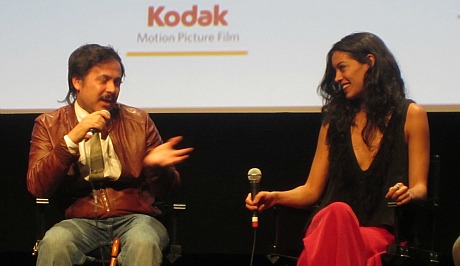
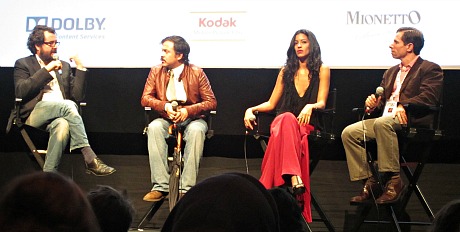
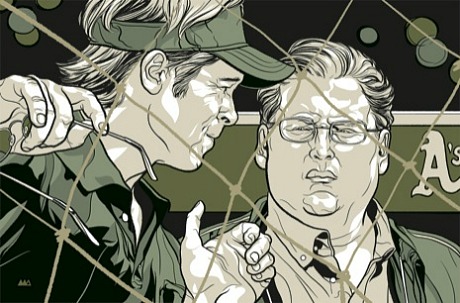
During the L.A. Film Festival I spoke to John Michael McDonagh, the witty and easy-rolling director-writer of The Guard (Sony Classics, 7.29). And now I can’t find the effing transcript. But you don’t actually need to speak with McDonagh (although he’s pleasure to chat with and I’d love to raise a glass with him some day) because The Guard says it all.

McDonagh (the brother of playwright and In Bruges screenwriter Martin McDonagh) is operating here in a sort of Quentin Tarantino-ish realm. The difference is mainly one of regional idioms. Tarantino is a dispenser of American criminal-class attitude, and McDonagh is a master of Irish ramble-on digression.

Set in County Galway, The Guard is nominally about a charmingly corrupt small-town cop (Brendan Gleeson) and an American FBI agent (Don Cheadle) becoming unlikely allies on a case involving a dead constable and a team of drug-runners (Mark Strong, Liam Cunningham, Rory Keenan).

But it’s really about the art of inspired chit-chat and hardly ever sticking to the point. It’s basically a movie that says “Look, we have to do this sort-of cops and bad guys thing because you need a story of some kind, right? But let’s mainly have a little fun with some spitballs and in-betweeners and side-pocket shots. Because that’s where the elevation is.”

It’s a bit early to calling Best Actor shots, but Gleeson’s performance as Sergeant Gerry Boyle ought to be lock for one. It’s the best role of his career, hands down.

It really should mean something to the online movie community when a film has a 100% Rotten Tomatoes rating, as The Guard does now. Very, very few films achieve that number.

What will this mean box-office-wise? Perhaps not much because Walmart crowd doesn’t read reviews and probably feels a little funny about paying to see a movie about an whimsical Irish fat guy and a deadly earnest, somewhat testy-mannered FBI guy. The determinations of the Walmart crowd can be breathtaking at times. They’ll face a firing squad before paying to see one of the most entertaining films of the year, hands down.

Last month I wrote that “when the kids were toddlers they’d call a film like The Guard ‘a talking movie.’ People sitting indoors and playing verbal ping-pong, etc. But what talk! What delicious Irish ping-pong!

The Guard is a loose-shoe, Guiness-slurping thing that’s simultaneously digressive and twinkle-eyed, and one of the best ‘cops and bad guys batting the ball around’ movies in ages. I don’t know if this indie Irish production will be eligible for a Best Original Screenplay Oscar, but it ought to be. It’s all dessert.

“I had a little bit of trouble hearing all the dialogue when I first saw The Guard at Sony Studios (Jimmy Stewart, room #24). Irish-speak has a certain gliding, looping, burry sound that can you can lose the ear for if you’re not careful. It’s a little like Shakespeare — once you find it you can hear it, but you can fall off the track if you’re not careful. In any event I heard every syllable during [an LAFF] screening at the LA LIVE Regal. I think it was because the sound sounded a bit sharper and cleaner.”

Fear of Cliff-Jumping

In Contention‘s Guy Lodge has taken issue with yesterday’s riff about Baz Luhrmann‘s forthcoming 3D version of The Great Gatsby, which alluded to one or two concerns about what Luhrmann might do to F. Scott Fitzgerald‘s classic novel, and how costar Carey Mulligan, as I put it, is probably “too diplomatic to voice fears along these lines.”


(l.) Carey Mulligan during a video interview last weekend at ComicCon; (r.) Great Gatsby director Baz Luhrmann.

“I love how you’ve completely fabricated this certainty that Carey Mulligan is secretly on your side in all of this,” Lodge wrote. “If she had such misgivings, would she really have committed to the project?”

Here’s how I responded this morning in the comment thread:

Wells to Lodge: If you’re a gifted, A-list actress and you’ve been offered a shot at working with an impassioned brand-name director (i.e., one who isn’t necessarily on his aesthetic game the way he was 10 or 15 or 20 years ago but who’s still cooking with gas and full of beans) on an ambitious and/or nervy sort of project based on a greatly admired book by one of the great names of 20th Century literature, you may well decide that you owe it to yourself to take a risk and jump off the cliff and see what happens, etc.

“An artist who can’t think or act boldly or perhaps even recklessly from time to time isn’t an artist. Mulligan is obviously not stupid. If she’s seen Australia she knows what could possibly happen here. But she doesn’t want to play it timidly and safely. ‘Art isn’t easy’ plus she’s in the company of Leonardo DiCaprio and Tobey Maguire and Isla Ischer, etc. She’s figuring even if it’s a fiasco nobody will blame her for doing everything she can to breathe fresh life into Daisy Buchanan.

“Plus it’s…I was going to say it’s a great part but Mia Farrow‘s performance as Daisy Buchanan in Jack Clayton‘s 1974 film was so irksome that I wrote her off for years after that. But it’s certainly a part that allows for a performance by Mulligan that could work out nicely in this or that respect. At least theoretically.

“Honestly? I don’t know that I want to see Mulligan playing a flamboyantly unstable Zelda Fitzgerald-type airhead. I love C.M. for her class and sass and the aesthetic focus that led her to do that Manhattan stage adaptation of Through A Glass Darkly (and okay, her sexiness), but as Daisy she’ll have to suppress a good deal of what she seems to be basically about.

“I wrote that she’s ‘too diplomatic to voice fears along these lines’ because YOU AND I KNOW, GUY, that despite whatever particular enthusiasm she’s feeling about the role and this film that she’s almost certainly nursing fears about the whole thing going wrong in some horrifically miscalculated way (as Australia did).

“What if Luhrmann had managed to shoot his own Alexander the Great movie as a competitor to Oliver Stone‘s version? Can you imagine what that might have been? In terms of the potential excess, I mean? The mind cartwheels.

“I mean, c’mon, a Great Gatsby movie in 3D…? To what possible end?

“The idea of transforming the Capulets and Montagues into warring, swaggering, gun-toting gangsta clans in flashy urban threads and driving around in hot cars …that was cool. But you know that no good can come of doing Gatsby in 3D unless Baz just shoots it plain and simple and straight in a Masterpiece Theatre way (which you KNOW he’s incapable of doing), in which case the 3D would just ‘be there,’ so to speak — it wouldn’t stand in the way or block the path or vulgarize whatever remnant of Fitzgerald’s novel that might still work in this day and age. If Baz cooled his jets and just shot it in 3D (which, again, WILL NOT HAPPEN) the technology might not muck things up in any sort of coarse or obnoxious way. It would just ‘be in 3-D’…which might be okay.

“But you KNOW Baz can’t leave well enough alone, and that’s why Mulligan is almost certainly scared. She’s a brave enough artist to go for it regardless and who among us doesn’t respect her for that? But don’t tell me she hasn’t awoken at 4:30 in the morning once or twice since signing to do this thing & asked herself, ‘My God, what have I done?’ I’m not saying she’s ‘on my side’, but she’s a highly alert and perceptive artist of the first order, and she knows or has sensed or at least considered everything I’ve written here….c’mon.

“Fear is a natural component of creativity. And the right kind of fear feeds the fire.”

Earthy, Fragrant, Calming

God, the green is such a relief after staring at that horrible orange Haywire poster for the last three hours! It’s like a nice misty rainshower on my eyeballs. Why don’t they just say “September” instead of “Fall”? Bennett Miller‘s biz-minded baseball drama opens on 9.23. Why be opaque about it?

I love the smell of moist earth and grass when I sit along (or close to) the first or third-base line in a major-league stadium.

Scrap This

I’ve explained two or three times that orange is a bad color to use in ads, movie posters and/or DVD/Bluray covers. I mentioned this in a recent riff about a British Touch of Evil Bluray. And I wrote last August that “any emphatic use of orange feels a bit oppressive” because “it’s a safety color when you’re hunting or working construction or standing on a busy traffic road in the evening, but it’s also a control color — a symbol used to enforce rules and segregate prisoners and make people stay within boundaries.”

Orange doesn’t say “life can occasionally be beautiful or transporting.” It says “do this,” “watch out,” “don’t go there,” “slow down,” etc.

Bazzed-Up Gatsby

I for one am tremulous with concern about what Baz Luhrman is going to do with (and to) F. Scott Fitzgerald‘s The Great Gatsby when he begins shooting it in 3D later this year. Carey Mulligan is too diplomatic to voice fears along these lines, but she surely knows that Baz would sooner slit his throat than simply “film the book”.

My guess is that Luhrman’s conjuring of 1920s Long Island will be as authentic as his recreation of “belle epoque” Paris in Moulin Rouge, or maybe Zack Snyder‘s ancient Greece in 300.

The upside is that no matter how eccentric Luhrman’s version turns out to be, it’ll have more of a pulse than Jack Clayton’s 1974 version, widely regarded as one of the stiffest adaptations in Hollywood history. The downside is that Baz has been indulging his exuberant instincts more and more as he grows older. The Baz who made Strictly Ballroom or Romeo + Juliet, even, has pretty much disappeared.

The lineup, once more, will be Mulligan as Daisy Buchanan, Leonardo DiCaprio as Jay Gatsby, Tobey Maguire as Nick Carraway; Joel Edgerton as Tom Buchanan, Isla Fisher as Myrtle Wilson; and Elizabeth Debicki as Jordan Baker.

Pink Ladies

Yesterday evening N.Y. Times reporter Michael Cieply wrote about catching up with Werner Herzog, of all people, at ComicCon. The legendary 68 year-old filmmaker “was absorbing the Breughel-like atmospherics” while taking a break from a death-row documentary that he’s making with Erik Nelson.


Photo by Awards Daily‘s Sasha Stone.

Also taken by Ms. Stone.

Worse Than Most Cancers

For my money, CNN’s Dr. Drew Pinsky has delivered the likeliest explanation of why Amy Winehouse is dead. “Opiate addiction takes months to years of treatment,” he explained yesterday. “And one of the most serous risks in my experience of that recovery for celebrities and particularly musicians is that they return to their career, they return to the road far too prematurely, and it’s absolutely predictable what will happen.

“People look at these stories and go, ‘Oh, addiction treatment doesn’t work.’ The crazy thing about addiction is that part of the disease is a disturbance of thinking [in which] addict tell themselves they don’t need to listen to what they’re being told to do.

“But just as with the diabetic, if they don’t take their insulin [and] the addict doesn’t do their recovery program, they inevitably in all cases will relapse, and if it’s opiate addiction, it’s a progrssion to fatality. The prognosis for an opiate addict is worse than the vast majority of cancers.”

LexG Makes Big-Time

The Observer‘s Tim Adams has written an excellent piece about comment-thread big-mouths that partially focuses on LexG. The article also looks at the anonymity factor, which I feel is vital for good frank chatter. Yes, HE’s very own LexG is shaking the rafters in England. (Adams twice asked for his email address, which I passed along. As there are no LexG quotes in the piece, it’s possible that he blew Adams off…just like he couldn’t be reached for a recent Oscar Poker podcast.)

“Some trolls have become nearly as famous as the blogs to which they attach themselves, in a curious, parasitical kind of relationship,” Adams writes.

“Jeffrey Wells, author of Hollywood Elsewhere, is a former LA Times Syndicate columnist who has been blogging inside stories about movies for 15 years. For the last couple of years his gossip and commentary has been dogged by the invective of a character called LexG, whose 200-odd self-loathing and wildly negative posts recently moved Wells to address him directly:

“‘The coarseness, the self-pity and the occasional eye-pokes and cruel dismissiveness have to be turned down. Way down. Arguments and genuine disdain for certain debaters can be entertaining, mind. I’m not trying to be Ms. Manners. But there finally has to be an emphasis on perception and love and passion and the glories of good writing. There has to be an emphasis on letting in the light rather than damning the darkness of the trolls and vomiting on the floor and kicking this or that Hollywood Elsewhere contributor in the balls…’

“When I spoke to Wells about LexG, he was philosophical. ‘Everybody on the site writes anonymously, except me,’ he says. ‘If they didn’t I think it would cause them to dry up. This place is like a bubble in which you can explode, let the inner lava out. And, boy, is there a lot of lava.’

“He has resisted insisting that people write under their own name because that would kill the comments instantly. ‘Why would you take that one in 100 chance that your mother or a future employer will read what you were thinking late one night a dozen years ago if you didn’t have to?’ For haters, Wells believes, anonymity makes for livelier writing. ‘It’s a trick, really — the less you feel you will be identified, the more uninhibited you can be.

“At his best LexG really knows how to write well and hold a thought and keep it going. He is relatively sane but certainly not a happy guy. He’s been doing this a couple of years now and he really has become a presence; he does it on all the Hollywood sites.’

“Have they ever met?

“‘Just once,’ Wells says. ‘I asked him to write a column of his own, give him a corner of the site, bring him out in the open.’ LexG didn’t want to do it; he seemed horrified at the prospect. ‘He just wanted to comment on my stuff,’ Wells suggests. ‘He’s a counter-puncher, I guess. The rules on my site remain simple, though. No ugly rancid personal comments directed against me. And no Tea Party bullshit.”

“The big problem [Wells] finds running the blog is that his anonymous commenters get a kind of pack mentality. And the comments quickly become a one-note invective.

“As a writer Wells feels he needs a range of emotion: ‘I also do personal confession or I can be really enthusiastic about something. But the comments tend to be one color, and that becomes drab. It’s tougher, I guess, to be enthusiastic, to really set out honestly why something means something to you. It takes maybe twice as long. I can run with disdain and nastiness for a while but you don’t want to always be the guy banging a shoe on the table. Like LexG. I mean it’s not healthy, for a start…'”

Supplemental Thoughts: (1) I’m not the only person on HE to use my own name — many journalists who comment (including Glenn Kenny, Joe Leydon and Lewis Beale) use their names so I shouldn’t have spoken so quickly. (2) LexG has positive currents in him, and genuine enthusiasm for this and that from time to time, so I didn’t mean to characterize him solely as “banging a shoe on the table” kind of guy.

Good Grades

Both Variety‘s Peter Debruge and The Hollywood Reporter‘s Kirk Honeycutt seem to agree that Jon Favreau‘s Cowboys & Aliens (Universal, 7.29), which screened last night at ComicCon, has wisely emphasized classic-old-west aspects and solid character-driven writing over flash-in-the-pan alien FX, and is therefore no Wild Wild West.


Snap of crowd at last night’s screening taken by Cowboys & Aliens producer Ron Howard.

This doesn’t entirely square with a view by TheWrap‘s Tim Kenneally that Cowboys & Aliens is “an action flick from head to tentacle” — a “Gunfight at the O.K. Corral meets Independence Day” that “will not be lauded for its emotional complexity” and is “not entirely out of this world.”

Deadline‘s Luke Y. Thompson didn’t run a review, but he’s reported that it’s a spottily flawed, somewhat superficial film, but that the fans loved it, particularly the violent scenes, and double-particularly those between Harrison Ford and Daniel Craig.

Debruge calls it “a ripping good ride” and “a full-bodied, roundly satisfying yarn, positioning [the film] to join the half-dozen Westerns to crack the $100 million club.”

Honeycutt calls Cowboys & Aliens “a solid success. For a tent-pole, Comic-Con movie, this one devotes a gratifying amount of time to character and achieves most of its success because Favreau has intelligently cast his film and let his actors do their thing…as good as the visual effects are, you walk away from the movie with a memory of actors’ faces, lines of dialogue and actions that speak more to character than to shock-and-awe.”

HE’s Michael Merlob couldn’t get into the screening, but says he’s “heard mostly good things. Some folks are saying it has plot holes but is well-executed overall. Reactions seem generally positive.”

July Vibe, "Heavy"-osity, etc.

Yesterday evening I briefly visited an open-air MOCA reception at West Hollywood’s Pacific Design Center for Miranda July, director of The Future (Razor/Match, 7.29). and particularly her outdoor sculpture exhibit, “Eleven Heavy Things.” (Now through 10.23.) That’s July posing within one of her front-lawn sculptures with that grinning middle-aged guy with the glasses.

I spoke to Beginners director Mike Mills, July’s husband, whom I’d met at a recent Santa Barbara reception, but not to July, whose upcoming film I still haven’t seen, in part due to my own instinctual, possibly unjustified fear of what The Future may bring, and partly due to a recent lack of screening invites from Marina Bailey.

For me, the unnaturally sculpted hill-and-dale lawn in front of the PDC is one of the most serene atmospheres you can find in Los Angeles. July’s six or seven “Heavy” sculptures ahave been placed — embedded — on this lawn. The grass smells wonderful.

Choke

I’ve never gotten over vague feelings of shame that arose from a minor incident that happened in a McGraw-Hill building bathroom in 1981. Maybe if I finally admit what happened I can get past it somehow.

I’d been hired to work as a freelance writer for a new outfit called Product Information Network (P.I.N.) by a very kind and extremely bright guy named George Finnegan , a friend of my father’s who lived near our home in Wilton, Connecticut. It saved my life, this job, as I was skirting on the edge of poverty when Finnegan brought me on. I was so grateful to be able to report to work on the 19th floor and snag a weekly paycheck and eat lunch every day, etc.

Cut to a moment in the late afternoon when I hit the bathroom. I did my business, washed my hands, combed my hair and hit the light switch as I left. Pure instinct — I always kill the lights when I leave any bathroom. A split second later I heard Finnegan’s deep voice say, “Hey.” He’d been in one of the stalls and I hadn’t noticed, and now he was immersed in total blackness, as there were no windows. I turned around to flip them back on when I heard him bark a second time, only much more sharply and loudly: “Hey!”

The anger in his voice scared me and I panicked. I was suddenly terrified that he’d know it was me, and all I wanted to do was get out of there in case he was about to leap out of the stall and turn the lights on himself. He might get really angry, I feared, and possibly fire me or something…who knew? I only knew I didn’t want to be busted. So I bolted out of there and left him in the dark. It makes no sense, I know, but that’s what I did.

As I was hurrying back to my office I heard Finnegan say “HEY!” one last time and then, “God damn it!”

I was terrified for the rest of the afternoon, thinking he might have suspected it was me and would call me into his office and grill me, etc. But nothing happened. I’ve told myself since that everyone panics and it’s not a major crime. Also that if Finnegan hadn’t sounded so angry as he blurted out that second “Hey!” I would have turned the lights back on. I can say that with confidence. But he scared me so I ran.

If he’d only been a little calmer about it. It was all my fault, of course, but if Finnegan had said in a mild, light-hearted tone of voice, “Uhh, hello there…? Lights?” That wouldn’t have caused me to panic, I’m fairly sure. So in a way it sorta kinda was Finnegan’s fault.

I’m kidding, I’m kidding.