

Last night Steve Coogan and journalist Greg Dyke tore into former News of the World deputy features editor Paul McMullan on “Newsnight,” a BBC talk show.
Kick It Around
Yesterday morning In Contention‘s Kris Tapley and Indiewire columnist Anne Thompson briefly revived their Oscar Talk podcast. But it was just a one-off. They announce at the conclusion that they’re going on hiatus again and will return on 8.26.
Tapley and Thompson share some intriguing calls here and there. But Thompson, in my judgment, passes along what feels like contradictory sentiments.
Early on Tapley asks Thompson about the Best Picture and/or Oscar-nomination potential for Terrence Malick‘s The Tree of Life. Thompson mulls it over, hesitates, decides what to say. “I have to tell you that I’m assuming….that Terrence Malick is taken seriously by many of the crafts people in the Academy,” she finally says. “Because [The Tree of Life] is a work of considerable achievement…it’s very hard to call, very hard to tell…[but] the Academy will recognize the craftmanship involved.”
In other words, The Tree of LIfe hasn’t a snowball’s chance in hell of being Best Picture nominated.
Fox Searchlight will presumably push for this honor, and in a better world a movie that swirls around so imaginatively in the oceans of the past and present, like Life, deserves industry-wide praise. But Malick doesn’t make “Academy movies” and he’s never kowtowed to or schmoozed with the Academy membership, so forget it. Especially with mainstream boomer critics like Kenneth Turan and Marshall Fine being foursquare against his latest. The Tree of Life might have a shot at a Best Picture nomination if the ten-nomination standard was still in effect, but with the current system? No way.
The contradiction, it seems to me, comes when Thompson applauds the Academy’s recent Best Picture rule change, which declared that for a film to be Best Picture nominated 5% of Academy membership must put it at the top of their nomination list. She says she’s “thrilled” with this new rule because the ten-nominee experiment of ’09 and ’10 was “a big mistake” because “Academy members were stretching to fill in those ten slots and putting in movies they didn’t love.”
The 10-nomination idea, of course, was to offer some seasonal nomination love to the widely admired also-rans (indie quality faves plus popular audience pics like The Dark Knight) that didn’t have a serious chance of winning. It was an equation that a mentally-challenged person could comprehend — five nominations for movies that members genuinely love, and five nominations for movies they seriously like. How difficult is that? At the end of every year I compose a list of excellent, very good and very respectable achievers, and it always comes to at least 20 if not 25 films. And Academy members couldn’t think of ten?
Thompson acknowledges that it’ll now be “tougher for independent films to get into the top five…consensus and mainstream titles will win the day.” And she’s “thrilled” with that? Yet she’s reluctant to call a spade a spade by declaring that The Tree of Life is exactly the kind of film that is out of the Best Picture race because of the new rules.
Tapley ask Thompson if Super 8 is an Oscar contender? What? Super 8 is a highly enjoyable, quality-calibre, Spielberg-referencing summer monster flick that was never expected to compete in this realm. And yet they go on and on. Tapley: “Could it get nominated?” Thompson: “I don’t think for Best Picture.” And yaddah yaddah.
Thompson also calls it “the ultimate boomer movie” No — Super 8 is the ultimate GenX movie. Apart from those who enjoy the revisiting-the-Spielberg-glory-days aspect, it’s primarily connecting with people who were tweeners and teens and early-college age in the late ’70s or early ’80s…people in their early to late 40s. Only the youngest boomers (a.k.a., the generational tweeners born between boomer and Genx, like President Obama) fit this demo. Most boomers started popping out in ’46 and throughout the ’50s, and are mostly aged 50 to 65.
Tapley asks about Lars von Trier‘s Melancholia, which Thompson calls her “favorite film at Cannes,” and whether Kirsten Dunst, winner of that festival’s Best Actress award, will get any awards action. Short answer: Nope — Von Trier killed Academy interest with his flippant Nazi remarks.
Right after the Melancholia discussion Tapley says that “we’ve got ComicCon coming” in a week and a half and Thompson replies, “From the sublime to the ridiculous!” Good one.
Jason Reitman‘s Young Adult is mentioned, and I don’t agree with their downbeat “uh-oh” tone. Tapley: “I’ve heard Margot at the Wedding comparisons.” (So have I.) Thompson: “That’s not good.” Tapley: “[Charlize Theron is playing] a character you don’t necessarily empathize with like characters in [Reitman’s] other films.”
Wait a minute — a troubled, somewhat curmudgeonly but (to go by the Diablo Cody script I read) highly unusual and interesting female character is “not good”? Why is that? Why can’t we sink into characters who are a little bit thornier than the usual-usual? Isn’t life-reflecting honesty what finally matters in a film? Shouldn’t our ultimate criteria be the quality of writing and directing and acting?
Horse Suffers, Music Swells
All you need to know about Steven Spielberg‘s War Horse is in this two-minute clip of John Williams‘ score. Gentle, quiet and fluttery. Perhaps a score with a bit less of that Spielberg + Williams emotional chain-pulling we’ve all known over the last 30 years? And then the French horns kicked in, and I knew for sure that this film will be shovelling it big-time.
Williams’ theme suggests pride, heart, struggle, conviction. More to the point, the use of French horns is movie-score shorthand that informs the audience of the following: “Something touching and stirring and triumphant is happening, so it’s time to let those suppressed tears well up and fall down your cheek. Rest assured our film is destined to move you in profound, Oscar-baity ways.”
Don't Golly-Gee-Gosh Me
The best interviews in which both participants are filmmakers (or significant contributors to films) are those in which (a) there’s a very slight vibe of contention or aesthetic disagreement between them, such as the famous Steven Soderbergh-Lem Dobbs commentary on the Limey DVD, or (b) the interviewer admires the interviewee but not to a degree that he’s unable or unwilling to ask serious probing questions, like Soderbergh interviewing Mike Nichols on the Catch 22 DVD.
No offense, but the worst kind happen when the interviewer is obsequious and possibly favor-seeking, or is at least looking to avoid any question or remark that might persuade the subject not to hire him down the road.
This interview between JJ Abrams (Super 8, Star Trek, MI3) and composer Michael Giacchino (Lost, Up, The Incredibles, Star Trek, Let Me In) happened on June 12th at the Hammer Museum. Almost a month ago, and it’s only just now being posted? Lazy.
Clean, Shaven
Even the notoriously scowly, Resurrecting The Champ-hating Devin Faraci has to admit that this new Straw Dogs poster is an improvement over the previous attempt, which was revealed on 6.14. I didn’t have a big problem with version #1 because it basically replicated the original 1971 poster while adding a slogan (which I could have done without) and a small insert of the face of Alexander Skarsgard, who plays James Marsden‘s nemesis, within the broken glasses.
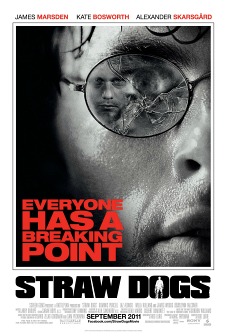
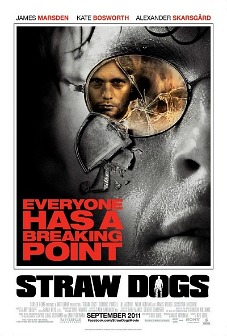

But the new version is better, I’m now realizing, because it (a) removes the amber color element inside the shattered lens, (b) makes Skarsgard into a much more subtle (and therefore creepier) presence while adding Marsden’s openly glaring eye, which was absent in version #1, and (c) gets rid of the chunks of broken glass that were previously stuck to Marsden’s cheek (and which were also stuck to Dustin Hoffman’s cheek in the original).
Good Shepherds
About 10 months ago I wrote that “the highest calling of a Hollywood columnist during awards season is to be a strong and impassioned shepherd and show the sheep where the good grass is. Not to imply sheep don’t have a nose for good grass on their own. Of course they do. But there is crabgrass, grass, decent grass, better grass, higher-quality grass and world-class gourmet grass, and I would humbly submit that committed shepherds have a special eye and an attuned nose for good grass…that’s all.
“Put another way, the Oscar-season columnists who say ‘I’m just taking the pulse of the town and staying out of the argument’ are like Judean shepherds on a hillside near Mount Sinai. Shepherd #1: “Look at those sheep over there, eating all that yellow grass and those weeds.” Shepherd #2: “Yeah, I know, and with that really nice looking patch of rich green grass to the left about 100 yards.” Shepherd #1: “Why don’t we get our staffs and scoot them over in that direction?” Shepherd #2: “No, no, that’s not our proper role. We’re here to just chill and observe and keep an eye on whatever the sheep are up to…nothing more.”
Bend With It
Every time I visit a convenience store I start looking around for those clear rounded plastic jars containing cheap black combs. I’m referring to ones made out of slim and bendable plastic with thin, malleable teeth that go for only 99 cents, and not the stiff and unyielding slightly heavier kind with overly dense teeth that drugstores sell for $3.50 or $4. Only down-at-the-heels liquor stores sell cheapo combs. I refer to them as James Dean combs. They slightly bend with your hair and slip nicely into your back jean pocket without a feeling of excessive rigidity.
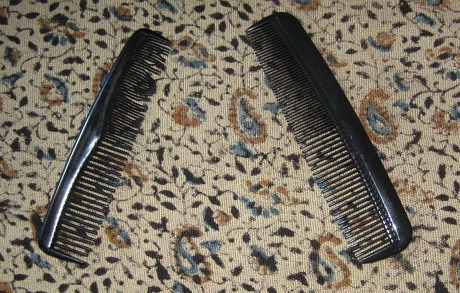
(l.) The “good” James Dean comb; (r.) the “bad” KMart/CVS comb.
I’m obviously coming from a highly fickle place, but I’m always on the look for cheapo combs and they’re disappearing from the marketplace, i fear. Can’t find them anywhere. The next time I see a batch I’m buying the whole supply.
The Blobs
The latest obesity statistics (released by the Robert Wood Johnson Foundation and Trust for America’s Health) indicate that Americans are much heavier now than 15 years ago. There are now five states (Mississippi, Alabama, West Virginia, Tennessee and Louisiana) in which nearly one in three people are obese. And the state with the lowest 2011 obesity levels — Colorado, with 19.8 percent of adults considered analogous to walking sea lions — would have had the highest rate in 1995, the report says.
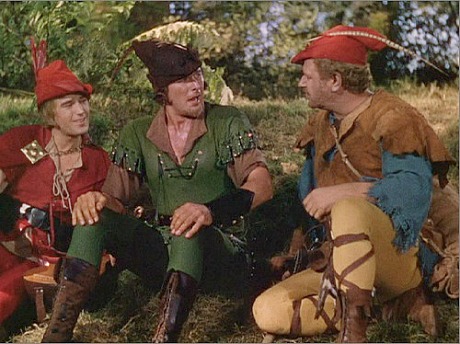
(l. to r.) Patrick Knowles, Errol Flynn, Alan Hale, Sr. in The Adventures of Robin Hood.
Think of that — every fifth person in the healthiest state in the nation has the physique of John Candy in Planes, Trains and Automobiles.
To get an idea of how things have changed over the last few decades, consider a light-hearted scene in Michael Curtiz‘s The Adventures of Robin Hood (1938) in which Alan Hale, Sr. (i.e., “Little John”) is repeatedly ribbed by Errol Flynn and his Merry Band of Men for being too heavy. They surround Hale and laugh and nudge him and really let him have it — your body is rather laughable, good fellow!
Except Hale’s Little John isn’t close to being fat by today’s standards. He has the physique of Seth Rogen before he lost weight for The Green Hornet. He’s definitely more svelte than Jack Black. Don’t even mention him in the same breath with pre-weight-loss, Get Him To The Greek Jonah Hill.
He's Got It
Sony Classics’ new Restless trailer allows me to repost my initial Cannes impressions of Henry Hopper — the 19 year-old son of the late Dennis Hopper — who stars in Gus Van Sant‘s film: “The movie is somewhat precious and Harold and Maude-like, but I sense that Hopper has more in his quiver than what the material has asked of him. He seems to be holding back for some reason. Which, to me, feels interesting.
“Hopper projects interior currents that have been thought through, or at least don’t seem too acting-school instinctual or showoff nutso. He has a reasonably steady, patient, almost Montgomery Clift-like vibe, which I would describe as bothered and vulnerable but not childish, and connected to some kind of integrity or value system — there are lines he won’t cross.
“There’s a sense of intelligence and discernment in Hopper. He doesn’t seem to be handing the role of Enoch — a kid who’s survived a car crash that took his parents’ lives and thereby has a morbid curiosity about death and ghosts and whatnot — in a manner calculated to appeal to dim-bulb teenage girls. And he’s good looking in a Clift-like way (similar bone structure, narrow nose).
“I don’t want to overdo this but he has…well, a sharp but oblique quality that could grow into something.”
Lockdown
This isn’t a review (or even a mini-review) of The Help (Touchstone, 8.10), which I saw tonight. That’s for down the road. But I could sense from reactions at the screening that it’ll be a hit with over-25 educated femmes, and perhaps beyond that demo. A youngish woman sitting near me was teary-eyed when the lights came up.
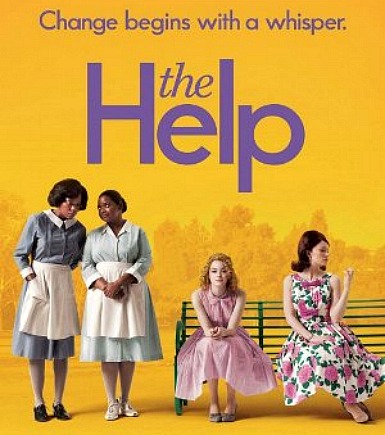
Emma Stone is the bright and diligent writer who interviews African-American maids working in Jackson, Mississippi, for a book exposing small-town racism. Bryce Dallas Howard plays a racist wicked-witch wife. But the stars of the film are Viola Davis and Octavia Spencer as two of the maids who secretly help Stone. They both give knockout performances, and are now at or near the top of the 2011 Best Supporting Actress list.
"I Know You're Not The Seein' Illusions Type…"
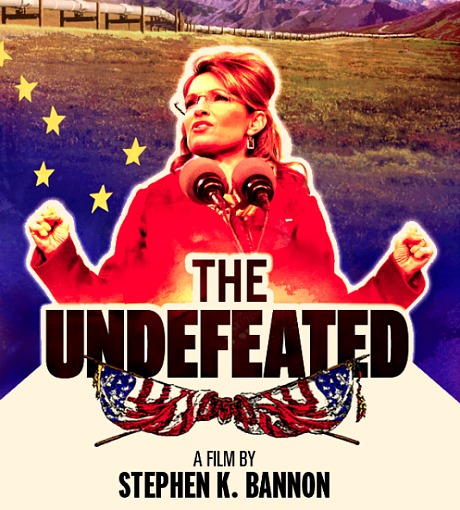
Press screenings for The Undefeated, Stephen K. Bannon’s pro-Sarah Palin documentary, are happening tomorrow in New York and Los Angeles.
Fun and Games
I too am planning on attending next week’s Dolby pressathon in San Francisco on 7.1 Surround Sound. Besides MCN’s David Poland, I mean. I’d been looking forward to a wholesome and stirring learning experience. “Uhhm, I don’t want to look in your direction…I’m looking through you…you’re not there…if I don’t maintain my Islamic jihad stance I won’t be a man,” etc.
