J-Law

LexG attended last night’s Jennifer Lawrence‘s q & a at the Arclight following a screening of Winter’s Bone. Pete Hammond conducted the interview; costar Dale Dickey also attended. Here’s what LexG sent along, minus the usual hormonal stuff:

“Lights go down, movie starts up and I’m sitting there watching it, and out rolls this backwoods teenaged girl with puffy cheeks, and at first I’m like, er, ‘Wait a minute, is this the new Megan Fox I paid 16 bucks to see in person? It’s like some rural chick in acid-washed jeans or something. Shouldn’t she be glazed in an orange sheen and bent over a motorcycle?’

“But the movie goes on, and seriously, no joke, you are watching the absolute real-deal, star-of-tomorrow, ‘holy shit is this chick incredible?’ performance of 2010! From two minutes in, I forgot I was supposed to be checking out some new hyped It Girl, and was just riveted by the movie’s no-bullshit milieu and integrity and gritty, tense undercurrent with Lawrence rolling through every scene like a dogged, reluctant investigator a la Gone Baby Gone or Cutter’s Way but transplanted to the dour, drab, blue-sheened backwoods world of Missouri meth cooks and scary associates.

“Ultimately, the movie probably succeeds more as a mood piece, character study, and a strong woman’s vehicle than as a 1-2-3 connect-the-dots potboiler. It’s one of those movies where you’re there in the moment from the jump, then around the 85-minute mark it dawns on you that the ‘plot’ specifics aren’t going to be resolved and half the threads unravel into vagueries. But Jennifer Lawrence is a force of nature in it.

“So the end credits roll, lights come up, and by now I’m expecting this chipmunk-cheeked, unassuming bad-ass underaged avenger chick from the movie. Out rolls Pete Hammond to run the q & a. First out of the gate is Dale Dickey, who is incredible as the Lady MacBeth-y Merab in the movie, and who some may remember from her white-trash turns in Domino and Breaking Bad. Cool actress, mega-talented.

“Then out comes the lanky, statuesque Lawrence in a purply ruffled top and jeans, and (yes!) giant high heels with her cute toes poking out. A Star is Born, people! Not remotely the naturaltough-chick hero from the movie, but a genuine movie star who captivates from the get-go, answering questions and generally being awesome.

“This was one of the rare times in life I wish I had an actual good phone instead of a 2002 7-11 pay-as-you-go phone, or I’d have some pics of this stunning, A-list-ready, ‘next big thing’ pro a mere twenty feet away. No idea why her likely most-seen credit thus far has been The Bill Engvall Show because we’re talking mega-stardom on the horizon.

“Hammond and the audience asked some pretty straightforward questions about…. about…something. Like where Lawrence and Dickey grew up (both in the South), their process, rehearsals, who in the cast was a real actor and who were locals (big tip o’ the hat to the audience member who apparently thought veteran actor John Hawkes from Deadwood and Miami Vice was just some local yokel.

“Nothing particularly revolutionary was revealed by either actress, although I liked it when J-Law said she liked to be “bossed around” (hot), and that her M.O. is dependant on the other actor in terms of whether they like lots of rehearsal, or to keep it loose and natural on set. But it was obvious that Lawrence is charming beyond all belief and is set to be a major, major, major star.

“The sea of difference between Lawrence’s Ozark movie and this stunning vision fielding questions with grace, self-deprecation and magnetism speaks well to her amazing acting prowess. Bet on it — instant contender for Best Actress at the Oscars.”
Dark Star

I’ve known Phil Spector‘s musical signature all my life — that “wall of sound” thing that gave such ecstatic echo-phonic oomph to all those early to mid ’60s hits (“Be My Baby”, “Walkin In The Rain”, “River Deep, Mountain High”) and Beatle songs he produced a few years later. But I’d never heard Spector speak or gotten to “know” him until I saw Vikram Jayanti‘s The Agony and the Ecstasy of Phil Spector, which will play the Film Forum from 6.30 to 7.13.

And he’s a fascinating man — there’s no getting around that. A brilliant, oddball X-factor “character” of the first order. I’ve known a few guys like Spector. They’re egotists and half-crazy and it’s always about them, but they’re a trip to talk to and share stories with. If you love show business, you can’t help but love how these guys are always sharp as a tack and don’t miss a trick and are always blah-blahing about their genius and their importance. Except Spector’s blah is backed up by truth. He’s a serious maestro who really did shape and inspire rock ‘n’ roll in its infancy, and who touched heaven a few times in the process.

Okay, so he probably shot Lana Clarkson, a 40 year-old, financially struggling actress, on 2.3.03 when she was visiting his home. Or maybe he threatened to shoot her and the gun accidentally went off. Or whatever. And maybe Spector telling a Daily Telegraph reporter two months before the shooting that “he had bipolar disorder and that he considered himself ‘relatively insane‘” was a factor. And maybe he deserves to be in jail for 19 years. The guy is obviously immodest and intemperate with demons galore.

But you can tell from listening to Spector that he’s some kind of bent genius — that he’s brilliant, exceptional, perceptive — and that it’s a monumental tragedy that these qualities co-exist alongside so much weirdness inside the man — all kinds of strutting-egoist behavior and his having threatened women with guns and all of that “leave me alone because I’m very special” hiding-behind-bodyguards crap. Because life is short and the kind of vision and talent that Spector has (or at least had) is incredibly rare and world-class.

That’s why Jayanti’s film is so absorbing, and why the title is exactly right. Why do so many gifted people always seem to be susceptible to baser impulses? Why do they allow bizarre psychological currents to influence their lives? What kind of a malignant asshole waves guns around in the first place? I’ll tell you what kind of guy does that. A guy who never got over hurtful traumatic stuff that happened in his childhood (like his father committing suicide), and who decided early on that he wouldn’t deal with it.


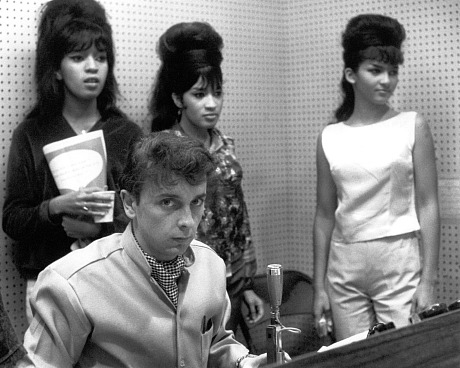
Phil Spector and the Ronettes during a 1963 Gold Star recording session in Los Angeles.

It’s another tragedy that this BBC doc, originally aired in England in 2008, is viewable on YouTube. Perhaps this will affect ticket sales at the Film Forum, or maybe it’s generally understood that you can’t absorb a doc about a music legend unless you see it as a unified big-screen thing with decent sound pumping out of the speakers.

It mainly just needs to be seen, period. Spector’s story encompasses so much and connects to so many musical echos and currents that people (okay, older people) carry around inside, and the way this history keeps colliding with what Spector probably did (despite his earnest claims to Jayanti that he’s innocent) and the Court TV footage and the evidence against him and the thought of a woman’s life being snuffed out…it’s just shattering.

I’m adding Jayanti’s film to my list of the year’s best docs. I’ve seen it twice now and I could probably see it another couple of times. Anyone who cares about ’60s pop music and understands Spector’s importance in the scheme of that decade needs to see this thing. It’s a touchstone trip and an extreme lesson about how good and evil things can exist in people at the same time.

At the same time it’s slightly pathetic that the trailer that the Film Forum site links to is so poorly sized and cropped and has no real focus or intrigue. It doesn’t represent how good the film is. Not even close.

90% of the doc alternates between interviews with the hermetic Spector, taped between his first and second murder trials, and the Court TV footage. But the arguments and testimony are sometimes…okay, often pushed aside on the soundtrack by the hits that Spector produced with the Ronettes, the Righteous Brothers, Ike and Tina Turner, the Crystals, Darlene Love, John Lennon, George Harrison, Bob B. Soxx and the Blue Jeans (that rendition they and Spector recorded of “Zip-A-Dee-Doo-Dah” in ’63). It’s the constant back and forth of beauty and darkness, beauty and rage, beauty and warped emotion — repeated over and over and over.

I never knew that the title of Spector’s “To Know Him Is To Love Him” (which he wrote and performed with the Teddy Bears in ’58) was taken from his father’s gravestone. I’d forgottten that he wrote “Spanish Harlem” — an exceptionally soulful ballad for the 1960 pop market. I never gave much thought to what “Da Doo Ron Ron” meant — I never thought it meant anything in particular — but Spector says it’s a metaphor for slurpy kisses and handjobs and fingerings at the end of a teenage date. Spector also had a good deal to do, he says, with the writing of Lennon’s “Woman Is Nigger of the World.”

There are two curious wrongos. Spector mentions that his father committed suicide when he was “five or six” — he was actually nine when that happened. (How could he not be clear on that?) Spector mentions that line about John Lennon having thanked him for “keeping rock ‘n’ roll alive for the two years when Elvis went into the Army” when in fact Spector’s big period began just after Elvis got out of the Army, starting around ’60 or thereabouts.

Spector mentions that if people like you they don’t say bad things about you, but it’s clear that if he hadn’t been such a hermit and hadn’t acted like a dick for so many years, and if he hadn’t been photographed with that ridiculous finger-in-the-wall-socket electric hairdo, and if he’d just gotten out and charmed people the way he does in the interview footage with Jayanti then…well, who knows? Maybe things might have turned out differently.

Grandpa On The Floor

Last night I finally watched the trailer for Red (Summit, 10.15), an action comedy about over-the-hill spies that someone has described as Space Cowboys meets the Bourne franchise. The director is the German-born Robert Schwentke, who makes slick, semi-diverting programmers like The Time Traveller’s Wife. An awful lot of smirking and chuckling going on. Meh.

However, I admire the fact that almost the entire cast is over 50 — Bruce Willis, Morgan Freeman, Helen Mirren, John Malkovich, Karl Urban, Julian McMahon, Ernest Borgnine, Richard Dreyfuss and Brian Cox — and the two youngest, Mary Louise Parker and John C. Reilly, are around 45. No kowtowing whatsoever to younger audiences by throwing in a couple of twentysomethings — a certain integrity in that.

"Mr. Zuckerberg…?"

The teaser tells you that David Fincher‘s The Social Network (Sony/Columbia, 10.1) has some kind of grave element going on. It says it’s not just another “this is what happened back at Harvard” whatever-dude story of ambition and greed and fucking your friends. The dialogue clips and theme titles say this initially, but the main ingredient is that ominous musical score.

It sounds like a London Symphony Orchestra arrangement that may have taken an inspiration from Bernard Herrmann‘s “Gort” music from The Day The Earth Stood Still (but without the theramin).

Trailers will sometimes use out-sourced temp music so there’s no assurance that this kind of music will be heard on the Social Network soundtrack. I checked to see who the film’s composer is and found no one.

Producer Scott Rudin informs that the teaser was created by the “very, very talented” Mark Woolen (head of the Santa Monica-based ad agency Mark Woolen Associates) “with a great deal of collaboration with Fincher.”

Incidentally: I was going to put this trailer up last night around 8 or 9 pm New York time, but I noticed right away that YouTube had removed the file due to copyright complaints, presumably from Sony attorneys. And then it re-appeared this morning. Why would anyone behind The Social Network not want this teaser to not be seen? Mystifying.

From A Hole In The Ground

Yesterday’s Restrepo-meets-Rachel Maddow post got two whole responses…yes! Moviebob noted that Big Hollywood people “are pissing and moaning about this one for the same yet totally opposite reason — they’re mad that it’s just-the-facts approach is ‘hiding the truth about the war being just,’ and here on HE I’m reading that it’s ‘hiding the truth about the war being a lost cause.’ And then AH wrote that Restrepo “shows that to the soldiers on the ground, reasons don’t matter.”

Yeah, sure — reason and context don’t matter. Just do the job, get your three squares and sleep in a warm cot. The American mantra at home and abroad!

Restrepo‘s Afghanistan grunts don’t seem to know or care if U.S. forces are winning, losing or in a stalemate. No thoughts whatsoever about the world beyond their perimeter. And so in the spirit of honest on-the-ground reporting Sebastian Junger and Tim Hetherington did more than submit to this mindset during filming. They also edited Restrepo in such a way as to persuade audiences to embrace this no-bigger-picture, keep-your-head-down attitude while watching.

To some Restrepo is the summit of straight-dope, you-are-there, no-agendas-or-interpretation documentary filmmaking. To guys like me it’s about the avoidance syndrome that filmmakers have learned is the only way to go if you’re dealing with the Middle East conflict — don’t contextualize or interpret or ask “what does it all mean or amount to?” because average Americans will ignore you if you do.

The lesson is simple: Just keep your Middle East war doc plain and non-judgmental and Hurt Locker-ish and you’ll get a lot of critics on your side, and some people might actually watch your film when it plays on HBO or PBS or wherever. But go the Michael Moore-Oliver Stone route and you’re severely limiting your audience.

What’s so bad about just telling it like it is, right? The Afghan grunts are just into taking the fight one day at a time, cleaning their weapons, making nice with the locals as best they can, watching each other’s backs in firefights, wailing with grief when one of their own gets killed, talking about girlfriends back home…eating chow, catching zees, smoking cigarettes and watching Captain Kangaroo “so don’t tell me I’ve nothin’ to do.”

War is so much more digestible or at least tolerable if you keep your head down and avoid dealing with unnecessary complications and save your brain for the immediate stuff in front of you that you have to deal with.

Which, come to think of it, is the way a lot of regular Middle Americans handle life in the U.S. of A….no? Keep it simple and local, dumb it down, don’t read or inquire too much and get yourself in a tizzy, watch Fox News, stick to the basics, wash the dishes, pick up a bucket of KFC for dinner, change the oil, take the kids to school, walk the dog, feed the cats, join a health club, pay the bills, mow the lawn and go to the pet store and buy a couple of white rats to feed to your pet python.

People who live and think this way domestically are the salt of the earth — the folks who live their lives and pay their taxes and attend concerts in the park and go to ice-skating rinks and have pool parties in the backyard. If you want to sound like a misanthrope you could also call them the American walking dead — the go-along shopping mall zombies who make the American heartland such a wonderfully boring and submissive place to live in. (This is the central observational backdrop of Green Day’s American Idiot, of course.) But let’s not go there.

So its a mirror-image thing. Restrepo is essentially about an Afghanistan War/U.S. troops version of the basic American head-down, know-nothing attitude, and vice versa. Surviving, getting along, tending to the basics and so on is the way most people deal with life — I get that — but there’s no way this go-along attitude, either on domestic or foreign soil, is what anyone might call “interesting.” And capturing it is not my idea of stirring filmmaking. It’s more like an exercise in submission or sedation, even.

Apatow's Fault?

In the possibly correct view of N.Y. Post critic Kyle Smith, Adam Sandler‘s Grown-Ups — which currenty has an 8% Rotten Tomatoes rating — was more or less sired by the lackluster commercial response to Judd Apatow‘s Funny People, in which Sandler played a realistic but somewhat dislikable comic. He didn’t like the vibe so he turned around and went full-whore commercial.

“Sandler (whose much sharper early comedies were unjustly maligned by critics) can be an interesting writer and actor,” Smith writes, “but whenever he gets spooked by the reception of grown-up work like last year’s Funny People, he becomes Hollywood’s real-life Billy Madison — skulking off to the least challenging path. In response, I was aching for a real-life Click, so I could fast-forward through the nullity and get on with my life.”

No Hesitation

Nothing says “instant buy” to me like first-rate Blurays of classic black-and-white films. Warner Home Video’s forthcoming Blurays of John Huston‘s The Maltese Falcon and The Treasure of the Sierra Madre (due on 10.5 but secretly so far — Amazon and other sites haven’t posted the news) will presumably be up to the standards of their 2008 Casablanca Bluray, which, if true, will make me drool with anticipation.

Blinders and Sandbags

Consider the between-the-lines implications in Rachel Maddow‘s recent interview with Restrepo co-directors Tim Hetherington and Sebastian Junger. Does she not seem to be agreeing with what I said on 6.20, which is that the film “lies through omission about what’s really going on in Afghanistan in the broader, bigger-picture sense”? The doc’s refusal to supply context about a platoon’s experience in Afghanistan’s war-torn Korangal Valley makes it almost value-less, I feel.

Sex With Dogs

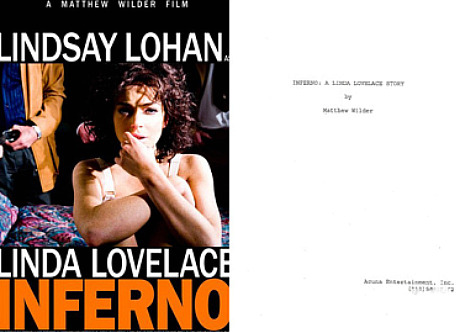
Jezebel deputy editor Dodai Stewart has posted descriptions of and excerpts from the script for Matthew Wilder‘s Inferno: A Linda Lovelace Story, which may go before cameras with Lindsay Lohan in the title role.

More than a few sites have described Wilder’s script, which may have a certain integrity on the page but also sounds like a sleazy exercise. It somehow feels less dicey to link to Jezebel‘s story about it.

The script is “full of sex and dirty language,” Stewart says, and with “downright harrowing” depictions of ugly humiliations that Lovelace suffers at the hands of husband/manager Chuck Traynor (as well as her own mom).

I don’t know about this. It feels icky and wrong. Lohan is an adult, of course, but a wobbly one of late. And it almost seems as if she, like the wounded Lovelace before her, has been somehow “played” into agreeing to perform this part. Lohan seems so wrecked and weakened in her own right — why would she want to add Lovelace’s anguish to her own?

“You’ll find child abuse, three orgasms, two beatings, intense humiliation and a bloody car crash — all in the first 32 pages alone,” Stewart writes.

“The first disturbing scene (on page 10) involves a young Linda being smacked in the face by her mother, who also burns her daughter’s hand with a Bic lighter. But the real terrifying stuff happens between Linda and Traynor, who humiliates her during a sexual encounter, making her say, ‘I’m stupid’ and ‘I’m a fat fatass’ as he fingers her and brings her to orgasm.

“Just a few pages later, Chuck, wearing big Frye boots, kicks Linda until she is bruised all over, and then, to comfort her, kisses her bruises — then pushes hard down on the bruises as foreplay.

“From there, things just get worse: Chuck coerces Linda into turning tricks; her first encounter is in a seedy motel with five middle-aged businessmen. One fondles her breast while singing a tune from Mary Poppins. Later in the script, she gets a strange boob job, cooks naked and gets a violent spanking from Chuck. She cries — sobs — while making the legendary film Deep Throat, and has a foursome with Sammy Davis Jr. at Hugh Hefner‘s Playboy Mansion, where there’s also a crowd that urges her to have sex with a German Shepherd.

“Linda and the dog, Fritz, do not actually engage in intercourse,” Stewart reports. “Linda gets on all fours and waves her butt in the air and the pooch gets freaked out.

“The story is detailed, vivid and lurid, and some of the lines Lindsay Lohan will recite are a definite departure from her Disney career.

“But the truth is, the script is actually incredibly well-written. If handled properly, it could be a sex/drugs/violence retro classic in the vein of Boogie Nights. The material is there.

“Does Lindsay Lohan have the talent to play a confused, controlled, emotionally and physically abused woman trying to claw her way to a normal life? Probably. Will she surprise everyone by turning in the performance of a lifetime? Maybe. Will she show up to the set? Unsure.”

Dead and Loving It

Today marks the one-year anniversary of Michael Jackson’s death. An epitaph came to mind on the evening of 6.25.09 (i.e., the day that everyone in New York saw an all-media screening of Michael Mann‘s Public Enemies) that I didn’t post out of sensitivity to the fans. It was the same line that Gore Vidal spoke after the more-or-less-suicidal death of Truman Capote: “A wise career move.”

Again

Hitfix’s Greg Ellwood reported today that during a Los Angeles Inception interview Leonard DiCaprio said (a) he’s definitely “hard at work” on a J. Edgar Hoover biopic with director Clint Eastwood, but that (b) he won’t wear a dress, in line with rumors that Hoover was a gay cross-dresser.

“Will I wear a dress? Not as of yet,” DiCaprio said in answer to a question on the subject. “No, we haven’t done the fitting for those. So, I don’t think so.”

On 4.3.10 I wrote that that I’d read “most of Lance Black‘s J. Edgar Hoover script, and I haven’t come upon a scene calling for DiCaprio to wear lace stockings and pumps and a cocktail dress, so we’re safe on that score.”