
Reitman on Cancer/”Can Sir?”

In Contention‘s Kris Tapley spoke to Up In The Air director Jason Reitman earlier today about a suspicion voiced in a 1.3.10 HE story (“Bingham vs. Cancer”) that Reitman might have shot the film with an undercurrent of fatality in mind. Here’s how Reitman responded:

“You find out at the end of [Walter Kirn‘s] book that Ryan Bingham is dying of terminal disease and that he’s going to the Mayo Clinic. That’s something I never really wanted to include in the movie. I never shot a scene that suggested that the character was dying. For me, at the end of the movie, he’s making a choice about where he wants to go for the rest of his life, and he certainly does have a rest of his life.

“The ‘do you want the can, sir?’ scene came out of a real moment in which I was on a plane and I overheard a flight attendant ask someone, ‘Do you want the can, sir?’ and I literally did a double take, then I realized what she was saying.

“It’s inclusion had to do with two things. One, I thought it would be a cute nod to the people who’ve read the book, and two, more importantly, it kind of speaks to the idea of how Bingham collects things and the way we obsess over travel in the sense that it’s a disease, being that addicted to traveling and the obsessiveness over miles or any kind of fruitless collection is like having a disease.”
Invited After All

The New York Film Critics Circle has relented and decided to allow reporters and columnists to attend the NYFCC Awards on Monday, 1.11, at Crimson (B’way and 21st). Budgetary concerns had prompted an earlier decision to politely say “sorry fellas..no can do.” The turnabout comes with a condition that said observing journos will have to sit in an isolated area upstairs with no food. (Like the kids table during a Thanksgiving dinner.) I’ll be bringing my own Chinese takeout and a bottle of wine.

Rotten Tomatoes Absorbed

Every time a larger company buys a smaller company, the participants are all smiles and optimism. Somebody always says “we’re a good match, a great fit,” etc. And within a few weeks or months, the larger company always starts modifying and making changes (streamlining, refining, cost-cuttings) to the smaller outfit. It’s a genetic jungle paw-print thing — the dominant must somehow imprint itself upon the submissive.

One way or another, this dynamic will manifest in the wake of the Flixster purchase of Rotten Tomatoes. Somehow, some way, some high-up hotshot will figure a way to “improve” Rotten Tomatoes that will very gradually diminish the brand. They might even fire a person or two. I’m not saying that the buyout/merger won’t improve revenue for all concerned….for a while. But sooner or later someone or something good will get brushed aside.

Pellington’s Orphanage

The subtle chills in Mark Pellington‘s direction of The Mothman Prophecies (’02) makes him an excellent choice to helm the English-language remake of The Orphanage for New Line Cinema. American mainstream moviegoers weren’t all that interested in seeing Juan Antonio Bayona‘s brilliant 2008 Spanish-language original because…let’s see, what was the reason again?…oh, right, because it had subtitles. Naturally!

Pellington will direct with Guillermo del Toro (the godfather of the ’07 original) and ContraFilm’s Beau Flynn and Tripp Vinson attached to produce. The Ebnglish-language script is by Del Toro and Larry Fessenden.

After seeing Bayona’s film in the 2007 Cannes Film Festival I called it “the creepiest sophisticated ghost story/thriller to come along since Alejandro Amenabar‘s The Others, and if you ask me (or anyone else who’s seen it here) it absolutely deserves a ranking alongside other haunted-by-small-children classics as Jack Clayton‘s The Innocents and Nicolas Roeg‘s Don’t Look Now. It also recalls Robert Wise‘s The Haunting, although the ghosts in that 1961 film were all over 21.”

World Awaits

Wells to British journalists & inside-trackers: I ask again, what’s the poop on Mat Whitecross‘s Sex and Drugs and Rock & Roll, the Ian Dury biopic that opens in England four days hence (1.8)? The London media has seen it but I’m finding no reviews. Andy Serkis is most likely phenomenal as Dury, but something must be wrong because the film isn’t showing in the World Cinema section at Sundance 2010.

I don’t trust the 12.13.09 review on the IMDB page.

If there’s a problem with the film (and I say “if”), it may be suggested in the trailer. Very little quiet is indicated. No intimacy or character hooks. The film seems to be all about bellowing and howling and pouring of milk into mixing boards — i.e., outrageous behavior of one form or another.

Kansas City Sheep

Today the Kansas City Film Critics Circle chose Christoph Waltz — Waltz! — as their Best Supporting Actor for 2009. The echo chamber of critics’ group choices has been lampooned in this space repeatedly and still the KCFCC fell in line. Okay, Up In The Air for Best Picture is a wee bit afield but they went for Kathryn Bigelow as Best Director, Meryl Streep for Best Actress, George Clooney as Best Actor, Mo’Nique as Best Supporting Actress, Jason Reitman‘s Up In The Air screenplay for Best Adapted, Quentin Tarantino‘s Inglourious Basterds screenplay for Best Original, etc. Shameless.

“Not Authorized,” Says Beatty

Irked by salacious excerpts that have appeared here and there (like in Sara Stewart‘s story in today’s N.Y. Post), Warren Beatty has issued a statement through his attorney that Peter Biskind‘s “Star: How Warren Beatty Seduced America” is “not an authorized biography.”

Biskind hasn’t responded to an e-mail I sent him a while ago, but as far as I can discern he’s never claimed that the book is authorized. He’s been a little vague about it (like Beatty tends to be about many things), but has written that Beatty spoke to him off and on, but not, apparently, in a way that added up to very much. My impression is that Beatty’s input wasn’t substantial.

Biskind says in the introduction that he’s talked with Beatty many times over the years and that he “sat down [with Beatty] a few times” as part of his research. He also writes that during these sessions Beatty “was clearly uncomfortable, watchful about what he said, dispensing his responses one grain at a time, telling me nothing I didn’t already know.”

He also says Beatty told him during a lunch “that the only reason he had agreed to do the book was because he thought that once word of [the] book spread around, the other writers with books in progress, specifically Ellis Amburn and Suzanne Finstead, would just go away…in other words, he was just using me to scare other writers off.”

In a statement to the Huffington Post, Beatty’s attorney Bert Fields states the following: “Mr. Biskind’s tedious and boring book on Mr. Beatty was not authorized by Mr. Beatty and should not be published as an authorized biography. It contains many false assertions and purportedly quotes Mr. Beatty as saying things he never said. Other media should not repeat things from the book on the assumption that they are true or that the book is an authorized biography.”

NSFC Half-Honors Schneider

It was announced two or three hours ago that the National Society of Film Critics didn’t give its Best Supporting Actor award to Inglourious Basterds costar Christoph Waltz — they split the award between Waltz and Bright Star‘s Paul Schneider. How could the NSFC possibly misunderstand that 2009 is a Waltz-and-Waltz-only year?

Kathryn Bigelow‘s The Hurt Locker won for Best Picture, Best Director and Best Actor (i.e., Jeremy Renner).

Seraphine‘s Yolande Moreau won for Best Actress — her second major domestic award after winning same from the Los Angeles Film Critics Association. (She also won Best Actress from the Cesars and the European Film Awards.)

Mo’Nique‘s Precious performance took the Best Supporting Actress award…who else and what else? (Hearing her name makes me numb.) Joel and Ethan Coen received the Best Screenplay award for A Serious Man.

“Hissing Pythons”

Avatar‘s right-wing dissers “are essentially right,” says The Punch‘s Joel Meares. “James Cameron has made over the bitch extraterrestial of his early film, Aliens, and birthed an outer-space race straight from the hearts and minds of leftist hippies everywhere.


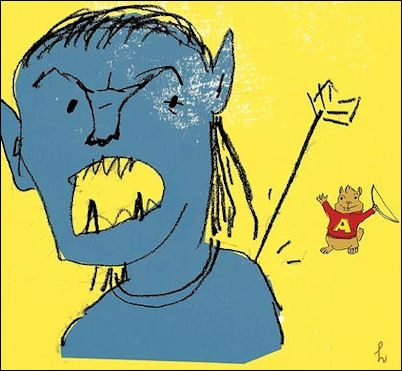
Sydney Morning Herald illustration by Simon Bosch.

“As a (skim) latte-sipping lefty and current resident of New York, a place that makes Sodom and Gomorrah look like Amish villages, I’m delighted with the result. And so should you be, whether you vote Liberal or Labor.

“As even its critics attest, Avatar is a great entertainment. If there’s an ideological undertone — or overtone — so what? Just slap on your 3D glasses, sit back and disagree.

On 1.2.10 the Sydney Morning Herald‘s Miranda Devine — a conservative — said she’s “thankful for more ‘human-affirming’ movies,” citing Juno and Knocked Up as examples. “Leftist critics have cried foul at both of those,” says Meares, “reading into them a strong anti-abortion message. It’s been argued that the one says it’s better for pregnant teens to keep their babies while the other says career women should not abort theirs.

“I don’t disagree with those sentiments, but I am pro-choice. I didn’t feel the need to decry the hissing pythons of the right once the credits had rolled on either of those films.

“I also tune in weekly to watch 24‘s Jack Bauer save the world from extremists, one mode of torture at a time.

“Hollywood’s entertainments are driven by ideologies right and left — okay, mostly left — that we might not like. Pointing them out is merely acknowledging the obvious. Avatar‘s a big expensive ad for the green lobby. Okay, then what? Does that discredit the entertainment?

“Do we really need to waste any more time writing about it? Or for that matter, responding to those who do?

“In my defense, they” — the righties — “started it.”

Beautiful Feeling

Hours after my first viewing of Avatar on 12.10 I wrote it was “ardently left, pro-indigenous native, anti-corporate, anti-rightie, anti-imperialist, anti-troop-surge-in-Afghanistan,” etc. Then I said on 12.24 that one of the great pleasures of this film is the way it makes right-wingers furious and miserable. So I’m very sorry that I missed this 12.25 rant by Telegraph‘s conservative commentator Nile Gardiner, because it says all the right things.

Avatar is “a distinctly political work of art, with a strong anti-American and anti-Western message,” he stated. “It can be read on several levels — a critique of the Iraq War, an assault on the U.S.-led War on Terror, a slick morality tale about the ‘evils’ of Western imperialism, a futuristic take on the conquest of America and the treatment of native Americans — the list goes on.

It’s also “a highly manipulative film,” he wrote. “When I saw the movie last night in a packed theatre, I was disturbed by the cheering from the audience towards the end when the humans — U.S. soldiers fighting on behalf of an American corporation — were being wiped out by the Na’vi. Washington is one of the most liberal cities in America and you come to expect almost anything here – but still the roars of approval which greeted the on-screen killing of U.S. military personnel were a shock to the system, especially at a time when the United States is engaged in a major war in Afghanistan.

Avatar is more than just a cinematic thrill-ride. It is an intensely political vehicle with a distinct agenda. In fact I would describe it as one of the most left-wing films in the history of modern American cinema, and perhaps the most commercially successful political movie of our time. While the vast majority of cinemagoers will simply see it as popcorn entertainment, Avatar is at its heart a cynical and deeply unpatriotic propaganda piece, aimed squarely against American global power and the projection of US economic and military might across the world.”

Yes!