Another Blu Letdown

The long-awaited Bluray of Michael Mann‘s Heat (Warner Home Video, 11.10) lacks that Bluray schwing. Here I am sounding like a plebian again, but dammit, you buy a Bluray version of a film you already own on DVD because you want enhancement — something with finer detail, more color gradation, sharper focus — a more robust pop-through quality. That’s what you pay for, right?
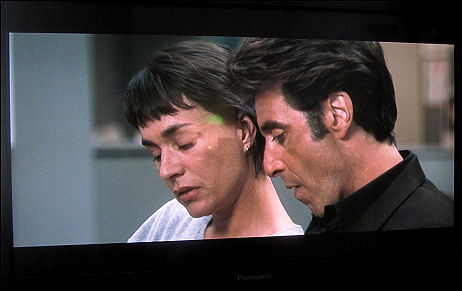

Diane Venora, Al Pacino in Michael Mann’s Heat.

The Heat Bluray offers a slight sense of enhancement, okay, but there’s nothing all that “extra” about it. The instant I popped it in last night I said to myself, “Oh…this again.” That’s because it looks almost exactly the same on my 42-inch plasma as the Heat Special Edition DVD looked on my 36″ Sony analog back in West Hollywood.

If I didn’t understand and respect what Mann has approved here — he wants a theatrical look and/or doesn’t believe in tweaking what a film looked like to begin with — and if I was in a pissy-type mood, I’d call this Bluray a bit of a burn.

As DVD Beaver’s Gary Tooze puts in his just-up review, “The Heat Blu-ray presentation “is significantly ahead of the DVD counterparts but doesn’t exhibit the demonstrative depth and detail that many have come to expect from this new format.”
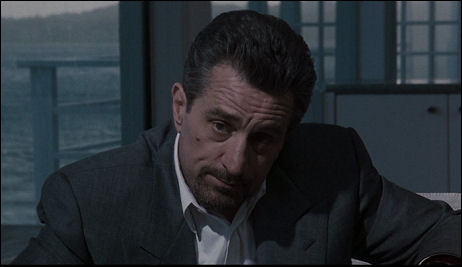
The Heat Bluray is a very handsome and honest presentation of how the movie looked on the big screen under the finest of circumstances. There’s obviously nothing “wrong” with that — shot on film, looks like film, etc. I guess I’m just a Blanche Dubois type where Blurays are concerned — “I don’t want realism, I want magic!”

You know what does look significantly enhanced and more visually exciting than its previous DVD version? The Planes, Trains & Automobiles “Those Aren’t Pillows!” special edition DVD that came out on 10.20. I know the previous DVD very well and this, played on my 42-inch plasma, looks very nice. And it’s not even a Bluray.

So in a Pepsi-challenge battle with the Heat Bluray, PTA wins. I’m sorry, but it’s more pleasing to the eye.

Precious and Rage

I read Armond White‘s absolute corker of a Precious review yesterday afternoon as I was rushing to the L train and a 5 pm appointment in town, etc. I knew it would be all the online rage and of course it is that now, but everyone knew that White-the-contrarian would go for the kill on this one, especially with the Oprah Winfrey connection. Is White regarded as such a kneejerk trasher of popular liberal-minded entertainments that the spectre of a brilliant African-American critic obliterating Precious won’t count? I wonder.

“Shame on Tyler Perry and Oprah Winfrey for signing on as air-quote executive producers of Precious,” he began. “After this post-hip-hop freak show wowed Sundance last January, it now slouches toward Oscar ratification thanks to its powerful friends.Winfrey and Perry had no hand in the actual production of Precious, yet the movie must have touched some sore spot in their demagogue psyches.

“They’ve piggybacked their reps as black success stories hoping to camouflage Precious‘ con job — even though it’s more scandalous than their own upliftment trade. Perry and Winfrey naively treat Precious‘ exhibition of ghetto tragedy and female disempowerment as if it were raw truth. It helps contrast and highlight their achievements as black American paradigms — self-respect be damned.

Precious is meant to be enjoyed as a Lady Bountiful charity event. And look: Oprah,TV’s Lady Bountiful, joins the bandwagon. It continues her abusefetish and self-help nostrums (though the scene where Precious carries her baby past a “Spay and Neuter Your Pets” sign is sick).

“Problem is, Perry,Winfrey and director Lee Daniels‘ pityparty bait-and-switches our social priorities.

“Personal pathology gets changed into a melodrama of celebrity-endorsed self-pity. The con artists behind Precious seize this Obama moment in which racial anxiety can be used to signify anything anybody can stretch it to mean. And Daniels needs this humorless condescension (Hollywood’s version of benign neglect) to obscure his lurid purposes.

“Sadly, Mike Leigh‘s emotionally exact and socially perceptive films (Secrets and Lies, All or Nothing, Happy Go Lucky) that answer contemporary miserablism with genuine social and spiritual insight have not penetrated Daniels,Winfrey, Perry’s consciousness — nor of the Oscarheads now championing Precious. They’ve also ignored Jonathan Demme‘s moving treatment of the lingering personal and communal tragedy of slavery in Beloved.

“Both Leigh and Demme understand the spiritual challenges to despair and their richly detailed performances testify to that fact. Gabby Sidibe and Mo’Nique give two-note performances: dumb and innocent, crazy and evil. Monique’s do-rag doesn’t convey depths within herself, nor does Mariah Carey‘s fright wig. Daniels’ cast lacks that uncanny mix of love and threat that makes Next Day Air so August Wilson-authentic.

“Worse than Precious itself was the ordeal of watching it with an audience full of patronizing white folk at the New York Film Festival, then enduring its media hoodwink as a credible depiction of black American life. A scene such as the hippopotamus-like teenager climbing a K-2 incline of tenement stairs to present her newborn, incest-bred baby to her unhinged virago matriarch, might have been met howls of skeptical laughter at Harlem’s Magic Johnson theater.

“Black audiences would surely have seen the comedy in this ludicrous, overloaded situation, whereas too many white film habitues casually enjoy it for the sense of superiority — and relief — it allows them to feel. Some people like being conned.”

Security

One awfully nice thing about pets is that you don’t have to look your best for them. They’ll take you with your hair combed or scattered, pants on or pants off, showered or not, with or without a manicure. They’ll put out the same you-and-me-forever vibe as long as you’re mellow and affectionate and put food on the plate. And they won’t walk into the room and say, “I’m really sorry but I just met this cat lover in the other building who makes me feel more secure.”


Aura — Thursday, 11.5, 11:05 am.

More To It

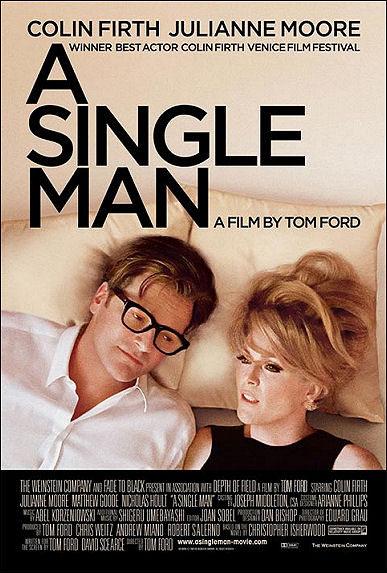
In a brief 11.5 riff about the Weinstein Co.’s poster for Tom Ford‘s A Single Man, In Contention‘s Guy Lodge wrote, “Call me cynical, but are they trying to hide the fact that it’s about a gay man?” Gee, I don’t know…maybe? Movie Marketing 101 says that you always conceal or downplay the gay element contained in any film, whether it be in the story or lead character or whatever. The Weinsteiners did the usual thing.

But it’s surprising that they didn’t try and convey the film’s selling point, which for me is its sense of taste and restraint, a feeling of early ’60s elegance, an extravagant and yet muted visual mood. A Single Man is about a gay man, sure, but more precisely about a sad and spiritually deflated one, and while it pulsates with a certain high-toned homoeroticism, it’s really more about rediscovering a yen for life — that sense of want, expectation and delectation that keeps us all going.

I would have tried for a kind of Michelangelo Antonioni vibe if I’d designed the poster. An image that would have suggested a film that delivers a gently classy atmosphere that doesn’t “hide” the gayish current as much as make it palatable and intriguing for viewers of all persuasions.

I was thinking to myself as I walked along First Avenue in the East Village last night that I really love walking around Manhattan. (As long as it’s not windy or bitter cold, I mean.) And it hit me that if you’re not feeling really happy about the relatively routine aspects of your life — about the simple joys of being alive and healthy and mobile and being able to dodge a cab at the last millisecond — then you’re missing something very basic.

Too many people look to highs and crescendos and big career accomplishments in life as the primary definers of happiness or fulfillment. I’ve just been through a stirring and delicious adventure with a beautiful blonde over the past month or so — definitely one for the record books. But I honestly felt more spiritual satisfaction last night on First Avenue than from anything that came out of the hormonal and spiritual intensity of the last four weeks. It’s not the riding of the great waves that matters the most (and I’m saying this as not just a lover of breathtaking women but also boogie-board surfing) — it’s the way you feel as you’re sitting on the beach and watching the waves at sunset, right before you roll up the towel and head for the car.

This feeling of serenity and contentment is what A Single Man puts across at the very end, and it’s really quite wonderful.

Hold Up

On 10.29 I expressed regret at not being in Los Angeles this month in order to catch American Film Market screenings of Noah Baumbach‘s Greenberg and Sofia Coppola‘s Somewhere, which New Yorker columnist Richard Brody had claimed would be showing there based on a Variety ad. It turns out this was a wrongo — neither film will be showing at the AFM. Now I feel less deprived.

Babe’s Legacy

Now that the World Series is over and the N.Y. Yankees are world champions (first time since 2000, 27 wins overall), I feel free to ask a question I’ve had on my mind since the series began: why do so many baseball players these days have the bodies of linebackers? What happened to the concept of pitchers and catchers and shortstoppers being relatively trim and, well, athletic-looking?


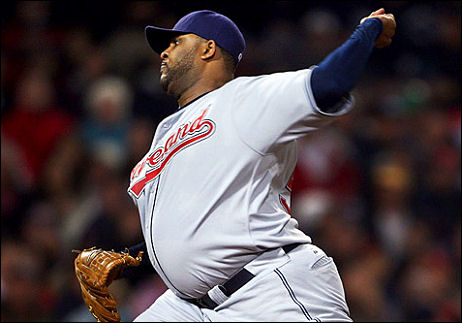
N.Y. Yankees pitcher Carsten Charles Sabathia

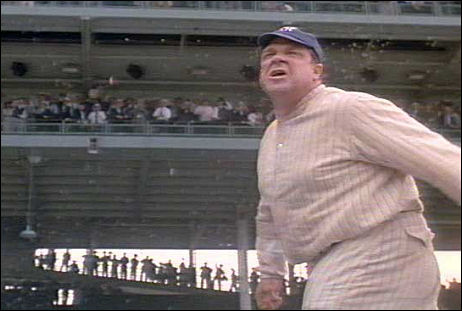
I’ve been looking at pitchers the last few days who almost look like sumo wrestlers trying to lose weight. Seriously, half of today’s players look like Babe Ruth, and he used to be a total stand-out in his era — the swaggering, jowly-faced slugger with a big pot belly. Nobody looked like that in the old days except the Babe. And yet some of today’s players make Ruth’s physique seem relatively contained.

All I know is that once upon a time they all used to look like Lou Gehrig or Joe DiMaggio or Mickey Mantle or Whitey Ford or Reggie Jackson or Don Mattingly or Derek Jeter. Guys who didn’t exactly have lithe Olympic-swimmer bodies but who at least seemed to have the ability to show restraint when they ate.

When I played softball as a kid we’d make fun of a kid named Brendan McCran, who had portly tendencies. We used to call him “the fatter batter.” This wouldn’t happen today because Brendan-sized kids and professional players have become the norm.

It’s the culture and the fatty foods out there, of course, and the fact that most American males are fat or least seriously beefy-looking. Outside of aesthetes and fat-recoil types like myself we’ve all come to accept bulk and girth as the social/cultural norm, and bit by bit this has crept into professional baseball culture, and now it’s almost gotten to a stage in which the average player looks like early-SCTV-era John Candy or Dan Blocker (i.e., “Hoss”) from Bonanza.


John Goodman as Babe Ruth

It takes a non-baseball fan like myself, a guy who might go to a game every two or three years (I love sitting alongside the third- or first-base lines and smelling the earth and the damp grass) and who only watches baseball games during the World Series to stand and notice stuff like this. The regular fans don’t say anything about lardbucket players because they’ve slowly been conditioned and made the adjustment. But I remember and I know. Baseball players used to be guys who looked like they were in some kind of shape. Obviously Alex Rodriguez looks fine, but you’ve got tons of barrel-gut types out on the diamond these days. You can’t tell me I’m wrong.

Side-issue: I also don’t like the way everyone seems to have dropped the high-sock, calf-leg, knee-britches thing that baseball players wore for decades. Now they just wear these droopy, dopey-looking pants that look like pajama bottoms. What are they going for, comfort? No flair or sense of style. (Again — this is from someone who doesn’t watch baseball all that much. I realize this has been more or less the norm for years.)

L.A. Woman

Fantastic Mr. Fox director Wes Anderson red-carpeting at a 10.30 AFIFest screening in Los Angeles. Of course. But what gets my attention (since I know the Wes/Fox rap) is the fascinating activity (i.e., a rapid progression of thoughts and moods) on the face of Fox Searchlight publicist Melissa Holloway.

The Sword

Deeply sorry about the whacking of Entertainment Weekly‘s Christine Spines, as reported this evening by Indiewire‘s Anne Thompson. Spines is an A-level feature writer who used to bang out profiles and investigative pieces for the old Premiere. Further regrets for the 10 other EW staffers who got cut also.

Bullock’s Best

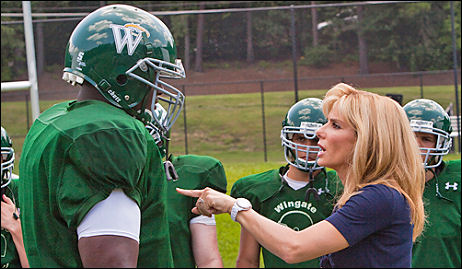
John Lee Hancock‘s The Blind Side “is the kind of inspiring and solid upbeat studio release that could, and should, put Sandra Bullock firmly in the race for Best actress,” Envelope/Notes on a Season columnist Pete Hammond posted this afternoon.

“This could be her Erin Brockovich. Just like the film that earned Julia Roberts her Oscar, this is a true-life story about Leigh Anne Tuohy, an unstoppable force of nature who persuades her very white Southern family to take in a virtually homeless African American teen named Michael Oher (played by newcomer Quinton Aaron). This unusual adoption leads to a brand-new life for the boy and sends him on his way to eventually becoming an All-American football star.

“Aaron and the rest of the cast, which includes Tim McGraw and Kathy Bates, are just fine. But it’s Bullock, burning up the screen as an upscale Southern woman who finds her heart and soul, who should finally earn some awards attention. It’s easily her best screen work since her underrated supporting turn in Crash.”

Standing on 57th Street

In Contention‘s Kris Tapley saw Crazy Heart earlier today, and is now proclaiming that Jeff Bridges has bounded or barrel-assed into the Best Actor field, or words to that effect. I’m about to watch The Last Station and I can’t embed links with an iPhone, but now I’m ever more envious of the L.A. crowd.

“It’s not just Jeff Bridges who leaps onto the Oscar landscape with Scott Cooper‘s Crazy Heart,” Tapley writes. “It’s [also] possible in a few months that we’ll be talking pretty seriously about Maggie Gyllenhaal in the supporting actress race and, most certainly, T-Bone Burnett‘s contributions as the film’s music supervisor.

“[It’s] a slow burn that settles warmly in the tradition of Tender Mercies or Nobody’s Fool. While it might be unfair to reduce it to a ‘country-music Wrestler‘ (as the Hollywood Reporter‘s Steven Zeitchik did yesterday without having seen the film), that is nonetheless a pretty streamlined way of describing the narrative.

“More importantly, however, that ‘performance of a lifetime’ from Bridges that Fox Searchlight was on about when the studio bought the film nearly four months ago? I think it could be this year’s Oscar-winning lead actor turn walking away.

“Bridges fully embodies the broken but spirited Bad Blake, an alcoholic country singer touring the Southwest in his 1970-something Suburban, playing any dive that’ll have him. He brings every inch of charisma and charm he has to a role that certainly doesn’t seem made for him on the surface, but somehow ends up entirely owned by the actor come film’s end.

Bridges haunts the stage behind a dark pair of aviator sunglasses, under a silvery, unshampooed mane, unmistakably conjuring the image of Hank Williams Jr. as he belts out a number of tunes from gig to gig. He shares the screen with Gyllenhaal, who plays Jean, a journalist and single-mother love interest. Gyllenhaal holds her own and provides a complex, emotional core to the story that could also nail down a few kudos here and there.

Colin Farrell has something of a glorified cameo as Tommy Sweet, a famous modern country star who owes his career to Blake, while Robert Duvall (who also serves as one of the film’s producers, along with Burnett, in fact) offers a small but meaningful supporting turn as Blake’s confidante.

“From where I sit, I’m having a hard time arguing with Bridges’ potential as this year’s Best Actor Oscar winner — especially when you look at the competition. George Clooney, Daniel Day-Lewis, Morgan Freeman — they all have their Oscar. The potential for a big awards comeback from Robert De Niro was considerably muted when Everybody’s Fine landed with a thud at AFI Fest last night, while other contenders just won’t have the strength of ‘the story’ that a Bridges campaign will have.

“The man is one of the great unrecognized American actors. Crazy Heart will give voters a chance to both remember his consistency, recognize that he remains Oscarless and, best of all, feel good about checking the box next to his name. Because this really is one of his finest moments.

“I imagine we’ll be talking about Crazy Heart more and more in the coming weeks and months, but those hoping for a last-minute shake-up certainly look to get their wish. These are the moments I live for in an Oscar season.”

O’Neil vs. Goldstein…Again

L.A. Times columnist Patrick Goldstein echoed my own dismay when he criticized Envelope/Gold Derby columnist Tom O’Neil on 11.2 for posting an anonymous Oscar voter’s opinion that This Is It, the Michael Jackson documentary, will grab an Oscar Best Picture nomination.

Engaging as the film is, the voter’s claim is absurd given the obvious fact that This Is It (a) is first and foremost a cash-grab enterprise that (b) obviously has no theme or under-current due to its total lack of interest in portraying the Jackson back-story or any of the circumstances behind the “This Is It” rehearsal footage — it’s strictly a sizzle show. Best Picture contenders can and must be made of sterner stuff.

I also shook my head when O’Neil posted a forecast by World Entertainment News Network’s Kevin Lewin about Guy Ritchie‘s Sherlock Holmes looking like a Best Picture nominee, which Goldstein also made fun of. The Academy rulebook does not state that “humungously-budgeted, big-studio features directed by cravenly-on-the-make directors, especially such films that use florid CG compositions and cruise through their narratives with a smirking jocular tone, can be allowed the honor of a Best Picture nomination” — but such a rule does exist in the minds of most reasonable-minded Aademy members.

“Call me old-fashioned,” Goldstein wrote, “but these postings are another good reason why all of our nutty Oscar pundits should be required to actually watch a movie before being allowed to publicly predict its Oscar fortunes.”

On the other hand, O’Neil made a fair point earlier today when he said “this certainly wasn’t Goldstein’s policy back in the old days, before the recent proliferation of award pundits, when he still held this terrain largely to himself, issuing racetrack odds on Oscar front-runners long before even the National Board of Review kicked off the derby with its first award.

“In 2001, Goldstein issued his earliest odds on the best-picture race, betting on Ali in August — long before he saw it and seven months before the Oscar ceremony took place — with 4-to-1 odds. Ali wasn’t even nominated; A Beautiful Mind triumphed.

“In 2003, Goldstein issued his odds in early November — before he saw Cold Mountain or Lord of the Rings: Return of the King. His odds on best picture: Mystic River (6-1), Lord of the Rings: Return of the King (8-1), Cold Mountain (10-1), Finding Nemo (14-1) and House of Sand & Fog (15-1). Mystic River didn’t win, of course, and 60% of his picks for best-picture weren’t nominated.

The fact, says O’Neil, is that “Goldstein’s racetrack odds used to be an annual attraction. But now he refrains from making firm predix, preferring to take potshots at others who do. Last year he blasted me and cohorts as a ‘gang of daffy, clown-suit-clad Oscar bloggers’ who have ‘hijacked’ the Academy Awards. He thrills at taking aim at me personally. He’s written in the pages of the L.A. Times that reading Gold Derby is ‘a high camp experience,’ like watching a Joan Crawford movie (a compliment, actually, which he meant as insult, of course) and blasted me personally as ‘the poster boy for the trivialization of Oscar coverage.’

“The one person who seems to be safe from Goldstein’s public ridicule while Oscar blogging is Goldstein,” O’Neil concluded. “Two months ago, on Sept. 1, he fumed at me for commencing Oscar discussions too soon over movies none of us had seen yet. Then, just two days later, he announced at his blog that the Oscar hopes of The Road — which he hadn’t seen — had taken ‘a big dive’ after Variety‘s review came out. Seven days later, after a few more reviews surfaced, a headline at his blog advised readers to “Put The Road back on your Oscar contender ballot.”

Helping Hands

It struck me when I first saw the trailer for John Lee Hancock‘s The Blind Side (Warner Bros., 11.20), an adaptation of Michael Lewis‘s 2006 book “The Blind Side: Evolution of a Game,” that it seemed like a more affluent, white-middle-classy, economically upbeat version of Lee DanielsPrecious.

The rough shorthand is that both are about compassion and nurturing offered to a young African American — an obese female teen in Precious, a mountain-sized homeless teenaged male in the Hancock film — grappling with poverty and self-esteem issues that would choke a horse.

Based on a true story, The Blind Side is primarily about a good samaritan — a middle-aged Republican/Christian wife and mom named Leigh Anne Toulhy (Sandra Bullock) — who takes in the homeless Micheal Oher (Qunton Aaron) — 16 years old, 78 inches tall, weighing 350 pounds — and gets him enrolled in a Memphis-based Christian school, which quickly leads to opportunities to play college football. Oher is now an offensive lineman for the Baltimore Ravens.

So Hancock’s film is mainly about goodness and charitableness shown by well-to-do white folk in a well-heeled environment, while Precious is set in modest, down-at-the-heels (in some cases squalid) Harlem locales, and is pretty much an African-American tale about African-American characters and culture. But they’re both about coming to the rescue of damaged youths, and good people extending a hand.

No one seems to have written about The Blind Side except L.A, Times columnist Patrick Goldstein, who called it a “wonderful new film” in a column posted yesterday. With the film opening in two and a half weeks and no one else saying anything just yet, it may be that Goldstein is himself being compassionate. I’m told it’s not Best Picture material, but that Bullock registers quite strongly and convincingly as Toulhy.

I do know that Hancock is a first-rate director (The Rookie being one of my all-time favorite G-rated films) and if it turns out to be a truly heartwarming thing…well, let’s see.

Here’s a video of Lewis talking about Oher’s story: