Portman Again

After spotting Natalie Portman at last night’s Mike Nichols discussion at MOMA, I saw her again about an hour ago at Gemma, the Bowery hotel eating spot. I was there talking with the Anvil! guys at a big table, but since I’d written earlier this morning about her forthcoming appearance at the Soho Apple store on Friday, 4.24, I felt it couldn’t hurt to double-check.

So I went over, introduced myself — she initially gave me an “oh, shit…what’s this?” look. I showed her what I’d written (she and Christine Aylward co-hosting a discussion of a new web project called “Making Of”) and asked if I had it totally correct. She said yes, I said “cool” and went back to the Anvil! table.

Gathering of Wits

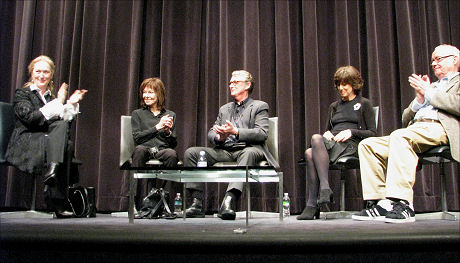
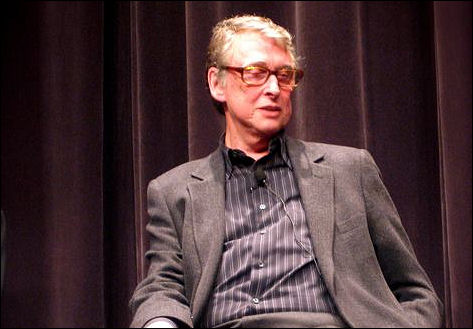
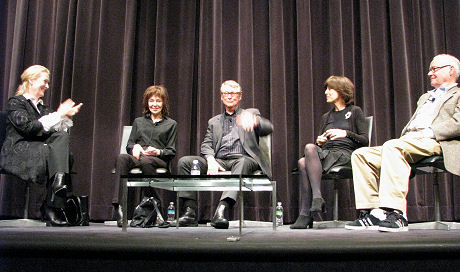
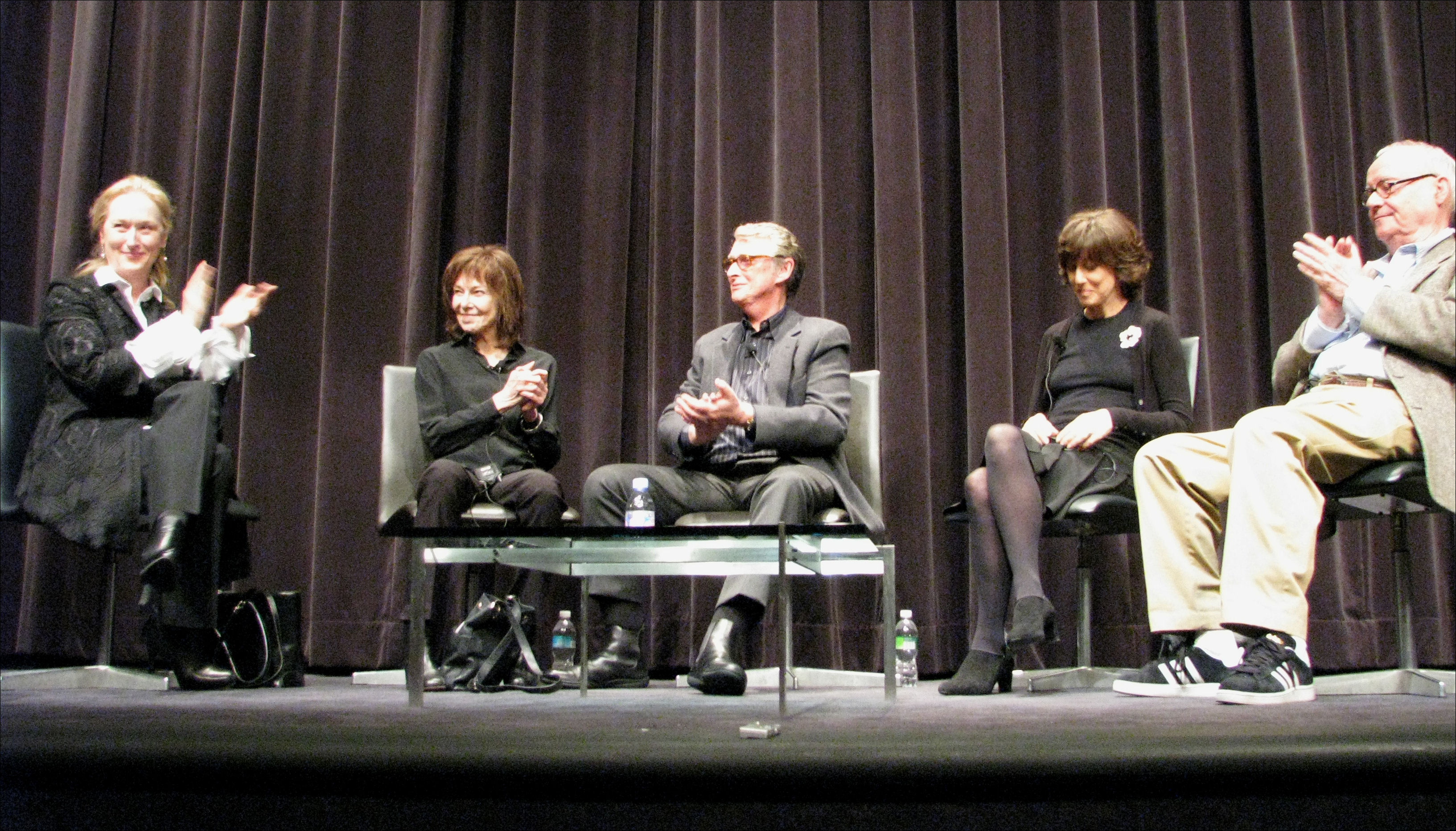
Last night Museum of Modern Art film curator Raj Roy hosted director Mike Nichols and four legendary collaborators — Meryl Streep, Elaine May, Nora Ephron and Buck Henry — in a moderately dazzling, often funny, at times chaotic group discussion about Nichols’ films, which are screening at MOMA now through May 1st. It mainly felt like a spirited dinner-table thing between Uncle Mike and the in-laws. A nice, raggedy, catch-as-catch-can vibe.


(l. to r.) Streep, May, Nichols, Ephron, Henry — Saturday, 4.18.09, 9:25 pm

Nichols, Roy, Streep (star of Nichols’ Silkwood, Postcards From The Edge, and costar of Angels in America), May (Nichols’ comedy partner from the early ’60s), Ephron (screenwriter of Silkwood, Heartburn) and Henry (screenwriter of The Graduate, Catch 22, Day of the Dolphin) were onstage for roughly 75 minutes. Here‘s my edited mp3.

The beginning was a bit lurching and unfocused, I felt, and quite enjoyable for that. Roy asked a question that went on and on until he was stopped by Ephron when she said she was very much looking forward to hearing the question (or words to that effect).

Then Roy went in the other direction (i.e., under-explained) when he turned to May and said “perhaps you could talk to us about writing comedy, with Mike or with anybody?” May gulped, looked down, and said, “Uhm…if you could be a teeny bit more specific?” Huge laugh, mild embarassment. So Roy tried to elaborate but the words he was looking for weren’t quite materializing. And so Streep, feeling the angst and the struggle, suddenly chimed in and said, “Oh, I know what you’re trying to say!” And then she went off in her own direction.

Nichols debunked the auteur theory at one point, asserting that all films are collaborative efforts with dozens if not hundreds of people contributing in this and that way.

Streep recalled how Out of Africa director Sidney Pollack told her toward the end of shooting that he was sick of the physical chore of it all and that he couldn’t wait to “get back to Los Angeles and the editing room so I can make this movie.” Nichols, on the other hand, really loves the filmmaking process because of give-and-take familial atmosphere, and that he always gets a little gloomy when a film is about to finish.

Movies always take you back to the world in which they were made, Nichols said, but life has a way of overtaking them. “We ran Catch 22 just to check the print and it was almost like a documentary,” he said. Joseph Heller‘s book was fairly nervy and audacious for its time, he recalled, but “everything has caught up to it. The whole idea of everything being pure market forces [is] pretty much the way countries are run and certainly the armed forces.”

A question was asked about the casting of Dustin Hoffman in The Graduate. Nichols recalled a Mad magazine parody in which Benjamin Braddock says to his mother, ‘How come I’m Jewish and you and dad aren’t?’ I never said to myself, ‘I need a Jew here.’ But I needed an outsider. And then I thought of a guy that I saw in a play playing a tranvestite Russian…” Henry corrected Nichols by saying, “Actually a German tranvestite cripple. And [Hoffman] was totally convincing on all three things.”

Nichols spoke about how he’d screen-tested Robert Redford for the Braddock role, but told him over a game of pool later on that he was wrong for the part. “You were wonderful [in the test], I said, but you can’t play this part. ‘Of course I can!’ said Redford. No, you can’t, I said. You could never play a loser in a million years. ‘That’s not true!,’ he said. Then I asked him, ‘Have you ever struck out with a woman?’ and he said ‘what do you mean?'”

Nichols was born to German-Russian-Jewish parents (his given name was Michael Igor Peschkowsky) in Berlin, Germany, in 1931. His family moved to the U.S. in 1939 to flee the Nazis. He began as a comic performer, and the thing that gives Jewish comics their edge, I’ve always felt or sensed, is that they have acute feelings of dread and angst, which of course provide the fuel. I would have liked to hear Nichols expound on this, and to what extent the Nazis shaped his art.

I happened to see Natalie Portman, whom Nichols directed in Closer, on the way out. She and Christine Aylward will be co-hosting a Tribeca Film Festival event at the Soho Apple store on 4.24 in which they’ll discuss a new web project called ‘Making Of’ — a site that promises to transform the way people view, enjoy, and participate in entertainment.”

Step Up From Rotary

What’s your first reaction to this shot of legendary investigative journalist Seymour Hersh, who’s been a regular contributor to the New Yorker since the ’90s? Mine was an immediate assumption that if you took a similar shot of an equally hard-working younger journalist — certainly anyone from the GenX or GenY pool — you wouldn’t see them talking on a corded handset.

Pudgycakes

Am I hallucinating, or has N.Y. Times reporter Michael Cieply written a Hollywood Elsewhere-styled observation piece about how more and more leading actors are looking heavier and heavier? Do I not own this topic? Have I not staked out once-thin-but-now-overweight actors and filed a claim? Cieply even mentions the tendency of movie stars to have big heads, which I’ve also been riffing on for years.

“Based on a close look at trailers, still photos and some films already released, at least a dozen male stars in some of the year’s most prominent movies have been adding on the pounds of late,” Cieply says.

He mentions the girthy Denzel Washington, 54, and John Travolta, 55, in The Taking of Pelham 123. The wider-faced Hugh Grant in Did You Hear About the Morgans? The “better padded” Leonardo DiCaprio in Shutter Island. Plus Tom Hanks, Jason Segel and Vince Vaughan.

Let’s see — that’s seven. Didn’t Cieply say twelve? He mentions Seth Rogen but Rogen, of course, has lost weight recently. He could have mentioned upcoming comedy star Jonah Hill, I suppose, although Hill has always been fat. There’s certainly a striking difference in Kevin Costner of today vs. the one who starred in Field of Dreams and Bull Durham, but who doesn’t thicken as they age?

Obama Doc in ’09

11 days ago Variety‘s Tatiana Siegel reported that Sony has bought all int’l media rights (excluding U.K. TV) plus domestic home entertainment rights to Edward Norton, Amy Rice and Alicia SamsBy the People: The Election of Barack Obama. It will open in U.S. theatres via HBO Documentary Films, Siegel wrote, although she didn’t include a projected release date. In fact, she didn’t even spitball about a possible ’09 release.

That suggested to me that the doc would probably come out in ’10, which “will feel too late in the game,” I wrote. Well, scratch that. I don’t know why Siegel wasn’t told but By The People will come out this year (sometime in the mid to late fall, or possibly December), and in fact is right now in a finished-enough state that certain parties have seen it and raved. Which means it could qualify for ’09’s Best Feature Documentary Oscar. (Maybe.) Which means it could play at the Venice or Toronto Film Festivals…maybe. But it’ll definitely be in theatres before 12.31.09, to be followed by HBO cable playdates.

Norton’s Class 5 Films produced By The People; Rice and Sams directed.

“I Want To Be Your Friend”

I love how kneejerk righties are using this photo to sell the idea that President Obama is being somehow intemperate and/or naive in extending a limited form of friendship towards Cuba and Venezuela (and that country’s president Hugo Chavez) based on future cooperation. Anti-Americanism is always made, never born. Caribbean and South American leaders who’ve called out American politicians for acting with arrogance and authoritarianism and looking no further into any situation other than to determine what’s best for corporate interests aren’t necessarily wrong.

Monochrome Megabeast

Late last month the History Channel began airing a show on Predator X, the aquatic superbeast that swam the seas and ate everything and everybody some 147 million years ago. 50 feet long, 99,000 pounds, foot-long teeth, four flippers, etc.

I would pay to see a movie about this guy, seriously, but I wouldn’t want to see it made by McG or Stephen Sommers or Roland Emmerich. I’d probably want something more in the vein of John SaylesAlligator, which is to say adult and knowing but with a slight wink. And yet real. If I were Tom Rothman I would give orders to shoot it in black and white 3D, which would obviously proclaim an ironic attitude. But then I’d flip this around by making the special effects as good as they possibly can be. And I’d somehow work in a scene in which Predator X eats a boatload of Somali pirates.

Perfect Day

Yesterday was warm and fair and almost summery. It was easily 2009’s best walking-around weather so far, and a declaration from nature that the horrid cold has pretty much come to an end. The whole city, it seemed, was on the streets; nobody was indoors; everyone you ran into seemed to be in at least a fairly good mood. (All photos taken with iPhone.)


Prince Street near Thompson — 4.17.09, 6:45 pm.

Just after picking up a copy, standing in 42nd and 7th Avenue subway — 4.17.09, 2:25 pm.

Hanging under the marquee for 33 Variations, the Jane Fonda play.

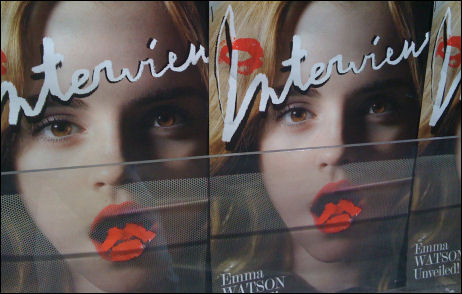
It appears as if 19 year-old Emma Watson, like her Harry Potter costar Daniel Radcliffe, is unusually short. As is Macaulay Culkin, another former child star. Not to mention Mickey Rooney. I’m sorry, but it seems a curious irony in their having become rich and famous for having played children while children, but their genetic inheritance, curiously, doesn’t hand them an opportunity to physically grow out of that phase and move on. I know I’m not supposed to say this and that the HE scolds will jump on me for doing so, but it does seem a bit odd.

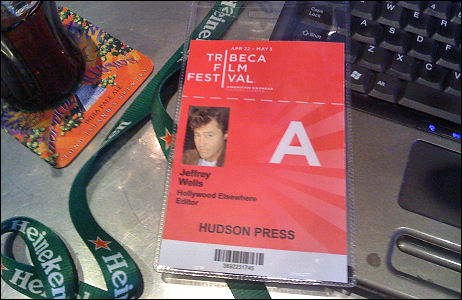
I tapped out some stories, lunched with a journalist friend, visited the Apple store in Soho, picked up my Tribeca Film Festival pass, etc. A friend and I walked around the meat-packing district last night, which seemed to me (being a recent arrival) to have transformed itself into the garden district of New Orleans or the Left Bank/Sorbonne area in Paris.

Pardon, Monsieur Hulot

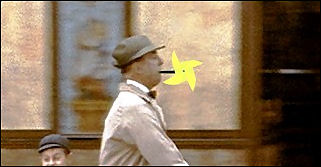
The news broke yesterday that the Paris transport authority, RATP, has transformed itself into a kind of bureaucracy of the absurd by removing the trademark pipe of Jacques Tati, the legendary absurdist French director and actor, from a poster advertising a Tati retrospective at the Cinematheque Francaise over concerns that an image of a pipe violates laws preventing the advertising of tobacco products.

The poster image is a famous shot of Tati/Hulot riding a bike in his classic 1958 film Mon Oncle. The pipe is Hulot’s trademark as much as the bowler hat and cane are trademarks of Charlie Chaplin, but p.c. dictums have erased it as far as the retropsective is concerned. In it place the Paris censors have inserted a yellow children’s windmill.

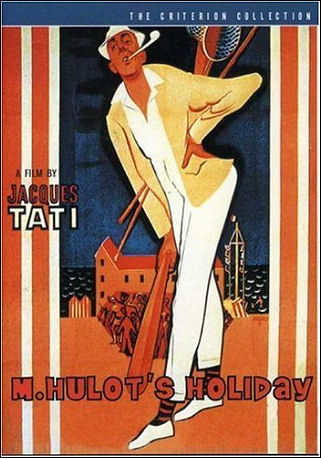
Tati played Monsieur Hulot in four classic films, each time with the exact same manner and accessories — M. Hulot’s Holiday, Mon Oncle, Play Time and Traffic. (There’s a fifth Hulot film, Evening Classes, that I’ve never seen or even heard of until I checked today.)

Metrobus, the publicity wing of the Paris public transport network, told reporters that “allowing Monsieur Hulot to smoke on buses and underground metro platforms would be an infraction of the law banning advertising of alcohol or tobacco.”

Director Costa Gavras, president of the Cinematheque Francaise, told Le Parisien that the ruling “is absurd and risible…I think it would have made [Tati] die of laughter.”

Torn Up Inside

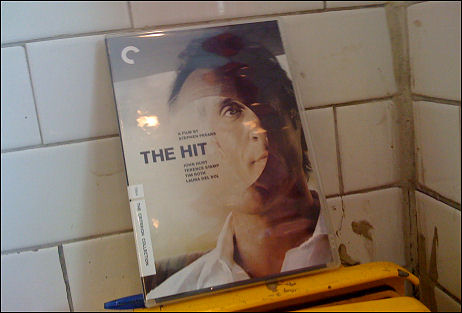
Criterion’s high-definition DVD remastering of Stephen FrearsThe Hit (1984), available on 4.28, is worth buying for several reasons. The cincher for me is John Hurt‘s legendary portrayal of Braddock, a British assassin sent to Spain to capture and bring to Paris an ex-gangster (Terrence Stamp) who needs to pay for ratting on the London mob. It’s one of Hurt’s two or three finest performances, no question, and certainly one of the most pleasurable ever delivered in a crusty, hard-boiled vein.

Hurt wears jet-black shades for at least half the film and has very few lines, but he teems with repressed feeling in every scene. There’s never a moment when you can’t tell exactly what he’s thinking or feeling. His Braddock is half-moving, half-amusing (and sometimes hilarious) and altogether unforgettable for all the things he’s clearly afraid to speak of, much less think about. He’s a walking dead man in many respects, but Hurt lets you see and feel everything churning inside — the fears, longings, trepidations. And all with a deadpan expression and next to no facial movement.

This got me to thinking about other great hard-boiled performances. I’m not speaking of actors who play their parts with a minimum of expressiveness — hard and frosty, wearing sunglasses, smoking cigarettes, etc. Anyone can do that. I’m speaking of performances, like Hurt’s, that use that terse, tough-guy thing but make it all feel like opera.

Jean Servais asTony le St√©phanois in Jules Dassin‘s Rififi — that’s another classic of this type. Lee Marvin‘s Walker in Point Blank isn’t quite on Hurt’s level (the part isn’t written that way), but he slips in and out of a lost-and-melancholy mode. Who else? Clint Eastwood in Unforgiven?