Anderson-Seitz Reboot

“With just five features in 13 years, Wes Anderson has established himself as the most influential American filmmaker of the post-Baby Boom generation,” says Matt Zoller Seitz in the first of a five-part narrated video series (along with a printed essay) that will run over the next five weeks.

(The video is very nicely done, Matt — hats off. But the automatic play-reboot function is impossible. Send me a code without it and I’ll put it up again.)

Publishing a pro-Anderson manifesto is, at the very least, an idiosysncratic if not brave thing for Seitz to have done. I mean, is it not the prevailing view that Anderson pretty much shot his wad with Bottle Rocket and Rushmore? And that he’s been slipping more and more into WesWorld and getting more and more caught up in Wes-aesthetics-for-their-own-sake ever since?

Apart from his brilliant ’06 American Express commercial and that Jason Schwartzman and Natalie Portman Hotel Chevalier short that accompanied The Darjeeling Limited, Anderson’s post-Rushmore features have come to symbolize an approach to filmmaking that is so poised, precious and fussed over that the primal dramatic stuff doesn’t come through like it needs to.

As David Amsden wrote in a New York profile of Anderson in late September of ’07, “Pepper in some resurrected classic-rock songs; deadpan dialogue; themes of failure, nostalgia, and fractured families; and the result, at its best, is a world unto itself.”

The other prevailing view is that former collaborator Owen Wilson provided an influence that kept Anderson from getting too Wessy. Like the also-faltering M. Night Shyamalan, Anderson needs to find a way to write his screenplays with (i.e., trust) a bright somebody or other with anti-foo-foo roots and convictions who can save him from himself.

The beginning of the fall-off wasThe Royal Tenenbaums. The first big uh-oh was The Life Aquatic. The Darjeeling Limited, for me, was the Big Thud. And yet Seitz’s essay, I have to say, is great stuff. The passion is right there. It made me fall in love with Rushmore all over again, and feel hope for Anderson’s future works. One hopes in particular that The Fantastic Mr. Fox (which had a test screening in New Jersey a little while ago) will pan out.

“What makes Wes Anderson distinctive is the sheer range of art that has fed his imagination,” Seitz writes. “Nnot just recent American and foreign films, but films from 30, 50, even 70 years ago, plus newspaper comics, illustrations, and fiction. The spectrum of influence gives his work a diversity of tone that his imitators typically lack. It is a style of substance.

“Anderson’s scavenger-hunt aesthetic stands him in good company, alongside Quentin Tarantino, David Gordon Green, James Gray, and the other Anderson, P.T. This series may incidentally illuminate why Anderson-esque movies — from Garden State to Son of Rambow — can seem, no matter what their virtues or pleasures, a weak substitute for the real thing.”

On 9.24.07 I posted a short list of “career-saving suggestions for Anderson to consider: (a) Do a T.E. Lawrence and join the Army or Marines as a raw recruit with a fake name, and serve in Iraq for a year; (b) get a job in Iraq as an ambulance driver, and have an affair with a nurse if he gets sent to the hospital if and when he gets maimed by an I.E.D.; (c) do a T.E. Lawrence and take a low-level job in some blue-collar industry in Missouri or Mississippi for a year, again under a fake name; (d) do a John Pierson and run a repertory movie theatre in some far-off territory for a year — soak up the exotic atmosphere, get to know the locals, etc.”

Joined At Hip

I met briefly with We Live in Public director Ondi Timoner and her five-year-old son Joaquim early this afternoon inside the Manhattan offices of Murphy P.R. Her film, which won the 2009 Sundance Film Festival Grand Jury prize, is about living virtual at the expense of natural, and how we’re all sinking deeper and deeper into it. (It’s certainly the story of my life, I can tell you.) We Live In Public is showing at New Directors, New Films this week. I’ll most likely run the piece along with the audio tomorrow.

Jarre Is Gone

The legendary movie-score composer Maurice Jarre died yesterday in Los Angeles at age 84, following a long bout with cancer. I’m probably not the only one who’s feeling a bit forlorn about this. Jarre’s music could be a little sappy at times, a little too on-the-sleeve. But his melodic gifts seemed almost heavenly at times, and he was one of Hollywood’s most impassioned old-time maestros — right up there with Miklos Rosza, Dimitri Tiomkin, Elmer Bernstein, Bernard Herrmann, Alex North, etc.

You can love or admire various films, directors, actors, screenwriters, choroegraphers, directors of photography, screenwriters, etc. But music goes right into your heart and makes the spirit take flight. Jarre’s Lawrence of Arabia music is arguably a more vital component in that film’s appeal than Peter O’Toole‘s performance or Robert Bolt‘s screenplay. (They are at least equally matched.) I never loved Dr. Zhivago, but I can’t listen to Jarre’s overture for that 1965 David Lean film without feeling a slight melting in my chest.

His music for Richard BrooksThe Professionals (’66) was electric, crackling, alive, heartfelt. I’m also a big fan of Jarre’s score for John Frankenehimer‘s The Train (’64). And his scores for two great Peter Weir films of the ’80s — The Year of Living Dangerously and Witness — are also among his best. I’m humming the Living Dangerously theme right now. The closing-credits music he created for Witness was a profound counter-point to the Philadelphia detective and Amish farmer cultures shown in the film — it stood its own ground.

All The Way

The first thing I saw on the iPhone after coming out of my second viewing of State of Play this afternoon was the NC-17 rating given to Sacha Baron Cohen‘s Bruno. This is surprising? What kind of rep would this 7.10 Universal release have if the MPAA’s ratings board had given it a nice obliging R? Please.

The idea with Bruno is to make average folks in all socio-political realms (i.e., not just red-state males) cringe and go “eeeww!”, and to do that right it has to top the naked wrestling “eewws” in Borat, so what else could have happened?

The Wrap‘s Sharon Waxman reported last night that the offensive footage includes Cohen having “anal sex with a man on camera” — big deal. Jim Carrey does some fairly brazen ass-banging in the M.I.A. I Love You, Phillip Morris. I mean, we are experiencing the Fall of the Roman Empire and the End of Civilization as we know it…are we not? So why not allow such scenes to be included in adult fare?

Why can’t U.S. society at least be more like Sweden or Denmark? They aren’t so wang-averse over there. I thought that Billy Crudup‘s blue schlong in Watchmen signified a sea change in U.S. values.

There was also a reported MPAA objection to Cohen being shown “sneaking naked into the tent of an unsuspecting non-actor” on a hunting trip. Piffle.

A scene showing “two naked men attempting oral sex in a hot tub while one of them holds a baby” is, according to a Universal spokesperson, “not on the list that the MPAA finds objectionable.”

Another One Down

Another story I missed last Friday (and all weekend, for that matter) was the last gasp of L.A. City Beat, the smallish alternative weekly. They’re dead, buried, a memory. I was going to use “financially afflicted” as an adjective, but is there any print publication anywhere that isn’t sliding down the slope?

The only reason I picked up City Beat year after year was to read the esteemed film critic Andy Klein, and when they whacked Klein last January in a cost-cutting move I said to myself, “The hell with these guys.” I was actually thinking of a scene in Out of the Past when Jane Greer hopes for the quick death of Kirk Douglas . To which Robert Mitchum replies, “Give him time.”

Wolf vs. Gray Lady

“The New York Times, as we know it, has been disappearing for some time,” Newser‘s Michael Wolf wrote last Friday morning. “It may — diminishing as though by half-lives — have degraded to the point where, in any practical sense, it has long since ceased to be the leading voice in either journalism or the establishment.

“This is partly of its own doing: Almost all of its strategies to deal with the changes in the newspaper business — its national strategy, its online strategy, its regional strategy (buying the Boston Globe), its international strategy (buying the International Herald Tribune) — have bitten it in the ass. Nor have its strategies to deal with the changes in news itself been so successful — the featurizing and softnews-ifying of the front page has made the must-read Times a not-so-important read.

“But mostly the problem is that the New York Times is a newspaper. Once there was the New York Times, which, while in the form of a newspaper, represented something so much more significant–it was a daily bible. But now it is just a newspaper — no better, no worse. And there is nothing that it can do to escape the problems and the fate of all other newspapers. Technological obsolescence doesn’t discriminate. (The Times’ game efforts to compete in this world have only meant that it’s seen a faster undermining of its main revenue source — the newspaper).

“The last of the Times Mohicans — that band of journalism devotees (something more and more like railroad hobbyists), retro-Jewish liberals, and those remaining establishment types who depend on the Times to write about them — with their belief that the Times is unique and necessary, continue to hope against hope for a white knight solution.

“They will supply the whimper.”

Storaro Styrofoam

I woke up this morning and looked up at the ceiling — or rather, at the low-cost bullshit styrofoam ceiling (favored by low-end contractors, all the rage in North Bergen) that I’m stuck with for the time being. And it hit me that each styrofoam rectangle is precisely the same proportion as a widescreen 70mm aspect ratio — 2.21 to 1. I was recalling this and that scene from Apocalypse Now, particularly Martin Sheen inside that bamboo cage. This is my life.

You Can Have Him

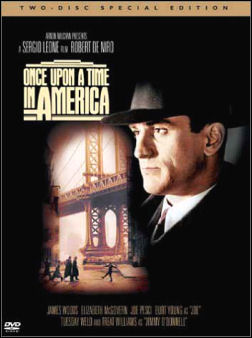
A friend sent along this video piece featuring Once Upon a Time in America costars Rusty Jacobs and Scott Tiler — the guys who played young James Woods and Robert De Niro in Sergio Leone‘s 1984 gangster classic — visiting some Manhattan-Brooklyn locations. “But they’re wearing T-shirts!,” came my reply. “So it was taped last summer. Or maybe two years ago. Or five. In any case, what’s the point?”

It’s interesting to hear Tiler say the following about Leone: “It’s almost unheard of that a director spends 11 years conceptualizing a film and not making any other movies in the interim….this movie was so in his blood, so in his conscious and unconscious, that he understood every last element…every line in the script.”

If he knew it that well, I asked myself, then how could Leone have come to an agreement with the Ladd Company that said/stipulated that Once Upon a Time in America would run no longer than two hours and change? (Or two and a half hours or whatever it said in the original contract.) And yet he comes up with a six-hour cut that is gradually pared down to 227 or 229 minutes. Nearly four hours long.

Of course, it’s been widely accepted for decades that the longer OUATIA is a much better film than the chronological, pruned-down Ladd Co. version, which was put into theatres at a running time of 139 minutes, or 90 minutes shorter.

Once Upon A Time in America, but I’m not in love with it. I’ve never been much of a Leone fan. I’ve felt from the get-go that he was over-rated. All those relentless close-ups of sweaty guys wearing sombreros and chomping on unlit cigars. I know that one is expected to swear by Leone, but I’ve never been able to make myself re-watch his films on DVD. Once is enough.

Pigs in the Gutter

It’s criminal and appalling, but the apparent fact is that quality-level DVD rips of The Hurt Locker have been on Pirate Bay for a long while now. And last night a journalist pal told me that a bootleg bum sold him a “clean” DVD of Kathryn Bigelow‘s film the day before yesterday in the Bronx. For a dollar. Which means that other bootleg gypsies are selling it also, not just in New York but in grubby, down-at-the-heels areas of every city in the country.

Guilty Aforethought

A Manhattan all-media Observe and Report screening is happening tomorrow night. I consider it vital to attend and report. I was told last night that the ending is (this may be putting it too specifically) Travis Bickle-ish. Whatever. The guy I spoke to called it Seth Rogen‘s last fat role — his no-holds-barred kiss-off to the fat chapter in his life.

Showest Standing

Collider‘s Steve Weintraub has just posted some pics of various new standee posters being displayed at Showest, which starts tomorrow in Las Vegas. The only one that got me besides the Hurt Locker poster is the one for Robert Downey, Jr., and the Curse of the Crystal Indiana Holmes.


“If he doesn’t die today, there’s always tomorrow.”

Turndown Day

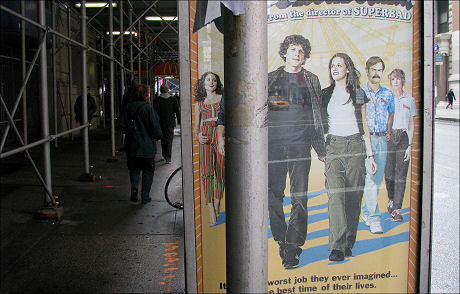
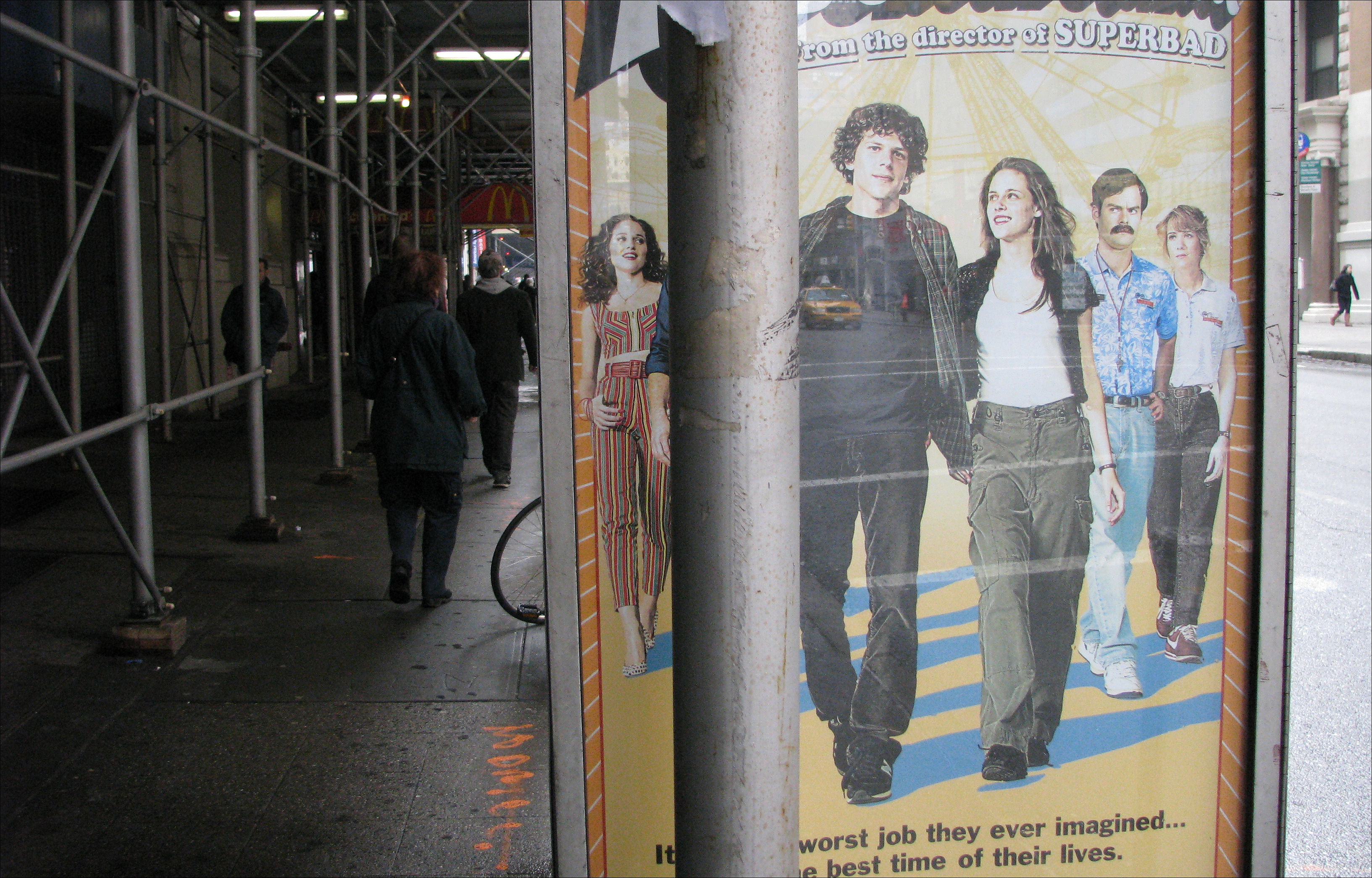
As I began to say last Thursday, Greg Mottola‘s Adventureland (Miramax, 4.3) is modestly pleasing — a period relationship drama with comedic spritzing that’s unforced, settled down, not bawdy or coarse, and proportionately buyable. That’s another way of saying it’s a piece of recognizable realism with two solid, nicely unpretentious performances from Jesse Eisenberg and the always sublime, rock-sexy Kristen Stewart.

When I begin to watch a film about kids in their early 20s doing whatever, I silently pray to myself, “Please don’t let it be stupid.” Or “please let the characters not be gullible or at least have a shred or two of common sense, or at least a capability for intelligent dialogue….please.” Most of the time films of this sort fart in my face, but not this sucker. Adventureland is bright and honest and restrained in a likable, low-key way.

I didn’t like some aspects. I could have done without the stabs at humor. (They feel off-point.) The parents of Eisenberg’s character — Jack Gilpin, Wendie Malick — felt overly curt and charicatured. But I was generally pleased. Not to the point of doing cartwheels in the Brill building lobby, but a film can put you in a pretty agreeable place without making you get all gymnastic.

The irony is that this intelligent, mild-mannered quality may turn out to be a commercial problem. There’s almost nothing in it for the apes who love the downmarket obviousness of the cruder Judd Apatow comedies (I Love You, Man, Forgetting Sarah Marshall, The Year One).

I can just hear the word-of-mouth outside the plexes next weekend. Viewer #1: “So is it funny? Is it foul? Do girls get naked in it? Does anyone lean out of a moving car and throw up?” Viewer #2: Uh, well…no. It’s not really a comedy-comedy. In fact, it’s not even a dramedy. Nobody gets pissed on or thrown up on. Nobody gets naked. It’s more of a nice little realistic love story between two fairly aware people. No tricks or gross-outs.” Viewer #1: “Fuck that!”


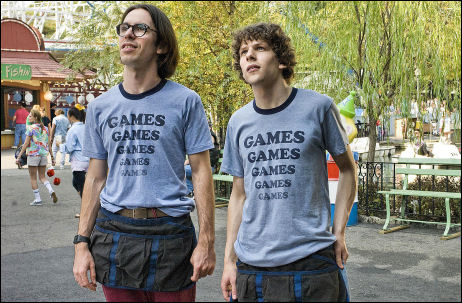
Martin Starr, Jesse Eisenberg

Set in the early ’80s Pennsyvania, it’s about a virginal college grad (Eisenberg) who takes a nothing summer job in a local amusement park after being told by his parents that they can’t afford to pay for his grad-school tuition, much less a trip to Europe. He gradually falls in love with coworker Em (Stewart), who slowly begins to reciprocate despite a side affair she’s having with Connell (Ryan Reynolds), an older married guy who works as the park’s mechanic.

Secondary loser-type characters float in and out — the park owner (Bill Hader ) and his wife (Kirsten Wiig), a brainy Jewish nerd type (Martin Starr), a straight-laced hottie (Margarita Levieva ). Various obstacles, complications, and distractions manifest. But the Eisenberg-Stewart thing — will they? can she? should he? — is the main order of business.

And it all cruises along within an ’80s period vibe. Like a cousin of All The Right Moves. Everything looks and feels a bit grubby and low-thread. Terry Stacey‘s cinematography has a slightly downgraded feeling to it, like a none-too-slick New Line film of the era.

Mottola, the director-writer, uses Lou Reed‘s “Satellite of Love” on the soundtrack (and even throws in a discussion about the lyrics at one point), but the song that seems to sum up Adventureland, for me, is “It’s A Turn Down Day” by The Cyrkle. Generationally wrong, of course, but tonally or attitudinally it’s somehow right in line. I can’t explain it any more fully than this.