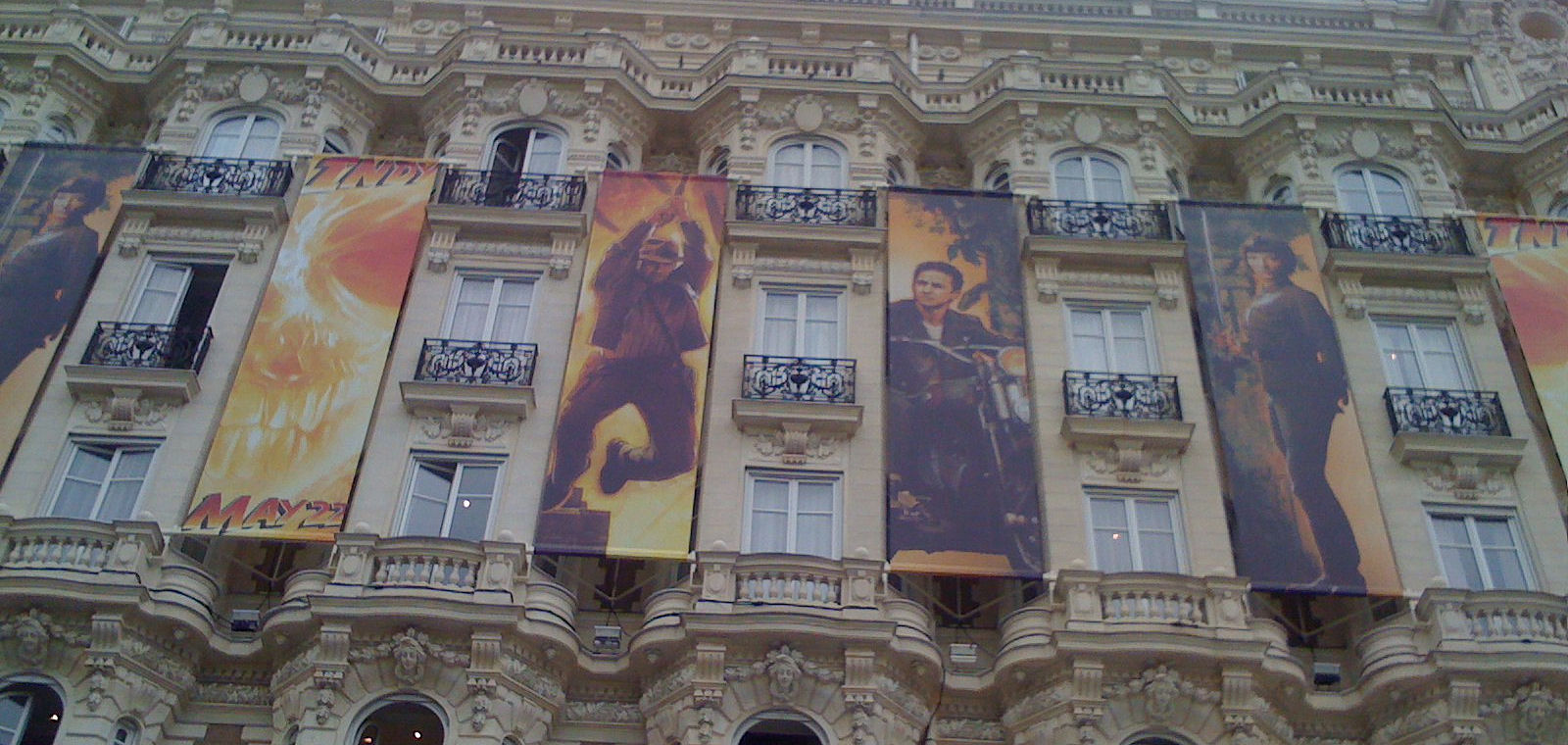
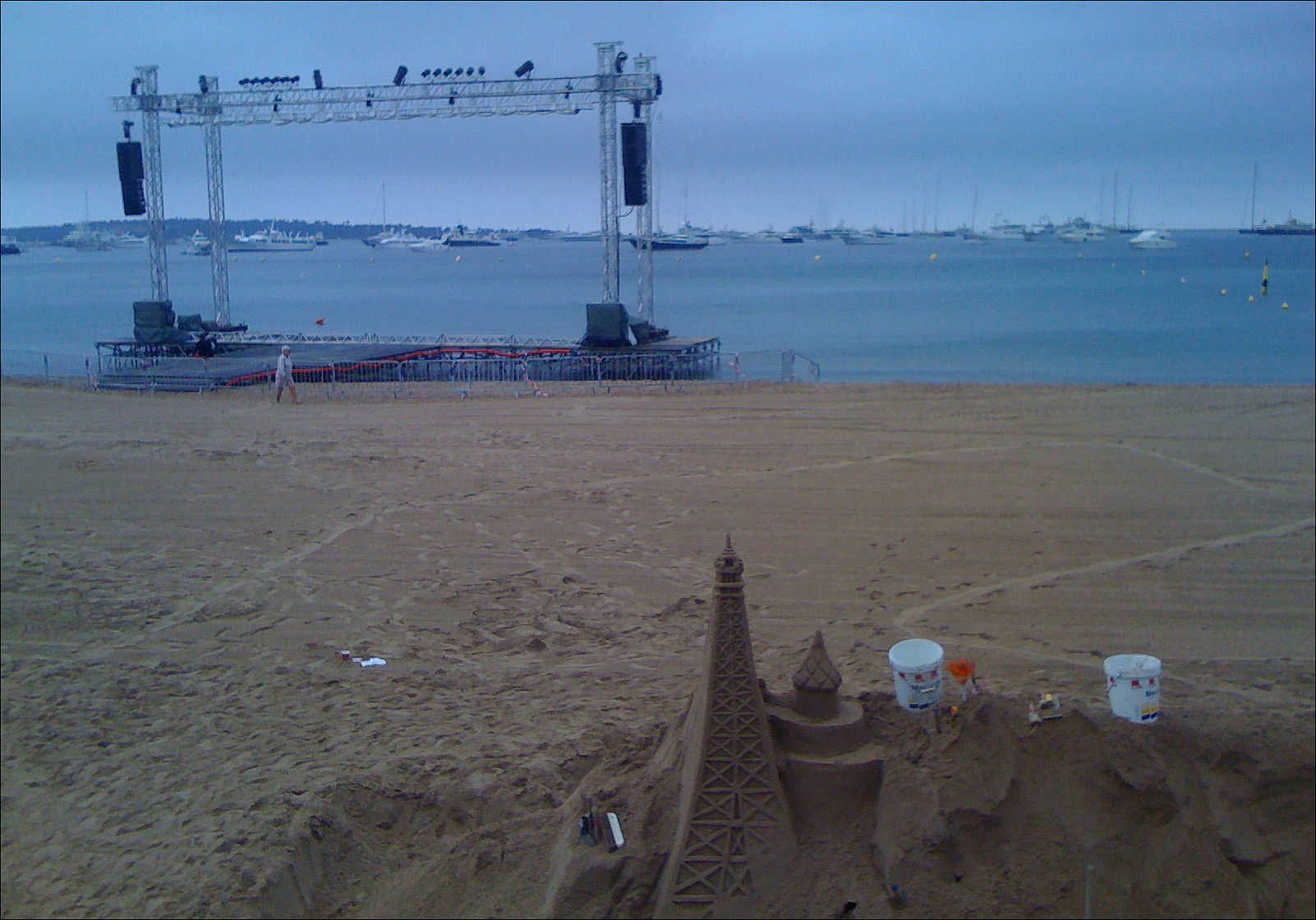
If Kelly Bush (i.e., Ben Stiller’s rep) is reading this, could she please call my cell? Or e-mail me. We spoke two or three days ago in the Carlton lobby. Thanks.
Next Nine Hours
The Weinstein Co. sent out invites to press late yesterday to attend a coffee-and croissant announcement event this morning at the Martinez beach, something about a big literary acquisition. Then the Woody Allen/Vicky Cristina Barcelona press luncheon happens at the Martinez Palme D’Or restaurant from 11:30 am to 12:30 pm. Some will slip out around 12:20 pm in order to get down to the Palais (a good half-mile walk) for the 1 pm Indiana Jones screening at the Grand Lumiere, which is going to be a madhouse. Then comes the Indy 4 press conference at 3:30. And then the writing of the full review, which I probably won’t finish until 5 pm or so. (11 am NY time.)
Harlow on Indy 4
I don’t know how the Times Online‘s John Harlow managed to see Indiana Jones and the Kingdom of the Crystal Skull “last week,” unless he put on a hat and a fake beard and snuck into an exhibitor screening. Nonetheless, he’s got a “review” up in the Sunday, 5.18 edition. However good or bad Indy 4 is, I’m not going to take Harlow’s word. His prose tells you right off he’s a relatively easy lay.
Harlow spends the first six paragraphs blah-blahing and blowing obsequious journo-farts. He finally gets down to a semblance of business in paragraph #7: “The good news for Harrison Ford fans is that Indy may be older and greyer, but there’s still a spark to his repartee,” he says, “and he still gets the girl in the end (the girl in question being Marion Ravenwood, played by Karen Allen, who was the love interest in the first Indiana movie, Raiders of the Lost Ark).
“Whether Ford’s charm will be enough to earn the film the $400 million it is estimated to need to recoup Paramount Pictures’ investment remains to be seen. However, a preview attended by The Sunday Times last week suggested that the internet gossips who have doubted the film’s drawing power may be proved wrong.
“Jones admits early on that chasing baddies is not as easy as it used to be. In one scene he escapes from a nuclear blast by hiding inside a lead-lined refrigerator. Science and probability were never among the series’ strong points.
“It rapidly becomes clear that since we last saw him saving the Holy Grail from the Nazis, Jones has become a sadder and more solitary character.
“His gloom is broken when an unlikely pair of treasure hunters — Mac, played by Britain’s Ray Winstone, and Mutt, played by Shia LaBeouf, a teen idol — warn him that the dastardly Soviet Union is after a crystal skull that, in the finest Indy tradition, offers dangerous powers to anyone who possesses it.
“Much has been made in internet chatrooms about LaBeouf’s potential impact on the film, and fears that he is merely a sop to lure teen viewers. Yet LaBeouf, who made a striking impact against computerized villains in Transformers, matches Ford quip for quip and leather jacket for leather jacket.
“The first Indiana Jones film in 1981 was Spielberg’s homage to the Saturday morning cliff-hanger serials of the 1930s. The latest film still has a pleasingly old-fashioned feel, with several long, slow shots, plastic-like foliage, tinny sound effects and a silly python.
“Cate Blanchett makes an eye-catching appearance as Irina Spalko, the spooky leader of the Russain villainry; John Hurt, the veteran British actor, lurks menacingly as a rival hunter.
“The crystal skull itself was formerly the subject of obscure disagreement between Spielberg and Ford, but it’s now hard to see what the fuss was about. It might as well have been a brussels sprout for all the difference it makes to the plot.
“The real pleasure for series fans may lie not so much in the madcap action, the carnivorous bugs and the familiar perils of quicksand, but the restored romance between Ford and Allen, and the fatherly relationship that develops between Ford and LaBeouf, who is clearly the new pretender to his whip.
“Indy treats Mutt with the same sarcastic disdain that his own father, played by Sean Connery, lavished on him during the Last Crusade. You can probably guess how it all works out.
“The new film has long appeared critic-proof — audiences will flock to it whatever the critical verdict. Yet will it have the box-office legs to join its distinguished predecessors among the most popular films in Hollywood history?”
Here’s another early review from the Times Leader‘s Michael H. Price.
Indy Schmooze
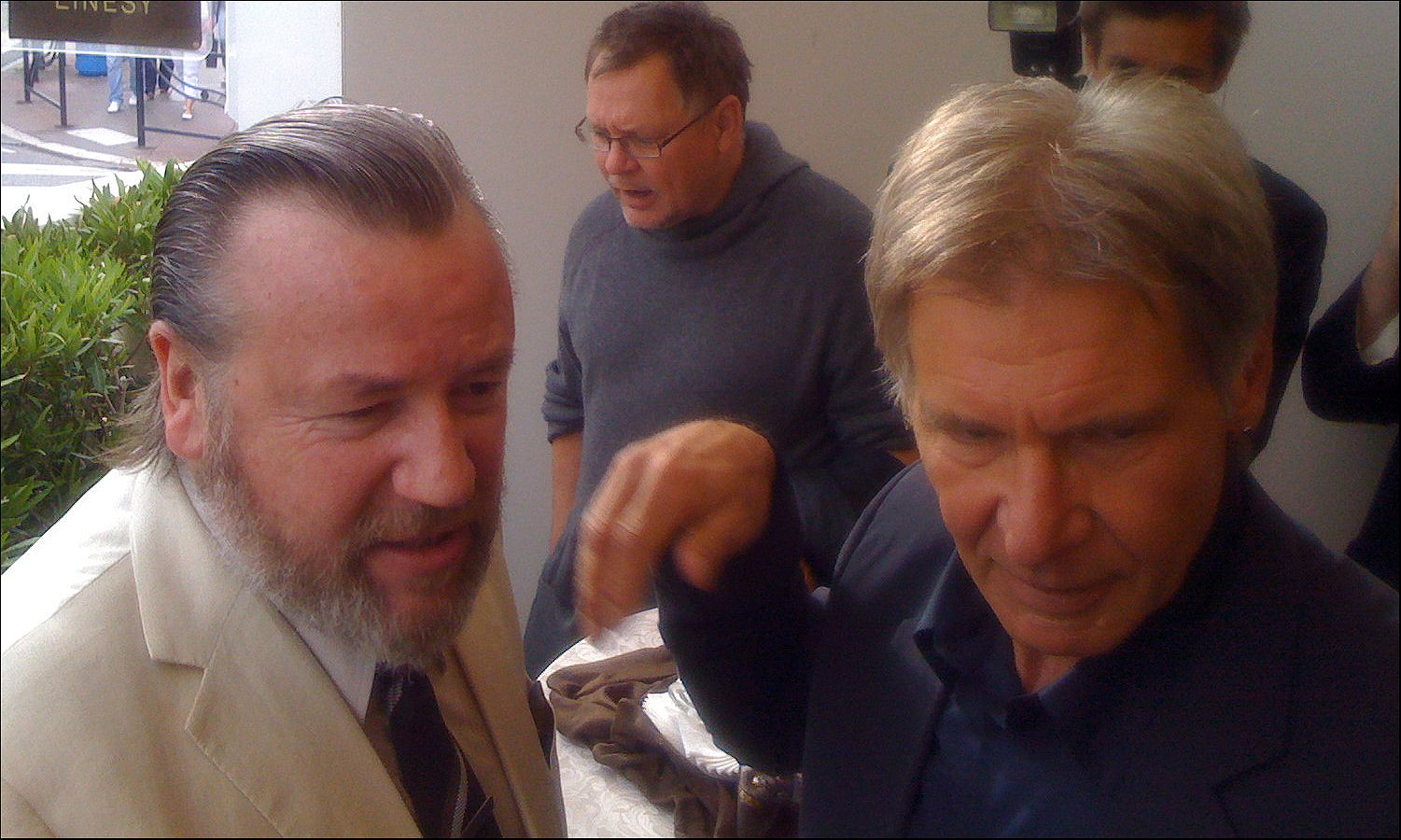
I went four, four and a half minutes with Harrison Ford a little while ago at a small Indiana Jones and the Kingdom of the Crystal Skull party held at the Carlton hotel. Usually you get maybe two or three minutes with a major star at a gathering like this with aggressive journalists prowling around like wolves, looking for a name to bite into and a quote to take home.
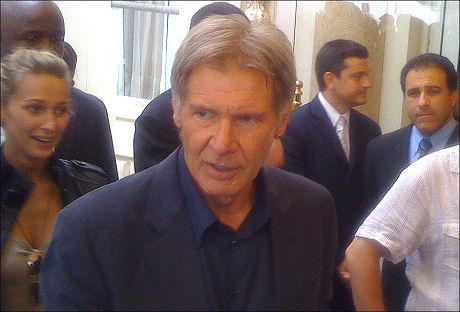
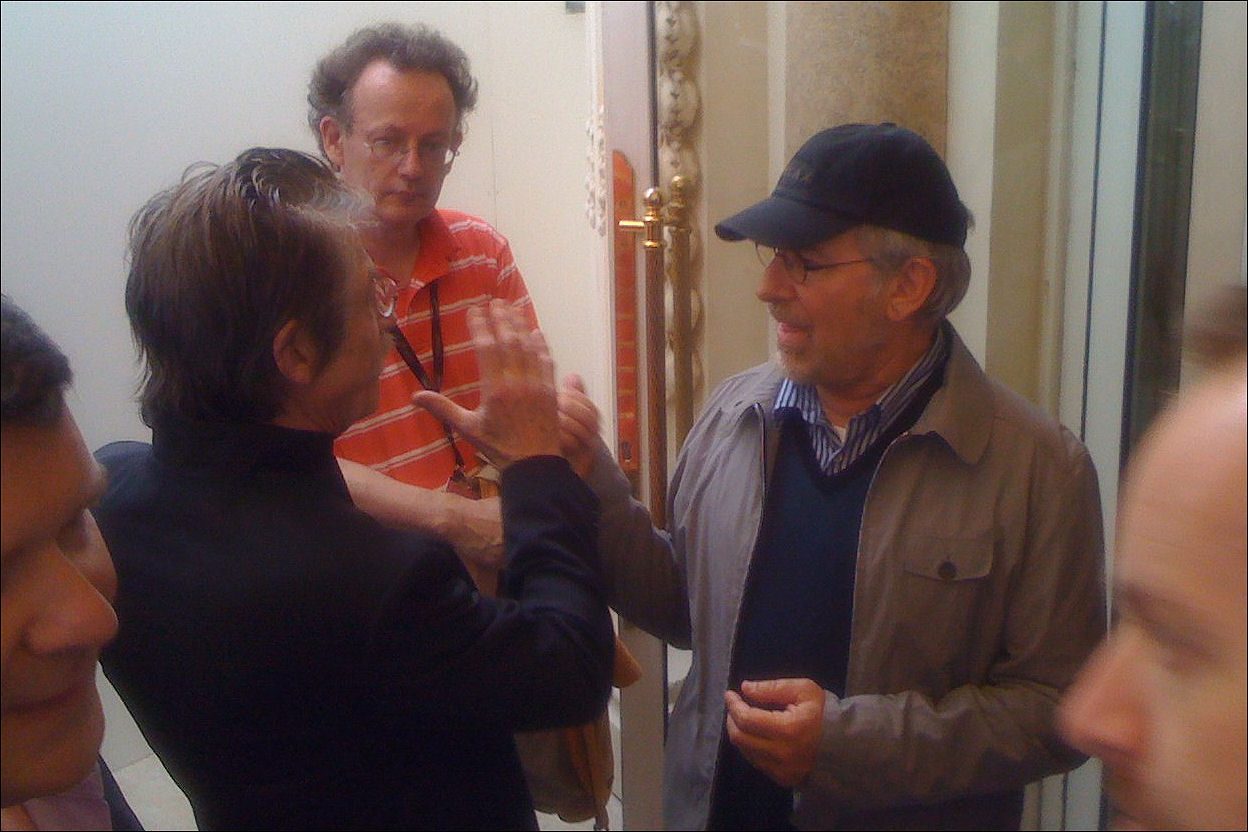
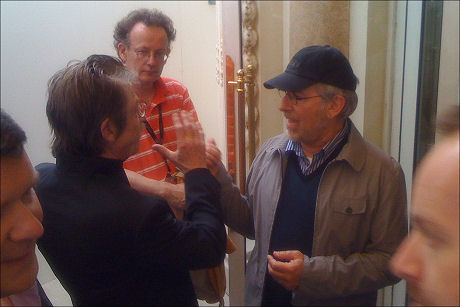
I didn’t even try to talk to Steven Spielberg, who was wearing a black baseball hat and dressed like some semi-retired suburban guy driving down to the hardware store for some weed killer. He was there for maybe 25 minutes, if that. I also spoke to Indy 4 costars Shia LeBeouf (guarded, formal), John Hurt, Ray Winstone and Jim Broadbent.
Ford and I talked about director and mutual friend Phillip Noyce, who directed Ford in Patriot Games and Clear and Present Danger, and about Phillip’s recently born daughter, Anthony Minghella‘s tragic death, his excellent appearance (trim, bright eyes, good color..forget that Uncle Festus stuff!), how often he works out (three times weekly), how many stunts he did in the film (“I just did the acting,” he said) and some minor stuff. We’d last spoken at a San Francisco junket for Clear and Present Danger, in ’94.
It was an odd crowd. Nothing but “top journalists,” as one Paramount publicist said, but some of them looked…I don’t know, a little weird. Like cattle buyers or Israeli used-car salesmen. They didn’t have the right uptown, dark-suited vibe. Bad clothes, funny hair. Not to judge a book by its cover.
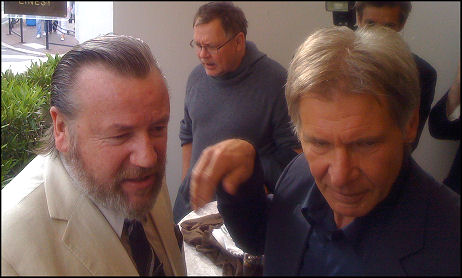
I saw Ford give Fox 411‘s Roger Friedman one of those “jeez, man…I don’t know” looks when they started talking. Friedman has seemingly asked something unusual or challenging, something that required a little heavy consideration.
I told LeBeouf he looked great also, adding — this was a minor mistake — that the program obviously agreed with him. “The program?,” he asked. “Yeah,” I said. “AA….no? I read you’d gone into the program after the Chicago Walmart bust.” “Nope…no program..just livin’ my life,” he replied, registering zero emotion, cool as a cucumber. The guy looks rail thin — thinner that the way he looks in Indy 4, thinner than Transformers, etc.
I spoke to Hurt about his portrayal of Warren Christopher in Recount and the hullaballoo that had broken out about the accuracy or fairness of depicting the former Secretary of State as a wimp, which the film certainly does. He said the research was up to the filmmakers, but that he knew they had based the screenplay on first-rate source material. He also said that Recount screenwriter Danny Strong is smart as whip and a mine of information.
Unfair Practices
Collider‘s Steve Weintraub is, it seems, justifiably fumed over the continuing refusal of Variety and the Hollywood Reporter to credit online entertainment sites when one of the latter has broken a story.
Example #1: On 5.24.07, Weintraub posted a scoop about Ted Elliott and Terry Rossio agreeing to write an upcoming Lone Ranger movie. Ten months later — on 3.27.08 — the Hollywood Reporter’s Borys Kit and Carl DiOrio wrote a story which pretty much repeated Weintraub’s story.
Example #2: Two days ago (5.14), Weintraub says, Latino Review posted a story that broke the news of Jason Reitman’s Up In The Air project. At 9 pm the same day, Variety‘s Michael Fleming and Tatiana Siegel posted the same story with no mention of Latino Review. (Unfortunately, Latino Review didn’t post an exact time when its story went up.)
Mild Passe
Walter Salles‘ Linha de Passe “is very subdued and intimate,” says a buyer who caught it this morning. (Unlke myself.) “Closer to Central Station then Motorcycle Diaries, it’s the tale of four brothers and their pregnant single-mother in the poor neighborhoods of Sao Paulo, with each family member dealing with some sort of problem throughout the film.
“It lacks a bit of direction and focus here and there. My favorite brother has to be the soccer prodigy who desperately tries to make it into a semi-professional team. There’s also an interesting cynical look between the evangelical faith — one of the brothers in a born-againer — and how this is losing its hold amid the surrounding madness that is overtaking the world.
“My bet is someone like IFC, Roadside Attractions or even Sony Pictures Classics could give it a small stateside release. Now, let’s hope Walter decides to finally make On The Road.”
Good Guy Woody
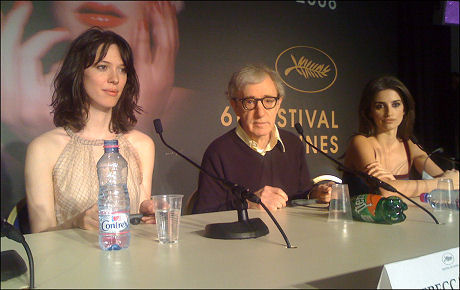
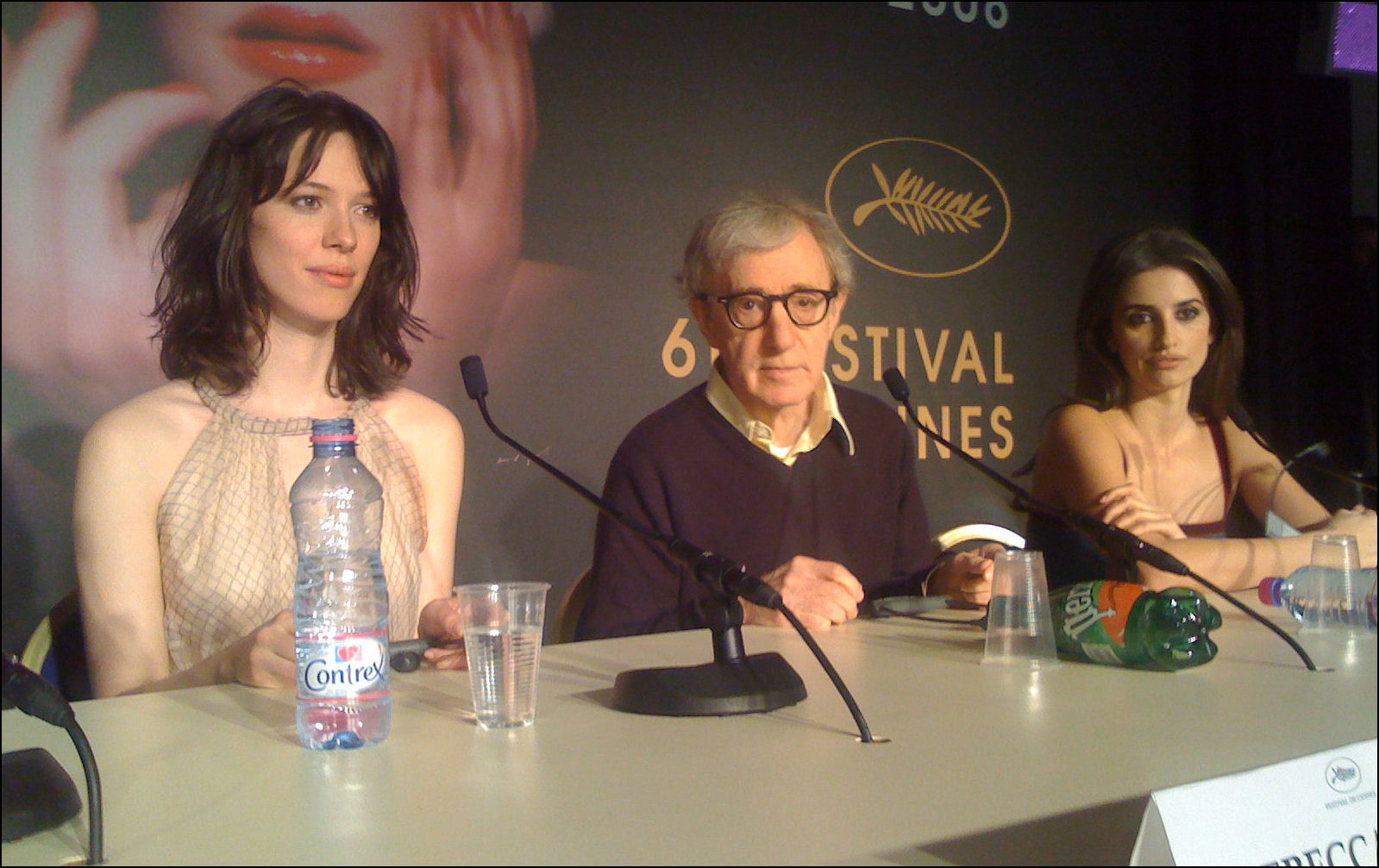
At the just-concluded (and all too brief) press conference for Vicky Cristina Barcelona: (l. to r.) Rebecca Hall, Woody Allen, Penelope Cruz — Saturday, 5.17.06, 2:38 pm
Indifference
“For all the warnings of history, the makers of Indiana Jones and the Kingdom of the Crystal Skull will stage their film’s world premiere at the festival on the French Riviera tomorrow night,” writes Times Online correspondent Dalya Alberge. “The film, which opens in the setting of 1957 at the height of the Cold War, is arguably the most anticipated movie release of 2008. Such is the interest that the trailer was seen more than 200 million times in its first week of release on the internet.
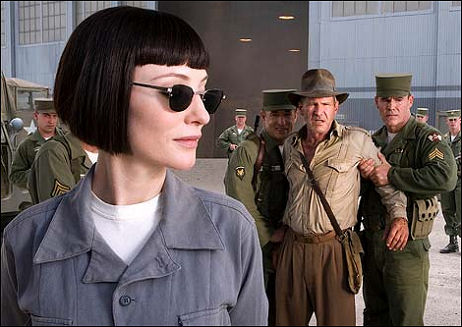
{[But] the last time a studio dared to premiere a major blockbuster in this sanctum of high-brow cinema, it was savaged. The actors and director of The Da Vinci Code barely escaped with their lives.”
Except The DaVinci Code made lots of money after that. The ’06 Cannes beat-down was embarassing, sure, but the general public didn’t care. Hundreds and hundreds of millions were spent on DaVinci Code admissions. And nobody in ticket-buying land will give a damn if Cannes critics whack Indy 4. At all. Obviously Paramount marketers know this, and that’s why they’re here. The Cannes spotlight will boost the film’s European, Eastern European, Russian, Asian, African and South American earnings. And that’s what matters.
Stern Response
Bust ’em, sic ’em….slap ’em down.
Checklist
I’ll be attending press conferences for Woody Allen‘s Vicky Cristina Barcelona at 2:30 pm and James Toback‘s Tyson at 4 pm. I’m trying to bang out a Tyson piece as we speak. There’s an Indiana Jones party starting at 5:30 pm (I saw George Lucas the other night at the Kung Fu Panda party.) There’s a party being thrown by the Turkish ministry starting at 9 pm — presumably an opportunity to speak with Three Monkeys director Nuri Bilge Ceylan. I was told last week I might get into the Vanity Fair party at the Hotel du Cap, but that’s starting to look dicey.
There’s also Pablo Larrain‘s Tony Manero, which is having a Director’s Fortnight showing at 10 pm this evening. I missed the 8:30 am screening of Walter Salles‘ Linha de Passe. I don’t have to make journalistic history every day. I can just attend a few things and shufle around and write what I write when I get to it.
Sad Suitcase
Four days since I’ve arrived — today begins my fifth day without a change of fresh clothes — and Air France is still hanging onto my little black suitcase. It was driven from Paris to Nice on a truck late Wednesday night, I was told, but the driver hasn’t shown up and Air France is having trouble locating him. The bag sure as shit hasn’t been dropped off at the Majestic — I know that much.
Maybe the driver stopped for a couple of drinks and he needed time to sleep it off. Maybe he met a hot lady at a truck stop. Maybe he’s seriously distraught over a recent divorce or financial loss and decided to drive the truck off a cliff.
The upside is that Air France has an alleged policy about compensating passengers who’ve been without their luggage for over 48 hours. We’ll see how that one goes. I wonder if they’ll just say “okay,” or will I have to go into the whole song and dance about how they’ve screwed me financially, cost me time and extra money (I bought a pair of pants) and so on?
Waker-Uppers
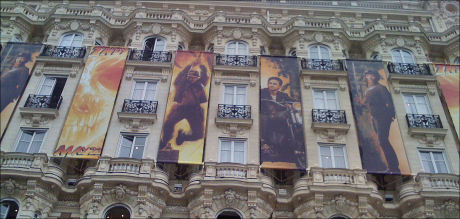
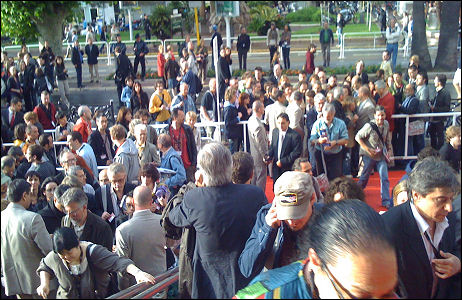
Journalists scrambling up steps of Salle Debussy to get into last night’s Vicky Cristina Barcelona screening.
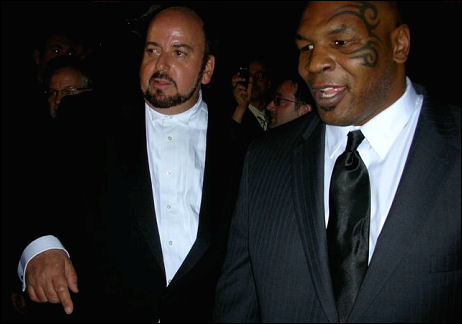
Tyson director James Toback, Mike Tyson. (Since goons kept me out of last night’s Tyson party where I could have taken my own shots, I copied this from Anne Thompson’s Variety blog.)