…but if you over–splooge without restraint, readers will naturally pull back. I’m a sincere, serious fan of American Fiction but not to this extent.
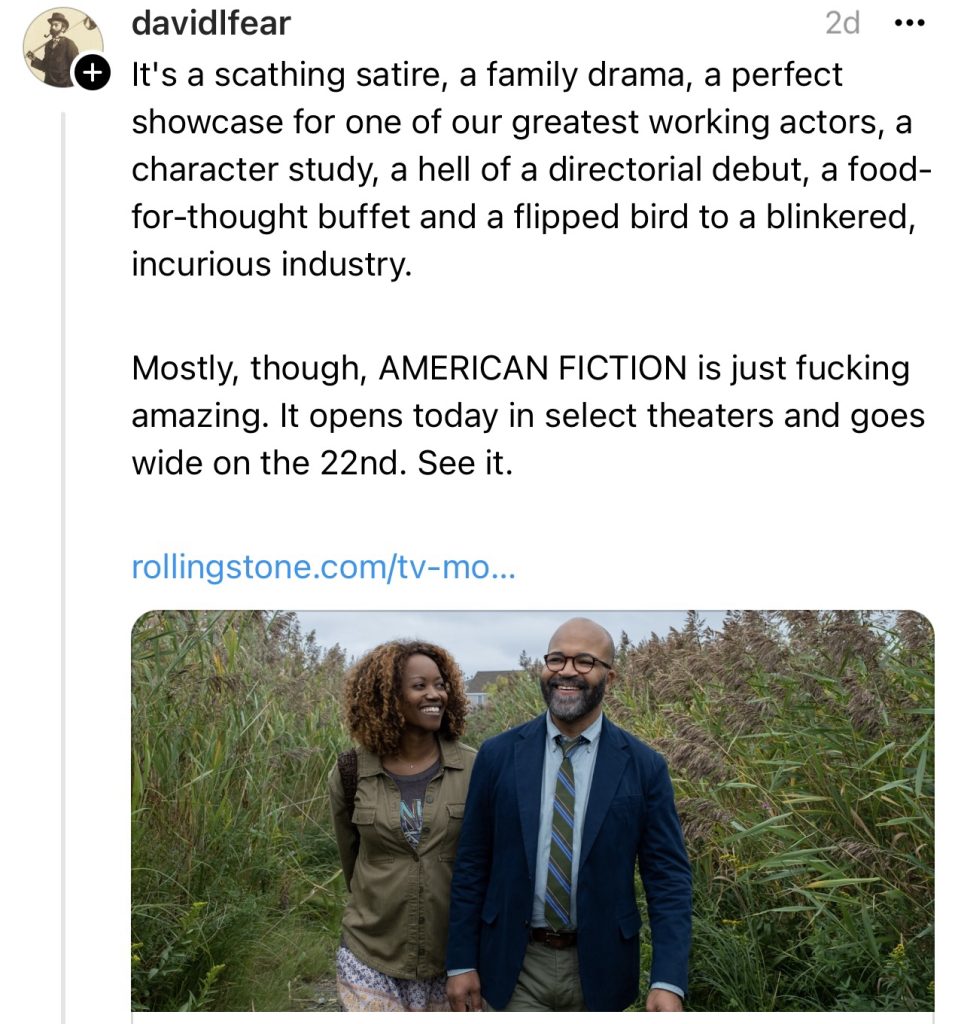


…but if you over–splooge without restraint, readers will naturally pull back. I’m a sincere, serious fan of American Fiction but not to this extent.
As the son of the real-life William W. Wonka, my opinion on the film is all that matters, and I do declare that WONKA stunk. It’s the Butterfinger of blockbusters. Put that in your pockolate! I prefer my chocolate DARK, thanks… pic.twitter.com/s1mExqaJSP
— Jeff Sneider (@TheInSneider) December 16, 2023
Oscar Poker had been moribund for two weekends, sidelined by tech issues and whatnot. Obviously time to record again, and so Jeff and Sasha went to town on a rainy Sunday afternoon. And here it is.
Points hit:
How the Oscars lost their brand.
All hail Adam Carolla’s spot-on analysis about sports vs. award season and politics.
Leave the World Behind – a Netflix movie exec produced by the Obamas, and whether or not that’s creatively upfront of agenda-driven.
Having freedom of mind as opposed to being “in the bubble.”
Complimenting Jeff for not being an Oscar whore.
Jeff’s ongoing annoyances with Lily Gladstone and Barry Keoghan.
The Best Picture standouts, according to Jeff — Poor Things, Maestro, The Holdovers
The Boys in the Boat is an “old-fashioned” but very well-made and deeply likable film.
How Barbenheimer signified the return of “traditionalism”.
The 4K Titanic Bluray is great.
Was Joan Baez molested by her dad? What is she trying to say?
Therapy is ruining everything.
How erasing boundaries led to helicotper parenting in the 90s, which led to “safetyism.”
Why is Todd Haynes’ May December so popular with woke-bubble critics?
Again, the link.
HE has posted a stinging retort to the nagging pestilence known as “Seasonal Aflac Disord” after he ignorantly stated that George Clooney’s The Boys in the Boat (MGM/Amazon, 12.25) was, in a manner of speaking, superfluous to the cultural conversation.
This was a coded way of saying this 1930s Olympic sports saga is of no interest to under-40s because it doesn’t reflect our 2023 reality, in part due to the non-diverse cast.
HE to SAD: It’s NOT a “snoozefest”, you woke ayehole. It’s engrossing, nicely paced, attractively shot, well-performed by an engaging cast, etc. And it’s set in 1935 and ‘36, not “WWII.”
Repeating: Certain critics on your side of the cultural divide are apparently dismissing The Boys in the Boat for racial reasons — i.e., the cast being entirely white.
They’re not saying this in so many words, of course, but it’s a very safe assumption, trust me.
This is no different than certain critics hypothetically dismissing, say, The Color Purple or Ma Rainey’s Black Bottom over ethnic identity signage.
Racism is racism.
The Boys in the Boat feels familiar and conventional, yes, but it’s very nicely done in every category and is emotionally affecting. It’s Clooney’s best directed film since Good Night and Good Luck.

Back in the mid ’90s I’d have written about that infamous VHS tape showing how The Naked Gun movies copied jokes and sight gags from Get Smart, Sledgehammer and other comedy movies and TV shows.
The VHS video in question (originally mentioned in Spy magazine in July 1993) has been digitally remastered and updated. It now includes David Zucker’s contention he’s only been influenced by his own work. I’m not saying that Zucker is basically a comedy kleptomaniac (I wouldn’t know), but there are those who feel this way.

How odd that Snoopy has suddenly become a thing on two fronts — not just retail shelves but also in Bradley Cooper‘s Maestro or more particularly in that already famous argument scene that happens around the three-quarters mark.

From “Why is Snoopy so popular with Gen Z?,” posted on 12.15.23 by Morning Edition‘s Leila Fadel and Steve Inskeep:
“One of the hottest toys this holiday season has little chance of making it into the hands of children. That’s because people in their 20s, people who are adulting, are grabbing up a toy known as Puffer Snoopy.
“Puff Snoopy Dog is a upmarket version of the cartoon beagle from Peanuts. He wears a puffy pale-blue jacket and a green-and-yellow ski cap.
“Snoopy was selling for $13.99 at CVS until stores sold out. People from Generation Z, we’re told, are posting on TikTok about their frantic searches.”

Hands down, no question…I hated John Wick, Chapter Four so much I began dreaming about strong opiates running through my blood…what a relief that would be, I mean.

TheWrap‘s Steve Pond is reporting that 64 voters for the Golden Penske Awards “are threatening to withhold their final ballots after being told that they will not be given tickets to the Globes ceremony in January.”
HE to readership: Do you care if 64 members of the Hollywood Foreign Press Association don’t get to sit in the ballroom as the show unfolds? I certainly don’t.
Pond is reporting that “a block of 64 members are expected not to vote as a protest in the final round of balloting. The Golden Globes currently have 300 voters, so the boycott would affect a little more than 20% of the voters.”
What’s that time-honored expression? Fuck ’em if they can’t take a joke.


Something vital would be missing. McCartney’s hair has never thinned out, no bald spots, etc. Imagine if his hair was as sparse as Bob Mortimer‘s….it would be awful.
Pay zero attention to the Rotten Tomatoes and Metacritic pissheads who’ve given George Clooney‘s The Boys in the Boat (MGM/Amazon, 12.25) failing grades. They’re wrong and mean.
I saw it a couple of weeks ago and it’s fine. It’s a familiar underdogs-take-on-the-powerful-guys sports saga…certainly not the most ambitious film of the year but it’s been assembled with clarity and confidence…it’s clean and unfettered and on-track, and there’s nothing inherently wrong with this kind of film.
I realized about halfway through The Boys in the Boat is Clooney’s best film — the least troubled or problematic, I mean — since Good Night and Good Luck (’05).
I had problems with Confessions of a Dangerous Mind, Leatherheads, The Ides of March, The Monuments Men, Suburbicon, The Midnight Sky and The Tender Bar. Given this 18-year history I wasn’t expecting much from The Boys in the Boat, God knows. But it surprised me. It’s really quite decent. There’s nothing really wrong with it. I’m speaking serious truth here.

Friendo: “The Boys in the Boat is the very definition of competence and likability.
“The reason for the low score is obvious. It’s allegedly a bad movie because it’s about WASP white men, and only WASP white men. Robert Daniels, the racist black critic, dissed it for that.
“And that (implicitly) is what everyone else is doing. It’s the woke militia saying: Enough movies of this sort!”
“When Seattle ‘Boys’ beat Aryan Krauts,” posted on 10.4.23:
George Clooney speaking in Boys in the Boat featurette: “These guys at the University of Washington are taking on the seniors, and then taking on the fraternity [something], and then taking on the Nazis.”
Clooney is using the usual shorthand, of course, but does he really mean that the young athletes who belonged to Germany’s 1936 Olympic rowing team were devout “seig heil” guys? Yes, Adolf Hitler saw the Berlin ’36 Olympics as a a potential proof of Aryan supremacy (Jesse Owens screwed that pooch), but how many German citizens were ardent supporters of the Nazi party that year, and how many were playing along to get along? A third or less?
How many blue-state liberals today pretend to be wokester sympathizers but are just keeping their heads down in order to stay out of trouble?
Let’s imagine, God forbid, that The Beast might win the ’24 election. He would therefore be president during the 2028 Olympics in Los Angeles. Would it then be fair or accurate to describe the U.S. Olympic team as “the MAGAS”?
On top of which I don’t like his bee-stung nose…I never have.