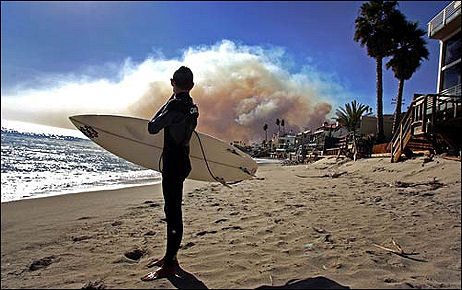
This Richard Hartog/L.A. Times photo of the Malibu fire, taken yesterday, is my favorite so far. This Al Seib image has something also.

The Guardian‘s Peter Bradshaw is absolutely correct in his interpretation of this Lion King clip. The lioness Nala “is settling back in a very languorous and inviting manner” as she looks up at Simba, “and then we cut to a close-up on Nala’s face, and that…minxy facial expression of a Disney character who clearly and explicitly wants something that I can’t remember a Disney character wanting before or since: vigorous and protracted penetrative sex.” This is apparently the only animated sex scene in the 80-year history of Disney studios.
For the second time in two days, Hollywood Elsewhere is raising a glass and offering a hearty pat on the back to Ryan Gosling — first for delivering a supple and layered-enough performance in Lars and the Real Girl to persuade Huffington Post guy Nick Antosca that Gosling’s Lars may be a serial killer in sheep’s clothing, and secondly for exiting the set of Peter Jackson‘s The Lovely Bones one day before the start of principal photography over “creative differences.”
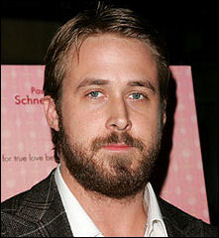
The story obviously won’t be complete until somebody divulges the particulars, but anyone who tells the notoriously unrestrained and full-of-himself Jackson to go fly a kite gets a thumbs-up from this corner on general principle.
Mark Wahlberg has replaced Gosling; shooting starts today in Pennsylvania.
Slate‘s Kim Masters is reporting that the Gosling walk-off “may lead to litigation, though it’s still unclear what the fight was about.” She also speculates that the incident may be “worrisome” for Gosling, what with ticking off Jackson and DreamWorks honcho Steven Spielberg simultaneously. Ryan, you have earned the loyalty and respect of untold multitudes by telling Jackson where to shove it, including, I’m sure, many people in the industry. Good fellow!
In the view of Huffington Post contributor Nick Antosca, Lars and the Real Girl is “the newest entry in a small subgenre of recent movies: the Endearing Potential Serial Killer Comedy.
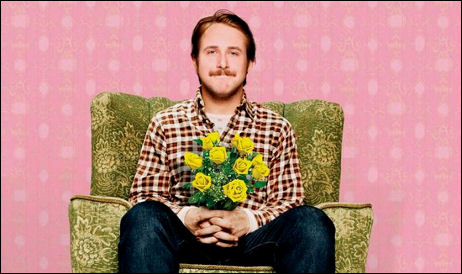
“The only other entry in this subgenre is The 40 Year Old Virgin. I laughed about one and a half times when I watched [that film]… the jokes seemed lame and forced and the writing was amateurish, but the big problem was that Steve Carell‘s character just seemed so fucking creepy. That weird, strained stare…that rabbity way of speaking… those little dolls all over his room. I had the distinct feeling that if he got pushed just far enough, he’d snap and put someone in a crawlspace.
Same with Ryan Gosling‘s moustachioed, vaguely greasy lead character in Lars and the Real Girl. “So Lars is so uncomfortable with human contact that he buys a life-size sex doll made of silicon and weighing as much as a real human to be his girlfriend? Okay. And he brings it to dinner and props it up at the table and calmly talks to it as if it’s talking back, to the alarm of the other dinner guests? Okay. And everyone in the small town decides to pretend that the doll is a real person, because they love Lars so much and humoring his delusion is therapeutic?
“The movie treats Lars if he’s just a little shy, but the hilarious thing is that he’s clearly insane and dangerous. If you’re unhinged enough to believe that a mannequin is actually a human, then you’re probably unhinged enough to convince yourself that a human is actually a mannequin. And then what would be the problem with, say, chopping its head off?
Lars is “the more extreme version of the suspension-of-disbelief problem, already written about pretty much everywhere, that plagues a lot of recent comedies,” Antosca writes. “Catherine Keener and Carell in The 40 Year Old Virgin? Dimly plausible…but a stretch. Seth Rogen and Katherine Heigl in Knocked Up? Good movie, but no way. Emma Stone and the obese, sociopathic Jonah Hill character in Superbad? Never.
“Judd Apatow…please, no more.”
A voice is telling me Antosca is onto something here. Could this be the beginning of the “Make Lars into a Serial Killer” online movement? Look at that face…look at that moustache. The guy’s a sick deranged fiend. Satan in a flannel shirt! Give him an axe and set him loose upon the town.
If anyone wants to Photoshop any horror film posters with Ryan Gosling front and center, I guarantee I will post them with full credit acknowledgement.
Speaking of ’60s zeitgeist-reflecting movies, here’s the single best moment in one of the most famous and justifiably admired of all the British- produced films of that decade.
Variety‘s Joe Leydon is calling Peter Hedges‘ Dan in Real Life, which had a nationwide sneak preview last night, “gracefully understated and thoroughly engaging…a pleasant surprise.”
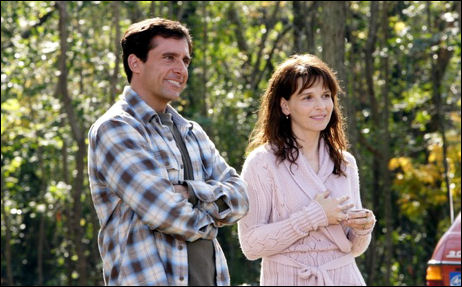
With Steve Carell and Juliette Binoche playing 40ish types who who fall inconveniently in love, pic “deftly interlaces heart and humor in a witty, warm and well-observed comedy about the unexpected and inconvenient blooming of romance at the weekend gathering of an extended family.
The film “more than fulfills the promise evidenced in Hedges’ Pieces of April. From a B.O. perspective, his follow-up has the potential to delight a demographically diverse audience, and generate enough favorable word of mouth to register as one of the fall’s true sleepers.
“It’s intended as high praise to note that, in sharp contrast to most other recent American-made laffers, there’s a decidedly European air to Hedges’ effort. Indeed, it’s not at all difficult to imagine, say, Daniel Auteuil in the lead role winningly played here by Carell.”
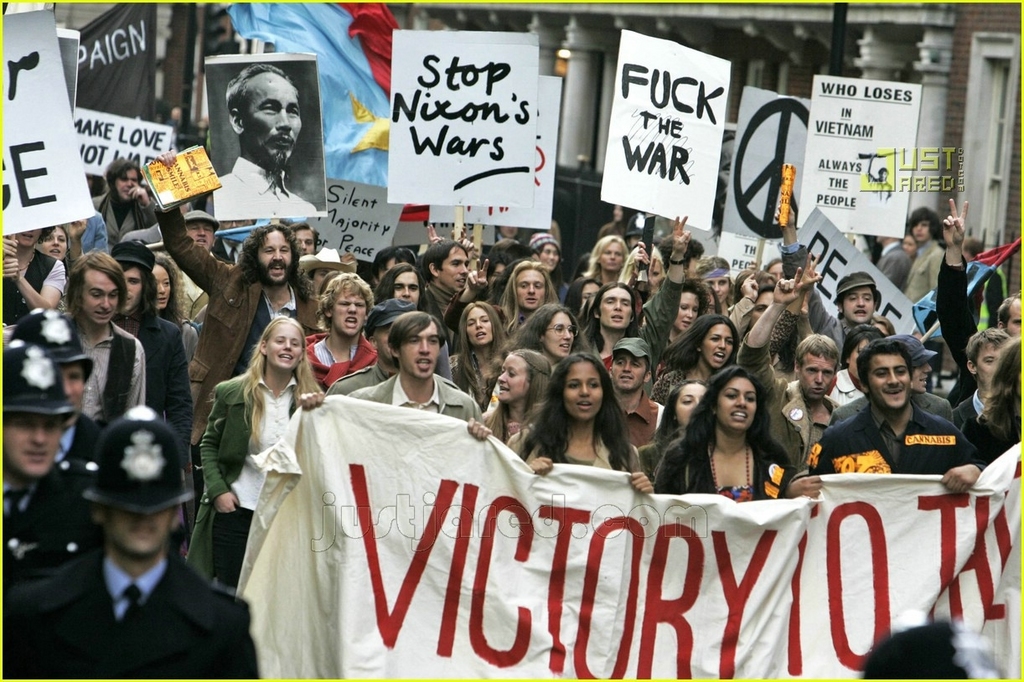
Last month British director Beeban Kidron (Bridget Jones: The Edge of Reason) began shooting Hippie Hippie Shake, about the adventures of Richard Neville, the publisher/editor of a famed counter-culture magazine called Oz that caught the airy-fairy mood and merriment of late ’60s London. (It actually published from ’67 to ’73.) Universal will probably open it sometime in the fall of ’08.
Written by Lee Hall and William Nicholson and based on Neville’s same-titled 1996 memoir, the film will focus on (a) the magazine’s general ups and downs, (b) an obscenity trail that resulted from Neville (Cillian Murphy) and colleagues distributing a certain sexually explicit issue, and (c) the relationship between Neville and girlfriend Louise Ferrier (Sienna Murphy).
I’d love to see this Tim Bevan-Eric Fellner production do it right, but haven’t hippie films always been a problem? Isn’t there some kind of curse upon any film trying to reenact or reconstitute that old love beads-slash-Bhagavad Gita-slash- Moody Blues vibe? Isn’t there something immensely difficult if not impossible in trying to make that incense-and-peppermints chemistry seem palatable by the standards of 21st Century culture?
Julie Taymor‘s Across the Universe, Robert Zemeckis‘ Forrest Gump, Oliver Stone‘s The Doors…what other films over the last 15 or 20 years have gone back there? Has any ’60s-era film felt half as authentic as Control does in its recreation of early to late ’70s England?
The potential for hippie-film awfulness is huge. I guess I’m thinking of stinkers like Ernest Thompson‘s 1969 and Rob Cohen‘s A Small Circle fo Friends, and Larry Kasdan‘s decision to chop off the flashback sequence in The Big Chill because (according to legend) everyone looked vaguely silly in their hippie haircuts and tie-dyed T-shirts.

The most in-the-pocket depiction of ’60s vibes and attitudes came from five films — Blow Up, Easy Rider, M.A.S.H. (set in early 1952 Korea but totally informed by Los Angeles hipster attitudes of 15 years hence), Who’ll Stop The Rain? and Platoon.
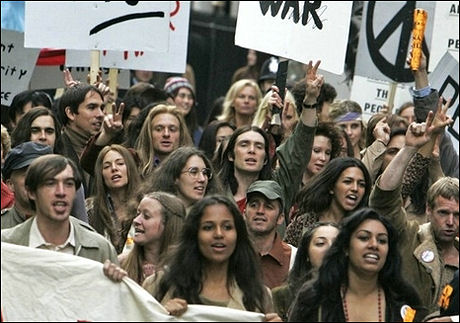
Note: In the above protest-march photo, three darker-skinned women of an apparent Middle Eastern heritage are visible. This in itself makes Kidron’s film seem slightly inauthentic. People of Middle Eastern ancestry (Indian, Pakistani, Iranian) are quite numerous in greater London today, but their numbers were smaller in the late ’60s plus the strictness of their family and neighborhood culture has always discouraged outside fraternization and cross-fertilization, particularly with those of an anti-traditional counter-culture bent, and particularly among women.
“Most directors do not go on to make one of their best films after receiving their lifetime achievement Oscars,” Dennis Lim‘s 10.21 N.Y. Times piece begins. “But then, most directors do not have the near-legendary stamina and efficiency of Sidney Lumet, who accepted his honorary Academy Award two years ago, turned 83 in June and now has made 44 features in 50 years. His latest, a bracingly bleak crime melodrama called Before the Devil Knows You’re Dead (opening Friday in NY and LA), has been upstaging filmmakers less than half his age on the festival circuit this fall.”
Time‘s Lev Grossman orchestrated and presumably edited a q & a discussion between Cormac McCarthy, author of the novel of No Country for Old Men, and director-writers Joel and Ethan Coen, who made the immaculate film version, but he wasn’t allowed to participate verbally. Because McCarthy is extremely press shy, Grossman had to sit on the couch and just listen.
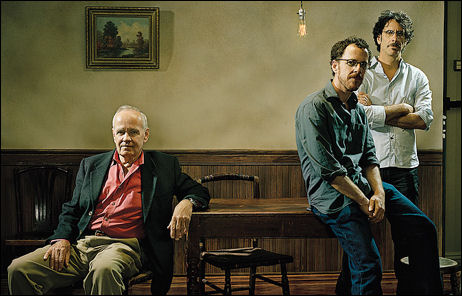
What resulted is an okay thing, but it might have been better with a pushy journalist asking intrusive questions from time to time. An extra pair of editor eyes would have helped as far as the photo caption is concerned. On Sunday afternoon, it identified the filmmakers as Joel and Ethan “Cohen.”
In the same issue, Richard Corliss reviews the 11.9 Miramax release and says “it’s a shame” it doesn’t open until after Halloween “since it has a villain crazier, scarier and more implacable than any horror ghoul.
“As incarnated by the great Javier Bardem, Anton Chigurh is a killer from hell who likes to play mind games with his victims before he makes them play dead. How could an ordinary fellow like Llewelyn Moss (Josh Brolin) hope to elude this monster, when Moss has $2 million that Chigurh plans to get back without saying please?
“Even when Joel and Ethan Coen are writing originals, their movies often have the texture and density of novels. For their first official adaptation from a prime American author, they have stayed remarkably faithful to the Cormac McCarthy story, including a detour at the end that will baffle some viewers.
“But the rest is tough, tangy and thrilling — perfect scenes of rising tension, wily escapes, fatal face-offs. There’s one moment (it’s just a phone ringing downstairs) that will churn your blood and turn it cold, and plenty other frissons that could make this the biggest hit of the Coens’ sly career.”
I respectfully disagree with Todd McCarthy‘s half-positive, half-dismissive Variety review of Ridley Scott‘s American Gangster, and his view in particular that “maximizing a gritty big-city story requires a credibility composed of thousands of small details, and this is one area where a citizen-of-the-world director like Scott can’t excel.”
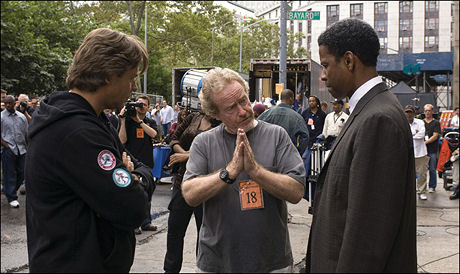
The situation, he says, is “akin to asking [Sidney] Lumet or [Martin] Scorsese to make a definitive film about crime in ’70s Newcastle — they could do a respectable, even exciting job of it, but it probably wouldn’t ring deeply true.”
But it does ring true. For me, anyway. Brits are famous for delivering American-set crime dramas with great chops and authenticity (as Karel Reisz managed with Who’ll Stop the Rain and John Boorman did with Point Blank), and this is one of those cases. I believed every New York second of American Gangster. For my money, Scott has not only skillfully channelled Lumet and Scorsese but the entire hallowed universe of ’70s urban filmmaking.
“American Gangster wants to be a great epic crime saga so badly you can feel it,” McCarthy says. “The true story at its core — of the rise, fall and redemption of a ’70s-era Harlem drug lord — is so terrific, it’s amazing it wasn’t put onscreen long ago, and it would be difficult today to find two better actors to pit against one another, as hoodlum and cop, respectively, than Denzel Washington and Russell Crowe.
“With so many elements going for it, this big, fat Universal release is absorbing, exciting at times and undeniably entertaining, and is poised to be a major commercial hit. But great it’s not.
“Memories of numerous classics hang over this film like banners commemorating past championship teams — The Godfather, Serpico, Prince of the City,, Scarface and Goodfellas, among other modern-era crime-pic landmarks. Like most of those, this is a quintessential New York story, one you feel could have been the basis for a Sidney Lumet masterpiece.
“But while American Gangster is made with consummate professionalism on every level, it just doesn’t quite feel like the real deal; it delivers, but doesn’t soar.”
Jerry Seinfeld‘s Bee Movie opens a week from Friday (11.2) and nobody’s seen or said a thing about it. Except for what was said and shown at the big Cannes Film Festival promotion five and a half months ago. The first screenings aren’t happening until Tuesday, 10.30 and Wednesday, 10.31. The only thing to go on today is a softball Seinfeld profile by N.Y. Times guy David Itzkoff.
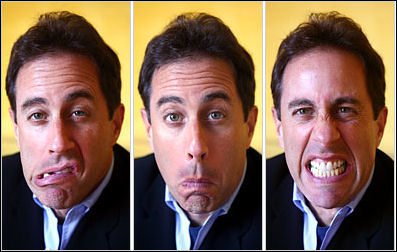
The best part of the piece explains how Seinfeld “can be affable with fans, but he doesn’t hide a certain earned arrogance. When one stunned onlooker [at a restaurant] asked for his autograph, Seinfeld said, ‘Sure’…then kept walking straight to his table.”
“While attending the United States Open tennis tournament, Seinfeld recalled, he was approached by a well-attired fan who handed him a business card and invited Seinfeld to visit his brokerage house. Both men became noticeably perplexed when the offer was declined. ‘I said, we don’t know each other. You’re a total stranger,’ Seinfeld recounted. ‘He says, but we really like you. I said, thank you so much, but this is as far as we go.'”
“Seinfeld adds: ‘This is a sophisticated guy that doesn’t understand the TV only works one way.'”
Bee Movie is about Barry B. Benson (Seinfeld), a bee who’s not happy with the idea of just making honey for the rest of his life. One day he gets to leave the hive on a honeysuckle mission in Manhattan’s Central Park, and eventually runs into humans who try to swat him to death.
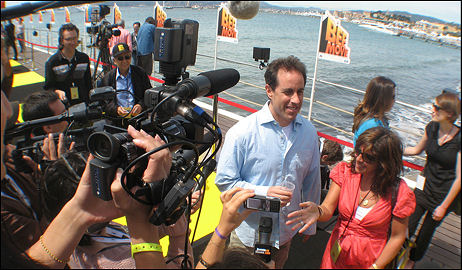
Barry is nearly all in at one point when he’s saved by Vanessa (Renee Zellweger), with whom he promptly falls in love. (Kind of a King Kong-Ann Darrell romance in reverse.) Then he decides to talk to her. In English, that is. Then he learns about the human honey business, and decides that humans are ripping off the bees in order to do so, and so files a lawsuit to try and prevent this.
As I wrote last May, “I like ‘silly’ if the movie really goes for it whole-hog.”
I stood below the Sunset 5 marquee yesterday evening just before 9 pm, trying to talk myself into seeing Lars and the Real Girl. And once again, for the seventh or eighth time, I said “naaah, later.” A movie journalist repeatedly missing showings of a respected, well-reviewed film like Lars is obviously derelict, but the truth is that I’ve been avoiding it because of my Ryan Gosling problem, which is hard to describe.
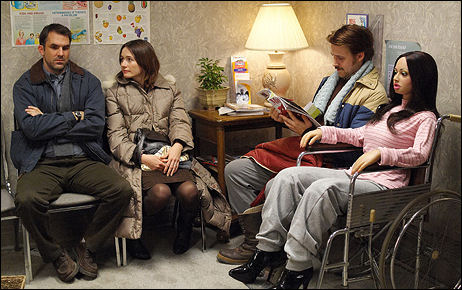
I agree that he’s one of our very best actors of any age — some have called him the new Brando — and yet there’s something about Gosling’s look and manner that has always seemed a bit odd in a visitor-from-another-planet sort of way. To me, he’s always seemed distant and self-regarding. There’s no doubting that every performance he gives is some kind of brilliant, but in my delusional-fan way of absorbing things I’ve never wanted to hang out with the guy. It’s not that I find him dislikable as much as lacking a certain chemical component that I would want in my life.
This is compounded by Gosling having put on weight, grown a blue-collar mous- tache and worn flannel shirts — three style choices I have always had major problems with — for his part in Lars and the Real Girl. It’s obviously a neurotic affliction, but I can’t stand to look at, much less wear, flannel shirts. Strange as this sounds, if I see some some dumpy guy in a bar wearing a flannel shirt I will either go to the other side of the room or leave altogether. Especially if he’s wearing a moustache.
These reactions are aggravated when the wearer is also going with the whole unshaven, slightly greasy-looking rural or suburban working-guy fashion trip, lace-up work boots and all. I know about that mode of appearance — I’ve known dozens of guys who look and dress and live like this — and I want as little to do with it as possible when I go to movies. That may not sound “fair” but that’s how it is.
Plus the idea of a doofus who carries a love doll around is repellent to me. Why should I invest two hours of my time in a guy whose emotional state is this far off the planet?
I realize that it doesn’t get any shallower than when you process a film according to obvious subject matter. I rail against people refusing to see films because of some gut disinterest in subject matter, and here I am doing this very thing. I have no excuse, no defense. I will somehow make myself see Lars and the Real Girl soon, but I may as well be honest and admit that it’s been a real struggle.
“Don’t feel too badly about missing Lars and the Real Girl,” a big-city critic writes. “I found it frankly disgusting, and I don’t think of myself as a prude or conservative. I wonder about what’s missing in the lives of critics who see this film as some kind of affirmation of life.
“It’s about a grown man having a romantic relationship with a plastic doll. He’s a very sick individual, yet the movie wants us to think he can be cured if everybody just tolerates his quirk until he sorts things out.
“No way would an entire town put up with this nonsense. If this were the real world, Lars would be committed pronto, or run out on a rail before Aunt Bea had time to bake a batch of brownies.”