Tell Me You Love Me

HBO’s Tell Me You Love Me, which isn’t featured at all on the HBO website but is scheduled to air on September 9th, is about the emotional but mostly sexual lives of three middle-class couples. I haven’t received any HBO screeners yet, but it’s being described here and there as a precedent-setter in its depictions of graphic, no-holds-barred sexuality.


Tell Me You Love Me costar Michelle Borth

“No previous series, on pay cable or anywhere else, has dared show anything even close to this much skin,” writes L.A. Times guy Scott Collins. “The climax, if you will, of the first episode finds a woman (Sonya Walger) in her 30s masturbating her husband (Adam Scott) to orgasm, with the entire act and all relevant body parts plainly visible. Even Jane Alexander — yes, that Jane Alexander, the snow-domed, regally poised 67-year-old former chief of the National Endowment for the Arts — drops trousers for some frisky senior sex.”
The Kansas City Star‘s Aaron Barnhart conducted an informal poll of TV junket journalists who’ve seen an advance episode or two, and found “that while eyebrows were raised by the sex scenes involving the younger couples, jaws positively fell open when Alexander got it on with her husband. No ageism on this show!”
Barnhart also reports that “perhaps the actress who will get more attention than any other on this show is Michelle Borth, who plays Jamie, a 20-something whose frequent romps with her fiance, Hugo (Luke Farrell Kirby), are, to borrow the phrase of another HBO program, real sex.”

Obama Girl

As I wrote before, the notoriety of “Obama Girl” Amber Lee Ettinger is mildly troubling because of what that website video she performs in (www.barelypolitical.com) says about the intellectual and spiritual vistas of average 20-something women, which is that they can only get excited about a Presidential candidate (Rudy Giuliani has a few “girls” also) based on their perceptions of sexual power and/or charisma — i.e., the “Daddy factor.”

Imagine if Hilary Clinton looked like Valerie Plame. Can anyone imagine a guy (or guys) performing in a music video that expresses how aroused they are with her, and how much they’d like to do her? C’mon…
It’s a safe assumption that Ettinger isn’t very knowledgable about Sen. Barack Obama‘s political positions or personal philosophies, and that she hasn’t read his book. Barely Political is ultimately about Ettinger trying to hook herself up with everybody and everything and wind up with a divorce, a Porsche SUV and a McMansion. And yet something tells me she’s probably helping the Obama campaign.

lower case, please

One of these decades mainstream print editors are going to give up on their absurdly stubborn insistence on referring to this or that “Web site” or “Internet traffic.” Wired magazine editors put this issue to bed three or four years ago…hello? It’s either “web site” or “website” (i.e., my preference) and “internet” is always lower case. It’s infuriating running across these damn caps in old-line print publications.

More “I’m Not There”

My Toronto sources won’t cough up, but the odds are favoring a Toronto Film Festival unveiling of Todd HaynesI’m Not There, the apparently episodic/impressionistic/multi-stranded Bob Dylan film that has six actors (Cate Blanchett, Christian Bale, Marcus Carl Franklin, Richard Gere, Heath Ledger and Ben Whishaw) playing the legendary poet/singer. It’ll probably show up at the slightly-earlier-breaking Venice Film Festival also, but Weinstein Co. publicists are claiming they don’t know the score with that. (The Venice lineup will be announced on 7.26.)
The U.S. release date, however, is clear: November 21st and not September 21st (which is what the IMDB is wrongly reporting).
A guy identified as Ericwithak is claiming some degree of familiarity with I’m Not There, having written that ” the movie is running way too long, [in part because] the flow from between Dylan’s is strained, at best. I got the impression that its a really great idea that was not fully developed on the page. The idea of multiple Dylan’s could work really well, but in its incarnation, it feels like there’s no reason for it beyond the fact that it’s a cool idea. I found myself often wishing we would spend more time with Blanchett, who is the heart and soul of the movie and gets Dylan better than everybody else.
“Don’t get me wrong — no one in this is outright bad (except maybe Gere), but I just don’t know what the hell they were all doing there. There is a really good movie in there. I do believe that. It just needs a very gifted editor to get it out.”
Take this with a grain of salt, of course. I don’t know Ericwithak, although he’s declined to get in touch. That makes him suspect in terms of his character or at least in terms of his internet vigilance. That said, what he’s written does square with what I was told about the film by a somewhat knowledgable trade guy prior to Cannes.

Chiullan on “Factory Girl” DVD

The unrated Factory Girl DVD (out tomorrow) is “among the best single-disc releases of the year thus far,” writes HE columnist Moises Chiullan, “featuring not only the much more fleshed-out Unrated Cut of the film, but supplemental materials that aren’t just there to fill space like so many other DVDs.”
Chiullan adds, however, that he “really detest[s] the SEXY UNRATED UNCUT marketing design on the cover and spine, but that’s the only qualm I have with the whole thing. I thought the theatrical poster would’ve made a great cover, and having SEXY UNRATED UNCUT on the spine makes it look like it’s glorified softcore porn to a guest who sees it on my shelf.”

Sleepy Meyer profile

“Though profitable for the last nine years, Universal has been noticeably short on blockbusters to call its own,” N.Y. Times reporters Michael Ciepley and Brooks Barnes observe in the 7.16 issue.
“That is largely by design. In a strategy that is starkly different from other top film studios, [studio chief] Ron Meyer has determined that Universal should stay well behind the leaders, allowing the flashiest and most expensive projects — and typically the biggest payoffs — to go elsewhere.
”We gauge ourselves to be in the middle,’ Meyer said. Universal currently ranks last among major studios at the domestic box office and hasn’t placed higher than third in the last seven years.”
How does Meyer’s “stay in the middle” strategy square with the $175 million spent on Uni’s Evan Almighty, which every box-office handicapper considers a flat-out flop in relation to cost? Evan “will lose money for both Universal and its financing partner, Gun Hill II,” Ciepley and Barnes report, “though not a large amount,” says Meyer.
So goes a noteworthy piece about a mild-mannered studio honcho pursuing a prudent, mild-mannered filmmaking policy. Apologies to Ciepley and Barnes, but it nearly put me to sleep. I had to repeatedly stab myself with a push pin in order to stay awake.

Denby on “Hairspray”

“I admire John Travolta, but using this movie star, rather than the [Broadway stage version]’s Harvey Fierstein, as Edna Turnblad, is an idiocy on the same level as replacing Julie Andrews with Audrey Hepburn for the movie version of My Fair Lady, declares New Yorker critic David Denby.


New Yorker illustration by Jonas Bergstrand

“Both Fierstein and Divine, who played Edna in the [1988 John Waters] movie, worked as female impersonators who confidently let us in on the joke. In the show, when Fierstein held forth on life and love and the Gabor sisters in his basso absurdo — a testosterone-drenched Bensonhurst snarl — he was not a man pretending to be a woman; he was a man openly playing a woman and speaking in his own voice.
“But Travolta does a wistful imitation of the female sex. Buried in a full-body fat suit and various silicone prosthetic appliances, he looks rounded, smooth, and cute, rather like Miss Piggy, and he speaks in a light, high female voice — he sounds a little like Robin Williams in Mrs. Doubtfire, without the lilt.
“The role demands exaggeration rather than modesty, yet Travolta, with a misbegotten sense of duty, tries to give an authentic performance as a working-class Baltimore housewife of forty-five years ago — a shy, guarded woman who is embarrassed about her weight. It√ɬ¢√¢‚Äö¬¨√¢‚Äû¬¢s a touching attempt, but the lunatic joke that started with Divine has almost vanished.”

Travolta’s Pickup Lines

The Newark Star Ledger‘s Stephen Witty has written the following about some overworked repartee used by John Travolta:
“Here is the first paragraph from a story by Jesse Green on the front page of the New York Times‘ Arts & Leisure section for Sunday, July 15:
“We had only just met, but John Travolta, big and handsome and hypnotic, was fondling the lapel of my navy blue blazer. ‘Ooh, what a great idea to match this with a cobalt blue shirt,’ he cooed. ‘I wouldn’t have thought of that.'”
Here is the first paragraph from a story I wrote for the Star-Ledger‘s Spotlight section on June 13, 1999:
“John Travolta is on his knees in a Manhattan hotel suite, tentatively touching my shirt. “I just got to tell you I am completely inspired,” he says. ‘This is a different style, the two-toned shirt with this tie and the suit — what is this, navy blue?'” He feels the material. ‘Marvelous. Honestly gorgeous.’
Which proves one thing, I suppose, and one thing only: When it comes to wooing journalists, Johnny T has got to come up with some new pickup lines.”

Blanchett Dylan

Unlike The Envelope‘s Tom O’Neil, who sharply criticized this 7.13 I’m Not There YouTube clip that he linked to earlier today, I don’t have a big problem with Cate Blanchett‘s inhabiting of a 1964-ish Bob Dylan. I find her voicings and mannerisms intriguing, curious…oddly cool.

I also love that it’s been shot in black-and-white, and that David Cross is such a convincing looking Allen Ginsberg.
I was told last May that the reason that Todd Haynes‘ long-awaited film wasn’t submitted to Cannes was that it was long (in the vicinity of three hours) and unwieldly with too many hard-to-place strands. I’m Not There will presumably ge given a berth at the Toronto Film Festival, with the Weinstein Co. apparently intending to open it on 11.21. (The IMDB says 9.21, but that can’t be right.) Many of the early fall prestige films are starting to be shown now, and I’m kind of wondering why I haven’t heard about any I’m Not There screenings.
The other five Dylans are being played by Christian Bale, Marcus Carl Franklin, Richard Gere, Heath Ledger and Ben Whishaw.

Hairspray

There will be no hating on Adam Shankman‘s Hairspray (New Line, 7.20) by me. It’s a spunky early ’60s musical with “fun” performances (i.e., spirited by way of pronounced insincerity), dead-on retro clothes and hair styles, some well choreographed musical numbers and a few laughs here and there. The trick is to watch it without getting bored or suffering a major migraine. I was going through my usual movie-agony spasms (leaning forward, hands covering bottom half of face, quiet groaning, frowning) but I’m a sorehead who doesn’t get musicals, right?


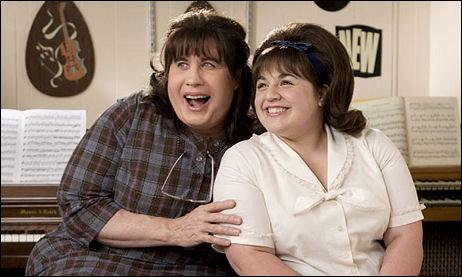
John Travolta, Nikki Blonsky

Hairspray is wafer thin, full of shit, repetitive and broader than a barn door but it won’t give you cancer or indigestion or anything along those lines. Standards are always put aside when a robust musical comes along and says with a wink, “Do you get where we’re coming from? That we’re all about singing, dancing, winking and arched eyebrows within the prism of early ’60s nostalgia and culturally refer- enced air quotes? Of course you do! So relax and enjoy.”
The fact that Hairspray is a mildly amusing one-note crock isn’t bothering the critics so far. (It has a 100% Rotten Tomatoes rating as we speak.) They’re calling it entertaining goodtime fizz because (a) their taste buds are corroded or (b) they know the middle-class mall crowd loves easy-to-get retro jukebox pablum, and they don’t want to risk seeming elitist or clueless. Or both.
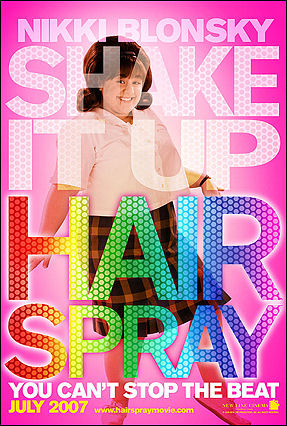
The original 1988 John Waters film of Hairspray (not a musical) was pat and shallow in a mocking-retro sort of way, and the Hairspray B’way musical was the same thing with big-heart songs and dance numbers. Now comes a big-screen musical version that follows the drill with a John Travolta fat-suit performance that’s moderately okay, a spunky lead-girl performance by Nikki Blonsky and a couple of good-sport turns by Michelle Pfeiffer and Christopher Walken so…what’s not to like? It’s fine.

Which it is. As long as you don’t mind totally pissing away the time it takes to watch it. As long as you can roll with the fizz and the bullshit and the gay Tin Pan Alley attitude. When it comes to musicals I’m more into Once or Hair or Cabaret or Carousel. Shows that came from something strong and real in the first place, and aren’t so much into going “wooooh!”
Hairspray is set in a 1962 Baltimore that existed in some ways (the hair styles, clothing, cars and sets are perfect) and never existed in others. Cute bubbly fat girls like Blonsky (the truth is that she’s dangerously obese) never, ever hooked up with slim good-looking guys back then. (It doesn’t happen today either.) People who knew good music were into Little Richard and Jackie Wilson, but interracial socializing was rare and interracial dating wasn’t noticable until the late ’60s. The movie has the surface details down, but too much of the inside stuff is fanciful tripe.
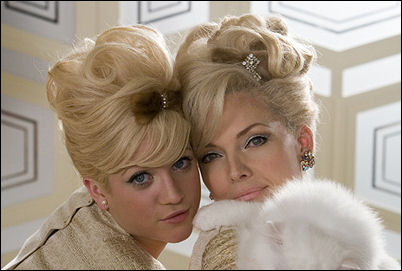
Blonsky plays Tracy Turnblad, a perky high-schooler who dreams about dancing and becoming famous on a local rock-music dance show called the Corny Collins Show. Her mom Edna (Travolta) is more obese as Tracy, and her good-natured dad (Walken) runs a quirky toy and curio store. Tracy has the hots for Link Larkin (Zac Efron) after laying eyes during an audition to replace a Corny Collins dancer. Her relationship with Larkin pisses off the frosty blonde Amber Von Tussle (Brittany Snow) and her frosty blonde mother Velma (Michelle Pfieffer) somewhat, but what really throws them off-balance is Tracy’s notion that the white-bread show should allow black kids to dance also.


Brittany Snow, Michelle Pfeiffer

Blonsky is very good and talented and likable, but she looks like a smiling little beach ball in a cartoon. I realize I’ve got a rep of being Jabbaphobic, but I really and truly don’t have a problem with largeness as a rule. Plump is cool and fat happens, but extreme obesity is an affliction. Am I lying? To me a seriously obese person is like a drunk staggering around with a bottle of Jack Daniels.
Travolta has been telling interviewers that he tried to play Edna as a real woman and not as a guy giving a drag performance. That’s true as far as it goes but it’s mostly smoke because Travolta isn’t the maestro here — Shankman is — and the scheme of the movie blocks any interest in real-people behavior. Edna emotes within the broad-ass emotional framework of a stage musical, but there’s a ceiling with this kind of thing.
The bottom line is that you have to understand, agree with and follow certain rules of engagement in order to enjoy Hairspray. Maybe the reason I couldn’t have fun is that I understand the rules all too well.

Read more

Bush’s apology

“The people trusted me with an important position. I didn’t live up to expectations. If only I had kept my promise to go after the thugs who attacked us on 9/11, because now I’ve made Osama and Al Qaeda stronger. I know my false claim about Al Qaeda’s ties with Iraq led to Iraq’s being tied down by Al Qaeda. I see now that my bungled war on terror has created more terror, empowered Iran and made America less secure. Oh, yeah, and I’m sorry I broke the military.” — an imagined letter of apology from George W. Bush, inspired by a confession written by Beijing’s former FDA-type regulator Zheng Xiaoyu before his execution last Tuesday, and written by N.Y. Times columnist Maureen Dowd.

Cell-phone movies

“If there’s a specter that’s haunting Indiewood and Hollywood alike, it’s the shambling figure of [a] semi-shaved, post-collegiate 22-year-old watching movies on his cellphone,” Salon‘s Andrew O’Hehir wrote a couple of days ago.

Why do people keep bringing this up as the next big shift in viewing habits? Cell-phone moving images are strictly about fast and short and move on to the next distraction. If I’m stuck or locked down somewhere I might be persuaded to watch a news show on a iPhone for 20 or 30 minutes, but sustained viewing of anything on a screen that size makes your eyeballs throb. Seriously — does anyone know any 12 or 14 year-olds who prefer iPhone-sized screens to watch movies on? (As opposed to music videos, YouTube clips, amateur porn, movie trailers, etc.)

There’s a certain coolness that comes with watching movies on iPhones if you’re in the mood to do that, but step back and consider the obvious — the size of an iPhone screen makes watching whole movies on them time and again (week in and week out, a regular viewing habit) fairly ridiculous.

“Now, I don’t know anybody who has actually watched a feature film on a telephone,” O’Hehir goes on, “and I’m not even sure it’s feasible. But three different people in the film industry have mentioned the idea to me within the last week, and the question of its present-tense plausibility is clearly not relevant.

“What people are really saying is that a big, weird change is coming. They don’t quite understand it and they can’t do anything to stop it, but they’re worried that the whole business of selling $10 tickets to go sit in a dark room with some strangers and a movie projector is suddenly going to seem like Thomas Edison‘s windup gramophone and its wax cylinders.”

Obviously the theatrical experience doesn’t rule like it used to. It’s still a preferred option, but “option” is the governing term. Movie-watching can happen anywhere these days, in any kind of environment that allows for semi-darkness or at least shade. I just can’t imagine anyone actually preferring to watch full-length movies on screens that are less than 15″ inches wide. I don’t even like that very much. I’m okay with watching a film every so often on my 17″ Gateway, but not as any kind of habit. I’m not even particularly comfortable with 27″ flat screens. I mean, they’re tolerable but in no way preferred.

My own viewing tastes and preferences from (b) on down probably synch up with those of any movie-lover with a semblance of taste (and I’m including 12 year-olds in this equation): (a) Private screening rooms in Los Angeles or New York or any big-league city, (b) Recently constructed ace-level theatres (Arclight, Landmark, Bridge, Egyptian, Aero, etc.) with stadium seating and all the other high-standard trimmings, (c) high-def 16 x 9 flat panel viewing off Blu-Ray or HD-DVD, (d) my own Sony 36″ flat screen, and (e) my 17″ Gateway laptop.

Cell phone viewings aren’t taken seriously in this corner. They’re not even in the “hey, maybe” category. And forget small-screen TVs. I’ll consider the notion of seeing a film in some schlubby run-of-the-mill theatre like the New Beverly or the Regency Fairfax or the Monica plex on 2nd Street, but only if backed into a corner. On the other hand, the Vista in Silver Lake is pretty cool.