

Baseball Ignoramus Scratching Head
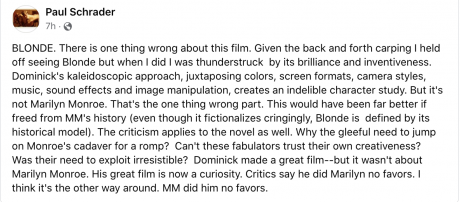
Being something of a clueless baseball “fan” (i.e., having not really followed the sport since I was 10 or 11), I was initially confused by last night’s Washington Post story, written by Chelsea James, about Aaron Judge‘s historic 62nd home run against the Texas Rangers.
In so doing the Paul Bunyan-sized Judge (6’7″, 282 pounds) passed Roger Maris “for the most homers in a single season by an American League player.”
That’s very commendable, I thought, but why didn’t James’ lead paragraph convey two basic, crucial facts? One, Judge’s 62-home-run record was topped six times by three National League players — Barry Bonds, Mark McGwire and Sammy Sosa — during the steroid era (mid ’90s to early aughts). And two, Judge had beaten Maris’s American League record without the aid of steroids. Or, put another way, that he had slammed those 62 in a “clean” way.
In paragraph #3 James gently puts it as follows: “All three played at a time when MLB did not test for performance-enhancing drugs as stringently as it does now.”
And how come the TV cameras — here comes the ignorant, don’t-follow-baseball part — how come the cameras cut away to an older white couple (Patty and Wayne Judge), jubilant and hugging, when it seemed apparent they they weren’t related to the biracial Judge? Oh, I see…the 30 year-old Judge was adopted by the Judges in ’92. Didn’t realize that…sorry.
What a relief when I came upon a story by Sports Illustrated‘s Thomas Neumann, titled “Baseball World Debates True Home Run King After Judge Hits No. 62.” A story that doesn’t pussy-foot or beat around the bush….thank you!
“One thing is certain after Yankees outfielder Aaron Judge hit his 62nd home run of the season Tuesday,” Neumann began. “The American League has a new home run king.
“The blast lifted Judge past another famous Yankees outfielder, Roger Maris, giving him sole possession of the AL record.
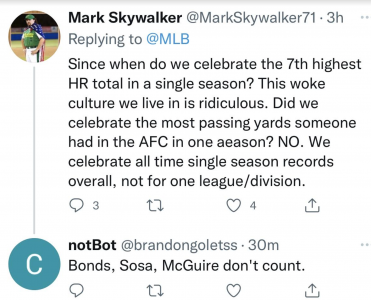
“However, that mark was exceeded six times in the National League during the heyday of the steroid era. Barry Bonds set the MLB record of 73 in 2001. Mark McGwire hit 70 in ’98 and 65 in ’99. Sammy Sosa hit 66 in ’98, 64 in ’01 and 63 in ’99.
“By being associated with performance-enhancing drugs, the feats of Bonds, McGwire and Sosa are discredited by some fans who view their accomplishments as tainted.”
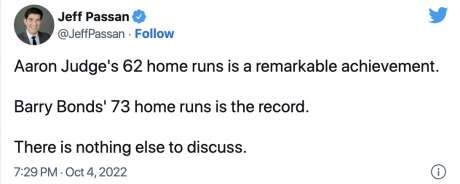
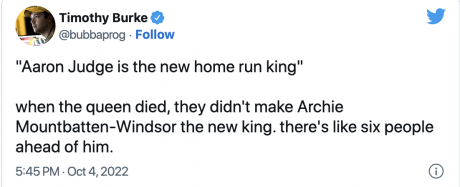
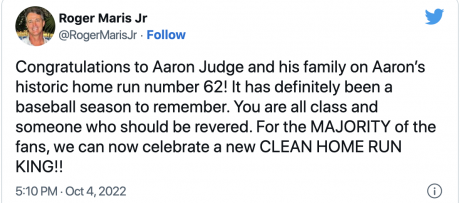
We could celebrate the "clean home run king", whatever that means, or we could watch this two minute collage of balanced breakfast Barry Bonds nuking balls out of the park and into the bay https://t.co/FhoxKxnayk pic.twitter.com/eLm3lU2WUT
— Jeff Veillette (@JeffVeillette) October 5, 2022
What Was Kidman’s Reaction?
Posted on 9.17.21: “Kidman is describing a kind of theatrical experience that happened every so often (i.e., infrequently) in the 20th Century and up until fanboy movies began to take over about a decade ago, give or take, and certainly since wokester cinema became a persistent presence about five or so years ago, and since cable and streaming became the the default end-game for any Hollywood or English-language film with serious aspirations. You can also find ‘the Kidman experience,’ so to speak, at film festivals.
“Otherwise anyone who gets around (Kidman included) knows that the kind of levitation she describes in the spot has all but ceased in the plexes, which have become gladiator arenas and repositories for rancid formulaic crap. Except during award season and even then on a mostly-miss-the-mark basis, the suppliers of commercial fare aren’t the least bit interested in even trying to fulfill the Kidman aesthetic.”
Actual Press Release
“Paris, October 4h, 2022 — Microids is pleased to announce Pendulo Studios’ latest narrative adventure game, Alfred Hitchcock – Vertigo, which is now available on PlayStation®5, PlayStation®4, Xbox One consoles, Xbox Series X|S and Nintendo Switch. It will launch on October 4th in North America.
“Loosely based on the famous director’s movie of the same name, Alfred Hitchcock – Vertigo is a narrative experience, also available on PC (Steam, GOG, Epic Games Store).
“Alfred Hitchcock – Vertigo tells the story of Ed Miller, a writer who escaped unscathed from a car crash in Brody Canyon, California. Ed insists that he was traveling with his wife and daughter, though nobody was found in the car wreckage. Traumatized by the crash, Ed begins to suffer from severe vertigo. As he starts therapy, Ed will try to uncover the truth behind what really happened on that tragic day.”
Loved Sissy Spacek’s Loretta Lynn
And I certainly admired and respected the Real McCoy — a country music legend, a contemporary of Elvis and Jerry Lee, not much younger than Hank Williams. And I understand the basic thing about country singers being conservative. But her musical gifts aside, I always felt a certain distance from Loretta Lynn. She was a Nixon fan in the early ’70s and a supporter of Donald Trump’s candidacy in ’16. But Sissy Spacek‘s performance melted my heart, and it obviously came straight from Lynn’s life so I guess I should respect that. Hard to believe Coal Miner’s Daughter opened 42 years ago. Tommy Lee Jones‘ “Doo” was one of his finest.
Feinberg’s Latest Best Picture Oscar Spitball
…feels a little off here and there. I’m at a disadvantage as I haven’t yet seen Steven Spielberg‘s The Fabelmans (Universal, 11.11), which Feinberg and a few others are calling the Best Picture front-runner, and I haven’t seen Martin McDonagh‘s The Banshees of Inisherin (Searchlight, 10.21) either. And we all understand that things are always a little bit vague at this point and that Feinberg will sometimes err on the side of generosity around this time, etc. But I can at least insert my own spitball projections and hold my finger to the wind, etc. Boldfaced italics indicate serious HE faith.
Feinberg Frontrunners:
The Fabelmans (Universal) — HE agrees that Spielberg’s Amarcord is a Best Picture nomination shoo-in. Boil it all down and the basic reactions are that (a) it’s a good, approvable film for cineaste devotionals — the sentiments all fall under the umbrella of positive, supportive, affectionate, Belfast-y, etc. But the serious rocket-fuel enthusiasm seems restricted to the performances by Michelle Williams and Judd Hirsch plus a cameo from a certain fellow who needn’t be named at this point. Everyone adores the final scene.
Top Gun: Maverick (Paramount) — Likely to be nominated for the money it made and for affirming the widespread belief that Joe and Jane Popcorn adore grade-A, woke-free entertainment values.
Everything Everywhere All at Once (A24) — A likely Best Picture nominee, but an infuriating Matrix-y multiverse film (over-plotted, superficially trippy, all that hammering, on-the-nose exposition). The only blessing, really, is that excellent ending. The absence of invisible elements (i.e., things that are there but not precisely identified or explored) is a huge issue. Where would this movie be without the shallow enthusiasms of Millennials and Zoomers?
The Banshees of Inisherin (Searchlight) — Hoping to see it soon.
Women Talking (UAR) — Not a chance. Strictly for glum-faced wokester elites.
Elvis (Warner Bros.) — Liked and respected for the most part, or at least sporadically enjoyed. But truly loved by no one + everyone hated Tom Hanks‘ Colonel Tom.
Glass Onion: A Knives Out Mystery (Netflix) — Not a serious Best Picture suggestion.
The Woman King (Sony) — Good, energetic, well-crafted, respected. Might be nominated for political reasons, but most certainly won’t win.
She Said (Universal) — Positive word-of-mouth for a smart, engaging, urban #MeToo film. Doesn’t quite deliver those Spotlight-ish undercurrents, I’ve heard. but crisp, urgent and well-ordered.
Tár (Focus) — A dynamic, first-rate, high-style fascination piece. A chilly mood trip about a steely, not-entirely-there character whom you can’t really “read”, but that’s what gets you at the same time. Elusive and chilly but carried by Cate Blanchett‘s mesmerizing performance. Too cold to win.
Major Feinberg Threats (i.e., Scott has his doubts)
Till (UAR) — Danielle Deadwyler‘s performance is the all of it.
Close (A24) — Brilliant, searing tragedy of innocence destroyed. Pre-pubescent terrain but devastating.
Triangle of Sadness (Neon) — Not as good as The Square.
Good Night Oppy (Amazon) — Nope.
The Whale (A24) — Haven’t seen it.
Empire of Light (Searchlight) — Excellent yesteryear vibes, fascinating drama. awesome Olivia Colman performance.
Armageddon Time (Focus) — Get past the James Gray shrug factor and it grows in your head. Gets better every time I think back on it.
Living (Sony Classics)
HE’s bottom line: The Fabelmans, Top Gun: Maverick, Everything Everywhere All At Once, She Said, Tar, Close, Empire of Light, Armageddon Time (8)
Obnoxious Couple in Starbucks
I have a 10:45 am appointment at the Norwalk DMV (new license and plates), and I’m chilling in a nearby Starbucks. “Chilling” isn’t actually the word due to a boom-box couple sitting 15 feet away. They’re broadcasting (i.e., shouting, bellowing) their conversation, and every customer has no choice but to listen to the dude, who sounds exactly like Delroy Lindo as he turns on the charm. The Delilah he’s flirting with is no broadcasting slouch herself. They’re oblivious to the fact that the conversational noise they’re making is as distracting (and certainly as annoying) as a barking dog. It all comes down to how you were raised. If you come from a loud family, you’re going to follow suit as an adult.
But They Don’t Matter
White people are a problem. Obviously. They need to be devalued and dismissed. Help me out with the Kanye and Candace thing.

Magnificent!

Hearty congrats to Adam McKay (writer), Steven San Miguel (narrator), Bruce Herrman (editor) and Staci Roberts-Steele (producer).
“The Party of No Common Sense”
In a 7.20.22 Atlantic article titled “The Real Reason Democrats Are Losing Ground on Education,” Conor Friedersdorf reports that typical voters are not wildly supportive of equity and gender identity standards.
Friedersdorf based this conclusion of a poll conducted last May by The American Federation of Teachers. The poll is composed of responses from 1,758 likely voters. One of the poll’s findings is that voters are split on which party they trust more as far as education is concerned — 39% for Republicans, 38% for Democrats.
Democrats have lost ground on this issue because they’re all tied up in wokester theology, and average voters hate that shit.
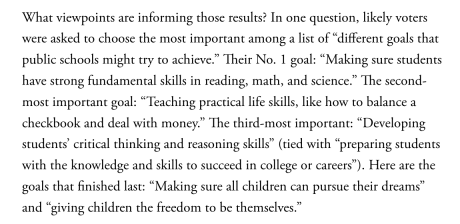
Here’s a key paragraph from Friedersdorf’s article:
Whoopi’s Non-Existent “Fat Suit”
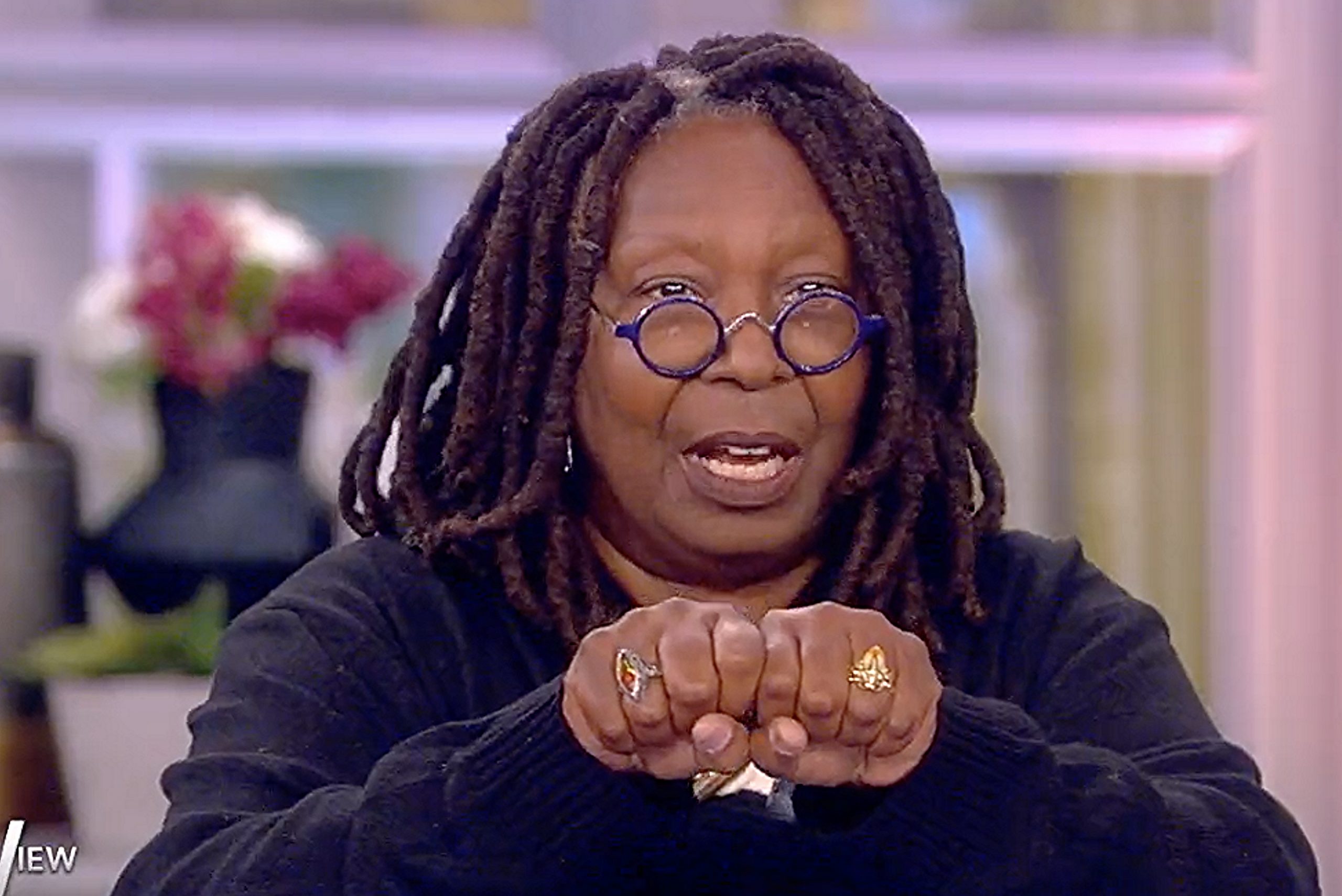
Earlier today The View;s Whoopi Goldberg corrected a Daily Beast film reporter (i.e., the Baltimore-based Kyndall Cunningham) for saying she wore a “distracting fat suit” in Till.
I saw Till yesterday afternoon, and I’d be lying if I didn’t admit that Whoopi looks seriously overweight. But not because of a fat suit. Whoopi’s shape is authentically her own.
“I have to say something because there was a young lady who writes for one of the magazines, and she was distracted by my fat suit in her review,” Goldberg said on Monday’s View. “Now, and I’m just going to say this. I don’t really care how you felt about the movie, but you should know that was not a fat suit.”
If a white male film critic had complained about Whoopi’s fictitious fat suit rather than Cunningham, he would be out of a job as we speak. If a white female critic had been the culprit, she would be in trouble but possibly still employed. Cunningham is safe due to being Black and a total wokester — political protection at its most thorough and fortified.
Goldberg to Cunningham: “I assume you don’t watch the show or you would have known that that was not a fat suit, but I just want to let you know that it’s okay not to be a fan of a movie, but you want to leave people’s looks out. So just comment on the acting, and if you have a question, ask somebody because I’m sure you didn’t mean to be demeaning.”
.@WhoopiGoldberg speaks on the importance of her film 'Till,' which premiered at New York Film Festival, and she addresses a claim that she wore a fat suit in the film.
"You should know that was not a fat suit," she says. "Just comment on the acting." https://t.co/cVclFZQmjA pic.twitter.com/V7ULf3c8Pi
— The View (@TheView) October 3, 2022
Two Suffering Angels
The two suffering angels of the Best Actress race are Blonde‘s Ana de Armas and Till‘s Danielle Deadwyler. Both are based on real-life figures who lived 60-plus years ago — AdA’s Marilyn Monroe and Deadwyler’s Mamie Till.
It seems highly likely that both will be nominated but who knows? Perhaps voters will conclude that one suffering angel is enough.
Many dislike Blonde but everyone admires Ana de Armas’ lead performance — nobody’s blaming her for what they don’t like about Andrew Dominik‘s film. Methinks that many Academy members of color will vote to nominate Deadwyler as well as Michelle Yeoh, the likely Best Actress nominee from Everything Everywhere All At Once.
I can’t gauge who gives the most emotionally live-wire performance between them, but ethnic voters will probably regard them in a similar light (yay, team).
Who are the most likely contenders outside of these two or three? I’m presuming it’ll be The Fablemans‘ Michelle Williams, Cate Blanchett‘s Lydia Tar in Todd Field‘s TAR and Empire of Light‘s Olivia Colman.
That means, if I’m correct, that the following performances are looking at an uphill situation: The Woman King‘s Viola Davis, Babylon‘s Margot Robbie, She Said‘s Zoe Kazan and Carey Mulligan, Good Luck To You, Leo Grande‘s Emma Thompson, The Wonder‘s Florence Pugh.
In sum, the six hottest contenders are Danielle Deadwater, Ana de Armas, Michelle Yeoh, Michelle Williams, Cate Blanchett and Olivia Colman.
HE faves, in this order: Cate Blanchett, Olivia Colman, Danielle Deadwyler, Ana de Armas, Michelle Yeoh. I haven’t seen The Fablemans.