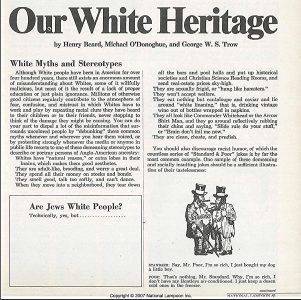
In a comment thread about Ken Burns‘, Lynn Novick and Sara Botstein‘s The U.S. and the Holocaust (PBS), the six-hour doc about the prevalence of anti-Semitism in this country during the 1930s and ’40s, HE comment guy “bentrane” explained something:
“Let’s be correct here [and understand that] Jews are not a race,” he wrote. “They are members of the Jewish religion, which has members of many colors. If we are talking about prejudice against the Jewish people, we are talking about anti-Semitism, not racism.”
To which I replied: “But Woody Allen’s depictions of his Brooklyn-based Jewish family in Annie Hall and Radio Days and Crimes and Misdemeanors made it fairly clear that they were defined by a lot more than a nominal, going-through-the-motions investment in attending Jewish services at their local temple on Saturdays. They were a colorful ethnic tribe, outspoken and passionate and a bit coarse at times. Don’t forget how Allen made their appearances and behaviors seem especially pronounced when, in Annie Hall, he compared his family with Diane Keaton’s midwestern white-bread family (which included a ‘classic Jew-hating’ grandmother).”
Bentrane to HE: “Ethnicity is not race. And not all Brooklyn Jewish families are alike. My mother was a Brooklyn-raised Jew, and her family was solidly middle class, totally secular.”
HE to bentrane: “Speaking as a New Jersey and Connecticut-raised paleface, I can assure you that WASPs are as much of a tribe as Japanese-Americans or any other ethnic group living in this country and having bonded geographically for cultural reasons. You’re saying there’s no such thing as a racial component in U.S. whitebread culture (descendants of European tribes from England, Ireland, Scotland, France, Sweden, Finland, Norway, Germany, Russia, Italy)? Are you saying race is purely a matter of skin shade? This country is bursting with tribes. Zoomers are a tribe, etc.”
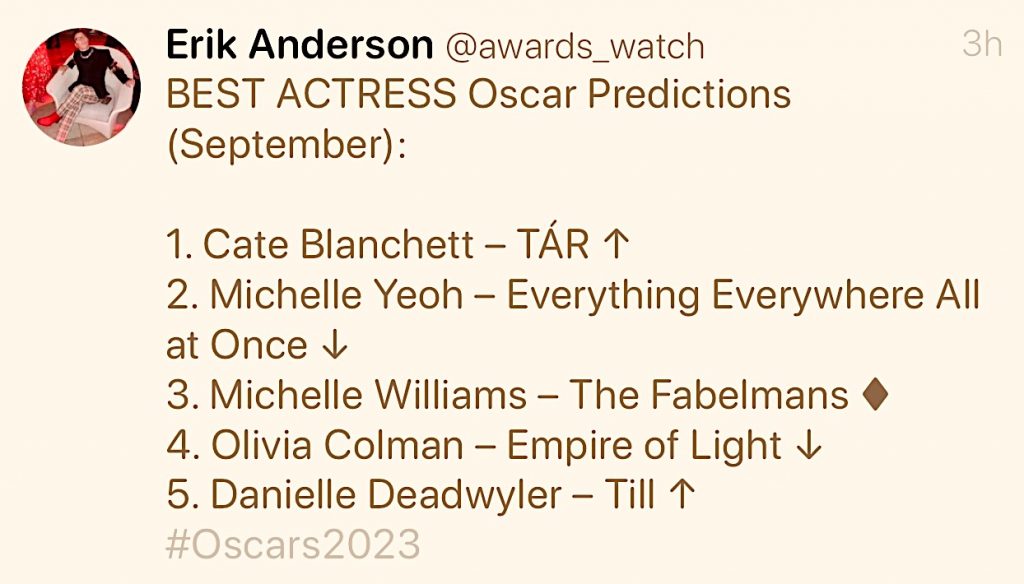
This morning “Rosso Veneziano” dismissed Sam Mendes’ EmpireofLight as a “panned” film, at least in terms of its award-season potential.
HEresponse: “EmpireofLight is my idea of a sublime and deeply moving yesteryear film, and is exceptionally well acted. There was no question in my mind that it was an authentic, emotionally fine-tuned masterwork after I saw it at the Herzog. It seemed “just right” in so many ways.
“As a study of a few characters living smallish lives in a somewhat isolated English coastal village in 1980 and ‘81, it recalls the complex textures of another tale of small-town characters, some of them grappling with sexual matters and with a certain movie theatre occupying an iconic space in their lives — Peter Bogdanovich’s TheLastPictureShow (‘71).
“A few wokester fanatics panning EmpireofLight in Telluride (vigilant defenders of Black identity and dignity, they didn’t care for the curious but affecting inter-racial romantic rapport between Olivia Colman and Michael Ward’s characters) doesn’t mean shit.
“Critics are truiy their own species these days, living on their own politically-attuned planet. Eternally fickle and excitably hair-trigger, they often seem divorced from and in some cases contemptuous of Average Joe perceptions about this or that film, and particularly those, it seems, that have explored racial situations or narratives. (2018’s GreenBook being another example.)
More than any other time in cinema history, today’s elite critics are, to a large extent, living for and within their own realm.
“There are noteworthy exceptions and honorable outliers, thank God, and I’m not saying the elite critic cabal is entirely untrustworthy, but in the matter of films that either touch upon or seriously explore the holy woke covenant (race, gender, sexuality and whitey-very-bad), they’re never been more unreliable than today.”
Friendo: “I dunno. I’ve spoken to folks who don’t like it, and they didn’t seem to be coming from a woke perspective.”
HEtofriendo: “They’re not ‘wrong’ but they’ve allowed themselves to be triggered by the romantic inter-racial dynamic. If Michael Ward’s character (who is only slightly older than Mendes’ age was in ‘80) had been white, the same know-it-alls you’ve spoken to would be much more accommodating. Then again the film wouldn’t stand out as much, of course, if Ward’s character had been a pale-faced Mendes stand-in.”
Bottomline: If you’re dealing with a Black lead character, a director-writer has to play his/her cards in exactly the right way or the elite critics will scold to no end.
Mendes casting Ward as a generational stand-in for himself seemed, at first, like a fashionably woke gambit before I saw it. But the writing and the acting and the overall quality factor won me over. I melted. And Ward is so charming and good-looking.
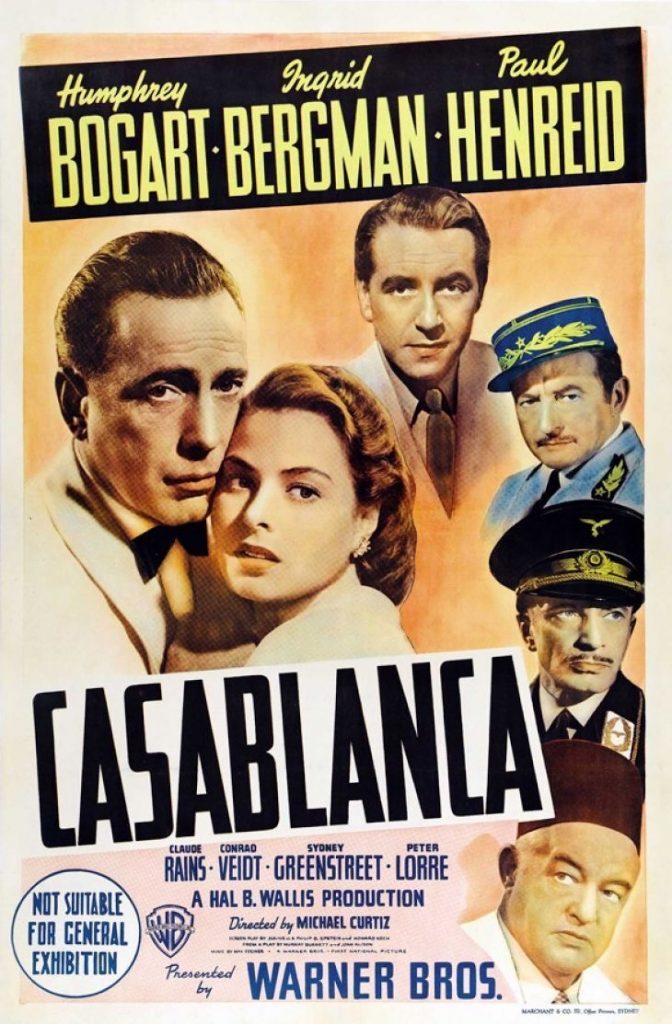
We can assume that “not suitable for general exhibition” was roughly equivalent to what an R rating means today. (Or used to mean). What in Casablanca could have given moral guardians this level of concern? Probably the allusion to sexual relations outside the bonds of marriage between Richard Blaine (Humphrey Bogart) and Ilsa Lund (Ingrid Bergman). What else could it be?
I’ve seen two-thirds of The U.S. and the Holocaust, the six-hour Ken Burns doc that focuses on anti-Semitism in this country during the 1930s and ’40s. It’s a stunning indictment of the way this country used to be, or certainly the way it used to think. And of course, it stirs thoughts of other forms of racial and ethnic prejudice that have permeated U.S. society since the Eisenhower era. I can honestly say that these four hours made me more fully aware of the degree of heartlessness in this country between 75 and 90 years ago. You sit there and listen to PeterCoyote‘s narration and you just feel more and more numb and forlorn. I’ll watch Part 3 sometime this weekend.
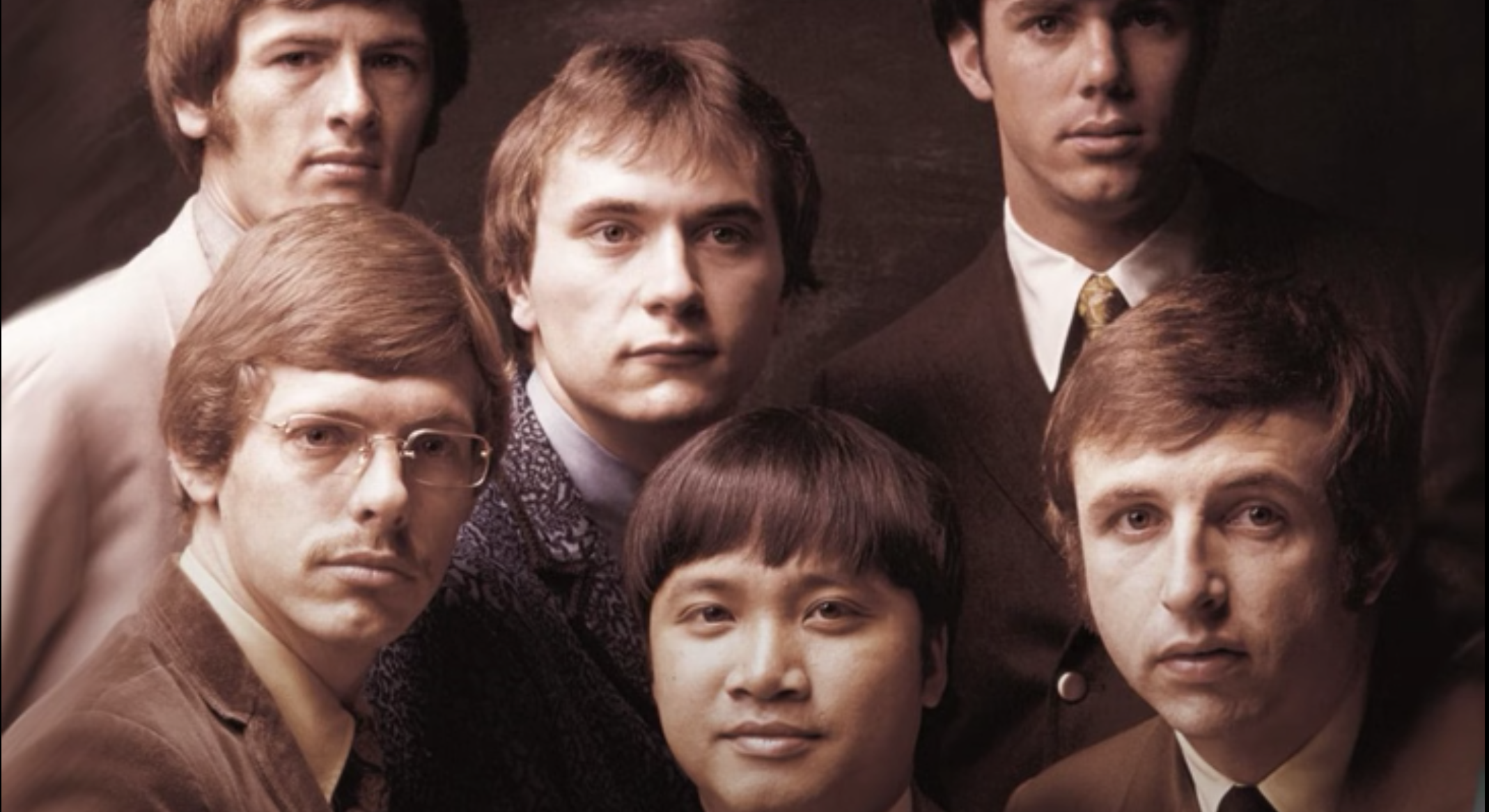
With The Association‘s “Cherish” being used prominently in the The Greatest Beer Run Ever, I’m reminded of how this mid-to-late ’60s pop group didn’t fit the mold. ’60s pop groups had to have reasonably good-looking guys — that was the standard set by the Beatles, Herman’s Hermits, The Dave Clark Five, etc.
And then along came The Association — a six member group that had two handsome guys and four with the oddest, most homely-looking faces in pop-music history.
The dorkiest was Terry Kirkman, who could have been cast as a college-aged serial killer. Next came Larry Ramos (died in 2014 at age 72), a chubby guy who looked like a typical member of an A.V. Squad. The thick-featured Brian Cole (who passed in ’72 at age 30) looked like a bouncer or a rugby player. Russ Giguere was semi-presentable but couldn’t pass the dishy-pop-star test — too geeky, granny glasses, thin moustache.
Jim Yester and Ted Bluechel were the only ones you could honestly call “good looking.”
Note: I posted something similar three or four years ago but I can’t find it.
Ask any half-thoughtful person if they feel that the post-#MeToo reputations of Harvey Weinstein and Woody Allen are roughly analogous, and they’ll most likely say “hardly…a single, highly disputable allegation is a far cry from several credible accusations of sexual assault and rape.” The fact is that the association persists only in the minds of certain journalists. Claudia Eller’s just-posted Variety interview with Cannes Film Festival jury president Cate Blanchett is a case in point.
Blanchett’s answer to Eller’s tabloid-attitude question (“Would you ever work again with Weinstein or Allen?”) skillfully sidesteps what she seems to actually think, which is “where’s the legal proof in the Allen pudding?” Remember Blanchett’s response to a similar question from CNN’s Christiane Amanpour a few weeks ago? She said that social media is great for raising “awareness about issues,” but it’s “not the judge and jury,” and that if evidence comes to light that warrants prosecution then a prosecution should result, but if the evidence isn’t there…well, you know, maybe the Robespierres should settle down, take a breath and direct their energies elsewhere.
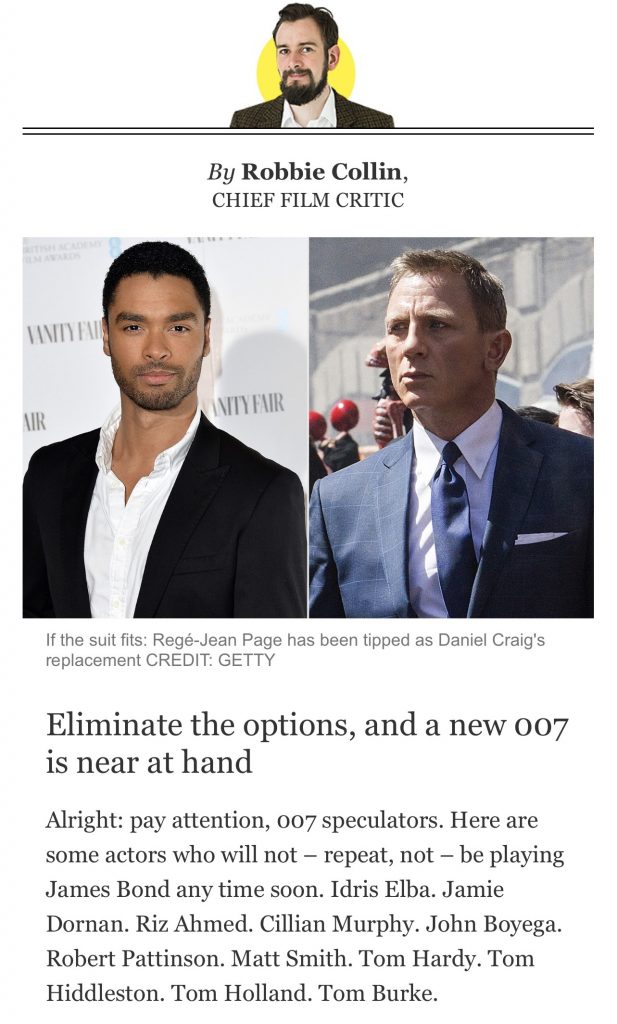
I have no problem with Rege-Jean Page, the 34 year-old Bridgerton and Gray Man costar, becoming the next James Bond.
Well, maybe I do. I wasn’t knocked out by his one-note Gray Man performance, and Page is kind of slender and small-shouldered and lacks the necessary Sean Connery-like brawn, no? If he were to get into a brutal fight with Robert Shaw aboard the Orient Express (Istanbul to Venice), nobody but nobody would bet on him winning. He’s a bit willowy.
Just for the pure euphoria of it, I would love it if they write the next Bond so he’s not in touch with his delicate inner feelings, but would regress into a courtly, well-educated, Connery-like hound. Connery’s Bond was polite and deferential with women, but he was also a caddish, semi-entitled, self-amused sexist swaggerer. Which is what everyone liked that about him.
A friend says “alpha men can’t be eliminated from film or film will die” — it’s that simple.
Honestly? I say put aside the idea of a BIPOC James Bond and cast Jake Picking. You can dismiss the idea but Picking has the goods — 31, good-looking, muscular, big-chested, nice jawline. All he lacks in the British accent, but that can be learned.
And may I say one other thing? The last time I checked James Bond was dead — killed by British missiles at the end of No Time To Die. I realize that at the end of the credit crawl it didn’t say “007 will be back” but that “James Bond will return.” Which made no sense, of course. How would that work unless the Bond films are going to become period pieces, set in the ’60s or ’70s or whatever? What’s the point of killing a franchise figurehead if you’re just going to bring the character back in a couple of years, like nothing ever happened?
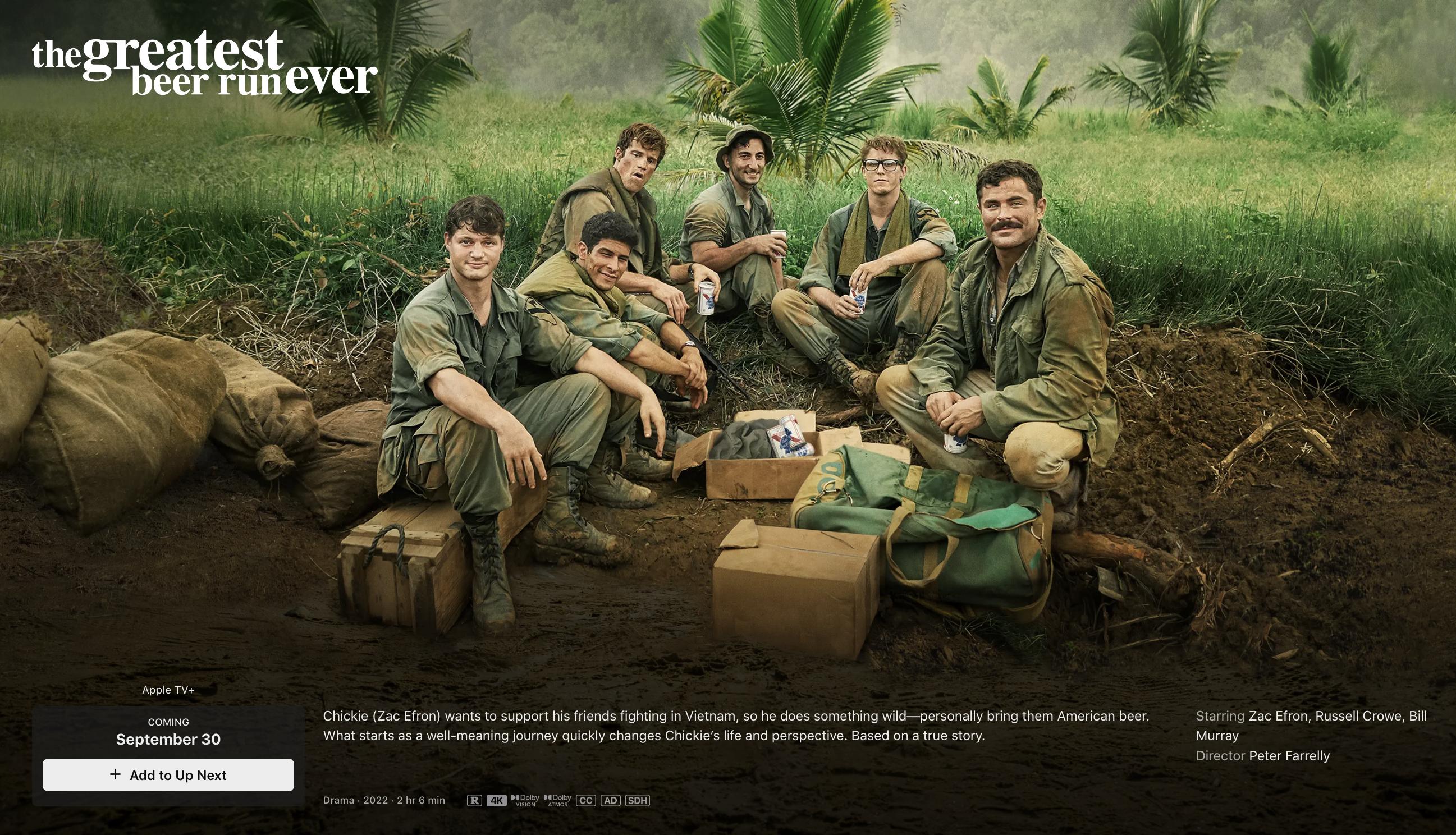
In mid 1967, an under-educated, under-achieving alcoholic moron (Zac Efron‘s “Chickie” Donohue) from a Manhattan working-class neighborhood foolishly decides to use his Merchant Marine credentials to travel to war-engulfed Vietnam in order to give beer hugs to his military-serving buddies, but gradually has his eyes opened to the real-life horror and particularly the bullshit that LBJ and General Westmoreland have been leaning upon to justify it.
At the end he returns to his home in Inwood, New York, with a somewhat more mature attitude — “less drinking and more thinking.”
Will someone please tell me what’s so awful about a movie that tells that more or less fact-based story? Particularly if the film in question delivers decent performances, reasonably convincing dialogue, tight pacing, semi-realistic depictions of combat and one absolutely killer line of dialogue?
Here it is: Somewhere in a jungle hell-hole Donohue is about to leave a landing zone on a helicopter, and one of his anxious and exhausted G.I. buddies is regarding him with concern. A fellow grunt notices and says, “You don’t have to worry about him. Every once in a while, you’ll run into someone who’s too dumb to get killed.”
Yes, I’ve finally seen Peter Farrelly‘s The Greatest Beer Run Ever (Apple, streaming on 9.30) and it’s a tolerable sit and sometimes better than that. And there’s absolutely no question in my mind that the current aggregate ratings — 44% Rotten Tomatoes, 35% Metacritic — have been motivated by politics and score-settling. For nearly four years the arch-backed film critic cabal has been dying to punish Farrelly for Green Book having won the Best Picture Oscar three and a half years ago, and now they’re sticking it to him with relish, and to Beer Run for fun.
I’m saying this because I know (i.e., not guessing) that in a fair and just world, Beer Run would be averaging so-so or not-bad scores. Scores that say “this movie has a couple of problems, okay, but not lethal ones…it may not be good enough to be raved about, but it’s a decent try and a moderately passable in-and-outer. In HE’s mind it’s a solid ground-rule double, and in baseball that’s a totally respectable thing. You didn’t whiff or pop out, and you’re in a position to score if the next guy slams a single. But in movies if you don’t hit a homer or a triple, you’ve somehow failed.
A majority of critics are saying Farrelly has struck out or been thrown out at first, and they’re just not being fair or honest. They’re basically saying “because this film isn’t as authentic as it could have been in some respects, and because it isn’t political-minded in a way that we’d prefer and because of two or three aesthetic choices that we disapprove of, and because most of us have been dying to take Farrelly down anyway…for all these reasons we’re going to do our best to kill Beer Run.
“Some of you will pay to see it and find it a decent enough thing, and we don’t care about that. We’re writing from within the social-political membrane of an elite cabal and that’s all your going to get from us…elite cabal viewpoints.”
This is the value of myself and Hollywood Elsewhere — a site that occasionally has the character and the courage to say that a film achieving a level of ground-rule double accomplishment is nothing to be ashamed of, and is certainly nothing to trash or urinate upon. The Greatest Beer Run is what it is, and I know it’s a decent (and sometimes better-than-decent) thing as far as it goes.
I absolutely approved of the central arc or journey of the story, which I summarized above. And yet I gradually understood more and more that, to paraphrase Richard Masur in Risky Business, it’s not quite good enough to be called Ivy League. It might’ve worked but it didn’t quite get there. Perhaps the scope was too vast — a spotty but sprawling Apocalypse Now-ish war flick with a civilian perspective — and it simply exceeded Farrelly’s grasp. Which is nothing to be ashamed of as he clearly tried like hell. And like I’ve said two or three times, a few portions hit the mark, and now and then it surprises you.
I was definitely surprised by Farrelly’s decision to play “Cherish,” the 1966 Association song, on the soundtrack as a suspected Vietcong collaborator is brutally murdered. The song has been set up earlier in the film when Chickie tells his barroom buds that he really likes it, but at the same time a viewer will have to admit that “Cherish” is one hell of a counterpoint, given what’s being depicted.
Late yesterday afternoon I caught Manhattan’s first commercial screening of Peter Farrelly’s The Greatest Beer Run Ever(Apple, 9.30 streaming). It happened at 5 pm on the top floor of Union Square’s Regal plex, and I almost died from watching all the crap-level trailers. (The BlackAdam is especially toxic.)
This isn’t about the film (my review will appear later this morning) but about a mentally disturbed guy who talked loudly throughout the entire film. Tohimself.
Nobody said or did anything to influence the behavior of this horse’s-ass-who-was-off-his-meds, myself included. I should’ve manned up and walked over and offered my usual usual —“due respect, bruh, but would you please shut the fuck up?” But an instinct told me that this erudite 30something skull-capped gentleman might be the hair-trigger type. So I sat there and tookit.
Thank you, Regal management. I paid thirty-six bills (including medium-size popcorn and a “small” half-quart-sized drink) to have my Greatest BeerRun experience interfered with by a muscle-bound, brain-scrambled psychopath.
Prior to its Toronto Film Festival debut, Apple’s plan for PeterFarrelly’s The Greatest Beer Run Ever (Apple) was to open theatrically on Friday, 9.30 and begin streaming a week later (10.7). But just before it got hammered by Toronto critics, Apple moved everything up a week.
Curious as it may seem, Beer Run is opening today in New York but without an all-media screening preceding this booking. (Which never happens.) And yet Apple has arranged for an all-media Manhattan screening on Thursday, 9.29 — one day before the Apple streaming begins.
Theatrical bookings of BeerRun are also happening today in Los Angeles and Dallas.
For what it’s worth, I’ve never in my life heard of an all-media screening that happens a week after a film has opened theatrically. Or, for that matter, only a day before it begins streaming.
Intrigued, I’m on my way into the city to catch a 5 pm screening of Beer Run at the Union Square Regal. Yes, right now.
We all understand a lot of critics had it in for Peter and this movie before they saw it. They hated Green Book four years ago, and now they’re delivering payback for it having won the Best Picture Oscar. Whatever the actual merits of BeerRun, these folks were locked into hate mode.
The Wikipedia age still saysBeer Run “will be released in select theaters and on Apple TV+ on September 30, 2022.” Time for an update!
Sasha Stone on Bardo: “In my opinion, Bardo [will probably] work best as a stoner movie, like 2001 was once upon a time. Get baked, trip out. I think if you are coming from the perspective of a film critic and you’re trying to string together some sort of plot or meaning you will find fault with the film itself, rather than shifting your perspective ever so slightly and making an effort to see where Inarritu is coming from. I don’t know, just a suggestion.”